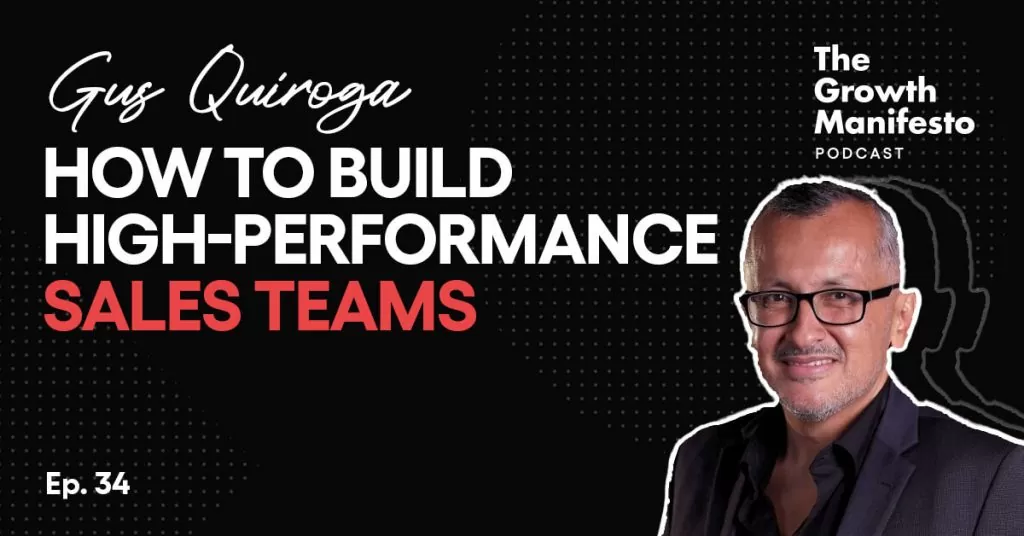
How to build high-performance sales teams
Gus Quiroga, Head of Cognitive Applications at IBM, breaks down the trust equation, enterprise sales stakeholders, and how to coach and hire sales teams.
 with Gus Quiroga


Overview
This episode is a discussion with Gus Quiroga – Head of Cognitive Applications at IBM and one of the best sales professionals I know. We talk about sales strategy, leading sales teams, selling into enterprise and everything in between.
Key takeaways
- The trust equation defines trust as credibility plus reliability plus intimacy, divided by how self-oriented the seller appears.
- Sellers should avoid asking 20 qualifying questions and instead bring a researched opinion to validate with the customer first.
- Selling to large enterprises means navigating multiple stakeholders and a hidden political hierarchy that often matters more than the org chart.
- Sales leaders should build coaching, cadence and culture together, since strict daily call quotas without the right culture just wear people down.
- Hire hunters who are motivated by money and targets, and farmers who are motivated by long-term relationships and trust with customers.
Chapters
- Introducing Gus Quiroga on sales
- Defining sales as matching value
- Why 20 qualifying questions backfire
- The trust equation for sales
- Selling into large enterprise organisations
- Leading sales teams: coaching and culture
- Changing a broken sales culture
- Hiring hunters versus farmers
- Learning sales through mentors
About the guest
Transcript
Auto-generated from the episode audio, so expect the odd mis-heard word. Timestamps open the video at that point.
I don't know if you've heard of the trust equation, Alex, but... I haven't. Well, let me tell you. And I've read a lot of sales books too, but I have never heard of the trust equation. It's actually a formula, and forgive me because people aren't formulaic, but it's just more of a description of the things that come to build trust in a psychological interchange between two people. and they are, I think the formula from memory goes, it's credibility plus reliability plus intimacy
divided by self-orientation, right? So in other words, you've got to have credibility, lots of reliability, be very intimate and not be so focused around what you want but what the client wants, right? So the inverse. You're listening to the Growth Manifesto podcast, a Zoom video series brought to you by Web Profits, a digital growth consultancy that helps global and national businesses attract, acquire, and retain customers through digital marketing. This episode is a discussion with Gus Kedoga, Head of Cognitive Applications at IBM,
and one of the best sales professionals I know. We talk about sales strategy, leading sales teams, selling into enterprise, and everything in between. So let's get into it. all right so today we're talking with a man a man named gus kid olga kid olga right is it kiroga that will do and i think that's pretty close i get how do you say it i'd say kiroga
kiroga he's the head of cognitive applications at ibm and he's one of the best sales people that I've ever met. I first met Gus through my co-founder Paul Sprockreif and he said there's this guy I know he's pretty good at sales and I'm thinking that he should come and train up our sales team here. I was like yeah yeah cool yeah of course how good could he be? Anyway we're in Melbourne at the time and you came down and you did a session for four hours on selling into enterprise and the insight that you gave was just unbelievable we were just like wow okay this guy he knows his stuff
right that was my first experience second experience was this was a few years ago back when experian um you could get experian information into facebook right and funnily enough you were leading a sales team there as well um and a lot of the people there were doing these techniques i was like these are really good techniques there's a really good approaches and then i'd found out only afterwards oh that's gus who's leading that team right and you are one of um the most
charismatic sales people that i've ever met yeah you're relaxed you're fun but you know your stuff right and so today i'm super excited to do a deep dive into sales right now i have an agenda of things i want to cover um i've shared some of the the information with you haven't i gus and you said wow we're gonna need way more time than this right um but i'm hoping at the end of all this that there's a really solid information around sales strategy and around actually how to lead a sales
team and then everything in between that's my intro as the intro you've set a very high bar will get you everywhere but now I'm under pressure to deliver so let's go for it no okay cool let's get into it let's start with sales strategy yeah let's start with sales um how do you define sales oh god sales is part science it's part psychology but if anything if I can encapsulate it in one thing it's about matching value to need that that that is sales in a nutshell understanding
what customers what people need and what they don't even know they need and matching that to something that you or someone that you work with be it someone in your organization or a business partner has to offer so us the sales professionals are in the business of matching need to offer or solution and so and so how do you identify that value that need yeah say for example that you're
stepping into to a consulting um a consulting uh role of some sort you come to us and you're trying to figure out the best way to sell to the customers that we want to sell to. How do you approach that? Look, I think the heart of that question is one of the real traits of great well-rounded professionals is that we listen. And we listen to the market. We listen to our customers.
We listen to our competitors and we listen to our colleagues. so whilst it's not a good idea to have a preconceived idea of how you're going to help your client it is a good idea to have a preconceived idea of how you might be able to help your client so going in to visit a customer particularly when we're talking about the first time that we visit you've got to research you've got to understand that customer you've got to understand that customer in the market and you've got to understand what noise they're making about where they're heading, what their direction is.
So you have a narrative that is relevant and engages you in their value cycle. So how do you identify what the need is? You may have some idea if you're listening to the market, but then it will go back to some of the classic sales approaches, which is building that trust so that the customer will share what really is and what their problems are. How do you kind of conduct that research in that first instance? yeah i say for example like if there's cool so that for example i kind of as i spoke with you
and i was like hey look like i've got this company there's an issue with sales yeah yeah we're not selling enough yeah that's going to be a common thing everywhere right we're not selling enough and we need to fix it yeah what's the first thing like in that process of you know to fix a sales problem yeah so so in this case you're talking about someone that has perhaps reached out to me to offer them some help in sales consulting capacity
to reinvigorate or to identify how we could make that sales organization stronger I think the first process in really understanding it apart from of course talking to to the leaders and getting their point of view as to what they see is actually embedding yourself in the journey going out with customer going out with the sales people seeing them engage with customers seeing them in the office just watching observing and getting a first-hand view day-to-day of what's happening now that here we're talking about uh
observing to consult on a process and that process is a sales process but it applies just the same if for example you're talking to a customer that you may be selling some marketing software for argument's sake. They may or may not already have a piece of technology, but there's great insight in sitting down and seeing how they're using it, understanding where are the opportunities to make it better? What frustrations are they having? What's the commentary around the organisation
and the team with the software? What about the people that depend on the outcomes of that software? What are they saying they're getting from it? So there is an opportunity always when you answer that question as to what do you do first, if you have that trust and you have that engagement with the customer to go in and actually take an observer's role to get deep in what it is that you might be able to do to help. Unless they're asked and they can give it to you on a paper, which is, you know, Nirvana. But that's rare, isn't it?
That's rare. That's rare. I mean, it seems to me that there's a really big challenge in really understanding what the customer actually wants, that they're not telling you they want. They say this thing over here is what they want, but what they actually want, they're not saying, right? How do you identify those hot buttons or the things that you know you need to know to sell to them, but they're not telling you? Yeah. Look, I think you have to follow the journey, follow the bouncing ball with customers. So whatever they ask you, whatever they say, hey, I've got a problem with my invoicing. I'm just picking something random, you know, but what's the problem with your invoicing?
uh we're getting too many mismatches between what we've uh actually sold and what we invoice which creates problems okay um well why is that problem happening because this and why is that happening because that and who's involved in that so you've got to kind of follow the bouncing ball and take it all the way to the process and at each point you've got to ask a very critical question and what's the impact of that and how is that important to you right and you you kind of start
to uncover you you take a problem and you spread it out into its dimensions and you start to find the things that actually are having the most impact and that the customer may themselves not even realize right they're just looking at it from this macro problem mismatch of money out to money in mom have you really looked at what what where it's happening what the real impact of that is so would you say that that this is because i want to put any words in your mouth because i probably would get them wrong so i'm trying to ask the right questions but you go in in the beginning
like like in any role like if you're being hired for some reason or kind of have a top like a task to sell to this specific segment the first part is to ask tons of questions to the people that you're trying to sell to is that right like you just want to ask lots and lots of questions yeah there's a yes and no right there's a danger in that and and i'm going to explain why um so if if you pick up one of those classic sales books they'll tell you about uh qualification is what
you're referring to and you know and there's lots of questions and there's ways to answer questions open questions closed questions you know uh suggestive questions um and so on and so forth The problem that I find with that approach today is that it is too much of a blanket approach, whereas you need to understand the individual customer. Think about some of the large organizations out there that have got 20 different sales reps calling them every day and say, hey, I'd like to ask you 20 questions about your problem.
They just don't have time for that. so more and more and this comes back to the first point about research about how you engage more and more the customers are expecting that you know a little bit already so you can't go in there asking 20 questions so for example um you know where whether it be selling a marketing solution an invoicing solution uh selling a printer whatever it is it doesn't matter you need to understand somewhat about the types of challenges that that type of customer would face or about
the types of opportunities that that type of customer is missing out on and you need to take that opinion you need to bring that to the party if you don't then you are the in the disparaging sense of the word a salesman you're not embedding yourself in the customer's value chain so don't ask don't don't i don't subscribe to the ask 100 questions i subscribe to the come with come with value and come with an opinion and get that validated with the client and then explore from
that point on got it and so you need to do your own research and you need to come up with some assumptions on what you think is going to be the best approach the best the best way in is that right and then you're quickly going to know if it's right or not because of how they respond is that right absolutely and the salient point there is not coming with a solution in mind when you don't know the problem sometimes you do sometimes you do sometimes it's out there hey
i realize that um you've had an issue with um um anti-money laundering and there's been significant breaches caused by x we've been doing this for these and these and these organizations the outcome of that with this i'd like to come and talk to you about how we can how that would work in your organization great there's one of already preconceiving a solution but in other instances it's not so black and white and so you may need to point to sort of more generic uh known challenges in the industry such as
hey i understand that uh let's let's talk about a printer i understand that You know, paper consumption and re-fulfillment is becoming onerous, particularly with the issues around mobility. Is this something that is of concern to you? And would you like to talk to us about how we can help you? Right. They'll tell you yes or no, if you have the right level of trust, if you've created trust with the customer. And if they say no, that's fine. You move on. Right.
Yeah, sure. You know, what's really interesting is that the first example that you gave about the anti-money laundering thing is like the structure of the perfect outreach email, you know, like that's the structure of the outreach emails I do. That's the ones I've seen perform the best. And so you just said it just off the top of your head. And I just want everyone who's listening to just transcribe what he just said, put that into an outreach email. That stuff works. So yeah, thank you for sharing that. There's different kinds of sales approaches, techniques and so on.
And sales has had a bad rap because of car salesmen. And what's that one? Glen, Gary, Glen Ross. Glen, Gary, Glen Ross. That was the one I was trying to think about. Yes. I know them all. You want the good leads? You want the good leads? See this watch? So it's had a bad rap because of that, but it changed since the 70s, hasn't it? It's changed quite a lot. Yeah, of course. How has it changed since the 70s? You know, especially in the last, say, 5-10 years as well.
I think how it's changed is that sales has been finally, and not quite there yet, but I think people are starting to appreciate that it is a profession. That it's actually a career path that you follow from graduate entry right until the end. um you know i'm seeing now for example even in some of one of the organizations that i work with you know we see 50 and 60 year old sales reps now these are guys that and sorry guys are saying the
generic sense these are people that could have easily branched out into leadership or running their own business but no they have decided that sales is a profession that they want to follow and there's a very good reason for that. Sales is part art and it's part science and people are appreciating the complexities of actually being successful. So they know that it's a lifetime career journey to get really good at it. I've been doing this for a long time
but I continue to sharpen my blade. I go back to some of the basic stuff that I learned 20 years ago and I think I'm forgetting some basics But I'm also learning about new things because it's complex, because how you sell in a channel is different to how you sell on the phone, to how you sell direct, to how you sell to big business, to how you sell to small business. So I think that complexity and the importance of sales, sales structure and sales alignment to purpose has been well understood.
and so now it is more respected as a profession and the way that we hire into it is critical you know before and i remember sadly not not too many years ago i would hear people say oh that guy he's got the gift of the gap we should be in sales guys we are not in 1970s glenn ross gift of the gap is probably a detriment because it means you're too enamored with your own voice and you're not listening right right because it's become a
profession and people appreciate the complexity of it and the difficulty of actually excelling in the profession um and yet because i did hear you and you know like let me start by saying i'm the first person to say that like i respect sales i like the word sales i think it's a positive word i think it's a word that that like it represents the lifeblood of the capitalist society right like
it's something that is that should be kind of put up on a pedestal right um but lots of sales people still don't want to be called salespeople. They want to be called consultants. They want to be called this. They want to be called that because I think they feel that the people that they're going to talk to, they don't want to be sold. Is there something in that still or is there something in that? So, you know, this Tin Man generation, it's only a generation ago.
It's actually in my generation. It was when I was starting off in the profession of sales. So that's not going to go away quickly. And I think that it's going to take still a number of years. And for instance, right, there is still no professional degree called Bachelor of Sales. Yet you have to be proficient in finance, in marketing, in psychology, in behaviours. So it's going to take some time. There are some degrees that are starting. I've seen some out of the US, some out of the UK,
but there's no profession. Until there is a profession form which is called Bachelor of Sales, I think we're going to struggle to get that respect. And there is a negative connotation with the word. But more people need to go out there and embrace it and just understand that they are part of the value chain and that your job is not to convince customers. It's not. Your job is to add value to customers. And if you don't, then get out. Go find another customer and don't waste people's time.
So there is a negative connotation. But here's the funny thing, right? have you heard of the company at Atlassian yes yes once or twice once or twice yeah so they got they've got this they're very proud to say oh we don't hire salespeople and I think what an absolute joke you know everybody hires salespeople you just don't give them the title of sales people got it everybody everybody sells and i think that's the big thing that people need
to understand everybody sells when you send out an invoice and your accounts payable person talks to the customer about paying they're in the sales process because they're affecting the value chain which is the credibility of the organization the customer service the respect with which we treat customers and therefore the trust that comes back to you as an organization it's the end of the value chain as we deliver it to customers you know the person that um that
processes your order uh the guy that delivers the phone they're all part of the sales process and people need to get this you start selling and and i i remember i went and did this negotiation course about 10 years ago and it was a real epiphany moment for me they asked this question, it was about negotiation part of sales when do you start when does the negotiation start and we asked the whole room right and it was like oh when you put the contract
in front of them or when you give them a price or when you walk into the room and you start talking about the deal and all sorts of answers and by the way do you know when a negotiation starts? Oh, let's have a guess so I can be publicly told I was wrong. I think the negotiation starts when the first communication is sent off. Bang. Call it a communication. Did I get it right?
Absolutely. Oh, cool. Well, you know, in the digital world. I've been doing some riddles with my seven-year-old son, so I'm always looking for, like, what's the thing I'm not thinking about, you know? So, yeah. Yeah, good, good. That was abstract thinking at its best. And in the digital world, it is when the first communication goes off. But sort of in the pre-COVID world, it's when you first meet the customer. That's when the communication, that's when the negotiation starts. And really what that tells you is that sales is not about just willing and dealing. Let me not tell you the price I want and let me try and get the most out of you.
It's about meeting a customer and the first time you meet, establishing trust so that you can engage openly and credibly for mutual benefit, for mutual growth. And if there is none, you can still have the trust and you walk away and come back another day when you've got something to offer or when they've got something they need. That's awesome. There's a couple of points, but I think let's just focus on that trust thing. what are some ways what are some tactical things that the people that are listening to this podcast can listen to on what they can do to accelerate that
trust building process if there's a process to accelerate it you know you know so this is part of the science of selling and and for those that are listening they would have heard perhaps of what we refer to in the profession as as the trust equation. I don't know if you've heard of the trust equation, Alex, but let me tell you. And I've read a lot of sales books too, but I have never heard of the trust equation. It's actually a formula and forgive me because people aren't formulaic, but it's just more
of a description of the things that come to build trust in a psychological interchange between two people. and um and they are i think the formula from memory goes it's uh credibility plus reliability plus intimacy divided by self-orientation right so in other words you've got to have credibility lots of reliability be very intimate and and not be so focused around what you want
but what the client wants right so the inverse to answer your question if that's what the trust equation is then how do you build trust um in a mechanical way is that you've got to work on your credibility first and foremost right so how do you go about building credibility that actually starts before you meet the customer and you know we hear a lot about social selling and social profiling and all that sort of stuff but if you're on linkedin or you're on facebook and all this sort of stuff then you know you've got to be develop some sort of subject matter expertise
it also is with the way that you engage customers and you're bringing something that shows that you are credible or knowledgeable in the space reliable if you make a commitment you stick to it or you don't over promise when you can't deliver or you under promise and you under deliver Intimacy, you know, you actually are genuinely engaged. And I mean genuinely, right? Customers are too smart. They'll work out. You're saying, really? Tell me about that.
Wow. That's just this thing. And the customers will pick that up. Genuine intimacy is when you've actually shown that you've taken time to understand, to research and to find out not just about the business process, but the emotional process that the customers are going through in conducting their activities. And self-orientation is, you know, I look at self-orientation as it's about what's in it for you, not what's in it for me,
the person that's in selling, but what's in it for you. So I really need to turn up thinking I can help you, right? not if i get this deal that's going to push me up to my multipliers and i'm going to get massive comms i'm going to get this deal at any cost i'm going to work it out i don't care because i'm going to i'm going to jam this deal into this client i'm going to make them buy it and then in six months later i go why did i buy this what did i need that for yeah trust has gone out the
window you'll get the one sale but you won't get the second one and great sales people are talking are thinking about the second and the third. So that sort of, I think, just very briefly. Yeah, no, that's... It captures trust. Yeah, that's really good. And you know that example which you just kind of gave about the bad example of, you know, to make the sale? That sounds like the last time that I bought a car. That's what that sounds like, right? But you kind of want in the car, so you're kind of saying, hey, there's something I want, but that whole process
is accelerated into two or three hours sometimes, and then you walk out with the car. But the more complex stuff, like if you're selling to enterprise or to companies or, you know, to businesses and so on, it's a lot more, it's like a longer term, I guess, engagement, isn't it? But let's just jump quickly then to like, how does selling change depending on who you're selling to? Like if you're selling to a small business or to an enterprise or to this specific industry or that industry, does it change?
and if so how yeah look um selling does change in the approach in who you engage with how you engage who you bring into the sales process with you but there is fundamentally it shouldn't change what what it is it's degrees of complexity and amount of length right so let me talk i think first of all and more importantly about what's consistent across sales consistently across sales
irrespective of the size of the organization is as i said sort of matching matching offer to value right uh to need um and so you've got to always be thinking how do i become part of the customer's value chain sometimes that's a very short process uh because you're dealing with a small organization with a small value item and so the decisions can be very quick. But there's still a value exchange in that process.
That's the first thing. Now, thinking about it in terms of what's fundamentally different, let's say, first of all, large organisation, small organisation. In a large organisation, for more complex products, because it's not always a complex product into a large organisation, they still buy pens and staplers, believe it or not, right? But if we talk about a large organisation into a complex model, the biggest difference, I think, is that you have a multiple stakeholder engagement.
What that means is that there are different people engaged in the buying decision. You do have an economic owner. So there is someone that owns a budget. But you might have a technical owner, someone that specifies the requirements. You may have influencers, people that are users or are trusted parties within the organisation who may have an opinion as to what's right. That may not necessarily be functional.
It may be perception. It may be relationship. It may be credibility. You know, there is trust with this organisation or that individual. And you have sign-offs, you know, people that need to assume the risk ultimately for what is purchased because it has impact across the organization um and and and so on and so forth right we can we can so um that's the first thing about uh large organizations you've got multi-stakeholder engagement the other thing and i think the one this is a big one that that
inexperienced sales professionals miss out on is that there is an organizational hierarchy in large organizations, in large enterprises, but there is also a political hierarchy. So what that means is, you know, you might deal with the office manager who reports to the sales manager who reports to the general manager who reports to the CEO, organizational hierarchy. But it really turns out that in the political hierarchy,
the office manager is best friends with the CEO and the office manages the person that is actually pulling the strings, hypothetical, right? Yeah. Or, you know, there is an external consultant who is not in the organizational hierarchy but is a really strong, trusted advisor. Are you talking to that consultant? Because if you're not, you've missed it, right? There is also things that happen not because they are the best thing
for the organization but because they're the best thing for the people in that organization or the person. Do you understand what is that motivation? Is it because the person doesn't want to be exposed? Is it because if this fails, that person doesn't want to have to carry the can? Do you understand politics of the organization? So this is big business, right? Politics, an organization, multi-stakeholder engagement for complex products. Right. I think in the smaller organizations, those things, generally don't exist the smaller you get and i'm going to write down to micro soho's right
you you're basically dealing with the top almost always um as you as you get smaller you're more likely to deal with the top and uh and then it becomes a question of more a question of the uh the personality i believe the personality profile of that buyer are they risk averse are they entrepreneurial are they the kind of person that says hey um i need to buy this uh accounting software it needs to do this for me and if i can get it under a hundred dollars a month i'm done
you ring up hey i've got this software ninety dollars it's recommended by by you know this magazine and uh it's going to be okay great done where do i sign low involvement low engagement they know what they want. Others may, even if it's $90, let me go, let me check MYOB, let me check all of the other different products that are out there, zero, and let me check all of the features, let me check the terms and conditions, and you spent three months selling a $90 a month subscription.
So it then becomes a question of, I think, the psychology of the buyer that you're engaging with more prominently than the political and organisational hierarchy of a buying group. Yeah, okay. So the sales process is essentially the same. The length in terms of the follow-up or the communication, that's factor one. The number of people which you need to sell into, that's factor two. So the smaller the company and the shorter the sale,
the faster the process. and the longer the bigger the sale or the more complex the longer the sale and then you have risk that if you're going to the wrong company and you're spending six months yeah but that's the wrong one then that's where it's kind of like higher stakes right because if you get that level wrong you've lost a year of opportunity cost of success of your organization right correct correct look i want to add that there is a third point and then i'll come back and tackle that comment that you made.
This is a very good one. The third point about enterprise selling that I forgot to mention is that it's not just lots of people on the buyer side. There's actually lots of people on the sales side. When you sell into an organisation, into an enterprise for complex products, you are not just the one person. You've got to bring your technical people, your accounts people, your consultants, different subject matter experts, your executive sponsors, you know, there's a complex engagement as well
that comes to build that trust and that credibility, that intimacy, all of those aspects that I described, they're not vested in one person. It's truly organisational. So it is far more difficult, particularly when you're talking about doing a $50 million a year deal, right, which is a big decision, very different to buying a $50 a month accounting package. because the risk reward is huge so it's it's a very different process um and just to be clear
you've had that level of experience trying to sell that size of a deal is that right that's right i just want to put that out there clearly for people that are listening um just just think the complexity of trying to get our company to sign a contract for 50 mil right think how hard it is for five grand 50 mil so like that just gives context in to the information that's coming from gus you know right now and you know just like it's really really important
to understand his experience here what do you see as some of the biggest mistakes that you see like in this process this sales process mistakes that people make number one is not properly researching the client to understand whether in fact you have something to offer this is kind of going in with happy eyes and saying but my product is so good everybody wants it or my service is so compelling everybody wants it maybe but not now or not at that price level or not at that degree of complexity
whatever whatever it is right so i think that the first mistake is is having happy eyes and say we're so good you know everybody wants it it's kind of an arrogance thing um there's also an arrogance thing at the individual level where where sellers go in not listening uh so they are just getting pushed by their managers i want the quota i want the sale which of the top clients you're going to deliver this month uh i'm going to close coca-cola and i'm going to close agl okay great
gus what's happening with agl oh but the client said uh they're not i don't care make it happen that's the other mistake is not understanding the client's buying cycle and their buying need you can create incentives you can say hey and you know the the sort of the lowbrow incentive is it's a it's it's a million bucks you know if you i know you want to buy it in july but if you sign off in june i'll give it to you for 800 000 that's kind of very weak selling but it happens and i know
it happens because it means the organization can then book the revenue and so you can create incentives but ultimately the client will determine if that two hundred thousand dollars is enough of an incentive to buy something now that they don't really need now they need it in july so the the second biggest mistake is kind of trying to force the client off their natural path without demonstrating true value um what else can i say there are so many things that i see out
Oh, God. Demeaning the competition. Don't do your integrity any help if you go out there and bag the competition. Say, hey, Alex, you know why you should buy my company? Because that company is so shit. It doesn't work. That just looks really bad on you. it means that you don't have anything good to say about your own company that will compel me you
just want to focus on what they're bad at and guess what my brother works at that company so you're bagging my brother right i mean i'll just give you an example of silly things that stuff can happen though that stuff does happen all the time it happens all the world so you never go out there with negativity you know you know negative selling or bad press selling you leave that to the politicians right that's labor versus liberal that's democrat versus republican not in business yeah okay yeah no that's good and I'm sure that but
there's like you know like like a lot more there but that's really good three things that I wouldn't have chosen you know like I would have gone they're not making enough calls and not doing this not doing that but but this is more strategic in terms of actually how you approach and look yeah and you'll i mean you make a valid point i mean but these things um you know i i think about it in terms of the hierarchy of high performance is is what i'm to it and i've always said that if if i am your leader and if i'm your manager and i am invested in making you successful if i'm having a conversation apart from you just
started the job and if i'm having a conversation with you about uh alex how come you haven't made 50 calls today assuming that's the sales uh methodology or approach you you're taking then it means that there is a fundamental problem if or if my coaching is about how many calls have you made there's a fundamental problem with the seller with the product with the offer or with your leadership we should not be at that at the bottom of the high performance hierarchy we should be at the top of the high performance hierarchy which is where we coach where we talk
about you know what's been the perception of the customer what is their buying cycle what do you think you're doing however you approach this what would you suggest we could do differently right yeah sure looking at that level you're talking at the top of the high performance hierarchy so that's why i focus on that if i'm talking about that then i probably shouldn't be my team unless that just started, of course. Sure. Well, let's just jump to that then. Let's talk about leading teams. Let's talk about leading sales teams.
And this is going to be relevant for people that run small companies. This is going to be important for CEOs. This is going to be important for sales managers. This is going to be important for pretty much anyone that is seeing you in the company that wants to make more sales. and wants to do it cost-effectively on target and all that other jazz. You've led a lot of sales teams. What's the most important thing, in your opinion, for leading a team?
A couple of things I'm going to say, and no particular order, but coaching, right? Coaching is absolutely fundamental, and I'll go into a bit more detail. Cadence or drumbeat is absolutely important, and training. And then I'd probably add another one, which is culture. So let's talk about those in no particular order. And I'll start with cadence and drumbeat because this is kind of what everybody understands and it's easy. So it's the idea that you need to set a very clear agenda or a very clear understanding of what other elements of high performance and success.
So in other words, someone comes into my organisation and if they're smart, they'll say, hey, what do I have to do to be successful? Let's say they're not experienced. Or what's your approach to success in this organisation? And I'll say, here are the basic cadence elements. in this business you need to make eight face-to-face calls uh a week or you need to make uh 50 phone calls eight eight face-to-face calls a week you need to have uh five times validated pipeline you need to have three times qualified pipeline you need to have 10 active deals in a
quarter right this is you kind of set up some metrics uh for deals over uh 50 000 or 5 000 or or $50, whatever the scope of the organization, you need to have a sequence of events. You need to have understood what are your key next steps and you need to be recording that. So these are kind of cadences and metrics that help give people clarity as to what are some of the mechanical basics of what they need to do to be successful. They're the basics, right? Because I can make 10 face-to-face calls a week,
but if I don't have core skills, empathy, and listening, then they're going to be 10 useless calls. Or I can call the same guy 10 days, 10 times a week, and that's also useless. So this doesn't define success, but it gives you a measure, a way of putting data and analytics into success so people know what they need to do. And then, now that you've given a basic framework, then the next thing you need to do is perhaps coaching, right? And so, you know, and depending on how large your organisation is,
I certainly believe that frontline managers in particular, so the guys that immediately report into the immediate managers of your frontline sales team really need to be invested in coaching. And that is a very difficult skill to master. I can't say that I'm a master. I continue to refine my craft in it because it's really hard. And it's really hard because of one thing.
Too often you see someone and you know exactly what they're doing wrong. But if you tell them, then you've failed at coaching, right? There is a moment where you might tell them because they have absolutely no experience and you've got to tell them because they have no basis. But to be a true coach, you've got to guide them. you've got to kind of take them to their own answers because that way it was more likely to
get embedded and they will own the outcome of the action and then follows right so coaching in the front line is absolutely fundamental and as leaders we need to invest in our front line managers to make sure they know how to coach not cater because anybody can say so alex 10 meetings You've done five. Pull your socks up or you're out. That's the work, right? That gives you a little bump and then an exit of your sales organisation.
Right. But you do need to cadence it. You do need to kind of, when you see you've got 10 and this person is consistently doing five, it's not about why aren't you doing 10. It's like let's understand what's impacting your ability to hit 10. It may work out that it's the third thing. This is a bit of coaching, right? And that will lead to the third thing, which is training, right? Any great sales leader, frontline, second line, third line, knows the concept of activity skills pipeline, right, ASP.
So, yes, activity is make the 10 calls, do the two visits, whatever. um pipeline is yeah absolutely identify and show me that there's an opportunity for you to hit your number there are different levels of maturity of these deals but skills you've got to invest in your people people don't just come out the i told you at the beginning of this this is a this is a lifelong journey now to become a professional in sales and that 60 is still learning you've got to invest in your people and find those gaps and build those skills
right so that's the third dimension and then we talked about culture right now uh what is it um uh there's there's a saying i think it's something like culture eats skills for breakfast or culture eats cater culture eats talent talent yeah something like that it was the guy from silicon valley there you go mark andreson i think it was yeah you can adapt it to anything you want Yeah. And it's true. And it's true, right?
It's kind of like, you know, when your dad says, oh, don't hang around negative people because all they do is bring you down. Right? It's true. It's in an organization, you know, sometimes you have this top salesperson who is just a gun. Everybody's at 100% and he's at or she is at 300%. But he's a complete asshole. Pardon my French. Yes. Right? That person is a cancer. That person has to go because that person is impacting the culture
of your business and bringing everybody else down. So whilst that in itself doesn't define culture, culture is something that you live and breathe and it develops, right? I mean, of course, you can do it purposefully, but it develops. But a culture of success, a culture of fun, a culture of teamwork, a culture of winning together and losing together, a coach a culture of openness willing to expose yourself and say hey i got this wrong guys what did i do wrong here's what i did help me someone right that whole that culture and i
believe that's a culture of success and high performance that is more impactful than anything else because what it does it makes the top performers bring the bottom performers up right and it makes the bottom performers want to push themselves up and it makes it fun and it makes it therefore you don't have this peak of performance that just goes like this it gets you more sustained performance and then more importantly it resonates in the market you can
build your talent bench and you've always got a good supply of people to want to join your business because you've got such a great culture. Yeah, awesome. You spoke about cadence, but did you speak about the drumbeat or is that the same thing? Is cadence and drumbeat the same thing? Yeah, yeah, people use it interchangeably. Okay, cool. I write them as separate points. No, sorry. So, I mean, look, sometimes we use drumbeat more to refer to the end of month or end of quarter pursuit on a deal.
so for example uh we know not because we want it to happen because the client has indicated hey uh we're looking to procure at the end of the month or by the 20th of this month and then we need to sit back as a team build a sequence of events to that date and then establish a drumbeat which is kind of like depending on the size of the deal the complexity or whatever daily or twice weekly or three times weekly stand-ups, 15 minutes where you build a drumbeat.
It's like, okay, what's happening? What's next? What's the next step? What have you done? What have you done? Okay, so we kind of keep the momentum. Got it. Energy levels up on the actual deal. But it's part of your cadence process. It's kind of like you made the call, you did the follow-up, you wrote the contract, you got legal review, you called the client, right? These are all part of your metrics anyway. So there is a correlation between it. Yeah, we do dailies. We do stand-ups, which is on Zoom nowadays, right?
It's like Zoom-ups or whatever you want to call it. But it's basically every day just to set that drumbeat, to set that cadence. But it's interesting to hear it in terms of the sales perspective as well, to really keep your team on the ball, right? And I think it's also a fantastic way to check in on things. How's it going? Is there issues? Because I'm sure they could be stuck but they don't want to bug you or they don't want to think or they're trying to figure it out themselves. And so that's a good way to stay across the team, right, as well.
Yeah, and it's a great way. Let me just add something, right, because it's about energising people. But there's a real catch here. Drum beats don't work if your culture is wrong. So let me explain. If you've got a culture of people bashing, of under the bus throwing, then people perceive drumbeat as you don't trust me. You want to make sure that I told you I was going to do this.
Did you actually do it? So it becomes this grinding sensation and a cause for disengagement from the organisation. so if your culture's not right your drumbeat will fail it will make people do stuff but again remember you know when you beat people up it only makes them go a little bit higher for a little while then so you've got to have a good culture together hey guys let's keep each other picked up what happened oh you know i was going to make the call uh and i got distracted i didn't make it okay
cool do you need some help with that you know because we all know we've got other stuff all right let me help you that it's also because we get distracted there's so much going on and the drumbeat keeps you focused on what matters but you've got to get your culture right so that it's effective okay let's talk about culture then in a sales specific organization right it could be in the sales team or it can be like in a sales organization completely right what do you do if like if the culture is not productive yeah like if you're listening to this podcast and you're
like oh damn i think i don't have the right culture right i thought i had it before but i had this thing in my gut that said maybe there was something wrong i heard this podcast i okay i don't think i like i don't think i have the right culture but what can somebody actually start to do to change that culture yeah look um i think that people see through bullshit and um and sometimes leaders they get together and they say oh we need to change the culture they bring in consultants
and then they say hey for change the culture you got to do this this this and then they go about mechanically implementing those things because that's what they told they have to do but what they forgot is to actually believe in it themselves and live it and act it so unless you from the top are living and breathing that culture because you believe and and to your point you know people are not then if you're not showing that don't expect anybody else to do it right so it's it i'm not
saying it starts at the top because it can start anywhere then you know the seed for culture can can really grow from anybody but you certainly need to live it and breathe it as a leader and that means believing in it not just giving it peace if you don't believe in it then then don't apply because people will see through it they'll call bullshit you've seen quite a lot of teams over the years um it seems like it would be easier to step into a new role have a team and change the
culture because you're fresh and it's like it's like it's a point of change but what if it was like if it's the same team as it was previous as it is now and now the only thing that can change is you how do you change yourself as a sales leader and be consistent enough that your team no it's not just some fad if i just hold off for a month he'll forget or she'll forget you know like how do you as that person shift very very very hard right um let me just say
kind of a reverse answer there is a point in which you have to be honest with yourself and say i've expired my usefulness in this role or in this organisation. And that's okay. That's not an admission of failure. It just means that you're ready for something else or you've been doing this for too long. It's hard to change, particularly when you're putting the mirror upon yourself. It's very hard to change. And this is why I say that you have to want to change.
So as an individual, and really I'm speaking about myself here now, When I realise that I need to change something different, I need to really soul search and say, why do I want to change? How does that align to my values, my beliefs, my goals and aspirations in this company? And if I can attach to something that is meaningful, either at a personal level, for example, one of the things that's helped me change a lot in the last,
I'm going to say last couple of years, is my relationship with my daughter. is me wanting to get much closer to her and having her trust me so that as she gets into her later teens and she gets in trouble, she comes to dad, right? Rather than dad doesn't find out and the problem becomes worse. So how do I, I wanted to create with us in our family a culture of openness and trust and I was really working on that. So that was a true motivation for me to change.
if I can attach that to my work life and say for example I said okay people are not trusting me people are feeling that I'm disingenuous that I'm just saying it but I really am just interested in myself then I need to soul search and understand whether that's true I believe it and whether I want to change and maybe looking outside and saying well where else could that be reflected and hey that's reflected with my daughter I better change that and I better change that here because if I don't change it here, then I'm not going to change it there.
So that's one thing I would say. The other thing I would say is you've got to seek feedback, external feedback. If you're really, really invested in your team and your people, you've got to be okay to hear bad feedback. Hey, Gus, it turns out that when you're in these meetings, you ask people for their opinion, but then you just interject and it turns out being your opinion anyway.
I didn't realise that. I'm sorry, right? And you've got to be prepared to take that and not say, thank you. Now I'm going to make sure that person never gets a promotion. Right? Don't do that. Don't do that. Culture. That's culture. Culture. So because there are these fear cultures and people that don't do this. So you've got to be prepared and open to take in feedback if you're going to change. Now, like I said, if there is no motivation outside of your organisation that addresses your personal values, if you're not open to feedback, if you have a determination that you're setting your ways or know that's how I like to run things and maybe you've expired your usefulness and it's time for you to move on.
And I think that's cool. Okay, let's go to the other side of things, right? let's say that you are doing a good job and you do have a good team um um but now there is a person inside your team that isn't performing anymore or was performing but maybe they've lost some of their mojo or maybe they're not taking on board some of the new initiatives or maybe you know they they're doing like good enough but they're not at that kind of what do you call it the hierarchy of excellence or whatever they're like halfway and they're happy a bit kind of like they're basically
happy at halfway but how do you approach that kind of challenge i come back to a point i made earlier the first your first go-to in this should be coaching and remember coaching is not telling people what to do hey i noticed your performance has dropped 50 here's what you need to do no deal hey i've noticed your performance is has dropped 50 you were previously achieving these levels of results and you're very highly respected in the organization for your ability to constantly
perform can you tell me about what's changed that you believe is impacting your performance and start the conversation right and then okay and then okay so how is that impacting it might be and you know you'd be surprised when you're open and you recognize people and you tell them what you're seeing and why that's that's important and i tell you something like well it turns out that my husband has cancer right and i'm more focused at home than at work at the moment wow sorry how
can i help right uh it might be that hey i've been doing this for too long i'm tired um you know i I just, I don't think I want to do this anymore. Okay, great. That's also good. Maybe it's time for a career change. Maybe I need to move you into a different role because the skills are still there, but maybe the motivation for that sales path isn't, right? And you can't inspire if there is no motivation. So you've got to then think through your coaching,
find out what is the new motivation. Great point. And then inspire that new motivation, that new path. So these are a couple of things. And look, and then there is always also a point which a manager, and I think this is very difficult, it's a soft skill, and as managers and leaders we practise this, is getting to the point where you realise there is no path for this person, right? And this is like the person that says, no, but I'm going
to get it together, I'm going to work, I just need help with this and that and okay here's your training here's your coaching i'm going to go out with you on calls and they're still not delivering maybe they've lost it maybe they just uh something has changed in their psyche uh or maybe the market has changed and their approach no longer works it comes a point where you need to think about managing people into new opportunities i even like how you structure your sentences so eloquent yeah and that's okay too yeah sure so it
does seem what it does sound like a large part of a sales leader's role is coaching your team yeah that's a large part of it right like is that correct to say yeah yeah look um it's sort of you should never stop coaching but the degree of coaching changes uh as the further you go away from the front line so let me put it this way the most effective coach is your next one up so sales manager should be the best coach for the sales rep the sales director should be the best
coach for the sales managers and so on and so forth right clear clear i got it let's then go to the other side well we'll take the same point and we'll go left right i'm bad with analogies but i keep trying to use them anyway um how do you actually find and recruit the best sales people you're stealing from the competition so are you talking about what's an awesome salesperson or
how do you go about finding an awesome salesperson well let's do both because i like the two points now. They are different, right? So, let's talk about what's an awesome salesperson first. Yep. Because that's a more interesting question for me, I think. So, an awesome salesperson is different depending on the stage of the market cycle that your organization is in,
your channels to market and the product or service that you offer. Wow. I was hoping it was going to be a way simpler answer, but yeah, this is great. No, but this is so good though. This is so good. Please continue. I'll just get someone that's coin operated or get someone that's really operated. And look, yes, there's ticks on all of that, but it doesn't always apply. And let me give you an example now. Please, please. statement so um if if you're starting up okay and you don't really have a customer base
what you need are hunters and you hear the terminology hunters and farmers i still believe that that is true you need these hunters now hunters by their very nature are people that are corner operators that are that are risk of risk takers right they love the challenge you know they hear someone say no and they go i'm i'm three no's closer to a yes and you know they take that as a as a as a as an opportunity to prove themselves you know i'm pushing the extreme right
right but there are people that are of that nature and that love that and when you're starting to build a customer base, you need more hunters than you do farmers because you've got no one to account manage. So whereas if you're in your market cycle and you're relatively well established or you haven't really innovated with new products or the market has been fairly stable, then what you're doing is you need to make sure you retain your customers and you grow them
and an aggressive, you know, take no prisoners kind of hunter will not work. They will kill your customer base. It means someone with a higher degree of empathy, a higher degree of listening skills, a sort of a longer term view of the relationship and probably not so coin operated as you would a hunter. right so that's kind of a first point around around the market right the other thing is that
if you're selling direct to customer versus selling through business partners it's very different right if I'm if I'm trying to sell I don't know what what you guys do say search engine optimization right if i go and talk directly to uh coca-cola about search engine optimization i am the i'm building that trust i'm the subject matter expert they need to believe that i know
what i'm doing whereas if i'm selling the same service but i'm using a business partner then i'm using their trust i'm using their relationship and their proximity so now my role is to empower to assist, to understand the process, remove any blockages, educate, train, find the right incentives, but I'm still a salesperson, but I'm a channel salesperson. So, again, very different set of skills that you need.
And then think about phone salespeople versus field salespeople, enterprise salespeople that need to not be egotistical that I run everything but need to be inclusive and collaboratively and sell as a team versus the lone soldier with the suitcase pounding the turf. So the first thing, this is why I say you really, to find what you need, what makes a good salesperson depends on all of these things. Now, if you want to find, because I'm sure the listeners have said, but what am I looking for in each one of those cases
to make sure that I'm hiring the right person? I'm going to say this. what you're looking for is someone whose motivations, their goals and aspirations are clearly aligned to what you're trying to do and what you need them to do. So if I'm going to hire a hunter, I'm really looking for someone that comes to me and says, look, Gus, I really just want to buy a house by the end of the year.
I'm going to need to save $200,000, which means I'm going to have to achieve 200% of my target, right? That is the kind of person I want to hire if they're a hunter. You go for motivation there, aren't you? Yeah, that's the motivation. Their motivation aligns to my... Is coin. Is coin operate. It's coin, right? Yeah. If I will find a good farmer, then what I'm looking for is someone that says, look, you know, I want to make sure I want to come into an organization
where I'm really building good relationships with the customer. They're trusting me and, you know, we're able to grow together and I can go ahead and say and really point to the things that I've achieved. Of course, I want to make a good living, but really building that connection and driving that outcome is going to help me. And here's the proof of where I've done it before. That's what you need to look for, right? And that's what a great solution is. So I think the key ingredient is how do you find great talent? Make sure that their motivation aligns to your requirement.
And then the final thing is make sure that you don't just focus on skills. Focus on behaviours, right? Because remember, we're bringing in a person that is going to be part of your culture and if culture is so important, you need the right behaviours. so get the basic skills you know are they good listeners can they build empathy um are they coachable probably a big one are they coachable and um and then what are their behaviors how did
how do they come across in how they will conduct themselves in the organization and that's fundamentally important which is why you have a three-month calling off so you can actually see those behaviors in play got it just quick one on the hunters and farmers process right so the hunter will go out to start the conversation like are they going to close the first sale or are they just starting the conversation to pass it to the farmer either that's sales design right that's sales design you yeah but is there a thing with relationships though like the person that
started to the relationship should stay there all the way through the first sale or is it okay to pass it off it is okay through it is okay to pass it off but it really depends on what you're selling right it depends on the level of complexity of the level of engagement of the product and and how you do it so for example I've led organizations where the hunter goes out and opens the doors creates the opportunity understands the need and embeds themselves in the value chain and soon as they realize there's
an opportunity they bring the account manager and part of your value proposition proposition is is alex so we're going to work together on on helping you solve this uh this accounting problem that you've got we're going to do that through these number of services and i'm going to bring this software we're going to program it in now once we've done that here's the team that's going to take over and they're going to make sure that you realize value there's some customer success team and this guy's going to work with you in terms of what you do next right so you kind of don't just cut it off you bring them into the sales process now in that sense
you still close it but you very quickly introduce the account manager again depending on the value of the deal it doesn't happen all the time but it can happen like that yeah it's about sales design yeah perfect i mean like so before when you said that you could talk hours and hours and hours on this stuff you actually can talk hours and hours and hours and i wish the purpose here right i know it's a podcast it's not a whole course right let's jump quickly to one more topic and then we'll basically end off with some quick fire questions right um this is last one is across the borders
for everyone right you said before that everyone sells right um let's say somebody wants to improve their sales abilities their sales skills and they might be wanting to get into a sales role or they may already you know be in a sales role and they want to be better yeah what would you advise them of the places to go to learn like you know some books or some tactics or some courses because there's no school for it right so what would you recommend because there is no university for sales
not in australia anyway um so we have to go to different places and resources to learn but but let me let me start by advising people that want to get into this amazing profession is learn the basics first and and some of the basics things like understanding what is it what is a buy lifecycle how do people actually make decisions you know what are the gates they go through in making decision learn about what a sales funnel is you know what what is what is this concept of a sales funnel
and why is it important right so get those basics done and then start learning some of the more uh necessary hard skills such as how you how you run questioning opening questions uh persuasive questions exploratory questions open and close questions questioning technique is absolutely fundamental and and it's fundamental to get it to a point where it's not canned that it just flows naturally because you're actually interested
and listening so learn some of the questioning techniques um and and there's some other stuff right and then in terms of how you do that or where you go um the problem with with uh i find with sales is that every every couple of years a new sales book comes out with a new approach and a new technique but fundamentally they're all based on the same concept just refined for the type of sale like Miller Hyman is for you know large enterprise selling whereas spin selling
kind of focuses more on on your mid-market uh I believe low engagement selling and everything in between right Challenger, Holden, Socket there are so many different sales techniques out there um my by the way my technique is a combination of all of those go out and pick a pick a technique and not not for the sake of making that your way of learning but for starting somewhere and then refine it over time based on who you sell with who you sell to
etc and then the the last thing i would advise people that want to get into sales or learn sales is go out with other go out with other sales people but find out who is the best salesperson you know or someone that knows a great and go out with that person and see see greatness see great selling at work and you know great selling you know how you know someone is a great seller when you go out with them because you don't realize that they were ever selling
it doesn't they're just engaging they're exploring with the customer, they're having a great conversation about the art of the possible and it seems to be flowing there seems to be no agenda it's just happening and at the end the customer says you know what Gus it would really be great if you could help me with this how about I introduce you to some people what could you do to help me progress this here okay
well let's let's meet the people and I'll see what we can do I mean if you get there you've done an amazing job and that's what great sales people look like great go out with one of those find one of those and go out with them yeah learn more than anything you'll level it and just observe just a quick one on the question styles like is there some book out there that has question styles or questions yeah i i can't think of anything any up to my head but seriously uh just guys google uh you know uh open and close questions in selling right or qualification
uh questions in selling or how to qualify a customer and if you want to really get smart how to qualify a customer in software selling, in hardware selling, in pen and paper selling, right? Got it. It's all out there because people have great blogs, there's great websites like Sales Hacker, Mindfest, all of these sales sites that just have great, great resource.
but caution which is why i say start with the basics learn that and then pick one technique and follow it caution everybody thinks that their approach is better and it's not what you got to get to is your approach right so when you look around you will start to get confused so should i use Holden or could I use Challenger? What about Socket? Now this is more of a spin. No, this
is a blue sheet approach. I'd go Miller Hyman. I'd go Unselling on this, right? I'm going to try to find a book that has an overview of all of them, you know? So I can, well, I'm sure there's an article out there that does it, right? Yeah? That's a good one. Okay, that's really good, man. Let's do some quickfire questions. and then we'll wrap it up, yeah? That's right. If you have to choose just one channel or tactic for driving sales or growth, what would it be?
Facebook. Facebook. You like Facebook, do you? They know everything about everyone. That's great. Awesome. Go social. If I had to pick one. Yeah, cool. Number two, what book has had the biggest impact on your success? None. That's the important thing. None. All of them. All of them. Oh, yeah. Good one. You take a little bit out of everything. Don't get, but look, I'm being flippant. If anything, and this is very eighties of me,
but this, uh, Stephen Covey's, the seven habits of highly effective people, that, that is more successful because it's not about learning a technique. It's about having a mantra for how you conduct yourself in life. Yeah. Great. What's your number one piece of advice for hiring awesome people? Number one piece of advice. Find entrepreneurs. No, that's find people, and this is what I mean, find people that see their sales profession as their business.
And if you think about what it means to run a business, if you find someone that says, this is my business, they're going to own it. They're going to be passionate about it. They're going to make sure that they've got coverage, they've got depth. find people that see sales that their profession of sales as they're running a business right so if you know what running a business is then that's a great great trait to have yeah and that's something i can kind of confirm as well like every time that we find somebody that's tried their own
like side hustle that's spent their own money on facebook ads that spent their own money on google trying to make money themselves that education just by itself that approach that psychology of failure constant failure to find a result yeah you can't train it and that yeah you can't it's the determination to succeed and they and they they just they're just better people agree yeah number four how do you relax after a crazy day in the office oh well two things i cook
and i watch mindless action movies i don't have to love it um what's your best time time management or productivity tip? To-do list daily. To-do list daily. Yeah, I love it. Same. What's the best piece of business advice that you've ever received, if there was one? Your integrity is your single biggest asset. There you go. That was said to me by Brian Torrance
in 2000. Yeah, right, and such an important one. But they say something like, It takes a lifetime to build and it takes a second to break, you know, to destroy, you know. And last one, what do you do for fun? Cook. But I also, I like to, I like to socialize with friends. I like to just grab a glass of wine, chat and debate. I love, I'm the kind of guy that,
let's say I really like red jumpers and someone comes in and says, oh, red jumpers are the best. I say, really? Why? Blue. You're that guy. I just want to, I want to hear the argument, right? Because you mind through arguments. Like I love, I love people that say, oh, I hate Trump. Really? I love Trump. He's the best president I've seen ever. What? I hear the debate, right? I don't care.
I want to hear the debate. It's just good to have social discourse. That sort of makes – I find that fun. So positive friction, you're fine with positive friction, right? I'm fine with positive friction because I don't understand that. Okay. Gus, thank you so much for your time today. This has been such a fantastic podcast. If people want to get in touch with you, how do they do that? LinkedIn. They can. They find me on LinkedIn. My handle is, I think, GusQ2000.
Oh, we'll put the link in the show notes. Put this link in the show notes. So reach out to me on LinkedIn. That's the easiest way I respond and I'm happy to share thoughts and have a debate with something salesy. Yeah. And, you know, just kind of one small story just before we go. Trying to get Mr. Gus Kidogger on this podcast, I sent him I don't know how many emails and text messages. And then the final attempt was I just picked up the phone and he answered the phone. And I was like, is this a lesson in sales, dude?
Yes, it is. I don't know why people are so scared to pick up the phone and call, right? If you put value, the customer's going to listen. And it worked and it worked. Thank you so much, Gus. This has been such a fantastic conversation. And I'll talk to you soon, brother. All right, pleasure. Take care. See you, mate. Bye. Thanks for listening to the Growth Manifesto podcast. If you enjoyed the episode, please give us a five-star rating on iTunes. For more episodes, please visit growthmanifesto.com forward slash podcast.
And if you need help driving growth for your company, please get in touch with us at webprofits.io.