
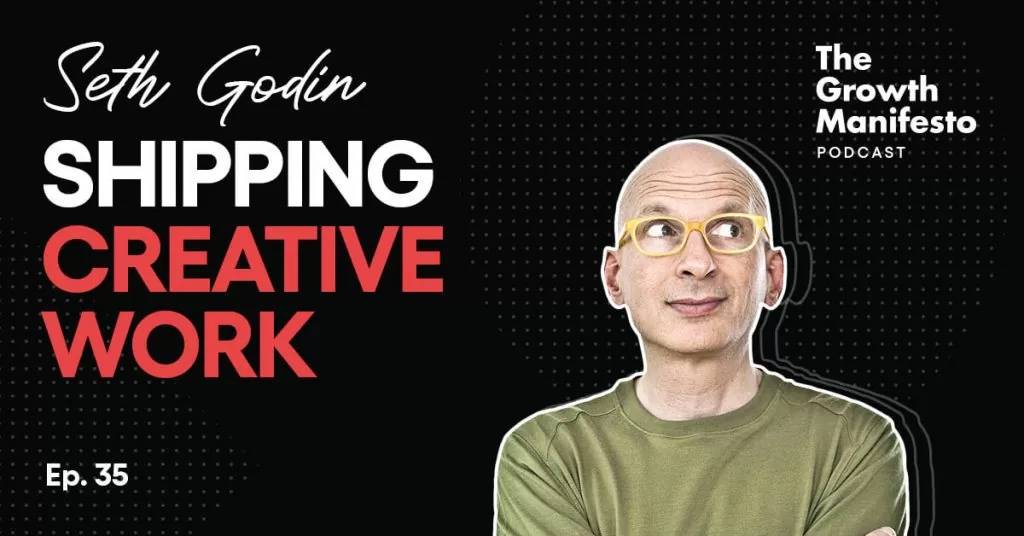
Shipping Creative Work with Seth Godin
Seth Godin discusses his book The Practice, arguing that shipping creative work consistently to a small audience beats chasing mass reach or authenticity.
 with Seth Godin


Overview
This episode is a discussion with Seth Godin, where we talk about his new book – The Practice: Shipping Creative Work, that talks about how anyone can find their voice and put their best work out into the world. In case you don’t know who he is, Seth Godin is the author of 19 books that have been bestsellers around the world and have been translated into more than 35 languages. He’s also the founder of the altMBA and The Akimbo Workshops, online seminars that have transformed the work of thousands of people. And in 2018, he was inducted into the Marketing Hall of Fame. So if you’re listening to this podcast you’ve very likely heard of Seth Godin.
Key takeaways
- Godin argues consistency matters more than authenticity, comparing it to wanting a surgeon's best work rather than her authentic mood.
- He says creative work means shipping regularly to a smallest viable audience rather than chasing mass reach across the whole internet.
- Writer's block, he says, is really fear of bad ideas, since writing down 99 ideas usually surfaces at least three good ones.
- A personal brand, he argues, is a specific promise rather than a logo, and you can wreck it in a single day.
- Good ideas come from the iterative effort of shipping work, not from waiting for a muse, since flow comes from the work itself.
Chapters
About the guest
Transcript
Timestamps open the video at that point.
So the path is really clear once you tell me what change you want to make. Maybe the change you want to make is you want to go from being an unknown comic to being a respected comic. Oh, really? Respected by who? Right? Respected by the people who, you know, want to laugh at off-color jokes and drink seven beers? Or respected by the people who read The New Yorker? Tell me who you're trying to change. Let's be really specific and put you on the hook. and people hate that because people don't want to be on the hook
and I want to point out that being on the hook is the only place to be because when you're on the hook is when you have leverage is when you're making a promise that you can work to keep and so we got to get really clear about who are we seeking to serve who are we helping to change and if you can't start there you're going to get stuck because the first time you show up you're not going to get a standing ovation and then you're going to give up All right. So today we're talking with Seth Godin and we're talking about shipping creative
work, which is also the subject of his latest book, The Practice, Shipping Creative Work. So welcome, Seth. Well, thank you for having me, Alex. It's good to see you. Sort of like looking at me, but it's okay. Thank God the glasses are a different color. I think that makes it much better. Of course, let's just get straight into it. Let's start with defining creative work, Seth? Yeah. How do you define creative work? If you're really lucky, that's what you do for a living. You don't dig a ditch. You don't follow a manual. You're not a cog in the big industrial machine.
If you do that kind of work of being a cog in the machine, you're in trouble because the computer is going to do your job or someone outsourced is going to do your job. So our dream is to do creative work. But creative work is work first and foremost. Means we do it when we don't feel like it. we do it with respect for the customer we do it with a practice so that we can do it regularly and very few people have ever talked about how you get good at that they talk about how you build a
bridge they talk about how you do seo they talk about how you day trade bitcoin but they don't talk about how to sign up to ship creative work and creative work is anything we do that might not work that makes things better creative work is anything we do that might not work that makes things better that seems like that would be almost everything that is worth anything to do right like that's well except i mean like if you are every industry if you're the clerk at the avis rent a
car counter you know it's going to work there's no risk press these seven buttons do this right And most people were indoctrinated to want that to be their job. They want their job to be being told what to do. There was a very famous study done in Rochester, New York, near here, in which they asked thousands of teenagers, 17 years old, if you could have any one of these jobs, which job would you pick? U.S. Senator, Supreme Court Justice, head of a Fortune 500 company, assistant to a celebrity.
and most people pick assistant to a celebrity because if you're the assistant to the celebrity you get to be near someone who's doing creative work but you don't have to do anything so there's a fear that people have around putting themselves out there is that right yeah exactly so but there seems to be a general um i guess confusion around kind of creative itself you know it seems like it's It's like the madman style person that sits in an office and has an idea and they sell the idea or it's the author that spent 20 years.
And so there's all these examples of the extreme levels of creative kind of expression. And so there's a lot of people. Those people aren't actually that creative. But yes, I'm trying to puncture these myths. And they're not that creative? No. How do you mean? Well, Isaac Asimov wrote 400 books in his lifetime. Each one was an act of creativity. Somebody who spent their whole life tortured to write one book contributed less, because the torture wasn't what we wanted.
we wanted what the book would do for us not that person hanging themselves out to dry and so creative work with a capital c is about ego creative work that i'm talking about is about contribution so it's about contributing and i think so just for the people that are listening to the podcast the world that we live in today is best on the internet and it's much it's much much easier these days to ship creative work, right? Of course.
So is there anything on the internet that is not creative work then? Almost all the stuff on the internet is not creative work. Is it? 90% of Twitter is either someone trying to start an argument or saying ditto. That most of the stuff that passes for content marketing isn't content marketing at all. It's just somebody following a rule book, doing the checklist stuff, not making work they're proud of, not doing anything that's going to be extraordinary. Most of the videos that are on YouTube are copies of other videos that are on YouTube.
That the number of people who have carved out an idiosyncratic, peculiar, particular voice is tiny because it's so scary. So let's talk about that. How do you find your own voice? Because I do agree with you that a lot of content is a regurgitation of other content. right um and it feels like most people will have read online and will have learned online and then the information that they know is learned from someone else and so then the first time they're
going to publish anything it could be a version of that so how can somebody actually start to find their own voice okay so there are a couple pieces of that first of all i'm not talking about the content in the sense of the engineering truth of it, because there's only so many natural laws, you know, force, momentum, velocity, you're not going to invent a new one of those. What I'm talking about is, would we miss you if you were gone? Is there something distinct
about your contribution that made a difference? So if we look at the math of Wikipedia, what we see is that more than 100 million people visit Wikipedia. Very few of those people, three or four million, end up making an edit. And almost all of the edits are typos. Almost all of the edits are tiny, trivial things. And there are only 5,000 people who have earned edit privileges to be able to be a high enough level that they can start
or substantially alter a significant Wikipedia article. there's nothing stopping anybody from reaching that level and almost no one does because that is the level of original work i made that sentence that sentence is something i am proud of that i stand for it's sure it's based on a fact that's in evidence but i was the person who shipped that work so the you know the second half of your question was where do you find your voice controversially i don't believe anyone actually has a voice i think you pick one you adopt one
that if i had been born in spain i would not talk like this it is not genetic to me what happened was i said certain things at a certain age and it worked so i did it more and then i did it more and so now i play a role i am when i'm doing my work i am showing up as seth godin with a capital S and a capital G. Whether or not I feel like it, my work is to be a consistent version of me. And that is my voice. I found it. I didn't expose it. I found it by choosing it, by seeing
here's a place I can contribute by being this kind of person and talking in this kind of language. That's an interesting one, because you talk about consistency. And then you talk about, in the book, consistency compared to authenticity. And there's a massive amount of conversation these days about to be authentic, but that's not, but that isn't exactly how you would explain it. Is it? No, I think authenticity is a crock. I think it's a place to hide. Authenticity is what we say when we tried something that didn't work and we're
upset. I was just being authentic. You know, like how dare you criticize me for saying my truth? No, you didn't say it for you. You said it for me and it didn't work. Own it. And when we go to a surgeon or a lawyer or any performer, we don't want their authentic self. We don't want the surgeon to come in and do a lousy job because she had a fight with her husband. We want her to be the best version. We want her to do the best surgery she's ever done. We want consistent surgery, not authentic surgery.
And it's the same with creative work. This is the part, yeah, that I think people are going to find a hard time trying to get their head around, is that consistency is more important than whatever their concept of in terms of authenticity, right? And so to be consistent, to turn up every day and to do something every, well, per day is going to improve kind of how creative a person becomes. Is that correct? Exactly. Because creativity is not about catching the muse
who is some goddess from another planet. Creativity is the act of doing this work with skill to make things better for other people. If you want to have a hobby, none of these rules apply. I think hobbies are great. I encourage people to have hobbies. But the minute you want someone else to like your work or buy your work, it's not your hobby anymore. So I have hobbies, but I refuse to transact around them because that would ruin them and turn them into a profession.
Yeah, I have hobbies as well that I just do just to do them. And I don't care if someone else actually listens, but then I write and I care what people respond. And I care that that can instill some type of action. So does that mean then that people who are looking to be more creative should be okay with trying to put stuff out there and to hit the publish button? Yeah, so not just to write, but to write something and publish. Like, is that what you mean by ship creative work and not just to be creative at home in front of a laptop?
If it doesn't ship, it doesn't count. Tomorrow morning, 4.30, there's going to be a post on my blog. Not because it's the best post I ever wrote, but because it's tomorrow morning. Because I decided 20 years ago to write a post every day. And I haven't revisited that decision. I made that decision once. and 7,000 blog posts later, I don't have to have a meeting with myself about whether this is good enough to publish. I just have to say, is this the best available post I've got? If it is, I publish it. And it turns out the ones that I slave over the hardest
that I am sure are perfect don't resonate. And the ones I write in five minutes because I've had a busy day go like crazy. I have no idea. I'm wrong all the time, but I ship the work. and that's interesting because i mean i just posted something um just on linkedin yesterday like i kind of submitted it like i constructed it i thought about it it was shorter than i ever would um but it's done better and i don't know understand why and it it pains me because i want to be better
every day and i'm like why is this post better than the other and i guess to your point doesn't make that much of a difference you have to publish you have to see and you have to be consistent with that. That's right. And it doesn't have to be every day. But my argument is that this work we are doing, if we're doing it generously, not just to amuse ourselves, we make a promise to the audience. And we have to keep the promise. Part of that is being consistent. Part of that is being persistent when we are welcome. And so the difference between, say, Bob Dylan, who continues
to play for millions of people a year and somebody from the 60s who's gone is bob keeps showing up he brings the best version of bob dylan he can to the people who want bob dylan and almost no one goes but the people who do go still account for millions of people yeah sure yeah right and that's it it's really interesting because this starts to bring up a lot of like emotions in people fear doubt um you know but all the things that you know perfectionism like how do people
start to overcome that because people have an expectation of who they are and then when they hit the the first time anyone publishes the first time i did a podcast like here because i have a stutter and all that i was like wow like this is not going to work but i was like look i'm just going to start to record the first one was hard and it wasn't as good as the fifth one or the 10th one and so on right um but not everybody is prepared to put themselves out there and to fail and so but how can people start to warm themselves up to being able to publish because there is this
massive fear like of like hey i want to publish but i'm scared of being embarrassed yeah so i want to do a small digression and then come back to that it's interesting that in an industrial economy where everything is about the things that are easy to measure, which we call hard skills, you have been indoctrinated, like many people, into believing that the fact that you have a stutter means you shouldn't have a podcast because you aren't hitting every single word at the rhythm you're supposed to. But you're not mentioning that you have more empathy and energy
and excitement and optimism than almost anybody who has a podcast. So the person who's sitting there with perfect diction and who's boring as dust thinks they're entitled to have a podcast because they fit in. This is perfectionism. That's not what the world needs more of. It needs these real skills, which some people call soft skills, of humanity showing up. And if you show up with enough humanity, people don't care whether you have hair or not. People don't care whether you have a stutter or not because you're connecting with other humans. And so to answer the original question,
we come to the smallest viable audience. So all of us grew up with mass media. And so we know who Oprah is, and we know who Aretha Franklin is, and we know who Ellen DeGeneres is, at least in the States, right? That success looks like 30, 40, 50 million people. But the internet is not a mass medium. The internet is a micro medium that nobody on the internet, nobody reaches 30 million people a day. And so instead of saying, how many likes did you get on Twitter? We can say, did a hundred
people get touched by you in a way that they will soon forget? And if you can publish to a hundred people, what's the worst that could happen? It'll just bounce off. You'll never hear from them again. that's it but there's plenty of other groups of 100 you're never going to run out if you can serve the smallest viable audience and overwhelm them with what they need they'll tell the others and then this micro medium kicks in and benefits you and it's so interesting on
that point as well because yeah because on that point i thought well because of the stutter like like it's not going to be as good but then everyone was like well wow because of the stutter this is really interesting like the fact that that you have this it's it's it seemed to have connected like a lot more and it was the opposite of what i thought because like but because like there's something that happens i think in somebody's head where it's not real the fear that they have they don't understand how people are going to react and so then they are thinking
they're positioning it too high and then they're getting stuck um and so i like your point on just start with a small audience, start with something small and publish. What does somebody start to write about? Okay, cool. Say, for example, someone says, this sounds great. I want to start. What should I talk about? You know, how do I talk every single day about something, say, for example? So I would ask, what's the change you seek to make? So let's say that you're a periodontist and you would like to change the way the 9,000 periodontists in your country deal with infection,
right? Let's pick something super specific. You can't just change it in five minutes. It's going to take a persistent drip wise, creative narrative to help earn their attention, then earn their trust, and then get them to make a small experiment and then another one, and then to real to community. So the path is really clear once you tell me what change you want to make. Maybe the change you want to make is you want to go from being an unknown comic to being a respected comic. Oh, really? Respected by who? Right? Respected by the people who, you know,
want to laugh at off-color jokes and drink seven beers, or respected by the people who read The New Yorker. Tell me who you're trying to change. Let's be really specific and put you on the hook. and people hate that because people don't want to be on the hook and I want to point out that being on the hook is the only place to be because when you're on the hook is when you have leverage is when you're making a promise that you can work to keep and so we got to get really clear about who are we seeking to serve who are we helping to change and if you can't start there you're going
to get stuck because the first time you show up you're not going to get a standing ovation and then you're going to give up. That's a super point. And I think this seems to apply quite a lot to thought leadership of sorts, right? So to putting stuff out, to achieving a goal. And so like on the one side of it is the music side. And then on the other side is what everyone on this podcast is going to be doing, which is thought leadership side, the content marketing side, the content side, we'll call it, right?
So from the content side of things, it seems that you need to have achieved some level of skill or some experience or something to be able to do that. But that's only in perspective of the people which you're trying to serve. Is that right or not? You know what I mean? Because like if someone's just starting out, they're not going to be going out there saying, hey, I'm going to change the game when they're just starting out. But they want to ship. So what does that person do? right so first i need to put an important aside here with exclamation points on both sides
i have never met someone who woke up in the morning saying i wish someone would hustle me today i wish someone would use social pressure and other tactics to hustle me into doing something i don't want to do i wish someone would use pop-ups and pop-unders and funnels and trick me and all that to get my attention. No, no one says that. So don't do that. Nothing you're working on justifies you doing that. Number two is, of course, you don't have an enormous amount of
expertise in whatever you want to do. So maybe you begin by convening people who do, by making connection happen. That in itself is a creative act. So I don't know if you know the legend of Esther Dyson or not. Esther is one of the most important people in the history of tech. I met her in 1983. In 1983, Esther Dyson had a newsletter. It was written on blue paper. It was mailed to its subscribers, and it was eight pages long, single space typed. And it outlined people
that she had met in tech who were launching interesting companies. If you wanted the newsletter. It costs $3,000 a year. And she and her partner began probably with 50 subscribers, but it was so valuable to these venture capitalists and others that the word spread, you needed to be a subscriber. And at its peak, I think it had 3,000 subscribers, 3,000 people paying $3,000 in 1983 to hear Esther Dyson every two weeks, talk about who she had met.
So now the question is, is it worth going out of your way to meet Esther Dyson? It took a long time to get a meeting. If you got a meeting, you went to her building. There were two elevators and she was on the fifth floor. And if you took the wrong elevator, it stopped at the fourth floor. So you had to send that elevator down to the basement and then quickly get in the other elevator so you get to the fifth floor. It was a puzzle. Then Esther started a conference. And the only people who were allowed to come to the conference were people who subscribed to the newsletter. And at the conference, she had her favorite people of the year present their companies. now if you were one of these entrepreneurs is it worth it to present at the release 2.0 conference
if you're one of these investors is it worth going to the everyone wins what did esther do she convened she created connection where there was no connection within five years she knew more about the future of tech than anybody because she had spent her time as a convener hearing different points of view and reflecting it back to people in a way that was generous. She hustled no one. She ended up becoming an angel investor in probably hundreds of companies. She was on the
board of Meetup before it sold and on and on. And I've known her off and on for years. Is Esther a genius? Yes. Was she born a genius? No. Right? Helps that she comes from a family of geniuses. So she was expected to be a genius. If you've heard of the Dyson sphere, it was, I think, her uncle, physicist invented it. But the point is still, this is open now to everyone to say, there is this genre I want to work in. There is this place where I want to put a stake in the ground that is generous. How will I then go to the next level and the next level and the next level?
And any industry you can name that has a successful player in it has a successful player because they got there an inch at a time. Starbucks didn't start with 12,000 stores. It started with three and they didn't even sell coffee. They just sold beans. So the process is available. You got to commit to it. You got to commit to it and you have to take action. It seems like action is the key to all this. Is that right? Generous action.
Generous action. Generous action. would we miss you if you were gone if you didn't build this would we miss it so if you are busy interrupting people and i gotta tell you i am spammed with every two-bit hustle you can imagine you know people will miss those when they go away and they do go away the people get out on the other side are the ones who are step by step generously shipping the work to a small group
of people in the right genre causing connection and conversation to happen and then it grows so we're really talking about kind of almost creating a personal brand isn't it this is what this is about like in a way is that right all right so let's talk about brand brand is not logo um hyatt hotels have a logo but they don't have a brand nike has a logo they have a brand if nike owned a hotel you know exactly what it would be like if hyatt made sneakers you have no idea. Right. So a personal brand is simply a promise, an expectation. When I get on a podcast
with you or read something you wrote or give you any form of my time, I have an expectation for what I'm going to get from you. That's your brand. And you can wreck your brand in one day if you want, but that's your brand. Most people don't have a brand. They just have a logo because I am not willing to give them enough of my time and attention for them to earn anything because they haven't shown up in a way to have gotten my time and attention people that listen to this they may be thinking if i go out and publish how do i not like ruin the the brand in a day just like what
you just said it's like ah like like i don't want to ruin my brand in a day so how do i avoid that yeah so the promise has to be very specific if you promise that you are the most reliable consistent and trained heart surgeon in all of Tucson and it's not true, you're doomed. If you promise that you're going to show up with something interesting that may or may not work for people on some fringe of something, you can keep that promise. Right? So like, think about,
say, the early days of Bitcoin. The people during the early days of Bitcoin who showed up and promised a stable, reliable, predictable replacement for cash, they're all gone, right? That's Mt. Gox. It's gone because they couldn't keep their promise. On the other hand, if you show up and say, hey, I'm Mike Novogratz, I'm swinging big bats here, and this is the most volatile, weirdest thing ever, maybe I'll be able to double our money, the people who invest in you are like, go for it, Mike, because they knew what the promise was.
so then how do you come up with the ideas the ideas of because it like to write 7 000 posts like some days you must be sitting there thinking what am i going to say today you know like you know so i make your process i make these on my glow forge you can't see these on the podcast um they're going to be part of the the launch of the book and they're called writer's blocks and I don't know if you can read it. Yeah. And there's a video version of the podcast too, by the way, so they can see it.
This one is different, but this one says no such thing as writer's block. Writer's block is real and there's no such thing. What people who say I don't have any ideas are actually saying is I'm afraid of my bad ideas because everybody has bad ideas. And if I said, write down 99 bad ideas, I guarantee you at least three good ones will slip in. They will. So you don't have idea block.
You're just afraid of bad ideas. Write down more ideas. Keep writing down ideas and sooner or later a good one's going to show up. And then the psychological part of it is that you have to be okay in choosing the best of those nine to nine and just publish. And just publish. And how long would you take to publish something? You know, what's the time frame that somebody should have, you know, like, is it half an hour? Is it six hours? Is it two hours a day? Is it like, you know, like what is the amount of practice somebody should be putting out there?
Well, so I think different people have different postures. And I think it depends on what your idea looks like. If you are developing a pacemaker, I hope that you spend at least a year. Your idea to the world. Paul Graham, the great entrepreneur, founder of Ycom. Paul, if you read his posts at the bottom, he lists all the people he ran the post by before you read it. Because he wrote a post once a month.
I, on the other hand, have no one look at my blog posts before they're published. And every day I write three or four and you see the best one, right? The next best one that I've got. And the promise is really clear, which is if you don't like this, just wait till tomorrow, there'll be another one. and that promise enabled me to not have to sit with a post for a long time. If it's controversial, if I'm dealing with something where I'm over my head, I'll work on it for a month for sure, and other people will read it for sure. But my best blog posts, 20 minutes.
So you do take time if it's controversial because you don't want to risk the promise, the brand, right, and to say the wrong thing. And yeah, and I think if people are out there, because this comes to the imposter syndrome, which everyone has at all levels, it gets easier the more that you write, right? But it feels like... It only gets easier if you get lazy. Because, well, first, everyone's entitled to a microphone, but no one's entitled to an audience and no one's entitled to applause.
so just because there's a process doesn't mean it's going to work it just means it's going to work better than if there isn't a process so with that said uh the thing about being an imposter is i feel like an imposter any day i'm doing good work and if i don't feel that way then i might be busy but i'm not working very hard so you feel like an imposter anytime that you are doing great work. Is that what you said? Yeah. And why is that? Because I'm doing something that might
not work. That's what it means to be creative. What it means to be creative is you're shipping generous work that might not work. Well, the stakes are much higher for me than they are for someone with 50 followers. So given how high the stakes are, and I'm working on something that might not work, of course, I feel like an imposter because I've never done that before. So you keep pushing yourself. And that's the creative part of it, isn't it? That's where that creative the creative muscle almost starts to play it's when you get into the the zone almost
right the flow state and then all of a sudden stuff stuff starts to come out from somewhere this is where is that place what's that place called where things come one reason that rock stars burn out is they end up playing covers of themselves that the audience doesn't want to hear the new album the audience wants to hear their greatest hits and so they stop you know the Rolling Stones stop being the Rolling Stones and they start being a Rolling Stones cover band. And that's enervating because that's not what they signed up for. And so the dance is to figure out
how do I make a promise to people that I'm going to do live on a frontier and it might be interesting and it might not work. And I'll always do it with good intent, but your mileage may vary and you may not get the joke and that's totally okay but so where did the creative ideas come from because because like at the beginning of this like you spoke about the muse right the muse that will come up with that idea and i have found that you know sometimes like i might be on
the beach or like i might be out somewhere something will pop into my mind that will change everything right and we're not talking about that right now are we that's something different isn't it or is it similar i don't know so the great cory doctor of science fiction author taught me last week uh talent is just a skill we didn't realize we were practicing so what happened when that idea popped into your head is it was one of a parade of a thousand ideas
but one of your filters highlighted it for you and you didn't hear the other ones but they were there good ideas are simply the iterative process of effort and you might not be noticing the bad ideas but they are definitely there i can confirm that by the way it's hard to get the good ideas And I think to that point, it does. So just to confirm. So people that ship creative work consistently will have the good ideas pop into their mind because of the work that they're shipping. And that changes their psychology because the more they do it, the more experience they have and the greater their context.
correct absolutely correct that um flow comes from the work the work doesn't come from flow so what about um the madman style creative ideas right say for example if that was like your job right and you needed to come up with ideas that were not the same as everyone else and that was your job right and i don't know like it was like a logo design or it was i don't know some story which you had to create, or it was like an ad, let's say, because this is like a marketing
podcast as well. How would you practice that kind of work, shipping that kind of work? Well, the first thing is we need good taste. And to get good taste, we need to understand genre. And it means we have to have done the reading. You can't work on a logo without knowing who Paul Rand was, right? You can't work on a logo without having seen a thousand logos. Otherwise, you're just an amateur, right? Once you understand the genre, then you can say, well, I see the
terrain and there's terrain over here that is largely unexplored. But because I understand the genre, drawing out what's on that terrain is really easy, right? It's really easy for someone who invents TV shows for a living to come up with MTV cops. And if you come up with MTV cops, you have Miami Vice and suddenly you're a genius. But it wasn't very hard. It was the hardest part was other people had come up with it with with Miami Vice before but had discarded it because it felt too risky because it felt too far afield from the junk that network TV was brought. So he had the
wherewithal to consistently persistently get that show made without compromising it into just a version of Mannix, right? And so the original idea of Miami Vice took less than a minute to think up and less than half an hour to draw out. The hard work was not compromising after that in all respects, like what should be on the soundtrack? And what should be the color scheme? And why is it like this? And who is it for? And what do I say to the critic
who doesn't get the joke, right? But those things are all executions on an insight that comes from a deep understanding of genre. Now, it is possible to just get lucky and show up with your thing out of the blue. But those people tend to be one hit wonders because they don't have the discipline to keep doing that work with passion. And so the problem I have, other than the moral problem with people who hustle, is they're
building their whole thing on the slimmest of ideas with almost no execution behind it. They lose interest after a few weeks. And that's not how you build something great. If we think about, and I don't think Facebook is something great, but if your goal is to create a change in the culture or create a lot of money, Facebook had. Facebook had one idea for 100 people at Harvard, right? Actually, there's two ideas. Idea number one, you don't have a date. Idea number two, people are talking about you behind your back.
You want to hear what they're saying? That's it. That's all Facebook is. And then 15 years of hard work. And there's a few other things, but yeah, I get what you're saying. So you just talked about the risk of something. Say, for example, the Miami Vice, that was a risk, right? And it seems to be that some of the best stuff feels inside of you a bit risky, right? So is risk a good sign that maybe this is the right path?
And how do you know just when it's too far? It's too risky. So this is good taste. Good taste is knowing what your audience wants three minutes before they do. And if you do it 30 years before they do, then you will be ostracized because you go too far. If you do it three minutes after they do, no one cares. so the act of good taste whether or not you use words to describe it to yourself is knowing enough about the genre and your audience to be just far enough ahead and all
you have to do is you know watch the cresting wave of youtube or the cresting wave of the podcasting world to see the pace of what it means to be just a little bit ahead and there are people who have gone too far and they, you know, so someone like Brian Eno. Brian Eno is respected and revered by a very small group of people. And it's a small group of people because he was too far ahead to get the masses to get his joke. But if you wanted to, you could have made a living
just taking a Brian Eno idea and bringing it out a year later. You talk about the audience as well. Yeah. So is it clearly defining the audience? Is that a really key part of this process? Is it clearly defining who you're talking to? Like, is that going to make it easy for people? Yeah, it changes everything. And I think you can start by saying my audience is anyone who gets the joke. The problem with that is you have to then try a whole bunch of people before you figure out who your audience is. it makes way more sense you know my friend chip conley built an entire chain of hotels
in which every hotel was modeled after a magazine because he figured if there's a million people who are reading home and garden or a million people reading fast company or a million those kinds of people need a hotel so let's rhyme with that he picked his audience and then he built something for them and certainly that's what conde nests did for 50 years right the kind of person who reads Gourmet is not the kind of person that reads Architectural Digest. Pick your audience first. You don't have to be super specific, but it certainly helps if you can be clear about who
that tribe is and what they need from you. Yeah. Okay. Okay. So to the people that are listening that are starting to think, okay, cool. I want to start something now. I'm inspired by Seth. I get it. I'm scared, but I'm going to do it anyway because I have to be consistent. What would you advise them? What's the first thing they should do? Well, I guess if we're talking about someone who is actually as novice as you are describing, I would pick an audience you don't want to serve for the long haul and practice on them.
So let's say you live near a figure skating rink, which means that there's 100 people who go figure skating every day. What do they need? What innovation would make their life better? what might they buy from you go practice on them and if you fall on your face you never have to go back to the figure skating rink again it's invisible practice over there practice over there practice so i started in the book packaging business because the beauty of it is you've got
two stamps you could send a letter to anybody in the book industry and if they liked your idea they would mail you money and that i got 800 rejections in a row i was a complete failure but no one knew that I was getting in rejections because each person only rejected me 20 times. And eventually I figured it out. I got the joke. And so I could play in that space. And then when the web came along, it's a totally different group of people, but I knew how to pitch idea people so I could go
pitch AOL. And I crushed it at AOL because I was better. AOL had this greenhouse thing where you could pitch them an idea and they would meet i broke the record for the fastest yes 14 minutes after i pitched them they agreed to give me six figures for my project how did that happen because i've been pitching the book industry for 15 years right so i i you pick your minor leagues then go to your next leagues that's how i would begin and that's the same for anybody that hasn't shipped creative work before right because there are people out there that are extremely experienced
in their field, but have never shipped something creatively. And so now their ego is going to be their biggest challenge, right? Is that they're scared that now they've got all this status and then they're going to publish something and their status is going to be reduced. So it's a really good idea. Don't start there, right? If you're a stamp collector and a surgeon, don't publish in a surgical journal, publish in the stamp collector. Got it. Got it. Um, Seth, this has been a fantastic conversation. Um, this book, the practice shipping creative
work asks, how can people purchase it? Where can they purchase it from? It's out now it's available wherever finer or unfinder books are sold. And, uh, there's an audio book too, but I don't need people to buy a book to make a difference. I wrote a book so that you would get a few and share them with people and form a support group. But I have a blog, Seth's blog. It's free. There's 7,000 posts on it. And I run workshops at akimbo.com. So plenty of ways to level up. But my agenda is not cutting down trees. My agenda is helping
people get what they want to get. That's awesome. And the book as well is so interestingly written in that every chapter is really short and punchy. And so it's really easy to read anywhere, because it just takes you a couple of minutes. And that's one more chapter. and it's extremely well written. So I highly recommend it as well. Thank you so much, Seth. This has been such a fabulous conversation. Have a great afternoon, I guess, there. Yeah, nice work. Cheers. You're amazing. Thank you. It's a pleasure. Thanks for listening to the Growth Manifesto podcast.
If you enjoyed the episode, please give us a five-star rating on iTunes. For more episodes, please visit growthmanifesto.com forward slash podcast. And if you need help driving growth for your company, please get in touch with us at webprofits.io.