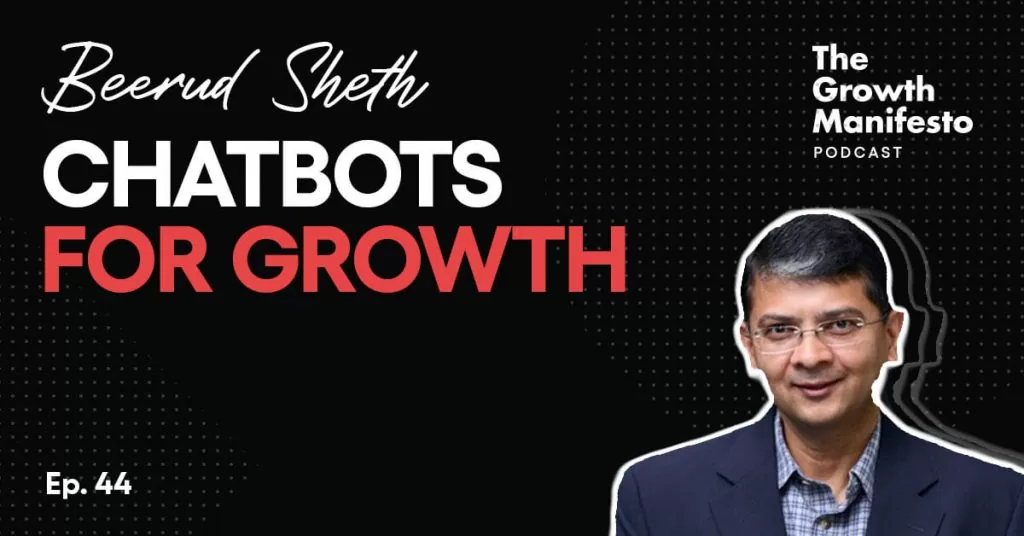
How to use conversational marketing + chatbots to drive growth
Beerud Sheth explains how conversational marketing and chatbots work, and why messaging apps like WhatsApp succeeded where early chatbot hype stalled.
 with Beerud Sheth


Overview
In this episode we get into the weeds about why and how to use conversational marketing and chatbots to drive business growth.
Key takeaways
- Chatbots need a popular messaging channel to succeed, which is why the 2016 hype cycle stalled until WhatsApp and others opened business APIs.
- Outbound marketing messages usually stop abruptly after one notification, but Sheth argues each one should instead start a conversation with the customer.
- A phone number is the key identifier for conversational marketing, since SMS and WhatsApp both use it, giving businesses direct customer ownership.
- Training a chatbot well depends on the diversity of unique customer queries collected, not simply repeating the same conversation many times over.
- Sheth says Grit by Angela Duckworth shaped his thinking most, arguing perseverance predicts success better than intelligence, talent or skill.
Chapters
- Intro: why conversational marketing now
- Introducing Beerud Sheth and Gupshop
- Why chatbot hype stalled
- Turning ads into conversations
- Getting started with chatbot tools
- Training chatbots with real data
- Replacing email with text marketing
- The future of conversational interfaces
- Quick-fire questions and closing advice
About the guest
Transcript
Auto-generated from the episode audio, so expect the odd mis-heard word. Timestamps open the video at that point.
You know, the reason why there's this interest in conversational, like I discussed earlier, was it's the rise of smartphones, the mobile screen, and mobile marketing is sort of the killer opportunity. The messaging inbox is, you know, that people read it, people open it, the conversion rates are very high. And if you can blend into that inbox without being too intrusive or annoying, I think that's a huge opportunity. You're listening to the Growth Manifesto podcast. a Zoom video series focusing on what it takes to drive growth in today's competitive business
environment. Brought to you by Web Profits, a digital growth consultancy that helps global and national businesses attract, acquire, and retain customers through digital marketing. In this episode, we get into the weeds about why and how to use conversational marketing and chatbots to drive business growth. So let's get into it. today we're talking with birud chef ceo and founder at gupshop the largest developer of chatbots and smart messaging solutions in the world with clients including facebook twitter
whatsapp linkedin and citibank he's also the founder of eland which is now upwork which listed in 2018 for 1.5 billion dollars today we'll be talking about how to use chatbots and conversational marketing to drive business growth and just quickly before we get started make sure to go ahead and hit that subscribe button so that you get the latest episodes as soon as they're released. Now let's get into it. Welcome, Birud. Hey, Alex. Thanks for having me here. I'm excited about this one. And I have to admit, I've tried to use chatbots many times over the years because I believe the hype, but I just haven't figured out how to use them to drive
growth consistently across different businesses and across industries. That's my goal for today. And I think this is going to be a common goal that lots of companies have had, right? And so maybe let's start, let's get straight into it by defining conversational marketing. Yeah, because they're linked, aren't they? But what is conversational marketing? How would you define it? Right. Well, so let me just start by defining conversational, right?
Which is a little narrower and there's a whole range of conversational experiences. Marketing is one part of it. You know, commerce, customer support, there's other parts of it as well, right? And, you know, and I'm just going to give you a slightly longer answer so that it explains why it's important, the context of it, right? I think if you really think about it, the way we interact with computers or with businesses, right, the user interface, if you will, changes every decade or so, right? So, in the mid-80s with the birth of the PCs, it was sort of the desktop metaphor, right?
You had a desktop computer and you downloaded desktop applications. In the mid-90s, it changed the web model, right? Browser and then you visit websites. In the mid-2000s, we ended up with this mobile app model, right? You had a smartphone and then you downloaded apps. And now what's happening is, you know, it's changing to this messaging framework with conversational experiences, right? So coming to the definition, really, it's a conversational experience is one where you can really just chat, have a natural, intuitive, conversational experience with a program or with a business, right?
And it's really as simple or intuitive as chatting with another human being. What's really happened is with the rise of smartphones and the small screen, there's only so much real estate, right? So you can't have lots of buttons, screens, tabs, and so on. Really, all you can do is like short messages, right? That's also why the rise of tweeting, for example, and publishing. Similarly, the rise of messaging for personal communication, right? So if you think of it that way, that sort of form factor works. And now if you can chat with your friends,
wouldn't you want to chat with businesses in the same way? So that's, but obviously businesses might receive messages from millions of people. So they can't have humans on the other side. They have to automate parts of it, some of it, maybe all of it. And that's, you know, so they build what are called chatbots. Chatbots are really software programs that can simulate a chat conversation. And really, you know, so I think this is becoming the preferred mode of communication, both in our P2P and, you know, person-to-person interactions,
and now also in B2C, right, business-to-consumer interactions back and forth. So, you know, there was slightly a longish answer, but hopefully that explains some context of why it's come about this way. No, definitely, for sure. And I think what's interesting is that, like what you said just a second ago, lots of companies want to use this, yeah, including us, including all of our clients, right? But they don't want to use it at the cost of the experience for the customers, right, or the consumers, right? And so chatbots have been pretty big, but they haven't been the game changer that I would have thought they would have been the first time I heard about it all those many years ago.
Why do you think it's not been such a big change that the shift towards chatbots kind of hasn't been as quick as what it probably should have been? I think, you know, the way I would, you're right. I mean, there's been this hype cycle, right? The hype started in 2016 when Facebook Messenger opened up APIs for the first time and Slack also around the same time. And after that, you know, it was going to change the world and it didn't quite do so.
And the hype cycle has gone up and down. And maybe my sort of, you know, I've sort of thought about this long and hard as well. And I think what I came away with was, you know, in the beginning, chatbots were sort of all dressed up with nowhere to go, right? You had a lot of this technology, a lot of this capability. AI has made tremendous advances, natural language processing and so on. I think all that is good. But chatbots are like performers.
They need a stage to perform on. They need a messaging channel in which to show off their capabilities. And which messaging channel would it be? So the problem, I think, is Facebook Messenger is popular in some parts of the world, but it's not as heavily used as, let's say, your preferred messaging channels, which in many parts of the world is, for example, WhatsApp. In China, it's WeChat. And even in the US, it's mostly iMessage or text messaging. And those channels, which are extremely popular, which we use maybe 50 or 100 times a day, didn't have any chatbots because they just didn't allow those capabilities.
And where chatbots were possible, I mean, those channels didn't have the users and therefore the usage, right? Right. So it's, you know, and in fact, that's why. So we built out a lot of tools in the beginning and then we realized, wait a minute, sort of the platform has to be set up. The stage has to be set up first before before chatbots can show off their capabilities. And, you know, things have changed since the beginning. Now, for example, WhatsApp has opened up business APIs, which allow businesses to send these messages.
I think there are more IP. I mean, even with text messaging, you can do a little bit. Now, text messaging has a different limitation because it's sort of generally plain text, 160 or 140 characters, right? So it limits what you can do. WhatsApp probably is the best example right now. And then, you know, we are also pioneering some new messaging channels that enable these things. There's also RCS that's supposed to be coming as yet another channel. So I think with that, you know, you will drive, you know, and meanwhile, chat bot technology and AI and all that has just gotten much, much better.
So I think really, you know, you need these two things to work together to deliver that experience and bring it to the consumer. And I think we are nearly there. Yeah. And we're going to unpack all the parts which you just said about kind of the AI and all that, those components, I guess. and this might be just because I'm old now. But, you know, so when I hit chatbot, for some reason, I just think of that thing that pops up at the bottom of the screen as you scroll down as a little kind of thing that goes,
hey, how may I help you with a little icon of a bot, right? That's what comes up. But what you've been talking about is this integration with existing messaging platforms, yeah? Is that where the majority of chatbot kind of interaction happens is across the messengers and the WhatsApps and so on. Is that where you're seeing it kind of happening at the moment? Yeah. And for stronger reasons than you might realize, right? Which is when you think of the large screen format, right,
on a laptop or a desktop. In fact, we had, I mean, messaging goes back, I don't know, three or four decades. I mean, you had IRC in the beginning, and then you had Yahoo Messenger and ICQ and AIM and many other messaging channels, right? And on the big screen, it would always sort of sit in this corner, in the bottom right corner where, you know, you did your real work on the big screen. But once in a while, you would chat with your friends. And that's all it was. It was sort of like a niche application on the side and so on. Right. So similarly, when you visit a website today and you see this button on the bottom right corner, you sort of say, OK, I do my real transactions, commerce, whatever I'm here to do sort of on the website.
And suddenly if I can't do that there, then I go talk to this little box on the side, which may or may not be able to help me. Right. The moment you go to sort of the small screen. Right. You have very little real estate there. Right. There's not much you can do. And we know from billions of users that the one app that works universally well is the messaging app. Right. Because, I mean, those are those are sort of the most heavily used apps out there. So as that happens, you know.
All the apps you mean, yeah. So the messengers, WhatsApp, all of them are included in that, right? If you take all of that, I mean, almost in any country in the world, that's like the most heavily used app on a smartphone, right? So messaging has now gone from being this little thing on the side to being sort of the main app, the primary thing that people spend their time in. And therefore, businesses are starting to say, wait a minute, if this is what people like on the small screen, small form factor, then we got to meet our users where they are on their terms.
We got to visit them in the experiences that they like, right? So firstly, it goes from being a sideshow to being the main show. And then when you embed chatbots in there, I mean, already, you know, people do so much work and activity just through messaging friends and family on the smartphone. Meanwhile, all those big screen formats like screens, buttons, tabs, and so on, don't work quite as well on the small screen, right? So, so it's sort of this shrinking of the real estate is driving, is making messaging sort of the main thing. And therefore, you know, it's almost the moment you add chatbots in there, it becomes the primary experience, right?
So my view is on a website where you have a little chatbot, if you have a problem, you message there. But on the smartphone, when you have a chatbot, you'll do everything there. You'll do commerce, you'll do marketing, you'll do interactions and customer support as well. So it's sort of like I said, the bot is essentially, every customer touchpoint is going to become conversational, will be a chatbot, and it'll do all of it, not just a little thing on the side. you're slowly convincing me if this is really good, right?
With the messages, who starts the message then? Say, for example, it's WhatsApp, yeah? So does the customer or the consumer have to start the message or can the business kind of upload the contact details and begin the message? But what's the process there? So it could be both, right? Let's back up for a second. So today, I mean, for decades now, if you think about it, you know, U.S. is a slightly different market because it's very media saturated and the Internet was already a big deal before the smartphone came along.
OK, but the rest of the world literally leapfrogged to the smartphone. I mean, that was literally the first computing device that many billions of users have had. So their whole worldview is mobile-centric, mobile-only, right? Oftentimes, they may or may not even have a laptop or a desktop or don't use one, even if they have it sitting at home, right? So consequently, all of these experiences ride on mobile devices.
And so, for example, if you think about when you shop Amazon in the US, you'll get an email confirmation. Well, if you do it in China or India or many other parts of the world, you'll get a text messaging SMS notification. You book a flight, you order food, you do any e-commerce transaction, any banking. every time you swipe your credit card, you'll get a lot of these messaging notifications, right? So businesses already are sending these very basic notifications, right? Now, if you think about it today, that just, it's the end of the interaction.
They send a notification saying, okay, your payment is due or you spent $10 at Starbucks, right? But wouldn't it be cool if a user could reply to it, which is saying, okay, can you, how much credit limit do I have? Can I reschedule my package delivery? Can I upgrade my flight? You know, or things like that, right? So each of those notifications could trigger a conversation and by enabling a user response, right? So in this case, it's the businesses initiating a message to the user. They're already sending billions of messages in aggregate. And that could be the starting point of a conversation.
Another scenario is where it's user initiated, right? If they've been using some product and now they want to, they have a problem, they're troubleshooting, or they might be looking for a deal or they're just window shopping and browsing and they can look up things as well. Those kinds of conversations would be user initiated, right? So in that case, they would seek out the bot, which is not terribly different from finding a friend in your contact book, right? So imagine in your address book, you have a list of friends. In the chatbot directory, you have a list of available bots and you say, okay, Domino's pizza
and I want to look at it and order it. So I think both of those are possible. could be business initiated, user initiated. But the point is what happens after that is sort of the rich interaction and conversation after. That's very powerful. Yeah. And I can see the value once you have somebody as a customer, I can see the value of like the engagement support, you know, the automation of a lot of other manual tasks that happen after that. What about before they become a customer. Is there ways to engage with people before they're a customer? Like I
know with account-based marketing, which is basically a enterprise level engagement, when somebody comes back to a website, the bot comes up, it pops up, says, Arthur, hey, welcome back. And they start the conversation off from basically the point that was left last time, right? It's not exactly converting them before the initial purchase or the initial, I guess, engagement, but that's an example of a way that it can happen
kind of ahead of the purchase, right? But what are the other ways or what are the best ways to kind of use these bots to engage with prospective clients or prospective customers? Oh, absolutely. I think, firstly, you know, these sort of bots or conversational experiences can be used in literally, I believe they're going to transform virtually every customer touchpoint, whether it's in marketing or sales or support. Now, your question is, you know, at the front end of this, where a prospective customer, right? How do you engage?
So the idea there is you take every advertising channel and you can make it interactive and conversational, right? So let's take different examples. Imagine a billboard to begin with, right? I mean, businesses already have these billboards. And by the way, if you go to China already, virtually every one of these billboards will have a little QR code in the corner, which if you scan, will give you details about whatever it is the billboard is selling.
So now you can engage, interact. If it's a special offer, you can book it or customize it, or you can look at different options and terms and conditions, whatever it is, you can do that. Similarly, if it's a print ad, same thing. Let's take the offline example. You have retail stores, restaurants, malls. There's just so many of these surfaces, each of which technically should be. I mean, before I enter a store, can I just find out what deals you have, what offers you have? It can save me some time. Or even when I entered the mall, what are the specials for the day or the food court things and so on.
So it offers a lot of, so suddenly all of those offline surfaces become interactive. Every restaurant table, for example, could have, again, a QR code, which allows you to order, get the menu, look at recommendations, and so on. Similarly, in digital, it's even simpler. Every one of your social media ads or search ads could, again, trigger a bot. Every one of your outbound messages could lead to that. So the point is, there already is a lot of outbound advertising happening, but all of that advertising, they make the message and it just stops abruptly right there.
They communicate that key message and it stops as opposed to it should be the beginning of a conversation, not the end of a notification. right and if you just think of it that way where you take any outbound marketing message any ad campaign and make it conversational right that uh opens up a lot of doors because now the user you know now you're no longer just sort of broadcasting or mass marketing you're customizing you're personalizing you're individualizing because because the user is now part of the conversation
you know they are they can get clarifications they can get you know details they may have special requirements, all that kind of stuff, right? I mean, and when we think about conversational, the analogy I like is just like in the offline world, right? I mean, if you're walking around in a mall, you'll know sometimes they have these people who are very friendly and chatty and they start talking to you. And before you know, they've sold you, you know, or upsold or cross sold something to you. But it's not just a hard sell. They engage you in a conversation. And that's what
people like. I mean, that's how we communicate, right? So I think it draws people in. It's user centric, consumer centric, and sort of, you know, it allows them to pick and choose what they want. So I think there's immense potential of conversational marketing and advertising. So I like the QR code example, because that's how you start the conversation in the offline world. In the online world, you can send traffic to a bot or to a website, right? If you choose to go to a bot, you don't get the same experience as them coming to the website, experiencing the brand,
or maybe, you know, just kind of just seeing it and kind of just getting that credibility factor high. So does that mean that it may not be the first touch that like, it may be a second or third touch, but once they are across the brand a little bit, because otherwise, if everybody has the same bots, how do you start to differentiate between companies anymore? right and so yeah like could you talk to that look firstly it depends on what what screen you're dealing with right like we discussed earlier for mobile for example yeah if you're on the large
screen yeah i mean clearly the best way to make an impression is you know sort of i mean you have a much greater real estate to work with and therefore you can do more things if you're on the mobile screen you don't have that luxury you don't have that choice right so and by the way the customer is just sort of maybe passing by. It's a transient experience. They just quickly want to do something, check something. And I think if you think about it as life becomes busier and more complex, the simpler and easier you make it, right? Meaning just provide the service and get out of the way,
right? As opposed to really trying to shock and awe the user into sort of your brand experience, right? So I think it really depends on context, but I think on small screens, it is better to really make it quick and easy. And I think in conversational experiences, now there's different ways of demonstrating brand value or brand power, if you will, right? I think it could be through greater personalization. It could be through greater, you know, richer AI. You know,
the analogy, I mean, if you, again, if you think of the old offline world, you know, Nordstrom had a great reputation for service because their salespeople were good at figuring you out, knowing things about you. If you're a repeat customer, of course, they knew a lot. But even as a new customer, they'd sort of try and figure you out and sort of provide just a lot of customized personalized service. And that's hard to do. It's like, if you think about it, two decades ago,
it was hard to differentiate websites because everybody had these basic HTML. And then later on, you know, all of this design and stuff came in where now you can, you know, you can communicate and differentiate through your website. It's almost the same thing. I mean, just because there's a million bots doesn't mean you can't differentiate any more than, you know, you can't differentiate your website because there's billions of them. So, so I think you just have to get better at, at, at the medium and, but you have to be true to the medium, right? The, the answer is not, okay, let me show them a website because on the small screen, you know,
that's actually more likely to fail than, than just sort of being true to the medium and just delivering a richer experience there. And I think that's a fantastic point. And so thank you for answering that. And I think what that opens up is that like, there's a conversation around the multi-touch experience, right? There's, there is rarely a time where a consumer will just engage with the company once and just become a customer, right? That's, that's a critically important point. And so if there are going to be the multiple touch points, you can use chatbots and conversational marketing at key stages to progress the conversation.
It might not be first touch, but it might be second or third or eighth touch, right? And if they're on LinkedIn or if they're on Facebook or if they're somewhere, you could start the conversation. Oh, hey, back again, you know, here's some information or here's some content and so on. So I like that thinking. let's go now to how to actually make it sound conversational because you know i've experimented with the simplest of the chat bots where come to the website and we want to engage we want to show them some content we want to have start a conversation we want to qualify the right
people to have the right conversation with the sales team and for the others we want to support them you know with any information that we can but probably can't speak to somebody because there's too many people. So how do you get the conversation sounding like a conversation, not sounding like a bot that doesn't have the right answers? Right. No, and that is indeed hard. It takes, you know, effort and fine tuning and so on. Right. So that's just hard work, like in setting it up. So there's going to be time to set it up properly. Is that right? That's exactly right. But it's
getting easier, right? Let me explain. So even before we get to bots specifically, I think there's been a lot of recent advances in AI, in particular in natural language processing, right? I think if you think about it, there's this huge resurgence of interest in AI, because I think around 2012, you know, there was this huge step function improvement in image recognition, right? So that improved dramatically with deep learning and you hear this all the time,
but that was sort of a big, you know, dramatic improvement in that. And I think over the last couple of years, we've had a similar moment in the natural language processing side of things as well. And if you've been following the news that are these new, you know, GPT-3, for example, I mean, these are these natural language processing, you know, language models that are being created to understand language. And what they do is they feed it billions of documents and there are millions of parameters. And, you know, they get very good at understanding language.
And the good thing about all this research, which is out, you know, in academia and sort of in the public domain where you can take these language models and then, so you just start from a very high point, right? You can kind of stand on the shoulders of giants and then really fine tune it for your purposes. So if you're building a chatbot for a banking application, you can still leverage the language model built by somebody else and then, you know, fine tune it for sort of the banking conversations and interactions, right?
So as the state of the art progresses, it becomes easier to build these chatbots because it can understand better what the user is asking, right? So most important thing is really natural language understanding. When the user gives you a query, if you can understand it, then usually providing the response is much easier. You can do that programmatically if you only knew what the user was saying. And I think that's improving dramatically. So I think this is getting better. And then on top of it, like a lot of bot developers, you know,
they specialize in certain verticals. So they'll build, they'll give you a pre-templatized bots and so on, which allow you to do different things. So it may be specialized in certain domains and such. Yeah, I think now's the time to look at these, to build it. Of course, the specifics about your brand, your customer, your business, I mean, those are things you'll have to figure out. But let's talk about that, yeah? So say, for example, that I am listening right now to this podcast and I am becoming convinced. I'm like, okay, I'm being sold now.
Like, I understand now. And this is something which I'd like to execute on. what is involved for the particular company particular brand to get started with this you know because obviously there's all of the language models out there and all that type of stuff all this ai stuff but for me specifically what do i need to do to get started okay so i think it um it depends firstly on what kind of business it is right and where uh you're sort of a one of a large number of businesses like say if it's a if it's a restaurant or a hair salon right i mean
something like that, there are millions of those. And what happens is you could take one of these templatized bot experiences that work for other restaurants and you just have to fine tune it for yours. So I think in those cases, you get sort of nearly finished bots or products that you can use and fine tune. And it's not that hard. And even a non-technical developer could take it and run with it. I think there are quite a few options. So you'll have order management, you know, maybe appointment scheduling, depending on the business and the context.
So it has a lot of these things already in there. If you're a large enterprise with a custom requirement, you know, and then it depends whether you have the technical teams and resources or you don't, there are more tools that are richer tools. I mean, if you have, you know, the other end of the spectrum would be, let's say, if you have a developer team, then very likely, I mean, there's a lot of NLP AI models available off the shelf. I mean, of course, all the big tech giants offer APIs, you know, for language
understanding and language processing. So there you can really fine tune, pick and choose, do some testing and so on. But if you're not that advanced, then, you know, you can, there are some places where you can really do some sort of, think of it as a flow, a conversational flow chart. Meaning if the user says this, then do this. If the user says that, then do that instead. And if you just sort of lay out a flow chart, it can convert that, you know, a bot can take that into a full on experience and build from there.
So I think there's a range of tools. I think to simplify, there's like the no code tools. There's the low code and the your code, if you will, right? There's high code things. And I think it really, you know, it just depends on your ability and interest and desire to fine tune it. But there's a lot of options opening up. So two questions and they're both at the extreme opposite ends of the business kind of scale. The first one is, like if I'm the small business and I want to find the templatized solution, is that a service that GupShop offers or is that a service that a provider that GupShop offers?
But how do they find this information? Right. No, that is something that GupShop does offer. And we are continuing to add, you know, more and more verticals and so on. So we've done, we've done something for salons. We've done something for restaurants. We'll keep adding more. Right. I mean, just to, just to back up a little bit and just provide some context about GupShop. So it helps us, you know, firstly, GupShop, the word itself is a Hindi word for chat. Right. And I, I joke that people should remember as, remember it as the next famous word from the
language that gave them yoga, Nirvana and Kama Sutra. Okay. Yep. Very good. That's the fourth one now. That's right. There you go. So, and what we do is, you know, we are a message, there are two elements to it. We are a messaging platform, a cloud messaging platform, which allows enterprises to send text messages, WhatsApp messages, you know, IP messages and so on. And then on top of it, we have tools for a conversation for building conversational experiences. Right. And, and in that case, like I said, there's a spectrum of tools.
For some people, it's just the tools themselves that they can pick up and use. But in certain cases, we can pre-build and templatize sort of bot experiences. And so we're doing that for different verticals and even specializing it by geography, right? Different languages, different countries and so on. So there's a lot of work to be done there, but we are starting to do that. In any case, of course, not the only one. There's a lot of, you know, I think bot development itself will grow into kind of like web development, right?
There's a ton of ways of building websites, right? You can hire a premium agency to do custom websites. You can take WordPress and tinker with it yourself, or you can go to there's plenty of templatized places where you start with a template, customize it, and so on. So I think it's sort of, you know, this is obviously not as mature as web development, but the same ideas are emerging. And the answer, by the way, might vary, saying if somebody is just beginning with this, I would say start simple, start small.
Start perhaps with a pre-built template or something that's easy to use. And the reason for that is your own thinking about how the conversational experience should go itself will change once you actually see it. You can theorize all you want about it, but once you actually build something, put it in front of your users and see the actual queries that they're asking, I think what you end up building would evolve with that. So in that sense, it's very easy to start small, to start with some pre-built stuff.
It may not be very advanced in terms of AI and so on, but you may be surprised. Maybe it's adequate for your use case or maybe just completely not adequate and you really need to go deeper and so on. Right. So that's the part that nobody can answer for you. Right. Is it for your audience, for your brand? How does it fit and how is it easy to automate if it's, you know, if that, if those conversations are typically, there's like 20 questions that everybody asks all the time. Well, then it's very easy.
It might actually a lot easier to just templatize it. So the user doesn't even have to type as opposed to, you know, forcing them to do it. But it's one out of a million choices. Like think about Alexa, right? say play this song i mean there you don't want to navigate through a menu and genre and you know artist and so on you just take the song name and it should figure it out exactly so the experience can can vary depending on you know what is it that you sell how many options there are and so on thank you that's at the one end that's at the small end at the big end is where it seems to
be the most exciting because that's when you can pull in customer information and there's a databases on top of databases, on top of databases. And it feels like that's where chatbots thrive because that's where they can start to have their own AI kind of optimize their messaging. Could you talk about how larger organizations are using this for the people who are not investing in it yet? Right. Yeah, absolutely. I think, you know, there, I mean, the sky's the limit really, right?
I mean, it's a little bit like you want to replicate the, you know, you go to a hotel, you go talk to the concierge, right? And the concierge, I mean, a good one just sort of, you know, they can help you with just about anything, right? You want recommendations, you want to make a booking, you sort of, you know, find out different things. It's sort of the same idea or a good assistant, right? An admin assistant who can really over time gets to know you and can personalize it and so on. So I think the core of it, the heart of it is really the NLP
or natural language processing capabilities around that. And that's where, you know, and so when you receive a user query, the key is to understand what's called the intent, right? What is the user asking about and the entities in there? So, for example, if they say, I want to book a flight from New York to San Francisco. So, the intent is a booking and then, you know, from city to city. I mean, those are the entities and based on that, right, or I want to buy a blue T-shirt, right?
I mean, so the intent is purchase and then blue and T-shirt and so on. So if you can extract those things for the domain, the moment you have that, then the bot responses can be automated and it could be a rich experience, right? So one part is getting the AI horsepower, if you will. but AI actually is only as good as the data you use to train it, right?
Which means now you also need a lot of history of user queries, right? What are your users typically asking you? And chances are your customer support teams already have some examples of the kind of queries that come in. What are the common problems and so on? And then even on your transactional website, right? What is it that people do the most? Are they coming there and buying? Are they window shopping? Are they browsing? Are they trying different variations? Are they reading up on the reviews? So depending on, like I said, what the product is, what the space is,
I think you want to optimize the conversational experience for those things. But between a good sort of training data set and the AI models that can sort of use this training to fine-tune the responses, and then you put it in front of users, you know, you gradually roll it out. You don't want to, you know, put it out there all at once, but you will discover very quickly what queries are being answered, you know, accurately, which ones are not yet and which need more work. And, you know, maybe there's some of it might still
be ambiguous. So you need to, you know, train it a little more and things like that. But I think it's a, it's a bit of a nitrative process. You know, again, the human analogy is imagine if you had an intern that you've just hired as your concierge and you sort of train them a little bit and then you put them out there you know and have them do a dozen conversations see what they understand what they don't train them again and then put it out there and maybe you know in in like a month or a few weeks uh they're ready for prime time right so i think that's sort of a
evolution yeah so i've seen a lot of the case studies of banks um that use this technology and that seems to be the reason, well, because they have so much data and then they have so many customers and then they need this actually to be able to even provide a certain element of customer service. Is there a minimum number of customers that a company should have before they can start to consider the use of AI
as part of their conversational chatbot strategy? You know, I don't know if it's, I don't think it's a function of the number of customers so much as, you know, the complexity of the interaction, right? I think, I mean, so let's back up a second, right? If you don't have a chatbot, right, how are you providing all these services? And if your customer is calling into the call center and, you know, sometimes waiting on hold for 10 or 20 minutes, you know, I mean, that's a frustrating experience, right?
Because you wait on hold for a while, then you spend another few minutes validating that you are who you are. And then all you had was one or two questions like, what's my credit limit, available credit limit for my credit card, right? And it should not be that complex, right? It could be a lot simpler. In some cases, there's just simple things. how do I reset my password or some basic queries like that can be easily automated. They're not even very complex. Or if people are browsing and window shopping and things like that, again, you can allow
by automating it, you can allow it. So I think it really depends on the nature of those interactions. And I think if you can, through these conversation experiences, dramatically improve the customer satisfaction, the ability to do it promptly, instantly, you know, provide convenience, essentially giving them their time back and so on, right? So it's sort of, I think, so certainly if they have larger user bases, I think the impact is far greater because whatever you build,
you know, will impact that many more users. But even it could be, let's take, I don't know, real estate transactions, right? I mean, the number of customers is small for any broker, But each of those conversations are very advanced and complex, right? I mean, you're evaluating a property or a house. Even there, you know, there's a lot of, I mean, it's a consultative purchase. It's a complex sale. You're not going to just decide on the spot. Or maybe if you're buying an electronics item or something, you know, you want to look at it. So I think those are really just depends on what it is as much as, you know, how many users you have.
okay okay um because it is about the data set so for the real estate example for in terms of the example the data set's not going to be very high so the ai is not going to really be able to be trained that well so it's still going to be quite of it's a manual process still like unless like you've got like a history of a thousand sales with a hundred thousand interactions. We can import that.
No, no, I don't think that's the concern in the sense that see the size of the training data set is not simply just the number of, you know, conversations in the past. I think it has to be the number of unique conversations, right? So for example, if you may have, you know, there may be a thousand customers over time, but they almost always ask the same questions, right? What are the nearby schools and how much traffic is there? What's the noise level and so on. So really, if you can get that representative sample, right?
So you want to get the breadth of coverage. You don't need a hundred messages that say the same thing about schools, right? So if you get, the important thing is to get the coverage. And I think that's possible. I mean, real estate is sort of a constrained environment. There's only so many things you can ask about a house, right? And I think if you have that diversity, then you can train it. And sometimes, you know, I mean, you can even oftentimes, let's say a broker themselves would know, right? Here are the questions that people have asked. And I just sort of start with it, put it out there. And then, you know, so, so it's really the breadth, the diversity
of training material and not the repetition of training material. Okay. I got it. Oh, well, I'm getting it. I wouldn't say I got it yet. So let's talk implementation. Let's say I come to GupShop and I want to get started with chatbots, right? Or with conversational marketing or with messaging, right? How much time should I be thinking somebody needs to spend to set this up the first time, you know? Like in a simple enough format that it's going to have a good experience, you know, for my customers, not too advanced where it's going to take six months, right? But what's,
how much time, you know, should somebody be thinking that their team or themselves would need to be putting into the first setup? Oh, I think the first setup, I mean, you could get going in minutes, really. I mean, it's not- But for a good experience, though. Yeah, yeah. Well, so agreed, right? I mean, you're not compromising on the user experience. I think it really depends on the scope of what you're doing, right? So let's say if you're taking small steps, you may already be sending out text messages, for example, but suppose your next
campaign, you say you want to make it conversational. So you say, okay, you know, we have some special offers or let's say if it's a restaurant and here are the specials for the day, right? And so instead of putting it all in, so there would be a text message along with the link. And when the user clicks on the link, it opens up this sort of conversational experience saying, here are the, you know, four or five things. Here's the chef recommendation, you know, There's a special offer for you individually and so on.
So it may be a five or 10 message long conversation. And it's fairly constrained simply because of the context and the scope of the message and the campaign itself. Or take another example where it could be some sort of a loyalty campaign or loyalty offer saying, hey, thank you for being a loyal customer. Here's a special offer for you. and when they come into the conversational experience, they can pick from one of three different possibilities and they can select it and pick the color and the size
and then they get a gift, for example, right? I think these are just very simple variations, but the scope is inherently limited, right? Because you're not saying come and chat with me. You're just saying, look, there's a little gift for you and pick the gift. So it's small, it's succinct And that could be done literally in minutes. It'd be a great experience. It's certainly better than just a plain notification. It's a lot more interactive. It's personalized. Yes. And it can be, you know, developed and deployed like in minutes.
So is this, I like simple ways to think about things, right? I like simple models just to get started because once you get started and there's some performance, you get excited at that point, right? So I'm all about how do we get that first win, right? It feels like a simple place to begin is instead of email marketing, right? Because everyone is sending emails, right? This might be a really good experiment to see how does your customers engage in their own preferred messaging apps versus email, which we know still works, but maybe it's not as engaging.
Is that a good place to start, like to see how this could work? Oh, absolutely. I mean, there have been some examples, you know, done out there and published as well, where really, firstly, when you do text messaging, right, it has to be opt-in. You can't just sort of blast it out to lots of people, right? So, because there are penalties for sending text messages without permission and so on, right? So, let's say typically most businesses, they'll have their loyal customers, they collect the phone numbers and so on. So if you have those, and even if you run sort of a small experiment where you send them a message, now text messages, because of all these restrictions are more likely to be opened and read, right?
The read rates are very high. Yeah. And the click-through rates are also very high, right? And when they click on it, you bring them into this sort of rich conversational experience that it doesn't have to be complex, but it's custom built for the scope and the purpose that the campaign is meant for. And it allows you to personalize, right, literally to every individual. So as soon as the person clicks through, you know who they are, you know what they like, maybe you have some history around it as well. So exactly. So if you can, if you replace email marketing with a small sort of text message messaging campaign or a WhatsApp campaign, along with sort of this, you know, conversational experience, I think that would be a quick, simple win.
And the amazing thing, by the way, is you'll see the results also in minutes because people are used to, you know, in texting, as you know, right? The normal behavior is you open it right away. Right away. Very likely that more than half the people will just read it instantly. Who owns the data, right? Because if I, again, simple, but a few years ago, again, there was this big thing with Messenger and you'd get all your subscribers in Messenger, but they're in Messenger. Yeah. They're Facebook's subscribers. Yeah, they've subscribed to your chat kind of section in there, but they're not yours.
So how do you make sure that you own the data so that if Facebook changes their algorithms and now you have to pay to get all the messages out, whereas before it was free, how do you actually control it and how do you then distribute it across the platform of choice? Right. No, I think that's a great question. And see, the good thing about conversational messaging versus social media messaging, right, is that while in social media messaging, it's all happening in a public medium controlled by one of these social media companies where they can really limit your access or charge you for it, be the gatekeeper and charge a toll for it.
These messaging conversations are firstly inherently private and they belong to you. And really it's between you and the end user, right? So even WhatsApp, for example, has end-to-end encryption, right? They don't record any of these messages. They're changing some of their policies, so we'll see how it shakes out. But right now they don't. Even when you send text messages to mobile operators, they don't, you know, store or record these messages. They don't have access to it in general. So in that sense, it's really a private interaction between a business and their consumer, right?
So you have the subscribers as part of your own database. So say, for example, if I want to start my conversational marketing, and I have a database, so what do I need to get started? Is it just some phone numbers and some emails? Is that enough? Where's the start point? Just so I know, okay, I can start. Exactly. So it's really the identity. In most cases, a phone number is enough because both SMS and WhatsApp use phone number as an identity, right?
The other channels don't quite use it, but I think they generally have less traffic anyway. Facebook Messenger has a different kind of ID. You know, you could do it in email too, but email, yeah. So, you know, email when it's read on a big screen, it's easier to send them to the website. If it's on a small screen, you know, of course, it's better to send them to a conversational experience. The problem is you don't know. I guess you can optimize it based on the click as to whether they're coming from a mobile device or from a large website and send them to different places.
But with messaging, you don't have that, you know, confusion. I mean, with messaging, almost always the user is clicking through from a mobile device and therefore you can optimize the conversation experience. So the phone number is a priority right now, right? The phone number is key. It's not email because otherwise you could email market, right? That's not the point. Exactly right. So I think, yeah, I think, see, the whole thing, you know, the reason why there's this interest in conversational, like I discussed earlier, was it's the rise of smartphones, the mobile screen, and mobile marketing is sort of the killer opportunity.
The messaging inbox is, you know, that people read it, people open it, the conversion rates are very high. And if you can blend into that inbox without being too intrusive or annoying, I think that's a huge opportunity. I think I'm getting it now. It's taken this long to get it. We're talking about texting essentially, right? Like it's basically texting, but through WhatsApp as well. We're not talking about
you have an email or a phone number, then that can be sent to Facebook Messenger because Facebook, they need to subscribe through Messenger to be able to communicate with them, right? So what we're talking about is places where we can start the conversation, which is oftentimes through the phone number or through WhatsApp. It's not these other messaging platforms that require the opt-in through the platform. Is that right? That's exactly right. And by the way, that goes to that. That's an aha moment for me, by the way. That's an aha moment. That's great.
Which means you control your database. You have direct access to that user. So even if, let's say whatsapp doesn't allow it you can still reach them through text messaging because the phone number is the phone number right it's not some secret facebook id that only facebook knows and you can't reach them if facebook doesn't want you to okay okay okay i'm getting it this is good because a few years ago like i was we we experimented like a little bit with um the text message marketing for content but it's a bit too intrusive you know but but having that
platform option seems to be much better. And WhatsApp is really just in the last few years has really taken off. I have so many conversations on WhatsApp, like across the day and WhatsApp groups and everything like that. And that one you open and just to all the marketers out there, you don't get like your emails open sometimes for days and days and days, and you want them to. Yeah. And in fact, I think to add to that, right. So even as GupShop, we've sort of pioneered a yet another messaging channel and we call it GIP, which is GIP,
which is just short for GupShub IP messaging channel, right? I think the way it works is it really just opens up a widget on any mobile device and that's a conversational surface, right? So you can, the point is you can send messages through this channel or through WhatsApp or through text messaging and just enable rich conversational experiences. So I think these solutions are proliferating. The channels are proliferating.
And like I discussed right in the beginning, a good channel is a prerequisite for a good chatbot. And I think now that these are falling into place, WhatsApp has done it, maybe RCS is coming, and then we've launched something called GIP. There are now enough channels there where I think that the stage is set for chatbots to shine now. Fantastic. Now, let's talk about the future for a second. Where do you see this in 5, 10 years? I'm sure this is something that you've been thinking about a lot of time.
But where do you see this going in 5, 10 years? What's a potential scenario that could play out? So firstly, when you think about chatbots, like I was saying earlier, I think it's the most intuitive, natural sort of way. I mean, this is how people interact with other people. I mean, ever since we are babies, you know, we learn how to do this. So there's no training required. You know, there's no language barrier, literacy barrier, because this is how we communicate.
And by the way, we've talked mostly about text messaging, but messaging could equally well mean voice, right? Think Amazon Alexa or Google Assistant, which, by the way, any chatbot you build for text can easily, you know, with some minor modifications would work equally well on voice as well. Right. So so when you do that, it becomes possible. Right. So so coming back to the future question, I think every brand, every business, in fact, every software program you interact with,
very likely will have a conversational interface so that you interact with the tools and services and businesses just like you interact with friends. Everyone has an assistant or a concierge. And I'm assuming in five, 10 years, certainly they'll be smart and very personalized and customized. So they don't waste time. They don't ask you too much. They recognize you instantly. And when you say, you know, get me dinner, they know what I mean. Right. Or, you know, I'm looking for whatever new device or some new service. I mean, it sort of it knows it knows enough about me, my history, my preferences and so on. Right.
So it's a little bit like the Star Trek experience. You remember they had that computer and they would just say, you know, computer, what's, you know, where are we? And, you know, what's this planet and what's going on? I mean, you just sort of, you just ask and you converse and, you know, you get the answers that you need. It's certainly a lot simpler than, you know, having to. I think the way I like to describe it is, you know, the old interfaces like websites and apps, right?
They force humans to behave like computers, right? But chatbots force computers to behave like humans, right? They will talk to us the way we're used to talking, and it just will be more and more intelligence happening in the back end. And even better to think a couple of steps further ahead is once there's a proliferation of a lot of bots, right? Maybe thousands or millions of them. I think then maybe you'll just have your assistant bot, just the one that knows you extremely well,
which in turn talks to all the other bots and says, you know, I figured out the weather from here and the train timetable from here. And I see you're going to be delayed. so I postponed your meeting and I've done, you know, it's just figures out all of those logical sequence of the dependencies and so on and just makes your life simpler in that sense. I mean, I look forward to that day because I want the bot to do so many things for me. But is there a hint to where this could go in China? Because in China, in the WeChat platform, you can do everything in there. You can purchase in there. You can engage with specific organizations
in there, you speak to your friends, you make like, it's all in there. Is that like a hint of where it could go? Because I think like in the West, it's about the website still, it's about the platform still, but in China, the WeChat phenomenon has really put everything into these apps. Is that where you see it going? Yeah. So I think sort of yes and no. And let me, let me explain. Right. So the thing about WeChat is it's really a super app, right? It's the one app that substitutes thousands of other apps because they've created these things called
mini programs that any developer can create and embed it inside the WeChat app, right? So it's almost like, you know, just like you have an app store, they kind of have their own mini program store, right? That allows you all these diverse experiences. The thing that they haven't done, which I think would be even better, is the conversational piece, right? So each of these mini programs are still sort of like mini websites, right? Their websites and buttons and so on. But if you wanted support, if you had queries and so on, I mean, that's not what it's built for.
When you think about a messaging app, right? I mean, if you add a lot of mini programs, it sort of mixes the metaphor a little bit, right? Because on this side, it's chat. But on this side, there's like lots of these programs and so on. I think it'll be even better and more seamlessly integrated if even the business mini programs were conversational and then they're just threads in the same messaging app. Got it. Got it. So, yes. So the part of it is it's just the one place. You know, I think the way I like to think about it is think about this device.
You know, your smartphone has your remote control for the world. Right. You press a button, your taxi arrives, another button, food arrives. you press another button, you get a deal and so on and so forth. And while that vision worked out for the top hundred apps or so, the long tail, it doesn't work for the small businesses. Like how many restaurant apps do you have? How many mall apps do you have? You don't, right. But I do interact with all these brands. So once you have these conversational thing, then your messaging app is like literally the one place where, you know, it's the glue that connects, holds your life together, right.
Connects everything. It tells you when you need to do something, but otherwise it goes away. Or if you want to initiate something, you can go find it, chat with it, trigger something, and get done. But literally, your whole life will be controlled through this one app in that sense, the messaging app. And that's why the messaging platform is key right now. And that's why the prevalence of the WhatsApps of the world is really accelerating the bot evolution. Exactly right. Right?
Exactly right. Because I think what messaging does is, you know, it connects little experiences from different things, because let's say I want to pay my bill. I want to order a cam. I want to order my food and I want to approve, you know, some requests from the office. I want to, you know, check my credit card balance. I mean, there's, that's how my life is. Our lives are getting more and more complicated and we all need to keep switching context. And either you're going to keep shuttling between dozens of apps again and
again, or are you just going to stay in one place where it lets you know when you need to think about something? Otherwise it just disappears into, you know, into ether. And, but, but it's the messaging metaphor is sort of, it's the glue that connects all the pieces of your life together. And I'll tell you what's interesting. Cause I went to Singapore to China, not in the last year, but like, you know, like a fair few years ago and QR codes were very common, right. But they weren't common in the West until COVID. Now COVID with all of check-ins, people know how to do it.
So I think that is also going to accelerate the usage of these things. And once you get used to something, it's really hard to go back. So once you get just used to asking something inside of WhatsApp or whatever, you don't want to go to a website, submit a form. I mean, who wants to do all these steps to just ask a simple question, right? And so there's a lot of change happening in the world last year, this year, you know, but I think it's accelerating with all the other changes that are happening. So this is really a great conversation. I have some quick fire questions and then we'll just
basically finish off by just talking a bit about actually how people can get started with GupShop. Yeah. So I've got five questions, which I like to ask the guests in the show. Number one, what book has had the biggest impact on your success? I don't know if it's a single book. I love reading. Okay, well, if I had to pick one, I would say Grit. It's a book by Angela Duckworth, which has some very interesting insights about what's the one factor that's the predictor of success. And it's not intelligence, it's not talent, it's not skill.
It's really just the grit, the perseverance, the determination. And for an entrepreneur, it's sort of an essential prerequisite. Yeah, thank you. And I totally agree with that one. Number two, what's your number one piece of advice for hiring awesome people? I would say hire for aptitude and attitude rather than just resume value or skill set alone, right? You want to hire good people, aggressive, growth mindset,
you know, performance-driven, self-motivated. I mean, these factors oftentimes outweigh the skill set alone because they can acquire the skillset along the way that's needed. They can solve a lot of other problems, right? That's our project where profits too. So totally agree with that one. What's your best time management or productivity tip? I will often be, you know, multitasking. I love the podcast when I'm driving or when I'm working out, you know, I will.
Yeah, I think that's the one thing I found really, really useful. and especially if you can get good podcasts. Your challenges are just sort of, I mean, as a business person, all your challenges just in your head. You need to be even keeled, balanced. There's ups and downs, rollercoaster of business, especially of early stage entrepreneurship and so on. And things are never as bad as they seem or not as good as they might seem. I think you just can focus on the things you can control without worrying about the rest.
Do the right thing, build relationships. and so on, right? So it's really just, if you can think right in your head, that's probably the best way to handle the vagaries of business, yeah. Definitely. And number five, how do you relax after a crazy day at the office or the home office these days? Oh, I have teenage kids, so I hang out with the family, spend some time, maybe just watch some, you know, mind-numbing tv with the family or something like that yeah just just yeah i think i mean you're
stuck at home so really that's the best thing uh you know yeah fantastic okay now if people want to get started with gupshop you know what's the process you know so how do they you know start their first experiment or like if they're the larger organization how do they get in touch you know to maybe get some support like integrating um across their organization sure so i think um i mean there's there's a lot of stuff on our website and we've geared a lot of it to be self-serve easy to use easy to get started try before you buy right so all of it is kind of no
commitment you know see if it fits i think that's the most important thing it's all well documented and so on um gupshop.io is the website right and then the links in the show notes yeah okay And there's messaging APIs that they can very quickly use. There are some conversational tools and experiences that are campaign tools that they can use. You know, many different channels, you know, WhatsApp, GIP, you know, other things as well. So I think it's very easy to get started. But in addition to that, if they need to reach us again, I'm on Twitter, LinkedIn, you know, just Birud has many different ways to access and reach me as well.
Rude, thank you so much for taking the time today to really explain chatbots and conversational marketing to me at a level that I actually understand now. Because you hear about it and you've got these preconceived notions of what they are. I mean, you're in it basically every single day. So you know what it is, but there's still so much unknown about the possibilities of it. And so I think today has been an awesome conversation to really understand that. And I'm definitely going to be experimenting with chatbots after this.
Great. So hopefully you're a little more convinced than before. Yeah. I'm a lot more convinced. I actually understand the difference now between what I thought was a chatbot, you know, which kind of appears on the big screens versus kind of integrating with existing messaging platforms. And I think that's the big shift and understanding how to leverage that. The fact that we have to use to have their phone numbers and stuff like that. and then we can engage with them at a certain level on the device and in the app
that they're spending the majority of their time in. So thank you so much for coming on the podcast today. And talk soon. Yeah, thanks. Thanks so much for having me here. Thanks for listening to the Growth Manifesto podcast. If you enjoyed the episode, please give us a five-star rating on iTunes. For more episodes, please visit growthmanifesto.com forward slash podcast. And if you need help driving growth for your company, please get in touch with us at webprofits.io.