Crypto and financeEntrepreneurship
How Brock Pierce went from child actor to crypto billionaire
Crypto entrepreneur Brock Pierce on going from child actor to blockchain investor, co-founding Tether, and why he only backs ventures where he has the skills.
 with Brock Pierce
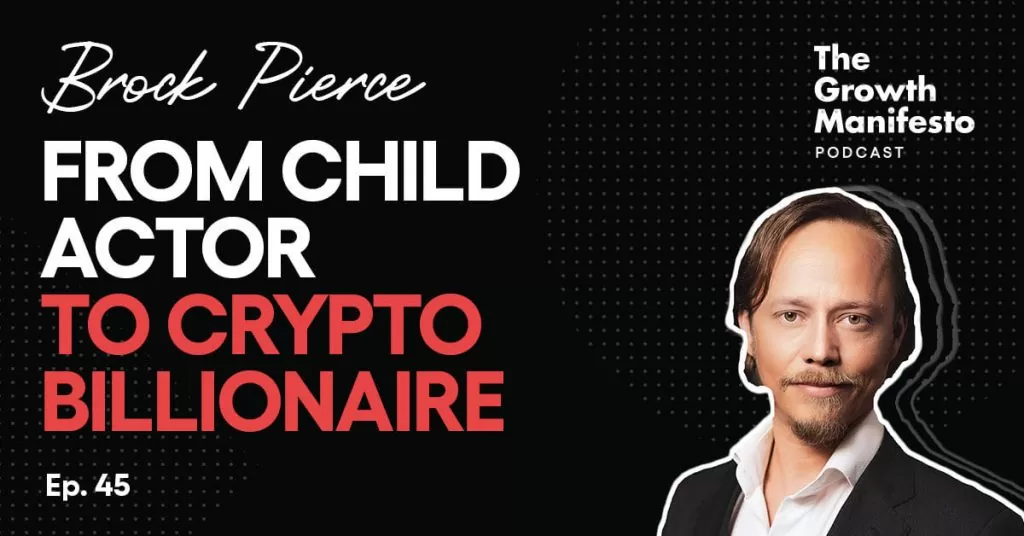


Overview
In this episode we talk with Brock Pierce about his journey from child actor, to internet entrepreneur, blockchain entrepreneur, philanthroper and US presidential candidate.
Key takeaways
- Pierce only enters a new venture if he already has at least two or three of the core skills it needs.
- His first internet video startup raised $88 million and filed to go public, then collapsed in the 2000 dot-com crash.
- He built a supply chain of about 400,000 people, mostly in China, to professionally mine and sell in-game currencies.
- Pierce co-founded Tether, putting the US dollar on the blockchain in a system now processing about $150 billion a day.
- He ran for US president in 2020 as what he calls his trial run to understand how the political system works.
Chapters
About the guest
Transcript
Auto-generated from the episode audio, so expect the odd mis-heard word. Timestamps open the video at that point.
But I always thought like, if you're going to try and do something, you need to have at least two or three of call it the five prerequisite skills required to do whatever that business is. So if you have a background in like B2B enterprise, that's one thing. If you've got a consumer marketing background, so you have to look at what that business is and what are the core skill sets required to be successful building whatever that business is. And if I don't have at least two of those things in terms of my past experience, I would automatically eliminate it because it just means the learning curve is too high.
And I also don't have the experience to assess whether it's a good or bad idea. When you have no experience, everything kind of looks good. You know, once you know a little bit about something, then you can be discerning and you can say, wait, no, that actually isn't good for the following reasons because I learned last time that that doesn't work for X, Y, and Z. You're listening to the Growth Manifesto podcast, a Zoom video series focusing on what it takes to drive growth in today's competitive business environment. brought to you by Web Profits, a digital growth consultancy that helps global and national businesses attract, acquire, and retain customers through digital marketing.
In this episode, we talk with Brock Pierce about his journey from child actor to internet entrepreneur, blockchain entrepreneur, philanthropist, and US presidential candidate. So let's get into it. Today, we're talking with Brock Pierce, chairman of the Bitcoin Foundation and co-founder of the EOS Alliance, BlockOne, Blockchain Capital, Tether, and MasterCoin, which is the first ICO. He's an early investor in Bitcoin. He's raised over $5 billion for crypto projects. He's in the
Forbes top 20 wealthiest people in crypto, and he ran for the US presidency in 2020 and will be running again in 2024. He founded the IMI Exchange, which sold for more than $100 million. He founded XAM, which was acquired by Tencent in 2012. And he's a founder of more than a dozen companies that I can't even get into in this intro. Today, we'll be talking about his approach to business, crypto, and how he's been able to achieve so many successes in his life to date. Plus, we'll talk about the US presidential race as well. And just quickly before we get started,
make sure to go ahead and hit that subscribe button so you get the latest episodes as soon as they're released. Now, let's get into it. Welcome, Brock. Oh, thank you for having me. Glad to be here. Yeah, it's exciting to have you on the podcast. And I was doing a lot of research about the content of this podcast, and you've done a lot in your life. That's an understatement to say. You started more companies that I can list and you've done it successfully, but it all started back in 1990. They haven't all worked out. They haven't, well, there's been enough that have worked out,
like a lot more than the standard entrepreneur, the standard business person, the standard person. But it all started back in 1992 from Mighty Ducks with Emilio Estevez. So how did you go from child actor to entrepreneur and then to US presidential candidate? Like that's a pretty good trajectory. So can we start there? Well, yeah. So I'm originally a kid from Minnesota. And so my mother ended up briefly or for some time acting as a casting director in the
Minneapolis Twin Cities market. and in Minnesota companies like Kellogg's, Sears, Target, General Mills, 3M they're all Minnesota-based companies and when I was growing up they would only hire locally for their commercials and their print advertisements and so my mother having at least started in that business in some way which I was a little too young to remember all of this I booked my first acting job at the age of three which eventually led like a lot of kids from Minnesota me playing hockey when Disney
came to town in 1990 to film The Mighty Ducks. I booked a role as young Emilio Estevez or Gordon Bombay, opening up the movie. The film eventually came out in 1992. And Disney then brought me to California to shoot Mighty Ducks 2. I moved out to California in early 1994 when I was 13 and kept making movies, eventually starring in some of them. The one that's political was a movie called First Kid, where I starred as the son of the president of the United States of America with Sinbad as my Secret Service agent. Bill Clinton and Sonny Bono had cameos. I got to spend some
actual time in the Oval Office. And then by the time I was 16, because I didn't choose to be an actor, I was three years old. I just grew up as an actor. I started to ask myself the existential question of like, you know, who am I? Is this what I want to be doing? Is this my calling? And having been a byproduct of the first generation of kids to have access to computers and the internet, I came to the realization that technology was going to change the world. And I wanted to be a technology or internet entrepreneur. And so I chose to quit acting and to embark on an adventure
of entrepreneurialism. And remember, I was 16 at the time, and this is back in 1997, when as a young person starting a business was unheard of. That's something now that, you know, is not so crazy. But at the time, I was one of the first, if not the first, 16, 17-year-olds to raise real venture capital, perhaps, in the world. So what was that business? What was your first business? Yeah, having grown up in the entertainment business and grown up in the media industry, I said, where does media and technology meet?
and you know we we Napster you know had come out and we're starting to see people downloading music and okay there's video games you know what's going to happen to television and what's going to happen to the film business and so having grown up in that period and this will date me for you know anyone that's young watching this but back at the time we had broadcast television and we had cable television. We didn't even have like the ability to record your TV show. That concept didn't exist yet. TiVo and replay hadn't yet been released back in the nineties. And I remember that
the idea was that we had limited content that only served very broad audiences on broadcast and then, you know, still fairly broad audiences on cable. And with the internet, in theory, we would have unlimited channels. And so my view was that people were going to use their computers, eventually their mobile phones and other things to receive content. And the idea was that people would eventually create their own content with their camcorders and other digital devices that
they would upload user generated content, think YouTube, that we would have original content produced for the internet, which we now see in mass. But this was, you know, I think we were the first ones really pursuing this idea at the time, and that we could also license and repurpose content, I think, you know, Hulu. And so we were the first company really trying to pioneer sort of video consumption and that technology had a substantial role in it. And we were so early when we went to meet with the, you know, the heads of the TV networks and the heads of the movie
studios, you know, they looked at us like we were crazy. They're like, no one is ever going to watch, you know, television on their computers. I mean, that's crazy. Not in a million years. That's why they've got TVs. But we were convinced that technology had a role in playing this and we were right. But we were wrong about timing. At the time, they projected that broadband penetration was going to roll out at a much faster rate than it eventually did. And the U.S. still sadly lags behind the rest of the world in this way. But that's another conversation for
another time. So fast forward, we raised $88 million. We were one of the hottest startups in the world. We filed our S1 to go public in the fall of 1999. And then when the internet bubble burst in the spring of 2000 and the world came crumbling down and 99 out of 100 businesses failed, we were one of them. And so all of a sudden I'm going, all right, I'm a washed up actor. I'm a college dropout and I'm a now failed internet entrepreneur. What am I going to do
with my life? And I said, well, I'm going to get up and try doing it again. And I decided that, having played games and seen the emergence of virtual worlds and been a magic, the gathering player and baseball card collector and all these things. I said, wow, these new massively multiplayer games, these virtual worlds, these virtual countries, they're going to have economies and people are going to buy and sell these digital assets, these NFTs and this digital currency.
And so I embarked on that mission. And that's what I spent most of my 20s doing. Yeah, right. And so you went from that to really ramping up the number of companies that you founded and invested in over the time. What changed in terms of the velocity of the opportunities that you were creating? Because something must have changed because not everybody has done as many things as you've done in their whole life. So what was your mindset? Well, I have this sort of insatiable appetite to like learn and to do. I never really have idle
hands. I keep myself very busy, probably to a fault. You know, I'm never as well rested as I could be. I don't get the breaks that I probably should take because I'm consistently committing myself to things and I take my commitments seriously. So I'm, you know, and I'm getting better and better at not over committing and committing to the wrong things, but making sure that whatever energy I'm expending is, you know, creating some hopefully positive output. And so
I just kept doing more and more things because I kept seeing how the world, this connects to that and that connects to this. And you keep seeing the interconnectedness of all things and how ecosystems work. And rather than me, you know, kind of like carving out this one niche because I saw an opportunity, I started looking at all the things that interconnect with that. And then I kept working my way up and down the value chain to understand more and more. I mean, there's so many things that we did during virtual currency that, you know, I've never really
even talked about, we helped build out one of the first largest affiliate networks in the world. Had I double clicked just on that one thing, so we built out an affiliate network for ourselves. And this is at the beginning of affiliate sort of marketing on the internet. I could have like created a whole nother business just out of that and built one of the first affiliate, you know, sort of marketing networks or agencies on the internet. And we did a hundred plus million. I think we were probably the first company in the world to do that on the internet. There's so many things that are not even part of the story, but that's where I didn't pursue it because I didn't see that as kind of core and strategic.
One of the things I did do. So what we were doing is we were making a market for digital currency and games. And so at first I was teaching people how to play play games professionally, because if you were really good, you could make, you know, five hundred dollars a day, a thousand dollars a day. And I learned very quickly that I couldn't scale that. I would need tens of thousands, maybe hundreds of thousands of people. And I'm like, well, I'm not gonna be able to do that in an office. How am I going to handle it? Well, I'm gonna have to like, basically go teach the world that they can play video games and make money. And I'm like, well, where in the world are there a lot of people where, you know, making a couple hundred dollars a day would be like so exciting that they would drop everything they're doing.
I'm like, well, probably in the developing world. So what part of the developing world? I'm like, well, India. Well, in India, the parents really discouraged the kids from playing video games. So it's not really a gaming culture. I'm like, well, maybe Eastern Europe. Okay. Looks interesting. Latin America, China. Yeah. China has like this really gaming culture. I'm like, yeah, China's got a lot of people. China seems like the right place. I'm going to move to China. And so I've never been to China in my life. Never been to Hong Kong in my life. And just like jumped out of plane, flew over to Hong Kong,
opened up the Yellow Pages and said, how do you get an office? How do you hire people? I started, rolled up my sleeves and started building a company. And so we did that. And so we eventually built up a supply chain of about 400,000 people, principally in China, that would play these video games professionally to mine currencies that we would then sell all over the world. And I'm like, well, how do I get more customers? Well, there's all these websites that give you information about the games. And at the time, because again, this is 2001, two and three,
you didn't have that Google box that like you could put on your website and Google just makes money for you and sends you a check. None of that existed yet on the internet. And so if you were a subscale internet website, meaning you had less than 10 million page views a month, which is a substantial number, basically there was no way to monetize. There was no way to generate revenue. You needed basically at least 10 million page views for what you'd call a, an ad network to consider signing you up and to sell ads for you.
And so if you had a million or 2 million page views, it was so crazy in like 2002 and three that you lost a lot of money because there was no, what you, you'd put a button on your website and please say, please donate to us. But with all that traffic, your hosting fees were really expensive. it. And so recognizing this, I could have gone and advertised with all these websites, but instead of advertising, I just said, are you guys making any money? They're like, no, we're losing like $2,000 a month. This was a hobby. I was just a big fan of the game. And so I made websites and did this stuff and now everybody's coming to it. Now it's costing me
a fortune. I can't afford to keep it up. I'm like, well, how about I buy it? And you get to just keep running it autonomously. And so I did 30 or 40, maybe even 50 acquisitions, rolling up all the gaming websites at the time so that we got the critical mass. And that was called the Zam Network, which ended up becoming a top 100 web property in the world in terms of traffic. And that was, you know, how do you advertise your services while you build the biggest media property? And so it was just, you just keep kind of going, let's go left, let's go right. What
connects with this? What connects with that? Learned a lot about payment systems. We were PayPal's largest merchant for years. We launched Alipay in China. We were Google's largest advertiser for a brief moment because when Google first launched their advertising, we were one of the first people to use it. And at the time, mainstream companies didn't use Google. To be the largest advertiser in the world on Google at that time, you needed to spend a million dollars a month because this is back in the beginning of Google. That's once-and-click days.
Yeah, these were these were the early days. And I'm just so honored to have had an opportunity like, you know, these are kind of like wild things to have been there and said, wow, this Google advertising thing is going to be a big deal and be one of the first people to adopt it in a big way. And then driving PayPal and then, you know, Alibaba or Taobao at the time, you know, they came to us and they said, wow, you're the primary driver of new customers to PayPal after eBay. And we really need you to basically launch this new Alipay platform.
And I chat with them and I'm like, yeah, but I don't know why I would do that. And they're like, what do you mean? And I go, well, the reason why my business does billions and billions of dollars in sales is because, yeah, we're a good market maker. We know how to buy and sell and do all these sorts of things. But it's ultimately because I have access to all the international payment systems and I have English customer support. If I enable Alipay, a Chinese payment system to connect with the whole world, that will allow my entire supply chain to potentially sell directly everywhere else.
And I'm not sure why I would, you know, basically king make you and enable your success. It probably undermines my business. And it's no offense. I'm being honest about it. I mean, I don't know why I would make that happen. And they're like, well, what do we have to do for you to help make AliPay successful? You know, do what you did for PayPal. I'm like, well, what do you mean? They're like, just tell us what you want. I'm like, well, if you give me an exclusive on all digital assets in perpetuity, then I would help you do that.
They're like, done. And so I entered into an agreement, which they violated, which is probably a 10 plus billion dollar damage. And by the way, they violated it pretty quickly. As soon as we launched them and drove them all their users, they basically said so much for honoring. That's not very nice. Yeah, that's not very nice. So it sounds like your strategy is that you want to basically be part of the entire ecosystem and you connect the companies which you started, which you found, which you create.
And so you want to touch every part of a consumer's journey as part of that system. Yes, it's less about what I want. It's more intellectual curiosity. And so money doesn't really motivate me. It's not like, oh, I want to own this or I want to make all this money. I'm just genuinely curious, how does this work? And oh, can I make it better? And most of the things that I've done and do are also things that have never been done before.
I'm really interested in venturing into the unknown. You know, I like to think that I see beyond reality as it exists. I don't see the world for what it is. I see the world for what it can be. And that's really what it is that fascinates me. And you'll notice with each of those stories, being a very early adopter to something or pioneering something that hadn't yet existed. Okay. Okay. And I mean, I've got the preparation I've done. So I have all these questions,
but we're going to jump around now because this is opening up some great conversations. That fits really well into you being in blockchain because blockchain is the next version of the internet, you know, just like in a simplistic way of saying it. Right. And so when did you first see the vision for blockchain? Well, I wouldn't have called the division for blockchain. But prior to Bitcoin, you know, having been doing all of this work with virtual currency, you know, people were coming to me and talking to me about, oh, can we build community currencies?
And I spent a lot of time understanding frequent flyer programs, you know, gambling based currencies and all. I spent a lot of time, this was my business, to understand what are the other markets I could expand into. And so the concept of Bitcoin or something like it was something that I'd already been focused on. But it wasn't really until 2012, because I'd have conversations with people about Bitcoin. And they'd say, what do you think?
I said, well, I mean, it's clearly the future of that or something like it. I just don't know if the future is now or 25 years from now. I learned that in my first business experience, this concept of market timing. I got it wrong the first time. I generally haven't gotten it. I'm early, but not so early that I've failed entirely as a result of it. And so I wait and I'm patient until I see enough data points that says, okay, it's happening. But it was in 2012 where I'm like, all right, I see critical mass. I see all the early signals that I needed to see were there.
And I'm like, okay, the future is now, this is happening. And that's when I dropped everything I was doing. That's when I started to unwind, you know, I had another call it 10 different businesses that I was working on and where I started to unwind those things as fast as I possibly could, or at least my commitment of time to them so that I could devote a hundred percent of my energy to what has become this movement. And so you saw that critical mass nine years ago. I think if you ask the general population of, you know, the world, it was three years ago.
And so you were there way, way, way early and you put everything into it. And you must have seen something in that that other people hadn't seen to be able to be so a business about it, you know, like because it has a general like back in the day, like when it was 60 cents for a coin or whatever it was. and it fluctuated because Goldman Sachs was purchasing and selling and all that type of stuff. That was back eight, nine years ago. And you were all invested at that point. And so where do you see it going eventually?
Because obviously, to stop all your businesses and to focus on this one area, which has worked out really well for you, by the way, that's a big risk. But you were so convinced about it that you went all in on it. So what convinced you about it? And where do you see it eventually going? Well, again, remember the decade prior to this, I had spent my entire decade focused on virtual currency and digital currencies and games, where we were testing economic theories in virtual countries.
My main investor in 2005 or 2006, it closed in January, was Goldman Sachs Principal Strategies. This was the division of Goldman that ran their proprietary trading. They were responsible for generating 40% of the profits of Goldman Sachs. I was the first private investment they ever made because they took a look at what I was doing. And they're like, you're managing the economy for like 1300 countries. Like in some ways, this is more complex than the global financial system. Like, who are you?
And so, you know, it for anyone that had a background in game currencies, we saw this much faster than everyone else because we had spent 10 years basically preparing ourselves. The idea of a digital currency existing in the world, like was like, yeah, duh. For those of us that had already done all that like legwork. And that's why founders like Jesse Powell, the founder of Kraken, you know, he had started one of the companies back in the day with us, Loot.com.
Roger Ver came in as a part of that. Mount Gox was a Magic the Gathering online exchange. So there's a lot of us that were the early builders of the ecosystem that came out of gaming, that we came out of the game currency side of the market. Then obviously you had the cryptocurrency, Cypherfunks. And there were a few different groups that came at this from a different perspective. But yes, anyone that came out of the game currency space at least should have recognized that there was this idea was viable enough to the point to have taken it seriously and hopefully seriously enough that you at least bought some.
I hope you all did. The early adoption of cryptocurrency. and this is something that is lost on most people. Most of the early buyers of cryptocurrency, when we talk about the large numbers, right? The mass adoption, they were all online gamers. It's why South Korea and China, the largest online gaming markets in the world were the biggest trading markets in the world for a long time. We, the gamers were the ones that figured this out fastest because we didn't have the learning curve of like,
what digital currency, what's that? Why would I want that? You know, if you were in a game and you'd already been buying it and selling it, you're like, oh, OK, yeah, that makes sense. So I think it's a quick, a quick aside to all the parents who are concerned that their children are playing games or that they're on their phones too much. This is what can happen as a result of that, you know, because I remember the magic, the gatherings and Second Life and all these huge games and all the parents were really upset at the kids for playing it their whole life. but it's changed the world and it's led to this huge shift in the economy of the world.
But I think it's got some time to go still because obviously there's established players in the game. But I mean, like even in the last three, four months, it's really starting to skyrocket. But let's jump to your mindset and your approach to business because obviously, well, not obviously, but you have started a number of successful companies. Yeah. I'm sure you've started some that haven't been successful, of course. Right. But the success rate is generally high. How do you, um, or what do you look for like in an opportunity before you invest in it?
Well, you know, from an investment perspective or, I mean, or started or just put something into it. I mean, for me, and this is again, to each their own. You know, I'm interested in things that are novel. You know, if many people are doing it, I don't really feel the need to like get in on that. It's like, all right, a bunch of people are doing it. Great, good luck. How can I help you? If there's any advice I can provide, wonderful. But that normally doesn't excite me. I'm interested in novel things,
just in terms of where, because you have to have, you know, like an investment mandate. You have to choose for yourself. And this is advice I'd give for everyone. Like choose your parameters of like, what are you willing to do and what are you not willing to do? Because once you've started to like have that process, it's very easy to then eliminate things that don't fit, which then allows you to devote more time and energy to those things that do fit into the parameters of what you're willing to do. Right. And so for me, I don't really want to do things where I don't have some experience.
Now that's starting to change since I moved to Puerto Rico, but we'll save that conversation for a moment. But I always thought like, if you're going to try and do something, you need to have at least two or three of call it the five prerequisite skills required to do whatever that business is. So if you have a background in like B2B enterprise, that's one thing. if you've got a consumer marketing background. So you have to look at what that business is and what are the core skill sets required to be successful building whatever that business is.
And if I don't have at least two of those things in terms of my past experience, I would automatically eliminate it because it just means the learning curve is too high. And I also don't have the experience to assess whether it's a good or bad idea. When you have no experience, everything kind of looks good. you know, once you know a little bit about something, then you can be discerning and you can say, wait, no, that actually isn't good for the following reasons. Cause I learned last time that that doesn't work for X, Y, and Z. And so, um, you know, I'd like to have some of the prerequisite skills. If it's an investment in other things, it's even less important. The idea
it, the most important thing is the people, the people, the people, the people, you know, what, what has allowed me to be successful a number of times is ultimately, you know, sort of tenacity. It's the ability to get up every day and just keep working and working and grinding and grinding, you know, at a particular problem. When they say it's like 1% inspiration, 99% perspiration, they're not really wrong. You know, it looks like overnight success to everyone on the outside, but that's because you didn't see the five years of blood,
sweat and tears that normally went into making whatever that was successful. Unfortunately, I've never seen anyone build a business where it was really easy. Sometimes it's easier than other times. Sometimes you have less headwind, less almost failing multiple times, running out of money, all the things that often happen through that process. But you have to really be committed. Um, you know, a lot of people look at entrepreneurship and they're like, oh yeah,
I want to start my own business. Cause I want to be my own boss. You know, I want to work my own hours. Uh, let me, let me, let me tell you when, when, when you're, when you're the founder, basically everyone is your boss. And you work on limited hours. So, um, uh, just to put it out there, but there, there is, you know, there is a reward. Um, it's very rewarding. It normally does not, It's normally not rewarding monetarily because most of the time you fail. That's just the real odds. And most people become entrepreneurs out of naivety to some degree because they actually knew how much risk they were really taking, how much work it would ultimately be.
And that you're probably not going to get paid and run out of money and all the other things. You probably wouldn't do it. But it is ultimately really rewarding because it's so empowering to like be responsible, you know, for your own success to some degree. Right. Obviously, you've got luck and a whole lot of other factors that contribute to that timing and otherwise and making the right connections. But it is a wonderful adventure, but it's not for the faint of heart. And so you like to go in to areas that are novel and you like to have the expertise of three out of five things that are going to contribute to its success.
How do you have so many wins in novel areas? Because, you know, that's the highest areas of potential failure, right? Is that it's something new, it's something big, it's something that's going to change things. So many things can go wrong. Many things can go wrong. It's hard enough to succeed when it's an existing enterprise, it's an existing market, everything's there. and you can just be a bit better. But when it's novel, the rules aren't there. So how do you ensure the above average success which you've achieved? Well, it comes from having done it, you know,
most of my life at this point, right? The first time, you know, I had a vision of kind of how the world was going to be used. I was right in the end, but, you know, I didn't have any experience in assessing that. But what that did is after the fact, and by the way, after that first business failed, it was still years later before that idea ultimately worked with YouTube and others. So I didn't have any of that validation yet that I was right.
I still believed I was right. I was still convinced I was right, though I had no evidence of it. And instead, I looked at these gaming worlds and I'm like, I actually think that lots of people are going to play in these things. And I think that these currencies are going to matter. And again, I had an accurate view. But once you do it once and then twice and then three times again, you're it's like Malcolm Gladwell in your 10,000 hours. I spend my time living in the future. Right. I'm I'm viewing the world, you know, a little bit ahead of where it is right now.
And once you spend decades of your life, you know, kind of operating in that mindset and constantly looking at the world for where it's going, you start to get good at it. It's almost like you have a crystal ball. You can almost see around corners. I know what's going to happen before it happens. But to break it down in a logical, rational sense, so it doesn't sound so, you know, foo-foo, a lot of it is also data. What happens is I'm on the forefront. And so because I'm there, I'm constantly getting all sorts of data and I'm looking at early indicators back to, like I said, why I stopped everything I was doing in 2012 to move into the cryptocurrency and blockchain space, eventually pull time is because I was watching the data.
And I don't need a whole lot of data at this point for my intuition to say, okay, this is working. I'm making decisions off of very limited information. But when you spend decades making decisions off of very limited information, you get good at making decisions with very little information and with a high degree of accuracy. And that's to give you the real logical sort of rational breakdown as to how I really do it. Yeah, sure, sure. Sorry? instead of I got a crystal ball. Oh yeah. No, no, no. Of course. And that intuition part is so
true because especially after like a long time in business, you just feel things and you're very confident about them. And it sounds like because of all the things that you've done, you're very confident in certain areas. But you started off in the acting game. Then you went into the internet game. Then you went into the blockchain game. And in 2020, you ran for president and you're doing it again in 2024. What are you hoping to achieve from the experience? Yeah. So, you know, the last
decade has been, you know, in the helping to move cryptocurrency, blockchain, and a lot of these technologies that philosophically can drive financial inclusion in the world, that can bring transparency to the world, that can start to solve for governance related issues, that can improve democracy, a whole host of things. You know, having spent a decade doing that, I'm recognizing how we're building this new parallel system. The question is, how are the old and the new going to come together? You know, are those incumbent systems going to be at odds with these new systems?
Obviously, that wouldn't be a very good thing because we're not talking about like startups right now. We're talking about with fundamental, you know, changes in the way that society and government and business functions. And so one of the roles that I've played in the industry for a long time is I spent time with governments and I spent time with banks and I spent time with major institutions that were fearful of cryptocurrency back in 2013 and 14 and 15. And I would help them understand that you don't need to be afraid.
You know, people's first reactions to things that to things they don't know is fear. You know, is it going to eat me? Right. And so you fear that which you don't understand. But how do you conquer fear? You conquer fear with knowledge. And so I provided people with sufficient knowledge and information to get them comfortable that, oh, I don't need to I don't need to freak out or react in a way that could be harmful because I truly believe that these things are necessary. And I view my role in that regard is to kind of bridge, to build a bridge between the old and the new as the world sort of changes, because I think the world is changing and it's going to change rapidly and it's going to change in a very big way.
And I hope to see an evolutionary event over a revolutionary event because revolutionary events tend to be chaotic and violent. And, you know, let's evolve if we can do that. And so that's the real reason why I've gotten into politics. My running for president last year or in the 2020 election cycle, clearly I had no intention of winning in that election. It was an exploratory mission to understand the mechanics of the system. to understand how things work.
And so I view that as my trial run, my basic training. And I'd say my basic training is complete. I understand the system to some degree. I understand how it works, ballot access issues. I've been inside the belly of the beast. And what have you learned from it? What are some of the lessons? Because it's so interesting. That's so interesting. Well, one part of it is that the system is rigged. And this is not to point fingers at anyone. This is just the House systems evolve.
And so if you want to run for president as a Democrat or a Republican, you need twenty five thousand petitions or signatures as an independent candidate. You need seven hundred thousand. And the number continues to go up. I can talk to you for an hour about this stuff, but I think that stat kind of says it all. And that is where Democrats and Republicans don't agree on a whole lot. But one of the things that they do agree upon is that they don't want anyone else competing.
And what are you going to bring from your business career and all the lessons that you've learned and all your successes to the presidential campaign? Well, I think one of the things that I can bring to public service is my background in trying to have a vision of the future. Clearly, technology is changing the world and it's going to change the world more and more rapidly. And I think one of the things that we need is visionary leadership that are not making decisions by looking at the past or through the rearview mirror, but actually have the foresight to know how to navigate the challenging but opportunistic road ahead.
And I think this is an area where I can be very helpful. You know, one of the things not to step back, but it's worth noting, one of the things that I did during my tenure, not that I'm out of it, but within, you know, call it the cryptocurrency and blockchain space is back in 2013, 14. I recognized that the same technology blockchain that makes Bitcoin possible could be used for government issued currencies. And so we started a company called Tether, where we invented the first ever stablecoin, where we put the U.S. dollar on the blockchain.
That system is doing $150 billion a day right now in transactional volume. It's at a $50, $60 trillion a year runway rate. It has higher trading volumes than any cryptocurrency. currency. It's kind of a massive deal when you start thinking about how technology is going to impact the monetary system of the world and how technology can be used by central banks to upgrade their currencies. And this matters in the sense that like China has just launched the Chinese
digital one using this technology to challenge the U.S. dollar's reserve status in the world. Most people don't know this, but if the U.S. economies and the U.S. dollars reserve status were to change, we'd go from being called a $120 trillion economy to maybe a $12 trillion economy, meaning everything in this country might lose 90% of its value very quickly. I mean, this would be the U.S. dollar, whether you like it or not, is the foundation of our nation, the foundation of our nation's economy, at least.
And and these are the sorts of things that I spend a lot of time, you know, concerned about. And what can we do? And OK, if things are going to change, what's the process of change? You know, how do we do these things in a way that create as pleasant or as smooth a transition as possible? And I wish I could promise people a smooth transition, but unfortunately, the road ahead is going to be a bit of a bumpy or a rough ride. And I just encourage everyone to have faith and kind of breathe through it and remember to stay present and that love is the answer.
um and i mean you're up against um the republican and the democratic parties what strategies are you going to use to be able to compete with them because i'm assuming it's going to be pretty challenging in 2024 what kind of approaches in terms of business or strategies just from business like any um advanced ideas that that will help you to cut through that challenging landscape? Because I'm sure it's going to be very challenging.
Well, I'm not definitively running in 2024 yet. It's a little too early to make that final determination. Well, if you do. So hypothetically, if you were, what would you do and how would you just leverage your unique talents and capabilities to get the message out there? Yeah. So, I mean, I'm already doing that. Obviously, by running for president last time, I put a stake in the ground that said, hey, I'm committing myself. I've signed up, right? I'm here. I'm here to do my public service. I'm prepared to commit
and sacrifice and all the things necessary. And I'm not doing it for money or power. I don't need that. If I wanted money or power, there's a lot of things I can do. Running for office is not the one that's going to probably get me either of those or more of it. I'm doing this because I'm deeply concerned about the state of the world. I truly think that we're doomed if we don't do something different. You know, we can't keep doing what we've been doing. It's like we're running in circles. We have no aim. Where are we going? Right. What is our destination as
a nation? Like ask yourself that. Where are we going? What is our goal? Because as Americans, there is a responsibility. Each and every one of us have to like ask ourselves these questions. where are we going where do we want to go what kind of future do we want to live in what are our values what are our principles you know what do we stand for you know one of the problems we have right now is people are not voting for things they're voting against things and it's one of the things you mentioned is like how am I going to compete with I'm not running
against anyone I'm running for everyone and that's I think one of the main things that like we have to change. And that's at an individual level is remember, like one of the most important things. Why are we here? Why are we here on this earth? You know, what is what is our life all about? And I'd make the argument that one of the core reasons we're here is we're here to learn to act according to our conscience, you know, to do what we believe in, to do what we believe is right. And when it relates to our elections, the same thing is there. We shouldn't be voting against
people we should be voting for whatever it is that we believe in. We shouldn't be divided because we're told, oh, no, if you don't vote for this, this may happen. Like, it's the same tactic that's been being used for 200 years to divide us. You know, it's to convince us to act out of fear. It's an interesting one because, you know, how do you get people to really spend the time to know what they're voting for, not what they're voting against. It's really easy to get people to vote against something,
but it's really hard to get them to kind of understand all the issues, actually understand all the parts to the pieces of the puzzle. So how can people or is it possible for the population to get there? And if so, how? all. Yeah. So I'm, I mean, I believe in us, so I'm, I'm convinced we can get there. Now the question is, you know, do we, do we choose to get there? And I'd say the future is going to happen
to you or it's going to happen with you. And so it requires people getting involved. It requires people like leaning in and saying, my voice matters. My vote counts. I can make a difference. we can create the change that we want to see in the world. And that's where it starts. And I think that we've seen that. Look at what's just happened with this Reddit rebellion, right? And what's happening at GameStop. There's a movement that's starting to happen. I think that this is a watershed moment.
We've had a very kind of rude awakening in 2020 as we've gone through all of these extreme challenges that have been presented by COVID. And, you know, but it's also broken all of our patterns. You know, there's always a silver lining. There's always something positive you can find in almost all situations. There are, I guess, maybe some exceptions when people die or otherwise. But generally, you know, there's always a valuable lesson to be learned from most every experience we have.
But our patterns have been broken. It's given us an opportunity to like, take a step back, get our house in order, both figuratively and literally, and start deciding, you know, is this serving me? Is this working for me? You know, and hopefully we're becoming more discerning and we're making wiser and better decisions. But people are starting to get engaged. I mean, the American people historically had a very bad track record of saving money. But these stimulus checks have gone out, perhaps because people couldn't go to restaurants or stores. They saved the money.
I think that's a great thing that Americans are learning to save, but they didn't just put it in the bank. They went and opened up Robinhood accounts. That's a whole nother conversation. That's a good conversation too. Just I'll make one pause there on a potential joke. And I can't say, I know this is fact, but there's a lot of suspicion, you know, that this Robinhood has secretly been working for the Sheriff of Nottingham, that it's a possibility that their business model has been to steal from the poor and to give to the rich. And so definitely be wary.
and we'll see as all the facts hopefully come to light what actually happened there. But the positive thing of all of that is people are getting involved. I believe this is a watershed moment where the people are empowered. We're seeing the beginning of the democratization of opportunity in this nation. Historically making money in the stock market, that was something that was limited to the elite. You know, the fact that the retail is like not just participating, but moving markets, challenging, you know, the powers that be.
Doing short squeezes on the hedge funds. Like, wow. This is really exciting stuff. I mean, it's kind of like it's the Occupy Wall Street movement, that 99% movement all over again. But except for this time, it's like tactical. It's like, oh, we found a flaw in the same way they find flaws in us and exploit it. Now we're going to exploit it on them and hit them where it hurts, you know, in the wallets. And GameStop has still been sitting around 50 bucks. They've, you know, it obviously had that big run up to 300, but at $50, I mean, the line
is still being held. And just for full disclosure, I bought $50,000 worth of GameStop at about 300, I think over 300, not with any expectation of making money. I bought the stock to hold it all the way, hold the line to the end with an expectation that I may lose all of my money. I did that because I think there's a line in the sand that's being drawn right now. And it's like, what side are you on? Are you with the people? And we're seeing that. I mean, crazy things. You
saw AOC, Ted Cruz and Donald Trump Jr., you know, all agree, you know, and they stood with the people. I think it's the only time they've ever agreed on anything. Maybe the sky is blue, but I mean, kind of amazing things to see. And then, you know, to see Elon Musk and Chamath and, you know, by the way, Chamath is running for governor of California. If you're in California, that's awesome. And if you're in California, whatever you do, you definitely want to be looking at this this recall vote. There is an opportunity for Californians if they're not happy with their
governor to to recall the governor, not telling you what to do, but something that everybody in California should be aware of. Because if we really want to build a better world, it starts with us being aware of the things that we can do and then making choices. You know, we have to we have to start to be empowered and to think, you know, to for ourselves to be free thinkers, and not just to follow blindly. And that's what has me so excited about everything I'm seeing right now is I see less and less sheeple
and I see more and more people like taking a stand and it gives me great hope. So it seems these platforms and the growth of the platforms, the Reddits and everything like that that's happening and the ability for people to actually collectively group and take action. It's like the first time in history that it's come to this level of sophistication. And I am very aware of how you can always see
a little bit into the future based on your history, right? And so how do you see the digital communities contributing to change in the elections? Like, is it kind of similar to the Reddit thing? Like, is it that kind of approach where people come together for the first time? I mean, they're distributed, but they're together, like in terms of their focus. Like, is that what you're seeing? That collective community coming together on a cause and kind of making a difference?
Yeah. I mean, that's one of the things that telecommunications, right? You know, communications have changed. You know, they're allowing communities of people to be connected all over the world in essentially real time. You know, you can be anywhere and be connected based upon a common interest, a common goal. And so this networking, this connectivity is fundamentally making very big changes that we haven't fully yet even realized or utilized in all the ways that we can.
and we're going to continue to see more and more of these things happen. And I think, you know, what we've seen with the Reddit rebellion, I think whatever happens here, even if we lose all of our money, it's like the movie 300, right? You know, this is Sparta. Sadly, in that story, the 300 died in that battle, but then the Greek army came together and won the war. And so, you know, whatever happens here, you know, continue to like stand up for what you believe in. And, uh, you
know, if ever there was a moment or a time where, uh, uh, it's important to like speak your mind, right. Uh, to, to, to be clear, you know, it's definitely it. We are living through some very, very challenging times and they're going to be challenging for the years to come. You know, even if let's just say COVID disappeared today and tomorrow is a new day, the ripple effects of what's happened here are going to be felt for, for a long time. You know,
50% of small businesses have failed or will fail as a result of this. The mental health issues that, you know, America and the world is facing as a result of this, an entire generation of kids that have had a year of education disrupted. and we know kids need consistency. You know, and whatever trauma we face as young people, it takes sometimes our whole lives. Sometimes they're never even dealt with. The economic carnage, 26% of all U.S. dollars ever created were created last year.
Wow. With no end in sight. That is frightening. What do they call that? Quantitative easing, isn't it? Yeah. And so it's, you know, it's, you know, it's, and if ever, you know, there's two ways that you can respond to all that information. It's like, oh, wow, this is really frightening. And yes, it is. And we can, you know, continue to stay, you know, locked in our houses, you know, which you can do, but or we can, you know, you can still be locked in your house if you want.
But, you know, or you can get involved. Like. The world needs us all right now. I mean, if ever there was a moment where every one of us matters, every one of our lives matter, every single one of us has the ability to make an impact in the world at a time where it's really needed. you know I would just hope that you know you find your motivation you know whatever it is that you
know can get you inspired enough to be one of those agents of change because you know if not now when you know this certainly feels like the time to me. Sounds like you want to have an impact in the world. And it sounds like you see a little bit over the horizon where others can't. And I think you see opportunity, which is really interesting as well. Let's jump now to something
else that you're working on, which is called Integro. What is Integro? Yeah. So Integro is the name of our foundation down in Puerto Rico, which is the main place where I live. And in Spanish, it has two meanings depending upon the inflection. One is integrity. The other is integration. And so the idea is someone that isn't from Puerto Rico that moved there. The idea is that I wish to integrate with integrity, to be there to help support and serve
the Puerto Rican people and the Puerto Rican institutions and the island and the land of Puerto Rico. And so I originally kind of committed my life to public service about four years ago. And when I made that sort of commitment to see how I could help recognizing and concerned with all the things that I was seeing in the world, I'm like, well, what part of the United States is struggling the most? And I was like, well, it looks like Puerto Rico. And I started a bank there back in 2014. So I'd already been familiar and I used to visit in my teenage years.
but I'm like okay I'm gonna move down to Puerto Rico but I didn't know when and I'm like sometime in the next few years and then Hurricane Maria hit in 2017 the fall of 2017 that devastated the island and I'm like oh this is really bad timing but if I've committed to moving to Puerto Rico to help I guess um I guess now is the time I can't tell myself I'm gonna do this and like not go now And I'm like, I guess here we go. And so I moved down to Puerto Rico in the midst of the longest blackout in U.S. history to see how I could be helpful.
And not really knowing anybody, not even speaking the language, but like, let's go figure it out and see how we can help. And so one of the first things I did is set up this foundation. And we've been doing a bunch of incredible work on the island. If you'd like to learn more, you can check us out at integro.net, I think maybe even .com, but it's integro. We're on social media. And we've supported 175 different organizations in Puerto Rico in the beginning of COVID.
We donated a million dollars worth of masks, KN95 masks, to first responders, buying food from farmers. We support the preservation of the Puerto Rican parrot. It looks like we're going to be doing some work for the for the Olympics and the Puerto Rican Olympic team. And basically, we do everything you can think of, because I think from the earlier parts of this conversation, I'm a curious person. So instead of like saying, oh, here's the one thing I'm going to support in Puerto Rico. I'm like, let me do a little bit of everything. And that's that's for me really a way to at least get a basic understanding of all the issues.
And then once I have all the information, I can start saying, where are the voids? Where are the holes? What are the things that are not happening? What are the big things that need to be done that aren't being done so I can do those things? And so this is sort of what that process has been. Well, what are some of the strategies which you would advise other people who run foundations have you figured out that kind of help the success of that foundation? Because not every foundation is equal and not every charity is as successful as every other charity.
And so what are some of the things which you've learned, um, which you can share about kind of how to have the biggest impact in the foundation itself? So in this area, this is where, um, you know, I'm, I'm, I'm my weakest, um, because this was not a skillset that I had when I embarked on this mission. That's what you said earlier. That was the one exception, wasn't it? Yeah, well, yeah, I had very little, I had none of the skills. Other than maybe I knew people with money.
That was my one skill. Arguably, maybe the most important one. I guess we're building a nonprofit or a charity, yes. And so, wow, it was much harder than I thought. But anytime you embark on a new thing, every time you start from scratch, it is never an easy endeavor. It doesn't matter how many times you've done it before. And when you venture out of the things that you know and have experience with, it's especially hard. And so I've given money to charities my whole life. But there's a big difference between giving money to charity and running a charity.
And so the first year was very difficult. And just trying to figure out, like, what do we do? Where do we go? And so the first year was I'll take a step back and I'll talk about the things that I think can be helpful to anyone else doing this. And so having a background in business, in capitalism, I think of myself as a conscious capitalist, as someone that thinks through the holistic impact of my actions and the things that I do. I'm not going to do things that are going to have a negative impact in the world.
Back to my mandate of what I won't do and what I will do. There's so many ways to make money and there's so many ways to give money and there's so many things that one can do with their time. Choose wisely. You really do have more of a choice than you realize. And so really do the things that you feel good about, the things that make you proud. And what you'll learn is as you do that, you'll just do everything better because you're proud of the work that you're doing. And it'll impact everything that you do and the quality of the things that you do. And so as a capitalist, though, we have this thing, you know, return on investment.
And, you know, there's accountability and all these measurements. One of the things that I've noticed in a lot of the philanthropic world is there's a lack of transparency. There's a lack of accountability. There's a lack of metrics. And this other thing is, you know, when most charities receive money, you know, they get a dollar, you give them a dollar and maybe 10, 20, 30 cents goes to the underlying cause. And as an investor, as a business person, that would be a failed business. That's a bad business model. And even if I gave a dollar to a charity, if only
one dollar went to the underlying cause, that's not, there's no return. And so I'm looking for a return on impact. I'm taking the same things that I learned in business and I'm trying to apply them to philanthropy, meaning I want to give money to things that can have multiplier effects. And so like with those COVID masks, I put in $333,000 and I went and convinced Binance, a big crypto exchange to two to one match me. And so I gave away a dollar and I got someone else to give me two. I got a multiplier on my money. And if I had more time and it wasn't a
state of emergency, I probably could have been done better, but that was like, okay, good enough, let's go. Right. And so these are the things that I'm always trying to do. And now I'm also starting to study how government works and how you tap into government funding and things of that nature to create positive outcomes and impacts. And I think I'm going to get to the point that everything I do from an impact perspective, that is not like a social impact business thing, but the work I do in government policy and philanthropy, you know, I think that I'll average at least five, maybe
10 to one on my money, which is, you know, something that is not typical in philanthropy. And everything that I'm doing in this regard, I will be publishing information. I believe in, you know, this open source movement. So everything I learn, I will continue to publish and share in such a way that the whole world can benefit or replicate if they wish. Another thing that we're working on in Puerto Rico right now is we have a number of different programs, but one interesting one is the idea of giving just $500 to call it 20.
We haven't finalized the numbers. It's almost should be done before the end of this quarter, but call it to 25 different nonprofits a quarter. So we're giving to 100 organizations a year, and it's a small amount of money, but what you're doing is you're just kind of like spray and pray you're putting a little bit of money into a bunch of different organizations and then you see which ones actually send a follow-up email a thank you letter and you just basically have some criteria of did you do the following one two three four oh five they did the five things that we didn't we didn't even like take a meeting
right we just gave a little bit of money to a bunch of organizations to see what comes back and for those that met those qualifications then they get five thousand dollar donations you know And then we have a conversation with them. And if they meet that criteria, then they might get 25,000 or 50,000. And the idea is like the same concept of Y Combinator and accelerators taking some, you know, basically doing this reverse sort of philanthropic accelerator model where you're putting money into a lot of organizations, see what happens, and then basically do follow on sort of donation. And what I've learned is supporting small charities, you know, a dollar goes much further.
like a lot of those organizations the management there's no overhead literally they're just good people doing a lot with very little and so you know I don't profess to be an expert in any of this I'm three years in though and I finally feel like I'm starting to get a handle on things and I'm about to start you know I think in this fourth year it's where I'll start to innovate and do some things that are interesting at Big and Bold and may make an impact beyond just the work
that our organization and the organizations we work with are doing. And for you to say that, that means it's going to be big and bold, just to be clear, based on your successes in life so far. We just have some quick fire questions and then we'll begin to wrap up. It's five questions which I like to ask all the guests. Number one, what book has had the biggest impact on your success? Biggest impact on my success. I mean, you've had a lot of them. I'm just going to go with the first book that comes to mind. And this is an odd book, but it was The Count of Monte Cristo.
It was the story of Edmond Dantes. And this is back when I was a younger person, just kind of the tenacity of like, you know, there he was like, you know, locked in that prison cell and the tenacity of eventually, you know, being able to free himself and all the things. It's just this, it's a story of that. And then ultimately a story of redemption. But that was the first one that came to mind. Number two, what's your number one piece of advice for hiring awesome people? As finding out what motivates them, you know, what is their motivation, you know,
Because that's really where you want to align, you know, what drives that person? You know, what is it that is inspiring them and moving them? Because that's what you're looking for. You're trying to find your tribe. You're going to have different skills and you want people with different varying skill sets. But you want that commonality where, you know, you've got shared purpose or mission. Yeah, great. Now, number three, what's your best time management or productivity tip? Time management and productivity tip. well, make sure to give yourself ample time for creativity.
It's called don't overly structure and don't overly schedule. You're trying to find that balance of structure and sort of chaos. You know, you're leaving yourself ample space for those sort of the creative stuff to flow, but then creating enough structure that you can actually execute and accomplish everything that you need. and the continual striving to find that balance. Yeah, I was about to say that would be like a lifelong challenge to find that balance. It's a continual struggle. Number four, what's the best piece of business advice
that you've received? I'd say the best piece of business advice is to pursue again your passion. A lot of people in business are trying to pursue money. When money is your objective, when money is the goal, what you'll find is you generally don't get it. You know, when your goal is to, you know, provide a product or a service and to do something that you're passionate about, you end up doing it very well. And then money becomes the by-product of it. And so the main piece of advice I'd give with businesses, you know, it's not all about the
money. If you do good work, the money will follow. And last one, how do you relax after a crazy day in the office? Oh, these days, it tends to vary. Right now, I'm probably going back into a book phase. I'm having a dry February. So, I try to take one month out of the year and not socialize and have any drinks or anything. And obviously, I chose the shortest month of the year. Love it. But right now, I want to finish the last couple episodes of Mandalorian. It depends on
what my mood is. Sometimes I need something active. Sometimes I need something passive. Sometimes it needs to be exercise right now. I'm getting up every day before some, uh, sunrise and, and, and, and making sure that I meditate and get a little and create that space for me. Um, just so that I'm not like up and, you know, where I've got an hour or two in the morning where I'm not like, I can do whatever it is that I feel like doing and giving myself that space, uh, to just step into the day calm and composed. Yeah, great. And just one final point.
For the people who are listening or who are viewing this, so what's the one action which you'd like them to take? If there was one action that you'd like to take, what should they do? What site should they go or what should they do? I'd have to say considering everything going on with cryptocurrency today, I would never encourage anyone to invest in anything. But what I would encourage everyone to do is to invest in themselves. If you can afford it, go buy like $10 of Bitcoin. I'm not
encouraging you to invest in Bitcoin. I'm encouraging you to invest in yourself. You know, this is something that is likely to have a very big impact on the world. And by doing this, you are empowering yourself so that you can make informed decisions for yourself in the future. so you don't have to listen to someone else say, hey, this is what you should do. I'm trying to give you the knowledge and the information so that you can make empowered decisions for yourself going forward. And cryptocurrency is clearly one of those things
that I think everybody should at least be familiar with. Brock, thank you so much for coming on the podcast and sharing. Sharing about everything which you've done in your life. And it's been very impressive from child actor to internet entrepreneur, to blockchain entrepreneur, to the US presidential candidate and philanthropy. Thank you so much for coming on and sharing your story today, mate. Thank you. I really appreciate being here. Alex, thank you so much. Have a wonderful, wonderful evening. And hopefully we have to do this again.
Fantastic. Thanks, Brock. See you. All right. Thank you. Thanks for listening to the Growth Manifesto podcast. If you enjoyed the episode, please give us a five-star rating on iTunes. For more episodes, please visit growthmanifesto.com forward slash podcast. And if you need help driving growth for your company, please get in touch with us at webprofits.io.