
How to scale an ecommerce brand
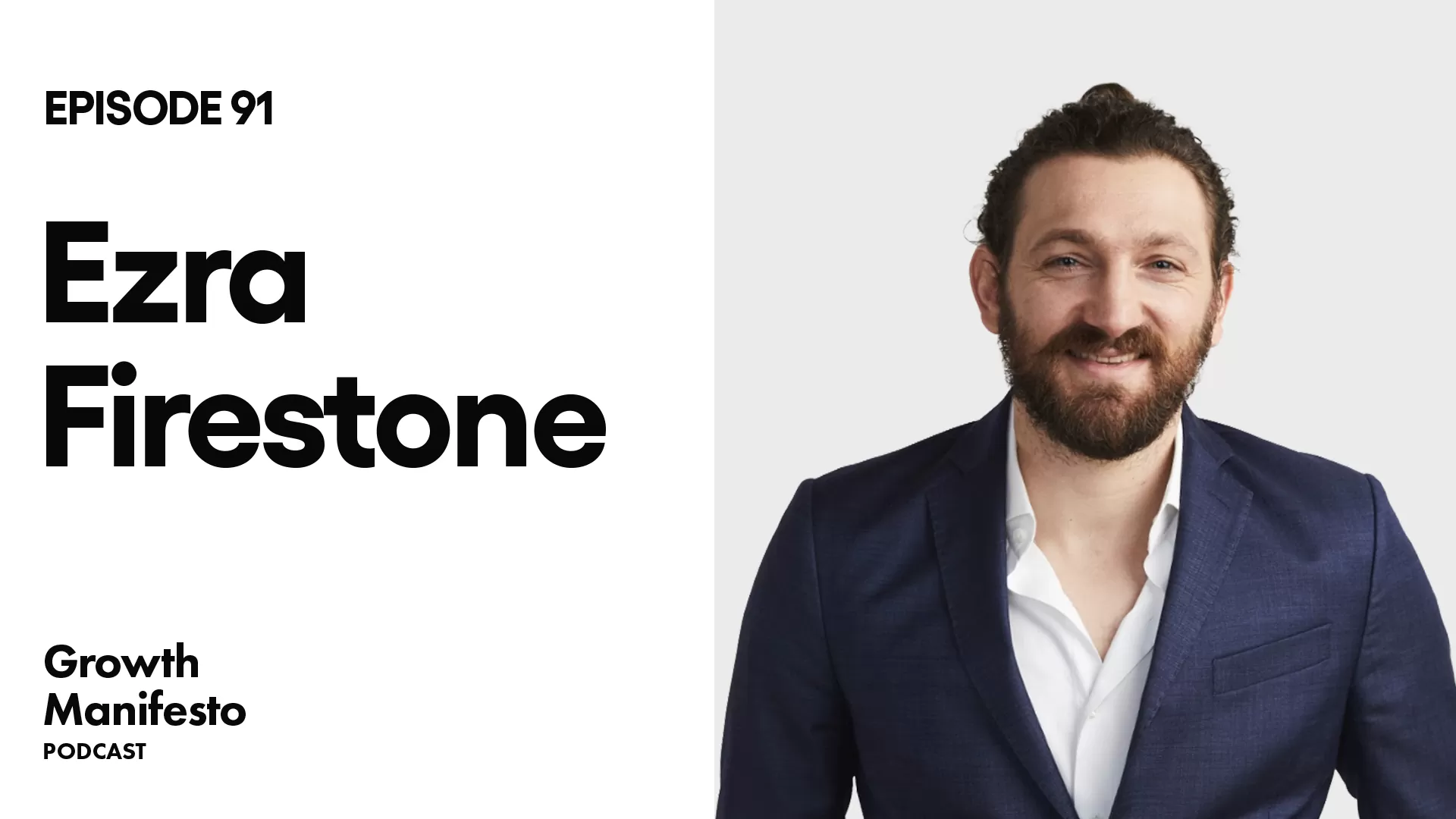
Ezra Firestone breaks down how e-commerce brands can win on promise, creative and lifetime value despite tougher ad targeting and rising costs since 2020.
 with Ezra Firestone


Overview
In this episode we talk with Ezra Firestone – Founder of Smart Marketer, Zipify Apps, and Boom! by Cindy Joseph, and one of the leading ecommerce marketers in the world – about how to scale up an ecommerce brand.
Key takeaways
- The best promise wins in the marketplace, not the best product, and the product's only job is to live up to what the marketing promised.
- Lifting average order value, purchase frequency and customer count by 30% each can roughly double a business's revenue.
- User-generated content from real customers remains his strongest source of ad creative, ahead of in-house or agency-made video.
- He runs a sale or product launch about every six weeks to keep the brand engaged, and rarely discounts by more than 20 percent.
- Marketing spend above about 35 percent of revenue signals a business heading toward failure, alongside cash flow and inventory mistakes.
Chapters
- Intro: state of e-commerce in 2023
- Ezra Firestone's journey since 2007
- Why the best promise wins, not the product
- The Apple vs Facebook ad war
- The Boomstick Trio promise example
- Turning customers into ad creative
- Growing lifetime value through three levers
- Five foundations every e-commerce brand needs
- Daily metrics and using ChatGPT for research
About the guest
Transcript
Auto-generated from the episode audio, so expect the odd mis-heard word. Timestamps open the video at that point.
It's actually easier now to learn the blocking and tackling of how to operate a business, but the landscape is a little more competitive and there's some unique issues facing the e-commerce market that are macroeconomic in nature. You're listening to the Growth Manifesto podcast, where we host in-depth interviews with business leaders, authors, industry experts, and entrepreneurs with a singular focus around business growth. At the end of each podcast, we want you to walk away inspired, to think bigger, and to have actionable takeaways you can apply to improve your business.
Each episode is like a masterclass on a key topic. So make sure to browse the episodes to find the topics that are most relevant to your biggest business challenges today. This podcast is brought to you by Web Profits, a digital growth consultancy that helps challenge your brands drive growth in a complex and fragmented digital landscape. You can find out more about Web Profits at webprofits.io. Now, let's get into it. This is Alex Kleanthus and today we're talking with Ezra Firestone. He's the founder of Smart
Marketer. He's the founder of Zipify Apps and he runs an e-commerce store called Boom by Cindy Joseph. And he is one of the leading e-commerce marketers in the world. And like we know now from the pandemic times that e-com is big and e-commerce is huge and basically all the brands are trying to get their e-commerce strategies working. But what that means is that it is getting more competitive than ever. And the level of sophistication in e-commerce marketing has just stepped up significantly in the last three years. So in this episode, we'll be talking about
the biggest opportunities for e-commerce in 2023 from one of the leaders in the world. And so I'm excited about this conversation because I have consumed a lot of Ezra's content. He gets very specific on execution for e-com and I'm going to try to put as much content in this 30 minutes as possible. Yeah. So with that being said, hello and welcome Ezra. Hey, happy to be here. Thanks for having me on the growth manifesto. Yes, brother. All right, of course, let's get straight into it. So for the people who don't know you, can you quickly share e-commerce journey, which
you've been on since 2007? Yeah, I started e-commerce way back in the day, you know, out of a small apartment on the Lower East Side of Manhattan. And this was before the iPhone, you know, this was before e-commerce was like really a thing. And I was fortunate enough to get started all the way back then. And through the years, I've kept doing it and I really love it. And I've this point have over 200 employees. I've had hundreds of millions of dollars in sales. I sold a brand for a very high eight figure sum. And I've just kind of traveled the path from do it yourself entrepreneur to small business owner to medium sized business owner to now pretty large
business owner and, you know, made a lot of the mistakes that you can make along the way and had a really good time doing it. And, you know, I'm considered one of the if not the best e-commerce educator in the world. And I really enjoy talking about e-commerce, talking about marketing, sharing what's worked for me. And I've been really, you know, it's been a cool journey. I've been blessed to have it and I'm happy to talk about it. Yeah, fantastic. And we're going to get into all that stuff. And just quickly for anyone who's just started listening now, you should subscribe and you should purchase all of his stuff. I don't get paid anything for this, by the way, but it's just really, really good, especially if you're
trying to get the edge in e-com. Anyway, I'm not pitching. So can I say, let's start with this, right? Because 2007, we're in 2023, that's 16 years now, right? How much has e-commerce changed in that time? And then how much has e-commerce changed even in the last three years in terms of what works? So the technology has changed, right? Like back in the day, you had Yahoo Store and OS Commerce and XCart and ZenCart, and you didn't have Facebook, you didn't have Instagram, you didn't have YouTube, you didn't have TikTok. All you had was Google search, search engine optimization and Google AdWords, like the technology that you use to host and deal with your customers
has changed, host your store and deal with your customers and visibility sources that you leverage to generate awareness have changed. But the fundamental sort of building blocks that it takes to be successful in e-commerce have not changed. You need to be able to make a really wonderful promise because what wins in the marketplace is the best promise, not the best product. The job of the product is to live up to the promise that you made. But people are buying the promise. People are buying what the benefit of owning this product is going to do for them. And if you can get really good at marketing, and that is videos and assets that generate awareness for your brand and sales processes like sales funnels, pre-sell articles, landing pages, opt-in pages, sales pages, if you get really good at generating awareness and sending someone through a sales process and supporting them along the way with things like live chat and things like FAQ and kind of all the stuff it takes to generate a sale, you still need to be able to do that.
And then you also need a product that is actually really wonderful and that will live up more than live up to the promises that you made so that you can get yourself a happy customer and convince them to come back and buy from you again because they like the products. and marketing sort of extends to the post-purchase experience, the pre-arrival email sequence, the customer support, you know, letting them know automated when their product has shipped and when it's arrived, the upsell and cross-sell educational email sequence, like your, you know, the sale events, the live events, all that kind of stuff that you need to be doing
as an e-commerce merchant. If you are best in class at direct marketing, so advertising, video ad creative sales funnels, and you understand product development and you understand how to support a customer, which is you needed all that stuff back then as well, you will still be really successful in this environment. Now, in the last three years in specific, a lot has changed. And I will talk to you about that in just a second, but that's kind of like high level. The technology and the visibility sources are different, but the fundamental skill sets that you need to be successful, you needed back then as well, right?
And you still need them today. And hey, there's different techniques. Today, there's a lot more places to develop products. It's a lot easier to develop a product. There's a lot more resources to support you in marketing. There's a lot more education around how to do marketing well. It's actually easier now to learn the blocking and tackling of how to operate a business. But the landscape is a little more competitive. And there's some unique issues facing the e-commerce market that are macroeconomic in nature that have happened in the last three years. Happy to go into those now if you want. Yes, please. Yes, please. Okay.
So, you know, COVID happened and everybody was stuck inside. and the usage of the digital medium like spiked all crazy and nobody could go to the everyone was afraid to go to the grocery store and you didn't know if this thing was going to kill everybody it was wild and so e-commerce got a bunch of users that weren't e-commerce users before a bunch of the baby boomers who didn't buy stuff online started buying groceries online started buying a lot everyone was spending more time on the internet spending more money on the internet and new users were coming to the internet to buy stuff that weren't previous purchasers of things
online. Then fast forward to now, the pandemic is over in terms of people are out and about and the e-commerce usage, you know, and everybody bet, by the way, that e-commerce usage was going to stay. It was like 17% of total retail sales before the pandemic. It spiked at like 26% of every dollar spent in America was spent online. And then now it's dropped back down to like where it was, but Shopify and all these big companies bet that internet spending was going to stay at post pandemic levels. And it didn't. And they're kind of in trouble because of that. They had to fire a bunch of people and all that kind of stuff.
But in any case, so basically people are going out now into the world. They're sort of like spending less time on the internet because the world is reopened. Some other factors that are the thing that is most thoroughly affecting the e-commerce market is a battle for ad revenue between Apple and Facebook and Google and TikTok and every other network. So Apple owns the hardware, right? Apple owns the device. Well, it used to be that Facebook, Google, TikTok, when somebody was consuming on the social network and then they clicked an ad and went to the website, Facebook could read all the data, what happened, what pages they visited, what products they looked at, what they bought, what they didn't buy.
Well, Apple said, hey, guess what? This is really valuable information. And we own the device. So we could actually stop you. We could wall you from seeing what happens once they leave your platform. We think we're going to do that because what that's going to do is going to make you much less good at figuring out what somebody wants to see next, who to target for an ad. And basically what Apple successfully did was cut the knees off of Facebook in particular's advertising business. Now, you're going to see in a year or two, Apple's going to open up their own ad business and leverage all this data under the guise. They did this under the guise of privacy. Hey, we're going to make it better for everybody.
We're not going to let them have your data. Meanwhile, they want to use the data themselves. So in any case, the point is that advertising has gotten a lot harder because the main ad self-serve ad platforms that e-commerce businesses use, such as Google, such as Facebook, such as Instagram, which are the same thing, Facebook and Instagram, such as TikTok, such as Pinterest, such as Snapchat, have gotten dumber at figuring out who is going to be interested in converting. And that's a factor that has really affected pretty much every brand on the Internet. Second thing is consumer spending has dropped since COVID.
People are going outside. They're not spending as much. Third thing is in the pandemic, our government here in America printed like six or nine trillion dollars of which who knows where any of that went. I think they were able to track down like where like a trillion went. The rest of it got gobbled up by who knows who. But in any case, what that did was it created like a crazy amount of inflation. And that inflation has really screwed with people here in America. And people are now freaked out about where like they're feeling that the squeeze a little bit. So there's just people are like we're entering a recessionary period because money's not worth as much as it was.
And people are a little freaked out in terms of consumer spending at this moment. Add on top of that, an additional macroeconomic factor is that Russia went to war with Ukraine, which had several ripple effects, one of which was increased fuel costs. And by the way, the pandemic disrupted the global supply chain. So bulk material, like I make cosmetics, my bulk material for mixing up lip gloss has gone up 20% in cost because their cost to ship because of the fuel increase has gone up. The timeline that it takes to get something has increased like six months.
So you have basically increased cost of fuel and increased cost of goods. You have lower consumer spending. You have less effective digital advertising networks. You have scared, I think I might have already said this, scared consumers. And then there was one other metric that I mentioned. I can't remember what it is at this moment. But the point is you have all these factors that have like layered together to make it a pretty hard time to be a e-commerce business owner because your cost of goods are going up. By the way, because of inflation and because everybody's feeling the squeeze, everybody
on every team wants a raise. So you've got your overall salary, which by the way, you should give your people raises at an appropriate rate whenever you can. But just to keep up with inflation, people need now raises. So it's like your team salary is going up, your cost of goods is going up, your cost of shipping is going up, and everything that was supporting you in being an effective business that sells products has gotten less good. So it's a little bit harder of a time. That said, as in any period of time, the best products, the best – first of all, the best ad creative, the best sales processes are still going to win, and the best products are going to prove themselves out in the marketplace.
And so your job is to create a kick-ass sales process and make a really wonderful product and run your business super lean. And maybe, you know, because margins really are what are going to dictate. Like if you have a product, if you're selling like super high average order value products, like, you know, let's call it fancy expensive leather goods that are 300 bucks for a wallet. It's like it's kind of a tough time to be selling luxury stuff because people feel like they have less consumer spending for luxury items if you just look at the trends. Also, if you have products that are really low margin, it's hard because margins are getting compressed.
Everybody's getting squeezed. So you probably want to stop giving away free shipping. You probably want to raise your prices if you can. You probably want to look at everything that you're spending in your business and cut out all the non-essential. Like you want to run lean. Thank you for that. And I think that frames the conversation, right? And I like what you said about some of the challenges. But I also like how you said it's best product, best system, the best creative wins. And I want to jump into all those shortly. You talked before, and I just want to quickly just talk about this part, right? You talked about, it's about the promise.
Not about the product, but the promise, right? And so what's an example of a promise where that is the thing which you are putting everything kind of behind in terms of your marketing, in terms of your brand and so on. It's what's an example of a promise. Hopefully you're making more than one promise. Okay. You should have a bunch of them. but take as an example, my product, my core product called the Boomstick Trio. It's three cosmetics. And our sales pitch there is your entire cosmetic bag in three simple sticks.
What we know about our consumer is that she doesn't want the same makeup routine that she had in her twenties and thirties, but that takes forever with a hundred different products. She wants something simple. She wants something easy. She wants something that is going to celebrate her and have her feel really good about herself, but be easy to apply and quick. So that is a promise, right? We're saying throw away your entire cosmetic bag and get these three things and you will have everything that you need. We have a bunch of other promises that we're making as well, you know, like our pro-age versus anti-age philosophy and how when you buy our products, you're adopting a mindset that is counterculture.
We have sustainability promises that we're making. We have animal cruelty promises that we're making. We have money-back guarantee promises that we're making. Like your overall aggregate promise is everything that it takes to get someone to buy from you. But within that, you've got a bunch of different promises that you're making. But the idea is, do you understand who your person is, what's motivating them, and why they're buying something in this category in the first place? And if you do, you can create a compelling story around that hopefully, by the way, is true. If it's not true, don't make the promise.
But, you know, around what you're selling to fit where they're at and solve their problem. Yeah. Thanks for explaining that one. That makes sense. And the next part is that you mentioned it's good if you can understand both the marketing side of things and the product development side of things. And I'm assuming, correct me if I'm wrong, is because you want to start with the customer first and create products that they want. Is that kind of how you think about it? Well, what I mean by that is that a lot of people do not innovate in the direction of product. They like white label something someone else has. And it's not much different.
And every bum on Amazon selling the same stupid blacklight flashlight. life. It's like you want to get good at iterating and developing product within your market in relationship to the desire of your consumers. Yes. But separate from that, because also outside of the desire from your consumers is your own research of what's missing, you know, from what's missing from the based on all the Amazon reviews from every competitor that you fed into chat GPT to figure out what people don't like about these things. What should you be adding to yours? So So you got to get good at developing product and iterating on product because product is
never finished. You're never done. You always want version two, version three, version four, continually making it better. And you want new products to upsell and cross sell to the people who bought one thing from you. So if you invest in the ability to develop product, you'll have a much longer life cycle in business because you'll always be making your product better. And you'll always be introducing new things for people to buy from you who like your first product. And a lot of people never get good at this. And it ultimately hinders their ability to be successful. So really we're talking about establishing an e-commerce brand, right? And the brand actually has a promise and then it develops products and continues to innovate
to serve its customers and continue to strengthen the promise that it has. Is that a good kind of way to think about it? One product to start, right? What is the one thing people are coming to buy from you? And what's the promise that you're making around that? and how did you make that the best possible product in that category? You gotta start there. And once you have that, okay, great. Now you can add on other stuff, but it's like, you gotta figure that out first. What is my hero SKU that people are coming to me to buy? Now, if you're a fashion brand, it's not gonna be that way because you're gonna be doing seasonal.
It's different based on your business model, but that's a fair assessment for certain brands, maybe brands with a thousand SKUs that are like automotive retailers or something. But for folks who are doing the kind of like D2C, disruptor style, low skew brand, you want to start with one item. Yeah, fantastic. And then there's so many parts and I'm trying to keep it condensed, right? But you talked about creative, right? And we know creative is important, and it's the differentiator and assuming the strategy is right, and there's a brand there, a good product, and you know your
market. What's your approach to developing creative that performs consistently? So the best thing that you can do to start is to use your customers to get creative for you. This is called user generated content. And it was really popularized in the last, let's call it seven or eight years. It's still the best content that we get for all of our ads. And that's your customers genuinely expressing how the product changed their lives, what benefits they get from owning the product, how they use it, what people think about them. We have this one ad running and it's like,
my husband came home and said, I can't remember the exact copy, but it's basically like her husband complimented her for the first time in 40 years or something, which is kind of sad when you think about it. But in any case, you know, she had some impact on her husband. She had some impact on her husband by wearing our products. And it was like, I think, I think that the ad opens with my husband said, Oh my God, or something like that. But the point is that, you know, if you can incentivize your customers to give you a video asset, that's your best initial ad creative. And then you can edit that together with product demonstrations and edit that together with voiceover and edit
that together with creative that you make in-house or that you pay an agency to make for you. But ideally, you know, face to camera, user generated or influencer. If you're paying, if you don't have any users, you don't have any customers, you can pay influencers. You can use platforms like Grim and platforms like Maverick and platforms like it's actually Grin with an N to find influencers who you can hire to make videos for you. But those are going to be the most efficient ways of getting initial ad creative. And have you got a general approach in how you structure the ad creative?
Like if it's going to be like a video, it's like this, or if it's going to be aesthetic images like that, like, is there a process which you follow or is it just flexible? And it's about value. We have a ton of different ad creative formulas and there's a bunch on the Smart Marketer blog. Our Love Demo Love formula is one of our most successful, most popular formulas that's sort of been adopted by the marketplace, opens with a face-to-camera customer testimonial, goes into a demonstration of the product being used in its intended environment, closes with a face-to-camera customer testimonial. That's a high-level overview of it. I got a whole pre-sell article.
If you Google Ezra Firestone, love, demo, love, you'll find it. But we've got a bunch of formulas we use. Great. And you talked about the influencer side of things, right? And I've had all types of experiences in terms of influencer style campaigns, and some have been successful, some have not been successful. Depends on the influencer, depends on the product, depends on the size of the influencer and so on. What's your approach to leveraging influencers? How do you approach the investment? And what do you look for in terms of a strategic approach?
Well, obviously you want to use influencers, that is. Yeah, we do. So I bought a brand called Overtone about a year ago. It's an eight-figure e-commerce brand that does semi-permanent hair color for people who want to dye their hair fun colors. And we use basically exclusively influencer content there. And, you know, we use a platform. I think we go back and forth right now. We're on Maverick to source and find our influencers. We give them really deliberate creative briefs. We look at their, you know, their reels and their category, their library of content to decide if we want to use them based on stuff they've made in the past. And then we pay them a usage fee and a creation fee to make videos for us. I mean, it's pretty straightforward with these platforms today.
You want to start small, start with people who are not that expensive. Ideally, you're getting four to six videos a month to start so that you've got some assets that you can edit together. You've got, if you have a bunch of products, like we have to decide, okay, we're promoting this color in April. We need to get assets together in January that we're going to be able to use. So there's a bit of a creative strategy to it, but high level, we just find people we like and pay them to make us stuff. I mean, it's not that complex. You don't care about them posting the content to their page. Sure. They'll do it and rock and roll. What you care about is using those assets to run as ads for yourselves.
If you're doing an influencer program where you're manually reaching out to people, we do this at Boom, you find people, you follow hashtags, you manually reach out to them, you DM them, you ask them if you can send them your product, you build a relationship, you try to get them to post. That's different and that takes longer. And I think people are just starting an influencer are probably not going to do that. So I think you start with the paid services. Cool. Hire an influencer, they create the content. Who cares how big their audience is, right? I mean, of course, it's helpful if they can actually produce a sale for you. But that's not the point.
The point is it creates content like the UGC style content. It's somebody else who's talking about it and they have some influence. And so now maybe, you know, so you can leverage that influence as well. That you can then use to run as ads. And do you access their shared audiences in Facebook and, you know, promote stuff to their bands and so on? Or is it just about the content only? And when you're hiring influencers? Yeah. Yeah, because some influencers, they can share their audiences, I mean, sort of meta, and then it's possible to target their audiences.
So that strategy worked really well. That strategy worked really well in like 2016, 17, 18. Now it's a lot more expensive to get people to post on your behalf. We are doing a little bit of that, but mainly what we're doing is buying content that we can then run as ads ourselves. If you want to pound the pavement, like I was talking about, build relationships, you can definitely do that too. A lot of brands do really well with it. It's just not one of our core strategies. Yeah, fantastic, fantastic. One of the things that we've been focusing on, especially in the last 12 to 18 months, is increasing the customer lifetime value. So having strategies where increasing the retention rate and the frequency of spend and monetary value and so on.
How much are you investing in that side of things compared to just acquisition only? There's three ways to grow a business. Increase the amount they spend with you, so your average order value. Increase the frequency of purchase or increase the number of customers. So more new customers spending more with you, how quickly they buy. If you can increase each of those by 0.3, you've doubled your business, right? 30% more new customers who have a 30% higher average order value who reorder 30% more often. So we're working constantly on all of those things.
And the way that we end up with reorders is we run sales and promotions and product launches. We've got five or six pieces of content going out every week to keep our community engaged. that this is a social media strategy to keep folks engaged in between when we have sales and offerings. We think of ourselves as a media company where we're communicating with a group of people over time about a collective experience that they're sharing. And we're doing so through content to keep them engaged. And then, hey, we've got a sale on our best sellers or we've got a sale on this category of products or, hey, we're launching a new product. And so the way that we get high LTV
is by creating high engagement consistently and then making offers once every six weeks. once every six weeks is kind of how frequent the offers are. Is that right? Six to eight times a month, a year, you run a sale or you do a product launch. And there's a lot of discussion out there on relying on sales and how that affects the brand and so on. Yes. What's your experience of, you know, leaning into sales to get the sales happening, right? Or into discounts to get the sales continuing all the time.
I'd love to know your thoughts around that because everyone has, you know, differing opinions on if sales are good or not, if it affects the brand or not, if it devalues the brand or not. Yeah. So I'd love to know your thoughts. I think the people who say don't run sales are confused and don't understand retail. I'd say 95% of brands out there discount their items. You have too much inventory of a certain item. It's going bad. And so you need to sell it now because it won't have another six months shelf life. And even the brands that claim they don't do it, end up doing it. So this whole, like, should I, it does running a sale devalue my brand. I
I think that's just a misguided and silly question, silly assertion that it will devalue your brand because clearly it won't. Now, if you are like JCPenney and you're just doing 60% discounts every day on everything, well, yeah, that devalues your brand, but it's a spectrum, right? And we don't ever discount more than 20%. That's the highest discount you'll ever find on any one of our brands. Maybe we'll go to 25 on Overtone, but not on Boom. So you don't have to do big discounts. You can do buy one, get one merchandising. You could do buy more, save more 10% when you buy 75, but 15 when you buy 120, when you buy 125.
So there's different kinds of merchandising that you can do during your sale events. When you land on someone's site, generally, the welcome pop-up is a 10% discount. So that's kind of like a static across the board. Discount strategy is sort of a welcome pop-up. But when we launch a new product, we don't discount it. We run a product launch and you just buy it for whatever it is. But then if there's a holiday sale six months later, that product, and then that product's in stock, you'll be able to get it for a discount then. fantastic thank you for sharing that yeah yeah and you know you got to just not discount too high and not run sales too frequently every six weeks is about the standard which you go for which is
i like that kind of that pacing which is uh which is good enough to create the creative and offers and just even just the flows of yeah just like all the activity that has to happen between the sales so i like that that's good there are so many channels and tactics and all these types of things that are available to econ brands these days but at the same time there are some things that haven't changed as well for the past 10-15 years right and so what would you say are the key areas that every e-com brand has to get right as a foundation before they start experimenting on
the more innovative areas you know and so i'd love to know the core foundation of things which you say these things you got to get right before you start experimenting with all this other cool fun stuff i don't really look at it that way the way i look at it is you have to do marketing well in any business. Marketing has to be done well. This is generating awareness, generating engagement, convincing someone to say yes to what you have to sell. You have to do that. Two, you have to get product right. Product is the experience of receiving the product,
the packaging, the componentry, how it works. If product doesn't live up to the expectations, you're fucked. Three, support. You have to do support well, which starts all the way before, starts at pre-purchase and goes all the way to after they've bought everything from live chat to email to FAQs and all that kind of stuff. Then you have to get systems and process as well. Because if you don't have a set of consistent systems and processes that you're using in your business, we send out a blog post every week. We update our ads. We monitor our ads and are
refreshing creative once a week. We have a weekly team meeting, stand up 15 minutes in the morning. Everybody goes over there. I'm talking as if you're a small team at the moment. We communicate in Slack and we house our files in Google Drive and we run our meetings on Zoom and we use Trello as our project management system. Like if you do not have systems and processes down, you'll just be running from one thing to the next. Nothing will ever be organized. Get yourself a good project manager. Five is money. People go broke because they mess up the money. They don't understand cash flow. They don't understand inventory carry. They don't understand taxes.
They don't understand how to read a profit and loss statement. So those are the five things that you have to do well. And if you do those well, you'll be successful. If you do any one of those wrong, you'll fail. Thank you for that. I'm going to push you a little bit now further into the marketing space. Now, okay, talking to the marketing side of things, if you're doing that well, you know, like are there areas which you would say you always have to get these things right? Yeah. Or these are the channels which if you can't make these channels work, it's not going to work. So if you can't get top of funnel acquisition to work, you don't have a business.
top of funnel acquisition is essentially at the highest level, a piece of video creative and a landing page. Those are kind of the two things, the minimum that you need there. And in a pre purchase email sequence, like an abandoned cart sequence and a hot list sequence and an SMS capture and a good product offer. So a bundle or something that get your AOV up your pre purchase upsell sequence, your post purchase upsell sequence, all that kind of stuff. But if you're not able to convert a customer, your business goes nowhere. You have to be able to acquire customers. I mean,
that's it. And by the way, there's not a lot of ways to do that. You can go out and buy customers through paid ads on YouTube, Instagram, Facebook, TikTok, got to get one. And that's what I'm talking about. Or you can do SEO takes a long time is a little harder to do is less scalable, which is going out and writing articles and trying to rank in Google for different queries, or you can have word of mouth, or you can get some kind of amazing press, maybe you hire a PR agent, and they go out and get you on TV shows and news articles and things like that. Or you can pound the pavement with influencers
and get them to post about you. But the fastest way is to buy visibility for your brand. And you look at every eight-figure brand, they're buying visibility as their core ingredient for generating awareness. Yeah, that's fantastic. And I mean, I agree with that as well because you kind of need to put something in front of people on social media to create the volume of sales to actually scale. And that's the thing which you just explained a second ago, which you just explained a really sophisticated first step, you need the creative that will get the first purchase. And to get that person to spend, there's like a few foundational
elements in there in terms of the sequences, automation, and so on. But the creative, the targeting has to work. I really liked that approach. And I'm just going to ask you just one thing on metrics. And this will be just one of our last questions. What are the metrics which you look at across the board every single day is what are the stats which you kind of just live by? There's a lot of different stats you should be monitoring for your e-commerce business, but your overall net sales by channel, net sales from your Shopify store, net sales from your Amazon store, net sales from your retail, your average order value by channel, average order value on
your Shopify site, average order value on Amazon, the percentage of discounts that you've given in a given week. So, you know, did you all of a sudden as a percentage of your total revenue discount 20%. Where did that come from? So you got to be monitoring that percentage of new customers versus repeat. So if you, you know, if you're doing 80% of your revenue from repeat customers and only 20% of your revenue from new customers, your business is slowly dying because you don't have enough new customers coming in to fund the future. So percentage of, of, of, of total revenue from new customers and percentage of total revenue from repeat customers, your spend as a percentage
of marketing. So let's say you made a hundred grand in revenue. You can't really afford to spend on advertising on Facebook and Instagram and everywhere else, more than like 35% of that. So 35 grand, if you're going to have a profitable business. So if your spend as a percentage of revenue is like 40 or 50%, you're going to go under pretty quick. Your spend by channel and your ROAS by channel. So your Facebook expense versus how much you made back on Facebook, your Google expense versus how much you made back on Google, and then so on and so forth down the line for every channel. Yeah, great. Thank you. And look, final question, because something which
you asked at the very start, you said ChatGPT. And you know, that's something I'm pretty much investing quite a lot into right now. How are you leveraging ChatGPT high level across the stuff which you're doing? To parse big data. So for example, we'll put like, we'll feed 100,000 reviews for our product in there, and then query it, ask it questions about what people like, don't like how to make it better, have it write articles for us or, you know, give us prompts for headlines based on the feedback of what, you know, so we use it for marketing and for product research. We'll do the same thing with our competitors. Yeah, right. And has it actually
helped significantly? Or is it just like something that's kind of nice to have, but it's not really? I mean, it's really useful, because you couldn't parse 100,000 reviews and get the data out of it. Great. Great. Awesome. Okay, Ezra, thank you. I think we're at time. I think we've gone over by a little bit. This has been such a great conversation. Thank you so much for coming on the podcast. For people who want to learn more, how do they get in touch? Or where can they just get some of your content or where can they start to subscribe and just hear more from you? You can find me on every network at Ezra Firestone. You can find my blog, smartmarketer.com.
I got a, if you have a Shopify business, I have a brand called Zipify apps, which is software for Shopify stores. But you just Google me. I'm around, I'm on whatever platform that you're on probably. And you know, let's connect. Ezra, what a great chat. Thank you so much. Congratulations on all the successes and really had fun in this conversation. So thank you so much. And we'll talk soon. Thanks for listening to the Growth Manifesto podcast. If you enjoyed the episode, please give us a five-star rating on iTunes. For more episodes, please visit growthmanifesto.com
forward slash podcast. And if you need help driving growth for your company, please get in touch with us at webprofits.io.