MarketingEntrepreneurshipLeadership and culture
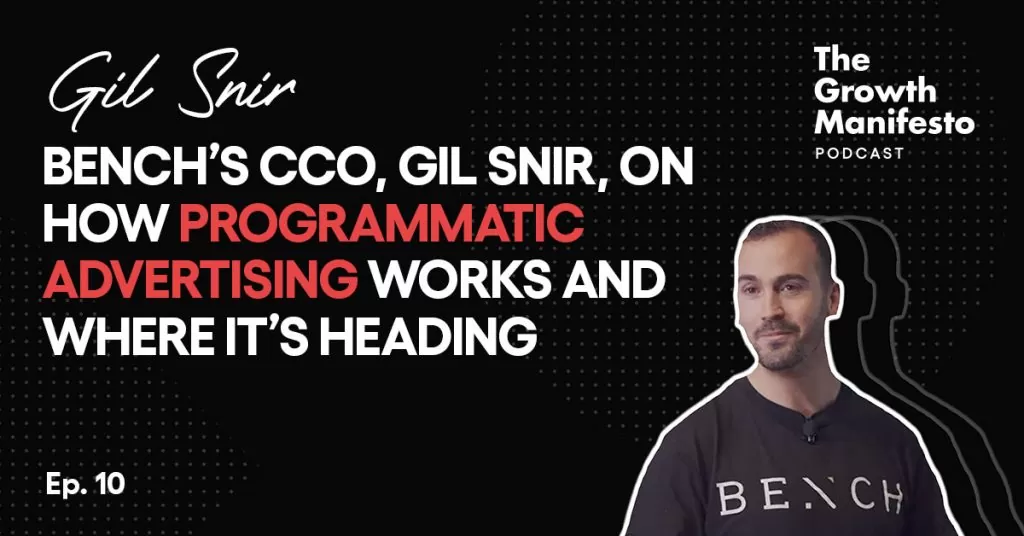
Bench’s CCO, Gil Snir, on how programmatic advertising works and where it’s heading
Bench co-founder Gil Snir explains how programmatic advertising works, from ad exchanges and brand safety to a FIFA World Cup campaign with SBS.
 with Gil Snir


Overview
In this episode, we interview Gil Snir. Co-founder and chief commercial officer at Bench, one of Australia’s fastest-growing programmatic advertising companies. This episode is all about programmatic advertising – how it works, how to use it in your business, and where it’s going in the future.
SHOW NOTES
across different platforms programmatically. 00:40:00 Fifa SBS Case study deep dive 00:44:58 Advisory position and Gils thoughts on advising. 00:52:00 Tough conversations 00:55:10 How do you communicate at Bench LINKS
—
Key takeaways
- The marketing funnel framework traces back about 120 years to a campaign that convinced the public that vaccines were safe.
- Brand safety in programmatic buying now runs on pre-bid technology that scans and whitelists publishers before an ad is ever served.
- Small businesses should exhaust existing-demand channels like search and email before spending on programmatic display, which typically needs at least $10,000 a month to work.
- Bench's FIFA World Cup campaign with SBS fed live match scores into ad creative within two hours of a game finishing.
- Founders build resilient partnerships by having the hard conversations early and sharpening disagreements instead of smoothing them over for the sake of harmony.
Chapters
About the guest
Transcript
Auto-generated from the episode audio, so expect the odd mis-heard word. Timestamps open the video at that point.
You're listening to the Growth Manifesto podcast, brought to you by Web Profits, where we share inspiring stories of real people who've succeeded in the marketing and business world. Today we interview Gil Sneer, co-founder and chief commercial officer at Bench, one of Australia's fastest growing programmatic advertising companies. This episode is all about programmatic advertising, how it works, how to use it in your business and where it's going in the future. So if you're interested in learning about how programmatic advertising actually works,
this is the podcast episode for you. So let's get into it. Hi, Gil. How are you? Hi, Alex. How are you? Very good. Please include this in part of the podcast intro. Gil, you're good at this. You've done this before, haven't you? I'm leaning into the mic. That's my strategy. Everybody says you've got to lean into life, but you know what? Once you lean into a mic, I don't know where that comment's going. Everything changes. Everything is.
The world can hear us and we're there to be judged and inspiring. You know what today is all about, Gil? You'll like this because you're quite an inspirational person. The whole idea of the Growth Manifesto podcast is to inspire other business owners or leaders in their field. So hopefully what we're going to get today, and I know I will. I've looked at your resume. I've looked at your website, your LinkedIn account, and you are really, really impressive. So I'm pretty sure we'll get some good stories out of you. Let's hope. I know. Here we go. Gil, the co-founder and the CCO of Benchmarketing.
Welcome. Thank you. Good to have you on board. Alex, how are you, mate? I'm good, Tony. How are you, mate? Very, very good. I'm extremely good. I did my TEDx talk the other day that I was pretty proud of. And for the listeners, what was the talk about? Okay, the talk was basically how to create true connections by becoming more vulnerable with yourself so you can become more vulnerable with others. So it was well received. I'm pretty excited about it. A lot of good work went into it. Got a lot of feedback, positive feedback from people writing in and wanting to connect and do some work around that.
So it was good. Awesome. That's great. That's great. And so that's the first step. The next step is talking at TED. TED Sydney. TED Sydney. That's where we're at, baby. That's the next goal. So watch this space as we say here at Web Profits. Yeah, I've already lined that up. Have you? As soon as I got off that one onto the website, I go, what have to do? Straight away. Yeah, yeah. So hopefully that will come. But I'll just keep on pushing because the message is good. It's around men's mental health, really. Awesome. How we open up as guys and the struggles. Very important. Yeah. But I talk about it from my point of view of the struggles that I had
and how I related that to my life and how I've hidden behind being, you know, a background in psych and also a coach and everything like that. I'm the fix-it guy. Yeah. Right? And then I discover I'm the fix-it guy. I never talk about my problems, which creates a disconnect straight away. So it was, yeah. That's great. Yeah. That's great. And congrats because I know how much prep, well, thought about prep actually went into it. Well, I'll tell you this. Alex loves this bit because we do some presentation skills coaching around that.
And Alex just thinks you can write a script and get up there and do it every day. Not anymore. Not anymore. Not anymore. Yeah, so we met because basically he has like a number of skills and one of them is a presentation coach and so that's how we met and then we ended up becoming friends and then we started a podcast together and so yeah, it's cool. I remember a couple of years ago I did a course at NIDA for public speaking and the person that was taking it said, I get shocked every single time I meet executives who have the confidence,
bravado or whatever it is that they think they can perform on stage their presentation for the first time to an audience and get it right and him having an acting background said we rehearse hundreds of times yeah to get that show right um and you guys think you can do it first time yeah was it a good course it was really good yeah yeah yeah well i thought i could do it the first time and he was like so um that's not really how it actually goes you actually have to practice things in life to be good at them. But somehow we think we can just stand up and just talk and we're going to be fine at it.
Yeah, it's definitely a false expectation. Yeah, and that's with me with a stutter as well. So I was like, seriously. So he helped a lot, actually, which is great. No, it's good. Look, I put into perspective for you, Alex, and I'll do this for you. 15-minute talk, 40 hours worth of work. Yeah, wow. Yeah. Okay. And that's changing a lot too. You would have experienced this at night. You'll come out with your original concept and you get feedback and you just keep on chopping and changing as you go and your story just goes on this own journey of going, oh my God, and I'm actually writing a journal blog at the moment
of where the TED Talk started to what it became. Right. And it's totally different. Yeah. The most important thing is, you know, practice but also practice in front of an audience, particularly an audience that's going to be open enough to be critical with your content. Yeah. And really tell you if it's engaging or not. Yeah. I'm lucky because my wife is ruthless in that regard. I practice, I intend to practice every time in front of her and, yeah, she will tell me exactly when she's switched off
because the content's boring. So, yeah, I've got a very good berobter of whether I'm on point or not. Are you a sensitive person? Well, I've learnt not to be as sensitive with her because the feedback can be quite critical. So she conditioned you up. She made you stronger. 100%. Yeah. I know, but feedback's really important. I want to get onto benchmarking because you've got an amazing journey here. And I'm guessing it started somewhere and you would have gotten some interesting feedback
along the way. So what was your journey? Yeah. So I started the company with my two co-founders, two guys, Shai and Ori, in 2012. When we started the company, all three of us came from very different areas of marketing. So we had Shai, who came from client-side roles at Telstra and Optus, some of their subsidiaries. Ori, that was very much a technologist in the early days of advertising technology in Israel. And myself, who sat primarily on the publisher side, working at a company called Online Marketing Group that eventually got acquired by Fairfax,
dealing with about 30,000 different domains and the network that they were managing. So we all came from very different areas with a single purpose, which was to try to make technology more accessible and to allow brands in Australia to catch on to the growing demand for this thing called programmatic, which was a very early days concept, which not many people knew about. If you do a Google Trends search for the word programmatic in 2012,
you'll see it's a tiny little sliver of a bar chart, whereas obviously now it's much bigger. Yep. Alex is... Yeah, yeah. So just a quick one. Tony, do you want to talk about your learnings around programmatic? Yeah, I Googled it. Okay. I Googled it. Great. It's good. Something I'd be using in the future. There you go. That's a good summary. Gil, where did you start before this place?
Because I kind of preempted you that I kind of wanted to hear about some of maybe your failures, some of the things which you tried in the past. And I think because I've done a lot of stuff that's failed, and I talk about that constantly. But I mean, had you tried something in the past, like entrepreneurially that had not succeeded? Or was this like your first time starting a business like this? Yeah, so I guess I was lucky in the sense that I started business at a fairly young age. So I went to uni and during university I was working full time managing sales floors for a telco distributor
and then moved on to the role at Online Marketing Group which was a part of the Fairfax Network. About three months after graduating university I started Bench. so this was my first proper venture. In earlier days I did foray into e-commerce so I think I would have been about 18 when I started my first business which actually was interestingly enough I wanted to create something in the e-commerce space
so I looked up some of the trends that were happening at the time and one of the trends that piqued my interest which had a low demand for keyword searches was shellac nail polish. That's huge now. Yeah. You're ahead of your time. Very much so. So I set up an e-commerce site and ordered shellac nail polish from China and sold that. And that business was small, but I flipped it pretty quickly and sold it,
made a small profit, and then went on to a couple jobs in between and then started Bench. Okay, so you haven't really had like kind of the failure story, have you? Like you've kind of just succeeded a little bit and then you've started this thing. And obviously, and I'm sure we'll come back to this as well, the Bench story was probably not so simple to scale that much. But it seems like you've succeeded. So I think in terms of failures, there's probably been lots and lots of little failures along the way.
So rarely would I have ever said I've stepped into something and then it's just been instant growth and success. Generally, what I've kind of done is tried to manage those failures. And a lot of it's also managing your own emotions when those rollercoaster rides go up and down. so yeah I mean in my roles at OMG and Fairfax there was lots of times when we'd roll out new products or try different markets and not get the success we wanted might have taken us back a few steps
but then we kind of re-evaluated figured out where it went wrong and then went you know back to the drawing board and you know back into the battle and tried again so I would say that there's been lots and lots of failures but ideally trying to contain them and not just betting the house on a play that may not work. So you're a bit more, let's say, risk-averse while still being an entrepreneur and still wanting to grow something, right? Because I think a lot of entrepreneurs, they bet the house.
Yeah. And they lose because it's the house. I think so. Definitely in the businesses that I've been involved in, risk management has been a massive part in that. But in the same sense, I also work and advise early stage ventures who have to be a little bit more risky when it comes to deploying capital and trying to scale, particularly when they're venture backed. And so I understand the trade-offs there. And you've just got to go into those opportunities with open eyes
and know what you're up against and what potentially is the downside. Yeah, sure. But so you then started Bench in 2012. Yes. And in 2016, you won the Deloitte Fast 50. And then you won it again in 2017. Yes. So congratulations, by the way, because that's a pretty hard list to win against. And so you would have had some massive revenue growth. Yes. So how did it start? And so how did you get the first wins or the first traction?
Because that's always the hardest part. So when we started, we were working out of our living rooms. So between myself and the two other co-founders, we would usually swap between whichever living room was providing the snacks and dip. So that was a hot desking environment, you could say. So, yeah, in the beginning, we were obviously very lean and not intending to pay ourselves and just basically working towards finding clients
and finding market fit for our offering. So we were lucky enough to pick up some clients early on that allowed us to build upon that. And then within about six months or so, we moved into a small office in Waverton and began the slow process of bringing on a team, starting with interns and then full-time employees and so on. And so you're on the north side. Yes. That's right. That's right. That's like a whole other country for people that are not on the north side.
That's right. For anybody who's listening who's not from Sydney, there's a concept that the north side is the dark side. It's just so far away to go over the Harbour Bridge. But let's come back to the beginning stages. So were you married at the time? No. Okay. So this is before the marriage. Okay, cool. And so how did that affect? Because obviously now like you are married. Yes. So you got married in the same period as you started the business. Or did you? So I got married two years ago. Yeah.
I met my partner about six years ago. So about, yeah, a year and a half into bench. Yeah, okay. And yeah. And yeah, interestingly enough, she was working in residential property and then commercial property. and somewhere along the journey, probably about four years ago, she started working for Bench, working in our marketing area as well as different projects and managing some of the various things across culture and HR as well. So, yeah, she was a part of the company for about three years or so.
Yeah. And then recently she's launched her own business. So she's now running a fitness studio. Oh, great. Great. So she can't bet the house on that. That was more of a bet the house play, to be honest. Okay, cool. Things are going really well. That's great. So how did you get those first two, three clients? What was that approach? Because that's always the hardest thing, right? Yeah. The process around that. Well, I think the main methodology that we used to win our first few clients was we just
understood what they wanted and we talked performance and that was a really new concept to bring into the world of programmatic. It was a new thing in general but particularly making sure that it was accountable meant that our clients who wanted to see a good ROI were keen to do that. So we started off in the darker world of advertisers which is those that are very, very heavy on performance so i'm talking uh forex foreign exchange uh health insurance uh
you know the things that you can't advertise on google that don't have like a permit or something right this is yeah oftentimes yeah exactly and that you know they'll they'll judge the success of it purely based on how much it helps grow the business um so that kept some really strong fundamental roots in terms of how we provide programmatic products that are performance driven Yeah, and just for people who are listening out there, so we've now just established a partnership between ourselves and Bench.
And over the years, we've had a lot of companies come to us to be a partner for Programmatic. And it was really cool because I had met you at like a dinner or breakfast or something. I think it was a dinner. And I was like, man, this whole industry, I don't believe it. I don't trust it. and it was the first time I spoke to somebody that actually talked the right type of talk in terms of advertising performance and that's how this whole thing started and I've been trying over the years to find a company that can really help us with programmability
because obviously that's a demand but trying to find one that is kind of transparent and that explains things and that focuses on the hardest thing which is ROI that's quite hard so I'm sure that's kind of supported the reason why you won the Fast 50 Award two years in a row? I'd like to think it played a role. But to be honest, I mean, when we met at that dinner, I think it was pretty clear that we had a very similar ethos on how business should be run but also how marketing should be done.
And one of the key things is, and I think this quote is a Jeff Bezos quote, where he, you know, when he advises different ventures internally in Amazon or externally, which is focus on the things that don't change. And one of the things that I like to do when I think about that is focus on the goals and objectives of marketers, which is effectively to drive growth. And if you're not driving growth, then it's very hard to justify applying budget to that channel or line
the next year for your own team, but particularly when it's accountable to the CFO or the board. So, driving growth and performance-driven focus was something that's constant. And then the other thing that we kept that was very constant is the fundamentals of marketing strategy. If you look at our software, the platform is built around this marketing funnel, which was effectively, it originated 120 years ago. What, the marketing funnel? Yeah. No way. Yeah, there's a really great story about that actually.
It was originated by a guy named Elmo who was believed to be the godfather of marketing strategy. Elmo? Yeah. From Sesame Street? His last name's Elmo. I can't remember all the other initials. Back then you had a few. Yeah, yeah, sure. So he actually was commissioned, his agency, which was I believe called the Advertiser's Agency. they were commissioned to basically convince the public
that vaccines were a good thing. Ah. Yeah. That's the first propaganda machine. Exactly. And so, yeah, there was clearly a lot more anti-vacciners back then. Yeah. And so it was a time when polio and diphtheria were pretty rampant. Yeah. So what he needed to do was develop a methodology to move people's behavior across a gamut of stages until they could eventually agree and accept that this was a good thing and start using those vaccines.
So I thought it was a really interesting story in terms of its roots. And, you know, sometimes you hear that cynical thing from marketers, which is, hey, it's not like we're saving lives. but you can reference that story. I always challenge that, by the way. Our marketing funnel is actually derived from saving lots of lives. I love your marketing funnel because when I went into your website, you actually have case studies and you actually identify in the different parts of the marketing funnel what you actually targeted with that client and the result that you got. I think it's just brilliant how you've done it. As simple as that is, it's quite powerful as well.
Yeah, well, I think advertisers need to quickly understand what the value is that they're going to get from something and it's a sad reality but the cycles are getting shorter and shorter. So people have to justify the value that they're getting in intervals which are much shorter than they did before. It used to be, okay, let's look at how the year went. Then it became quarter. Now it's month, week, sometimes day. Sometimes day. Particularly with your team. Yeah, we're aggressive on speed and performance. Yeah, exactly. And the data is available now in real time.
So if you can provide that insight, it's a huge advantage. When you talk about ROI with a client, are you specifically talking dollars or are we looking at other things like client retention or loyalty or things like that? Or is it mainly just dollars that you're talking about? So the way that we look at goals and objectives is in that funnel. And each of those stages of the funnel is usually categorized by an objective. at bench we use a nomenclature or a naming convention for those objectives we call them
layers so when we're defining layers what we're really talking about is things like awareness engagement leads direct response acquisition and each of those layers is going to be directly accountable to a particular metric that you can measure and so what we want to do is create that framework so that everybody knows exactly how they're tracking at any one time when and where possible. Some attribution is harder to measure, particularly over long time periods and particularly
the effect of branding and so on. But where possible, we do try to measure it. And when not possible to exactly attribute, we try to agree on assumptions that are logical and make sense for the business that we're working with. Sure. Now, you've had some really, really good projects in the past and one that I'm pretty passionate about is the World Cup. Yes. And I'd love to hear the journey of that, what happened, because it was a bit of a rollercoaster ride for everybody involved. So, yeah. Absolutely. So, yeah, last year, obviously, the FIFA World Cup was a massive event.
We worked very closely with the broadcaster SBS and they were entrusted again to run the FIFA World Cup. So we had a bit of a lead up to preparing for that. It was a massive event for a few reasons, but this particular year was the most televised and it was on the most digital screens and it was by far the most complex launch and event that had ever been run by FIFA and also by SBS.
So it was a huge technological challenge as well as an operational one. And so we launched it. It broke all records. Really, it was a fantastic time. Very exciting and particularly for a football lover. I'm sure you were. I had a heart attack and then it was all back on again. Yeah, exactly. It was good. Yes, yeah, yeah. Saved by the day. Yeah, yeah. So SBS approached you. Yes, what was the campaign? Yeah, just in terms of the. So we've been working with SBS for a long time.
so we knew about the campaign in advance. The planning of it started probably five or six months ahead at least and effectively what it required was to engage existing audiences and drive new audiences to the site and all the various catch-up and on-demand platforms to watch as many of the games that were playing at the time. and so you approached it programmatically obviously yes i'm assuming that's that's what
the company does exactly but so like and it can get complicated but kind of at a simple level i mean what were some of the cool things that programmatic could do that kind of other platforms couldn't do and why it was programmatically done yeah so one of the big changes that's happened in the programmatic space recently is that a lot of channels that were typically traditional to typically bought directly between an advertiser and a publisher have now allowed for their
inventory to be accessed programmatically and what i might actually do even for the audience if you think it's worthwhile is just explain what that is gill i'm gonna i'm gonna i'm gonna be honest with you yes the audience will love it some of them will me personally i'm craving for this. I did a little bit of research, but it's complex. I get it, but I don't get it. Yeah. So thank you. Thank you in advance. I'll try to demystify and maybe I'll kind of take you on a journey of how we got to where we are today. Beautiful. In the beginning,
there was an advertiser who had a brand that they needed to promote and a publisher who had a captivated audience that often that publisher would provide the content for free in exchange for the revenue they made from advertising. So they made a direct deal, okay, publisher would sell their inventory for a certain price, advertiser would agree to buy it and that's how that started. As the internet blew up and lots of websites began to be created, the advertisers needed a better way
of buying inventory that was more relevant to them, and same, the publishers needed a more relevant way to sell their inventory. So what happened was the publishers grouped together and created networks, and networks effectively were groups of sites that were dedicated to sport or finance or travel. The internet continued to expand, and there came the birth of what we know now as the ad exchange. So the ad exchange is a way for advertisers and publishers to interact in a real-time exchange similar to the stock market where the inventory is bought and sold in real time using algorithms that decide what that inventory should be purchased at by two pieces of technology.
and they are a demand-side platform which serves the advertiser's needs and optimises towards the advertiser's goal and a supply-side platform which is a piece of technology that serves the needs of the publisher. Nice. And you've married it together. And that's programmatic. Simple, isn't it, Tony? I get it. No, I do understand it. Awesome. Yeah, that's pretty cool. Cool. And so just to expand on that to where we are today, now the capabilities are far beyond just advertisers and publishers meeting in the
middle and bidding on inventory now what you can do is apply amazing levels of data and targeting particularly around things like location signals from phones give off the location of various different users and you can define how you want to show ads to them based on where they've been how long they stayed there how many times they visited other informative data that's being brought into the mix now is things like your interests and associations and maybe transactional data based on what you might have purchased from Woolworths.
Flybuys. That's what Flybuys is for. Oh, really? Yeah. Makes sense though, yeah. Yeah. So, I mean, Woolies with their everyday rewards cards, you can access that data through data providers. And basically it all culminates in where we are today, which is that programmatic is right now the best methodology for targeting your audience in the most specific way to make sure the ads are as relevant as possible. They are becoming much and much more premium, so it's not anymore that remnant inventory.
It's actually the highest quality inventory, and the data sets that you're applying on top of them are more and more accurate. So for an advertiser today, it's really kind of the golden age. You can do more than ever before. It's a really exciting time. And similarly for publishers, they're also innovating in the ways that they sell that inventory so that they can also be profitable and allow for great content, quality journalism to come out the other side. I think what's interesting is I think you touched on this before is the places that programmatic can be built
because this was the first part because I was like, hey, man, this is like at the dinner. I was like, why would I do programmatic when I can just go straight to the platforms? I can tell you why because I know now. Tony, why? No, go on. No, but then like could you just talk about kind of the places that a company can access now in terms of the placements? Yeah, for sure. So programmatic inventory really started in display. So the ad inventory available, particularly on desktop, but then mobile and tablet on different online publishers.
Now it's expanded to everything from online video to native inventory, those interstitial ad units that appear within articles. And more recently, the innovation's actually sped up. And it's exponentially bringing in channels that were never able to be purchased programmatically before. So today we can purchase programmatic inventory from connected and catch-up TV devices. We can also purchase across podcasts. So radio is transitioning online and audio is a huge element of programmatic buying.
And most recently there's a lot of innovation happening in digital out of home and the ability to programmatically place inventory across screens in real environments. Of course, just for people who didn't get that part of it, that's like the billboards. Yes. That's like bus shelters. That's like the parts which traditionally you'd have to pay the printers so much to get the billboard put up and they'd have to go up there and have to change up the sign.
But now it's a screen. Correct. instead and that screen is accessible programmatically through the ad exchange is that right more and more so so there's a there's a lot of connections and partnerships happening between the technology and the hardware to allow for that inventory to be purchased programmatically or or digitally depending on the capabilities of the particular market we are following very closely behind some of the most innovative markets that exist particularly in Asia including Korea
over to innovation that's happening in the states yeah so so we're doing good things so what's a cool example of how a campaign could work between the phone and then the bus shelter and then voice like like is there an example which kind of will put it together for people like like if I'm or potentially this could be, say, for example, the SBS example, right? Like is this some parts that were taken into account or is there kind of like a way to kind of like envisage it?
Because I remember you came here and you told a story about how it could be used. Yeah. I just don't remember what it was. Yeah, so first maybe even for listeners, it's worth mentioning why you would want to run ad units on multiple channels. And there's a lot of great data there. there was an excellent piece of research from analytics partners on the effectiveness of adding more channels into the mix. And as you add more channels, the advertising gets more effective. And just to kind of confirm that to the listeners is really important
because otherwise it seems a bit without the rationale behind it to just do more and be busier. What's the point? And it's actually to have a more meaningful message. I think the other thing to mention is that we as consumers are engaging content everywhere. So we live in the world where we're walking across streets, we're seeing billboards, we're engaging in TV shows, we are listening to the radio, we're doing all of that. So you need to find those touch points that are most meaningful.
And the big challenge for marketing today is how do you sew that all together so it doesn't become a big cacophony of noise. for a consumer, but rather something that is a narrative, a story that they can follow and feel like they're actually being listened to by the brand. It's a really important part, Sue, because you don't want to damage your brand either by coming across like being spam almost, where it becomes annoying and you get the opposite effect of what you're actually trying to drive. Correct. How do you create that story?
So on that point of not damaging your brand, There's been huge innovations in the topic of brand safety. So, you know, in the early days, Programmatic got a fairly bad rap for being remnant inventory and being on, you know, crappy sites or sites that brands wouldn't approve. But we've come leaps and bounds. So now all of the impressions that are served are actually built in with a pre-bid technology, which means that before the ad is even served on a screen,
It's scanned to ensure that the publishers that it lands on are all okay and approved, effectively whitelisted is what it's called. So yeah, just to kind of cover that point, brand safety is a – it's not a request. It's a minimum expectation from brands. So the technology is very much there to ensure that everything's above board and compliant. Yep. Nice. And the next part of that was, what's an example of a campaign we actually put together, let's say a story, so it actually did become a journey for the customer?
Yeah, so I think what we try and do is infuse the first party data and the information that an advertiser has about their customers into a digital format. So effectively what we want to do is store that information in a database where the information can be used and applied to testing which audience is going to be most effective. We originally make assumptions and those assumptions are based on data sets and those data sets might be available from the advertiser themselves.
So the web profits team may fill out all the information they know about their audience based on research, based on results and so on. And then we also record historical data based on first party information collected via things called cookies and pixels. And so that effectively makes the starting blueprint for where to look. Then you need some elements of the campaign which are experimental, that need to find audiences based on assumptions that you've made
and test them out. So we try to start with what we know and carve off some experimental budget for the areas where opportunities may sit. And what we can do at the moment is rely on algorithms to define where those audiences are based on the goal that we've set. So we actually teach the algorithm what to look for and then it goes out into the exchanges and the marketplaces and optimizes towards that audience that works.
Fantastic. So I'm still going to get you to talk about the SPS case study, but just quickly, just because we're just talking about the cost part now as well. So there's like a minimum starting kind of investment that a company would need to put into this, right? Like you can't start for five grand a month, right? And it's not the first place to start, right? So where's that starting point? So when should a company be thinking about, hey, now I should consider programmatic? Yeah. So programmatic, particularly the channels that I mentioned before,
often are generating new demand. They may be servicing some existing demand through retargeting and so on, but generally what they're trying to do is expand that potential customer base and engage audiences that may not be customers already. So there's a lot of learning required to figure out where those audiences are. Now, if you're talking about smaller businesses and early stage ventures and things like that, if their product has a fit for the market and there's already an existing demand for it,
well, they should focus first on those channels which service that demand. So what I'm talking about there is the likes of search, SEO, SEM, potentially if they've got a database, email, if there's aggregators, then affiliates, things that are already existing channels for accessing that existing demand. If they need to generate new demand, they need to go out and find those audiences. And they have information from their customer base that will be helpful.
But what they're also going to have to do is use the algorithms and the data and the feedback and the signals that they get from the exchanges and the market to define where those new customers are. That's where programmatic really helps. But that sounds expensive. That doesn't sound, well, depends on the size of your company, right? But for most companies that don't have a huge advertising budget, that sounds like that would be expensive. Yeah, I think you want to scale out those channels that service existing demand first. So if you're talking about Google AdWords and SEM,
there's probably a significant amount of spend that most companies can do before they reach a ceiling. Until they've done that, then they should focus on those as the low-hanging fruit before expanding out. And there's some exceptions to that rule. Obviously, Facebook, which is able to service and generate new demand at the same time, may be an alternative. But yes, you need to see some significant volume in your channel sales through those SEM avenues
before you can expand out. And then the other aspect is that we're using and interacting with lots of data. And you need to get a lot of signals before you know exactly what works and what doesn't. So there's some volume behind that. So generally for very small advertisers, it wouldn't be their first point of call. So what's the starting number? It depends on the channel. It really does. but I'm sure there's going to be something where it's like look not 10 look not five is it 20 is it 30 is it 35 50 like you know there's a starting point that yeah that for the most basic campaign
yes this is how much it would be with all of the learning that has to happen the signals the fact that we're trying to generate the demand yes you know like where does it make sense you know without uh shying away from that question I think it's such a good politician by the way what I can tell you is this yeah sorry you go I'm just trying to get the listeners an answer that they can think programmatic is this or not yeah I'm trying to be accurate not broad brush definitely don't want to come across as Switzerland but the I think it does depend on
the goal that the advertiser is trying to achieve as well as the channel or channels that they want to engage with and those are going to be dependent on what's most relevant to their audience But to give you an example, if you were to run a programmatic campaign only looking for new customers and starting with only one channel, let's say it is display across all devices, being desktop, mobile, tablet, I would suggest that you would not want to engage in that channel until you've maximized some of your existing channels like search up to a point where the CPA is not justifiable.
and then add-on display at a minimum of 10 gram. Okay, per month. Yes. Per month, yeah, cool. I got the answer, yes. But that's just for one channel, one very specific thing in Australia. Exactly. With no other platforms. Yep, and with the caveat of not knowing which industry, the industry may change the amount of volume that you need to see. Yeah. So, yes. Okay, that just gives some context. Now the SPS case study, because I didn't actually read that case study on the website, sorry, so it'd be cool to hear it, And it'd be cool for the listeners, I think,
to hear what actually happened for the FIFA World Cup. Yeah, sure. So there was a lot of screens that had to be engaged with. So we had to deploy the advertising across a huge number of channels. The other complexity to it was we wanted to ensure that the data that they had on their existing customers was captured, was segmented, and then was activated across all the various different channels. So that involved engaging very closely with their data management platform.
It's another acronym. I'll throw out you, Tony, at DMP. You can write that down. I'll use it. He's writing it down. So we had to understand very intimately what the segmentation of their customer base looked like. And then what we actually did was we started categorizing those audiences based on a naming convention that made sense and was relevant to the campaign. So you might have sports lovers, football fanatics, and high-quality drama audiences,
for instance, just to test out whether they're going to engage with a particular creative or not. So one of the very first things was identify who the audiences are and which data sources are going to infuse that audience with its pool of information. once we know which audiences we're wanting to test, then we needed to engage the creative in understanding what is going to move them the most. So the creative needed to be bucketed in groups based on what was going to be most effective.
So those groups might have been related to scores, might have been related to upcoming games, might have been related to purely just the event itself, the screens that it was on. So all of these were pulled into different groups and then the work became about testing which creative works best on which audience in which channel. So there was a highly complex use of testing to figure out what works the best. And then the teams actually engaged.
So at Bench, we've built out a proprietary campaign management software that effectively allows you to test all of those audiences across a variety of different channels. So we've integrated with about 32 different platforms and the same number of data providers to make sure that that testing is as granular as possible. So what the guys did was they actually figured out an operational process whereby when the game completed, the scores could instantly be fed into an online creative template
and pushed into ads environments on different channels within two hours of the game completing. So this was a process that involved a lot of moving parts, both operationally from the teams as well as technologically. But it meant that people were getting live scores in ads that were infusing those ads with relevant information to push them to the next game. And that level of kind of real-time reporting,
which is something that I think the news aspires to do from a content perspective. I know there's a lot of AI and machine learning trying to build out blog content that is automatically pulled from the live scores of games. So we were really trying to do that from an advertising perspective, added a whole other level of complexity to it. And I'm sure that that was probably the highest performing creative angle, I'm assuming, because it was so relevant and so instant.
There's a bit of a spoiler alert for some people, I'm assuming, who wanted to watch the game later, but they can watch that game. Yeah. They can watch that next game, right? That's what it's about. It's a good point. And so we had to really listen to the data and see whether that engagement was positive or not to understand what content needs to be pushed into that creative. How do you tell if it's positive or not? Like what's the kind of metrics that are being looked at there? Yeah, so I think it depends on the ad itself. If the ad's something that the intention is for people to click through, then obviously we're measuring clicks
and then on the site different engagements to all time and things like that. If it's a piece of content like a video asset, we're obviously looking at how long people are engaging with that piece of content, whether they're completing the video itself. Cool. Thanks for talking about the case study. And I think it was the right time for the case study because I understood all the parts of it now properly. You know what I mean? Alex, once you get your head around DMP, it's very easy after that. It's just... I'm so glad you wrote it down, mate. It's just getting the foundation right.
Correct. Now, Gil, one thing that you did say something very early on the piece that was really nice is that you actually act as an advisor to others as well. Do you want to share a little bit of that with us? Yeah, sure. So this year I started working with an incubator that focuses on insurance technology companies. They're called InsurTech Gateway. And what we do is look for young, exciting businesses that are in the insurance space looking to disrupt various areas of the supply chain and help them grow.
So that's been an exciting and different challenge. Have you actually met a few of these people and gone, you could really relate to either their nervous energy or their hesitation or things like that? Well, you get a very big mix when it comes to founders. Sorry, I'm laughing because I know that big mix. Yeah, exactly. And various different personality types, obviously, whether sort of technical or sales focused or whatever else.
So, yeah, I mean, you know, how they come across in different environments also depends on how comfortable they are at the time and what's at stake. So, yeah, you really want to just try and understand as best as you can how their synergy exists between if there's more than one founder as well as what their product is, how much traction, yeah. Have you still got your two original partners working with you? Yes. You do? How have you kept that together? Because that's not that common either. these days? Yeah, so we're very lucky. Bench is founded by three guys, myself and two others.
We've built that based on a trust in each other's abilities. And now we're lucky enough to have an amazing team behind us, which really is, I think, the biggest testament to our growth is the talent that we have in those walls. So, you know, I think I carry the same philosophy as the other two is in that you know we're aspiring to provide an environment that's exciting and that you know feels uh safe and uh you know it's a great place to work uh and uh you know the rest
sort of takes care of itself yep sounds like a lot of fun alex it sounds like web profits as well exactly yeah we have a lot of yeah similarities in terms of the culture and uh the people just get on well you know um so it's a similar style right and that's just coming back to the to the time that we met, you know, we share similar beliefs, you know, and I think that, that seems to permeate through your company as well, which is great to see. Absolutely. And yeah, we're lucky enough to have two members of our senior leadership team, which were pretty much our first two employees still with us and happy, I believe.
Yeah, yeah, exactly. It's all about it. Here you go. The three of you sitting down, three, when you first started in the origins of this, what made you believe that this was, that bench was actually going to work? Well, I don't know if we actually believed that it was going to work, but we definitely believed that we were going to give it a go. And effectively, when you're starting out in business, that's the main thing you need is the commitment to giving it a go. So once a founder decides to take the plunge and leave their day job and, you know, give it the
best crack possible, you know, they've already dived in with both feet. So, you know, the only thing you can do is, you know, continue forward and do your best. I think there were some early signals in the early days that we were on to something good. And I think, you know, one of them was in about a year, we picked up a client that was way too big for, to have gone with us, but for one reason or another, trusted in the vision that we were, that was driving us,
as well as the technology and the solutions that were being provided to them. So, you know, effectively we continued our motivation by getting more and more votes of confidence from the market. Similarly, as we continued on, we started attracting better talent. And so, again, that was another motivator, that things are going in the right direction and we should keep going. So all of those little things, you know, in the roller coaster of running a company, you know, the little, you know,
what's the Mario Kart boosters along the way, there were all those little boosters that kept us going, kept us, you know, motivated to go for the next stretch. For the next one, yeah, and it's so important, isn't it, just getting those little milestones and people backing you and go, hey, you know what, you're doing a good job. Yep, absolutely. Yeah, the boosters are important because there's a lot of time when there's no boost. Yeah. You know what I mean? That's right. It's the majority of your life. There's no business. Yeah. It's like playing golf. It's like that one good shot just keeps you going back, you know.
Yeah. You need to find that motivation and stay positive. How do you stay motivated? Like I said, surround myself. Yeah. Because I know she's. She keeps you on track. A hundred percent. Well, she's been a huge support for me and definitely lots and lots of good times and bad. So surround yourself with really positive people that are of the same mindset, which is that we're all human, we do our best, and we try to learn from the mistakes and move forward. That's a big part of it.
The other thing I believe is just to try to adjust your physical state where possible and try to feel better physically. That can also help with mental health. And, yeah, you probably know a lot about this, but finding people who can share the challenges with and that you can express the hard times too as well as the good times, I think that's super important. And it's only getting a platform now.
So it was really interesting to hear that work that you did at TEDx around vulnerability because, you know, obviously there was a good platform for that with Brene Brown and other speakers. Oh, absolutely, yeah. Which I'm sure you're across. And so, yeah, to share that with people that, you know, may not feel comfortable being vulnerable is really important. Yeah, it's something that I focus a lot on in leadership where I get leaders to actually become quite vulnerable on what are their deepest, darkest moments and how they've reacted in those situations. So what's their default position then? Because it's going to come out, as you guys know, in all different ways.
And once that's out, then people get to know, they go, oh, okay, you're going through that. Yeah. And then there's that normality and it's not a personal attack on somebody else, which is quite – so with yourself, when you're going through a hard time in business, will you open up to your wife or is there anybody else you would open up to? Yeah, so I've obviously got an amazing wife who has helped me out a lot in various different areas and we've got a great partnership, so everything is shared. but I've got great founders which we can rely on and trust each other.
So that's a huge benefit. Yeah, it's probably one of the major things when you've got a business starting out in partnership or with one or more co-founders is figuring out whether you can really rely on these people. And what I'd say is also try and have the hard conversations at the beginning. If this happens, what do we do about it? understand all of the ways of working and have a really transparent conversation about that and that can be a huge benefit down the track how did you establish that
well i think because we had a good foundation of trust we could kind of bring things up as they came around um but i would i would definitely suggest for people starting out and looking at opening up a partnership with somebody else to try to flesh out all of those things as early as possible it makes it much easier when everybody's agreeing to get things on the table than when there's a disagreement yeah absolutely that's good man that's good that's like a I like this
chat I mean like I can have this chat for hours so I don't know on the place where you want to take it next Tony oh no I was just going to say in that I mean I think one of the foundations is that you had you know you were all mates in the beginning but you're willing to have that you They talk about having the tough conversation. I think it's tougher not having the tough conversation. That's the hardest. The sooner you bring it up, the better it is, whether it's in business or whether it's in relationships or whatever because that's where the truth lies. And if you and I, if three of us are working together and we go, hey, by the way, I'm not happy with that,
it doesn't mean that's a full stop at the end. It's just the beginning of how to work out this challenge. And that's the perception that's got to be put in there. Yeah, absolutely. I think that there is a danger when you've got a team running and things are going smoothly to just try and continue that smooth running operation. But there's a concept by a guy named Ben Horowitz. He's a venture capitalist from, I think he's based out in San Fran, but he's got offices in various different areas.
But he talks about this idea of sharpening the contradictions. So really honing in on the disagreements and really understanding what are the root causes behind that instead of just sort of rounding the edges and, you know, getting everybody to agree and compromise for the sake of moving on. Well, that's the mistake that people make in leadership. They go, oh, we'll just round the edges and we'll try to make it nice and that. But that's, it's worse. Well, it comes out and, you know, if there's a real issue that's a bugbear for somebody, it will come to the surface in unexpected ways and probably in ways that are going to be damaging for the business.
So you really want to find that out, put it on the table and work through it for the most part to ensure that things are happy when you're in a downturn as well. So when things aren't going well, you really want to make sure that people are banding together and not separating. How do you do it at bench? I think we have an approach of open communication. So, you know, and this is an ongoing focus that we try to do, which is when things are agreed upon,
hopefully they're done in collaboration with the team. If that can't happen, then as quickly as possible, we really want to share with the team the thinking behind the approach, what we're doing forward about it, and also the vulnerability on the leadership side in saying when things have stuffed up or when we've promised something that just couldn't happen for one reason or another, that open communication ensures that everybody's on the same journey and we're all focusing on the same goal. And it allows you to get things wrong if you fess up to it
and make sure that you're doing something about it. Okay, nice. Yeah, certainly the partnership of the founders and the trust between them is everything in business. you want to as much as possible be focusing outwards and not to be focusing inwards. And so if you don't have that trust, probably the business is not going to succeed anyway. There have been some examples of some companies I have invested in where the shareholders weren't the most aligned and yet the business succeeded kind of independent of that
just because it was such a good business. but I've seen a lot more examples where because of that trust or the lack of trust, it just doesn't succeed, right? Because it's so difficult anyway. It's so hard. And even if you have the trust and the partnership is strong, it's still difficult. And so if it's not there, it's almost impossible. Yeah, I think if there's a toxic relationship, then the business will not be resilient to a downturn. It won't. It might succeed because there's upward trajectory because of market trends. but if there's a downturn and you're not winning,
then those are the fabrics that will break first, which are people won't start getting along and sharing things and they'll start hiding their work and not being accountable. There's an amazing framework by a guy named Lencioni on building a foundation of trust and that allows for healthy levels of conflict and then, you know, engaging teams. It's, yeah, I'll find the resources.
Yeah, that's great. It is, I mean, the last thing I'd say on trust is trust, I think, lies within yourself. Do you trust yourself to actually communicate that message across and do you trust yourself enough that you're saying it, it's for the good of others and not just for yourself? So there's a lot of trust within yourself before you start to trust others. Yep, absolutely. And that's where it comes from and that's where in leadership I always say, you know, do you trust that you're actually doing a good job? Do you trust your judgments right now? Do you trust that you're able to respond with whatever is actually thrown at you?
Yeah, for sure. And I think that it's also okay to let people know that you do doubt yourself and that comes around for everybody and that imposter syndrome is real and it rears its ugly head at the worst times. So just to have that acknowledgement that there are other people that feel that way who are in what would seem like the most successful positions is something good to keep in mind to know that, yeah,
you're not alone when those things happen and really to try and engage with people you trust in sharing those feelings and then you can work through them. Internalising them, it just makes it a much harder thing for everybody. It definitely does. Gil, I'm going to say thank you so much for today's journey into programmatic marketing. I've actually learned a lot. Great. Wrote down some of the acronyms? I did. I got DMP and there's... You didn't write any other ones. So many.
You remember vulnerability? That's the only one I wrote down. No, but on a sincere note, thank you so much because now I understand it. I get a gauge of what you do and I find out how powerful it is. And Alex, you asked some brilliant questions around the SBS stuff, so I really appreciate that as well. So in saying that, where's the future now for Bench? where does it lie for you guys? Yeah so I mean we're really excited with where things are at with the programmatic advancement of new channels so we're about to launch digital out of home on the platform which is really exciting that's a another tumbling block of traditional media that's
running into the programmatic realm and we're going to see more and more of that so yeah we're expanding our media products our platform is constantly innovating we've got an awesome team that work on that both locally and overseas and yeah effectively you know the more businesses and you know that we can service and provide an easier way of accessing programmatic and demystifying it and understanding how to get the best out of it the better so yeah that's our
focus. Awesome now people want to get in touch with you how would they do that best? So you can obviously get in touch with a website which is benchplatform.com that's yeah we're available and online we've got a active team of about 45 here in Sydney and yeah yeah I've got to say it is a great website I actually enjoyed surfing around on your website it's really informative you've got great case studies and actually explain everything what it is and awesome it was really nice and relatable most important question I want to ask you now Gil if you could choose any superpower
at all, what would it be? Reading minds. Oh, really? Would you go reading minds? How come? Well, I think I've already got that superpower. Really? Yeah, and another one? Okay, what's the other one? I mean, teleporting would be great. Yeah. But is that a superpower? Oh, well, it's not a normal power. Tony may already have that. I know, he's like bored. I mean, like, if you teleport yourself to somewhere else, but you can't do anything whilst you're there, like... No, no, no. teleporting means that you can actually transport your physical state to
another location. Yeah, that's right. You're there. You're there. Okay. It's not just to think about it. I suppose if that was the case and yeah, I can teleport now. Okay. Um, but yeah, I, I like to travel a lot. So yeah, if I could travel quicker, uh, then teleporting would be an awesome super. Was it, um, that movie, was it jump? The one he teleports all over the world. Like jumper. Yeah. Jumper. And he looks at a photo and he pops in. Um, Alex, what would your superpower be if you could choose any? My superpower. Man, I'm just not that creative.
I like teleporting too, but just because it's already been said, probably flying. Flying? Yeah. Because it's always fun to have flying dreams, right? They're the best dreams. And you wake up like, damn, I can fly. Surely I can fly. I don't try and fly. I just try and hover. I'm like, come on, I can like, you know, I can levitate. Yeah, yeah. And I'm trying and I'm like... Yeah, I'm like, yeah, no, it doesn't work. I tried that too. Yeah, you've got to go deep. You've got to go deep. I'm still practicing. I've still got the apps.
Yeah. Yeah, I think you have to get out of the apps to be able to levitate through meditation. You've got to finish the course. You've got to finish Headspace. That's right. It's 600 sessions. Yep. Just a quick one before we finish because I know you're about to wrap it up. Yep. So is your TEDx talk online somewhere? It will be. So they're in edit at the moment. so they said hopefully before Christmas. What's the title? So if someone wants to search, because this will probably be live probably after that's launched. Yeah, sure, sure. We're actually going through a title at the moment and I think it will be I Love You Mum?
Cool. And it's from Tony Kiss on TEDx, yeah? Tony Kiss. So that will come out. But yeah, Gil, you've been awesome. You've been inspirational. I love what you've done with two other mates. I think it's really, really cool. Pleasure. And thank you so much for coming on board. It's great to be here. Yeah, thanks, George. Yeah, this has been awesome. Thanks, man. Thanks for listening to the Growth Manifesto podcast. If you enjoyed this episode, please head on over to iTunes and give us a five-star rating. For more episodes, please visit growthmanifesto.com forward slash podcast.