EntrepreneurshipEcommerce and DTCLeadership and culture
How Outland Denim built a social impact brand
James Bartle explains how Outland Denim built an ethical, sustainable jeans brand that became known worldwide after Meghan Markle wore its jeans.
 with James Bartle


Overview
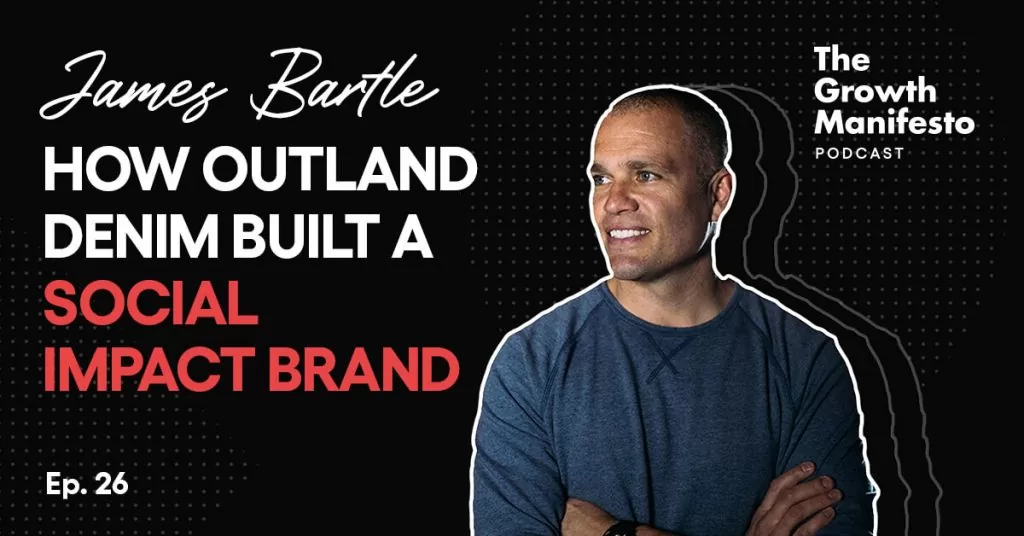
This episode is a discussion with James Bartle of Outland Denim – a social impact brand looking to change the fashion industry through ethical and sustainable standards (made famous with the jeans worn by Megan Markle). We talk about social impact, being an ethical and sustainable business, and the impact you can have on the world if you can make it happen.
SHOW NOTES
Key takeaways
- James Bartle started Outland Denim after witnessing a young girl being sold during a trip through Southeast Asia to see human trafficking firsthand.
- Outland Denim spent about six and a half years developing its ethical manufacturing model before launching the brand publicly in 2016.
- Meghan Markle wearing Outland Denim jeans in 2018 led the company to hire 46 new seamstresses to meet the sudden demand.
- Outland Denim deliberately sells through department stores and retailers rather than only direct, arguing that volume through existing retail creates more jobs.
- An equity crowdfunding raise during the pandemic brought in over $1.3 million from more than a thousand investors who backed the brand's social impact.
Chapters
- Witnessing human trafficking firsthand
- Choosing denim as the product
- Six years before the 2016 launch
- Working within another culture
- Landing Canadian retail distribution
- Meghan Markle wears Outland Denim
- Retail partners over direct sales
- Raising $1.3m in equity crowdfunding
- Quick-fire advice on hiring and character
About the guest
Transcript
Auto-generated from the episode audio, so expect the odd mis-heard word. Timestamps open the video at that point.
The idea came really about being exposed to the problems that we set our business up to solve or to be a part of combating. And those problems were made very clear to me when I was on a trip through Southeast Asia to see human trafficking firsthand. And I witnessed a young girl that was for sale. And it was a life-changing moment because it was just so obvious how scared and intimidated she was to be there. And as I spoke to the rescue agency representative that had that had taken me to see what was happening um he just said james if you look around you'll see that
these young girls are everywhere you're listening to the growth manifesto podcast a zoom video series brought to you by web profits where we talk about how to drive business and marketing success this episode is a discussion with james bartle of outland denim a social impact brand looking to change the fashion industry through ethical and sustainable standards made famous with the jeans worn by Megan Markle. We talk about social impact, being an ethical and sustainable business, and the impact that you can have on the world if you can make it happen. So let's get into it.
So today we're talking with James Bartle, founding CEO of a company that's called Outland Denim, which you may have heard about since the princess, who's no longer the princess, um mrs megan markle wore his jeans and we're going to talk about that story and we're also going to be talking about um just the company but before that time because i think people normally hear about it kind of after some like event and say wow you're so lucky but they don't actually hear about that first part of actually creating a company to get to a point that the
princess at the time would wear it yeah um so welcome to the podcast thank you so good to be here yeah cool man um so let's just start with how did you get the idea for Outland Denim and just for the people um who don't know um this started off as an ethical company um that manufactures um I think like it's only like jeans at the time right um a certain way and it's moved into sustainability as well so you know it's now both an ethical plus a sustainable company
but let's start with actually how did you get the idea for Outland Denim? Well look the idea came really about being exposed to the problems that we set our business up to solve or to be a part of combating and those problems were made very clear to me when I was on a trip through Southeast Asia to see human trafficking firsthand and I witnessed a young girl it was for sale and it was a life-changing moment because it was just so obvious how scared and intimidated she was to be
there. And as I spoke to the rescue agency representative that had taken me to see what was happening, he just said, James, if you look around, you'll see that these young girls are everywhere. And the problem is huge. It's deeply rooted in being born into a poor economy. and so therefore it was really clear to me that it needed to be something that was giving creating employment opportunity for them to be able to rebuild rebuild I guess their futures
based in something that was a lot more stable and I guess the the reason I chose denim was I always wanted to be a cowboy when I grew up and so it just goes hand in hand and you know I didn't want to make t-shirts i love love jeans always have loved denim and so um that's the reason that we we chose to go down this road and that was 10 years ago that was 10 years ago and what's it's such um a fantastic reason to start a company you know like like i think everybody has a good reason but i think um to have such a good impact or a positive impact like in what is like
a horrible, horrible thing that's happening in the world is such an interesting kind of a way to start. Have you always kind of had that kind of, I guess, like a background of like, you know, trying to help the world in some way? Yeah, look, I guess I've always been reasonably compassionate. So I've always seen things and, you know, I feel moved when I see some of those injustices that are happening around the world. And I guess, you know, I was raised with parents that were always bringing somebody in off the street that needed support of some kind, you know.
So it was, you know, I couldn't count how many times I've had to hop out of my bed as a kid to give it to somebody else. And I just I'm so grateful for that upbringing to just see firsthand what it looked like to love on your community. um so i i i come by i guess the the desire to do this quite honestly because my parents were so um committed to this kind of thing i guess i'm entrepreneurial as well and um you know i get
quite excited about new ideas and and especially when we're talking about big issues you know and you know imagine if that kind of conversation would be often heard between my friends and i as I was growing up. And so I think that, you know, moving into this kind of business was really just a natural progression of, you know, what I'd been exposed to as a kid and then moving through being entrepreneurial. I'm loving denim, I'm seeing a need and being so deeply moved by it that it just made too much sense.
And, you know, as we've gone further down this road in this journey, we have discovered that, you know, like if you want to create a product that's got the ability to change the world, I mean, I reckon denim is the best. And I, and I say that for a number of reasons. One is, which I wasn't aware of at the time, it's the hardest product to make. So there's a lot of love, a lot of effort and thought that goes into creating a beautiful gene. But then it's also one of the worst contributors to the environmental degradation that can, that continues to
havoc um these poor countries that we produce our our clothing in and so you go well if it's that product then i've got a great opportunity to be able to change that and create a new way of processing um denim that doesn't um destroy the environments that it's produced in um and then on the maker's level you know it's it's an amazing product to be able to train people on and it's a product that everybody has and it's a product that those that have bought a nice pair
of jeans before probably never want to throw them out and in fact i think they're a little bit like a song where you wear them and they remind you of an occasion they're that kind of product that's like they absorb history like they're it's an and i don't think there's another garment that does this and so i just love jeans and i love denim for that very very reason is that they they absorb history they have so much meaning and so when you associate that to changing somebody's life in a positive way it's really powerful um and so i guess that's how we we found ourselves in in
producing jeans yeah sure i mean just on that point um just there's a quick anecdote like i just threw away a pair of my favorite jeans that had rips and holes so bad that couldn't even be fixed anymore and i threw them away and i felt really sad at the time so yeah i completely understand like the connection to jeans like i have some now that's my kind of the thing every day that that i wear um yeah i will come back um to the sustainability part of it but you started this thing 10 years ago how long did it take you to actually sell the first pair of jeans because
you because like you get the idea and the idea which is really interesting came from a combination of your upbringing plus an entrepreneurial spirit which is oftentimes how like a lot of companies are made so which is a fantastic fantastic thing for the world um but then the first pair of jeans but how long did it take well man like i remember the first pair of jeans within the first you know month or two that we made we were learning and i was so excited to try them on and they were just the worst things you've ever seen you know it was so disheartening and it was at that point that i
realized how difficult this was going to be and that was then years of training getting experts in to help train our staff to get to a level where we could make jeans you know um most of our staff came from a background of having no sewing skills so this was a completely new skill that they needed to learn um look we didn't launch our brand until the end of 2016 um we spent um those first six and a half years in developing improving the business model proving that this pulled people out of poverty um proving that you could use a product like this to create um you know really substantial
change within not just its makers lives but their families and then beyond into their community as well so we spent that time doing that and during that time we were making and selling jeans at things like markets and festivals and friends and family um to to learn about you know how the market responded to the product how they responded to the story um before we launched our brand so we'd sold we'd sold i i would estimate maybe gosh i don't know maybe fifty thousand dollars worth of jeans in those first six years learn developing learning um how to do this and i'll tell you
some shockers in that time but you know it also proved that people really do want to be a part of this people really do want to see this change and they supported it and today we have beautiful jeans that um they buy because of the product and the the impact of that product helping people and plant it is just the cherry on top so it seems really difficult then well cool i'll start again it's hard to start a company definitely right like it's kind of the hardest thing it seems like
it becomes exponentially harder to create a social impact company that is based on the ethical approach to helping the world, right? What were some of the challenges in that process? Oh man, where do I start? And those challenges are still there today, you know, when you talk about working with different cultures, I mean, that's the biggest one. We bring, you know, I'm Australian. I have seen business operated in a certain way. I've been taught certain things
about the way it should be done. And I'm not just talking in business. I'm talking about in, you know, your people skills, relating with people, how do you manage a team? And so you go in and you try and work in a culture that operates entirely different. And you try and make them adopt your way of doing things. And it took me so long. It took years and years for me to realize that this was this was the biggest mistake one of the biggest mistakes i've made um if we really want to work within someone else's culture we've got to understand their culture we've got to go in and be able to see the benefits in the way that they work
and then trying to adapt that to the business that we are running so um that was a big challenge and continues to be and but is also one of the greatest learnings that i think that we've had is we need to operate to the strengths of their culture versus make them operate to the strengths of a culture that they've never experienced. But beyond that, you know, it costs way more to produce. This is really difficult to produce product where you aren't exploiting anybody.
And unfortunately, industries, not just the fashion industry, but most industries have been on this slippery slope into this dark place that we've all just, like all of a sudden found ourselves in opened our eyes and gone oh man like i can't i can't sleep well at night knowing that the products i'm buying are doing this to the environment or doing this to the people that live within it so we've had to adapt and change and we've been on this journey like i said for 10 years of trying to find new ways to create product where you can feel good
in it you can feel really good knowing that no one was exploited in this process this is the this is creating the most minimal impact on the environment of any of the products that you're going to find in the marketplace. And so that's a, I think a really exciting place to be, where you can see that a product is the change maker. And I think that's, what's really exciting for our future is that as we create products that are going to be the catalyst of creating that kind of change, then we will see greater change rather than us needing to make donations to
see the change happen. Yeah, right. Yeah. right and i can i totally hear what you're saying about it's more expensive you know like everything would be more expensive and like kind of trying to get from the ethical side of things where you fit into their culture and you can create product that people actually want to buy right like in that process and then scaling that up with the demand would be something like i can't even imagine the difficulty of that it's hard enough scaling up something if you just import it from china
right just like if you just import from china that's still really really hard but now you're having to create a manufacturing process and you're gonna have to get everybody on board for that then you have to actually sell these things like at a price point that there's a margin then you have to be able to create the systems behind the manufacturing to be able to handle of the increase in demand right like is that like a kind of summary on some of your challenges absolutely absolutely man like it's um it's consistent consistently challenging to create
systems that work um you know i'm i'm not a micromanager so i've um i've had to rely heavily on the team members that that are that they can see those micro details um you know it's it's really important that you have very good clear strong vision we want to get to here but then you need a really solid team to be able to go and put those things in place that, that mean that we can help. Essentially we, we operate two businesses, you know, we have a manufacturing business and we have a brand that sells product.
And so it's been twice as hard as setting up a brand for sure. But the, the payoff for that, I believe as we move into the future is going to be massive. You know, we talk about COVID, like the things that we've just, we're still going through right now here in Australia and worldwide. That has made people stop and think about the way we do things. It's certainly put pressure on, you know, this on globalization and how we do import and export so much.
And some is good, some is bad. And so I think it's exciting because we're rethinking how we do things. But for us, we see it as a benefit as having that control over our first tier, over our manufacturing, making sure that no one's explored it, that people have benefited, that we're able to show our customers that and that we can be entirely transparent about it, creates a pretty unique opportunity for a brand in today's day and age where consumers are now starting to demand to see these things. They're boycotting. Cancel culture has become a real thing.
It's not necessarily a good thing, but, you know, brands are being boycotted once they're exposed as to what's really happening behind the scenes. So I think that our brand is in a really strong position to be able to go into the future with the way we see society changing. And then you move from ethical to sustainable as well. So you're both ethical and sustainable. At what point in the journey did that happen? Was that recently or was that a few years ago? No, well, look, I mean, I call sustainability.
I refer to that as three things. I say sustainability is social, environmental and economic. And they can't be separated. And I think that as we start to talk about sustainability like this, I think that we then start to address everything that needs to be addressed within our businesses. And so when we talk about the environmental sustainability, that was, look, when I started, I had no interest. If you had talked to me about, I often say this, if someone had talked to me about the environmental degradation of the fashion industry, I would have thought they were tree-hugging hippie.
I would have said, oh, you must live in Byron Bay. But honestly, you can't turn a blind eye to it when you see it. And I saw it and I saw what was happening. And I see the way that the communities that our staff live in are being impacted by industry and, you know, the pollution and the lack of care or the lack of education around how important our environment is.
And so I was just moved and I wanted to learn more and I started to learn about it. And, you know, as our team learned more about it, we just realized we can't not do something about this. And so this is probably, I would say, oh, look, maybe four years into the process, we started to really go, no, we need to do something about this. By the time we launched our brand, we were well down that journey of addressing. It all happened before you even launched. So that first four and a half years,
you went through many journeys, it seems like. Yeah, it was endless, yeah. Okay. Because all these, like, it's really good framing for what happens next, right? Because you launched this thing, right? And that was, so that means, like, you started to sell jeans to the public in around 2016, right? That's right, yeah. Something like that? Yeah. and then like you got super lucky and the princess actually just wore your jeans right yeah like i'm
just trying to be funny there there's a lot of hard work between those points right we are super but what happened between 2016 and she wore it in 2018 is that right right yeah what happened in that time that she found out about it and that she wore it you know well look it was really it was really fast growth we were growing really quickly um we launched our brand you know we saw that the media um picked it up talked about it a little bit which gave us the next opportunity
somebody you'd hear about it we started selling jeans online they started to move we get the odd retailer um helping and trying to sell this product but it was a hard slog um and then i i actually got uh well my wife and and they um some of our friends that felt like oh there's this this great ceo summit in new york you should go to it wwd summit and i'm like oh no way that's gonna cost like 10 gram we're already skinned we're already trying to keep this thing going but they really
if I should go and so I did and I remember I remember being you know slightly excited about hearing what the future of fashion is going to look like I'm going to hear from Ralph Lauren and like these these leaders in the space and I just remember feeling so disheartened because all I heard from the entire industry the entire event was how to reduce cost where the industry is going what country to go to next and I was just like this is a disgusting industry um I don't want a part of this man the leaders in our industry are talking about what country they didn't say it like
this but essentially what they were saying is what country can we exploit next and I remember feeling sad um listening to this and going I don't think I fit I felt I remember saying to my wife I feel like a duck out of water like I just I'm not I don't fit in here and um I sat at this table beside this guy and he um he's a really friendly guy he's a canadian guy and uh he says uh oh what do you what do you do and i told him and he said oh are they the jeans you're wearing and i said yeah yeah
so he he just reaches right over grabs a handful of jeans and he's like oh yeah they seem pretty good well tell all your investors that you're about to lose all yours and their money too and i'm like oh awesome anyway this guy invites me to have lunch with him and his wife and i sit down we're having lunch and um tell his wife got it he didn't yet and uh he um you know he turns out to be a fashion distributor in canada one of the biggest distributors there and so um i stayed
in touch with him for the next six months he's just a real great guy like he's happy to help and support how he could but you know he didn't really have the belief straight away eventually he said well why don't you jump on a plane and bring some jeans over and come and see us and so i did i thought This is a big opportunity. And jumped on a plane. I remember landing in Toronto and he'd never seen the jeans other than what I was wearing. I threw them out on the table of his boardroom and they looked at me and said, oh, they look pretty good. He goes, okay, I'll take a risk. So he rang the three biggest retailers in Canada, Harry Rosen's Hot Renfrew and an independent retailer there.
And I'll never forget walking into that boardroom and showing these buyers the jeans. and they said, we'll give you 20 minutes. And we threw the jeans out on the table and thinking, oh man, like this is going to be, yeah, this is scary. And an hour and a half later, they're still with us and they're giving us insight on how to improve product and how to be better at selling and committing to buying our product. We went to the next retailer, same day, within an hour of the meeting, they sent an email back saying, yep, we're going to stock your product. And he said, you know, in his 30 years in fashion,
And he'd never seen a response to a brand like that. And he's now one of our biggest investors. And so it just goes to show, you know, like you've got to follow the path and, you know, you don't know what's going to come out of anything. And I've had been those retailers in Canada, Harry Rosen's and Holt Renfrew have been such incredible supporters. And what it says to me is that these leaders in our industry are there to create change. They want to use the fashion industry to create change. And that's why they gave a little brand from Australia a go.
That happened. We then just signed with David Jones in Australia. So we were growing quite quickly. And it was already difficult to keep up cash flow and, you know, HR staffing needs, all of these things, especially when you're working with people that have come from traumatic backgrounds. You know, there's additional challenges there in the workplace. and then I landed with our brand manager in Cambodia and we woke up the next morning and our phones were full of messages they were going mad and people were trying to get in touch and I
sleep with my phone on silent and so when I when I sort of looked at everything going on turns out that Meghan Markle had stepped off an airplane in Dubbo wearing our jeans and it was insane I'll never forget i hopped in a tuk-tuk to drive out to our um our production facility and i was with my team and i think there's four of us in the back this poor little tuk-tuk and um i just remember feeling how overwhelming this was to see um the response that we were getting worldwide um from
media everywhere from retailers everywhere wanting to know about this little australian brand that has this product that this princess has worn um you know that was that was a definitely a big moment for our brand no no question it made us no one to the world whereas before that you know yes we'd launched with the best department stores in Canada and we were launching with the best department store in Australia but um most people didn't know who we were and um Megan Markle made that possible but I think I mean I think what's most remarkable about um Megan Markle wearing our
product was that it had a such a profound impact on our brand it meant that we hired 46 new seamstresses as a result of her wearing our product once you know um incredible like it changed our brand it spoke to the reason we exist um and i think it's because the alignment with with her was so good um you know she does care about these things and she does stand for human rights issues and in particular, you know, around women and, you know,
marginalized women and what we speak to. And so it was just a really powerful moment for our brand and we've not stopped growing since. And what's really interesting about that story is that, you know, well, A, you get to see the full power of a true influencer. I don't think there's going to be, apart from Kim Kardashian, which is a different kind the princess is like up there right and i think like the impact that
somebody like that can have on the brand is huge now when that impact then leads to good things happening in the world that's that kind of kind of the ethical kind of benefit of that company right It's like the more we sell, the more we help. And I think that's what people don't get, especially people like who are listening to this podcast and who are basically in the marketing game, right? And they're trying to find the hook and the angle so that in social media,
we get more kind of likes and engagement and stuff. But if you can create something truly ethical and truly engaging, it's a self-supporting cycle where it actually helps the world. The more that you sell, the better that the brand does, the more people that you help, you know, and that's like, and I think, you know, because, you know, we have some clients as well that are in this space as well. And in social media, the sharing that happens, right? Like, like the, um, the,
the passion of people just kind of help to get the brand out, to stand behind it, to share this thing, because by sharing this thing, this is what I believe. Right. And like, Is that what you've seen as well in terms of the social media impact of this? No question at all. Look, I think, you know, what we've learned over the years we've been in this and in particular last four years since launching our brand is that our focus needs to be on being very real and authentic. And people can, I guess, relate to us in some way then because they know what they're relating to.
I mean, I think it's one of the most powerful tools we have. And then that is, I guess, aligning with the smaller audience that aligns with our brand versus trying to be too big and go too wide and appeal to everybody. They're lessons we've had to learn and are still learning. But the more we narrow in on that person who cares, you know, we just keep telling that authentic story. We see our community grow. We see our community support us. I think one of the greatest examples, we did an equity crowdfunding campaign just recently, and we did it right during COVID, right after lockdowns.
You know, advice was don't continue. But, you know, we had this belief that no matter what the economic situation is, we believed that we had some element of being recession-proof. And the reason I believe that is because, oh, it's a very real and authentic movement and impact that's had by buying this product. and I believe that most people want to be a part of creating that kind of impact. So if we can make it easy enough for people to do that, then it will still happen regardless of the situation we find ourselves economically.
Well, we went through the campaign, raised over a million dollars. We were the fastest campaign that they had had to hit our minimum target and this was all during a pandemic. And so it proved to me that we have a customer out there, we have a community out there that align with the values of our brand. And it's because of the values of our brand that we have such, um, uh, stoic support from them. And, um, I don't think that can be fabricated. Um, I don't think you can manipulate that.
I think that it's either real or it's not because I think customers can, um, uh, they can tell. Yeah. And, and I think that's why we've got quite a solid little business now. how did you balance the massive spike in demand after the princess wore your jeans and the requirement to be ethical right because you've got this once in a lifetime opportunity right now to help the world as much as possible if you can
harness it yeah how did you balance that I just we just about fell over actually to be perfectly honest you know it was it was growth that was so quick um that um we risked losing culture within our workplace um it was a very difficult time um and we learned so much from it and so what what i did learn is um there's always another opportunity um and you know as long as we stay true to what it is that we do you know um since then we've had leonardo dicaprio wear our product as well and you know like so it's it's um these and other incredible and australian
celebrities i mean uh isabel lucas who lives down near you like you know um really cool people out there that really have backed and supported our brand continuously and i would say um that the greatest lesson in that that really fast growth was that um the bucket analogy um you know we've got to fill that bucket um the capacity of the bucket to a certain level but then not let it overflow because we need a bigger bucket and so we needed to get more capacity before we could grow
again and but what i did in this situation was i overflowed the bucket because i was like um this is a like you say a once in a lifetime opportunity we need to make hay will the sun shines and so we were going at it and um in hindsight i go i should have stopped a little bit sooner and got a bigger bucket and then gone and filled it again so it's um it's been a big learning for us yeah but you know like i think um you can be a bit easier on yourself because in hindsight you didn't know that there were going to be all these other celebrities wearing it you didn't know what was going to happen or like i can't even imagine like how many missed calls
on your phone you like would have been like has the world stopped like but what's happened what the hell's going on you must have been really excited when you saw the princess's worn it what the what the heck yeah you know oh man it was like mind-blowing absolutely mind-blowing you know like i jumped on an airplane that night so i'd only been there for one night i had to fly back to australia because we had all these media opportunities which was so good for us um but yeah i remember we're sitting with our brand manager on the tuk-tuk and his phone would get that notification every time an online sale was made at the time because i think remember at the time
to we're selling jeans in australia like we're um it's a hot country um jeans is something that most people don't buy online until they know if they like them or not but our phone just his phone was just going ding ding ding like it was incredible wow and so indie sales just flow in and look we sold out of that product really quickly and and um surprisingly if she wears something they want exactly what she wore and so it flowed out into other products a little bit but not heaps if we we could have sold millions of products if we had it but we sold out we took
pre-orders people waited six months to get a gene you know like so um yeah look it was a it was a time that i'd love to have again to be able to do it differently um yeah honest but um it was still an incredible opportunity for us that's just put us on the map um we've got a long way to go we're still a small brand um but we've got really big ambitions yeah and that's great and like i just wanted like you know just to spend a couple minutes on that just because you spent so long putting this thing together you know from you know like the first five years at the markets and you
know traveling creating this thing and to have this at the end just be so confirmed that it's a good idea by this thing happening just would have been like okay cool it's like it's working um could let's just jump quickly um to what happened since that point right like like in terms of your strategy in terms of the marketing strategy um but has it stayed the same or has it changed like has it now kind of transitioned more to say online how has it changed since then
yeah look i mean actually my strategy was always quite different to what we hear in the marketplace You know, we hear a lot about being the disruptor of the industry. But see, my bottom line isn't just measured by the economic impact. It's measured by the social and environmental as well. So I know that for me to be able to have that impact across those three measures, we need volume. And if we need volume, the best way to get volume is by using existing retailers. You know, one in six people work within the fashion industry.
I see that it's our duty as somebody who benefits from fashion to be able to benefit this industry. So by just going direct, I actually see that as not necessarily a positive thing. I get that there's more margin. I get all of the benefits to the brand. It's the industry that will make the change. It's not Outland Denim that will make the change. We're just one small piece of making that change. So what we need to do is we need to sell through retailers. We need to partner with retailers and department stores. And we need the community to support those retailers.
And if we do that, we create local jobs and we create an economy, which is now becoming the engine house of creating the change. So yes, direct is important and COVID has forced us to go direct to consumer and put more effort into that. And it's been amazing because it's propping up our business. but I still want bricks and mortar retailers to be here I still want community to go out and enjoy
each other and enjoy the outdoors and being able to go and go shopping and you know support each other in that way so I am my strategy remains to be that yes online is really important no question but let's not forget the retailers let's not let them all die during COVID let's look for ways to support them. Let's, you know, so, so that's the goal, sell more products and sell them in ways that benefits more people rather than less. And that's a fantastic, um,
that's a fantastic explanation and you can see the value of a good strategy and seems like you want to have the biggest impact on the world. And so you're going down the hardest paths possible. Yeah. Right. And I think that's a big lesson for people is that, you know, if you want to achieve something big, it's hard. Yeah. It's hard and long and you've got to have some grit and it's going to be pain, a lot of pain, right, across that journey, isn't it? But, man, I reckon we've got to change our mentality to the way we look at that. You know, like we need to understand from the outset,
this isn't going to be easy. It's not going to happen overnight. You know, we're the overnight success that happened over the last 10 years and we still have a long way to go. Like, hey, we're not home and hosed. We're still a small brand with big ambitions. but you know it's those challenging times that mean that we're going to be good at what we do if we if we want to avoid them if we're not prepared to go through the trenches if we're not prepared to be knocked down and get up again then that's as good as we'll be but I believe that
this will work I believe this will change thousands of people's lives around the world And for that reason, I am just going to keep going and going and going. And if we get knocked down, I'm going to get up again because this is that important. This is not about fashion. This is about future. This is about freedom for more people. This is about environmental freedom. Imagine if we could innovate and create products that left the world in a better position as a result of being created.
Imagine if the byproduct of the things that we bought meant that the people that made it, every stakeholder everyone who touched that product on its way through was benefited what if the environment was benefited just as a result of us buying a product and i'm not going to stop until we get to that point um because i think that that's what's really going to change the world yeah that's fantastic point um the people um who watch this podcast and um who listen to this podcast they're senior leaders like in i'd say organizations of all sizes right and so they do
have influence in this kind of area right they could they could make the change or they could start the process of making that change yeah but what would you advise them as a place to start right because all these are existing companies yeah they're not startups yeah and there's a company and there's now a person who's now like in the senior management and they have some influence right and they have some potential impact and they believe in this yeah what do you say to someone like that because it seems like such a massive thing to approach right it is a big thing to
approach first thing is you it's your heart and i think it's just stopping and asking yourself okay um you know am i being the person i want to be by endorsing this or endorsing that you know so what do i want to stand for what what's my legacy you know i think i really think everything starts there um you know when you know that you want to be a part of creating change uh through the influence through the the avenues you have access to um then you'll look for the opportunity
and once that's happening then i would say the next steps i mean it is difficult it's going to be harder it's going to cost more so you've got to go back and look at your business model and can you adapt it can you change it it's not about being there today it's not about changing everything overnight it's about making the next step and the next step um toward using your influence to create more benefit for more people for the planet um i i i mean one of the reasons we've actually adapted our business slightly is that um we have now just started manufacturing for
other brands and the reason we've done that is i see that other brands have way greater power than we do um what if we were making their clothing what if we were able to go hey by making your clothing with us you're able to have the same impact as us because it's not easy for a big brand to just go and shift and change and so the leadership may desperately want to do it but but the business hasn't been set up to be able to and so um i i think that it's it's now a great time to be able to go to businesses and say well we can make this product for you and you can still
sell it to your audience so now your audience your customer can can be a part of creating this change and and ultimately work together as an industry to to see you know the old way abolished and the new way become the normal um and man like i won't have a marketing angle anymore when that happens which will be cool yeah and so there's so many interesting parts of this this conversation i The first part is that you care less about your brand than you do about changing the industry.
And so you don't mind if you're even kind of the behind the scenes part, right? Just where there's other brands out there because they're now supplying or purchasing stuff from you. Yeah. It's changing the world faster. So that's really interesting. your mindset you have less ego than a lot of other companies because the purpose in the company is to change the world and you're going the fastest way that you can there right like that way this way this way yeah and that's important and don't get me wrong um i've got an ego and i'm a prideful guy
at times and sometimes i get blinded by the lights and i want i want it and i want our brand to be the biggest brand don't give like man i'm still i i'm a human you're still a person yeah i have those issues but when i stopped like i talked about before like when when you stop and you say who do you want to be what's your legacy um i go no i don't i don't want to be that guy i want to be i want to be the guy that was a part of facilitating this this change and and we're a small part there's so many amazing people out there that are fighting this same fight as us
um we're just one small part but man if we can use our business to create greater change more rapidly then we must i know people i know people who are on those in those situations of exploitation i i mean i talk about often this one young lady that um has actually moved now she's about 18 but she's married and but as a 14 year old she um was taken and and um she was a slave in a garment factory in Malaysia.
And her friend was taken with her and her friend actually died in the garment factory because they're literally slaves and they just get someone else if one dies. Until she was rescued and she came to work with us and referred on by an NGO. And it was an absolute privilege for us to be able to work with her to help her develop her skills and independence so that she was no longer a victim. and she was a survivor who is courageous and has gone and forged a wonderful life for herself
but those people are out there today those people are actually the ones making the majority of our clothing that we wear and we turn a blind eye to and i just want us to go you know what if i can only own one or two pairs of jeans versus 10 but i know that i'm not endorsing that and the world changes it changes really quickly and um i know it's hard to understand the power of your dollar but the power of your dollar is so so powerful so powerful when the bigger brands who
don't necessarily operate to the standards they should see that people will no longer buy their products they will rethink the way they make them they will rethink the way their business operates And it's at that point that we have a very exciting opportunity. When brands like Outland Denim become a threat to the big players, it's at that point that we have an extremely exciting opportunity to be able to create way greater change in the world. Yeah, right. Yeah, right. And so if you're in a company and you want to start to make change,
start small. Yeah? Start small, change something which you can control that will help the world in some small way. yeah it could be the company who you work with it could be the suppliers that that that uh yeah uh providing you uh services or product or whatever else it is right it's kind of but like if you have a budget which you control you actually have an impact at that point on how you choose to spend it so everybody has an impact especially like in business and in business there's
more leverage because of the volume of what people are purchasing and spending and so on right is that yeah absolutely and i and i think even beyond that you know like um those that don't necessarily have control over budget um but those that do as well you know education like you know you get convicted on something like this and now it's like okay now i've got a great opportunity to be able to speak into and educate my colleagues, make them aware of the issues that
you've found within maybe your supply chain. As you do that with your colleagues, you know, you're expanding on the community that are going to be a part of this. And a guy that's a real hero to me is a guy named William Wilberforce, who lived in the early to mid 1800s. He was a politician who um what he and his team were responsible for the abolishment of the transatlantic slave trade um he he had to fight three days after it was passed through parliament he um he actually died
and um but this man made this statement which has always been quite um impactful to me and it was that if you want to change anything first you need to change people's affections and um i think that that's really important and i feel like we've lost that today i mean if we look at the way we interact with each other on social media we look at uh whether it's the black lives matters movement or um you know protesting about anything activism about anything um i think we've lost a little bit of um the element of respect and a little bit um we've forgotten that if you really want to
change someone you need to change your affections and i'll take me as an example initially i didn't care about the environmental impact. I really did not care. I didn't believe it. I thought it was all a bunch of hype. And the reason was because I felt forced into it. I felt like I was judged for not believing the same thing. And therefore, my wall went up. And actually, those that were trying to make create change, we're having a very, in fact, negative impact, because I probably my
nature was to push back against it so i'd go further the other way but when i saw it and i saw it in a way that wasn't confronting in that you are the problem or and i saw what was really happening i was exposed to it my affections changed i went oh my gosh i i'm going to be a part of rectifying this and so things changed and i think we've got a lot to learn from that and i think if we want to bring people on the journey with us it's about bringing them on the journey with us it's not about forcing them you know um what you know push gets pushed back you know so
it's really changing people's affections and so i'd say when we start it's that's the first step i i have influence in my company i have ability to do something so the next thing i need to do is change people's affections and it's for that reason that within our supply chain if we find a problem we i don't believe in cancel culture i think cancel culture not always but in most cases is probably a negative thing. But what I do believe in is going, okay, here's a problem. How can we work with you?
To one, show you that this isn't the best way and support you in doing it better. And when we do that, it works. It just works, but the other way doesn't work. So by cancel culture, you mean, oh, well, I found something. So now I'm not going to use you anymore. Is that what you mean by cancel culture? Instead of that, you want to try and help them change how they approach things. Absolutely. But how do you do that without having them put up their walls, right? Because it's a very fine line telling somebody that this is bad
and showing them so that they change their affections. Yes, how do you do that? Because you probably have a lot of experience in this now, right? And not always successful. And that's the reality. You won't always be successful. That's okay. But how do you do it? Relationship. I love you, a relationship, I care for you. I'm actually, it's like whenever we go into any kind of conflict, we go in and we have a bee on our bonnet. I need to get my opinion forward. You need to hear me.
It never goes down well. But when I go into a relationship where they feel like I do love them and I do care for them, regardless of whether we see eye to eye and everything, I still absolutely respect you. I now have the ability to be able to speak gently into a situation. And trust me, this is hard for me because I'm more of a get the baseball bat out kind of guy. I'm not the let's speak nicely. My dad used to always be saying to me, James, you need to put just sugarcoat it a little bit. Would you sugarcoat it?
Don't say it so directly. Don't, you know, and it's a big lesson to me. I need to I've had to learn to go. Don't be so arrogant. Like, you know, actually, you don't know anyone that doesn't want to be a part of the change if they're given the opportunity. so just be gentle so that people can be learn what you've been able to learn and there's so much i don't know but and and i and i have to now learn when people come to me in that way to receive it you know so yeah it's both ways man but it's a it's it's i don't want to sound like like um it's
your intention though right it's the intention it's how you're approaching it because everything is like it's all words but it's all changed by intention and by approaching it a certain way you know like i'm not trying to be telling someone how it is but more taking them on a journey um which is really really interesting um how does like from a hr perspective from a culture perspective you know so what are some of the things which you've had to do to ensure that the company is
ethical in terms of everything internally as well as externally yeah um well that comes that comes down to leadership man like if if if you're not prepared to sweep the floors um if if you want to sit in your ivory tower um you will create a different culture to the one if you want to so i'm i'm a i'm a firm believer in that leadership is is um about serving it it really has to be it's about i'm prepared to do the jobs that you have to do um we have a a theory here that and it's um
that we will not expect anyone to work in a place that we wouldn't work ourselves. Um, and unfortunately that doesn't translate across most, um, through the garment manufacturing industry too well. So, um, I think that you've, you know, it's, it, it's about culture. And so what is important to us as a brand, what is important to us as a company? And so the things that we do training on is, um, the things that are important to us is honesty, integrity, and generosity. um they are real they're they're the pillars of our business they're the pillars of the culture
of our business and if we lose that we lose everything else so when we talk about honesty um you know how do we how do we communicate with each other um how are we held accountable to things um and what does it mean in in the way we then flow that out through our supply chain um integrity like how can we have any kind of integrity if we're not if we're going to go to the community with a story that's not true um again honesty um and generosity generosity is
key um i don't know if you've ever watched the movie pay it forward it's an old movie but if you haven't you should watch it it's called pay it forward the concept is a little boy comes up with a school project and i'm gonna ruin it for you now but it's fine it's fine on on something that would change the world and he comes up with this thing called pay it forward if i do something nice for you don't pay it back to me but pay it on to three other people and then those three other people they don't pay it back to the one who did it to for them but they pay it forward to three
more and i love the concept and that's part of what we try to teach within our um our facility is that this pay it forward you know you don't owe outland adam anything but you do owe it to your community you do owe it to the next person who needs the opportunity and one really cool story from that is um you know i'll never forget hearing this story but one of our staff um who had actually come from such a challenging background you know in the exploitation she had faced but her family actually lived under a plastic sheet so you know under a tarpaulin um
we don't even imagine what that's like you know but her mum dad siblings and herself lived under this she got this job and she was able to um build a home for her family and this was a like a color bond roof you know tin roof and wooden cladding and it was like up off the ground so in monsoon season the flooding could go underneath and um you know what a feat amazing not because of outland denim but because of her own hard work she did this and so when you're somebody who may have shamed from your past and you're doing this your dignity has been reinstilled she went on to buy
her sister back from a man that owned her and i mean it's just unbelievable so you go oh that's an amazing win okay this works if nothing else happens this business model is working but then a couple years later um we got this story that you know there was this this young lady on the streets that was really poor and very vulnerable um and so this same girl went and set her up as a tailor on the street used her own money to go and buy fabric um to go and set this this lady up and And so that's that pay it forward. So imagine if you can do that with your staff where they go,
oh, I'm going to pay it forward to somebody else rather than pay it back. COVID hits. I remember going around to all my staff and going, hey, guys, I don't know what's going to happen. This is really serious. You know, all of our Australian staff in our HQ, do you know what their first concern was? Our staff in Cambodia. They were way less worried about whether they're going to have an income or not than they were with our staff in Cambodia. but then what's even better is that they were more worried about this their colleagues here in Australia than they were themselves and I think that comes back to culture and the kind of people
that work within your business and um we we have a business full of people that are so compassionate and driven to be able to help the next person um and that's what ensures that we maintain integrity right throughout our supply chain. Wow. It feels so good to hear those kinds of stories, you know? And so I think like it is worth the effort to see actually how the decisions that somebody makes
actually affects the world. And if they can kind of just shift it just a little bit to start with, just a little bit. Across the world, yeah? Across business, you know, just a couple of percent this way the impact that that will have is very very big and i think that's probably one of the reasons um that the equity crowdfunding campaign has done so well right because like you um you raised over 1.3 million dollars from over a thousand people yeah right and that was in the middle of a pandemic like how did that happen like you
launched like yeah could you just spend a couple minutes just talking about that you know like But how did that happen? Well, I mean, look, the reason we wanted to do equity crowdfunding, we've always wanted this to be the people's brand, a brand that benefited as many people from beginning to end as possible. And so this seemed like the best way to be able to achieve that was to go, hey, I want you to actually have equity in this company. I want you to own shares. And so I want you to benefit from the success of this business as well. So putting that out to a community was scary during a pandemic.
Of course, there was doubt, but more of me was excited about what could happen. In fact, it was, I think, even more exciting because we were right amongst the pandemic that everyone thought it was going to fail. And for it to have the level of success that it did have was pretty mind blowing, I think, for everybody watching on. But it proved something. It proved that there is a new impact investment model. And we surveyed our thousand investors after the raise. about why they invested and 83% of the people who invested in Outland Denham invested because of the
social impact associated to the ability to have a return. So this is your new impact investor. You talk about impact investing in Australia and I've often said publicly that I think impact investing in Australia is pretty archaic. I don't think it's very sophisticated and I don't really think that all measures are being used to measure the impact or value of a company. They're really just using the same metrics as old school, not impact investing companies.
So what's exciting about this equity crowdfunding movement is that now you've got these micro investors or retail investors that are going to completely change the world because they're going to back the stuff that has impact. And I think this was the perfect example of how even amongst a pandemic, you can have success if you have customers or your community aligns with the same values as you do. And you know what? I'm excited for Outland Denham success because I think that most people's values probably, if they really stop to think about it, do align with Outland Denham's and therefore only see our community growing.
That's awesome. That's such a good story. just before we finish some quick fire questions yeah you know just like the first thing that comes to mind if you had to choose just one channel or tactic for growth what would you choose digital for sure digital marketing digital marketing what book has had the biggest impact on your success the bible that's the first time I've heard that one great
Great. What's your number one piece of advice for hiring awesome people? What's more important than their skill set is their character. A second question on that point. How do you kind of assess character quickly in an interview? It's very difficult, but I think quite quickly you can assess people's character through the right questions. And I think I get a sense of people's character quite quickly.
Yeah. How do you relax after a crazy day at the office? A cold beer. Nice one. What's your best time management or productivity tip? I'm the last person on earth to go down. I'd like to reverse that question. No, it's fine. It's fine. What's the best piece of business advice that you've ever received? Operate with integrity. And lastly, what do you do for fun? Man, fun. I don't remember what that is.
No. I only say to my wife, it's like, oh man, all my hobbies, I can't do them anymore. I'm so busy and I've got a young family. But if I had the time and we're in fast forward a few years, I used to race motocross and go out to the track and that kind of thing. I love camping. I love the outback. I love exploring. Yeah, well, fantastic. Awesome, awesome. And what's next in terms of Outland Denim?
What's the plan from here? Really excited. We've launched Maker Standard, which is the highest ethical standard that you can get. So everything we produce will mean that the social, environmental, and economic impact of that product has met our standards. And we're just now releasing this. We're going to be selling blank T-shirts so that schools and organizations, restaurants can easily partake in that. We're going to be selling them at wholesale prices so that we can get more people involved
in being a part of this movement and then producing for other brands as well so that we're able to stamp everything we produce so that brands can go to the marketplace with this story of we are now a part of this movement and this change. The people that are listening right now, if they want to contact you about this, So how do they get in touch to find out how to actually get your product? Yeah. Yeah. Look, they can come directly to Outland Denim or they can go to Maker Standard. Maker is M-A-E-K-A Standard. You can go to our Instagram and we've only just launched it all, but it's all there.
And, you know, so it'll be a nice slow growth. There's no big, there's no fireworks for the launch or anything like that. This is just a progression of Outland Denim in furthering the reach that we can have. and if you and this is just um and let me see how i go with this last one but but if people that are listening to this podcast actually want to pay it forward you know in terms of the information that they have received from you today well how can they do that you know so what's something small which you'd like them to do and you know the smallest thing which i think
has such a such a huge impact is just the way we interact with people just it might be just a smile it might be just looking for being able to open the door for someone um simple man i reckon that stuff has such a powerful impact on someone else's day um look for the little things hey such a pleasure to speak to you today um you have stirred up some feelings in me which is i think the whole kind of social impact thing you know and i think that's kind of the biggest part about it um
Thanks so much for coming on the podcast, man. And like, I'm so happy for everything that you're doing and all the success that it has come with it. So grateful, man. Thanks so much for having me. Man, thanks so much, man. See you later. Bye. Bye-bye. Thanks for listening to the Growth Manifesto podcast. If you enjoyed this episode, please head on over to iTunes and give us a five-star rating. For more episodes, please visit growthmanifesto.com forward slash podcast.