
MarketingEntrepreneurshipLeadership and culture
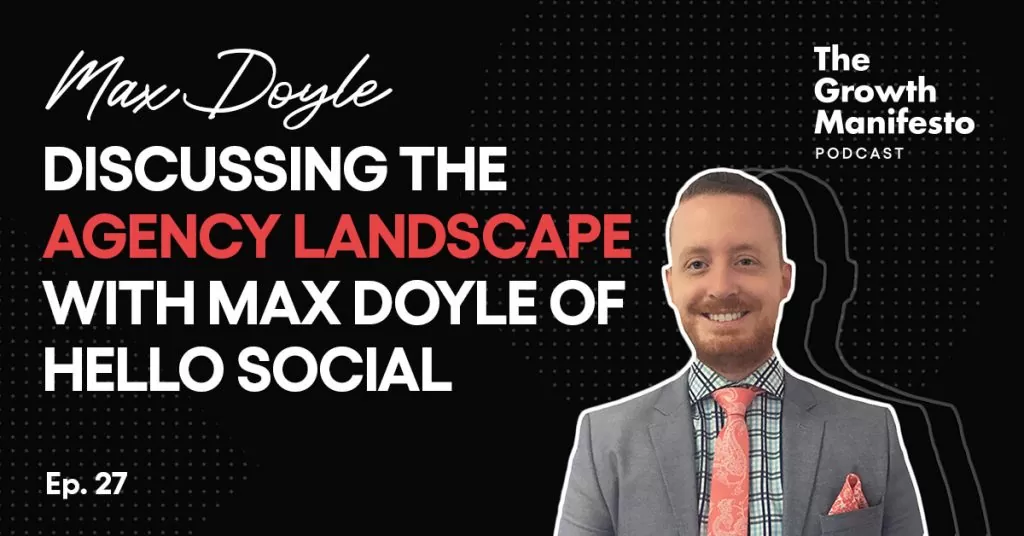
Discussing the agency landscape with Max Doyle of Hello Social
Max Doyle of Hello Social compares a content and brand-led agency model with a performance-led one, and explains memes and SEO that built his brand.
 with Max Doyle


Overview
This episode is a discussion with Max Doyle, founder and Managing Director of Hello Social (a social media agency, and technically a competitor of ours). We go head-to-head and discuss the agency landscape, the different ways to run a social media strategy, and how to differentiate yourself from the market.
SHOW NOTES
Key takeaways
- Hello Social chases top-of-funnel brand awareness and content for about 80% of clients rather than direct ROAS-driven performance work.
- Doyle invested in SEO from day one and still runs two blog posts a week to rank for relevant keywords.
- A weekly Wednesday meme, started as a joke, grew Hello Social's brand recognition more than a straightforward services pitch could.
- Paying several micro-influencers a few hundred dollars each and boosting their posts can produce more content than one big-name endorsement.
- Doyle credits persistence over intelligence for his success, arguing business rarely works out if it were easy for everyone.
Chapters
- Intro: Max Doyle of Hello Social
- Content agency versus performance agency
- From MySpace promotions to first job
- The retainer that funded scaling
- Investing in SEO from day one
- Building a reputation with weekly memes
- Company values: turn water into wine
- The software startup and its lessons
- Influencer marketing strategies for brands
About the guest
Transcript
Auto-generated from the episode audio, so expect the odd mis-heard word. Timestamps open the video at that point.
I had a friend and unfortunately he had to close his business down. It was really hard on him mentally. And it was almost like, and you shouldn't feel this way, but it was almost the shame of like, Hey guys, like I'm, I'm a business owner. I, this is what I do. And then saying, Oh, actually like I fucked that up. I'm a bit of a failure. I'm going to go and do something else. And, and not that makes you a failure, but like that, that, that actually was a really big motivator for me to continue going, to be honest. You're listening to the growth Manifesto podcast brought to you by Web Profits, where we share inspiring stories of real people
who've succeeded in the marketing and business world. Today, we interview Max Doyle, founder and managing director of Hello Social, a social media agency and technically a competitor of ours. In this episode, we go head to head and discuss the agency landscape, the different ways to run a social media strategy, and how to differentiate yourself from the market. So let's get into it. So tell us about your childhood, mate. This is actually pure vodka, just so we're clear. Absolutely.
Tell me about my childhood. I was actually grew up in the southeast of Sydney, funnily enough. Whereabouts? Poogee, actually southeast. Oh, okay, so you're actually an established person. Yeah, yeah. Isn't that what Adrian just said? Yeah, but he got it wrong, though. Is it the east-south? Is it? I don't even know. It was botany. Honestly, I don't think botany even is an area. You've got St. George, eastern suburbs. You've got Southern Shire. it's just a port really we love you Adrian don't hate us we're not making any friends around here
it's like you be careful actually if you mess with a video editor he's so handsome though like why would you want to it's the way he edits so Max tell me tell me tell me hello social is that a question yeah that was pretty much it No, no, no. Tell me where it's going. The whole idea of today is I'm going to love doing this podcast because now I've got, I was going to say David and Goliath,
but that's not fair, is it? No. On Alex, yeah. It's like David and David? Yeah, it's like David, yeah, sure. It's like Rocky 1. It's like I've got Apollo Creed and then Rocky Baboa. That's what I'm going with. They're two great titans going head-to-head in the social media space here and I love it. Where do we start? Alex, I'm going to start with you. G'day, mate. How are you? Good, thanks, Tony. How are you? Very, very good. That's something that we always do. There you go. That's something that we always do. You know what's interesting about today is that probably officially,
like we're competitors, like from the outside. Yeah, yeah. Yeah, we both have agencies in Australia. Yeah. Fact. Yeah, fact. Yeah, yeah. We both do social media. Also fact, yeah. You do social media very differently to how we do social media. I would imagine so. I don't know what you do exactly, but yeah, probably approach it from different ways as well, I would imagine. Tell you what, Max, this is a podcast, so we can ask any question we want. Go nuts. I can also say anything I want. It's a dumbest thought, really. You can ask Alex whatever you like. Yeah, you can. How do you do it? Show me your pinel, man.
Yeah. I'm trying to prepare more questions before I arrive. Don't worry. They'll come to you. Okay, brilliant. Yeah, they'll come to you. Here you go, Max. Just start writing. Anything comes to you, just go for it. No worries. No, no, but it is quite exciting. I mean, like Alex, you say you are competitors, but you aren't. How would you differentiate the two businesses? First of all, I think like in Australia, I think there's this extra attention. This has made Max uncomfortable.
What do I'm down the wrong pipe? No, so I think in Australia there's this attitude with the agency owners I've met across the years where it's like this really closed approach where like I'm quite open. So I just go and I just talk and I share. I don't share my P&L, but I do, you know, share and so on. And then they don't even share back. And it's like, and I'm like, why aren't you sharing back? It's like, oh, well, because, you know, we might have the same client and, you know, like, you know, like I don't want you to steal our clients.
I'm like, wait, just that's not how I approach any of this stuff. You know, like I am focused on our company. Like I'm focusing on us. I'm focused on just expanding us as much as possible. And I met the lovely Max one night and I'm like, hey, cool. So he runs Hello Social. I've heard so much about Hello Social. I've seen their stuff. I like their stuff. I know there's a fair few people like in where profit that have shared their memes. That was your social strategy in the past. Was that like a meme thing for marketers? Yeah, yeah. I'll go into that in depth later on. Yeah, because that was like super successful, I would say.
Yeah, yeah. I would say that was one of the things that put Hiller Social on the map like very early on. Yeah. Yeah, really like helped us increase our brand awareness when we really, you know, we were nobodies really. Like we're just a small agency, like four, five, six people in Sydney, not differentiating us from too many other players. And then we did the memes and that sort of really put us on the map for the first time as many years ago. and sort of built that snowball since then. How many years ago was that? Because I'm like pretty old now. I can't tell anymore how long things ago were.
Five maybe? Five years ago. So Hello Social has been around for seven and a half years. Yeah. Yeah. And so I would say that the difference, and this is, correct me if I'm wrong, right? I'm so intrigued to hear this and I'll tell you what I think the difference is that we can compare notes. Cool. And I'll ring a little bell for each round. Yeah, yeah. so what was that guy's name in Rocky? Fight. I'll be Mick, the old coach. I'll be coach, right? Yeah, great. But in all seriousness,
I think the difference is that from a social perspective, we use it to scale performance, yeah? And correct me if I'm wrong, but it seems that Hello Social is about the social media campaign strategy and kind of engaging across the brand to provide an experience. Now, correct me if I'm wrong. I could be wrong there. I would say you hit the nail on the head. I would say, yeah, what I would think you guys would be is more bottom of the funnel. It is more about conversion and ROI and all of that.
And don't get me wrong, we do have clients that we do that for. We have clients we do that for very well. But I would say 80% of clients are much higher up the funnel. yeah it's more about content production it's more about awareness and engagement i mean some of our clients for example makita power tools that have been around for a very long time you can't actually buy power tools off their website you can only buy it through their just their their vendors their distribution channels so for them it's just we just want you know everyone everybody got a very high level of brand awareness we just want people engaging regulators we'd always stay front
of mind build the brand you know and it's not like you can't track that with metrics it's not pure fluff by any stretch of the imagination, but it's, it's, it's the top end, not the, not the pointy end of the bottom. Yeah. I was also, yeah, I see the kind of content which you produce and it's extremely highly like there's a lot of production, production value around it. Yeah. And I guess I must be seeing kind of the big campaigns on your social media. Like for example, the Uber campaign, which you just ran for the Melbourne Cup. Is that right? Yeah. Yeah. Like that's not the kind of campaign that we would run, you know?
And that's why I was kind of assuming your whole. And in that sense, we are, although within the same space, we are apples and oranges. Yeah. That's the top end, like content, mass reach, impressions, engagement to some extent. Yeah. Very different from what's my ROAS, you know? What's my ROAS? I want to scale this bad boy. Yeah. And it's got to go fast and hard. Yeah. Well done, gentlemen. Round one. That was fantastic. On the scoreboard that I've got here, I've got Max at one and Alex at one. I saw a zero. That's a zero there.
What this is, it's called the name drop. Okay. It's called the name drop. It's the, who was the company that you just dropped? What was it? Uber. I don't know what you've heard of it. No, no, no. He said Makita. Makita. Thank you, Brad. He dropped that so subtly, like, oh, I just bought a Porsche. One of those subtle, like, oh. Alex, you get a point because you mentioned one of his clients. Okay, cool. I do that. You name dropped one of his, so that's Uber cool, right? Okay. You dropped your own. so we're at one all at the moment but you know you are an amazing human being i would love to
know the journey of how you actually got to hello social what did you do before and yep great so i um really hate it when you when you're at university and they're like we have a motivational speaker someone who's really done it coming in to tell their story and this guy walks in he's like yeah i drive a ferrari and and i i left my job after working there for eight years and i started company and then three years later I was a multi-millionaire I'm like that didn't fucking happen to me I was three years in still fucking eating meagerang noodles in the cupboard so I'll
tell you I'll tell you my story and so I really love telling people the real true raw story because people get one year into a business and like well I haven't made any money I've just gone into debt and oh it must I must be doing something wrong because everyone else is doing it so well and I think of most people that have made it in business, they know how hard it is and it's always hard. It's not hard one year in, it's hard also six, seven years in if you want to be doing it properly. It's still hard 15 years in, to be clear. Okay, fantastic, yeah, I can imagine.
And so I always wanted to be in business. I always wanted to have my own company. My father was a successful businessman and business was discussed around the dinner table. He had franchises in Western Sydney which were quite far between each other. So we spent a lot of time in the car driving between them and he would say, so Max, I've had this staff member, he's not happy about this, I'm going to tell him that he needs to improve this and then I'm going to tell him how much of a good job he's doing. And it was always discussed
and so I think it was always expected of me, not in a negative way, but it was always expected that I was going to go into business. and so I didn't know what I always thought I was going to have this big idea I thought I was going to have like the new uber or something like that but I didn't know what I wanted to do and so I thought okay I have to go to uni I'm 18 I finished high school I should go to uni I'll study marketing because if I can learn how marketing works then at least when I have my big idea I'll know how to get customers everything else has thought itself out right right yeah I
I tried to just create a lot of things and ended up just, I figured out how to do marketing without being able to create my own software giant. Yeah. Yeah. There you go. So, so, uh, finished uni and finished at uni, didn't finish uni. There's a difference. I, my most highest qualification is my, how far did you go? I went there for a while. Um, went there for like three or four years and then I left with no, no, uh, qualification. and you're studying marketing yep and i i think i just had to finish off one sort of um paper at
the end which i didn't do and i and i always said disgraceful and i always said to myself i was like i'm already going here for the education not necessarily for the qualification um which in hindsight was fucking stupid but anyway it is um so i only have for one paper at the end exactly exactly so i only have like one i only have um uh a i only have my high school diploma essentially which is quite ironic. So then I went and I was trying to get a job in marketing but no one would hire me because I didn't have any experience in marketing.
It's always so hard to get your first job, isn't it? It's like, oh, for your entry-level job we want someone with one to two years experience which is so silly in hindsight but now I'm on the other side of the table literally in interviews and I'm like, well, I can for an entry-level wage there are people out there that have one or two years experience and it would be a poor choice for me as a shareholder in this company to hire someone with no experience when you can get someone with one year for basically a similar salary, unfortunately. So I ended up getting, I thought, what differentiates me from other marketers?
And it was the fact that I did do promotions on MySpace back in the day. So like nightclub promotions and like running events. Is that what you did in the start? That's what I did whilst I was at university. Okay, so you're like, look, I've done marketing. I've been marketing MySpace events. Exactly, exactly. I know all this stuff. So this was literally like HTML code on MySpace. What, those flashy backgrounds? Oh, they called me Mr. Flashy background back in the day. Yeah, that was my jam.
I then went and got a job because I did know about Facebook and I was studying it so much at home. Got a job in a digital marketing agency doing their social media. I worked there for like nine months and I messaged a friend of mine who's a successful businessman and I said, all I need, I didn't even mean anything by it, I said, all I need to start my own agency is a website, a graphic designer and an office. And he replied, said, I can get you those things. And so that's how Hello Social initially was started seven and a half years ago.
And is he a partner in the business? Is that what his part of it was? He was at the beginning and he was a part of the business and helped me get it on its feet in those early days. And then now he is a shareholder. Oh, cool. Yeah. Yeah, I mean, that's like the best investment ever, like a website, some space in an office. And what was the third thing? A graphic designer. A graphic designer. I think he already had one. So I was like, okay, you get like 30% of their time. That's great.
So yeah. And so sort of wrapping up my point, the first six months, I think we did literally like three and a half thousand dollars revenue. Yeah. And obviously absolutely nothing. I had no idea. For lots and lots of hours of work. For lots and lots of hours of work, you know, 50 hours a week. And then, you know, setting up the company and all that sort of jazz. And then, and then we got some more clients and we got some more clients and it's, it's gone. It's gone. And he's pointing up and down and down. Yeah. Yeah. Sorry. It's going up, it's going up and down. but yeah it was just so hard during those early days and I look at all these other agencies that
start up and they stop after a few months when it gets hard when they can't pay their bills and I get it I would just you know my advice would be persevere through it's not going to happen overnight but if you're selling the right thing you're doing good work you know you put the hard work in it will happen. And how long did it take until you started to actually to get a proper wage out of it? Uh, it was how many years, months? It was, it was about a year until I could get like, uh, I was on $36,000 a year for like two years. And that's after the first year. That's after
the first year. And I had staff that were on 75, 80 and I was on 36 and I had, I had no money. Um, and I could have, you know, I could have left and gone and gotten a job for 80, 90 maybe. Um, But yeah, I just stayed true. And yeah, it picked up eventually. You know what? I actually wasn't really tempted. I think for me, having to, the hardest thing would have been like saying, I had a friend and unfortunately
he had to close his business down. It was really hard on him mentally. And it was almost like, and you shouldn't feel this way, but it was almost the shame of like, hey guys, I'm a business owner. This is what I do. And then saying, oh, actually, I fucked that up. I'm a bit of a failure. I'm going to go and do something else. And not that makes you a failure, but that actually was a really big motivator for me to continue going, to be honest. Well, it sort of makes sense because your dad is a business owner as well. Did he own many franchises or a franchise? What was it? He owned multiple – he owned – it was just one company,
but it was multiple franchises of that company. Okay. So was there also pressure from dad as well to succeed? In the back of your mind, maybe? Yeah, yeah, there was. There was definitely like, oh, you know, this, you know, But honestly, you're saying you should be a bit more advanced than this right now. Right. Which is quite – it's like I think of it – Is that what he said to you, by the way? Yeah. Wow. So that's extra pressure. Yeah. Far out. Thanks, Dad. Yeah, exactly. Exactly. Oh, well. Well, it's like the elite athlete having a kid and going, you should really excel in this sport as well. Yeah. You know, and it doesn't happen and then God knows what.
So you persevered and Dad said that to you. Do you still have a relationship with your father at the moment? Yeah. Yeah. No, absolutely. And we're very close. and you know I get it myself like I look at my little brother and he was helping me with something the other day and I was like you should be better at that at this and I was like Max shut up don't just don't say that you know like you should know better and so I think yeah people look at things maybe who have been there and done that maybe don't realize what they were like at you know 24. I also think we do take on like a lot of kind of kind of how our parents have done things and
the good parts and the bad parts, you know, and that's like, it sounds like, but you're kind of treating that your brother, like your father treated you kind of thing. Like, and I see myself all the time. Like, that's what my mom does. I hate that about my mom. I'm doing that stuff now and I really don't like it. And it's so good that when you can look at that in yourself and go, okay, I'm going to change that. That's not okay. Yeah. Cool. So then how did you get your first initial clients that actually paid you proper money? Not the ones that made you three and a half grand, the ones afterwards where you could actually start to kind of hire people. Yeah, what was your initial approach, you know?
The initial approach. That worked. Yeah, yeah, yeah. So I think, you know, we, God, we were spending a lot of money on Google AdWords in the beginning, approaching burning cash on that and the quality of leads you get when you don't, you, your company doesn't have a portfolio, you're probably fighting on price. And yeah, the quality of clients you're getting from Google AdWords in that setup, for us, we're really, really not fantastic clients. And that's the thing. That's where Hello Social has actually come from. It has come from working with small businesses
and working with small budgets. They had $1,000 Facebook advertising per month and we had to make that work. I actually think there's a lot of merit in really working with those small businesses because you do learn how to make the cookie stretch for those people. It makes you a better marketer for sure. You need to get it right with not much budget. Yeah, exactly. You're boosting something for like $10, $15 And you're like, come on, please work. They need seven leads for that. Yeah, exactly, exactly. So I think we ran for a while.
We were doing good work. And then we got referred like a few big clients. And then we worked really hard and we delivered on that. You got referred? Referred. From whom? From, I think I went to a few networking events, met a few people. And you've got to realize, I'm talking 2012, 2013. This has just been Facebook started. This is the early days. He's like, social media agency. Oh, there's like two of those, you know, like it was just meeting this other guy to find it out. But so we did get referred some good clients, some big, big brands, and then we did do good work for them.
And then I remember one of the big turning points was I had an intern who came to work at Hello Social and they did, and he was a bit older and I was like, why are you doing an internship? And he was amazing. And then he went and got a job at a big company. And I realized how good he was actually. And he was so humble, just did the work and an amazing job. And he was really grateful that that was his first job in Australia. Helped him get a bit of a resume, helped him get that job. And then he came back to us and said, you know, I did good work.
I was with you. I'd like to employ you guys. And it was a $14,500 retainer. And so $14,500 to a small business. That's fucking two staff members, you know. And then that consistent revenue just off that was for 12 months. And that really allowed us to then scale and get some more staff. And it's often that tipping point of what actually helps you. You get there. And it's not one tipping point and then you're off forever. I feel there's many tipping points you have over the years. And so how did you scale from that point? Okay, so now you've got the one client that is paying you that much money, let's say.
Yeah, yeah, yeah. And a bunch of small ones, right? But then you scaled. Yes. How did you scale from that point, you know? Yeah. I think it was, I wish I had like a magic story around what it was, but I think from then it was just, yeah, grinding, just working really hard. And I think that's so generic, but it just allowed me to hire a couple more staff, which allowed me to probably have a bit more time doing business development. So you did the business dev. Oh, yeah, yeah. I did the business dev until like five years. Yes, so sales is the business dev?
Yes, yes. Oh, yes. And so that's a really good point. yeah, and I'll dive into that more a bit. But I was, yeah, responding to the inbound leads. Where were the inbound leads coming from? Very good question. I think they, oh, I invested in SEO from day one. I shared an office with an SEO gentleman who was amazing at SEO named Dennis Koo. He was brilliant and he taught me very much the foundations of Google AdWords and SEO. And I invested in SEO from day one. And I
would say our SEO is fucking brilliant really if I'm being honest with you. Still now? Still now. 100%. We do two blog posts a week. We're very big on inbound marketing and we probably rank very highly for most relevant keywords if not first. Yeah, great. So you really don't like search ads? Oh, I do like... Because I saw you advertising quite a bit. Is that like just kind of after now there's all the money coming in. Now you're like I want more of the pie now. right that's because what because i just like some background i mean that's um kind of like
how we started as well like we were trying to pay money for after google ads in fact like in the very start we actually did a pamphlet drop and like this is before right i'm like wait a minute we have a digital agency some people won't know what a pamphlet drop is we might have to explain it doesn't need to be explained at all right but um it's not on the internet. But then I'm like, wait a minute. I'm selling this service. Why don't I use that service for us? Like this was like, this is after about like a month after I had folded like 9,000 envelopes. Cause I was doing, cause we didn't have much money. So I'm like, and
my tongue was like, Oh, it wasn't good. I was like, I should have got the sticker ones. The ones we have to lick. I won't even go there. You didn't get the sticker ones. Come on, man. It would have been an extra two cents a month or something. You know how to get a sponge. Anyway, it was bad. It was bad. So then I started AdWords, right? And then we were like, cool. We spent all this money and we got a client paying us 300 bucks a month. And we just over-serviced them. It just went nowhere. And we didn't get any referrals as a result.
And we started to kind of invest in some SEO stuff. This is like back in 2006, back when it was the Wild West, let's call it. And then all of a sudden, we started to rank at the top of Google. but number one for everything. All the keywords, all the pages. And all of a sudden we started to get phone calls. I'm like, where the hell are these phone calls coming from? And that was because of our rankings, right? And so that kind of lasted for about five years, right?
And that kind of supported a lot of the early growth until we had enough money to really spend on acquiring other customers. I think like in the agency space, it's really hard to acquire a customer. Like it's really hard to pay money on advertising to acquire a customer. Yeah. Like especially as a startup that doesn't have the brand, that doesn't have the portfolio, that doesn't have all the things, but just has this hunger and has this idea and wants to start. There's so many agencies now. Like there's just like in every area. Right. And so it's a similar thing.
Yeah. So we had this kind of thing that helped us scale in the beginning, you know, and I think that's that's harder these days i think it's harder for companies like these days to start an agency yeah 100 definitely more competitive yeah okay cool and so when did the thing um the the memes start i think it was um just explain the memes just for people um like that haven't heard like tony for sure hasn't heard it i don't know if i didn't know what it means but i got no idea yeah not not what the word me means yeah like explain explain should we explain what meme
means no no no no no please max over to you um round three um so basically um yeah so hello social every wednesday um at about 5 30 ish um produces and posts a social media or a marketing related meme so it's it's all it's a joke we never offend anyone definitely have the past have I got an angry client emails about it maybe um and so uh so many years ago we I think I posted
like a fucking tip like make sure you find out the best time of day to post for your Facebook page and I was like this is so generic everyone knows this shit like no one's interested in this piece of content no one I'm posting for posting sake which especially in a pay-to-play market that we're in today. You have to pay for people to see your content on social media. You, you know, you shouldn't just be posting for no reason. So I thought, God, like I would like to think of myself, believe it or not, as a funny human being. And I was like, you know what, I reckon I could try, I could try
like a marketing joke. And and I thought, okay, let's give it a crack. And I think I did one and it got like, got a bunch of likes. I was like, oh, okay. What was the joke? Fuck divino. I'll go on max. I should go, I should go through the archives. You should go through it. I should do it. For your next podcast when you talk about this, you should be like, it was this wait, that was a horrible one. The next one. I should get it like tattooed on me. But it landed, right? Like you got a response. It got enough of a response to be like, okay, that's alright, I can do that again. And so I think next Wednesday I did it and I did
a few. And then there was this really funny guy called Matt McCaffrey in the office. Really, yeah, very funny bloke and I think I handed it over to him and then he did some of the ones that got, you know, broke a thousand likes for the first time, then 2000 likes. And it started organically or was that paid? Was it a combination? It would be, it would be a combination, but I don't think the budget was like that huge. Yeah. Like maybe $50 or something or less. Yeah. Wow. And, and then, uh, and then
we just sort of became quite known for that. And the funny thing was, um, I remember I used to do the community management for it. Like we used to try and be like funny and witty, uh, which is very hard for me of course and and so I remember this um this one time this guy goes oh you're you're promoting this you're you're boosting this meme how stupid that you're boosting a meme and I was like and I replied to him I was like get your calendar out note down the date when you said it's stupid to boost a meme and let's have this chat in five years and and I you know have you
gone back to that post I haven't go back I've got so large to-do list no that's just just for vengeance. I should. I should be like, good day Tim. Remember me. I'm back. Tim 64389. Yeah, exactly. So yeah, so that really started to grow the reputation of Hello Social. All of a sudden people knew who we were. So I've gone from like no awareness to like actually there's something mildly unique about that. And you can't just in marketing, you can't just be funny. You have to have actually, you can't just be funny. You have to have a reason for them to actually make a
purchase and so although we are quite well known for our memes i would like to think we're well known for our content as well we do now two blog posts per week and there's like pretty and it's like it's in my opinion quite good content as opposed to you know fluffy unstructured not real tangible point gene takeaway it's actually like this is how to write an instagram bio like do this this this this like yeah yeah cool that bounce it's the funny the fun bounced out with the you know, real, like the actual substance.
Are you still doing the funny stuff these days? Yes. Oh, mate, that's, that is. Has it changed over the years in terms of like the performance or how much you have to pay or kind of like what it looks like? Okay. Like if there's something that can be shared or not. Yeah, no, no, no. I don't know. So a lot of marketers are going to think that I'm stupid for saying this, but there is a really big shift in terms of social media and Facebook away from just trying to get engagement.
And they're saying now that you should be more top of the funnel, so trying to get, you know, trying to reach a lot of people, the right people, reach a lot of people, and then get a lot of impressions with those people, so high frequency, they've seen your content a lot of times, and then try and drive other actually actionable metrics such as landing page views and website traffic and video views and then obviously conversions. So we used to focus on, we used to boost the posts for engagement
and we were trying to get, you know, we had a benchmark and now we've started boosting the posts, not that we click the boost button, just so we're clear. Yeah, I was like, please thank you for confirming that. Founder of social media agency with massive clients. Yes, I used the term generic. So what we do is we just go in and we hit the boost button and somehow it works. Yeah, science. So now we've changed our strategy to focus more on reach and frequency.
But anyway, that's actually not working, so we're switching back to engagement. But I think for most companies, they should be doing that. Long story short, cost per engagement has gone up quite a lot over time. Okay. Although, yeah, costs across Facebook are going up, as of course they are. Yes, definitely. Yeah. Okay. That's really interesting. And so how much did that have an impact on your growth? That kind of, because I think at the beginning you said you started, like at the time you had five staff and then you started the memes and then things happened after that, you know? And I think slowly but surely, yeah, we went up to about 16 staff
and I think people knew who we were. So I would say I have this notion in my head that there'll be a marketing team and especially a few years ago, social media was seen at the bottom like not too important and it comes last. Like you decide your strategy and then you hand out some, okay, go find the social media agency. Like it's bottom of the pile stuff. And so the most junior person in the team, they'd say go and find some social media agencies and then they do a Google search and they go, oh, I know how they're social. They do the funny memes. And that just got us a foot in the door.
That got you a foot in the door, yeah. And I think that's kind of the importance of the brand. I think that like it's such a competitive space now across the board that it's not enough just to say, hey, I do this thing. It's actually say, hey, I know this company. That's first. And then, of course, they do that thing as well. And I think with the amount of agencies out there, it'd be hard to really stand out these days to create that brand when you're having to struggle to make a profit from the really small sale value and then trying to expand it.
Because I know a few people that have started a couple of agencies and they stopped after a couple of years, It's like it must be so hard these days to start it and to scale it, you know. So I don't know how they would approach it these days. Yeah. How would you approach it if you had to start again today? Yeah, I would try and do something that's really, yeah, really unique. And that sounds obvious, but. That's not obvious at all. I think what people do is they go out and they go, okay, I'm going to cold call.
Yeah. Or I'm going to launch some ads. Yeah. That's not unique, but I think that's the standard thinking. So what would be unique? If I had to start it again, I would almost try and do like a PR stunt, just so that we'd get our name on the map. Other agencies, I won't throw shade at anyone on the podcast. Yeah, please, because there's a lot of agencies that actually will listen to this. Yeah, of course. So, yeah, other agencies have tried doing the meme thing, and I don't think there's enough room in the market for,
there's not enough rough room in the market for two people doing memes just so we're clear we own meme space now in marketing um but i think it hasn't worked so i think you know trying to be really different trying to trying to have like a unique brand like like you always should you know something that actually makes you different um what would i do i would probably again try to do something funny i love how they do marketing in new zealand they always just try and cut through with some with some humor and i think the australian market has so much dry humor over there isn't it I even love when you catch Air New Zealand flights,
the in-flight entertainment, the information, and it's got the All Blacks on there. They take the mickey out of themselves so well. Yes, it's so good. And it works. Yeah, yeah. You like humour a lot. You actually say, and you use that as your draw card, why do you think humour works in the realm of marketing? So I think it's, you know, there's so much out there that is boring and dry and factual. and how you get a message across to someone is you make them feel something.
And when you make someone laugh, it's a strong feeling, you know? And I think it just gets a lot of cut through because not many people, not many ads in marketing. I mean, if we look at the campaign from Uber with Kim Kardashian that came out a couple of days ago. Yeah, I didn't say that. Could you explain it quickly? So it's, oh God, I'm going to get in trouble for this one. So it's definitely, you know, it's live, but I can't remember the, so there's Kim Kardashian and then there's, I can't remember, it's Magna Sabansky.
I can't remember which character she's playing. It's from Catherine Kim. I can't remember the name. And they're having a conversation and she's teaching her how to say noise. And it's just hilarious. Like it's incredible. Everyone's looking at that, everyone's sharing it and everyone's going, ah, that is so funny. So they're actually engaging with it by laughing. Yeah, great. And so, yeah, in a dry, boring market, make people laugh, I reckon. But, I mean, that's not good. You can't be a law firm and be like, come to Crazy Camp's law firm. Why can't you? Why can't you? I think even more so for a law firm or something like that to actually take the mickey out of it
or make it more human and bring a funny aspect to it, I think that would be cutting edge. I do agree with you. But I don't think it's going to – it wouldn't. I wouldn't want to pitch it to them. I think. I'll be honest with you. You have to be brave, yeah. I think what's interesting to point out is that that strategy kind of fits Max. He's funny. That's his attitude. That's his style. He only wants clients probably who connect with the fact that's funny. If they're too serious, it depends on the client, of course.
That's okay as well. I think for law firms, I think, I don't know how many of the funny lawyers there are out there. Is that a thing? you know I think if there was a funny lawyer maybe they could do it but I don't think they could try to make it funny yeah okay fair enough say for example here right like at Web Profits that's not my style so if I try to be funny because that's going to get the cut through it's not going to be as good as someone who's actually funny there's some funny people here now I think you're funny Alex you guys are so
so supportive aren't they seriously I've seen a lot of funny people in my life and heard a lot of people top of my list is like like really well named comedians like Russell Brand and then Alex equal if not if anything I love you guys I'm such an optimist because I just take this as a I'm like yeah yeah I believe it yeah but still right like it's not going to be the same across the board so I think potentially there's something in there where I think a company that's
starting out especially like an agency they need to find out kind of their personality and put their personality out there. But I think try something that can get cut through somehow. I think there has to be like a massive amount of effort in something that's going to get that cut through. I think that's where a lot of companies don't put that focus. Then they go, of course, I have an agency. I'm going to start to do some cold calls. And I see a lot of agencies that have started out there and they don't actually use marketing to get clients,
but they're a marketing agency. That doesn't make sense. I know, but they go out and they sell it because it's expensive to do proper marketing. Yeah, but then how are you going to – oh, sorry. How do you grow, blah, blah, blah. They're telling you this, right? Sales team. A phone book. Oh, God. Losing their voice. Oh, God. No. That's hell for me. Do you know we're in the year 2019, right? But that actually works. It's just that like it's just – but then the person that started that, that actually can make it work is a salesperson usually, right? So I've seen the agencies that are started by a salesperson,
they grow really, really fast because it's sales focused like immediately. Maybe their service isn't as quality as some of the other stuff, which we pride ourselves on, but it still works for them. So there's a hole in the market there where the salesperson will be absolutely fantastic, but then the actual agency can't deliver on the product. Oh, that definitely happens very regularly. That's a lot of them. It's not the majority, but it's a lot of them. Yeah, okay. A lot of them. Yep. sorry Max I cut you off oh no no I agree I think there are a lot of agencies out there where the CEO is a great salesman
who definitely started off doing that cold calling stuff and I think at the end of the day they're not going to be working with the top brands they're not going to be able to deliver on that work because they I think at their core they're not they're a bunch of sales people that have some people doing delivery they're not actually marketers well they're not actually within that area that they should be in but I do feel really sorry for companies that provide Google AdWords that are all trying to get clients through Google AdWords. The cost per click on that must be insane. I know. So competitive.
Oh, God. It is extremely competitive these days. It's an interesting conversation on if there should be a standard for agencies, if there should be some type of, I don't know. Certification. I don't know. Certification, maybe code of conduct. I don't know. something it's because i've seen over the years a lot of dodgy stuff and but it sells right and it's changing i'm seeing like like a lot more pretty awesome agencies out there a lot more than
you know like it was like like in the very start um but there's still a lot of shady stuff out there you know and there's nothing really that we can do to stop that i guess that's why the brand is important you know i guess i just made a point and asked the question and that's that's me trying to be funny. How, how was that? Was that good? So good. So good. I'm down. Can I get, say it again. Would you like it on call? It was great. You can cut that one, Adrian. No, I'm joking. No, you can leave that. You can leave that in. And you know what? If you've got to explain that, it's a joke, even better. It's even better.
It's the first rule of telling jokes. That's how you know it's funny. How else would you know? I'd be sitting here, right? I feel like we should have another one. I love it. Absolutely love it. All right. So both of you guys, Max, So ask them if you know I'm off by heart. But with Hello Social, you've got these three things where you talk about your three family values. Yeah. And I really like that from your organisation. And I wouldn't mind looking at it. The first one is turn water into wine. Yeah. Okay. So what's that mean for Hello Social?
Fantastic. So turn water into wine is that – and on your first day at Hello Social, you will be walked around to the – literally there's pillars that hold up the roof and we've got a painting on them by one of our old staff members who's gone on to have quite a successful career. Paintings and I tell you, this is We Turn War into Wine. In an agency, we service our clients and most of the time our clients are really reasonable and really lovely people, but then every now and again,
you know, they're not and we are there to work for them and if they call us at 5.30 or 5 o'clock on a Friday and they need this work done and it's reasonable. If a client asks for something reasonable, we should do it. And we are at the behest of our clients. And sometimes we've got to get an ad campaign out and we've asked for assets from the clients and they send us these shitty little pictures from a catalogue which our poor graphic designers have to sit there and cut out from the white background
so we can actually make this mildly visually appealing for online. and so we turn water into wine we take this negative situation and we deliver something awesome for our clients and so many parts of all of our roles and I like to say this to everyone are not glamorous so many like from the managing director through to the most junior staff member so many parts of our job are not glamorous and we need to take that in our stride and just turn that negativity like it's a negative thing say you know what this sucks and that's okay
I'm going to turn water into wine I'm going to do something good Yep, nice. I love it. Now this one, Max, just getting to know you now over this podcast, this is definitely one that you made up. I made up. Anyway, never mind. For family's sake. Ooh, ooh. Okay. So we are a small business. We're about 30 staff. We like to think of each other as a family. And so that is doing an action or doing activities or having a mindset that is for the greater good of the company.
so if someone does the dishes that is that's a small act but it's for family's sake it's for everyone else in the office if someone works until 10 o'clock at night getting a campaign off for a big client with a couple of other people that's for family's sake because they're doing amazing work to get the recognition for hello social and obviously for the client and conversely you know on the other side when we had staff that have been a bit selfish a bit negative. I would say, I don't feel that you're here for the positivity of everyone else. And so
you don't really fit our values. And so I'm not sure if we're going to have a role for you here. Fantastic. I love how you actually put in the same category, either washing a dish or staying back at 10 o'clock, not holds the same value within your organization. That's a really nice thing because it just goes to show, you know, there's so many different aspects to a business and what makes it work and what makes it work for a client as well. That's really nice. Your third family value, cheers, mate. Yeah. So this is a really important one when hiring new staff.
It is we would like to hire people that we would like to go to the pub or a cafe with and say, cheers, mate. One of these. Let's do one of these. Cheers, mate. And it's a concept that, you know, we're going to be working in an office together for 40 and sometimes more hours a week. And if we can work with people that we can get along with the people we have common values with, it's going to make that time go so much better. You know, you can hire someone who's really amazing at performance ads,
but they're a bit rude and they just sit by the cells in the corner and eat, eat their lunch. Like for family's sake. Yeah. Yeah. Or. Come on. Cheers, mate. That's number two. Yeah, yeah, yeah. What happened? So, you know, you want – and then as a result of that, it's then hard to, you know, have a good relationship with that person because they're not engaging with you. And therefore, when things get tough, can you trust them? You know, when you go around to the battlefield, you look left, you look right. You know, you want to know you've got the right people with you.
You want to have those solid relationships. And you also – we want to hire people who have strong moral character. You know, if they get it in, they talk negatively. oh my old agency sucked they made me work till six o'clock three nights a week you know then they're not they're not they're not a person of um not necessarily personally want in the team do you have an induction process on to introduce them to these values and what the expectations are yes we have a new starter checklist and and that is one of the really important points and then during the first week which i do myself personally that checklist um and then i walk up from during
during the week and I'm like, sneak up behind there. I'm like, tell me what cheers mate means. You've got five seconds. No, but we do. You should try it in a German accent though. I should, I should. But we do quiz them on it that week on what the values mean. And then all of our, we have three Hello Social Awards each month and one of them is for people who have lived that value. And in our leadership team, every Tuesday morning, 9am, we discuss, okay, you know, Sam, who has stood out to you in the last week
as living one of the values? Who are they? What do they do? And why? Yep. I absolutely love it. And Alex, I know this is something that you've done at Web Profits as well. You have invested so much into a positive, beautiful culture of growth here. And it sounds like you guys are so in alignment of how you do it. And that's why you both got successful businesses. Yeah, for sure. I mean, our values are a bit less fun, but they're extremely real. And they're extremely – it kind of embodies the stuff that's important as well. I think that's – But do you mind going through your values? Because I actually – I personally love them, but yeah.
Yep. Go for it. Off the top of your head. Off the top of my head. Yeah, yeah. We have eight values. Okay. I don't think I can call it all of them. Can I have them in alphabetic order? No. So we play as a team. Yep. Yeah. It's open and no bullshit. Yep. And we swore on purpose there just to make it completely open. Make it authentic, right? Yeah. we play as a team and we play we play as a team and so it's about teamwork it's about actually having fun it's about
being open and transparent yeah and so that's like a super super important one and kind of having the harder conversations and not trying to hide stuff and there's four more as well you know but I think the big one is that because I used to think of it like a family too but then I heard this interesting I think it was a podcast because how good are podcasts but it was like this interesting conversation that it's more like a team than a family where a team, everyone has to really be contributing to the team. With the family, you have unconditional love. It's not unconditional here
and that's what I realised, you know, and maybe that's a bit more harsh than the family conversation but I heard it and I was like, actually, that's more in line with what the culture is here. Yeah, that's right. It's whatever works for you guys And it seems like it's both working really, really well for you. I mean, like I'm just gathering people that – well, I know people who work at WorkProfits love working here. So I'm gathering at Hello Social will be the same thing. Like you create a really, really cool environment where people feel wanted and the culture actually figures out whether or not you're going to last or not.
Yes, yes. No, I would love to think that everyone enjoys working there. Yes. On this podcast. Yeah, exactly. Why not? Yeah. Hey, just a quick one. Just because I just want to jump quickly to your software startup. Can you just talk about that quickly? I want your P&L on it. Brilliant. So, yeah. So, I think that service, people who run service companies and people who are marketing for services,
I think a lot of them look at the greener grass that is product, running a product company and marketing products and think, Jesus, wouldn't it be easier if I run a company that sold products? Like surely that would be like infinitely scalable, right? You know, if I, you know, let's say you were selling, um, God, what's a good product. Let's say you have a, um, you know, you're the first person who invented protein powder. Okay. Um,
and it was still 2019, so you could sell on the internet, one would like to think that if you had a good product, you could scale that business quite a lot because the amount of revenue you do is not necessarily attributable to things that slow a business growth down, which is people. Hiring people is very hard to scale typically. Anyway, so I read a book called The E-Myth, The Myth of the Entrepreneur, and it talked about the importance of systemizing your company. And I had another web development company.
And I was a share. I think I was a director. I think I was a director. I was a director. And it was years ago. Must have been at least six years ago. Like one or two. So I was a director. And I had a very good relationship with the managing director. And I was like, you know, I really could use this piece of this system, this piece of software. And if I could do that, I could really increase the efficiency of Hello Social. And that was our bottleneck was at the time working with sort of medium sized companies
was actually a workflow for getting some of the content approved. We weren't going out and doing photo shoots at that point and high end production. So it was more the content was more done with graphic design and it was higher volume in a sense. and so we created a piece of software that you would allow you to show the client what your facebook and instagram content would look like in situ so on facebook instagram and they could click approve or reject these were the days when we were using google spreadsheets it had one column
that had the the words in it the copy and then the other one had an image and it was just such a bottleneck within the company so i said hey mate can you build just you know build me a tool that we'll just automate this process and automatically schedule the content. It was a, um, after we sort of built the absolute embodiment of a minimum viable product, um, internally, I thought, you know what, I think other agencies would like this. And so in true startup style, I had a landing page, I had a GIF, sort of an animated GIF that was, you know, writing the post, dropping in an image,
and then sending off what it would look like on Facebook and someone clicking approve or reject. It was like an eight-second GIF and it just repeated itself. And the landing page had just that GIF and then create, approve, approve or reject and then schedule your content. And it had an email, like put your email address here if you're interested, coming soon. And I got like, I think I posted in a few forums and it went quite well. I got a few hundred people saying, I want that.
This is amazing. Give it to me. And so I thought, okay, we should probably go about trying to build this a bit more. Yeah. So that was how the concept started and how the initial company started. And then where did it go from there? Because obviously you went, I think when we spoke, you were I think heading to San Francisco or something at the time. So like it obviously went from that point to kind of heading to San Francisco. Yeah. So what was that journey? So I ended up, I was the CEO of that company for two and a half years in the end.
So it went in different stages. And we did build the product and we sort of funded it out of Hello Social, which is the reason I don't have a house. Is that true? Possibly. Possibly. Very possibly. Yeah. Okay. That wasn't actually a joke. That was a tear. Yeah, that was a tear. Okay, that was a real. Yeah. We can cut that out. I'm joking. I mean, that's what this is about as well. It's to say it's not all rosy. It's not all, you know, we just won Ubers
and we just won all these big campaigns. Actually, there's a bit of difficulty in this process, you know? Just a tad. Yeah, yeah, yeah. So we built the product up to a certain point and it was out there. Like eventually it went live. Eventually it was something that you could just start using. You could just enter your email address and you could just set it up yourself. You didn't need the intervention of us to go and set it up for you, which it did in the early days. And we said, okay, let's go and get some funding for this to grow it out to what it needed to be. And we basically didn't end up getting funding
before our money ran out, essentially. The company, so we had these big expansion plans. We had all these products we were going to build. We're going to, at certain times, we were going to, I think we have rebuilt it like several times, to be honest with you, but we were going to rebuild it again. and it was going to, yeah, we were just going to build more and more features and really take it out to the mass market. That's what we're going to do with raising funding. And I don't know, I feel like- How much were you going after? If you're able to share that, I mean, if not, it's fine as well.
I think it was like one or two million or something. Yeah, that's helpful to have. That's helpful to have. Would have made things easier. And so, yeah, we didn't end up getting the funding in the end and I still ran Hello Social and I made the decision that for myself, I was going to go back to Hello Social. So I resigned from the company. The company still exists and it's- What's the software called? Yeah, let's put it out there. It's called Review. Spell it, yeah. R-I-V-U-U. Dot com or dot com.au?
Dot com. Yeah. And it, yeah, so it still exists. We haven't built the additional features and it just exists in what it was, which in hindsight, I should have just, again, just gone for a minimum viable product without giving it out to all these clients. It's like, oh, it'd be great if it had social media analytics built on it. And I was like, oh, sure, I'll build you an analytics platform on top of the one function this is supposed to have. You know, you look back at these things in hindsight,
like, what the fuck did I do that? So yeah, so that was one of the many learnings that I had on that project. So what was the biggest learning? from that project? I'm not sure what the individual biggest one was, but I think if I had my time again, it is the job in a startup situation. It is the job of the CEO to look after capital raising. And I feel I probably, I should have focused more on that. Number one. So that's what I, one of my learnings. The other one is I would, yeah, continue on the minimum viable product for
quite a while I wouldn't um try and change too many features trying to add too many features and it's it's such a hard role being a product like choosing what what a product needs to have and stray from your goals and it was my my first time doing that and would you do it again with another piece of software you know sometimes I I I um consider going back in because it's still around and it's still it's still up and running it still has customers it still does its thing and I always look back and I'm like oh oh that's such a good business model surely it's scalable
wait no no Max no just focus on the one thing I myself where I'm at in my career having negatively impacted my golden goose so much by doing another company would just like to stick to doing just one company and so what happened like in terms of that you know yeah so basically I was running Hello Social. I was spending less time running the company and it lost a lot of clients. Over a while it lost some clients and it very much shrunk
and I went back into it. And when you went back in, it turned around. Yeah, yeah. Because I remember that time it was like, oh cool, now all of a sudden all these clients are coming back on and everything's happening again. Yeah, and this was- What changed actually having you back? What was the big difference? Oh, look, look, many, many things. It was several years ago. This is certainly not a recent story. Yeah, yeah, yeah, sure. And, you know, I mean, having these companies are bloody hard enough to run doing 60 hours a week, let alone when you're doing 12,
you know, I think that was it. That says it all. That says it all, isn't it? Yeah, interesting. Yeah, I actually had hired two developers here for about two years. We almost launched four or five products. I thought that F was going somewhere else. No, no, no. Thank God for that. So that's where the start is kind of funny. I was like, wow. I thought it was great. But yeah, like we never got there. And they kept going into these places of like trying to figure out how to do machine learning.
So we tried to find a way to build a product that would automatically look at the backlinks of a bunch of competitive sites and identify the ones that were the most quality and show us those ones and actually automate the process of acquiring them. Automate the process of acquiring them. So we would basically find the who is information, it would do outreach, it would just do all these. Oh, wow. We got stuck on categorizing links. And anyway, they were basically in there figuring out machine learning algorithms. This is like five, six years ago too. Anyway, it didn't work surprisingly. But I didn't know how to talk to developers.
Oh, they speak another language. I couldn't do it. I can talk to marketers. And I can talk all the way down to the smallest of tactics or details. But developers were like, the widget's not working. I'm like, we'll fix the widget. Oh, yeah, we're fixing it. Okay, cool. Fix it faster, please. How long will that be? I don't know. Yeah, it'll be about two weeks. Two weeks. Something comes up. And then it's like- Two months later, where's the widget? Why isn't it fixed? Yeah, so the timeline went out a bit.
It's to do with the JavaScript. And I tried to make a simple analytics dashboard, but then all the APIs were a challenge. And so I didn't know anything about APIs. And so years later, I spoke to a friend of mine and he's like, oh, have you heard of a product manager? And I was like, well, what's that? Because I keep hearing about them like at eBay, right? Like it's like, oh yeah, there's all these product managers that keep kind of handling things. I finally figured it out. I should have listened back in the day, right? And they're the ones that communists. So you were told that advice back then? Well, yeah, so I had a short stint at eBay back in 2004.
Everyone there is a product manager. I'm like, what the hell do these people do? Yeah, sure. And then this is only a few years ago now. I found out that the product manager is the person who communicates between stakeholders and developers. Yep. And they can talk to a developer and can get them to do things and can question them and can say, maybe that's not the right way of doing it And maybe that's a better way of doing it. And we don't have that person. It's all just a black box because the developers also need the product manager
to keep them in line because they're going to go off in different paths and do different things. And then we're like, let's rebuild it again. It's like, we need to rebuild it again or can we do it like that instead? You know? Oh yeah. We call them the developer whisperers. Developer whisperers. And so that was my journey, but I never actually just got it to launch. But I will do it again. It's just now I know how much it's going to cost, who I need. You don't need another house. And I, yeah, that's a long story too. And, and just to know the parts
where I'm good at and to actually find someone who can actually support the rest, you know. I think I was a bit too optimistic in the software development thing. I thought if you, I mean, how hard could it be to build a piece of software? Yep. Pretty hard. Who knew? Who knew? This, it's the, I think it's an optimism of entrepreneurs who just have one success and they can just have all these other ones and it's like it's guaranteed and it's like not guaranteed. Yeah, you think you're like, well, I'm God's gift because I got this far with this one. Clearly, I'm going to be good at this. And yeah, and we see it as well.
We have a lot of entrepreneurs come to us and they've built, you know, look at them on LinkedIn. You're like, oh my God, you started that. Fuck yeah, go you. And then they start this new business and it absolutely crumbles. And you're like, oh, okay, great. It is challenging all the time. And so before you said something which is something I still struggle on, to focus on the one thing. You said to focus on the one thing is to focus on Hello Social. Yeah. That's your thing right now. Is that hard? Oh, it fucking keeps me entertained, I can tell you that much.
Look, you know, at the end of the day, you're sitting in an office, you're going to meetings, you're answering emails, you're talking to people. Whether you're doing that for five companies or one, you know, the actions are still sort of the same. So there's different, obviously, different departments where I work and then I have like a new sort of branch of services that we want to create. And then it's almost like a new company, you know, like, oh, I'm going to work on, you know, years ago, it was influencer marketing, influencer marketing, what's that, you know? And then we built had a team for that and new systems, new processes, new people and
new clients. And it's almost like a whole new business within a business. Yeah. Can we jump to that quickly? Yeah, sure. So with influencer marketing, how effective is that for you and your clients? so I would say these days as well last 12 months let's say so I would say when you talk to someone you say I do influence marketing and I think most a lot of marketers would say you mean you get
a you know a person to post a picture of them sipping on a tea from your tea company and go I love this tea it makes me feel so happy and they would sort of look at you with a bit of a stain like that is not marketing you don't know what you're doing and I would probably agree with them so what is what is good influence marketing is sort of how has it changed over the last last 12 months it's not about that's almost sampling it's almost like just convincing giving someone four hundred dollars to post about your
your brand with you know tea bottle in the background or whatever that is that's that that that's only reaching a few hundred people that's not really and and people these days they they see through that and you're kidding yourself if you think they don't. There is amazing ways, innovative ways, which are so much fun of doing influencer marketing. So one thing that's actually quite old now is you have, especially with the bigger influencers like 500,000 plus,
it's more of an involved process. You will get a production team and you'll go and it's more like a content partnership and then that content can be um should not only go like going on their on their social media presence that's like that's like the tip of the iceberg that's like eight percent of it the rest of it is okay what can we do with that content it's going in the marketing collateral we have a a pretty large client at the moment and it's and the the influence of content that we've created for them is going on their products around the world it's gonna it's going
on as a little thing that goes on top of the product. And so- Is this something that's not on the internet? Something that's not on the internet. I don't know what it's called. Yes. What's that thing called? I don't know, it's made of paper, who knows? So, you know, the content, so that was part of the negotiation with the influencers, like your, you know, the content that we create with you, we're supplying the production team, so it's gonna be schmick. And you're basically brand ambassadors and that's going on products around the world. And they're like, oh my God, this is so cool, which it is.
And then the content that we create with them, the quality content then goes out on their social media presences. They would give us advertising access to their social media presences, normally Instagram. And then we are boosting that for quite a large amount of money, tens of thousands of dollars to target the target market of our client's customer. So they're not just seeing ads coming at them from the brand. And they're seeing this person that they follow or maybe they don't follow.
Maybe they've never heard of them and they're seeing content from them. So that is one of the sort of innovations and a way of doing it quite differently. And then that's also content production for the client as well. So is there a smaller scale version of that? So is there ones like, I say for example, if there are some organizations at the moment who are listening and they don't have tens of thousands for a post and a production team to go out. Is there a smaller version? Is there the ones that's between that and the people that are holding up the Windex
and saying, I love my Windex. Is there something between that? Yeah. Or is it not? Or is it just too hard these days at the smaller levels? I think it is. I think there's definitely a lot of innovation that you can have with the smaller brands as well. I think we've got some local businesses, like let's say a chain of like five or six businesses and then we'd send people there and then all of a sudden, well, what Influence are really good for is making something seem cool. It's that social proof.
So someone's only got like five, 10,000 followers and they go and let's say it was a local burger place and they take really amazing photos with that burger that is probably sometimes better than has ever been done for that burger place or any of their burgers they've ever produced before. And then that's a really interesting piece of photography for that. That goes out to their followers. And then again, that brand who might have paid that person $100, $150, and a free meal. So like...
It's pretty good for the influencer too. Yeah. So it goes out to their following. And then also is content. It's actually like content production as well. So it's also your content budget as well as also reaching other people and getting a really new take on what it is that you're doing. And that's a shift, isn't it? It's actually a content production play with an influencer promotion piece. Exactly. And how much is a photo shoot? A photo shoot's not cheap. Whereas, let's say you've got $2,000 for a photo shoot for your five chicken burger places.
You've got to do two and a half grand. Five and a half grand is not cheap. Spend the two and a half grand on influencers, $150 each. That's eight-ish influencers. And then you've got really eight amazing pieces of content. I like it. That's great. What I like hearing here that you both agree upon a lot of things and it sounds like although you've got your own organisations, your own companies, you are in a sense competition to each other but I think you could work collaboratively as well. Here you go. This is what I'm going to do. This is the challenge here.
In two minutes you guys are both going to work out. There's a new brand of butter coming out. I haven't got a name for it yet. You guys are about to name it. I can't believe it's not butter. Beautiful. And now you're going to come with a strategy on how you're going to pump it out there. Go. What do you mean? How do you want us to do this? Start talking. So A, I wouldn't be able to have come up with a name. That's great. That's what Max did. Well done. That's not my area at all. That's an existing name. Oh, is it? Name, yep. Or maybe it's a tagline. It's a tagline. I can't believe it's not butter.
For which brand? I don't know. It doesn't matter. That's it. He's writing it down. I can't believe it's not butter. Well, I think that's trademarked. Yeah, probably. How are we going to get this out there? I mean, I want to go down the influence path now on like something funny. Okay. If I'm working now with Max, right? And if we're working together, then I want the funny content that I can like promote like crazy across every channel. Yeah. So what would you do? And I want to put you on the spot now from a content perspective, you know, so what's something funny that we can do with butter?
All right. I'm going to do like stupid things that you, oh, stupid things you can do with butter challenge. So like we're all using it for food, right? But, you know, it could also be used for other things like. Greasing up bearings. Thank you. Greasing up the berries. That's where I was going with this. So it could be used for greasing up berries. So we could have like a, we could have a, what else you could use, Butterfall Challenge, right? and then we get, we actually seed it with like 10 quite big influencers
and we actually go and film it with them and then we get them to launch, hey, I just did the what I can do with butter challenge and we film it and we come up with some really interesting ideas. It could be playing pranks on people, butting up the floor when they walk out. I like the one where you go underneath the car handle, the door. Oh, we've all done that. Oh, mate. How good. Yeah. Yeah, we can do that. You two are trouble. That's what I can say. I've never done that. Now, Alex, you come into this as well.
So, Max, you've got some great – now, what do we do, Alex? We've got the concept. We know what we're going to do. What are you going to do for us? Oh, well, first of all, I like to retarget everybody that comes to the influencers page. I want to scale up their ads exactly like, you know, what Max said before about – No, I don't know what Max said. No, about what Max said before about actually advertising to their audiences. Cool, got it. Yeah. I want to capture their emails. That's my number one thing. Yeah, like I want to try to capture their emails
and find a way to get them to go in store and to choose it. Yeah, so to make maybe some competition that there's one person who buys his butter in this month that's going to get something fantastic, like a holiday to Mykonos or something like that, right? Now, people are going to probably go out to- You guys are working well on this project. Yep. Go on. That's about as far as it goes right now because it's FMCG. FMCG is like notoriously difficult to track back to a sale.
Yeah, there's some programmatic campaigns we could run to mothers or to people that are going to be there purchasing at that time, right? Yep. It's not the most exciting stuff. The campaign ideas sound way more sexy. yeah but like we'll just smother the internet with anyone who buys butter we'll see these campaigns will be part of it and we'll be leveraging that content um to really try to push them in store probably have to come up with some really um advanced ways to track store traffic and to really make sure that we can kind of integrate with some of this fmcg kind of uh
kind of um the targeting stuff let's say for example we can do programmatic campaigns that to target people who buy butter. And we can advertise this to them, right? That's like one thing we could do, you know? Yep. And lots of those scaling strategies. Cool. Max, anything else on that? So far, I'm liking the product. Yes, yes. I would say, besides my, no pun intended, cooked idea. You are the funny one. But also, just so you know as well, he does stand up. Oh, really? He does stand up.
Can I use that line? Yeah, you can. As long as you credit me at the end, like we're all gravy. so I would have to link it back in a positive way to the brand, you can't have an idea that doesn't link back positively and it would be something like use cooker the right use butter the right way and then I think in the FMCG land it's really about reach and frequency, people don't necessarily have to always engage with a product but they have seen actually the technical term is a fuck ton of times for them to actually want to go
in and make that purchase can I just put one in I'm not in the realm of marketing I'm a specialist especially for butter marketing that's my new keyword I'm going to rank for on Google butter marketing the butter the funny stuff you've gone targeting mums and that what about a campaign where mums do practical jokes on their kids around butter yeah and make that see how that could go up against like the cat memes almost almost but it works
it works right you know and there's other stuff that's a bit less exciting around the recipes around kind of you know you can get people to use that butter and like a cooking thing there's yeah there's stuff but yeah generally we're not the butter specialists and I think this is true this is true I found out literally today what the difference between butter and margarine what is it oh really so needless to say this is not my area of expertise what is it according to a person who's nicknamed plant mama I'm not even kidding. She said margarine comes from plants,
and she would know. She's the plant mama. And butter comes from animals. Is margarine from olive oil? No, that's something different. No, it can be canola oil. It can be any oil, right? Yeah, yeah. Anything from a plant. Gentlemen, it has been very, very entertaining having both of you on today. Alex, this is your show, so it's great to have you on your own show. It's bloody brilliant. Thanks, mate. Really appreciate it. Max, you have been absolutely funny, fantastic and inspiring. Thank you for being so honest, beautiful, vulnerable and informative for everybody.
Max, just one quick question for you. Best bit of advice you could ever give anybody starting their own company? There's a quote by a very rare man, significantly smarter than I am. And his quote was, be persistent, be persistent, be persistent. if success was easy or if business was easy everyone would be doing it and my key to success in my life was being consistent which is different from stubborn um i would say be persistent yeah
persistence is everything i think like i'm certainly not uh the smartest person yeah that one that part i know for sure there's way more people out there like max when it comes to smart but but but but persistent, persistent and stubborn towards my persistence. Like it would just, there is no other way. And I think that has to be the approach, right? Because it's not, it's going to be hard forever. Yeah, but it's going to be different. It's going to get a lot better, you know,
but it's still going to be difficult. Like I'm sure these days, it's not like it was in the beginning, but it's still hard a lot of the time. Oh, yes. It's hard in a very different way. Very different way. It's a more fun hard. Look, I think- It is. It's almost like a less hard hard in a sense. Yeah. Guys, thank you so much. I'm so glad that we've- That's right. It's fun. I know. Bam. You guys are awesome. Thank you very much. Thanks, Tony.
Cheers, mate. Thanks, Max. Thanks for listening to the Growth Manifesto podcast. If you enjoyed this episode, please head on over to iTunes and give us a five-star rating. For more episodes, please visit growthmanifesto.com forward slash podcast.