Leadership and culturePersonal growth
Redefining career development in a remote-first world
Julie Winkle Giulioni outlines seven dimensions beyond promotions, such as contribution, competence and connection, for growing careers in a remote-first workplace.
 with Julie Winkle Giulioni


Overview
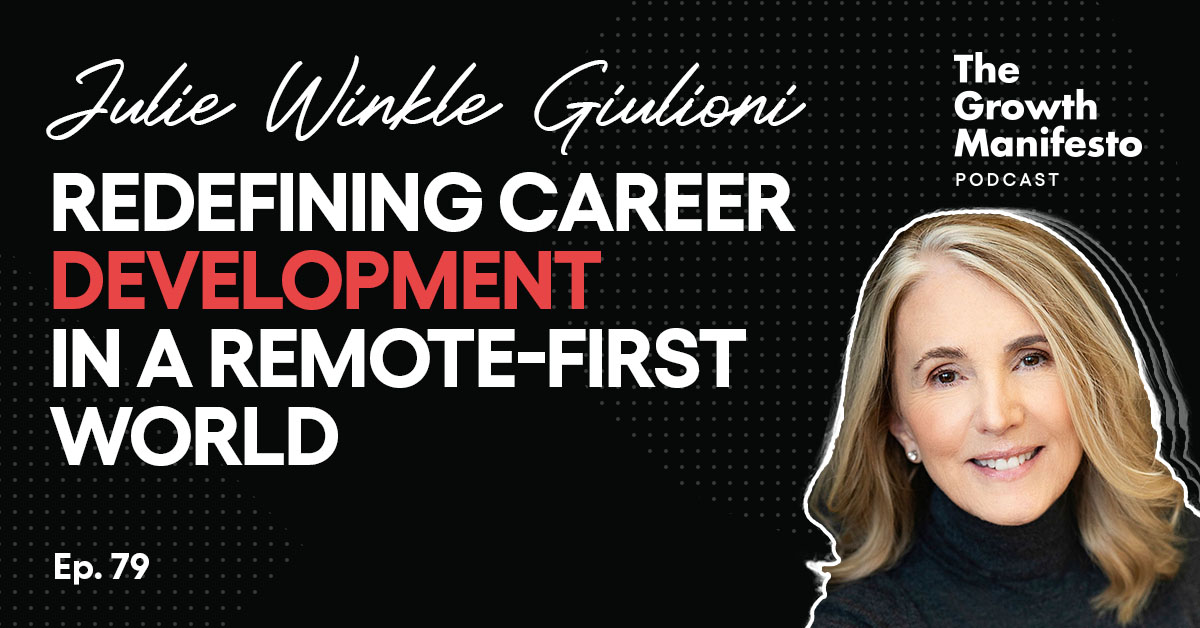
This episode is with Julie Winkle Giulioni – author of the international bestseller – Help Them Grow or Watch them Go, and one of Inc Magazine’s Top 100 Leadership Speakers. In this episode we talk about her latest book – Promotions Are So Yesterday – Redefine Career Development and Help Employees Thrive.
Key takeaways
- Giulioni argues career development can't rest on promotions alone, because giving everyone a title change is a mathematical impossibility.
- Her research with about 750 people worldwide found contribution ranked as the most interesting growth dimension, ahead of climbing the corporate ladder.
- Giulioni identified seven dimensions beyond promotion, including contribution, competence, connection, confidence, contentment and choice, that also drive career satisfaction.
- Managers can grow skills for free through strategic teaming, placing people on real projects that also happen to teach them something new.
- Career development works best as an ongoing day-to-day conversation, not a once-a-year meeting filed away for 12 months.
Chapters
- Intro: redefining career development
- Why career means more than promotions
- Seven dimensions beyond the promotion
- Contribution: helping people give more
- Competence: organic on-the-job learning
- Connection: building bespoke relationships
- Contentment versus ambition
- Coaching leaders to start the conversation
- How often to have career conversations
About the guest
Transcript
Auto-generated from the episode audio, so expect the odd mis-heard word. Timestamps open the video at that point.
And managers who understand that, leaders who know their folks well enough to be able to tap that, they are in a powerful position to engage and create satisfaction and employee experience. You're listening to the Growth Manifesto podcast, where we host in-depth interviews with business leaders, authors, industry experts, and entrepreneurs, with a singular focus around business growth. At the end of each podcast, we want you to walk away inspired, to think bigger, and to have actionable takeaways you can apply to improve your business.
Each episode is like a masterclass on a key topic, so make sure to browse the episodes to find the topics that are most relevant to your biggest business challenges today. This podcast is brought to you by Web Profits, a digital growth consultancy that helps challenge your brands drive growth in a complex and fragmented digital landscape. You can find out more about Web Profits at webprofits.io. Now, let's get into it. This is Alex Kleanthus, and today we're talking with Julie Winkle Giuliani.
She's the author of the international bestseller, Help Them Grow or Watch Them Go. And she's one of Inc. Magazine's top 100 leadership speakers. Today, we'll be talking about her latest book, Promotions Are So Yesterday, Redefined Career Development and Help Employees Thrive. And just quickly, before we get started, make sure to go ahead and hit that subscribe button so you get the latest episodes as soon as they're released. Now, let's get into it. Hello and welcome, Julie. Thank you so much, Alex. How are you today? I'm very well, thank you. I'm very well. So I'm in the morning and you're in the evening somewhere and fantastic on Zoom that we can have all these conversations. I love it. Isn't
this wonderful? Yeah, I think it's great. I think it's great. But let's get straight into it. Where did you get the idea for this book? Oh, wow. That's a good question. Straight in there. Straight in there. Well, because it's such a good topic and I think there's so much happening in the world with everything happening since 2020. There's a lot of changes with the Great Resignation or not, or, you know, however you want to frame it. And I thought that the ideas around the success around the career is not just about promotions. Right. And so I think that's such a great conversation. So yeah, that's a little bit more of a warmup. I love it. No, I love it. Cause you've
kind of made the business case for, for the book right there, Alex. So about 10 years ago, when help them grow or watch them go was published, the book that I got to write with Beverly Kay, I began doing a lot of deep work with organizations, with individuals, with managers around career development. And in working through the content from that first book, which was really about elevating the quality and the cadence around career conversations, we knew we were making a
difference. Managers and employees alike, they reported that the quality of the conversation was better, but there was still this frustration and this dissatisfaction and this angst in the whole conversation, the whole relationship around career development. And as I continued to work and dug under it, what became very clear to me was that a major source of a lot of the dissatisfaction that we all have around career development can be traced back to these very limited definitions
limited expectations that we have around what careers what career development is all about you know we have been sort of brainwashed into thinking career is the title the development the career development is the promotion and the movement among roles and it's a mathematical impossibility you know we're never going to be able to give a promotion to everybody who wants to grow. And so no wonder we've got these statistics right now around dissatisfaction,
intent to leave, number of people who are leaving. And so much of the reason is they don't see opportunities to grow. And so the world has changed. Work has changed. Careers have changed. It's time for career development to change along with it. And that was really the impetus for the book was how can we redefine career development in a way that meets today, that meets the reality of today's workplace. And so promotions are so yesterday. Yeah. So was there like a lot more
focus on promotions before everything got turned upside down, like, and everyone had to start to work from home or has always actually just been there, but it's kind of just been kind of hidden by something else? So from the time we're kids, most of us are conditioned to equate success in the workplace with a title. You know, we're asked, what do we want to be when we grow up? And then we get to the workplace and we're asked, where do you see yourself in three to five years? We are conditioned throughout our lives to think that that climb up the ladder, that the ascent
to next levels, that roles and titles and everything that goes along with that, that that's what success is. And so I would say from that standpoint, that has been a constant for the past, you know, as long as I've worked at least a few years. And so that undercurrent, that set of expectations and pictures of what success looks like has been there right along. I think what's happened over the last couple of years is many of us had to really confront our mortality.
We had to deal with some of the hardest things we've ever had to contend with. We have looked long and hard at what's important and reestablished priorities. And many of us have decided we want a different relationship with work than we had before. And that's where the opportunities, I think, really lie here is we're at a point, kind of an inflection point, really, when it comes to the workplace, where some of those old expectations are giving way to new priorities.
And managers who understand that, leaders who know their folks well enough to be able to tap that, they are in a powerful position to engage and create satisfaction and employee experience and the kind of retention that will battle some of the great resignation, reshuffle, re-evaluation, whatever we want to call it. So what do you think is this cause of the great resignation? There are lots of reasons. The data would suggest that certainly development opportunities for learn and growth, they are among the top reasons people are leaving. And that's not new either, let's be clear.
You know, for decades now, it's been career development has been one of the top reasons people stay, leave, you know, join a new organization. So that's a continuation of that trend. The other thing that we're seeing a lot, of course, is the desire for greater flexibility. You know, people who, you know, organizations for years that, you know, the remote thing, we wish we could do it, but we can't. You know, our systems won't allow it until they did.
You know, when they had to and push came to shove, we figured it out. The genie's out of the bottle on that. And now employees have gotten a sense of a different way of living, a different cadence, a different level of flexibility, and have been able to maintain or even elevate their productivity in the process. And so the, you know, the tug back to the workplace is not sitting so well with a lot of folks. and other organizations who are willing to be borderless and remote and hybrid are a more
attractive venue in many cases. It seems that these days, because so many people, especially over the last two years, because so many people have had to work from home, all the other kind of benefits around having a place where you go every day, a routine, you know, that gets you out of the house, people who you see every day, there was a lot of benefits to that. And then that was all just completely you know just ripped away like in a second and now it put all the focus on the actual the role itself right and so now there was nothing there to kind of hide the things that
were missing that was now gone and now it's all just this is my role how am I going in my role like is my role good and it's not yeah like it's not just about promotions because a promotion happens in a second but but it's the everyday right and what seems to be at the core of your book is the fact that the promotion is a title a title of course everybody would like a title improvement you know that's the purpose of a career to some point right like you know like across time that is the gauge of success but it's the everyday right and I think that's probably
what your book kind of focuses on is yes everyone would like more money of course of course right and yes career progression from a title perspective is important but there's a reality that there's also all the parts in between that because that happens in a second they change their footage signatures they change their LinkedIn profile but the everyday still kind of happens right so is that a correct summary of your thinking goodness there Alex yes yeah and you saw me writing notes because there's so much to unpack um where to start okay so I think it's Marcus
Buckingham in his latest book talks about the fact that you know having everything stripped away leaves just you in your job. And it lays bare the reality of that. There are none of those little softening of the edges. It's just that. And what are you loving and what aren't you loving and how is it meeting your needs? And it's much rawer, if that's the right word. But what I love about what you just said is, and this has always been the case, promotions have been a moment in
time. I liken it to when we plan a vacation. You know, you identify all of the landmarks you want to see. And you get plenty of pictures in your phone of all of those things. But what you remember, I mean, the real magic of that trip, it's what happens in between, on the way, wearing out your shoes, because you don't want to take a cab or the metro and miss anything, or, you know, the learning a little bit of a language and stumbling your way through and discovering that you can communicate.
It's all the stuff in between that makes a trip. It's all the stuff in between those events that makes life, right? And so it's the day-to-day that happens, the small moments of growth that happen over time that make a career. The satisfaction associated with getting a promotion, just like, you know, a raise. It's gone pretty fast. It's just now what they call you. It's just whatever you make, but it's the day-to-day ringing the greatest amount of satisfaction and engagement
and learning and growth out of those moments. That's what makes a career and creates the satisfaction that we're looking for day in and day out at work. And in your book, I saw that you did some research and you found, was it seven or eight things outside of promotions that contribute to a positive experience with work, right? And I figured that we could talk them through quickly, each of them, but can you maybe start by just kind of outlining them
just like in one sentence, I guess, and then we can go into each one individually. So can I just step back a moment from that to get to that point? Yes, please. These past 10 years, as I've been working with organizations and leaders around the world, and talking with folks really deeply about what careers mean to them, how they want to grow, and looking at the workplace to see what really is possible. The pattern started to emerge, and I started to see these seven other dimensions in addition to that promotion climb up the corporate ladder.
As much as I want to say it's so yesterday, it's today, it's going to be tomorrow. It's still a feature on the workplace landscape, but it's a feature that's available to so few people. It's a feature over which managers and employees have pitifully little control or influence. And so no wonder there's dissatisfaction. People feel disempowered and unable to affect their lives. There's no agency there. So these other seven dimensions that started to sort of bubble up, some of them are absolutely on the nose and you think about them when you think about career development.
So things like challenge. A lot of managers are really good at invoking challenge, stretch assignments and special projects and the like to help their people grow. So there's a dimension around competence. And again, as an individual, as a manager, that's something we think about is what do some people need to be good at to grow and to develop? What skills, abilities, and that becomes increasingly important given how fast the
world is changing, how short the half-life of skills are, especially technical skills today. So there are dimensions like that, that we think, yeah, sure. That is, I think about that when I think about career development, but then there are other dimensions like contribution. Contribution is that, you know, innate human need to make a difference, to give back, to leave things better than they were, to live on purpose. And that's only become more important now. But there's tremendous learning to be had and growth to be had in that.
There's dimension around connection, you know, and when you think about it, we grow through and with others so powerfully. So building relationships, expanding your network, building community, visibility are all central to our ability to grow our careers. There's confidence, again, not one that you normally think about when you think career development, but if you don't have it, it's a showstopper. And there are times in almost all of our careers where we've got those dips.
And the most powerful growth that we need to engage in is getting to a place where we trust our ability to show up and to perform predictably. And that means doubling down on confidence. There's also contentment. And I get a lot of sideways glances around that because a lot of people think, oh, contentment, that's sort of complacency. Do I really want employees who are content? But what we're talking about is this ability to cultivate a sense of ease and joy and meaning and balance that's needed to sustain us over the long haul that it is going to be multiple decades.
decades. You know, can't be that hard charging climb up the corporate ladder day after day for 50 years. And then there's also the dimension around choice. And that's a particularly timely one right now. You know, that sense of autonomy that we want control over where we work, how we work, when we work. And you think about when people are given more control, more decision-making authority, tremendous learning to be had in that. And so you mentioned the research that we did,
seven other dimensions, and then the climb, because it had to be a C to make all the C's work here. And so I knew that these were really, they made sense to people because they came from real people. But what I really wasn't sure about was when push came to shove, and people had to really say, what's more important to me, where would it all fall? And so that was our research. We worked with about 750 folks worldwide, and we just asked them to rank these dimensions,
just nothing more complicated than that. And Alex, what blew me away, what continues to blow me away as I work with groups and do this polling with groups and training and keynotes and that kind of thing is in aggregate, the people that we polled and continue to poll are more interested in all of those other dimensions than they are in climbing the corporate ladder. And to me, and contribution is number one, that in aggregate is the top most interesting
of the dimensions, which to me just sends such an incredibly hopeful message to managers who are kind of afraid to have these conversations because they think I can't give these people a promotion. you can absolutely give them an opportunity for contribution any day of the week you can find ways there's so many things that come out of this conversation it's really really interesting just thinking about just what it means for people to work today before you could like like in inverted quotation marks or whatever you could climb the corporate ladder right and so
you'd catch the transport into the city you'd have like the routine you'd speak to people it'd be a very social thing, right? Like, like I found that before, you know, like it's so nice just talking to you right now. It's like, oh, that's right. Cause like I am at home every day, but I'm having a conversation with you and I'm feeling like, wow, this is such a good engagement. I'm feeling very positive and I'm, I'm liking the beginning of my week already. Right. And so that happened quite a lot. I think, you know, for years and years and years, right. Where, but you'd come into the office, there's people, you'd go for your coffee, you'd have some meetings, you'd do your
work it'd be hard to focus because there's quite a lot happening so there were all those challenges but like you would accept a role that was less than because of all the other stuff and because of the environment and like the office was nice and everything was nice there and there was like like a free you know this in the afternoon or this in the morning and all that basically would cushion challenges and now that's all gone and so now it's the role and so now what's interesting is all these different components, these are part of the everyday, right? And this is the thing which
I think has caused like a lot of the transition or the great resignation because like all the other stuff's gone. It's like, and there's all this questioning, right? And so I think there are lots of companies that are adapting or that have adapted, but I think it's still a process, right? Because it's kind of changing how we work, right? It's changing the focus on what is important obviously there's still time for the conversation around the salaries and the promotions but I think it's the everyday right it's understanding that everyone's just at home
or there's a version of home and there's a version of the office but seems to be everyone more tending towards the remote first thing you know and so I figured it'd be good just to quickly talk through each of these because like I'd love the summary just then but I do think it's good just to give the listeners a quick overview about each of this. And just for the listeners as well, the book has questions at the end of each chapter on how you can engage with each staff member on your team, right? And so we'll start with kind of the high level, but for the specific questions,
I'd highly recommend the book because that actually says, ask these questions. Here are some tips and ask these questions. And because sometimes it's like, yeah, I get it, but it's like, how do I even have that conversation? So that's the book, the book's on Amazon. it's highly recommended but let's go start with contribution if we can right because contribution is an interesting one because everybody wants to contribute and to feel like they're making a difference but how do you like as a person in a company who manages a team actually help people contribute more like how does that work so a couple of different ways I guess when it comes
to any of these dimensions whether it's contribution or choice or contentment whichever We need to start by helping people understand what their priorities are, what's most interesting to them right now, and for us to understand it as well. Because what's happened for so long, it's like all we've had was the climb on the menu. And so that's what everybody ordered up. And now we've got an expanded menu or an expanded vocabulary.
But employees don't know this vocabulary yet. It's not intuitive. it does tap something that's been sort of rolling around in the back of their minds, but they don't yet have really the vocabulary. So from a leadership standpoint, before you can even start figuring out how I can help someone, for instance, contribute, we've got to figure out is contribution what's going to be most important to them right now, knowing that that's going to shift, you know, things are going to change and it might be contribution now and next week or next month, it'll be challenged. And we need to be ready to pivot, morph, and support those changes.
And so in the book, we've got a self-assessment that can be administered with employees to help them understand what are their priorities. We also have a free one online, which is a little bit more, takes it to the next level, and gives the employee a report, an email report that tells them where things stand and gives them some analysis and reflection opportunities as well. So what's the URL of that one online? Just quickly before we just skip past that, what's the URL? My website, juliewinklejulione.com. And link is going to be in the show notes. Thank you.
The homepage. So once we have helped the employee start to wrap their heads around, oh gosh, it is more than this. And you're right. I'm really interested in these things. Once we've got a joint understanding and we find that, for instance, it's contribution, not surprisingly, since that was number one in terms of our research, then the opportunity is to talk with that employee and figure out what does contribution look like to you? What's it going to feel like?
What do you want to give to the organization? How do you want to deploy your superpowers and talents? What voids do you want to step into? Or challenges are you ready to step up to? Or things do you want to do that are going to make things better here? And this is the key. We got to make it a two-way street. And what do you want to learn in the process? So we'll frequently, when it comes to contribution, when we look at it through the rearview mirror, I look back at things that I've stepped up and contributed.
I realized, oh man, that's some of the best learning I engaged in. But I didn't mind it for all I could have because I was just trying to survive and get through what I was doing. Imagine the power of on the front end contracting with your boss to say, yeah, I'm willing to step up and somebody's going on leave. I'll step in there for three months and take that role. And what I want to learn how to do is influence management. And I want to expand my network and get some visibility with senior leadership.
And I also am going to need to have a little bit more balance so that I can take some of that work home. I mean, at that point, you've got a really powerful two-way, mutually beneficial opportunity. And that individual is going to give, but also get in the process. And so it's a matter of really engaging in that conversation. and going layer by layer to figure out what does this person want to give? And, you know, what can we give in exchange?
The other thing about contribution that's really coming to the fore right now is, and we've seen it for some time, people want to live on purpose. They want to work for organizations that align with their sense of what needs to happen in the world. And so that's the other way we can play with contribution is how can we help people live more on purpose? What does that look like? And again, what's the learning to be had in that? so there's a difference between purpose and contribution that's the first point right so
contribution is contribution towards something in the company potentially or something for a client or something for whatever's happening like in an organization purpose could be the bigger kind of overlay across the whole organization when it's like yes i'm doing this thing this thing is maybe not the most exciting but it's contributing to this purpose i'm okay now to go in the streets and to pick up some trash, for example, because it makes the community clean or something. That's a bad example, but that's something. But you're right.
They see how they fit into the bigger picture. You can connect the dots from what I do to something that's really heady and meaningful. And people are looking for that. The other way this plays out is rather than purpose is the big umbrella, it can be that vein that's running through us. You know, that I have a real, a real commitment to sustainability. I'm concerned about what's going on with the planet. And so maybe in my company, there's a sustainability initiative.
You know, maybe I can do something, you know, make it an extracurricular that I'm adding on to my regular job. Or, you know, I can help study our use of plastic or, you know, I don't know enough about that. Unfortunately, I don't know enough about that domain to have a great example at the tip of my tongue. But where we can find an expression for our inner sense of purpose in the workplace, doing something of value that is a contribution and getting our needs met at the same time with a focus on learning.
And that's the thing, you know, this framework, it could be just an engagement model. You could say these are elements of engagement. What the book really focuses in on is how can you use these for growth and development and learning? because each has tremendous power that way. Great. So contribution is what a person can do above and beyond their current requirements. Is that right? Or their current role that they want to do, but that also ideally can link to skill-based improvement. But then you also talk
about strategic contribution. So could you talk that through as well? Yeah, it's about being conscious and deliberate and strategic about our contribution because we're contributing day in and day out. I mean, that's just how work gets done. We show up and we do stuff, you know, so we're contributing. And what I'm talking about here is being really intentional about it. So claiming, you know, I am willing to do this and I'm going to do it with the express purpose
of learning and growing. So that what happens so frequently, and this happens like with challenges in general, is we give somebody a development opportunity, you know, one of those challenges. And it's really just a whole lot of work. And that's what's in the foreground. And then the development part gets lost in the shuffle. And pretty soon it just becomes drudgery. We're talking about is being strategic and deliberate in terms of keeping the development
right there in parallel with the work. So we never lose sight. So that each step of the way, we're really making sure that those development goals are being met as well as the performance goals as well. Yeah, fantastic. And I think contribution is like its own topic for the whole podcast. It's such a big area, right? And it's an interesting one because I think that's the one place where I think there's a lot of opportunity if managers actually have a conversation about it, right? And I think that's the part, isn't it? That basically all this starts from a conversation.
Yeah. And what I have really come to believe, Alex, is that career development at its core, it's a relationship that plays out through conversation and not those conversations that happen once a year, you know, off in an office, putting everything together in a plan that gets stuck away for 12 months until we think about it again. it's an ongoing day in and day out relationship understanding where people are coming from what's interesting to them today what they're learning what they want to learn where the gaps
exist you know and that that means having those day in and day out conversations which kind of back to an earlier theme that you were bringing up can be more challenging in a remote and hybrid environment, right? Because back in the workplace, when we were all co-located, we were bumping into each other and having some of those ad hoc organic conversations. But out here in virtual world, we've got to be a lot more intentional about it. So it takes extra effort and more deliberate
attention on the part of managers and employees as well to make that happen. And that sounds like the one thing that is going to be kind of applicable across all these things, except for promotions and raises because they can happen in a second, but everything else now is becoming challenging because of the remote experience of everyone, right? It's not just there. I can't just see how that person is actually experiencing their day. What are their challenges? I can't overhear a phone call anymore. I can't just be across it. So that intention of staying across it has to be very high. Let's jump to competence, right? Because competence
almost seems like that's like a normal one, but I guess it's not really. Well, you know what? I do think it's a normal one. I think it's much more pedestrian and mainstream. When we think about developing careers, we think about what are the skills, what are the abilities, what are the capabilities that someone needs in order to move forward toward whatever their goal might be. I guess the point of view that we take, that I take in the chapter, is more about how we as leaders can orchestrate learning that's more organic and in role.
One of the things, kind of like promotions are a little bit out of our control as managers and employees. The classes, the programs, the seminars, the conferences, in many cases, those are out of our control as well. and yet that's sort of our default thinking when we think you know somebody's got to learn somebody okay something send them to school send them to class send them to a workshop and um it costs money and it's not always available and yet the truth is managers leaders have a tool that's
and i make my living off of training so please no it's good stuff keep buying and your training department in your organization uh they're filled with gods and goddesses so keep supporting them. That said, that's just a small percentage of how we can learn. Leaders and managers can create, co-create with their employees for next to nothing experiences that bring the learning right into the workplace. And so that's a big chunk of what we take on in that
that chapter is how can you and the employee look at the workplace and find the opportunities to organically grow and morph and challenge yourself and learn new skills. Maybe it's with others through coaching and mentoring and job shadowing. Maybe it's through job crafting, shifting some rolls around, or maybe it's through really intentional activities that we create that
give people the opportunity to try on new skills, to stretch, to experiment a little, fall down, fail, pick themselves up and figure it out again. Have you seen any interesting examples of how this on-the-job training upskilling kind of happens in a kind of hybrid environment? Because, you know, before it was like, like you sit side by side, hey, I've got a question, hey, I'm stuck with this. And there's quite a lot that happens just because of the vicinity, right?
And so there's quite a lot of osmosis, I guess, or something that just happens. And then just when that's not there, you know, you give kind of autonomy to the team and they've got their own training program. But I mean, like, I'm wondering if there's any kind of interesting approaches on kind of how you can kind of foster that, like in an environment where everyone's just at home? Yes. So two thoughts on that. Technology has been a great tool that way. You know, systems like Slack and Teams that have the opportunity for people to share and almost
as instantaneously as if we were sitting next to each other, get an answer to a question. The upside is some of these systems, it's captured somewhere. Whereas when I was sitting beside you and I asked and you answered, that's ephemeral and it's gone. And the next time I need to know that, I got to make sure that it's stuck in the gray matter somewhere. Some of these systems are actually offering the plus of being able to go back and see, oh, okay, that's how you do it or why you do it or when you do it.
So technology has served us well in that particular way. The other thing that I'm seeing a lot and that is just such a powerful win-win is strategic teaming. So when someone needs to learn a particular skill, to be able to put them into real work, real projects, real initiatives, work that needs to get done, that is giving them the opportunity to learn that skill.
That is putting them in proximity with others, even if it's remote proximity. I guess that doesn't really make sense, but you know what I mean. I do. In connection with others who have those skills and are going to be able to teach those skills. So the idea of being really intentional about how we put groups together to get things done. Some of the most effective leaders, the folks who have really thrived in over the last couple of years using distributed workforces,
What I've found is they've gotten very clever and strategic about how they organize their resources, blending people with initiatives to have the dual outcomes of getting the work done, but also getting specific learning done in each case. That's called strategic teaming. Is that right? Is that what you? That's what I just called it. Well, that's going to go into the snippet for social media. How do you use strategic teaming to kind of enhance your team's skills?
I like it. What I like, strategic teaming sounds really interesting. And I like how you can create an environment on a specific initiative by pulling together people who share similar requirements for growth or whatever and who share similar kind of values to do something. Or maybe different ones. That might be part of your intentionality. I've got to learn one thing. you've got to learn another and together we're going to be able to help each other get there and doing that these dimensions I wish they all stayed in their lanes and were were neat and tidy
and had clear borders but it that really gets into connection one of the other dimensions doesn't it because it's through those kinds of connections that the learning is going to happen and how managers and leaders orchestrate those connections. It's almost like, I don't know, like a conductor or a chef, you know, conductor bringing the instruments together to create the symphony, the chef bringing all the ingredients together to come out with that wonderful masterpiece
on the other end. Yeah. So let's jump to connection. And I am just really conscious of time. This is going to be way over an hour. So we might not be able to get through everything just for the listeners, but I'm going to try to focus on the ones which you've prioritized, like in the order of the survey. But let's go to connection because even at the beginning I was explaining, it's so nice to speak with you about, you know, something like in the morning, like it's a way to connect, right? And so it seems that connection was almost the main thing, not the main thing, but it was a top thing before the events of 2020, right?
But that was the thing which you would get like at like an office, right? Is the connection with everyone. Sometimes it was too much connection sometimes, right? And it's hard to be focused, but now we've gone almost the other way. where now connection is different. And so can you talk about connection and then what are some interesting ways that companies are fostering it? Yeah, yeah. Well, and you know, it's interesting, Alex, as you talk about it, because I get the sense that you're probably an extrovert and really enjoyed the stimulation of being in an office.
Well, I like both. I really like to be productive, but then I also like to be in an office and I don't want either to be 100%, right? So like, I don't want to be 100% in office and I don't know if I want to be 100% at home either, right? And so it's that balance. And I'm the same way. It's funny that you should say that because I'm an absolute mix of the two. But I'm just thinking about some of my friends who are more introverted. They have not missed the connections of being in the office,
The intentionality of the remote connections has really met a lot of their needs. So it's interesting. And it kind of goes back to what we were talking about before, doesn't it? About, you know, managers, leaders, they need to really understand their people. And it's not one size fits all, you know, as tidy as that would be. I've started to write and speak about bespoke development. You know, it's something that's customized and tailored just for the individual.
And one size doesn't fit all, but one size doesn't even fit the same person over the course of their whole career, because this is going to shift and we're going to have different priorities. So I was just looking when we were talking that I was looking down at was the book, because we've got the way we I organized the book was each of the chapters, most of the chapters relate to one of these dimensions. and basically unpacks it with a little bit of background. But for the most part, it's strategic interventions. It's really actions and tactics and templates and conversation frameworks
and that kind of thing that help managers to work with an employee and help them grow through that particular dimension. So it's almost more like a workbook or a playbook, just a reference guide. Exactly. that someone has an interest, for instance, in connection, you just go to that chapter and you've got some tools and techniques. But one of the tools is a targeted connection plan worksheet. And what this worksheet does is it introduces the manager and the employee, for that matter,
to all of the different ways, the vehicles that we've got in the workplace that allow for connection. Probably not all, but the ones that came to my mind. So things like just making introductions, Something as simple as that. Collaborative efforts, sort of what we were talking about, shadowing, bringing folks along on internal meetings, sending them along on external opportunities, group membership, securing a mentor, being a mentor, special projects, job rotations, temporary reassignments. There are so many different ways that we can think about connecting people for the purposes of work, but also for the purposes of growth.
Who's got something to learn and who's got something to teach and how do we find a meaningful way for them to come together? Connection is also a dimension of this is visibility. You know, both giving employees visibility to the broader organization, but also giving the broader organization opportunities for to see that individual for them to be visible as well. And so as a leader and an employee working together, how do we look at the landscape and figure out, you know, what parts of the organization do I want to peek in on and understand a little bit better, have greater visibility too?
And in what ways can I draw positive attention to myself? You know, whether it's representing my team at a meeting or speaking at a conference on behalf of the organization, writing an article for the newsletter, whatever it might be. But ways to show off, showcase my talents for the purposes of growth. What do you think about the mentorship side of things? Is that like an interesting way to really just give somebody that extra bit of attention?
Because it feels like there's so much interaction on Zoom these days, let's call it, and Slack and Teams and all that. There's so much of that. Like there's almost a need for some type of connection that's a bit more like deep. That's a bit more, yeah, deep is the best thing I can think of, right? That just has a bit more support attached to it. It's not just there's this meeting and there's that meeting and there's that meeting. because that's like, am I being connected right now or do I have just a lot of Zoom meetings in my calendar and then I'm stressed out now because, yeah. So what's the balance between kind of the volume of connection
and then the quality of the connection? Like, is there like some kind of a guideline on that? I wish, man, that sounds like the kind of thing we need a rocket scientist to figure out. There are probably axes to consider. But I think probably the answer lies in the word balance, Right. And the balance point will be different for all of us. You know, the stimulation that we get that many of us get from the different interactions can can be exhilarating. And yet there's something grounding about having those core people, you know, whether it's a mentor, your boss, good friends, close colleagues who provide almost like that thread of continuity among all of the other stuff that's popping around.
around. And, you know, we so frequently think about the value of the value of mentoring to the mentee, but there's even more growth probably to be had by being a mentor, having to discover new skills, having to learn more about yourself, having to be of service to others. There's probably more learning in playing the mentor role than even the mentee role. And so being able to
switch back and forth and enjoy both can be rich for employees. Yes. I mentor some people have done so over the last 10, 15 years. And what I find from it is that I know the thing which should happen. So the fact that I'm saying, hey, this is what you should probably do. I start doing it because I'm like, wait, how come you're not doing it? Because half the time it's like, you know what it should happen. And then they have a challenge. And then in terms of the helping, it helps you almost as much as it helps them. So yeah, that's just something to share from some of my experiences.
But yeah, it's actually good to mentor. It pushes you further because it forces a person to think, well, if that's what I'm suggesting someone else should do, and that's the best possible thing, why aren't I doing it too? Yes. I might go for a run now. No, no, I totally agree. And some of the most powerful mentor-mentee relationships I've had have been really mutual, where it goes both ways, where I'm learning as much from the other person as I'm sharing. Let's jump to one more point from the book. And then I've got a few questions
to wrap it up with, but contentment. Contentment was an interesting one that I saw in there, right? I've never heard of contentment before because before it was so, maybe this is not the right word, but it was more, I guess, like around the word ambition. And now there's more contentment. And I think that's an interesting conversation. So can you start by just, I guess, explaining contentment and then how that plays out? Yeah. So let me start by explaining that clearly
it needed to be a C word. So it might've been happiness or wellbeing, but they didn't start with C. So we boiled it down to, to contentment. But yeah, you know, and it's interesting because it's really tempting to think of contentment as the opposite of ambition. And I almost see contentment as a means toward being able to maintain one's ambition. So contentment is really
about getting clear on what one needs in terms of meaning and balance and joy with our work and an ease. And it kind of speaks to the ebb and flow of work and life in general, right? I mean, there are times in our career where the best step forward is to take a step back. And you look at so many people right now who are really grappling with burnout and stress and exhaustion after the
last two and a half years almost. And to expect that they're going to keep charging forward at the pace that they were in the way that they were, that's not sustainable. And so for many right now, contentment is a real priority. You know, how do I strike that balance? How do I find a sense of meaning in my work so that I can find that flow state so that I can enjoy
the work that I'm doing and stick around longer. I mean, it's in an organization's best interest to help people tap that contentment because a contented person is less likely to bail and be part of the migration. And so part of it is for the employee experience. But I think about, for instance, with balance, if my focus right now, my priority is contentment, I need greater balance in my life, finding that is going to make me happier, make me a more engaged employee.
But there's growth to be had in that as well. So how do I strike that balance? I mean, do I need to become more productive so that I'm getting more done over here? So I've got more time over here. Do I need to delegate certain things? Do I need to unlearn certain things? Do I need to reevaluate what's on my plate and shed a couple of things off of it. So, so again, it's, it's not just a model that speaks to engagement. We're talking about how can we also learn and grow
and develop in the process? It's a very interesting point. I think it's a superb point in, and especially talks to today's world, you know, this is like the seven areas in the book. they outline like all the parts of the person's professional career that are super important as part of the every single day right and where promotions are the one-time thing that's you know well we'll come back to that like in a second right um but like it's a point in time and
everything else is every single day right and trying to find that balance the thing which you said before, right? The balance between contribution and skills and, you know, and connection and confidence and then challenge and then contentment and contentment seems like it's kind of how do you take basically everything in the day and the week, the month and the year and try to find contentment in that because it's kind of like a balance, right? It's like there's a point between it's a
bit too hard to it's a bit too easy to there's a bit too much responsibility to there's not enough responsibility to now like I'm working at my peak now I'm about to be burnt out right and so contentment seems to kind of pull these things all together in some way is that is that the right way of thinking about it or not I could be wrong I love that way of thinking about it I mean you've kind of opened my eyes it's almost like contentment operates at a meta level yeah because to be content is almost the holy grail, right? I'm really happy with my balance of exercise. And I get to do
this thing on Mondays. And I'm speaking to that Thursdays, I'm contributing in some way. So I'm kind of content in a way, you know, I guess my, my thought is, when we think about, you know, contentment as a meta or whatever the meta is here that we want to aspire to, that it might not be a day by day sort of thing, that we're not going to balance all these things out and do them all on the same day. But over the course of our careers, we're probably going to lean in some of these
directions more than others at different times. And if we recognize this framework, you know, if it's now, if we can internalize it, maybe do a self-assessment one time, get to know the framework. Over time, we're going to start to recognize those little yearnings in our soul that say, oh gosh, you know, I'm getting a little bored and complacent here. I need some new challenge. That's how I really want to learn and push myself outside of the comfort zone and stretch beyond what I know. And now that's the time. But then I might six months later have
burned myself out a little bit on that challenge. Okay. Now my opportunity is maybe connection, you know and learning and growing through connection because that's how I'm going to replenish myself or contribution or so this idea that that maybe we don't have that meta balance in a day or a week or even a month but over the course of our career to be able to find expression and growth in all of this that's a career well lived let's jump now to the challenge for leaders
because we've gone through, I think, four of them. There's seven. But now it seems like with the leaders now to really create the bespoke training experiences, we'll call them, or the bespoke engagements with their team. What's the best way for somebody to start this process? Well, mechanically, I would say with the self-assessment. But in all actuality, probably need to start with a relationship because starting to talk about these different
dimensions, this is pretty heady stuff. It goes deep. I really think career development is one of the most intimate ways we interact with employees in the workplace. We're talking about hopes and dreams and fears and aspirations and loves and hates and all of it. And so So a relationship becomes really important. Just building that with just benevolent care and ongoing conversation is key.
The self-assessment from a mechanical standpoint gives you and the employee some data with which to work. When you look at, for instance, the report that's emailed to an employee after doing the online self-assessment, there's some really rich analysis there and a bar chart that says here it's your highest next highest and so on so that and even going through the assessment we find is really eye-opening for employees who are now having to make choices among things that again in the back of their mind they
kind of knew that these things were important but didn't have the vocabulary for it so when managers and employees have the output of this assessment what happens is we can start the conversation that much further forward. So what might've taken weeks or months to learn through ongoing coaching conversations, we know that, hey, it's contribution that I really wanna lean into for right now. And so then having conversations, as you mentioned in the book, each of the chapters for each of the dimensions,
there are lots of questions to engage with your employees, but having conversations about what that looks like, what they'd wanna do, because it's a partnership. You know, managers don't have to come up with all the answers. What they have to do is ask some great questions and partner with employees to identify what that particular dimension might look like so that they can plan it. And, you know, the other thing is, frequently when I talk with folks about this, they'll say, yeah, yeah, yeah, that's all really nice, Julie.
But won't people want still to climb the corporate ladder? And of course they will. You know, there are times in our careers where that is appropriate. Problem is we just don't have very much control over it. So these other dimensions give managers tools and ways to continue to engage and help people grow, using them as almost a means toward that end, which is, you know, when as and if that promotion might come. Yeah, that's a fantastic point there and super advice.
how often should a leader start engaging with their team on this? Is this like a once a month thing? Is this like a once a week thing? Is this like looking one-on-ones? Is this per quarter? You know, what is your recommendation on the frequency of these catch-ups? See, all of the above. Is there too much? Is there too little? Well, there's certainly too little, but is there too much? I have never heard an employee say, oh, whoa, I'm getting way too much in the way of attention and career conversation here. Never heard anybody say anything like that.
It's one of those things where I think like vitamin C, you probably can't take too much of it. But a leader wants to be smart about it, you know, and it's got to be set in the right context. So, yeah, you're probably going to and organizations are going to want you to have that annual conversation. And that provides important data for the organization. So that's an important touch point, but you can't do it once a year. So then maybe you're also doing something a little bit more formal and organized every quarter, just to make sure that you're really
attending to this. But then maybe you also have a standing agenda item on your one-on-ones, so that on a weekly basis, you've got a snippet of time where you're going to spend some time. And then if you're a really good manager, you're going to be watching for cues in the environment that allow you to just ask a question that helps people tap what they're learning, get in touch with what they're interested in. You're gonna use organic cues in the environment to be able to do something just on the spur of the moment, 90 seconds, two minutes, no big deal.
But that gets people thinking, gets ideas worming around in their brain, keeps learning and growth and development front of mind. Fantastic, Julie. Well, we've just covered a lot in this podcast and thank you so much for sharing so much. Just for the listeners, like if you're interested in putting this into practice, I highly recommend that you purchase the book Promotions or So Yesterday from Amazon. And Julie, so if there was one thing that you wanted the listeners or the viewers of this podcast to do, a site to visit somewhere to subscribe, what would you want them to
do? Well, most everything about me can be found on my website at juliewinklejulioni.com. So we've got a free sample of the book and the self-assessment and other tools and resources there. Julie, thank you so much for coming on the podcast. What a great conversation. I really just love all the thinking behind this because it gives people who lead teams something to focus on that's actually true, right? That's something that actually can help just to support the growth of the people in the teams.
And so it's been so good just to be able to talk that through with you today. Thank you so much for coming on the podcast. Alex, thank you so much. It's been a pleasure. Thanks for listening to the Growth Manifesto podcast. If you enjoyed the episode, please give us a five-star rating on iTunes. For more episodes, please visit growthmanifesto.com forward slash podcast. And if you need help driving growth for your company, please get in touch with us at webprofits.io.