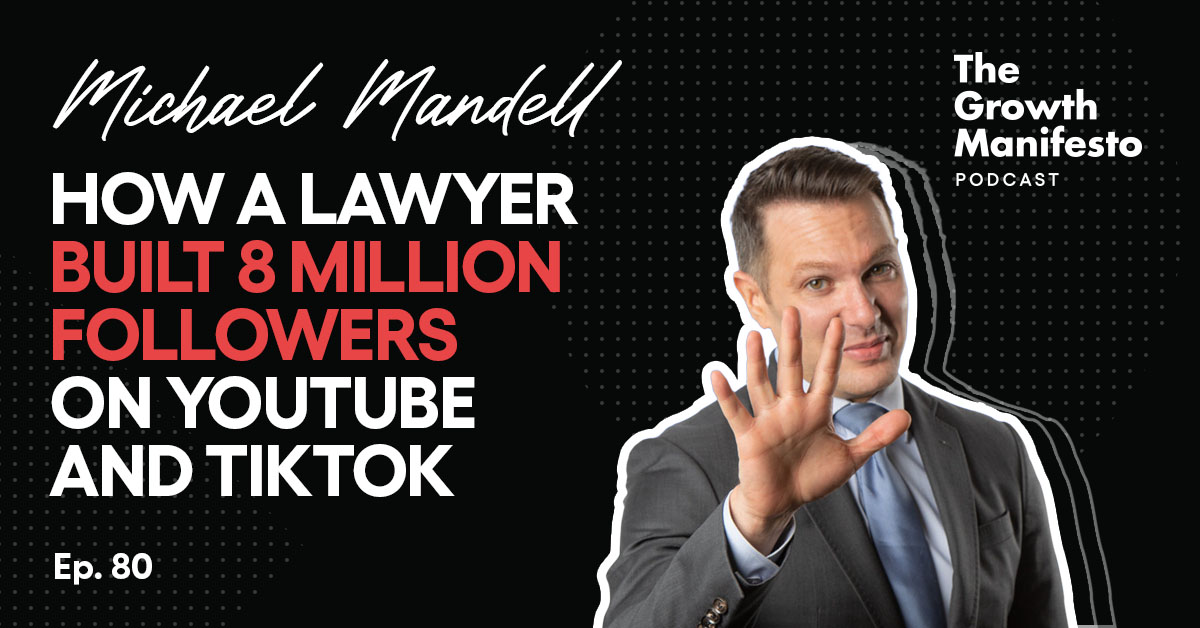
How a lawyer built 8 million followers on YouTube and TikTok
Michael Mandell, TikTok's top lawyer, explains how a speeding-stop video built 8 million followers and how he now monetises that following.
 with Michael Mandell


Overview
Michael Mandell – the #1 lawyer on social media with more than 6.5 million followers on TikTok, 1.25 million followers on YouTube, and hundreds of thousands of followers on Facebook and Instagram. In this episode we talk about how he was able to build up such a big following on YouTube and TikTok for what is considered a more traditional, legacy (and boring) industry.
Key takeaways
- Mandell argues content needs a mix of entertainment, inspiration and education, since combining two or three works better than just one.
- He spent most of his production time on scripting rather than visual effects, arguing a succinct message matters more than production polish.
- His first viral hit came about 30 videos and a month into posting, with a video on what to say when pulled over for speeding.
- Consistency in posting cadence, such as three set days a week, builds an audience that comes to expect content on a schedule.
- Mandell recommends limiting hashtags to three to five relevant ones rather than trending tags unrelated to the video's own topic.
Chapters
- Intro: the lawyer with 8 million followers
- Leaving big law for social media
- Building a content topic strategy
- The speeding-stop video that broke through
- A viral hit and its million views
- Hashtag strategy on TikTok
- Why consistency beats posting time
- Monetising the following with brand deals
- Final tip: lock in your handle
About the guest
Transcript
Auto-generated from the episode audio, so expect the odd mis-heard word. Timestamps open the video at that point.
Are you personally believing that you're bringing out content that people will find valuable, that it seems to get the point across as short as possible, because that's the name of the game, and just keep doing it consistently? You're listening to the Growth Manifesto podcast, where we host in-depth interviews with business leaders, authors, industry experts, and entrepreneurs, with a singular focus around business growth. At the end of each podcast, we want you to walk away inspired, to think bigger, and to have actionable takeaways you can apply to improve your business.
Each episode is like a masterclass on a key topic, so make sure to browse the episodes to find the topics that are most relevant to your biggest business challenges today. This podcast is brought to you by Web Profits, a digital growth consultancy that helps challenge your brands drive growth in a complex and fragmented digital landscape. You can find out more about Web Profits at webprofits.io. Now, let's get into it. This is Alex Kleanthus, and today we're talking with Michael Mandel, the number one lawyer
on social media with more than 6.5 million followers on TikTok, 1.25 on YouTube, and hundreds of thousands of followers on Facebook and Instagram. Today we'll be talking about how he was able to build up such a big following across these platforms for what is considered a more traditional legacy and potentially boring industry. Law, no offense. And just quickly, before we get started, just make sure to go ahead, hit that subscribe button so that you get the latest episodes as soon as they're released. Now let's get into it. Welcome, Michael. Hello. Thanks for having me, Alex. Yeah. Look, this is going to be another
super interesting conversation because what you've achieved through social media proves that it can be done with any industry because law, you would think, is the most difficult one because it's law. But somehow you'll find out a formula, secret formula, a formula. I know you have a course coming soon, so the formula is not going to become so secret in a minute, but we'll get to that later. Let's get straight into some background first. So how long have you been in law and how long were you in law before you started the social media push?
Yeah. So I've been a lawyer for nearly a decade. I worked in what we call big law, which are big, huge law firms. That was right after I graduated Duke Law School. It was very common to go into those big law firms when you go to a very prestigious school like that. But with the big law firms, I think we had 23 offices worldwide, over 2,000 lawyers. You can imagine all the red tape you have to go through
if you want to do any type of self-promotion or any type of promotion whatsoever, because it essentially reflects on the law firm's name. So no real opportunity to use social media during those seven, eight years that I was there. But then right before COVID, I decided to make the switch to, or sorry, right in the midst of COVID, basically, I decided to make a switch to go work at my family's law firm, personal injury lawyers. My father and uncle worked together, and I had always kind of had an interest on helping, you know, the little guy out rather
than defending the bad guys, so to speak, because over at the big law, I was defending pharmaceutical companies, plane crashes, anything that a manufacturer made that hurt someone. I was the guy defending the manufacturer and I was getting a little sick of that. So I wanted to go work, you know, the other side with my family. And that was the first time that I decided to use social media. And sure enough, though, within about a month of working at my family's firm, I had to quit working at my family's firm and open up my own law firm.
It just became too much. It's wild how insane things went from zero to 1,000, essentially, in a matter of months. and I couldn't handle, you know, both trying to do the duties at my family's law firm and at the same time helping everyone else reaching out to me around the US and even the world for that matter. So this is something which I just wasn't across was just the speed of it because, you know,
most people, most people I speak with, they were working at it for years before something hit. And what I just heard from you is that midst of COVID, you started something and then you launched your social media approach in the midst of COVID, which is less than two years ago now, let's say, right? And in that time, in less than two years, you've gotten to 6.5 million on TikTok and 1.2 million on YouTube. Arguably, it's easier on TikTok, right? But not so easy because 6.5 million is nothing to sneeze at. But YouTube has been around for a while. People have been trying to game that
for decades. And yet you got to 1.2 million there as well, which is a pretty big feat. So let's get straight into that then, because I thought it was a longer journey, but it seems like it's a shorter little success thing, right? So it's going to change my questions a little bit, not too much, but so when you got into it and you said, Hey, I'm going to try this thing. So what were you thinking at the time before you started? Right? Cause this is where everyone is right now. What the majority of people, I want to do this thing on social media. Everyone says it's going to take a while. We're in a boring industry. I don't even know what to talk about. So what was
your thinking before you got into it? Yeah. So, I mean, I want to start off that it wasn't like the first post I came out with all of a sudden it was success. You know, it was probably a month and a half, two months. I know that still sounds short. Whoa. Okay. Wow. But, but, but it was, you know, there, there was a lot of thought that, that got put into this and And really, more than anything, through the last two years almost, we actually, I launched my first TikTok, I believe it was around October of 2020.
But YouTube, we didn't start till October of 2021. So you can imagine that crazy growth. So you went the other way. You started TikTok first and then what, you pushed people to YouTube? I started uploading my older content to YouTube, and then it started gaining traction. And that's been kind of the thing that I've noticed with all of my videos. I mean, we tried it in the very beginning to post it on all platforms, but it takes a lot of time, especially when in those early days, it was basically just me and my cousin, who's my director.
And so a lot, it's still kind of like that. So it's still just a lot of time to even do the reposting as easy as it is. And so we kind of delayed doing YouTube for a while. But then, of course, now that blew up. But over these two years, we've really perfected the things that we know can get people's attention, how to make it more relevant, how to make it more valuable for people. All those things are really important when you come into this. But when it comes to starting out, as you asked, you really want to, my biggest piece of advice for people in just a general sense is don't just jump into it.
You got, if you haven't started it yet, then you're actually in a good place. You actually have all the time in the world to build up this inventory. It's not like people are like, where's your content? Where's your content? When you're in my position, you're like, we don't have enough stuff for every single day, you know? and it can get stressful. And I wish I could go back to having, you know, 100 or even 20 videos ready before. And so when you're in this position where you haven't started yet, you should be focusing on really coming up with a game plan and building an inventory of videos, especially
because most of your listeners out there have jobs, you know, their normal nine to five or whatever hours they're working jobs that they find it very difficult to make the time to make content. So do yourself a favor and build up an inventory. So that way you have a little bit of a cushion as you go into it. So it's going to be a fun conversation. A ton of questions. So first one. So what was your pre-plan before you started to publish or before you started to hit?
You said that you planned out content, quality, topic. So what was your strategy, let's call it, or your content approach for the topics and how you were going to publish? Yeah, it has evolved. I would say in the beginning, you know. Especially in the beginning, because in the beginning, the hardest part is to get traction. And then after that, there's a whole other challenge. But we'll start with the first challenge. Well, in the very beginning, you know, my goal was it wasn't to become viral. I was just hoping my friends would see my face and maybe their friends and give me a call about a car accident or something.
So but but that said, you know, I put my, you know, head into thinking about what, you know, would be some valuable tips for people. And, you know, the I figured why, you know, limit it exactly to personal injury. I wanted to kind of give people more of a general thing. And that expanded over time as well. I always tell people when they're thinking about what to post about, you should stay within your niche.
I'm in a little different of a situation because I'm trying to educate about every aspect of the law. But you don't want to necessarily do that because then you're going to get, if you're looking for leads and customers, you're going to get customers and leads related to the topics you post. which is true to this day. Anything I post about, I will get comments and calls about it. But that initial process of thinking was really about what's the value I'm going to give?
You know, it really comes down to that. There's different forms of value. There's entertainment value, there's inspiration, there's education, right? And if you can kind of combine all three of those or at least two of them, then you're going to have a better formula, right? There's people out there who just don't entertain and they just, you know, I think you've probably seen them on TikTok or the other social media platforms that talk really close to the camera, spit out the information, still gets a bunch of views, right? But I do think if that person was a little more
entertaining, it'd probably get even more. So the idea is to find a way to provide valuable information, but at the same time, some entertainment. And that's what I kind of wanted to do when I came out with these initially was like, all right, what do you what do I think people care about when it comes to the law? What are their most common legal questions? What what is a entertaining way I can insert my personality in that? And, you know, if I think it was funny, then maybe they'll find it funny. And if they don't, well, then, you know, I guess I got to go back to the drawing
board. But with social media, a lot of it is not so much about building the biggest audience. It's about building that audience that really connects with you. And so I think the focus should be less on the numbers and more on the engagement that you're getting from the people. And if you're putting your personality out there, you're bound to find people who dig it and people who don't. you know, and you want to go with the people who dig it and that's fine. I mean, that means you
have a stronger connection with people than if you, you know, kind of keep your personality out of it, which is a huge problem with lawyers. They're very scared to show any type of emotions. Well, it's funny because it's not just lawyers. I think like what is scary is to put yourself out there and to be risky, right? And I think being entertaining or trying to be entertaining whilst trying to be helpful could fall flat is the fear right and so people kind of limit themselves
you know i think it takes a while to open up right it's like the first season of a sitcom you know so all the actors they haven't really you know just kind of are settled into to the characters yet right but by the seventh season they're into the characters right how long before you got into your character yeah so was that like the first yeah I mean I think it become a lot more the more feedback that you've gotten like wow I did that I got 100,000 200,000 people just
subscribe cool should I do that you know some more so how long before you hit that it's kind of I mean you you got to look at how the audience responds and like when things are doing well then you certainly should continue repeating them in some form or fashion, but don't, you know, beat a dead horse, so to speak, right? Don't keep doing it till it's, you know, just not entertaining anymore. But, you know, you probably want to follow up somewhat quickly with something similar to it, you know, one or two more times, and then bring it back in a couple weeks or
something like that. But, you know, always take a look at what people are finding interesting, negative comments as much as people don't like to see them can sometimes be useful. You know, someone could say your voice sounded too high and maybe you were just speaking really high or something and you can talk at a normal level, like, or the, someone talks about the sound quality not being right. Maybe you're, you know, you're, you were holding the phone too far away or you're covering the mic or something. So there's definitely things very useful to look at. um as far as getting in the groove uh you know that uh i think i was talking on some other
podcasts about this um and they were like oh your first videos were so good i'm like well that's because the the the original first ones are privated or whatever because the uh you know in the very beginning i was pretty rigid um and i think it was just nerves and not really knowing what the hell i was doing and and all of that um that still worked though right that still worked even the rigidity that like that's not really no those ones didn't do that well they were definitely there were for us all that's good they were definitely before i had any hits so
who knows if i posted them after but i wouldn't post them after um because i just can see the difference um so it is just like everything in your professions out there uh practice makes perfect the more you get used to it the more you you kind of develop it the more you start making tweaks to it maybe uh i think in the beginning i was told i never blink because i think i was always you know you had the the scenes cut up and uh and i'm i was focusing so hard on the what i needed to say that
i wouldn't blink during each scene and it looked like i never blink when you splice it all together but there's just things that you get more comfortable you know then then you blink yeah um and so how many videos had you published before the first one that you left online you know because there come a point where you're like oh that's going to be privated how many until like you were like oh something's now working yeah i didn't private every single one i mean you know what i mean i probably had a bunch of stuff from 15 years ago not from two years ago yeah i would
say, I think it was, it was probably, you know, 30 videos or so. And it was about a month in, you know, that we kept trying and different things. And then we really hit with the, you know, what to say when you get pulled over for speeding, you know, when the cop goes, do you know how fast you were going? And, and I think one of those reasons why that hit is that It was just one of those topics that everyone, you know, wants to know the answer to, especially from a lawyer.
Right. Who else? Who else? The only two people they want the answer from for that are either a cop or a lawyer telling them which thing to say. Right. So I think that was just a universal question, I guess you could say, that people wanted answered. And I think the way we presented it obviously had an effect with it. But again, it all comes back to that, you know, what do people care about? How is it related to what you're doing? And how can you provide some value?
Yeah, great. And so then, so it's about the 30th video. You hit a topic, but you also hit the production quality. So the topic, let's start with the topic. How important is the topic to the success of each of your videos now? Well, not now, but like, especially like in the beginning, right? because I think now this like I still can't get away I still can't get I can't get away with posting anything you know like if it's boring it's going to do bad um so so I think so what's your approach for topics then yes yeah I mean we we go through that in in the course uh over here
that leads by Mike uh but the uh you know in reality the the topic is probably the absolute most important thing. That's where we start. We start with what is interesting, what could people like to hear about, how can we provide some value to that topic or that idea. And those things come in my head in all sorts of different ways. It could be because I got a phone call from a friend asking me something, or I see something online, a story comes out in the news. There's just a
million different ways that those ideas can come to you. But really, that is the crux is starting with the interesting topic. Then from there, you start adding all the bells and whistles. You start figuring out how are you going to say it? And then we go through this in the course of how you draft the initial script, how you start breaking it down, making it more interesting and all of that. And then after that comes how are you going to visually make it entertaining? Right. And it's not as I know with my videos, they're pretty they can get pretty more visually entertaining, I'd say, than others and probably more than most people want to spend time on.
And it's I can tell you, if you look at other tick talkers and people on social media, they don't do all the crazy special effects that we do and they still get great views. So the reason for that is, yeah, the visual effects can help a little bit, right? And they can definitely move people along and help to explain maybe drier topics. But if you can really start with that interesting topic, you know, you could be just spouting at the phone. Or you could just do a quick transition looking to the side or something, as you've seen other creators and people online do.
So really, number one priority is finding something that people want to know about. And that is number one. But then you also said you did 30 videos in a month before you started to hit something, right? So did you do 30 different topics? Or was it the same topic 30 different times? Or was it a few topics a few different times each? It was spreading around. That's a lot of content. That's a lot of topic ideation. That's a lot, right?
Yeah. There was definitely different formats and ways we were trying. We tried story times. We tried different, you know, here's like top five of this, best tips, you know, like all different ways to kind of figure it out. And then I can tell you that just because those ones didn't work until one did doesn't mean that those ones didn't work. The algorithm is kind of like no one can really say what happens.
And I can promise you that sometimes the same video maybe posted at a different time could do much better, right? So it's hard to know for sure what's going on there, which is why you want to just focus on, like, are you personally believing that you're bringing out content that people will find valuable, that it seems to get the point across as short as possible, because that's the name of the game, and just keep doing it consistently? because I think more than anything, than it being like, oh, that was the right topic or that was the
right thing. It was more like we just kept pushing out different things until we saw something. And it's that consistency that really got us, you know, to make it to the next level more so than like, you know, we just thought of the great topic that day, you know? So you started, right? And like i'm really trying to unpack this starting point because i think this is where the majority of people are stuck starting right and starting and then staying consistent with it um so i'm
just trying to understand like especially like the thinking the timing and stuff like that so started you got some topics now you're doing your production how long was each like especially for the first ones right how long uh had you spent in preparing a script for example compared to then you know, recording the videos and then basically all the editing of the TikTok videos. Yeah. Yeah. It's racking my brain to think back that part because it was, it was different. I was like working, I think I got off work at like 6 PM and then I would, you know,
go and film after that till like midnight or 1 AM. So it was like, it was pretty crazy at the time. That's why I had to end up leaving my family's firm because I couldn't do both. But But I think what I had planned back then was like two half days, or maybe it was one half day and one full day of filming. And then the rest of the week was kind of trying to find time to script. Sometimes I would script that day.
But the scripting was where the majority of the time was spent. you know it was it was really again it comes down to what you're saying right you could you could have unless you're going to just post like really cool visual effects and not say anything which some people do and it works for them in in this kind of platform where you're trying to get leads or or you know you promote your business in some sense or your specialty you've got to
start with like making sure your message is succinct, that it's, you know, valuable. And that is where your time needs to be spent. Then you, then you get into like, oh, well, maybe we should film it in this area because we're talking about trains. We'll film in our train station or something, you know, like whatever it is, you can, you can find little things to do to add a little extra dimensions to it, but that's all secondary. Interesting. So yes, the scripting, which is really interesting, right? Because I think you know when a lot of people think about hey i'm going to start you know doing something on
tiktok or this or there um especially from a video perspective they just start recording a video right and then they edit it later right and what you're saying is no no start with the topic script the topic try and make it interesting fun right but this is the points which you want to get across think about kind of how you can make this entertaining as well figure out your personality figure out you know how do you want to be you know yeah you know who is who is you who are you and you know who are you like if like it was just you with no fear right and so you know so you're
probably like a bit more entertaining as a person right and so then that has come out right like like you seem like a pretty positive person which kind of fits the style of your videos as well right and so of course you used to because okay so you did that and then something hit so what happened is when the first video just started to blow up yes what happened to your followers starting point and then there and then yes yeah let's start there yeah I mean you know it's funny
and maybe people say this no matter what but like before it blew up there were people commenting like here in the first, you know, 1,000 or 500, you know, before you blow up. It's like people kind of like could tell just because it was a matter of time till the message just got out, right? And that was kind of just shown by like, you know, good comments and good, you know, like engagement, even at the early stages. Once it did blow up, you know, then the phone started ringing
and it started getting crazy. But it was exciting. And it just meant that we're onto something that's working. And then from there, it was, well, let's do a couple more of these cop videos, right? Because that was what had been on there. But then we're like, we can't only do cop videos. Then we're going to be a one trick pony. And we didn't want to do that. And I think it's important to diversify your brand. Even if your job is specifically just, let's say, criminal law, then, you know, sure, you can do cop scenes, but there's a lot of other things, right, involved with a criminal lawyer that don't involve the cops, that could involve bail or jail or what to do with your lawyer, you know, all sorts of stuff.
So you want to continually expand. And so that was like kind of our game plan from the start was like, let's continue to, you know, put out what people are currently liking, but also test other things to find the next thing that we can bring in. And that's been really our program, you know, since for the last two years is just kind of holding on to what's working and trying out new things. So what was the follower increase the first time something hit?
You know, because I'm interested in this one too, right? Hey, look, I had about 5,000, 10,000 or 500. And then all of a sudden it was at 50,000 or it was at 200,000. And it's what was that first number where you were like, okay, now I have to step it up now. Now it's working. I mean, there was before like my massive, massive hit. There was one that got like a million views in a day. And it was like, I was like, all right, people are, you know, we're getting people's attention now.
And then the one that I came out with that really became a massive hit, it became a trend, which is, you know, that's not easy for anyone to get. But when it does, it can go pretty crazy. And it went worldwide with people, you know, making their parodies of it. And I went from, I had, I think I got, I basically got a million followers during the daytime, woke up the next day, had like another million followers. Wow. Okay.
This is really good context. I'm trying to put context to the story, right? The story is a really good story. but a million you i was like i think in 24 hours or to 48 hours yeah i mean it might have been slightly less than 2 million it was like it might have been like 1.7 million yeah yeah and 300 000 here and there whatever but but uh but you know and then since then it's that that was like and that's very common on tiktok which is why people will say tiktok's easier to get followers You know, you could you could have this one super viral video. Sometimes it's just like someone doing something weird. Right. And all of a sudden now they got a million followers. Right. But that's that that's why a million followers is great.
like, don't get me wrong, it's great for TikTok, but it's not, to reach the higher levels, you have to be more than just that one viral video. You have to continue making videos that go viral and building an audience. And so that's, you know, part of the puzzle that you have to figure out, right? And that's why I say it's smart to do what was working, but always experiment to keep growing your personality, your brand, your community, showing different aspects of your life, of your
business, so that there's variety. And so when you woke up one day, or a couple days later, and now you've got a couple million followers, right? You're like, okay, now there's something here. Yeah. So now, how did your thinking change to now having this audience not to be responsible for but you know to try to nurture and to grow yeah um like i said you know the the getting a a million followers on tick tock is still no easy feat um and so
my mentality started changing from i think i gotta leave my family's law firm is that what happened was it just when you and you had two mil and you're like oh okay i just felt like yeah i I felt like with the amount of influx of phone calls, messages I was getting, it was insanity. And I was like, I can't handle this in my other job. And I was in like a fork in the road. Like, what's going to be more fun to do?
What's going to be, you know, what's a kind of once in a lifetime experience? And I felt like if I pursued this route that, you know, I could maybe kind of become the first, you know, legal influencer in a way. And I like to compare myself to like Bill Nye. I don't know if you have Bill Nye over there in Oz, but he would talk about science. We grew up on him on TV and he basically would make science very fun and interesting as kids. you know, wacky kind of entertaining, but the most boring topic. Right. And that's the same
thing with the law. And so I saw in my head, like, you know, yeah, I can still generate leads from this and, you know, potentially do something to help them out legally. But also, you know, there's a new thing here that hasn't been done that if I pass it up, if I say no to it, someone else is going to do it or won't come by again. So that's why I kind of jumped into this full throttle. And now, you know, my life is really focusing on the content creation,
understanding the algorithms, you know, doing this. Whereas in the initial stages, it was a side gig. And so, so did the production just stay on the same, I want to call it plan? or did you say, now I have 2 million plus followers, we have to change something up? I think the production became more of a priority. I still reserve time for my law firm most of the
week and then have my scheduled days for filming on the weekends. But as things continue to grow, The content keeps taking more and more time. We're trying to expand into doing long form content, some pretty highly entertaining stuff. Obviously, that takes even more time. So that's always a struggle on it. But I've kind of made that decision to focus on content creation more so than anything,
because I do think we're in a unique position to pave the way for lawyers and other professionals on social media. Yeah, fantastic. And this is part of the reason why you're on this podcast, right? Because you've done such an amazing thing. So it's already, you know, it's certainly having an impact. So then TikTok, cool. There's a lot in terms of kind of the algorithms and so on. Just quickly, and this is kind of just one question, how important are hashtags for TikTok? how important are hashtags
how important are hashtags how important are they you know I wish I could say 100% that anyone knows I've spoken to I have ambassadors at TikTok and I've spoken to them it's just the best tip for it is keep the amount you use small I've been told 3 to 5 is really around where you should be. Look for trending ones that relate to your topic.
Make sure you don't use a hashtag just because it's like, you know, if it's like WrestleMania or something that's trending and you're posting about dogs. I don't know, like, don't do that. So make sure if there's a trending hashtag that relates to your video topic, use it. and you can look at uptrendy ones on the explore page. As far as I know a lot of people ask, should you use FYP or for you page? Apparently that does not work
despite a lot of people out there saying that it does something. What I've been told multiple times is that it doesn't and I trust the people telling me it. So I'm gonna say it doesn't work in my own experience, it hasn't. So the idea is you should pick hashtags that are, you know, relevant to what you're posting. I think it's a good idea to go a little broad and a little narrow when it comes to that. And then just don't overdo it because you also have to think about these things
from a visual perspective. If they see, if people, you know, see like 50 hashtags, they're just, no one wants to read that, you know? And TikTok doesn't have a way to separate it cleanly, really. So it just looks like a big blog. so all right thank you for sharing yeah that's really really good similar to how it was in instagram um back in the day just when that was going organic right um this seems similar but way bigger so youtube so you started youtube a year later now what was your approach to
starting youtube yeah so youtube shorts i mean i guess it's not 100% active to say it was a year later, I think we may have been posting earlier that year, but didn't see really any traction. And so we just kind of gave up. And then we heard like someone that we knew was kind of doing like all right on YouTube, like growing. And we were like, okay, let's try it out again. And that's when we tried it out again in October and it started exploding in a huge amount of growth.
the um the plan there was really you know just be again consistent the fortunate thing i had at that time was since i didn't post on youtube for like eight months in between like that i guess that one first trial period um the uh i had so much content just to kind of re-put on there and and i was just like okay let's just put put this on and then if a new video came out i put on the new video too. So it was just a lot of content ready to put on YouTube. And once I started seeing
the growth, I was like, all right, well, let's try posting more, more, you know, like because it started going on upswing. I'm like, all right, I'm going to post two a day, you know? Oh, I'm sorry. I'm post five a day, but I had the ability to do that. Right. And so that was, it is, I guess, and again, this isn't anything other than a personal anecdote about my, my experience. But when I saw that upwards trend, upward trend, I decided to keep posting a lot and it seemed to help. And now, you know, I just I've already gone through that inventory.
So now it's now it's one a day. Sorry, guys. Yeah. I can't do it. Yeah. Well, what's interesting. Well, a couple of things. My first question is, like, did you push people from your TikTok channel to your YouTube channel? or was it organically done? You know, just kind of you posted, posted, posted, posted, and then it just started working with not much cross promotion. It was organically done, to be honest. I was always trying to push people
to my Instagram from TikTok, had a little bit of success with it, but, you know, it's not easy to get people to cross over to the platforms. There are some techniques that people can try doing a part one on your TikTok and a part two on a different platform and things like that. But it's not always easy. And the thing I was actually most fascinated with recently was I reposted or I posted a thank you post we did for reaching a million subscribers on YouTube.
I posted that on TikTok. And I don't know for sure, but, you know, the amount of followers we got off that post from both, you know, like on the YouTube platform was huge. And I have a feeling that the post thanking people, although I didn't, you know, really tell them to go subscribe to my YouTube, had the, you know, effect of getting people to subscribe. because I always think that people don't like to be told what to do, but if you can somehow find a way to make them feel a certain way
without telling them, then it may have better effects for you. Yeah, sure. So thank you for clarifying the cross-promotion. And it sounds like a true thing that if I'm on a specific channel, I'm probably not going to go to another channel because someone asked me to, right? And you can see manipulation that it's, you know, a bad thing, but hey, this is a specific thing, you know, which you want me to do. So maybe I won't do it. Right. So, but that's interesting to know that you started organically, right? Just through YouTube. Does that mean that you started with shorts? Like it was just shorts only?
Yeah, we started with shorts. I think we experimented with a couple of long forms, but the idea was always to, we didn't have time. I still barely had time to try to make the long form stuff. So it was like, let's figure out how to use the content we've already created, keep things, you know, so we can keep this machine going, you know, repurpose and reutilize things that have already been created and if they need to be adjusted at all for other platforms, which is rarely the case when it comes to these vertical ones that, you know, they're normally all the same type of dimensions that, you know, it was pretty easy to do that.
And that's why we started. Now, you know, we we try to we're trying to do long form content and things specific for YouTube, because when you get to a certain level, it's a good idea to kind of cater to what maybe audiences want on certain platforms or just keep things maybe on one or start off, you know, exclusive on one, et cetera, things like that. So you took the TikTok videos and just uploaded them, basically,
just like for the first month or so or two months or whatever it was. Is that right? because all of the editing would have taken you so much time and you have to do your other content. You've got your business. You've got calls coming in. You're launching a course. There's all these things. Yeah, we have all of our videos. When we create them, we save them before we post them on any of the platforms. So we have basically the raw footage. If we go into the app with the video
and we add things like text bubbles or music or something like that, that's done within the apps. But if you do that and then save it, and then you're stuck with their watermarks and probably metadata that, trust me, these algorithms are pretty smart. So they're going to notice if you're repurposing stuff in that way. And it's not so much, I think, that they're like, oh, you posted it on TikTok. So we don't want it on our platform. It's, it's, we don't want TikTok
symbol on our platform, you know, that's supposed to keep people here, which makes sense. I mean, no Coca-Cola doesn't want Pepsi on their commercial, right? So it's the same concept. Okay. So you've got the raw footage and just before all of the personalizations for the platform, that's how it was done. So there was still some editing required, right? There was still some editing for YouTube Shorts, maybe it's a bit less than TikTok? Yeah, I would say pretty minor, you know, editing. Obviously, you got to put in captions, you know, and there's different strategies as
far as, you know, how many hashtags are used on one platform versus the other. But, you know, the idea being is that you can do yourself a favor by creating this content beforehand, you know, having it saved in your camera roll before you post it. And then, you know, not having to do as much work to post it across all the platforms. Cool. Publishing schedule for YouTube. Okay. So you started off and it was like once a day and that was working, right? And so was that the same time every single day? Because I've heard that's a thing. Is that a
thing for you? You know, just for your personal anecdotal experience, you know, was that a thing? Yeah, I think actually in general, you know, I like to look at analytics to see when the audience is most active to determine the time I should start posting. But then, you know, and I'll check them from time to time to see if things change. Although I do think there is some kind of circular thing there. If you're only posting around the same time, it's probably going to affect the analytics.
But either way, I think what I've been told and what I've also noticed is that the most important thing is to be consistent. And when I say consistent, it's a consistent cadence of when you post. You post three times a week. You post those same three days a week as well as around the same time. Just think of your social media like a TV show. It comes on air at the same time. Why do, why, if your favorite TV show was always coming on at different times of the day, you know, it'd be an issue.
There's a reason why, you know, media networks plan. You got your Sunday at 8 p.m. show, right? Always there. You got to think of it in that kind of respect because when you do start to build your community, they're going to be kind of looking for it around that time. And if they don't see it, they could unfollow you. They could get upset or you just miss out on those views for that day. Maybe. Yeah, sure. That's good. Now let's jump to monetization, right?
Because you have all these followers, subscribers and viewers. What does it take to monetize, you know, the action, right? Because there's a lot of production costs now that will go into it. Right. And, you know, it seems like just a few small videos, you know, here and there. but the production, the volume and the quality standards continue to grow. And then they expand, right? Like into now we have to do some long form. All this is just costs money, right? And so when do you start to monetize it? Or was it basically just like at the very start?
I think you mentioned, you know, some phone calls that were happening. You know, how are the ways that you were able to monetize the growth and the following across these platforms? Yeah. So I would say, you know, to be frank, a lot of the time was not spent monetizing. That's because, one, being, you know, really the first lawyer to pioneer this, brands and sponsors have had some difficulty understanding, well, how does my brand fit in with a lawyer?
Which, you know, I've had to explain and show proof of concept and build that over the last two years, essentially. Now, some people may have it much, much easier because there's already influencers in their space that they can point to and the advertisers can see, look, this realtor or whoever, whatever is related to your field is already doing stuff for X, Y, and Z company.
And so they know that they can place brands with you. There's also the ability to come out with courses, which we're launching soon. And as of today, we're still in the pre-sale, which is at a discount rate. But again, this course I've had ready to go in my mind for quite some time. It's just now that we're finally getting to the time where we're in the editing production
right now. So it should be out pretty soon. But it just takes a long time with these things because you're also focused on trying to make the content and keep the people happy. So there's different parts there. But also, I would say that the main thing that was kind of bringing in income while we were working on these things and trying to develop these things was the leads from these videos. I was getting hundreds of phone calls. I mean, I think I had like over 600 phone calls in
a month and thousands of text messages of cases. Now, not all those are real cases. Not all of them were cases we took, but that's something you can't neglect when you're building this. Sure, there's ways to try to monetize your brand or what you're forming as a social media content creator. But if you're in that dual position of giving out educational value because it relates to your actual job that you're working while you're trying to make this content, trust me, your job's going to grow.
You're going to get people reaching out. And then that's when you start thinking of different ways to help people and spread your time out because time starts to get very finite. yeah i can i can imagine just what it's like to you know just have like all this um like like full-time job and then this is kind of the thing that happens on the side it blows up and that becomes the full-time job to create content then all of a sudden you get 600 calls in a so basically in like like a 30-day period and now you have to create a process for how do you even
qualify them and then call okay so who do you call and how do you actually have a conversation with 600 people is that five minutes each what does that become 3 000 hours this has a minute sorry was like 50 hours but then that has to fit in and then there's probably the work at the end of that too right so that's just even before you actually have invoiced yet right so it's like um trying to balance that is part of the journey but i think what's interesting is that um you have this opportunity and you're breaking through um for like an industry that traditionally hasn't
been seen as a place for TikTok or as a place for YouTube, right? And I think, you know, what's interesting just for this conversation and for the listeners is that I think a lot of people probably think that they are in a boring industry who are considering it, right? I think the people that are already on TikTok trying to do TikTok, they don't have any issues, right? But I think for professionals, you know, it was like Facebook back in 2010, 11, that's just for kids. Same for instagram it's just for kids you know and now it's the same for tiktok that's just for kids and and it's just it repeats it starts with the younger people but then it starts to have like
like a groundswell and it becomes a bigger thing and i think now you've created something from a legal perspective um that is extremely impressive yeah um so you have a course that's launching now it's in pre-sale now i'm not sure if this is going to be published before the pre-sale is over. Let's not mention the price yet. We won't mention the price. But what's the course about? It's called Leads by Mike. And basically we take you through answering a lot of the questions
you asked me today, but I couldn't give you all the secrets. But we start from the process of what you need to get started to how you start scripting, to finalizing that script, to filming it to editing it to engaging with your audience it's a it's a full-on um top to bottom uh how to use social media to get um you know success on on getting leads and how to cultivate those leads and the course like is it um specifically focused on the tiktok channel and it's actually
it's actually focused on just short form content in general um so uh again like i was saying the this material can be used everywhere. So TikTok, Facebook Reels, Instagram Reels, YouTube Shorts, you got, I think you could even put it on LinkedIn, I guess, if you want. But you seriously have about four different ways to start promoting your video, which is great because there's different audiences among all of them. So the course is just really showing you
how to make the short form of content, which takes the least amount of time, which is one of the huge benefits. It takes the least amount of time compared to other types of content. Also has the highest reach, the fastest growth, and the biggest potential for you to get leads from in a short time. And what's interesting is that this is created from a lawyer who's done it, right? So for anyone who's considering or who's been thinking about creating content for social media and they're not
quite sure the place to start i can tell you from having a podcast the amount of production time that goes and the pre-production production post-production is massive this sounds like a really easy way in from someone who's figured out something that's led to 8 million followers across social media so that so i mean i'd highly recommend um to purchase it that's at leads leads at leadsbymike.com. I'm definitely going to get it, obviously, because I want all the insights as well. And I mean, look, this is probably not going to help his followers, but
he's available at law by Mike, right? That's a TikTok. And is that also at YouTube? Yeah. All the, all platforms law by Mike. Surprisingly, that was available. You know how hard it is to find a handle that is available on all platforms. I know you got one. It was, it was available and I snagged it up on every, I think I even have it on like Snapchat, which I don't use as of right now, at least. But, but I was like, I got to get it on every single thing. So hopefully no one out there is looking to take the name now on some,
some random thing, but you, you do want to try when you, when you, I guess as a final tip for some of your viewers and listeners out there, if you haven't come out with something yet on any social media, do try to find something that can be common among those. I mean, look, if you can't, I think on Twitter, I have law by Mike underscore, which I'm still complaining about with Twitter and they're not fixing it. So if you're out there, Twitter, I'm going to keep complaining about it. But, you know, you got to deal with it.
Sometimes it is what it is. But the more you can get it across the platforms, especially across the platforms that you think you'll be using the most. For me, Twitter isn't really the go-to place for short form content, like video content. So it's not the biggest deal in the world. But making sure that I had that name across the platforms that are heavily promoting short form content was important. So definitely look into that before you launch your thing. You can grab those names now before you post anything.
So do that as your first step. yeah especially because later um you're going to get um squatters who who is going to squat on your name and then they're going to try and sell it back to you for like 30 grand and you're going to be like i'll just put an underscore but i don't want to do that underscore thing yeah that's going to happen isn't it yeah it could it could unfortunately you know they don't try to do that with the lawyer good point i love that that's a good one that's a warning for everyone out there Hey, Mike, thank you so much for coming on the podcast.
Thank you for sharing. Congratulations on such a fantastic journey and kind of extra kudos for the speed of something kind of hitting. Yes, it's six weeks, but that's a long six weeks when you're creating a video a day. And I think, you know, just for the listeners, try and create a video for a day for a month. See how hard that is before you say, oh, that was lucky, right? Like, you know, because it's sometimes it's the right timing with the right topic with the right intention, but you got to do the work, you know, and I think, you know, fantastic
on you for doing the work and, you know, just for breaking through and thank you for sharing the story on the podcast today. Yeah. Thank you, Alex. Thanks for having me on. Thanks for listening to the Growth Manifesto podcast. If you enjoyed the episode, please give us a five-star rating on iTunes. For more episodes, please visit growthmanifesto.com forward slash podcast. And if you need help driving growth for your company, please get in touch with us at webprofits.io.