
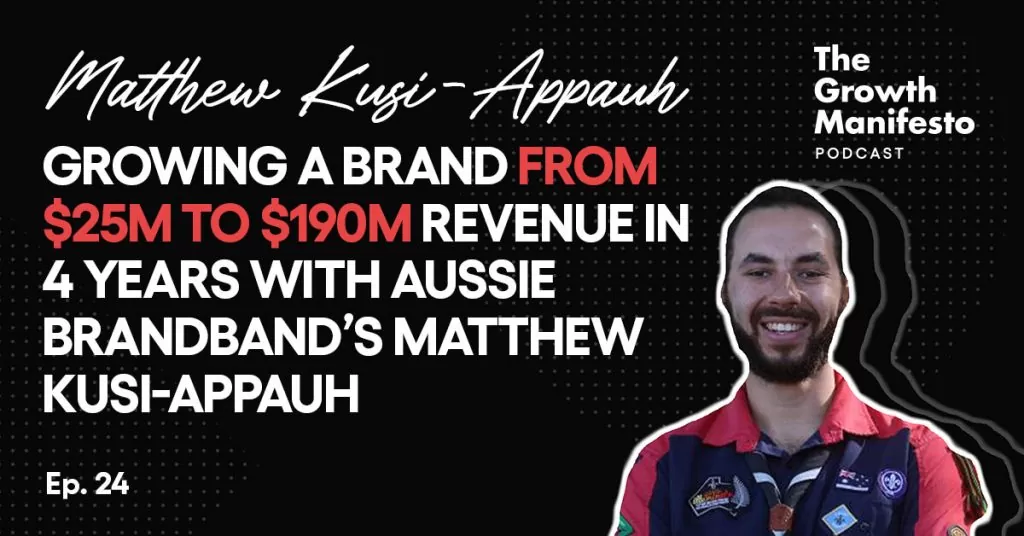
Growing a brand from $25M to $190M revenue in 4 years with Aussie Brandband’s Matthew Kusi-Appauh
Matthew Kusi-Appauh explains how Aussie Broadband grew from $25 million to $190 million in four years through direct mail, testing and product quality.
 with Matthew Kusi-Appauh


Overview
This episode is a discussion with Matthew Kusi-Appauh – General Manager Marketing & Corporate Strategy at Aussie Broadband. We talk about how they grew from $25m to $190m in annual revenue in 4 years, and lessons along the way.
SHOW NOTES
Key takeaways
- Aussie Broadband doubled revenue every year for four years, from $25 million to $190 million, largely through direct mail and constant testing.
- The company tested mail colour, timing and copy, then matched signups back to addresses to work out which pieces of direct mail actually worked.
- Direct mail volume grew from about 100,000 pieces a week to a peak of 500,000 a week as the strategy proved itself.
- Kusi-Appauh argues marketing does not make or break a company, product quality does, and Aussie Broadband's growth came mainly from its network and customer service.
- As an unknown challenger brand, Aussie Broadband attributed a sale to the first channel a customer interacted with, rather than the last click.
Chapters
About the guest
Transcript
Auto-generated from the episode audio, so expect the odd mis-heard word. Timestamps open the video at that point.
You're listening to the 2020 Marketing Series on the Growth Manifesto podcast, a Zoom video series brought to you by Web Profits, where we talk about how to drive business and marketing success through the rest of 2020. This episode is a discussion with Matthew Kuzia-Paw, the General Manager of Marketing and Corporate Strategy at Aussie Broadband. We talk about how they grew from $25 million to $190 million in annual revenue in four years and lessons along the way. So let's get into it. Today we're talking with General Manager of Marketing and Corporate Strategy at Aussie
Broadband. His name is Koozie, which is actually part of his last name. It's Matthew Koozie. Could you help me say it? Yeah, Matthew Koozie, F-O. Koozie, F-O, right? And he's led the marketing team at Aussie Broadband for the last four years and has taken it from 25 mil to more than $100 million in annual revenue. That was last year. They're now the fifth largest NBN provider in
the country. So I'm excited to have him on the podcast. And I thought a good place to start is how are you tracking like this year? Because I know last year you were at about 100 million revenue, which was like you doubled from 25 to 50 and then from 50 to 100 and like and that was a stretch goal and how are you going this year? So for the financial year that we've just wrapped up we're on track and obviously the numbers are yet to come in and be finalized we're on track for in the area of 190 million for the financial year which will which will put nearly nearly our third
year of kind of yeah doubling the size of the company in revenue terms so you've doubled three years in a row four years in a row yeah 25 50 100 190 yeah yeah sorry like i just had to count on my fingers sorry that makes me really really smart right now but you doubled um you know four years in a row yeah yeah so yep yep pretty much what's that like i mean how does talk to me about like the first parts of the growth, you know, so the first years, right?
Because we'll come to this last part, but, you know, talk to me about the challenge of actually having to double the revenue of a company every year for four years. What's that like? So it's been a very interesting journey. And I think that anyone who's operating in a, you know, what, what I would call a small business as Aussie was, certainly when I started, We had about 60, 65 staff. So it wasn't a large operation by any means. It was a very, very interesting journey. And one that I look at, and I think a lot of businesses have kind of probably come through, they've all had similar challenges, similar struggles along the way.
when we were starting out, we had a really kind of, we kind of had a real core group of people who were really invested in, you know, having a great performing network, great customer service. Certainly those early days, though, the biggest thing was how do we get our marketing out there? You know, you're competing against giants in the industry and particularly for Aussie broadband in the telco industry. We're competing against NBN, with the NBN products. competing with Telstra, with Optus, with TPG, who also have a couple of the other brands like
Ironit and things like that. So you're competing against these massive companies. The four biggest companies in the industry have over 90% of NBN connections. So as a small regional player that we were at that time, we kind of had a really good product that we thought and great Australian based customer service. But the challenge was just getting our name out there, you know, people who had never heard of us before. And we really started to actually quite critically look
at, okay, right, well, what is the right marketing channels that are going to allow us to scale, I suppose. And what we found is that as the NBN started to roll out, you know, people had 18 months to change. And so the NBN first came to an area and that caused everyone in the area to stop and go hang on a second I've got to I've got to make a decision do I stay with my current provider do I move do I whatever else like that and so we actually started funnily enough as a tech company the the origins of our marketing
strategy were direct mail because it allowed us to get our name out there to the customers you know right when they were kind of starting to make that purchase decision and that was kind of really what started to kick things off for us so you started off with the direct mail but then how did you figure out the strategy for direct mail because obviously there's so many parts to getting it right and you obviously yeah have gotten it right to be able to get past that like initial first step for sure so um one of the things that we um we're really kind of um and and i'll tell anyone who
listens i'm not a real marketer i actually you know studied international business and economics at university and so from the get-go it was very much a focus on testing and on getting getting data so we would send out a piece of mail and it might be it might have been green or it might have been blue or orange or whatever else like that and then test it how many calls did we receive from that mail okay right well then this one works better than than this particular piece okay right so we send out we iterate it we send out another batch of mail and we'd send it to
different areas and also at different points in time in the journey so you know we'd send mail before they went live and then test that and then when they went live on the nbn and then test that and then after they went live and at each point um every kind of different tactic or different execution that we use we test it we collect the data on how many leads do we generate how many sales did we generate okay right then let's make some improvements or some changes to to the copy or the color or the timing or whatever send it out again and so it was just a an iterative process And so certainly those early years were, you know, it was a kind of really slow start for the marketing strategy.
And, you know, the first year that I was with the company, we went from when I started 20 million and the first year we went from 20 to 25. So, you know, obviously an increase, but nowhere near as significant as kind of what we found, obviously, later on, because it took time to grow and test and whatever. And as a small business, you don't have the money to do everything all at once. You've got to start small and then build. And so that's kind of what we did. We started small. We started to build. We started to build, started to add other channels.
And again, with the same approach of testing and optimizing our kind of executions. And that ultimately led to helping us jump from 25 to the 50 and then 50 to the 100. And from there has been that kind of continued focus on testing and optimization. So then in those early days, you tested the mailers. And how did you test them exactly? But was there a phone number that was different? Or what was the difference between the mailers and how did you test them?
It's very much art, not science, I suppose. So in the case of for us, for direct mail, we actually looked at the address. So we would go, right, we've mailed this particular area, this locality or this postcode. And then because the NBN is primarily an address driven product, you know, you order it at your house. We could then match those addresses back to the mail that we sent to those areas. And that's how we started to attribute and work out the success of different pieces was going right.
That address is signed up. And at the time, we were we were basically focused on, you know, historically we'd done regional Victoria, a little bit of regional South Australia. all of a sudden we were getting calls from Queensland like butter and places like that that we you know had never marketed to that you know we had no brand presence in so early on it was an indication of hang on a second this mail starting to have an effect and then obviously looking at the data and matching the addresses back to the localities that we bailed we saw yeah
this is actually a spin a successful strategy and so with NBN specifically you chose the direct mail path because you had the addresses of where it was connected is that right yeah yeah and and we're very I guess everyone's got a kind of you got to play to the industry I suppose that you're operating in so this kind of strategy wouldn't work for a lot of industries where that you know they don't necessarily know where that where the customers are but you know because it's an address based product and the NBN was rolling out so we had
data on the nbn's going live in this particular area this particular postcode and that allowed us to then send send mail and the thing about mail was it scales at a as at a flat cost so the cost of sending a piece of mail to an address doesn't change like like say for example a digital channel where the more you bid that that price goes up and up and up per bid whereas you can send as me you know letters out as you like and that cost is actually the same so it allows it allowed us to
scale um yeah quite quickly and how many like like at the peak of the mailing this is just something i'm interested in um um how much kind of per week was being sent or per month yeah so was being sent in direct mail at its at its peak which um has only been uh certainly over the last couple of months, we've actually ramped up direct mail even further than what we
suppose what we started with in those early days, because we kind of started around 100,000 a week. And at its peak, we're probably running at 500,000 a week. 500,000 mailers a week. Okay, so you guys know something about direct mail now? Yeah, yeah. And that's great. That's a lot of production stuff. And that's a lot of testing. I mean, And how has the tracking now changed? Because obviously at that level of sending, is it as easy now to see the performance
as it was at the start? Is it still the same strategy or has that changed? It's not necessarily the same strategy. What we find is that as we've started to layer, obviously, additional channels on top, it does become a little bit more difficult. And obviously for any marketer, I suppose the challenge is always, okay, they saw a piece of mail, but then they clicked on a digital ad. And then, you know, how do you kind of attribute, you know, the different channels, a mix of different channels.
So it has definitely become a lot, a lot trickier than more channels that we've been operating in. But we still do look at, we still try and as best as we can go, right. What was the, what was the first place that person heard about us? So, you know, if they clicked on an ad, but they received a postcard, you know, or a piece of mail, you know, a couple of days beforehand, we normally actually look at go back to that piece of mail and wait that more heavily knowing that it's likely they're more likely to have clicked on the ad or
Google this or whatever else like that after having received say for example the piece of mail in there in there at letterbox yeah got it got it so in the beginning you started off with just direct mail how is the marketing evolved from 20 million dollar company just doing a hundred thousand pieces a week you know of direct mail to now 190 million dollar company and the fifth largest nbn provided in the country like how has the marketing changed in that time um i think it's probably been a case
of we've we've started to then supplement i guess um our direct mail strategy and it was more we've always had kind of other channels that we're probably using in um kind of piecemeal you know bits and pieces as we you know we were a small business at the time we didn't have a national strategy so you know the direct mail was the start of that strategy we supplemented that quite early on with digital advertising and digital obviously it is a channel that's extremely
effective particularly where you've got a particular a particular demographic that you're trying to target you can target things far more easily than you can just you know a direct mail you're sending it to a household but you don't know anything about that household whereas on digital advertising facebook google you can go yeah they're searching for for the nbn no and so that was a very logical kind of thing to pair with our direct mail strategy to make sure that you know okay cool we've generated that interest in hey look i need to look for an nbn provider right make sure that we're we're there when they search for the nbn they're there when they look up best
nbn deals so um yeah quite early on we've been using digital and and and it continues to kind to be a mainstay of our marketing campaign. One of the things that as we started to grow and expand, we were never really in a position to do large-scale broadcast above-the-line kind of advertising. About beginning of 2019, we first started our first TV ads that were just running in Metro Victoria and Metro New South Wales.
And we actually found pretty much straightaway running those TV ads combined with the mail and the digital advertising that we were doing, straight away having that top of funnel channel helped to lift our overall awareness. And pretty much immediately we started to lift our sales and our leads as a result. Yeah, it's really interesting. And I've seen kind of how you guys have expanded over the years and you're just kind of adding channel upon channel upon channel
upon channel. but I also know the attribution side of thing, which is what like you mentioned just a second ago is really hard, right? Like how do you attribute because you know you need to do more. You know you need to get more market share but you don't want to overspend and you don't want to overcapitalize on acquisition. So how do you approach it? Yeah, so for us, what's been really important is, as I said, that kind of constant process
of testing and optimization. We actually use quite heavily what we call the cost per sale. And, you know, again, it's more art than science, but as best as we can, we try to work out where did that lead first come from, if we can, and then we go, right, well, this is how much we spent on, you know, any given channel, whether it's mail or whether it's broadcast or whether it's digital, this is how much we spent, this is how many leads that we believe first came from that channel and then how many sales resulted you know from those leads
and that basically helps kind of allow us it's not it's not perfect but it allows us to measure the relative performance of the different channels and so depending on the the size of budget that we have which in the early days was obviously a lot less we could kind of you know leverage our most efficient channels in order to in terms of generating leads and put more money into those channels. And then as we kind of found that, Hey, this channel's reached, you know, kind of a natural, um, I guess, saturation point, we can't, you know, you can only scale,
you know, search Google search so much before it becomes kind of unrealistic. Well, then we would move into the next tier and then go, right. Um, okay. Uh, you know, that, that next platform, whatever it was, or that next execution piece of mail, whatever it is. Okay, great. Now let's tip some money into there. So, um, it's been a process. It is just trial and error and experimentation and then starting to go, right, well, we run a small trial or something. Okay, right. We think that the cost per sale is roughly this. How does that perform relative to our other channels? Okay, that's good. Great.
Let's scale up spend in those areas. Or other areas where we go, well, this is quite a high cost per scale. Let's actually scale down spend in that area. And again, we're constantly moving money to try and generate the most efficient results possible. so you and correct me if i'm wrong but you approach campaigns by suburbs or by postcodes like is that how you figure out your cost per sale kind of averages no it's it's just by channel yeah it is it is average yeah but it's by it's by channel so we try and look at um we try and look
at where what can we determine is the most likely place that that lead generated so as an example um you know like i was saying before somebody gets a gets a piece of mail and then a week later they come they google us they click a google ad they come to our website um so we would look at that and we go right well we know that we sent them a piece of mail and then they created the google then they searched us on google created a um a lead via google um but we would actually attribute that lead back to um that piece of mail so then we'd go right well how much do we spend on mail
say for example in the month of June okay this is how many leads we can we generated this is how many sales but if somebody clicked on a Google ad without that piece of mail being there then we would say well you know obviously in the absence of any other information we believe that that's actually come from Google and so that's how we go okay right well how much do we spend on Google in that month how many leads do we generate how many sales that's the cost per sale for say for example for Google contributing channels at all?
Or is it just first channel that like you guys look at? We just go first channel. And the reason being, I mean, obviously, this is a very, very broad kind of field and everyone's kind of got different ways. For us, in our circumstance as a challenger brand, you know, so we were coming from a position where when we started, we were basically unheard of in the market. it. So for us, our biggest kind of challenge was how do we actually get our name out there and get ourselves, you know, get our brand out there to people who've never heard about Aussie broadband
before. So once they had heard about us, you know, that was actually less important, the kind of specific sequence. Whereas, you know, if we were Telstra, everybody knows Telstra and therefore it's really important to them. What was that last thing that generated that action to sign up with Telstra, given that everybody knows about Telstra, but given that nobody knew about Aussie broadband when we started, we always went, right, well, what can we determine was the very first thing that that person interacted with or saw about us or heard about us?
But obviously, that's starting to change over time and it's something that we're constantly looking at and re-evaluating. Is that the most efficient way of optimising our spend, I suppose? and i guess like if we look at the above the line if you're doing above the line and at the same time that you're doing the direct mail what do you do with that above the line this is the thing above the line is where things started to really kind of
become really challenging to measure this attribution and it's something that i've you know myself and the team we've really struggled with um so what we've looked at for above the line and particularly the first kind of real above the line stuff that we did was would broadcast TBC ads. Now the kind of saving grace I suppose and we've got a partner that we work with in this space and who's their kind of advice was a five minute attribution window is generally what you would consider to have come from from TBC. So that's kind of what we built
into our model to say, right, if they were in an area where, say, for example, Vic Metro is an area or Vic Regional is another area. So if they were in an area and they created a lead within five minutes of seeing a TV ad in that area, then we would attribute that lead to TVC. Now, it's a flawed methodology right from the start, you know what I mean? because just because a TV ad played in an area doesn't necessarily mean that the person necessarily
was watching that or necessarily meant that they did anything. And because it's a TV ad has played, obviously that increases awareness. And that means somebody, you know, not necessarily within five minutes, but in the next day or the next week or the next month, they may sign up from that TV ad, even though they haven't necessarily just seen it. It's when they think to buy it. So, So where you've got the broadcast things, that kind of direct attribution does really start to break down. But what we start to do is we use it as a point of reference amongst other pieces of data.
So one of the things that we did for TV advertising was we said, okay, right, well, this is how we're attributing it using that five-minute attribution window. This is kind of the relative performance that it indicates. Let's look at it another way. And in the case of TVC, we actually took a baseline of pre-TVC. We said, right, what's the four weeks pre-TVC? What were the number of leads, the number of sales, and even website hits? And so we actually looked at that as a baseline and said, right, now that we've started to
introduce TVC, what are the website hits? What are the leads? What are the sales? And so we could also see a lift there that we could kind of go back and go, right, well, what's the the difference the uplift i guess as a result of tvc and given our spend what we calculate as the uplift that gives a separate indication of the effectiveness of tvc where you're not comparing apples and oranges i suppose with the direct attribution method versus the uplift kind of method but they're just multiple data points in the arsenal to say if one's
pointing you know it's good and the other one's pointing good then chances are it's working continue investing you know if one's going one way and the other metric is kind of going the other way then we've got to go hold on stop we've got to kind of do some more data and if we've got both metrics are pointing that hey look this isn't performing as well as our other channels then you know hey pull that back and that's kind of the approach we've taken with a lot of our our broadcast advertising as we've moved into tvc radio um out of home those kind of things
we've been using a kind of a combination of an attribution but also kind of an uplift as best as we can determine either from from you know market share or from from leads or sales above a baseline to determine an uplift and um that's another kind of just metric that we use in conjunction with our other stuff to try and determine successfulness yeah right um and it's an in perfect approach I think you know so many organizations have been
trying to figure out this attribution yeah so hard exactly when I first started I was like surely somebody has solved this but you know there's there's smarter people than me that have been working on this problem for so long but you know certainly over the over the last kind of four years it's very much being a okay no no this is this it's just an imperfect science and and that's I guess the key is you've got to do the best that you can neither you know there's no single methodology which is
perfect but using kind of a combination of them you can get an indication of what's working and what's not and I think you've always got to try because something that is imperfect is still going to be far better than something than nothing at all and i guess that's the biggest thing is is if you rely on um gut feel and gut feel alone i guess that's only going to ever take you so far you've really got to be able to go and pull together some data in order to be able to provide some kind of indication when and if that's not perfect all the time absolutely but it helps
us give some ways some feedback on on the performance of the marketing otherwise we're wandering blind yeah sure sure no no it's um it's such a challenge i think it's going to become an even harder challenge for you now because as you become that larger and larger company and like that household name and i'm sure that like that um the word of mouth is increasing significantly the brand's increasing significantly are you going to go to like that telstra example of kind of the last click attribution like is that what's going to be next i mean like how are you thinking about
what's going to happen next because it's not as simple as first click anymore right no absolutely um i think it'll be a long way you know telstra's market shares around the 50 mark and ours is around three so we've got we've got a long way you've got a bit of growth before yeah before before we're going to be in that kind of um that kind of scenario it is something that we've been looking at and i guess um we we've been kind of keeping an eye on on our on our prompted brand awareness but also our unprompted brand awareness.
And that's been a kind of an interesting piece for us to start tracking and going, right, well, our prompted brand awareness has actually grown really significantly, but unprompted is still quite low. So unprompted is still around effectively equivalent to what our market share is, which is, you know, not surprising, obviously, considering how long that Telstra has been in the market. When you're building a brand, you can't, you know, in a lot of cases, build a brand overnight, you know, and there's obviously certain success stories that everyone's
aware of, um, where they just go, you know, no one heard of Uber five years ago and now they're huge. But for, for, for most people, most marketers, I suppose out there in the field, if you're not, you know, those, those celebrities, I guess, of the advertising world, um, marketing is a, is a long term and it's a hard process to build a brand and to, um, you know, to, to kind of really get it in the mind of consumers and so i think i view it very much as a long game i don't think there'll be a point necessarily in the in in the near future anyway that will be will be well known
as a as a household name kind of thing sure sure well just on that point then you know so um but what are some of um the biggest marketing lessons that you've learned along the way i'm I'm sure there's been plenty. Yes, there has been. It's been very interesting. And I think that part of the lessons that we've had as Aussie broadband marketing, you know, you can say that like marketing makes or breaks an organization.
I don't really believe that that's true. the biggest lesson for me um operating you in this business has been actually that it's it's you are made or or broken i suppose as a business by the quality of your product you know um it's kind of this whole this whole adage of you know you can polish a turd i suppose um but honestly and that's what it comes back to and so we've been i think um uh far more successful um at at growing our business compared to say for example some other providers in the in the telco industry
and it's certainly not because you know as much as we'd like to think that we're the best marketers and things like that but that's absolutely not the case it's on the strength of our product we we have a such a hard-working team of network engineers and and technology guys that are focused on the very, very best networking, the best systems to provide, you know, the best NBN experience possible. And we've got incredible groups of customer service consultants that are focused on providing the very, very best customer service experience. And so from a marketing
perspective, when you've got, you know, an entire organization that's absolutely dedicated to delivering a high quality product, the marketing becomes easy. And, you know, to a large degree, markets itself and that's one of the biggest things that we've actually used in our campaigns we've got a campaign that we've been running now for the last few years called the can't beat feedback campaign and it literally is using feedback from our customers real examples of things that they've either sent to us or posted on social media or things like that that we've now use in
our marketing campaign and that's that's because of the strength of the product that's really something that's that's what's driven the growth of the business it hasn't necessarily been marketing as much as every marketer would like to think that you know that they're single-handedly responsible for the fortunes of their company um really product absolutely makes or breaks a business yeah for sure for sure and on that path on that point there um where are we now it's like the third of july we've we're still in the it seems like in the
middle of a pandemic still you know this whole thing started and i think aussie broadbenders would have been just one of the companies where everyone was like we need faster internet and we need it now right and so you would have received the benefit from that but it's not as simple as everyone on the outside would think it's like oh you know it's like you know oh for example like zoom oh yeah they must be so happy it's so easy like it's not that easy is it you know how did you kind of adapt to that increase like in the demand for people actually just wanting a better internet
service because i'm sure that would have been a huge challenge yeah absolutely i think there's there's no business i think at all that obviously hasn't been affected by the covid pandemic in some way shape or form um certainly some businesses have have grown as a result and i guess we've been in we've been lucky to be in an industry that that you know has kind of found you know people have needed internet all throughout the pandemic that's been more important but you're
absolutely right that hasn't come without its challenges we were in a position and I suppose we were quite lucky I guess because a lot of telcos particularly larger telco providers actually operated overseas call centers that were completely taken offline we were very lucky because we run an onshore call centre operation that we were able to continue running. Australia wasn't affected nearly as badly as other countries but what we did find is that you know you're in a situation where people need their internet more than ever but we also had to and they expect
you know they expect their internet to work and they want to be able to call in and all that kind of stuff but obviously first and foremost we've got to be thinking about the well-being I suppose and the health and safety of our staff. So we were in the process of shifting our call centre and a call centre is, you know, not like a standard operation where you've got a bunch of individuals, you go, cool, you guys work from home, that kind of thing. A call centre is a very kind of different environment. But we were trying to shift our call centre operations
to a work from home environment, which was, you know, completely new to a lot of our staff that we had in there and operating in a work from home scenario, trying to, but also simultaneously trying to keep our offices open so we could continue to train new staff and bring new staff on board very, very rapidly to meet that influx of demand. And so, yeah, we actually recruited, it would have been over a hundred staff
in probably a six week period just to help us to deal with the call volumes and kind of the inundation that came as a result from everybody needing to, in a very short period of time, have really, really good internet. So was the biggest challenge just being able to handle the phone calls? Like was the internet part kind of sorted and it was more just like how do you kind of handle support
and sales and follow up and yeah yeah is that what it was yeah exactly um we found we we find that there's a lot of um certainly when you know when customers are up and running um generally you know if their internet's stable there's no problem then great happy days and and um you know a lot of customers they they don't once they once they buy their provider they they choose their internet and choose their provider most of the times it's smooth sailing but it is um you know when they
need to sign up i guess and potentially they need to change providers and they need new routers and new hardware and they need to be guided to the process and so um people need that extra support you know internet's not necessarily as simple just plug it in and away it goes in a lot of cases and so yeah that was where we found that a lot of people it was that it was the customer service side of things where people calling and absolutely you know we you know really pride ourselves on being able to to provide that you know the best in class kind of customer experience um it was just trying to get enough staff literally on the phones to deal with the
influx of the calls that were coming in and we actually had calls from customers and other providers saying because they couldn't like you know um other providers the bigger bigger companies they completely shut their call centers so no one could get through to a single person And so we had other people, customers of other telcos ringing us to say, hey, can you help me with my order? Can you help me with my internet? You know what I mean? I'm with another larger company, but I can't get through their support at theirs. And we were like, look, sorry, we'd love to help you. You know, we really can't.
So it was a really difficult time, I think, obviously for everybody, but just for us to be able to get enough trying to transition our staff to work from home thing, but keep our offices open, keep on bringing on new staff to deal with that core volume. um but you know we've we've got some we're lucky enough to have some incredible people i suppose in the organization and so you know it was there were definitely some time and there were points in time when the marketing team even me i was actually on the phones answering calls from
customers just to be able to try and get through the backlog because it was pretty much a everyone stop everything we need to focus on on again on what's important is the product and the customer service and yeah we had marketing taking taking calls service delivery calls and myself taking service delivery calls to deal with it but sometimes you've got to do what you've got to do um and and uh and there that we've kind of found that yeah we're able to bring a lot of staff on board and that really helped us kind of um yeah ride that wave i guess and now things are far more
back to normal i guess and i can see um how it's like one of those moments right it's like it's never going to happen again like that and overnight you've gone from you know and this is just like like a sample guess right you know for 500 calls per hour to 5 000 calls per hour or something like that right like it just like just basically increases like at a factor of 10 like immediately right and then you're like well that that is there now that demand is there now so either we can step up and we can fill it or we can kind of hide back and and just be kind of
status quo but how many hours a day were you working at that time because obviously that would have been like off the hook you know like i can't imagine there was there was uh look a lot of people and and it's it's many hands make light work as as we have with any kind of whether it's a business or it's a it's a it's a community project or not for profit with anything you know it was a case of many hands make light work we were running a lot of overtime and as i said we I had guys in marketing that were staying back and running overtime to answer phone calls and all things like that.
But it was very much just a team effort. And I think that's one of the beauties, I guess. And when you've got a really strong culture in there, nobody thought twice about staying back to help out on queues or that kind of thing. It was very much a, this is the challenge. We've got to get this done. and ultimately we're committed to the best customer service. And so, you know, sometimes you need to go above and beyond in order to make that happen. And yeah, everyone pulled together through a really difficult time. And yeah, no, it was really awesome to see.
Yeah, that's great. That's great. And I mean, I think I had wanted to transition to Aussie Broadband and I just hadn't had like the reason because I was basically with like the bigger provider before and then contacted Telstra about, you know, something and they cancelled my internet by accident. Like I was just trying to get something updated, like to move to NBN and just cancelled it. And I tried to call them and I couldn't call them. So then I basically, I called Aussie Broadband.
I was up and running in like six hours because it was the same modem. It was the same thing. They just connected it, you know? And so that would have, like, that process seemed so easy for me but i'm sure that would have been pretty challenging at that end between the tech and the support and the follow-up i think that they followed me up like three times or something just you know just uh just for support um but it was really quick right and i think that was um a big reason for your success in that um yeah period it was like i got like i
was like my my internet you got my internet like like i run an internet company you know like you can't cut my internet like it absolutely it hurt and i'm pretty technical and i couldn't sort it out either you know and that's the that's the reality is is um you know yeah people will probably you know they'd rather go without a good deal of other things than um then go without internet and that's kind of you know as it as it shows it's so important in in keeping us connected keeping us together people are working from home they're studying from home you know kids learning
from home so you know internet is critical and when you need it to work and as you said um there's nothing more frustrating than not being able to get through when you've got it when you've got some kind of problem and so that's that is one of the things that we we've we've found and we get quite a lot of feedback on on the difference between um yeah other competitors and us is again it just comes down to that product and if you've got that that product the marketing becomes very easy way easier let's talk quickly about the team because i just heard you mention that just a
second ago right um four four five years ago um um it was a smaller kind of in-house team team one yep it was one i said that was just you was it with a hundred thousand or whatever and some of the founders or whatever right the founder or whatever yeah when i started oh well i suppose yeah the company started um uh we've been going for probably 20 years ago and it literally started in the lounge room with Phil Britt, our managing director, and John Reisinger, our CTO. And, you know, so we've grown from there.
But, yeah, certainly when I started in terms of marketing, and that was kind of nearly four years ago now, there was probably 65 people in the company in total. And, you know, the marketing team was just one, which was just me. And we've grown, yeah, over the last kind of, you know, three and a half, four years from that 65 to now we've got, you know over 450 staff members so um and in terms of the marketing team because i know that's expanded over the time as well how big is the marketing team and kind of could you talk through
quickly the first hires second hires and so on kind of like how you built the team because i know there's a lot of companies out there that have agencies or not and everyone knows actually having a full in-house team is probably going to be the best thing because they're all focused on you but you don't just go and hire 20 people straight away so how did you approach that yeah that process yeah so um when we when we started and i guess um you know we kind of when
when i was bought in i was kind of um the remit was to to become a national provider to develop a national strategy um and that was something that you know as i was saying we were just focused on regional Victoria, a little bit of South Australia. So there was some really kind of lofty goals, but you've always got to start small and work your way up. You know, you can't go out there, particularly for a small business and straight away go, cool. I need all these people. So very, it was just started with me very quickly. I said, Oh, actually, hang on a second, guys,
I think I need a couple of extra people. And so the team grew within the kind of the first three or four months, we grew to four. And that was like, at the time, like, wow, four people dedicated to marketing, this is going to be, this is outrageous. This is crazy. But it was actually, I think the start of, you know, you've got to build a really strong foundation and the real benefit of having, you know, we were a very small team, but we worked really, really closely together.
And when you've got a particularly, you know, something, I'm going to call it a small business again. It was quite small and it was quite dynamic. We were kind of changing things quite rapidly and there was a point in time we had, you know, an agreement with another telco to actually sell services in areas that we weren't directly connected to. So we had our direct network in kind of 12 of 121, what they call poise around Australia, but we actually needed another provider
to service the remaining kind of, you know, 111 poise or 110 poise because we weren't necessarily connected everywhere. And then pretty much one, it was actually kind of about 12 o'clock one day, the boss, Phil Brick, came down to our end of the building and said, that's it, we're not selling any more Optus services. That's it. Stop selling them all. And we were like, oh my God, we've just sent 100,000 flyers to, you know, 100,000 flyers a week going out to all of these areas that were meant to be on you know effectively using that
other provider and like straight away you know and it's marketer's worst nightmare because we've just invested in in the beginnings of this mail out and overnight it's just gone book not we're not selling any more of those services um so when you're faced with kind of positions like that and and kind of crises i guess you know because it was like an oh my god how the hell are we gonna we're going to fix this now we spent all this money and we've invested all this and now we can't effectively sell any of these services um it really helps to have a really tight-knit team
that you can rely on you've got to be able to rely on the people sitting next to you and and um you know i was very very lucky to have um awesome um those couple first hires and james samson in my team and arts kovacs um you know we were we kind of you know live together breathe together, working kind of side by side. And, you know, as soon as something like that happened, right, guys, what are we going to do? How are we going to change things straight away? And just, yeah, having those the right people around you is just so, so critical. And I was super lucky in
those early days. And they weren't, you know, I guess some people are like, oh, you've got to kind of, you know, you've got to look for people for experience, you know, you've got to get people in there that know what they're doing. So straight away, they can get off the ground and running. Our experience hasn't really been like that. And our whole philosophy at Aussie Broadband has been higher for attitude, higher for, you know, intelligence and skill. We can teach the, you know, the experience, the things you need to know.
And that was kind of the thing, you know, no one really came into the team having been a telco marketer, having, you know, had all this experience, blah, blah, blah. and I think that's one of the things that really kind of actually helped us because although it was a lot harder for us we didn't have any preconceived ideas around what worked what didn't work you know and so that meant that we had to test everything you know we had no other option so everything had to get tested everything had to get optimized and that kind of whole process grew from having a team that you know yeah they had they had the the kind of the passion
and the skill set but not necessarily the experience and and and sometimes that actually you know in our case actually really helped us in those early days and so you hired for the more i guess um like general role is that right like it was more yeah pretty much like marketing specialist like it didn't say what kind of marketing is going to do that's like you're in marketing is your specialty done and that's that's right and in those those early days because you know you're owning a small team everyone's doing everything and there were you know we do we'd go
right okay you're going to do this you're going to do this you know we were all really close together and so you know communication wasn't a problem certainly as we started to grow and expand um you know people started to develop into more kind of specialists you know residential and focusing on residential customers and business and business customers and those kind of things so that kind of came over time and certainly now we've got a team of I think yeah in total the marketing team I think is about 16 people or so and so now we've kind of got more specialist roles
but certainly in those early days everyone did everything and and still you know it's it's not you know kind of it's not unknown for us to kind of go okay hey look this isn't working so let's actually change this you know you used to be doing this well now let's do this and let's treat this this way um and being flexible and to continually adapt and change as the circumstances require and and you know in in 12 months time we'll we might have a different team structure again who knows um yeah and have you got um like 10 more minutes because i got a couple more questions or like
is it a hard stop at 11 is it a hard stop i got a hard stop at 11 so you'll have to Oh, wow. When do you choose to hire somebody else, you know, for the in-house team? You know, like at what point, like does it go from 16 to 17 or from 12 to 13? That's a really, that's a really tough question. it's not for us it's very much around the the the targets and where we need to be
so I guess probably a more typical approach is you know you wait till the workload and whatever else like that and then you go right we've got to add someone um if you do that though you I tend to find that you probably will miss opportunities that otherwise you would have been able to take an advantage of if you have capacity now you obviously don't want to have people that are sitting there doing nothing you know what I mean there's got to be you know at the end of the day I've got a budget I've still got to work towards as everyone who's hiring staff but certainly you
know when I kind of initially you know started and did that first hire I kind of wanted to hire one and then I ended up I ended up with three I went right well I need one right now but where the business is going and our kind of goals what we need to get to one is going to be enough for the growth that we have now but it's not going to achieve that kind of step change in the marketing that we needed to achieve at the time in order to hit the goals of the organization and so that's actually when we went well I hired two and kind of re-appropriated one from another area that kind
of made the three up I guess and and yeah and that was kind of the thing and so as we've kind of grown it's been well you know yeah we need somebody to possibly do this and it would be good to have it in-house, but it's more with an eye on the future and, hey, look, you know, in order to get to that breakthrough goal, what are the things that we need to start doing now? Because if you wait till that point that justifies having a full-time person, say, for example, take a role like the website, right? You know, and in our case, our website is the overwhelming
majority of our lead generation and probably, well, about 50, 50% of our sales run through online. And when you're smaller, you know, it's kind of like, oh, we can't have somebody that's dedicated full-time to the website. But when you look at actually how important is the website to our overall operations and how important is it going to be? Because if people can sign up online, it's a real easy experience. Good for the customer, obviously, they can connect really easily, but also good for the business. And so you go, right, well, if in six months time,
we need a full powered website and that website is going to be pushing through 5,000 sales on its own and responsible for probably the generation of 20,000 leads, well, invest in a website person now because that's what's going to allow that growth to occur for that point that you need to be in six months or 12 months time or whatever that is. Got it. Got it. One final question. what's next for Aussie Broadband what's next like you've come so far you've got from 25 to 50 to 100
190 million what's next so we're looking to continue our growth I suppose one of the things is that you know we're out to change the game I guess and what we've seen so far in telco is people are so used to probably they're used to waiting on hold they're used to a shitty experience everyone hates having to call their telco and that kind of thing. And, you know, where we're at and we go, the industry shouldn't be like that. People shouldn't have to put up with that kind of experience.
And so we're really out there to change the game. We think that, you know, there's a real market for what we kind of offer. And we're looking to continue growing and hopefully having a lot more customers that are happy with their MB&A experience and happy with their telco. And, yeah, we're looking at basically listing later on in the year, listing on the stock exchange that will help us to continue to grow, invest in our people, invest in our systems and our products and things like that. And, you know, hopefully, yeah, we will be a much bigger company in the next couple of years.
And obviously your role has continually changed from all that time four years ago to what it's going to be when it's a public listed company. So that was a question I was going to ask, but, but let's leave it there for today. Thanks so much for coming on the podcast. um today and sharing the story of Aussie broadband um it's been a fun chat thanks Koozie no worries thanks Alex it's been um yeah it's been great to be great to chat with you thanks for listening to the growth manifesto podcast if you enjoyed this episode please
head on over to iTunes and give us a five-star rating for more episodes please visit growth manifesto.com forward slash podcast