Crypto and financeEntrepreneurship
How Grayscale became the world’s largest asset manager for digital currencies
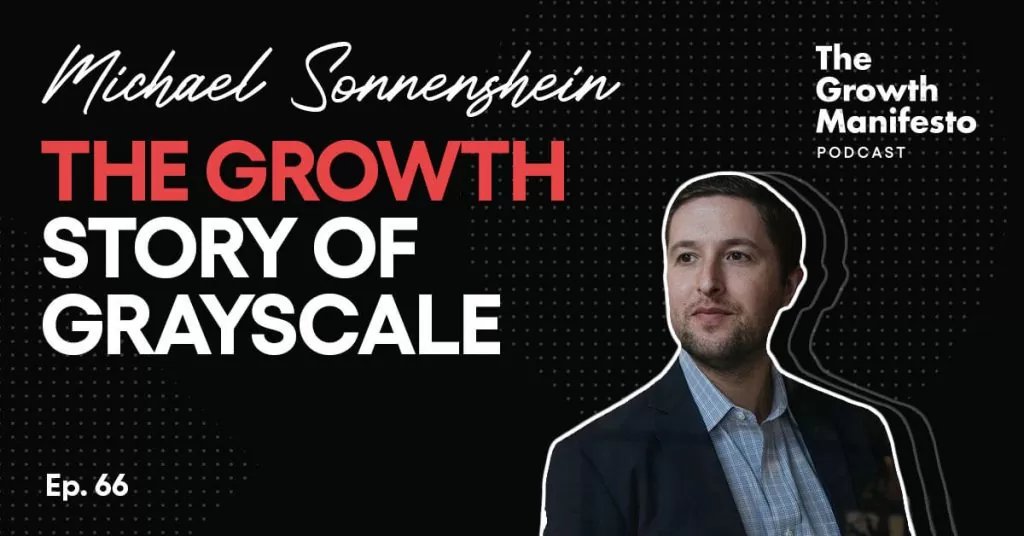
Michael Sonnenshein explains how Grayscale grew from a $60 million Bitcoin trust into a $45 billion digital currency asset manager still pursuing an ETF.
 with Michael Sonnenshein


Overview
This episode is with Michael Sonnenshein – CEO at Grayscale Investments, the world’s largest asset manager for digital currency with more than $40 billion assets under management. In this episode we talk about how to build a market-leading investment fund.
Key takeaways
- Grayscale grew from about $60 million in assets under management when Sonnenshein joined to roughly $45 billion across 15 products today.
- The Grayscale Bitcoin Trust holds about three and a half percent of the entire Bitcoin float, with no cash or synthetic exposure.
- Grayscale has worked with the SEC since 2016 seeking to convert its Bitcoin Trust into an ETF, calling it a matter of when, not if.
- Early Bitcoin investors were largely wealthy families and entrepreneurs, with institutional interest arriving only after Bitcoin broke its prior all-time high.
- Sonnenshein says the pandemic proved his team could stay productive without the roughly half his time once spent travelling for investor meetings.
Chapters
- Intro: Bitcoin, GBTC and the ETF goal
- What Grayscale does and its scale
- Joining Grayscale with $60 million in assets
- Launching a digital asset fund
- Turning from outbound to inbound investors
- Launching Ethereum, Litecoin and beyond
- The push to convert GBTC to ETF
- A typical week running Grayscale
- How to get started with Grayscale
About the guest
Transcript
Auto-generated from the episode audio, so expect the odd mis-heard word. Timestamps open the video at that point.
Bitcoin is something that could potentially change the world or create financial inclusion. And when I met Barry, I don't know that I'd ever had a conversation with somebody that had really, really taken a deep dive or even used phrases like change the world or reconstitute our concepts of money or how value moves around the world. And I was completely enamored by the opportunity. I would say through the lens that we look at the world, the crypto ecosystem has continued to mature and continue to evolve.
And we have remained committed and unwavering in the fact that we will be converting GBTC into an ETF. We believe wholeheartedly that, you know, this product is not only the world's largest Bitcoin product. It holds about three and a half percent of the outstanding Bitcoin float. It trades hundreds of millions of dollars a day. It's already an SEC reporting company. We think it is, of course, and remains only a matter of time. It's a matter of when, not a matter of if, you know, this is able to convert to an ETF.
And, you know, that's going to be a day that we will all celebrate with a lot of excitement because it'll be many, many years in the making to get there. You're listening to the Growth Manifesto podcast, where we host in-depth interviews with business leaders, authors, industry experts, and entrepreneurs with a singular focus around business growth. At the end of each podcast, we want you to walk away inspired, to think bigger, and to have actionable takeaways you can apply to improve your business. Each episode is like a masterclass on a key topic.
So make sure to browse the episodes to find the topics that are most relevant to your biggest business challenges today. This podcast is brought to you by Web Profits, a digital growth consultancy that helps challenge your brands drive growth in a complex and fragmented digital landscape. You can find out more about Web Profits at webprofits.io. Now, let's get into it. Today, we're talking with Michael Sonenshine, CEO at Grayscale Investments, the world's largest asset manager for digital currency with more than $40 billion assets under management.
Today, we'll be talking about how to build a market-leading investment fund. Just quickly, before we get started, make sure to go ahead and hit that subscribe button so that you get the latest episodes as soon as they're released. Let's get into it. Welcome, Michael. Thank you so much for having me. I'm really excited to have this conversation. Yeah, me too. Especially because you seem to have managed to bridge the gap between the Bitcoin industry and the investment industry, right? And so, you know, this is going to be a conversation about kind of like your journey, success, and kind of how you think about investing, right?
Because you've achieved some awesome things, right? But for those people who don't know Grayscale, would you give a quick overview of what you do? Absolutely. So Grayscale, as you mentioned, we are the world's largest digital currency asset manager. And that's a lot of words. So let's unpack what that means, right? We're an asset manager, which means that we offer products that allow investors to make certain investments. It just so happens that rather than focusing on stocks or bonds or commodities or foreign exchange, our focus is entirely on digital assets.
So that journey for us began in 2013 when we launched our first and what remains our flagship product, the Grayscale Bitcoin Trust. Today, as you mentioned, we have 15 different investment vehicles and about $45 billion of assets under management. And so what does that really mean? It means that we were early to identify that investors would want access to digital currencies, assets like Bitcoin and Ethereum and Litecoin, and I'm sure quite a few others that folks have heard of or perhaps have even considered investing in.
And we realized that because digital currencies have certain attributes that may make them tough to figure out where to buy them or how to hold them or transfer them or safe keep them. Well, maybe we could be the conduit to help a lot of investors get access to this ecosystem, but do so in a way that really felt familiar and comfortable for them. And so we package digital currencies into investment vehicles. And that's not new, right? Investment vehicles exist for gold, for oil, for subsets of the investment universe, healthcare
stocks, energy stocks, you name it. And so Grayscale has really been a really big catalyst for many investors, whether they're retail investors or even institutions who want digital currency exposure as part of their investment portfolios, but maybe don't either have the legal or operational wherewithal to buy digital currencies or hold digital currencies directly. Which is the majority of the market. And you started the fund back in 2013 when the price of Bitcoin was $200. It's now, where is it today? $46,600 US?
Yeah. So I don't know how quickly this conversation will be out in the market. But we launched the Grayscale Bitcoin Trust in September of 2013. Yes. Speaking with you today in September, actually, what's today's date? Oh, wow. We're almost coming up on the eighth anniversary of the launch of the product. But, you know, we have come quite a bit from that original early days of just focusing on Bitcoin. And now our products, you know, span over a dozen different digital currencies.
So it's been an exciting journey over the last eight years. But what was it like to kind of launch back then, you know, when like, because in 2013, like there was kind of hardly the conversation around the digital space, right, was at the very early stages. right? But this is before the mainstream started to get into it, you know? So what was it like trying to create an investment fund and to get people on board, you know, for something that just had the promise back then? Like, I'm sure it's easier today, like, you know, just depending
on the date of having a look at the funds under management for Grayscale, it's 30 billion, then it's 40 billion, now it's 45 billion, right? So it's very, very different today. But how was it in the beginning? Let me talk you through what that journey has kind of been like. So number one, I unfortunately missed day one of Grayscale. Our founder is a gentleman named Barry Silbert, and he started the fund in September 2013. I joined him in January of 2014. So just a couple months. Yeah, exactly. So I'll take you back to then. I left a traditional banking. I was working
at a bulge bracket bank. Actually, I worked at three different bulge bracket banks and then was looking for kind of my next career move and got very excited by the opportunity within digital assets, thinking about Bitcoin as something that could potentially change the world or create financial inclusion. And when I met Barry, I don't know that I'd ever had a conversation with somebody that had really taken a deep dive or even used phrases like change the world or reconstitute
our concepts of money or how value moves around the world. And I was completely enamored by the opportunity. And when I originally joined, my role was really to spearhead our sales effort. We had about $60 million of assets under management. And again, just that one product, Grayscale Bitcoin Trust, right? So that's just a passive Bitcoin strategy. And over the years, I continue to take on more and more responsibility and ultimately became CEO of the business at the beginning of 2021. But how conversations have changed over the last eight years,
some of the things that have transpired are things I wouldn't have even imagined. In 2013, I think maybe the only people that were talking about Bitcoin and into 2014 were really, really wealthy entrepreneurs, a lot of folks that were primarily around the technology scene and the software scene. This was coming up in social gatherings, dinner parties, things like that. I think in late 2014 and throughout 2015 and 16, we started to really engage more so with family
offices. So again, starting to see a little bit of a groundswell from retail investors, but mostly larger capital was coming from very wealthy families who I think, you know, if I really think about what their motivations were, they were excited by the technology. I think they were realizing that there was an opportunity, a risk reward scenario that maybe didn't exist elsewhere. And then also given how small family offices are, once they have conviction in something, they could actually make an investment pretty quickly. But I think it wasn't until 2017 when
Bitcoin kind of broke out to that new all-time high, right? Prior to then, the highest Bitcoin I think had ever been was probably around 1,200 some odd US dollars. And when it broke out beyond that, I think that's when it really started to capture the hearts and minds of institutions. There was starting to be the development of some really interesting trading tools. So indices were starting to get launched. Accessibility started to open up. And I think for us and a lot of other folks, there started to really be this conversation around institutional
adoption of digital assets and what is it going to take to get institutions involved with digital currencies. And I think that's only continued to unravel. As I speak to you today, you now have Fortune 500 companies that own Bitcoin on their balance sheet. If you'd asked me that five years ago, if you didn't have been asked for me that 12 months ago or 18 months ago, I'd probably tell you that would be long off. It would not happen so quickly. You have, you know, in the emerging
markets, you have countries like El Salvador that have now declared Bitcoin as legal tender. I mean, you really, really have started to see massive participation in this asset class on a global level that has really solidified its staying power. And, you know, despite all the progress despite all the growth and even just the growth at grayscale, which we're of course, super proud of. I got to say, I cannot characterize enough for anyone watching or listening how early days the entire thing still feels. Still feels that because it's kind of like the internet,
like, you know, it's back in 2004, five, like I started to market on the internet and I thought I had missed the wave because everything was like in the nineties and you know, the.com, the boom and the bust and the cryptocurrency industry is still at that kind of early stages and so lots of people still feel like they they have missed out because you know as at today it's around 47 000 um and so there's a lot of change happening right now but you know so what was some of the earliest challenges right because you had to to get the funds first before you created the
trust to list or like you listed first, you know, so what was the first big challenge of actually, you know, to launch this thing? Well, I'll start out by saying that there is no handbook, there is no guidebook, there is no quiz notes for how to, you know, launch these funds, particularly when it comes to digital assets, right? We've created products now around a totally novel technology. It's not securities. These are not commodities. These are not FX.
And so I think really the power of the way that we've built our business really has been leveraging some outstanding service providers, obtaining some fantastic legal advice, and really never losing sight of what's most important to us, which of course is our investors and ensuring that we're taking all the proper precautions. But we've definitely had to face a lot of not only challenges, but I'd actually say we've really been the pioneers that have actually set a lot of the industry standards.
So that's been things like really trying to ensure that anyone that we may work with for custodying digital currency, underpinning our products, are folks that adhere to certain standards and have certain kinds of reporting, disaster recovery, certain other kinds of redundancies and security measures in place. We've had to really work proactively with auditing firms. You know, for them, auditing, you know, different kinds of assets was certainly not something that was new to them.
That may be a little less traditional, but they certainly didn't have the familiarity or the comfort with digital currencies and perhaps had to audit those. And so that's been another area we've really had to partner and kind of pioneer some of those conversations and practices. And I really think underscoring all of what I'm sharing is that we as a firm have always taken a measured approach to what it is that we do. We are definitely a ask for permission, not for forgiveness kind of organization.
but we do it in a way where because we recognize the goal that we play, it's always been important to us to really educate the people that we're working with and really partnering with them to try and achieve that agility that is obviously really, really important to, you know, operating our products. Okay. That sounds very complex, which is probably why it took four years or two to four years to really start to gain traction. But you said you started to gain some real traction in 2017.
What was it like promoting the fund before that point? You know, like, how did you approach it? Well, I think for a lot of investors, they've really been able to find, you know, different reasons why this as an investment resonated with them. I think certain investors saw Bitcoin as a digital gold or a digital store of value. So it may be able to fit in their portfolios as a replacement or a partial replacement for assets like gold or other assets they may own as an inflation hedge or a safety, applied to safety asset so that their portfolios are protected when markets are turbulent.
I think other investors may have been excited about the underlying blockchain technology. And this was a kind of a pure play for them. And they believed in the inextricable tie between Bitcoin itself and the underlying technology and that owning exposure to Bitcoin would be a more liquid way to, you know, I guess, execute on that kind of a thesis. I think certainly many investors have long believed that Bitcoin is a new form of money, a new way that value moves, maybe a displacement or replacement of certain mechanisms that we use today to move value around the world.
And so I think kind of depending on the type of investor that we were dealing with, and certainly the types of investments that they're historically comfortable making, we were able to kind of find, you know, usually the right analogy or the right, you know, set of circumstances that would get them excited about it. Um, and, you know, at the same time, you know, continuing to really reinforce and, um, you know, education, um, and doing everything we can to dispel any of the kind of myths that may be out there around the asset class or, or any, you know, beliefs that kind of bubbled up to the surface that we knew in fact to not be true as well.
so in the beginning and this is you know across like a lot of organizations it's all outbound you know like it's all you know just knocking on doors and start um and trying to start these conversations when did the tide change where people started to come to you instead of you know um you having to go to them well i think a lot of that did start to occur really in 2016 2017 You know, for a long time, we were operating grayscale at a loss. And when we started to get to a significant size, we had no hesitations prior to earning a profit, running the business, investing in the business.
But certainly when we were able to turn the corner and start to achieve profitability, it started to open up the potential for us to have extra capital that we could really emphasize our brand and lean into things like advertising and partnerships. And so being able to, you know, get the word out there about the opportunities that Grayscale offered investors certainly allowed a lot more investors to come to us as opposed to, you know, us having to kind of do outbound sales work as heavily.
But I think to one of your earlier questions, something that has also been pretty pioneering about Grayscale is the fact that we have and have historically and continue to launch each of our products as a private placement. So these are generally soliciting investments primarily to accredited investors. So high net worth individuals, family offices, hedge funds, endowments, pensions, you name it. And we've done something that's been pretty novel. But again, asking for permission, making use of existing securities laws and regulations, which is that we moved to have those private funds actually pushed out into the public market.
And so we now have six different products so far out of the 15 products that also trade on the public market every day. And so whether you're here in the U.S. or you have access to the U.S. securities market from other parts of the world, investors have the ability to also participate in grayscale products right in their brokerage accounts, retirement accounts, you name it. And certainly the success and the receptivity of these products in the public market, I think, has also been a really big catalyst for us that's also allowed us to create a larger groundswell and also increase our investor base.
So that's also been something that we've looked back on historically. That's been a big part of our business. Yeah, which is fantastic. And, you know, I think what's interesting is, you know, today, super successful company, right? And, you know, everyone will just look at you and go, wow, they're so lucky. They invested in Bitcoin, you know, back in 2013 and started this big thing. And people just don't understand the challenges of those early days, right? And, you know, like to run at a loss for that many years, there must be a commitment, a focus on there's something here, there's something that's bigger.
And so how did you get through those kind of early years, right? Because it's so easy now. Well, it's not easy now, just to be very, very clear. But it's so much harder, you know, starting out, you know. So how did you get through those early years? Well, I think certainly, you know, we as a team developed a very thick skin and iron stomach pretty early on because, you know, you of all people and anyone listening or watching knows that digital currencies and Bitcoin, you know, as well certainly are no stranger to volatility.
And so whether it was price movements that could have shaken people out or caused them to have their conviction begin to waver, or it was the narrative, right? The early days of this asset class, and even still today, you know, it's been challenging for companies to get even bank accounts, right? or even just kind of simple services to really just help operate their businesses. The early days of crypto and Bitcoin, we were having to do a lot of work to dispel a lot of the narratives that, you know,
this was for laundering money or for illicit activity. I mean, those are the kinds of things that, you know, certainly were easily sensationalized in the news and that people could easily get carried away with. But if you actually do the work and educate oneself, and again, that's why we're so committed to that aspect of what we do, you very quickly learn and realize that, you know, some of those narratives are so false because these are some of the worst, worst mechanisms possible for doing anything the least bit nefarious.
And in fact, this is truly the largest and most innovative consensus mechanism the world has ever had. And we certainly think that, again, we're in early, early days of seeing the use cases that can be built on top of these technologies, including digital currencies, are probably just the beginning. The next fund that you launched was Ethereum in 2017. That now has over, well, of course, I had a look online. It said around $10 billion under management. I'm not quite sure if that's increased because it changes so much these days.
That's what happened basically in the business that led to launching the second fund now, right? Because you've got the first one is now hitting something and now you're like, cool. Okay. So now they're going to launch the next one. So what happened in the business to start that? Yeah. Well, you know, we have a really interesting seat within the digital asset community. You know, Grayscale is a wholly owned subsidiary of a company called Digital Currency Group. And so sitting where we do within the community really allowed us to have a front row seat to a lot of the entrepreneurs, a lot of the businesses, and a lot of the projects that
were being developed in the industry. And so things like Ethereum and other assets as they came along were pretty quickly floated onto our radar pretty much in their infancy. And I think we as a team have always towed that line. And there's kind of a healthy tension there, Alex, Right. What is it that investors want and kind of where do they want to deploy capital? And simultaneously, well, what do we as a team at Grayscale, what are we uniquely positioned to kind of unearth or find for investors, investigate those opportunities and bring those opportunities to them?
And so I think with every product we've launched, whether it was Ethereum or Litecoin or any of the other funds that have come into the market, we've always kind of had to balance those two aspects and also really stick true to those principles that I spoke to where we have to do our deep dives from a legal and regulatory perspective. You know, we have to figure out where price discovery is. We have to see if service providers can properly, you know, serve and, you know, work closely with us on ensuring that we are always acting in the best interest of our investors and operating these products the way that they're intended to.
And so you've launched another, if I'm correct, because you said like 15 products now, because I had a look online, it was 12, but I think there's more now. But you changed so much. That's the first thing that's really interesting about this space. But how much harder or how much easier was launching the second and the third and the fourth product compared to the first one? It's a good question. So I would say for a while, a lot of the products we were launching were single asset products. So each of the products was just solely and passively invested in one currency.
So certainly as we kept rolling out more single currency products, we not only began to learn some lessons along the way and smooth out some speed bumps, but we also were able to get them into market faster and continue to kind of replicate on the success of the previous products we had launched. I'd say one of the first really big challenges for us was when we really decided it was time to launch a different kind of product, a diversified fund, where the fund would be
legally structured as something different, as well as own multiple assets in the fund, as opposed to just a single security. I'm sorry, just a single digital asset, all packaged within a single security, a single investment offering. And so that was certainly an exciting opportunity for us. And that is when we launched our digital large cap fund, our fund that really helps investors make a singular investment, but get that broad-based perspective, that broad-based exposure to the asset class.
Yeah. So it's easier, but there's still challenges and there's like the different style of products that are being created, which is really interesting, right? So it still has its challenges, but you've got a few more processes now and a bit of a track record and a bit of history. So that probably fraction easier than those first three to four years. You talk about transitioning to exchange traded funds now, right? Because at the moment, it's trusts that then list on the stock exchange. But there's all this, the groundswell that is, you know, starting to hopefully move towards exchange traded funds. What's the process there right now? Because obviously, like, it's in, it's extremely early stages right now.
Sure. So I don't know if I'd call it early stages. It's certainly not for us at Grayscale. I mean, we've been working with our regulator here in the US, the SEC, since 2016, hoping to convert our products to ETFs. I think certainly the first candidate for becoming an ETF would be our Bitcoin product, ticker GBTC, the Grayscale Bitcoin Trust. Now, I think what's been interesting about this conversation is we've certainly had a very favorable reception from the SEC to have conversations around exchange traded products.
However, over the last few years, they've certainly denied some applications that have come before them. And they've cited that there's a couple aspects of the underlying market for Bitcoin that perhaps gives them some pause. Things like, you know, there not being enough surveillance of the market or significant regulated sizes of markets, things of that nature. And we seem to be perhaps at a little bit of a turning point. We have a new chairman at the SEC, and over the last couple of weeks, he's actually publicly provided some commentary that does maybe suggest that he and the SEC staff have now become a little bit more resolved with some of those previous concerns, given that they've kind of waved in publicly the fact that they'd like to look at some of these ETF applications again.
Now, what's the distinction that we're seeing now in the market, which is causing a stir within the investment community, is that the SEC seems to be calling out a willingness or a desire to look at Bitcoin ETF applications. but those that seem to be based on Bitcoin futures without really speaking at all on whether or not they're interested in looking at Bitcoin applications for ETFs that are physically backed the way that GBTC and many commodity based products are today.
And we think this is a really important, important point that we really want to stress because, you know, the SEC is a disclosure regulator. They're really here to protect investors and make sure that as investors go to the market, make investments, utilize products, ETFs and otherwise, that all the right risks are disclosed so that investors are making fully informed investment decisions. And so it would create, you know, Alex, an unfair or unlevel playing field if the SEC were to only approve futures based Bitcoin products without also creating the ability for spot or physically backed Bitcoin ETFs to come to the market at the same time.
And instead, you know, this is a decision that we really think should be up to investors. If you look at assets like gold, there's gold ETFs that hold gold and there's gold ETFs that hold gold futures, right? And if you have those both in the market, then investors can really choose which product really fits their needs best rather than having the regulator be the one to focus on which product may or may not be more appropriate for investors. It just seems like it's a matter of time right now, right? It seems like the momentum is there.
It's just how long now and what's left really to do? I don't know. I would say through the lens that we look at the world, the crypto ecosystem has continued to mature and continue to evolve. And we have remained committed and unwavering in the fact that we will be converting GBTC into an ETF. We believe wholeheartedly that this product is not only the world's largest Bitcoin product, it holds about three and a half percent of the outstanding Bitcoin flow.
It trades hundreds of millions of dollars a day. It's already an SEC reporting company. We think it is, of course, and remains only a matter of time. It's a matter of when, not a matter of if this is able to convert to an ETF. And, you know, that's going to be a day that we will all celebrate with a lot of excitement because it'll be many, many years in the making to get there. Yeah. And if we can look at like, you know, our companies like Vanguard and how much, you know, they actually have now because of, you know, the fact that they are like an ETF, this is going to be huge for Grayscale.
So that's very exciting for you. Like I wish you all the best to accelerate that process. Thank you. You did mention you hold three and a half percent. See, again, last time I looked, it was about 2.5%, but you heard about 3.5% of all the Bitcoin, right? And so what's your approach in the trust? Is it to buy and hold? Is that the strategy? Correct. Yeah. The Great Scale Bitcoin Trust is a passive product. So any money that is deployed into the fund itself is used to buy Bitcoin.
There's no synthetic exposure. The fund doesn't even hold a penny's worth of cash. So for investors who are looking for Bitcoin exposure, but don't want to set up a wallet or figure out how to buy Bitcoin directly, and who also may want Bitcoin exposure alongside stocks, bonds, ETFs, their retirement account, whatever it may be, this is a pretty seamless way to get that exposure right alongside those other investments. And is there like a limit to kind of how many Bitcoin the trust can hold, like in terms of the market size, like in terms of the Bitcoin in circulation?
It does call into a good question, right? I think one of the things that has and continues to make Bitcoin investable is the fact that it is a scarce asset, a verifiably scarce asset. You know, there are 18 plus million Bitcoin in circulation today. we know that there will only ever be 21 million Bitcoin ever created. And so certainly, you know, that would be a very good problem to have if the product ever crept up against any number that flirts with the outstanding Bitcoin float or outstanding Bitcoin supply.
But certainly we are not near that at the moment. And again, that's one of those good problems to have. Correct. You have another 14 products and you invest in companies like the Basic Retention Token and Decentraland and so on. How do you choose the next thing, right? Because you've got such a good start. Now it's like feels like the pressure of choosing the next thing is really, really important. So what are some of your considerations in the next product or the next digital currency?
Sure. Well, again, I think we tow that healthy line between identifying unique opportunities and also listening to investors around what they want. We try to be as transparent, Alex, as possible about this process. So we consistently maintain a list of assets that we're always considering to go inside our investment products on our website so that investors are never surprised or caught off guard by some of the assets that we may be exploring for consideration.
It does not mean that every asset that is on that list will make its way into a Grayscale product. But at least we're trying to signal to the investment community the areas of the market that we're investigating. And sometimes that invites people to share resources with us, share opinions with us, get feedback. But ultimately, when we think about products to launch, there certainly has to be a market fit. We want to really drill into the use case for a given digital asset. Is this a solution in search of a problem? or is this actually have some real world application or utility?
We're looking at some pretty basic things as well, right? We're looking at the underlying integrity of the blockchain that underpins this asset. Is it stable? Where does price discovery happen? What are some of the legal considerations around a given asset? How is it launched? Who controls it? We look at things like supply dynamics. Has all of the float for a given currency been put out there? Is it coming online? How does it come online? Where are the assets held?
The list, you know, candidly goes on and on. It's a pretty exhaustive process that, you know, thankfully is a very cross-functional, you know, procedure that we undertake as we evaluate assets for inclusion in products that spans operations, finance, legal, research, you name it. And so it's a team-wide effort, to say the least. That's an amazing answer because you answered all of my follow-up questions in that one answer. So that's a very good answer.
Thank you for that. Thank you. Awesome. So what does a typical week look like for you now? Because there's a lot of stuff going on with products and with interviews like this. And then you've got all the regulators and sales and client relationships. So what does a typical week look like for someone like yourself? because you're in a really interesting position. Yes. So when I have my CEO hat on, it's first and foremost about my investors
that are entrusting us with their assets. And so making myself available to engage with our investors, answer their questions, be a resource for them. With my CEO hat on, It's certainly next about my employees. We're a growing team and we have created, I think, a really, really unique culture, one that I would characterize as being inclusive and deliberate and really trying to pull people into the company that are probably trying to break ties with the traditional financial system, kind of taking the best of those experiences to grayscale.
And so my day is riddled with meetings and calls and brainstorms and whiteboarding sessions. You know, I tend to be pretty hands on and, of course, try to be as accessible and have as much of an open door policy as possible. But, yeah, there's there's, you know, constant interviews, press, TV launches. You know, we're making a big focus on investing in our brand, investing in technology, recruitment.
So interviewing and, you know, working closely with all of our service providers. You know, I think an interesting aspect about Grayscale is that we've been able to grow quite quickly, but do so with a pretty lean sales force and a pretty lean team. We're only about 40 some odd employees today, which is relatively small given the size of our AUM. And so that really underscores, I think, the kind of partnerships and commitments and working relationships we have with our service providers.
But typical days are certainly not nine to five. So I won't venture to guess what my typical working hours are. Um, but certainly outside of that, when I'm able to take off the CEO hat and recharge the batteries, uh, certainly spending time with my wife and family and friends, um, you know, comes, uh, comes, you know, right to center stage and, um, you know, get back up and kind of do it all again the next day. This is just a quick question just for myself. Um, um, what time do you wake up in the morning? Is that of interest?
Oh, I could be waking up at 5 or I could be waking up at 7. Every day is going to be very different. Got it. Sorry, that's just something which I'm just interested in personally. But, okay, a couple more questions and then we're done. First one is, you know, so what's your best advice for people looking to launch an investment fund? My best advice for someone launching an investment fund would be to probably ensure that they're surrounding themselves with really, really trustworthy legal advice.
when you think about anything that has to do with investments, raising money, investor protections, disclosure, et cetera, I cannot underscore enough the importance of having really, really sound legal advice. That can be done in-house, that can be done with external parties as well. But I think that that is probably core to being successful or at least setting oneself up for success when launching a new fund. Thank you for that answer. So would you do anything
differently if you had to start again? Would there be anything which you would have done differently? That's a great question. You know, no journey is perfect. So I would say, well, I would say this, you know, I'd say pre-pandemic, you know, I was probably spending about 50% of my time on the road. and while I look very very favorably upon those experiences events dinners people I've met places
I've been and very feel very fortunate that had a lot of those experiences certainly the degree to which I and my team as a whole have been productive throughout the pandemic in a safe and responsible way using electronic means has been really, really enlightening. And so perhaps I wonder, you know, all the hours I spent in airports and on planes and things like that may have perhaps been better served, you know, doing other things. So maybe that's a lesson we all could have learned
a little bit earlier. But of course, it is unfortunate that that's a lesson we would have had to learn from a global pandemic. Yeah, I think that's a fabulous answer. And I think that's something that there's quite a lot of organizations that are actually starting to see right now. But before, that was the expectation. It's really hard to go against the expectation when everyone expects the meetings and the handshakes and lunches and the dinners and all that type of stuff. But it's been super interesting to see kind of how the world has shifted the paradigm around the business side of things. Last question. And I'm sure this is one that everyone asks you.
But where do you see the price of Bitcoin and Ethereum in two years' time? It's a prediction. I have to ask you, right? Yeah, you do. I would be remiss if I didn't ask, you know? So I'm going to couch my answer in the following. I think both Bitcoin and Ethereum as assets are here to stay. And I see that based on kind of the signals that I'm seeing in the market and who's participating in this market.
All that being said, it would be very difficult to pinpoint where Bitcoin or where Ethereum will be in the future from a price perspective. Certainly for an asset like Bitcoin, which is verifiably scarce, it's simple supply and demand, right? If the asset is scarce and the supply is constrained and demand continues to grow, you know, basic economics would tell you that the price of the asset would increase over time. I personally continue to buy more of these assets daily. That's just the degree to which I personally have conviction. That being said, I can't underscore enough that digital currencies are volatile. We're only about a decade plus into the journey of their life cycle.
And so the same way that not every investment under the sun is appropriate for every investor, that also means that for every investor, digital currencies aren't necessarily appropriate. But I am certainly optimistic about the road ahead for digital assets more broadly. I love that you didn't answer my question, but that you are being completely legal right now. So it's not financial advice to be very, very clear. But look, I had to ask the question. Um, how do people, um, so for the listeners who want to invest, um, and who want to get
started with Grayscale, uh, what can they do? So first of all, before anybody invests, we can't underscore enough the importance of education. So come to grayscale.com, uh, follow us on Twitter, uh, follow us on LinkedIn. However, you kind of want to engage. Um, if you get to grayscale.com, there is a library, a wealth of resources, um, that you can access totally, totally for free. We try to put out as much content as possible to make digital currency accessible, help people make informed investing decisions, whether it's getting
more educated on certain assets, thinking about portfolio construction with digital currencies. We try to address all those topics in our research library. And then certainly those people that want to invest, if they're accredited and have, you know, qualify as an accredited investor, can certainly invest directly to the Grayscale website. And regardless of whether investors are accredited or not, they can also access Grayscale products on the public market, you know, right from their brokerage accounts. Michael, thank you so much for doing this podcast today.
I know our schedules kind of haven't been perfect, but this has been such a good conversation. And I thank you for sharing the journey so far because I know it's so easy to see the success today, but not many people can see the journey from the beginning, right? And so thank you for being so open and thank you for sharing. Thank you. And we'll talk soon. I look forward to it. Thanks so much for having me. Thanks, Michael. Thanks for listening to the Growth Manifesto podcast. If you enjoyed the episode,
please give us a five-star rating on iTunes. For more episodes, please visit growthmanifesto.com forward slash podcast. And if you need help driving growth for your company, please get in touch with us at webprofits.io.