AIStrategyLeadership and culture
How to use A.I. and Intelligent Automation to gain competitive advantage
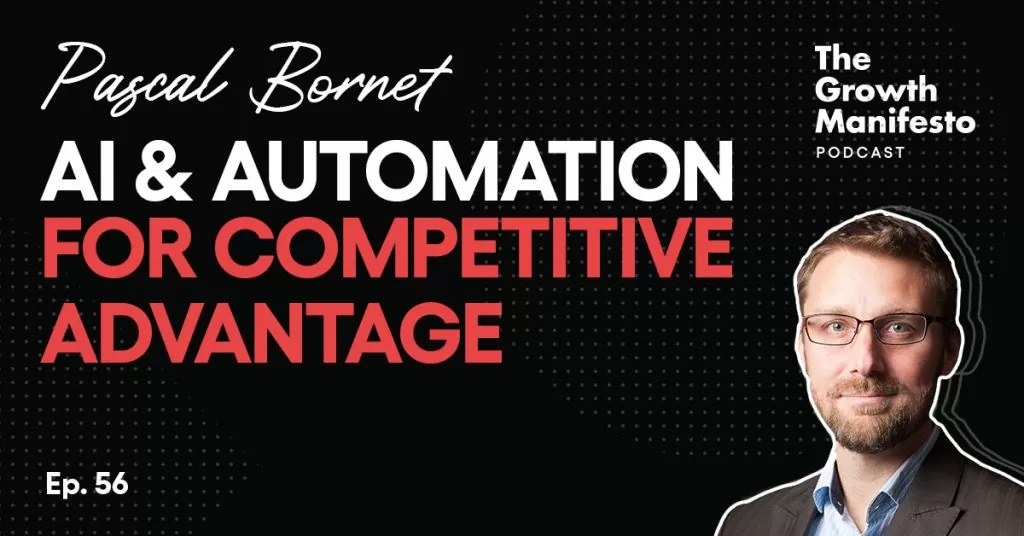
Pascal Bornet breaks down intelligent automation into four capabilities - thinking, execution, vision and language - for competitive advantage.
 with Pascal Bornet


Overview
This episode is with Pascal Bornet, author of the book Intelligent Automation. Pascal has more than 20 years experience leading digital business transformations, has founded and led the intelligent automation practices for Ernst & Young and McKinsey & Company, and has successfully led hundreds of intelligent automation transformations at scale across industries and functions. In this episode we talk about how to use A.I. and Intelligent Automation to gain a competitive advantage through streamlined operations.
Key takeaways
- Only about 5% of a company's processes generate roughly 70% of the total value from automation, so start there.
- Rethinking a process around its output, not just automating the existing steps, is the key redesign step.
- Transformations succeed only when management sponsors them and employees are given low-code tools to build their own automations.
- Research found about 30% of workplace tasks can be eliminated, 30% automated, and the remaining 30% should stay augmented by technology.
- The age of a company predicts automation adoption - older companies use less of it and are more likely to die soon.
Chapters
About the guest
Transcript
Auto-generated from the episode audio, so expect the odd mis-heard word. Timestamps open the video at that point.
When everyone in the company has the opportunity, is empowered to build their own automations, to improve their own work using automation, then their ownership will change. And they feel they are part of the transformation. They are part of the dynamic that is happening. They are not left behind. You're listening to the Growth Manifesto podcast, where we host in-depth interviews with business leaders, authors, industry experts, and entrepreneurs with a singular focus around business growth.
At the end of each podcast, we want you to walk away inspired, to think bigger, and to have actionable takeaways you can apply to improve your business. Each episode is like a masterclass on a key topic. So make sure to browse the episodes to find the topics that are most relevant to your biggest business challenges today. This podcast is brought to you by Web Profits, a digital growth consultancy that helps challenge brands drive growth in a complex and fragmented digital landscape. You can find out more about Web Profits at webprofits.io. Now, let's get into it. Today, we're talking with Pascal Boronet,
who's the author of the book Intelligent Automation. Pascal has more than 20 years experience leading transformations and has found and led the intelligent automation practices for Ernst & Young & McKinsey & Company, and has successfully led hundreds of intelligent automation transformations across industries and functions at scale. Today, we'll be talking about how to use intelligent automation to gain competitive advantage and drive business growth. Just quickly, before we get started, make sure to go ahead and hit that subscribe button so you get the latest episodes as soon as they're released. Now, let's get into it.
Welcome, Pascal. Thank you, Alex. Thank you for inviting me. Yeah, it's a pleasure. Very happy to share my passion. It's a passion that pushed me and my co-author to write this book. And I'm happy to share about it today. Well, it's definitely a very contemporary topic. There's a lot of lack of understanding about the whole industry, right? And so I think this is going to be a fantastic discussion to really understand, you know, what companies can actually do and how to get started, right?
But let's jump straight in. What does intelligent automation mean and what challenges can it solve? Good and important question. So we all hear a lot about artificial intelligence. It became a buzzword, I would say, over the last few years. And we use it for science fiction as well as companies. and people don't understand then how to pragmatically, in reality, using it and getting the efficiency gains that we are all looking for.
That's the reason why we haven't called it artificial intelligence, but intelligent automation. Intelligent automation really refers to the use of different types of technologies to automate some of the work that is currently being done by people. Okay. So the official definition is it's a combination of methods that includes people, organization, data, processes, and technologies that includes robotic process automation, machine learning, natural language processing, computer vision, and much more.
Putting all combining those technologies and concepts together, we are able to automate end-to-end processes that are currently being done by people. For example, purchase to pay is an end-to-end process that each and every company around the world has to perform to basically identify the vendors, procure goods or services, then identify if we received those services and goods in the right quantity, quality, in time, and if we can then pay them, those vendors.
Okay, so that's an example of a process that can be intelligently automated. Is that right? That's an example of a process, definitely, that is currently being done by people, and that can be automated. All the processes can be automated. I haven't seen a process that can be automated. Not yet. Okay, well, let's jump on that. Okay, because this is a really, really important part of it, right? Because in your book, you talk about you're automating the work of the knowledge worker, which in the past would be very, very difficult to do, right?
Because it's the thinking behind it. It's all the parts. Like it's become easier to automate the manufacturing industry. And there's examples of how Amazon have the warehouses that are completely dark, that everything is just completely automated. But what we're really talking about is to kind of automate the process of the knowledge worker, right? And so you just said that you haven't seen a process that cannot be automated yet, right? And so what does that mean though? Does that mean that like, because everything in a business is usually processed, right?
Like a lot of companies have processes. The processes are between people. There are decisions that are being made. There are things that are happening. How does this solve all the processes, right? Because it seems like, let's get that, the invoicing call, right? There's steps in that. It's just about numbers really and checking things, but how does it do everything else? Yes. So let's, so very good question.
Let's go, let's get back to our example of purchase to pay. That's universal. Every company does it. We said that it's the process start with, you know, that you want, you need to buy a good or a service to a vendor. Okay, so that's, and this starting point is usually being done leveraging machine learning to forecast what will be your needs. Okay, and especially in big, I mean, you can think of manufacturing company when they need raw materials, for example, that's a critical process to get their manufacture and production activities going.
So forecasting activity starts the number one process of this purchase to pay end-to-end process. is the leveraging machine learning to predict what would be the needs of buying, of which product do we need to buy to which vendor, for which quantity, and for when. Okay? That's the first step. So the first step is not even simple. The first step is to leverage machine learning to figure out what we need. So the decision is being made.
It's not just the process. It's the decisions in the process that we're talking about as well. Exactly. Exactly. So the way I define a process is a sequence of tasks. And those tasks can be cognitive tasks, like taking a decision, like digesting information to predict or to take a decision, or can be manual tasks, or can be tasks that are related to what we see, or to what we hear, to what we say. Yes, yes. So let's go step by step.
Yeah, yeah, yeah. Step by step. And I'm going to ask you to break it down really simply for me. I'm going to ask you lots of questions. So please, step one, machine learning to figure out the decisions. Exactly. And to figure out the decision of buying. So which product, to who, when, how much. You take this decision. And this means that you need to generate a purchase order. Okay. And very often, you will use kind of a workflow platform that will help you to connect with the vendors
and help them to go through this process that goes from step one, you get the purchase order. Step two, you get all the answers from the different vendors. And step three, you will have a first review process with a selection of top three vendors, for example, and finally get to the selected vendor. Okay, so that's, and so through this workflow platform that belongs to, so in the book, we talk about four capabilities that are basically four groups of technologies that helps to mimic what knowledge workers are doing in their work.
Okay. The first one was using machine learning. It was the thinking and learning. So that's the first capability. Now we're talking about workflow platform that helps to route the data, collect approvals, store the data, and help and support a workflow of decisions between people. So that's the execution capability. So then let's say we select a vendor and then we receive the goods.
And now we need to pay them. So we receive their invoice. Yes. And we receive their invoice. Unfortunately, not all companies have exchange of data, as you know. Yes. You might probably receive a paper invoice, but even you might receive it by email, okay, a PDF of the invoice. In this case, you will need, first of all, computer vision to help you read this invoice automatically. Okay. That's the third capability, which is about vision, basically.
That's what we do with our eyes usually. And now machine is doing it automatically thanks to computer vision. And then you need to probably read the email and probably interact with the vendors if there is an issue on the invoice, for example. And here is coming language capability, which is currently being done by virtual assistants that are leveraging natural language processing. Okay. And finally, you'll get,
whenever you're happy with the amount on the invoice, you got your goods in the right quantity quality, you want now to perform the transaction to pay those vendors. And this is a very transactional activity that can be simply automated using robotic process automation, for example. Okay. and this is the coming back to the execution capability. Got it. And so these four areas, so the thinking, the execution,
the vision and the language. So those four areas are the things which are required for every automation, you know, for every intelligent automation? Not, no, no, that's not everyone. Okay, sorry, you please correct me. Like I said, I'm going to ask lots of questions if I'm understanding it, yeah. So those are the capabilities you can use to automate a business process. Okay. But sometimes one, two, or three of them are sufficient.
Oh, okay. So there it's going to be a maximum of four, but it could be three, it could be two, it could be one. Is that right? Correct. Okay. This is really good, right? Okay. So let's, okay. Sorry, please. Very importantly, why those four capabilities? it's those are the capabilities that that we as knowledge worker are using to perform those processes either we read a document either we talk with someone either we we press a button to send an email or we are how we think and learn using data and and providing some insights and
predictions got it got it okay that's that's a very important point is that this it's an example of how someone actually operates right this is the work that's happening it's thinking it's looking it's doing and it's speaking or writing you know like that's the parts right yes if you want if you want we are kind of creating a digital twin of a knowledge worker that's another way of explaining it okay that's that we are creating a digital worker that is working hands in hands
with the human worker yeah sure and that's and i'm sure that's scary for some people but i think there's something on the other side of that. So we'll get to that a bit later, but just to understand the process. So now you've got these four areas you could use all four for like a more advanced process, or you could use fewer amounts, right? Now, when you explain it, machine learning, you have OCR, there's ICR, there's biometrics, smart workflows, intelligent chat spots, sentiment analysis. You've got all these things that sound so complicated, right? And for someone
who's saying, listen, I really want to automate some things, right? Like this is something I can say to be extremely valuable for the future. It has some competitive advantages, obviously, because it cuts down time, it cuts down issues, it cuts down errors, but how do you get started in this, right? You know, how do you say, okay, I get it. There's these four steps, right? Machine learning, right? Okay. Let's start there. You know, so what does that mean from an execution perspective right because i know there's platforms out there there's all like it sounds complicated
but it can also not be as complicated as it sounds so can we just talk about each of the parts and just kind of understand what's involved in that you know like in just getting started i mean obviously it can get very advanced right but just to get started that's a very that's a critical question and uh and uh the answer is uh think business first okay that's not we're not Technology is just a tool, okay? Just something to help. Most important is what do we need, okay?
So I'm currently performing this process. I'm onboarding clients in a bank. Yes. It takes, you know, when you want to get a bank account open, you need to produce a lot of documents. Okay, how can I get those documents? How can I get this process of onboarding of clients more efficient more pleasant for the customers, more pleasant for the employees that are working in the back office. Yes. It's just about this.
So to make it easier for the clients, you think of making it fully digital, for example, so that it's a workflow online that can be done from your sofa. You can upload your documents. everything is simple if you have a question you have a virtual assistant to help you in the back office of the bank usually you have employees receiving those documents typing those documents you know from image to a to a to a digital form
yeah I mean that's who wants to do that eight hours per day no I mean I wouldn't I mean yeah wouldn't wish this for my for my worst enemy okay so so So it's about helping those people in the back office, having optical character recognition tool, as you mentioned. So basically computer vision that helps to read the document, extract the information that we need, and directly process it into the transactional system that needs it, for example. And just put that part there.
I'm just trying to break it down. So we need to create the business process and have a look at it. And so I think the first part is rethinking the process, right? Correct. It's not taking the same process and just trying to automate it. Exactly. It's rethinking it, right? Thinking, okay, so what are the steps? Yes. Please. That's definitely a very important step. I would say it's maybe the second one. The first one is to identify what are the business needs, okay, and where are the strongest? Because at the end of the day, everything can be automated.
But some of the processes have a high value of being automated, higher value than others. And if, I mean, from my experience, if you have a look to the different processes you can automate in a company and it can go from a few hundreds, 500s to a few thousands, okay, if you really go to identify all of them, you see that only 5% of them, roughly 5% of them, we'll generate about 70% of the total value you can generate by automation.
Okay. So it's all about focusing on those ones first. And as you say, then those processes, we don't want to just copy what is being done today because we know it's not efficient. So let's rethink them completely. And the best way to rethink them, redesign them, is to focus on the output, the outcome. what do we need at the end? Okay, in the onboarding process that I just described, at the end, you need, I mean,
the bank needs to be satisfied with all the criteria that need to be checked for clients to be, so to manage regulation, but also to manage the risk of the bank. So what do we need at the end? Okay, that's what we need. So now how do we get all this and on an automated way? Okay. So it's starting by the end that you, so that's the end. That's the second step. And so you start at the end, you create the steps, right? That's all good.
Right. And we can all create the steps in some type of wireframing software, or even on a piece of paper with squares and step-by-step, right? Up on the whiteboard, if people have any whiteboards in their homes anymore, right? Like this office is open again now. So maybe in the office, but, but it's, it's created. So you've got the steps and now you start to think, all right, this step requires some OCR. This step requires machine learning. This step requires some language processing, right? Is that a developer which you need to hire to execute on that?
Is that how companies should be thinking about this? Is it like, all right, so I now know the parts and I know the challenges. Who can help me implement these challenges? Is it creating a team internally? Is it finding a part that can help you? So what are some of the ways that companies are approaching that part of it? Because I can see that that would be the biggest challenge is that. I could be wrong, right? I think when you get there, when you get there, meaning when you get
to a redesign process and you're clear on what are the steps that are necessary to get to your outcome, It doesn't need to be translated yet into what is the technology to help. Okay. But just, you know, that you need this, this, this, that, that. I think 70% of the work is done. That's the most important. Then it's about bringing a solution architect or someone who knows, doesn't need to be a very technical person. Someone that knows that, okay, this to achieve this,
you'll need, you'll need this type of technology to achieve that. You'll need this type. And, and so it can be one solution architect. It can be also, and I prefer this solution, to have around the table different talents coming from teams that usually are functioning on an isolated manner in companies. Most companies, large companies, have a team for robotic process automation, a team for customer service, which is dealing with chatbots, and another team that is about data science and machine learning.
So it's really about bringing all those talents around the table and redesigning together and identifying which technology we need when, where, and identifying how do we connect those technologies together. Okay. So basically, you do need somebody that is technical and has a technical understanding. And so you mentioned a solution architect. That could be internal. That could be a partner. And then, but you want to have a conversation with all the teams involved in the process to get their feedback and their thoughts on what should happen, right?
Now, before you said this, we can automate every process, right? In a company, right? And most companies, it's just a collection of processes, right? And then some sales and marketing and brand, right? You know what I mean? Like everything else, it seems to be like if it's a service, it's like a knowledge service, right? like if it's a product it's manufacturing that can be covered through robotics and so on right but how do you get the buy-in you know so what are those people then going to do if they're
going to help you create like I was watching some show and they were making like a joke about AI like there was like a bot there and they were like so we need to train the bot to do our job to replace us you know and it was just a comedy show but you know this is like a thought that people have if we are helping creating this thing for the process what about our jobs you know so what does that mean for us and so how do companies kind of approach that challenge or that conversation let's call it yes yeah and it's a critical component of a successful transformation okay
that's and um when we explain what is what is um um when we explain the different capabilities in the book when we explained the framework to successfully achieve such a transformation, people comes first. People is in the center. I'm used to say that those transformations are made by people for people. If you miss the people aspect, you miss the project. When we talk about people, we talk about two types of people. One is management.
management like CEOs, C-levels, their involvement, information, education, and sponsorship of the transformation are critical. I've never seen a company succeeding in this type of transformations without this. That's a critical component. so so so it's so so it's about it's about bringing them to this level
and helping them to to build their vision and to build their vision we need to to help them understand what are the benefits quantitative qualitative what can be a typical roadmap and and and and and they will be able to understand knowing the benefits how much investments they would they are ready to write okay that's the first but critical components of people. The second are all the other employees and they are extremely critical as well. There is no transformation that happens without people.
So you need to inform them, educate them. So that's one of the reasons we wrote the book. That's to create this tool that is necessary for those transformation to succeed. When you've informed and educated everyone in the company, You need to go further. It's not enough. You need to involve the people in the transformation. Today, and more and more, the technologies are getting more user-friendly.
You might have heard about low-code, low-code technologies. The philosophy behind that is that everyone in the company is a potential developer, citizen developer. Yes. And I think this dimension is extremely important and needs to be leveraged by companies today. Because when, for two key reasons, when everyone in the company has the opportunity, is empowered to build their own automations, to improve their own work using automation, then their ownership will change.
will end okay and they they they feel they are part of the transformation they are part of the of the dynamic that is happening they are not left behind they okay that's the first thing and the first thing is of course because you have more hands working towards building the trans implementing the transformation of course you go faster and you can do it bigger and the second and most important thing as a result of this is because the ownership of each and every people in the company is changing and moving towards this transformation to succeed,
the mindset, the culture of the company changes into more digitalization, more automation. People understand and are willing and, you know, the mindset is changing. The mindset is so important. The culture is so important. So, again, I'm going to try to simplify it so I understand it. But, okay, so you need the management to be on board because you're solving the business challenges and it's not going to happen without the management on board right but then from a staff perspective from a team perspective they need to be part of the journey
and what you're suggesting is that include them in the conversations on you know the stuff that's happening but maybe an easy way is to encourage people to spend some time on some of the low code platforms or the no code platforms just to have a play see what they can automate themselves kind of thing and then share that upwards kind of like the google company but i mean they're a bit more advanced, right? But, you know, everybody gets their 20% time to spend on projects, something different, something else. Is that kind of a way in? Like, I'm not saying spend 20%,
but, you know, just give people the opportunity to just play around, to see what they could automate themselves. So definitely that's a great point. So giving, empowering the people to do to do things is not is a good starting point but we need to go further and um and um and the next step is about incentivizing the people to do that okay and so i've seen many ways to incentivize people doing this uh from contests that that's give awards to people rewards to people in the
shape of promotions in the shape of mba courses offered in the shape i mean you can yeah okay it can be many things um but most importantly it should be part of the the kpis of anyone you know the the indicators the the key performance indicators of of each and every employee huh yeah i like that um just this i just was a quick aside is there like a low code or a no code platform that you know of that is like that's really good you know just save yourselves
time because there's so many out there now right um well is there one which you would recommend to people that like you've experienced with that you think they're really good that's that's that's a difficult question because it's like um it's like uh machine learning it's it's everywhere now okay it's so having every each and every tool now it's each and every technology on the market now is making their configurations easier by having user-friendly screens drag and drop type of
functionalities that make it more easier for everyone. So I would say each and every technology is following these trends. Yeah, sure, sure. Okay. Let's jump then to reasons why. Now, you know, the first part of this podcast has been actually talking about it and it sounds complicated, you know. I've tried to simplify the thinking behind it, but, you know, it's not simple, right? And, you know, the fear around the replacement of jobs or having conversations with the team that might be difficult, right?
And so they've got all these kind of obstacles in people's way versus like the future benefits of it, right? So, you know, I could just continue to run my company or whatever it is or my department and that's just going to keep running. I'm comfortable. This is going into a place of uncomfortable, right? We're going into a place that we don't know. We don't understand. Probably going to take a bit of time. We're not going to get it right the first time. There's going to be lots of conversations, right, about this, right? Yes. What are the reasons why somebody should do it compared to not doing it?
You know, so what does it do for the companies that have embraced it versus the ones that haven't? You know, so what does a two- to five-year trajectory look like, you know? No, that's a good point. That's exactly why incentivization is very important. To push people to act in the direction that is needed for them and for the company. And when I talked about the actions of the people that are necessary, I talked first about information and education.
What does it include? That includes not only what are those technologies and what you can expect from them for you as an employee, but also for the company, but also being very transparent on what does it mean for each and every people's role. And some roles, definitely, those people that we were talking about that are transcribing an image and typing it into a transactional system eight hours per day, those people definitely will have technology to do their work.
And as we said, nobody would love to do that at any time. so it's about giving the transparency to those people and telling them for in this specific example technology will help you now do the job that you that you were doing that was very transactional do you agree with that the people will say yes and now we've thought about refocusing your time on more value-added activities so for example why don't we help you
now to understand the data that you used to type and work on this data so that you can do some analytics, create some insights from it, and we will teach you how to do that. So this person will go from the stage of copying data the whole day without even thinking to a role where this person will have to think and will have to take some decisions will have to bring some insight
um and uh and and from a survey that psychologists have done um satisfaction and happiness at work happens when people have to take even small decisions but decisions and and and have and create some insight create something from from this so so what about psychology point of view it works so it's not that science proves it that's from a staff perspective right now from
a management perspective you know what happens if you don't kind of implement something like this and your competitor does you know so what happens if you sell as a managing team it's too hard right now let's come back to it later right and then at the same time a competitor of yours starts now and start to the advantage. So what does that gap start to look like after 12 months or 24 months of just waiting to start this journey? Yeah.
It's a very good point. So the first to start will be the first ones to learn from it. And, of course, will be the first one to collect the benefits from those technologies. Oh, so benefits for companies. For companies that do it, you know. So what are the benefits that companies get? Across the board, productivity improvement. Let's start with that. 20% to 60%.
That's what we've seen on the market. So meaning an improvement of net profit. So it's really that's what's driving the company's health. On top of this customer experience improvement, and we've seen percentages of NPS scores, so satisfaction of customers increasing by 50% after such a transformation.
with employee satisfaction. We've seen teams suffering from high turnover of the teams, like 25% to 30% of turnover because the work was very transactional, and people were not happy to do that, to teams that are performing well
with still being in a transactional environment, having 10% turnover. So really an increase in employee satisfaction. And I think those are four companies. Those are the critical ones. I mean, you have also the improvement of quality. you have also the improvement of quality that that means better outcome of the work but also
less errors and some errors can cost very much especially when we talk about finance finance department for example i mean yeah those are those are the ones that come to my mind now but in the book we list all of yeah yeah um it's it's it seems to be that the advantage happens like it's probably going to be an investment in the first 12 months, right? But every company will need to put that investment. So then if you're the company that does it first and you start to automate some of these processes,
you start to reduce your costs, you start to improve quality, you start to innovate faster. So just starting is the hardest part. But once you get to a point, now all of a sudden you start to snowball. and at that point, the competition are going to find it very hard to keep up, right? And so you don't want to be that competitor for that company. You want to be that company that the competitors are now struggling to catch up with, right? Exactly. You just forgot one thing, the increase of revenue as well
because of customer being more happy. Yeah, so you get more market share. It's simpler. You have a differentiator. Yeah, yeah. And so I'm just trying to be really clear for the listeners that like, you know, this sounds complex, but this is where the world is going, right? And so no matter what you think is going to happen versus the stuff that's actually going to happen, this is going to happen, right? Like it doesn't, like if you put your head in the ground and just hope that you'll be able to survive in 10, 15 years, there's a lot of disruption happening.
But outside of that, you're sure competition could be investing in this and you don't even know yet because it takes a bit of time, right? And so I guess it's just a call to action to really start to think about how you can change your organization for the 2024, 2025. Yeah, it's a starting point, but we don't know when it ends because I like a quote, which is intelligent automation
is a destination, it's an ongoing project, not a destination. So that's, it's not a one-off project. You need, you need basically one of the key recommendations we have and what the companies that have succeeded have done is to be the center of excellence that not only helps to drive the implementation of the roadmap of those concepts and technologies, but also that constantly watch what is on the market without the new capabilities coming.
that we can use to generate more benefits. So it's a never-ending game. Yeah, but I think what's important for everyone to know, because that sounds like, wow, that sounds like forever, which it is, but it's only hard in the beginning before you start to see the benefits. Once the benefits start to come through, it means you would have already figured out how to automate a process effectively, right? All the things that we've just spoken about in this podcast, you would have figured out. At that point, it's all about, wow, now how do we focus our resources to really get that next win and the next win and the next win
and it really starts to snowball so from a thinking perspective from a mindset it's just to get the first successful automation completed and put kind of into action right from there you'll be like okay wow now everyone will see it and be like okay i understand what they're trying to do now you know with this crazy intelligent automation thing right now i get it now i don't have to check invoices against the spreadsheet against the crm against the slack channel to the other thing and another something else and 19 people have to touch a specific invoice because of the
confusion around who said what what person about what so you know that's just one example um you said it can be done for every process so you know can it be done for marketing can it be done for okay so how could it be done for marketing since this is like a marketing podcast right How does this apply to marketing? So to answer your question, can it be applied to any function in a company and any company? The answer is yes. And we've demonstrated it in the book.
At the end of the book, we have, I think it's more than 100 pages of collecting more than 500 business use cases. Yes. And we've ordered them by function and by industry. Okay. Marketing is one of them. but you have human resources, supply chain, finance, you name it. And in terms of industries, we have health, banking, telecommunication, government.
So we've demonstrated it through this. And to answer your question for marketing, for example, we have anything that is related to, first of all, understanding the data and creating insights from, from this data. So let's think of what you can forecast, what you can plan. So forecast of sales, forecast of understanding of the market, segmentation of the market, segmentation of, of competitors,
of demands, monitoring of marketing actions, prediction of the impact of marketing actions, uh okay so there's it's it sounds like a it sounds like and this is just going to be me seeing if i understand it or even just asking a question but it sounds like it can do a lot of um the heavy lifting around the work that's already happening right like in terms of data and insight
and forecasting and all that type of stuff or the stats or the the checks and balances and all the that are happening what about from the creative side of things you know the coming up with concepts or you know like creating a strategy right like strategy can be very hard because you've got to have like lots of insight and lots of data and all that so is it that it kind of supports that process or can it actually do that process no yeah for creativity for critical thinking for
for relationship with people for there are there are a few capacities that technology is not yet able to to to achieve that's really good for all us marketers by the way who like who who like to think and all our consultants and strategists and all that type of stuff you know so definitely there are there are still some And I think it's going to stay for a while like this. I don't see technology being able to perform such high-level thinking activities yet.
So it's about thinking out of the blue, critical thinking, strategy, design, pure creativity, and relationship with the people. I mean, for the time being, we have virtual assistants, but they still like a lot of... Personality. ...components, yeah. I mean... Empathy. Empathy, for example. These things. Important one, exactly, exactly. Okay. So what we're really talking about is that there are core things
that people do within companies, right? But then there's a lot of stuff that happens between departments or functions or supporting the work or the thinking or the critical thinking or the creativity or whatever is the campaigns. And so what intelligent automation does is that it just removes all that stuff. So you can just focus on what's the most important. Exactly, exactly. So we did some research around this
that we present in the book. out of all the scope of tasks, work tasks that are being done by people in average in companies, more than 30% of those tasks can be eliminated. Just eliminated. Let's think of unproductive meetings, unproductive emails. We are spending a huge amount of time on this. Second, more than 30% of those tasks
can be automated. And here is more logistic, transactional stuff that we are doing in our days. And remaining 30% should be augmented by technology. We should keep them. So these are creative tasks. These are strategic components. These are decisions. For the time being, we can't automate. Again, I don't believe we'll be able to automate them for a long time in the future.
and where we need technology to help us to go beyond. So think of when we talk about augmentation, think of a doctor, a medical doctor, who usually spends hours reading x-rays to understand if there is a tumor or not. Thanks to technology, this doctor is augmented. He's capable to take the decision in just a few seconds, which has huge impacts on people's life. Yeah, sure. That's really, really, really, really interesting. So for the listeners, right, start to prioritize the business challenges, right? From there, look at potential solutions from there, find a partner, a solution architect, or, you know, just somebody internally or whatever else it is.
Then from there, you know, have like a round table to kind of create the process and execute on it and just try to focus on one thing, right? If it was to start to see the benefit from it, are there some easier places to start than others? You know, if we can just remove machine, say, for example, the machine learning part, does that maybe to make it a bit easier? Or do you always need machine learning? Is that the big part about it? Is that it does leverage AI to make the decisions?
Is that part of this? Can I automate an end-to-end process? But some of those parts in the process would remain manual. No, it's more... And the issue with that is when you scale the process from one decision to hundreds of decisions, then you still have this bottleneck of, that's done by people. That's not scalable. Or you need to hire, you need to hire. And then when your business is slowing down,
oh, you need to fire, you need to fire. And then you need to hire. It's very important to think holistically. Have the big picture first. Big picture first. Yes. And don't keep a task manually in the middle of an end-to-end automated process. It becomes your bottleneck, your weakest point. and yeah. So where do you see intelligent automation in 10 years from now? What does that look like?
You know, so what does the world look like in 10 years from now with every, you know, with so much advancement across so many areas? I think the pandemic has been, of course, a terrible, terrible event, but has, if we have a look to the positive aspects, has pushed the companies to digitalize themselves, to automate themselves, the companies that have not been able to collect their cash online, to sell their products online, to motivate their employees remotely,
either they are still surviving because of subsidies from government or they just died. So back to your point earlier, it used to be a competitive advantage of using such concepts. now it's a survival. It's an imperative for the companies. So I see the future being stronger and stronger and with more and more use of those concepts and technologies
and those concepts and technologies sophisticated in time so that they allow to scale those transformations. Today, this is what we are lacking. According to Deloitte, the good news is that more than 50% 5-0, 50% half of the companies around the world have started their journey on a way or another in intelligent automation. The bad news is, according to McKinsey, only 15%, so 1-5, have been able to scale it.
So basically have been able to implement it across more than three divisions of functions. Wow. So the holy grail is about scale now. Scale. And yes. Wow. And so if you're not one of those companies, that's something to think about, right? It's something to be concerned about. I mean, like at least the 35% that haven't scaled it yet, it's just yet. They just haven't scaled it yet.
I mean, they're still investing in it and they're still trying to scale. And I think the other thing is that, you know, things always change. Companies change. I think you said somewhere in the book, correct me if I'm wrong, but the makeup of the Fortune 500 will change over the next 10, 20 years. Could you just talk about that quickly? Yes, this is. So it's coming from a fact that the predictions are that, I mean, basically the life of companies, the duration of companies is getting shorter and shorter.
More and more companies die every year, but also more and more companies born every year. And the predictions are that more than half of the S&P 500 companies will change over the next 10 years. So the question is, are you part of it or not? Yeah. And to try to answer this question, are you part of it or not, we've analyzed data from a large sample of companies to understand what makes them different in their adoption of intelligent automation.
And one of the key criteria, the key indicator we used is the benefits created per employee. okay that really shows you how much you can produce as benefits by human resources so the higher of course the better the higher meaning meaning the more the better you use your your human resources yes and supposedly the more you are using also automation yes and we found out that the key driver that explains this
is the age of the company. So the age, so the older the company is, the less it's going to use automation and the more likely this company is to die soon. Sure. And to explain this, our finding is that those old companies have too much history, too much legacy. It takes to them too much
effort. It's a huge amount of effort to transform themselves. And we are talking about here significant changes that impacts everything in an organization, processes, people, data. So, yeah, the energy to bring all this from where they are today to where they should be tomorrow is huge compared to starting a new business brand new in leveraging straight from scratch those new concepts, leveraging
those new technologies. So that's why I mean we've seen more and more companies all those oldest companies changing themselves not by trying to change the legacy business but by trying to create a whole new business close to the legacy one see if it works make it small like a startup
that is close to let's take a bank an old bank you know all retail banking with agencies and so on and this this company creates a new startup and these startups creates the business online, completely online and brings more intelligence and automates and digitalize. then we see two behaviors. Either very often this new business will work very well.
So either the company uses this new business to say to the legacy business, guys, look at this. This is what we need to achieve. So let's get inspiration from it. And let's, okay, it's easier for the people because it's part of the same company. It's part of, they are their colleagues. It's easier to infuse, to infuse this new way of thinking and the new, okay. That's one. And the other behavior is to kill the legacy, slowly kill the legacy and slowly grow the new business.
Sure. So, yeah. Yeah. So things are going to change and things always change. And if you like, that's the one constant is that there is change and that's, you know, that that's, that's been stated everywhere. But from a company perspective, I do like the thinking around, look, if it's too complex to change internally, create a spinoff. Yeah. But do one of them, either do one or the other, but don't just hope that things are not going to change. Right. Because that's what happened
to Kodak, right? I think it was Kodak. And that's the best example of kind of what happens if you don't start the journey of where everything is going anyway. You may not know the outcome, but the journey, like what you said earlier, that's where it is. It's in the journey. And you just have to get to the first little checkpoint, the first thing, the first execution, right? Until you start to see the benefits. Pascal, it's been so good talking about intelligent automation with you. For the listeners, you must buy his book. It's on Amazon. It goes into detail
for across everything. It talks about the thinking. It talks about the different approaches. It talks about the different technologies. It's got examples. It's got societal impact. It's got the business impact. It's got case study after case study after case study. So if you're serious about protecting your company into the next decade, you need to buy as book. The other one is that you got to follow him on LinkedIn. Like it's, he's got one of the best LinkedIn content sharing processes. I wonder if it's automated. I don't think it's automated,
right? But like, it is very engaging. It is very thought provoking. And it's just fun to look at. Like, I think I just shared something I saw from you yesterday about the before the remote work versus after remote work. And like your one already had like 5,000 shares and likes. I shared it. It's already gotten like 50 from me. So like that's how good your content is. So for people who are listening, you've got to follow him on LinkedIn and you have to buy this book. It's going to be the best investment that you make protecting your company for the future.
Pascal, again, thank you so much for coming on the podcast today. This has been extremely enlightening and I hope all of the listeners and the viewers have found it the same. Thank you so much. Alex, this was a honor. Thanks a lot for inviting me and a great discussion. Really like it. Like your challenging way of questioning. Well, I'm just trying to figure out how to do it, right? Yes. We're just trying to figure out how do companies do it? Very punchy. Very punchy.
I like it. Yeah, cool. Thanks so much, Pascal. We'll talk soon. Thank you, Alex. Thanks a lot. Thanks for listening to the Growth Manifesto podcast. If you enjoyed the episode, please give us a five-star rating on iTunes. For more episodes, please visit growthmanifesto.com forward slash podcast. And if you need help driving growth for your company, please get in touch with us at webprofits.io.