
How to drive growth with better strategy and being ‘different’
Peep Laja, founder of CXL, explains conversion research, why motivation beats friction, and how to differentiate in a market of sameness.
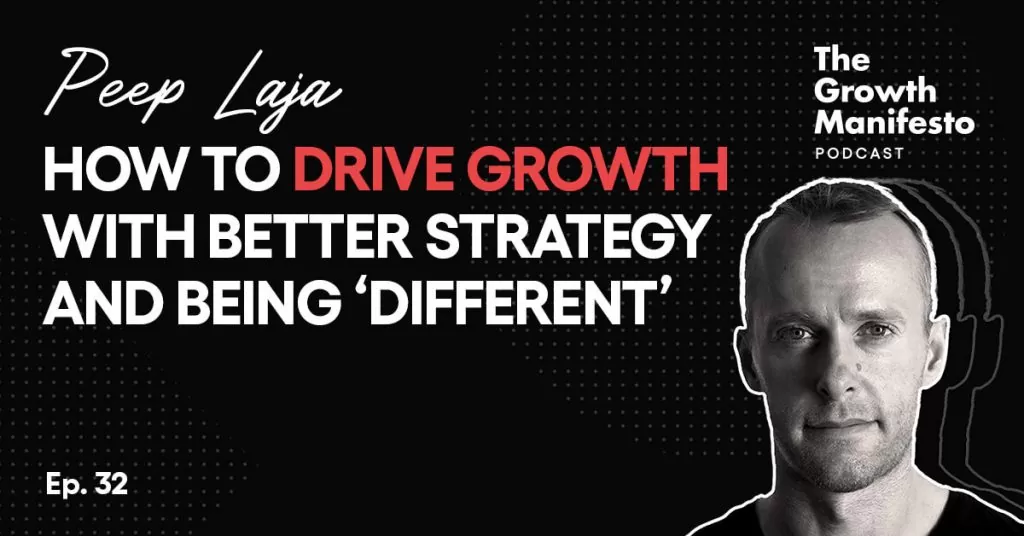
 with Peep Laja


Overview
This episode is a discussion with Peep Laja – conversion expert, entrepreneur, founder and marketer. We talk about CRO, strategy, and differentiating yourself in a sea of sameness.
Key takeaways
- A brand grows by appealing to a specific segment's values and deliberately repelling everyone who does not share them.
- Conversion research works because most people guess at website problems instead of asking customers directly what stops them buying.
- Behavioural design rests on two levers, motivation and friction, and motivation matters more since enough desire makes friction irrelevant.
- Copying a market leader's features or design never copies its success, since that success usually comes from somewhere else entirely.
- Sameness is the default for most companies, so differentiation and consistent daily content matter most for anyone who is not the market leader.
Chapters
- Brand values that polarise customers
- Introducing Peep Laja and CXL
- Building ConversionXL from Estonia
- Conversion research: data and interviews
- Two levers: motivation and friction
- From CRO expert to founder
- Differentiating in a sea of sameness
- Strategy: where to play, how to win
- Quickfire questions on books and hiring
About the guest
Transcript
Auto-generated from the episode audio, so expect the odd mis-heard word. Timestamps open the video at that point.
So there's one coffee brand, for instance, that I think is called Black Rifle Coffee Company, which is run by ex-military veterans. They donate some money to veterans, and they're super pro-Trump. So, and that is a key to a successful brand, is that you appeal to a specific segment on their values, what they believe in, and you repel others in the same way. So if you're anti-Trump, like me, you're like, fucking hell, I'm never buying this coffee, even though the beans might
be great, right? So, so you polarize people intentionally. So you have a shared, shared set of values. So like Patagonia makes vests and all kind of outdoor gear. And there are, you know, their website says fuck Trump, right? The reason I buy Patagonia gear, obviously it's great. I buy it also because I believe in sustainability and, you know, I want to help global fight global warming and all these other reasons then I hate Trump I buy Patagonia because when I wear Patagonia now that says something about who I am right if you talk about factually like the
fabrics they use designs I'm sure like North Face or whatever has similar stuff right so it's not objectively better it's it's just I buy into the narrative about who I am and who they are And in B2B, you can do similar things, you know. So today we're talking to Pep Laja, how do you say your last name?
Laja. Pep Laja. He's a marketer and he's a conversion expert. He's the founder of conversionxl.com, which has now been changed to cxl.com. Is that right? Yeah, but I had met you all those times ago when it was conversionxl.com. You have an agency, you have a training arm, which is called the CXL Institute. you've just launched a new company for copywriting and for copy testing that we'll come to a bit later and another company called Adept.
And what's Adept? Because I saw on your site that there's another company called Adept, which I haven't been seeing you really promote much. Well, it doesn't exist really yet. We're building it. You're building it. Yeah, yeah. If everything goes well, we're launching, we're going to launch it next spring. Basically, a new take on what online learning might look like. Okay, cool. And so we'll come back to online learning as well a bit later too. And I remember that I met Pep at a conference,
the Witch Test One conference in Austin, Texas. And he had a booth there and he was doing some free conversion reviews. So I figured I'll sit down and see what these guys in America have to talk about. and within about 15 minutes, I was like, what's that on your screen? You're like, oh, that's a course that I'm about to launch. I'm like, hey, could I just buy it now? And you're like, but like it's not ready yet. But somehow I convinced you, I purchased that course and that was the first Conversion Excel Conversion training. Is that right?
This is like five, six, seven years ago. It was fantastic. 2014 or something, yeah. 2014, 2014. That was the first time I'd met you And I remember how direct you were and how straight up and no, no fluff, no fluff. That's how I roll. Not everybody can, you know, roll with the punches, but some people appreciate it. Well, I appreciate it. And you seem to have a pretty strong knowledge around conversion optimization.
I mean, that's kind of how I met you. And that's kind of how you started in this whole thing, isn't it? because I mean yeah yeah yeah I mean I was determined to become the number one conversion person in the world by reputation and skill both although I that's now in my past because I've achieved it sorry yeah you know you got just tired of being a get tired of it and and also then by adding new
companies and had to move from a role of a consultant expert into a CEO role and business person so I haven't been practicing CRO you know actively for a couple years now I mean obviously on my own new startup stuff but uh yeah so let's talk about the conversion Excel blog right because yes when did you start that? I started at the end of 2011, like October. So about nine years ago. And it was my
personal blog at the time. So my business was another company called Markitekt that we merged with Conversion Excel later because it was too confusing to have two brands. But yeah, so it was me and I was doing data-driven blog post writing. And how long did it take you to get to being the top conversion site in the world? Because you achieved that within a few years, right? I think so. Well, I mean, it depends on how we measure it. But in terms of traffic, we became
pretty big, pretty fast. I think we had like 100,000 monthly within a year. Within a year? And how did you do that? We had some posts that went massively viral. So it wasn't all SEO traffic. It was like we were number one on Hacker News a few times, which sends you 100,000 per hour. And then Tim Ferriss tweeted some of our articles and that again and took my blog down.
And so we got also lucky, but I also worked my ass off writing those posts. So what was your approach to that? Because obviously there was already like a bunch of conversion content out there and somehow you came out. Well, the year was 2011. So the competition was much lower than what it is today. And not just in the CRO space, but how any business blog was being written back then, the typical blog post was 300 to 500 words, zero links.
You could, and people were claiming all sorts of truths without backing it up with evidence. And so my, before I launched the blog, I basically I did this competitive analysis of like, what are all these blogs out there and what are they doing and how can I fit in and be stand out really? because it's about being an upstart and you want to make your mark. And then I chose a strategy. It's like I only write long form posts. And back then I stumbled upon this study that if your blog post is at least
2,000 words, it gets more social media shares, more backlinks, and so on. So I set myself a standard 2,000 word minimum. And then also like every claim I make is backed up by proof, you know, linking to a study or, you know, something like this. And also I had set an internal standard that every post I write needs to be the best post ever written about this specific topic. So my very first post out of the gate was about pricing experiments.
And that, you know, when Hacker News number one and so on, Tim Ferriss tweeted it. So you found a formula and then you're like, well, I got something now. and yeah you replicated that is that right replicated it and i mean not every post goes viral but basically they they were good and they stood out because they were obviously clearly better than alternative you know i don't remember exactly who had a cro blog back then not very many people you know i think invest had a blog and maybe wider funnel had something uh but i don't
think they're even now taking blogging seriously so you know see in terms of zero there wasn't much competition I'm obviously other blogs also wrote about conversion optimization but within you know three years basically any CRO term you would Google we would have a blog post ranking for it you know in the top three at least and so you had the agency before starting the blog or let's start after the blog? Because of my content.
At the same time, I was famous in Estonia. And so I had my own Estonian marketing blog that was generating leads. And then I set up the agency to actually do stuff for them. And then I had reached what I thought was like peak Estonia. Like I can't get any bigger. Estonia is a very small country, like 1.3 million people. So I started my English language blog to build my personal brand and also to prove myself
that I can do it in a global setting. And then over time, I started also getting leads from American companies. Then I funneled those from my Estonia agency. But the confusion today is conversion Excel, but now it's market tech, what that agency was called and it was confusing and so we ended up merging them basically yeah sure and so that blog essentially helped you to break into the u.s market because it's a pretty hard market
to break into and to break into effectively isn't it right yeah i mean i i think online you know there are no country borders so english language is you know is the country on the internet right some telling differences with those z's and s's but otherwise you know well for sure yeah so we built the business on content marketing on on blog because i wasn't
really i mean i was active on social too uh but it's not like linkedin today i mean i was on twitter and stuff yeah business and i think for the first three years i wrote like every single blog post and then we were at a spot where i could also bring in like full-time content people how many blog posts per year were you writing probably published uh like 1.5 per week or something okay of 2 000 plus word articles yeah something like this i mean i can look it up but
at least one a week minimum you know i think more like 1.5 a week okay and so when did you launch the conference was that first cxl live or conversion excel back then was i think 2015 yeah i wanted to do it many years prior already and i had like i had the venue and everything was like ready to go and then the hotel was like here sign this contract and you know this is like five hundred thousand dollars worth of expenses and they don't
care whether you sell out or not you need to like commit year up front to all these expenses and so for two years in a row i chickened out i was like shit i don't know if i can do it yeah in 2015 and i was like i think we can do it and we did i think i came to that one it was either that one or the one after it was a great conference it was like in it was in horseshoe Bay. I think it was a Horseshoe Bay. Yeah. Yeah. That was a really cool conference. And I was like, I'm coming back to this conference. That's for sure. Um, but cool. So you've taken that,
but then you've stopped the agency life and now you've gone into startup land in business land. Right. So I mean, two things happened, uh, you know, in your life, you always have to ask yourself, are you growing and are you having fun and at around 2016 i felt that my growth my professional growth had slowed down like i've been doing this conversion stuff for a number of years now and i needed to like either chase a rabbit hole you know go really nerdy into i don't know
statistics or like take it take a new thing to to keep the professional development up but I kind of felt like I was also out of passion for it. So, uh, I wasn't having fun and I was still consulting, even though I was the head of the agency, but, uh, and I had been consultant since 2007. And so I was getting tired of consulting. I couldn't explain what P value is for the millionth time. Um, or when to stop an AB test.
And so basically I was looking, you're going to have to do it one more time today, my friend. Sorry. And then at the time, and anybody who joined our blog, I'm enjoying any subscribe to the email list. We sent out an automatic survey and, you know, like in one of the drip emails asking what else can we sell you if we were smart enough? And then we crunched that data. And we had like maybe 5,000 responses over the years. and it was like 80% said eBooks and courses.
And I had already launched some of my own, you know, side hustle courses. But then I thought, hey, our agency is so expensive. 99% of the email list subscribers can never afford us or they don't have the traffic to run A-B tests. How about we monetize those people by selling them content? you know uh we can't do CRO for them so they can teach themselves and then basically the idea came to build CXM Institute and I decided I'm going to run that unit and I'm going to pull myself out of
the agency combining me you know you know not growing and not having fun anymore with a new challenge that was exciting new growth and then there was a you know maybe um the first year was was a transitionary period it wasn't like overnight and people at the agency were also worried like will the agency survive me departing because i was the face you know but it turned out great and we'll get to some of the other pieces of software um shortly um but let's talk about
the thing which you you don't talk about anymore conversion conversion optimization because i know you've still got it in there it's still in there you can't hide from it that's what you know it's all the way in there deep all right um what would you say let's start simple yeah um the most important things to understand to improve the performance of a website what are the most important things to understand well if you want to improve the performance you get more sales and emails or whatever it is that you're trying to do first thing is to understand what are the problems
You know, what's holding people back? Why aren't they buying more stuff? Because you can only make stuff better if you know what the problem is that needs fixing, you know. So that's where you would start, you know, combining qualitative and quantitative. Quantitative digital analytics would, you know, tell you what is happening, where, how much, you know. Like where are the people leaking out of your website, where in the funnel or any, you know, because funnel is kind of an outdated model, but you can still see where they're leaking out.
And then you do qualitative surveys, interviews, live chat, all that stuff on top to understand like why. Yeah. Yeah, sure. So attending your conferences, I heard lots of different conversion professionals talk about conversions. Everyone kind of had their own different slight approach to improve the performance. And I remember your one was all about conversion research to really understand the customer.
And you were the first person that went into that level of detail about conversion research. So could you explain what it is and why it's so important? so conversion research in my experience is where you get 80 of the results because in order to improve your conversion rate as i said you need to know what the problems are and there are how do you know how do you know what the problems are if you don't research it right
um so you so that that that is the key like if you know what the problem is now i can do something about it um that that's that's the whole thing but like most people will come to a website and they will look at the site and they will look at the competitor sites and they will have a look inside their own kind of gut and they will make kind of these gut decisions and kind of assumptions right i mean that based on their experience to an extent you know like if the site is horrible
You can see some, you know, like if the copy sucks and the design is bad and or maybe has technical problems, the CSS is not rendering properly. That's easy, low hanging fruit and you can do it without looking at any data. You know, if you've seen enough websites, you've seen enough what works. But once you start getting to the, this is pretty good already. If you get to the, you know, this is somewhat optimized or even very optimized websites. And if you look at any market leader, so, you know, we go to, I don't know, HubSpot or Salesforce website.
If you just look at it and say what should be done to improve it, you know, the odds that you nail it are very small. So that's why that's when data becomes irreplaceable. And how do you keep on getting wins and those uplifts year after year after year? You know, at CXL Agency, you know, we have clients that have been with us now for five years. And still every single month we keep getting wins. And it's all because we do this continuous research and experimentation, obviously.
Because it's an interesting one because, yeah, that's such a fantastic point. Because, like, it's especially for the junior marketers, right? They are kind of fantastic at taking something that looks terrible. and making it kind of okay, right? Like that's easy to do because of all the courses that you learn, right? Like an attend, right? Like a course is enough to show you the things which will kind of take something that's completely horrible and make it just not,
you know, like so it can perform. But it is really, really hard to take something that is working and improve it because you can't just change the picture or the button color or the button or whatever, right? It's so much more psychological than that. Totally. And also what's happening is today the default templates of all the SaaS platforms, whether it's your Shopify or, you know, any landing page builder, they're pretty good. The default templates of even WordPress themes are pretty good out of the box. So it's like just eyeballing it to see how to improve it is getting harder, you know.
And hence again, we need to turn to data to discover what keeps people from buying. And sometimes you could just go and look at it. So here's a particular case where we had a customer of e-commerce. The cart page, so they add product to the cart, go to the cart page. The cart page has a massive abandonment rate. I think like maybe only 10% proceeded to the checkout. Typically it's like more than 50%. and we look at the page like what the hell is wrong with it seems pretty standard
and then we asked we put a survey uh or like a poll on that page asking hey what's holding you back from completing this purchase and like 90 percent of people said shipping costs and when you look at the page like and you evaluate the layout and the copies you would never think about it. And yes, the shipping costs were expensive, especially they were selling like kitchen stuff, like forks and knives and pans. It's like fork, $2 shipping, $12. And so once the
business knew that that is the problem, you know, they basically, it's not a conversion problem, it's a business problem. Like they, they, I think they, they changed their fulfillment provider to get better rates. So how many times is a conversion problem actually a business problem, but you think it's a conversion problem? Right, right, right. I mean, frankly, if your product sucks ass and you have terrible reviews about it everywhere, there's very little you can do, you know? So, I mean, product is something not,
is not anything that CRO controls. or if the same thing is overpriced, you know, if it's overpriced compared to the competition, like especially if it's kind of a commodity product. So let's say web conferencing tools. Let's say there's another new WebEx Zoom-like tool coming out that does exactly the same things. Oh, it's crystal clear video and whatever. And it's like a hundred bucks a month per user,
like considerably more expensive. Now do you see a role in it to improve the conversion rate? Like you can't because it doesn't have, it has no differentiation, which is a business problem. And it's overpriced, which is a business problem. So of course the role of a CRO in this situation is to say that, hey, this is the problem. And you can bring the data, you can survey the audience. You can provide qualitative data. 95% of people we talked to, they say they don't buy because of the price and they don't get how you're different or better you know
yeah sure sometimes yeah so outside of the the business problems then what are the things that conversion research should find you know so what are some of the things which you're looking for you know like assuming that that the product is good that the reviews are good that everything seems to be good in terms of the product and it's the marketing now. So how does, or what are the things which a person should be looking for in the conversion
research process? Well, the key thing is that you're trying to identify problems, friction, friction. So you don't want to hear about praise because like hearing, hearing, you know, why somebody likes the product doesn't help you sell more product. So typically I want to understand things like, you know somebody bought something you know you want to talk to them about like tell me what about finding the right product to buy was difficult for you
assuming that it's like let's say it's e-commerce and there's like hundreds of products because sometimes like product discovery is is is a hard difficult process then you want to understand you know was there something or what was something that almost stopped you from buying. Again, friction. What questions you had about the products or services or anything that you couldn't find answers to on the website? Sometimes the answers are there
that are just hidden or on the FAQ page that nobody ever visits or things like that. So you want to understand what the issues are and then also want to talk to people who actually don't complete the purchase. People who abandon cards or browse the website and then you know bugger off again like what's holding you back from completing a purchase well you know what's holding you back from adding this product to the current friction identify friction and qualitative is much more important than
quantitative data like analytics data will tell you where how much but not why but there is another thing about i'm talking about friction but there are basically two levers behavior classic behavioral design is that in order to get people to do something you need to increase motivation and decrease friction and motivation is a far more powerful tool than minimizing friction like if they want it bad enough friction becomes irrelevant like
if I'm selling you a new Tesla Model S brand new for $10,000, like I can ask, I can have a form field, form with like hundreds form fields. You're going to still fucking buy it. Cause it's a great deal. Right? Right. So, so you do want to understand those. So not only the friction, how to make it a more seamless process to buy, but what problem are they solving for themselves? So understand the user, the context, And of course, if you're selling pants, you know, it's like, what is the problem you're solving?
It's not that. But if it's like a B2B SaaS, it's more rational. There's a problem, you know. Or if you're selling pants, I mean, it's more fun and hedonistic stuff. But so understanding the user and what makes them want it more. You know, also maybe J.Lo was wearing these pants and this is, you know, I don't know. Yeah, no, I got it. Kim Kardashian's favorite jeans. So understanding motivation,
then that turns into usually you increase motivation through better copy. Yes, there's social proof that's needed and maybe a celebrity endorsement, but the celebrity endorsement is usually game for really big guys, right? Social proof anybody can do unless you're maybe starting out and you're getting started most. but copywriting anybody can write great copy you know so that for increasing motivation thanks pep um so it's cool so we there's two but just to summarize the two things that we're
looking for in conversion in conversion research is to reduce friction and to increase the motivation right they're the two things right but how do you approach actually acquiring this information so where do you get this qualitative data about friction motivation yes the easiest thing to start is with your actual customers uh so you need to talk to them so either through a survey which uh scales really easily because it's automated so typically you want to send out the
survey uh after they buy something so when they still freshly remember their purchasing experience when you survey somebody i mean a year after they bought something they've already forgotten the details but so you want to ask either on the thank you page like hey uh we'll give you whatever a $20 gift card if you fill out the survey you know some incentive is uh always helpful or you do it over email you said thank you you know we got your order and then a separate
email is like you ask them of course you the the response rate is gonna be low you know you get you know two to four percent five percent if you're good the incentive matters a lot you know so if you can offer either coupons or free product like whatever you can you know this is an economic calculation here yeah and then so on the survey you want to ask open-ended questions not multiple choice because if you're asking
multiple choice you assume you already know what the problems are like which of the following were the problems you know like then you're not opening yourself up to problem discovery I usually ask around seven, eight questions, which is a great happy medium between, you know, if it's more than 10, response rate goes down, suffers. If it's only two or three questions, you just don't get enough valuable data.
Yeah. So seven, seven is like a happy medium that I've found. And so survey, survey questions, you know, you were like, well, you know, what doubts and hesitations you had before making a purchase? What questions you had about the products that you couldn't find answers to? Or what was holding? What almost stopped you from making the purchase? What about finding the right product was difficult? Things like that. Also, like what problem were you solving for yourself?
if demographic information is important for some reason you can ask that but typically i skip it unless it matters how men or women answer separately now user interviews calling people up is much better than the survey but of course it doesn't scale as well because it's uh you know takes human time but i would definitely recommend doing at least some surveys and then even make it
a compulsory for a team that every every week you need to talk to at least you know two customers three customers uh so they would you know have a finger on their pulse and then uh so the so that's customer part and then the people who actually don't go through with their purchase the easiest thing you can do is put one of those polls on key pages. So let's say Google Analytics tells you that not enough people add products to cart on the product page, assuming it's e-commerce.
Or maybe on the SaaS pricing page, people go to the pricing page and then they leave. So you want to understand that the problem page. Then you put a poll on the website. And I like to do it was the automatic poll asks first a yes and no question, because it's easy to answer. Kind of like, is there anything from stopping you from making this purchase right now, or completing the purchase, or is there any confusion around pricing?
Or you know, like you need to think about the wording. And then when they say, yes, there is a problem. Now you ask, like open ended, type in what the problem is. Again, you get very low response rate, you know, So you need traffic and time to get enough sample size. So for qualitative surveys, you know, a hundred minimum, 250 is optimal. I mean, obviously five responses are already better than zero. I was about to ask the minimum number,
which you would be looking to actually get some insight from. Yeah, I mean, the five people might already tell you what the problem is and they're right. the problem that you have with low sample size responses is that you don't know the severity of the problem or how often it occurs. Cause let's say only five people respond to a survey, three of them highlight a problem. Now you can't claim, oh 75% of have this problem. Cause if you would survey, you know, 250,
maybe it's only five people who had this issue. So they might be outliers. You just don't know. but as with you know user testing 5 to 15 you know is enough and if you look at how governments do various types of qualitative research around the world often even 8 people doing an intensive study is like informs government policy so you don't need a lot
to understand the problem so okay um so it's easier for larger companies that have lots of customers what happens if you are um like a startup more or you don't have these customers which you can rely on or your conversion like the conversion numbers are too low because it's the b2b style sale which is six months and so like you don't get like a lot of conversion
how do you approach this process in that respect if the volume is not that high well if the volume is not high you need to just try harder to reach the few customers that you have so if you only get two purchases a week you can easily call each one, 100% of the customers you can just call them up and even be persistent about it and follow up and
you know like in a nice restaurant that when the chef or the owner comes out and greets all the guests it's kind of nice you can also say like if you're starting out assuming you're the CEO yeah business owner you know it might be actually a nice touch and you can bake it into your concierge VIP service you know like I'm personally calling you to check up you know on you yeah sure sure okay that's cool um so and this is probably the um the final question around conversions
because we have to jump to sales and marketing because i have a lot of stuff around there which i want to ask you what are some of the mistakes that you see people making you know you know like people who think they know about conversion optimization but really they don't because of these because they're making some fundamental mistakes you know what are those the fundamentals that people sometimes get wrong well a common one is not knowing anything about statistics so like you know you you have your uh you know a thousand visitors a month who make you know 30
purchases and then you you launch an a b test with you know seven variants and then you you who has stopped it after variant C gets three purchases, you know, and you think, oh yes, I'm so data driven over here. Actually you're an idiot. So yeah, sample size is a minimum, minimum volume needed to run any kind of experiment. Also, even if it's email open rates or stuff like that. So understanding that.
So as I see so many, even like startup marketing consultants are like posting on Twitter image, I love when I get, you know, 7,000% uplift. You know, you and me, we both know, we don't even need to know the samples as we know. Nobody ever gets a 7,000% uplift. Because this was like seven versus one conversions or whatever, you know. Yeah, exactly. so statistics read up on it take a course on it read a book on it i mean there's now there's so
much content about it out there if you just wanted to google it you know how what's the sample size you need or how many conversions do you need to before you end the test so that that's a big one uh two is i would say uh if you just uh assume that uh you copy famous websites and you you know, copy what they're doing and it will work as well. You know, like, um, you, Oh, Amazon is converting pretty well. They have, you know, a trillion dollars in revenue.
But if you put Amazon, you know, add to cart button on a new website, you don't get Amazon style revenue, you know, their secret of success is somewhere else other than their UI, you know? Um, so copying, I think copying market leaders or even your competitor, bigger competitors, is a dead end. So first of all, you don't copy their success by copying their user interface. But also at the same time, if you copy them and you look exactly like them, there's no reason to choose you.
Because you want to be different from the competition, not the same. The sameness is something that actually kills you. people will always go with a brand they know and if you're an upstart you need to be very different to give somebody a reason to choose you okay yeah right is there anything else that people should be wary about you know just because they've heard about ConversionXL they've seen some of the articles
and they know okay this is this is the software I use and I know if I have enough traffic I just do these two things. Is there anything like, do you know what I mean? Like it sounds fun when you get the tools for the first time or the second time or the 30th time. Yeah. I mean, tools are not magic, you know, like using a fancy expensive tools is not giving you a better results. You know, you paying, you know, a hundred thousand dollars for optimized. It does not give you better A-B testing results. Like compared to optimize, which is free. Yeah.
Okay. Tool is not magic. Tool is a tool. your brain is where the results happen you know you need to know the tool so forget about that and then also I guess some people are looking for that magic formula like maybe there's this magic layout the magic structure to my page that converts the best and while there are some best practices there aren't there's no magic you know and best practices is basically your first
hypothesis that you put out there and you should optimize from there it's not like best back practices is the the end you know it's where you start yeah cool and I'm not gonna ask you about the p-value like anyone that's interesting that can look online appreciate it cool let's jump to sales and marketing now because you've moved from a conversion expert conversion consultant conversion speaker conversion trainer to entrepreneur founder to marketer salesperson to every part of
that role um right yeah how is how is that transition you know just going from you know just knowing about this one part you know across all the marketing right but this really important part that is fantastic for high traffic websites it's worth a lot of money to now starting a business with this information in hand but how is that transition well it's both easy and hard it's fun because you're always new learning new challenges new things to learn about so that's
all great but also identity problems like well who am i now uh how do i position myself or even in social media is like what do I not talk about because you don't want to be all over the place and and also like what skills do I start developing now like because if you're focused it's easy you know if you're like broad is like I don't know like should I learn about
managing a team or finance or anything. It could be anything. So that was that identity crisis was it was affecting me also like people were inviting me to conferences and I was like, I don't want to talk about conversion stuff anymore. But like, and they said, okay, sure. So what would you talk about? I'm like, I don't know, actually, good question. Good question. Have you found that answer yet or not?
Have you found that answer? I'm much more comfortable in, because I've been now out of the, I took off the CRO hat, literally, four years ago now, 2016. Yep. And so obviously I'm much more clear about my identity and who I am and what am I doing, and also in terms of my learning. there are certain areas that I'm now just enjoying geeking out about much more than others you know like
and these are strategy differentiation and brand and they're all super interlinked and so I truly enjoy geeking out about this stuff and reading and also writing about this stuff and this year after multiple years of hiatus I'm back at the conference scene virtual this year obviously but I'm speaking about differentiation now okay well that's good
because that was one of the things I've got on my list to talk to you about before we get to that one you've been pretty consistent posting on LinkedIn yes every single day for how long now how long you been doing it for now oh I I think I decided to become consistent last fall, maybe a year ago. Okay. And so I have it in my calendar every single day to post on LinkedIn and Twitter. Usually the same stuff, just different formats.
Yeah, formats. Because brand building and audience building are just massively important. and personal brand of a founder uplifts the boats, you know, of the companies that you're associated with, you know, case in point, look at Basecamp and now, Hey founders, how they're super active on Twitter and cultivated massive following, writing books, super opinionated. You know, it works or, you know,
why would anybody use Moz over A-Refs or other tools out there? It's like, oh, we still remember the great Ren Fishkin. Right, right. Or, I mean, even I buy a Tesla because I'm a fan of Elon Musk versus like, who is the CEO of Mazda or Chevrolet? No clue. I have no idea what their brand stands for.
Like when I buy a Nissan, what does it say about me? Actually, I don't know because that's what a brand is. It's like if I buy you, who am I when I buy you? You know, because like running shoes, Nike, Idita's New Balance, whatever. There are no functional differences. Also no design differences because each brand has similar designs, you know? So it's all about the brand. and brand becomes the separation. And then the founder might be the,
why you buy a product, because you like the founder, or you know about them. And also often it's on social media, it's easier to build a personal social media brand, rather than a company profile, especially if it's B2B, you know, because it's, you know, maybe if it's you're a fitness celebrity, it's, you know, it's two in one. sure um yeah so what have you noticed in publishing every day for a year well certainly my audience is growing my personal audience is growing
uh and uh there are now people who are following me that are not even unfamiliar with my conversion background because like for the longest time people still put me in that pocket because you know people want to compartmentalize well i've known you from that's including me you know you know absolutely man that's it's hard yeah and so copy testing for instance this new SaaS company launched in May the whole marketing for it was through my in the
launch phases through my personal social media so we got to our first 1000 users through my personal LinkedIn and Twitter no other channel was ever used you know what was the ratio between LinkedIn and Twitter like if you were to think of the sort like or if you were to track the source rough I don't know I didn't do UTM or anything what does your gut say like I'm saying says that probably LinkedIn is better like
the visibility of a LinkedIn post is the reach is bigger Twitter I think a A tweet, the lifetime of a tweet is shorter. You know, it's like we're talking hours, unless it goes in a viral, and most don't. So I get, I mean, I'm not really tracking impressions on Twitter, although you could see impressions as well. But like, if I look at the number of likes, like engagements, LinkedIn versus Twitter, I get more on LinkedIn.
and my LinkedIn, the number of followers I have on LinkedIn is actually much lower compared to my Twitter. On Twitter, I have just under 40,000, 38,000, something thousand. LinkedIn, I'm actually not sure how many I have. I think you just got over 20,000. I think that sounds like a thousand or something, yeah. so so so considering the number of followers versus likes I think LinkedIn
gives you a better reach and also LinkedIn has serves those stats like how many people have seen it obviously it doesn't mean that actually saw it but which I think link is as well which positions as well it shows you the kind of people that are looking at it too yeah I just was asking that because I've been seeing a lot more attention being put onto LinkedIn and I've been seeing a lot more not not too many people but a fair few more people sharing thoughts sharing ideas sharing conversation starters how do you get your ideas to write every single day something every
single day well since i know i need to post every single day i'm looking for i'm actively on the lookout somebody asked me a question at work like one of my colleagues and I you know give them a rant that's like oh that's actually a good topic or yeah rants are always good topic but someone says something like I didn't even know I cared that much let me write this down now exactly exactly that's a good that's a good indication uh or you know you tell somebody a story uh about
your past you know in 2017 went to this conference and this guy said this and then we got into a fight and it's like oh that's a good start actually um so that's one two is well some people are natural original thinkers just just get a bunch of ideas and maybe have they have the luxury of having time to think uh because you're like if you're always working you know like it doesn't just come to you so my wife is an original thinker she always has amazing ideas i'm like can I tweet that I'm not that so I'm my brain the way it works is like I'm gonna I need to synthesize
different ideas so I need to feed my brain and the way I do it is I'm always reading paper books or handle more more these days always listening to audiobooks podcasts I want I'm driving these days with COVID much less than I used to I I'm an avid lifter you know lifting weights so when lifting put on a podcast podcast so always feeding my brain and then you put two and two together oh that guy said something in that blog post which happened to
me last week at work and then i read about it in this blog post and it's like that you know sparks and insight yes and then you know i and i send myself slack messages like my personal I DM myself so I wouldn't forget. So I have like a library of thoughts. And then every time I need to post, I have a certain time. I usually post when it's like 7 a.m. U.S. Central Time, which is my experimentation shows that that's the best time to post.
You get the most reach. So then I go through my library of thoughts. And also when I'm reading a book or listening to anything and then somebody says something that immediately is like, whoa, that's brilliant. When I notice myself reacting to an idea, that's a telltale sign that other people will also have a eureka moment. Not everybody, but people, because it's contextual, right?
But then I'll write it down. I write down and then I build a ramp on top of that or anything like that. So some days I am also like, okay, I need to post. My library is empty. I have nothing. Then I usually think about top 20 or 30 lessons learned doing my work. So if I had to teach somebody else what I'm doing, like what I'm, I pick a topic like recruitment, okay, interviewing people.
What are some of the key things that I have learned about interviewing people? as like yeah if I were to teach a junior colleague I would have a lot of wisdom to share and so I make that into a forum or LinkedIn thing have you found that the fact that you having to write every day has that had an impact on the success of your businesses just that I think so because it's writing stuff down forces you to clarify your thought because you you have all these ideas in
your brain but once you need to write them down and make coherent sentences you're like you realize that the ideas in your brain are not organized yeah at least my brain so it really forces me to think through the concepts and and then that also I'm taking it to my business you know when I'm learning about differentiation strategy in brand and writing about it I mean I'm also a student in fact most of the stuff that I say is note to self like myself yeah
sure and so is always relevant to what I'm going through right now and so I clarified my thinking to solve my own problems better yeah sure and I think think you know it is good to write it down that's number one it is different when you're writing it down for 20 000 people to look at and to potentially pull holes in and to really be at a point where you're prepared to stand by this right like because there's the other part is like i'm
going to put something out that's going to be maybe controversial because you know that's good for personal brand but it doesn't have to be but i have to be good at answering it because it has to be right doesn't it well i mean i'm not too attached to uh me being right because also when you use social media to write an idea you have character limits so you can't there are always exceptions and you know whatever people will say oh what about you know so it's okay i mean i'm not you
know you can endlessly defend your positions or you can say well yeah in that case sure that's different yeah sure but okay people do love strong opinions if you say sometimes it happens that you know like you soften it yeah and it's not as impactful people like fucking strong opinions and uh strong opinion posts just do much better and even if you get haters and i really do meaning like people disagree with me but not in the troll troll way yeah sure agreement
that actually helps the engagement like it's it's controversy so you can have a back and forth argument the more comments you have the more linkedin or twitter like will increase the reach well i've been following your stuff now obviously because i engage with it i keep saying it it's good stuff so if someone is listening i would kind of highly recommend um that you follow pep on linkedin because there's some good stuff in there that gets me thinking um a lot of it's around the things that we're speaking about um but the one i wanted to speak about next
is um i think the most important well it's a top one at the moment is how to differentiate yourself in the sea of sameness this is what you're doing right totally you know the main premise of the idea is is that you know the competition is harder and bigger and stronger than ever before because the barrier of entry to start a new business is lower than ever before. With the no code and so on, you can ship SaaS,
without writing any code even in the new stuff. So all these tools out there that make it cheap to get started. I mean, starting an agency, you need just a laptop. Like anybody can be an agency right now. And that's why there is so much competition. If you look at the marketing technology landscape, Chief Market maintains that the index of all these MarTech tools is like where we've gone in a couple of years, we've gone from like 1,000 to 9,000.
You know, like we have like literally like 100 email marketing software. So considering this, you would think that big companies are all about them standing out. But actually, no. The sameness is the default. Most companies, when they write about themselves, who we are and what we do, they write it from a position that we are the only ones in the universe. You know, like simple email marketing software, send great looking newsletters. That's like every fucking email marketing software out there.
Or like we generate leads, we're a growth agency. Well, so does everybody else, you know. so that immediately as a buyer you're looking for one and they all say the same things. Which one are you going to go with? The one that you have heard about. So much more important than differentiation is market penetration awareness around you. If you were the market leader you don't need
to think about differentiation that much like if you're a mail chimp You're the king of email marketing. So MailChimp doesn't need to be different. Others need to be different from MailChimp. MailChimp is the default, you know. Got it. So now if you're starting a new email marketing software and you have MailChimp and ActiveCampaign and all these tools, right, if you are not clearly different, you don't stand out, they don't even notice you, nobody even mentions you, how can you get noticed?
If I go to the G2 email marketing category and you're one of the 200 tools there, why would they ever even click through to your site? How would they ever find out about you? Because if you're a new company or even if you're somewhat old, you can't rank number one on Google because it's so hard. Even if you're number nine in Google or page two, I will never find out about you. And running ads is just so expensive. You need a lot of money to buy awareness. I mean, it can work, but it's very expensive.
It's much easier to do what Seth Godin wrote about more than 10 years ago, to be a purple cow, meaning that if they see you, they can't help themselves but say something. Like, whoa, that's weird. Email marketing for people who are into origins and heavy metal. Wow. That's a niche. That's a niche, isn't it? and then obviously if you're getting started if you're a startup you want to go for a very small
niche like the smaller the smallest market that can sustain your business you can expand out of that later like and that has been done so many times like think about all these big companies they started from a either a single use case or or even in personal brands you know tim ferris 2007 was that life hack guy, right? How to work less and, you know, build businesses that run themselves. Now he's a mainstream guy.
Like now he's everything, right? He has books on cooking and health and he talks about whatever, you know. So, but you start from a niche, what we did with CXL, you know, we were only conversion, now we're more things. So I think, you know, So differentiation is key to get noticed when you're not the market leader. And there are, you know, obviously... How do you differentiate yourself? Yeah, how? Well, let's do it in terms of, say, for example,
some of the B2B stuff, right? Let's start with that because that's probably where you have quite a lot of experience now, right? Okay, so features is a dead end. You cannot compete on features because every feature that you have that is popular and actually useful will be copied. I mean, you might have some time where you have this feature and others don't. But if it's popular, they will copy it. You know, like Intercom versus Drift.
Anything that Drift had in Intercom didn't, now they have it and vice versa. Feature-wise, it's identical. up. They just copy each other because what happens is that everybody's doing competitor benchmarking. And you can't win that game unless you're for some reason, you're a better innovator. You're better developers, you have more money, you have some sort of a moat. Few have. Like right now, Tesla is the innovator for the electric engine. They have better batteries and all that
stuff but every single car company is you know frozen in right I think five years from now it's no difference I mean everybody has the same technology you know so they only have few years of advantage maybe they can keep the innovator game up maybe it's very hard right and to do it over sustained period of time so forget features if you're a software company even as an agency like oh we do this weird-ass service I mean if people want to buy it every other agency will also start offering right especially because it's so easy then isn't it because all
they have to do is just say it they just say the same then sell it then figure it out you know they don't even have to build the feature yeah exactly so so like really like in the end how can you differentiate you know and the big one that the most obvious one is brand so you could have a brand which is a reason to buy that is a soft reasons demotion reasons value space so a good example
I have is coffee beans which is a commodity product right and you can't compete with features because like there are features like you know it's picked last month and roasted yesterday you know and we ship it to you fresh and all that stuff but anybody can do it and now in the U.S. everybody's doing it. There's heavy competition. So there's one coffee brand, for instance, that I think is called Black Rifle Coffee Company, which is run by ex-military veterans.
They donate some money to veterans, and they're super pro-Trump. And that is a key to a successful brand is that you appeal to a specific segment on their values, what they believe in, and you repel others in the same way So if you're anti-Trump, like me, you're like, fucking hell, I'm never buying this coffee, even though the beans might be great, right? So you polarize people intentionally. So you have a shared set of values.
So like Patagonia makes vests and all kind of outdoor gear, and their website says, fuck Trump, right? The reason I buy Patagonia gear, obviously it's great. I buy it also because I believe in sustainability and, you know, I want to help fight global warming and all these other reasons. Then I hate Trump. I buy Patagonia because when I wear Patagonia, now that says something about who I am, right? If you talk about factually, like the fabrics they use, designs, I'm sure like North Face or whatever has similar stuff, right?
So it's not objectively better. It's just I buy into the narrative about who I am and who they are. And in B2B, you can do similar things, you know, like Basecamp as a CRM software, objectively, well, they have less features than Asana or, you know, some of the other ones. But they have a set of beliefs, you know, like list clutter and the founders are against, you know, like Apple dominating the ecosystem.
and you buy into some sort of a narrative. Yeah, I'm for the upstart and underdog. There might be some emotional reasons that make you choose a practical thing like a CRM product. And same way founders is like, hey, Alex, I'm listening to your podcast and I'm following you on social. You seem like a great guy. Maybe I've run into you at a conference. When I need a growth agency, see, I'm going to go with web profits because I know Alex and I like him
personally. And that's, that's, that's a reason. It's an emotion, not a practical reason to choose web profits. I'm sure there are many practical good reasons too. That's again, why, why personal brand is so important. Like if they like you as a human being, uh, it goes a long way. So brand is a, is a massive one. And obviously it needs to be different. And I'm not talking about the visual brand, but more like what you stand for.
And in this day and era, I think brands need to vocalize also their set of values that are outside of like, oh, integrity, hard work, you know, like the basic bullshit. But more like even taking political stances, environmental stances, like, you know, like look at Nike and then Colin Kaepernick and all that stuff. We have to take a viewpoint on what do we stand for. But visually, there's this guy, I think he's Australian, Byron Sharp,
wrote the book, How Brands Grow. So he makes a case where distinction is a key brand attribute. And so think about, I'm talking visually now, certain brands own certain color sets you know like T-Mobile owns pink and THL is this yellow and red thing and you know some brands just don't want to call it so when I when we launched copy testing if you look it's like it's the kind of
this even obnoxious yellow because it's just nobody uses the color you know it's just which one I own that color anywhere you go online you see that yellow it's copy testing yeah sure we have the white black and the red thing that's not distinct because like there's a hundred thousand brands with the exact same color scheme it's kind of a legacy thing uh we might change it uh so i will so if you're thinking about visual brand i would think really different using you know pink as your color for growth agency because everybody wants
to be much a color you go with pink yeah yeah yeah no sure that's kind of our color as well so it's good that you picked that color although we've just changed to a to a mandarin color that's that's that's the the evolution um but that's really interesting so so it's interesting because you're saying that people want to connect on things that are outside of the thing that they're actually spending money on right so say for example i'm gonna buy like a jacket but i care
about this political reason or this like environmental reason the whole sustainability thing that works extremely well on social media you know having exactly and if you don't have a viewpoint if you're not communicating and a soft reason to buy you there are just less reasons to buy you because you're just like everybody else and same goes for social media and what you say is because it's scary to say strong opinions. You know, it is safe.
It is easy to be, I mean, it's scary to be different and it's safe to, it's tempting to be a safe and boring company is what I'm saying. A safe and boring company says safe and boring stuff. it's inoffensive and nobody will call you out on it but also nobody will care you know you will not get into a scandal nobody will accuse you of anything but also nobody will give a shit about
you you know yeah so i think you need to be comfortable with alienating 50 of people and maybe even strong hate uh because it's polarizing there might you know people hate Trump passionately, but they also love him passionately. You want to be like Trump in a good sense. Yeah, no, I get it. I think the first time I heard about that was from a guy called RJ Abraham.
You know, he's like a marketing expert and he's like, you want to polarize people and make them basically either hate you or love you. Like you have to do that because if they do that, they'll take action. the part in the middle is where you just die because everyone's exactly right and so market awareness penetration is most important and differentiation helps you get there uh i mean there are other smaller things besides like brand you have to do other thing is like you're the first so you're a category creator drift and conversational marketing uh but again like being
first is not a guaranteed sustained success. Like you need to keep on innovating, but like you can position, you know, Coca-Cola, the original and, you know, things like that. Then you can have what's called like attribute leadership. I do this one thing better than others, you know, where it's like, it's how drift positions they can see that come to say, well, we're for sales. And if you want to close more leads, use drift functionally, they're the same. And like, and they, they position also, if you talk to Drift sales reps, they say, well, Intercom is about support.
It's wrong. It's actually not. But that's how Drift says, they position their competition. You know, you choose us. And so that's attribute leadership. And then, of course, there's the classic preferred provider. Like most doctors, you know, choose our whatever. you know like yeah if you can get it if you can get you know like most cmos choose web profits yeah yeah so there could be history and heritage uh hard to do in tech but like if you do a
restaurant you know this is my grandma's recipe from the sicily you know and then of course there's also specialization in a particular market so we are not a payroll software for everybody we are payroll software for online coaches you know obviously the problem is when other the another payroll for online coaches emerges because if there's money to be made in the market they will come but also your competition is you know like lots of people have built
a smaller version of youtube that try to build like oh i'm building a youtube for kids or youtube for cartoons and they all failed because youtube already was youtube for cartoons or kids yeah sure i've also seen companies go for uh for netflix i think in asia it was iflix uh and they were like for people who don't have a tv so optimized for phones and tablets and so on but like netflix and visit created them you know like so so you can have a oh i'm specializing for
this target market but it might not be you know the big guy will still eat you a lot you know um yeah okay so where does uh strategy then fit into this because that was the third one we talked about differentiation and brand and you said the other thing which you're really passionate about is strategy how do you define strategy first of all let's start with that because everyone defines Strategy is how you win. So strategy answers two key questions. Where you play and where you play means which market,
which segment you're going after. Positioning comes into play here. So where you play and how you win. So if I decide that I'm going for, you know, meat size, uh, finance SaaS companies, that's my market, you know, or I'm going for whatever, uh, stay at home moms that are in the wealthy suburbs, you know? So, uh, that's, that's like the upscale, you know, like basically you decide where you play.
Then you need to evaluate what's going on, uh, in terms of to, to, to, to set the strategy for how you win, how you can win in that segment where you choose to in that arena where you choose to play and it starts with basically you need to answer the question what's going on internally and externally internally well you can it doesn't matter where you start externally like who are the competitions what are they doing how are they positioning themselves brand on it which soft values are they saying also like practical um so you need to know who's out there um
and then internally also like what are our capabilities you know like if you're a sas company like can we can we can we compete in software development like can we like you be an innovator or maybe we don't have enough developers maybe we suck at development maybe we have a big audience maybe have a big community like what's going on internally what are we good at what are we not good at um what resources do we have available um and what do that people want. Like you need to also bring information about the market.
What do you know about the buyer and so on and forth. And then you basically decide on a course of like coherent, you need to have an overarching, overarching basically idea of how we, how we can win this game. And then you translate that into a, you know, specific steps. we do this, this, this, this, this. Obviously, every strategy is a hypothesis. It's like A-B testing. There's no way to know what will work.
The strategy is a hypothesis about what will work. But instead, you know, in average A-B test, we run from 30 days or something. An average strategy, you know, it would run two years. Depending on where you compete, it might be less in maybe some faster mood, like technology markets. If you do like machine learning stuff, stuff changes faster. But if you do, you know, consumer goods, it might be slower. And so in the 90s,
there was basically this strategy guru, Michael Porter, maybe, you know, read a book of his in college. He was like, you know. He did the image. No, no, not Emi, that's Gerber. Oh, yeah, Michael Porter. Okay, yeah. Michael Porter, like I had to, in my microeconomics classics, I had to learn him. He's like, he wrote the first book on strategy and competing on strategy. So basically, he said already then
that instead of competing to be best, you should compete to be unique. So again, in your market, it comes down to the differentiation in brand and so on. we set a strategy, like the game of how we win is how can we serve our customers in a unique way and have a unique offering. Yeah, so this is something I... But how do you find that?
Because it's pretty hard sometimes because yeah, that's all good, but then you have to go in and then if you're wrong, two years pass and if you can last two years, right? Yeah. I mean, I can give you some practical examples from like CXL Institute. So CXL Institute, very competitive space, e-learning, you know, again, barrier of entry to put up your own online course is, I mean, anybody, everybody and their mother has their own online course, right?
So we are competing with those guys who all have some sort of a small audience, you know, then there are the big guys, the Coursera, the Udacity, and then there are like mid-range, you know, there's Digital Marketer, Reforge, all these players. So where do we fit in? LinkedIn Learning is a big one. LinkedIn Learning is releasing 60 new courses per week. 60. wow uh can we compete with them on a course volume like hell no we are a small business
you know six solicitors we have under 20 employees we cannot we cannot produce 60 courses per week so immediately in my strategy setting i now know i cannot win on that so i'm not even going to try to play that game i want to try to play a different game so okay so if i look at coursera where again coursera is an aggregator they don't produce their own stuff it's all university licensed stuff different different model so if i look at coursera it's all academic if you've
taken a coursera class you know what i mean it's it's pretty academic stuff i mean maybe there are some you know they have a lot of big library if you've taken a linkedin learning course what do see you see that the production value production quality is pretty decent but good enough but it's very superficial basic content uh and and if i look at digital marketer you know uh not to say anything bad about uh my amigos there but like our stuff like what their
stuff in uh particular issues is also i think basic you know so looking at all these offerings out there and our own capabilities. What is it that we have and can do and where we can win? So we put together we can win on quality. We cannot win on volume. We can win on quality. But there is a question of focus because we can't be broad. We need focus. So Udacity is going all in. They have a lot of stuff but they are mainly
focusing on all the AI and machine learning stuff. That's their focus. I'm not going to compete with Udacity because they have bigger pockets, you know? And so our focus is then also like, also who is the audience that we already have that we can serve or get, reasonably get? Where can we expand to like getting into training developers is too far of a reach because like we're marketing, we don't have developer audience. And also for developers, there's, you know,
a cloud guru, a code academy and whatever, whatever. so based on that it's like okay we focus on technical areas of marketing conversion optimization digital analytics growth marketing um and and you know basically that's how i'm thinking i'm just describing my internal yeah yeah no it's good answering the question of what's going on uh also if i look at my developers like internally we have had a lot of problems um shipping uh new features you know basically developing our learning management system
And so it's also like, I'm actually not sure that we should be even coding our own. Like we have our own. But looking at it, like we're not competing on technology. So I would actually be totally fine to outsourcing our LMS to a third-party vendor. Because that's not, again, what I'm competing on. I don't want to spend money on it. Why we haven't done it is that I haven't found anything out there that does what we need. Like that has the features we need. we've looked we've interviewed we've done
trials so yeah that's basically how I think about strategy and now I form our own how we can win and we're doubling down and obviously also we have the brand to support these or messaging since we're competing in quality and you don't develop in-depth skills in two hours like our stuff is long like mini degrees and we don't even allow people to buy a single course like we have one two hour courses but you cannot have a serious upskilling after
taking a one-hour class yeah so we we sell many degrees which are like around 100 hours which is serious effort and most are not willing to go through it so that means also our brand our brand needs to reflect that value of we we are not for the quick wind seekers we have for those people who are ready to work hard and have the discipline and think long term and you know our brand here is the go-getter so like it's all interlink basically yeah
sure and and I can see now why you went with the courses that you went with because they are very technical for the professional marketer they're not more towards the founder or towards the entrepreneur or the entrepreneur that wants to learn strategies at kind of the basic to intermediate level you're like your stuff is basically like um like above intermediate to expert you know and so it's that specific like
segment which there's not that much stuff out there and so you know like i know our team like has purchased like some stuff around kind of some of the the um the tag manager stuff and all this other advanced stuff because that was just the best stuff out there that we could find for that specific problem so I can see now how strategy kind of has reflected in that totally you know where you win where you play and how you can win you know yeah so it's just because this has gone up this is going over time and I didn't even get
to all the things I wanted to ask you about so we're gonna start to wrap it up quickly now but it seems like like a lot of your success like in your career like at least since 2011 has come from your ability to research and to think that you've done it in conversion excel with content um the same time just with all of ventures and so on you know like like you want to understand the customer the market the competition the position in the industry.
How much time are you spending on this part of it? Like, is it like a lot of time or is it just some time? Just some time? Yeah. And, you know, just doing the research and the strategy. You know what I mean? Like this part of it. Yeah, yeah. I spend a lot of time. I mean, in my daily calendar, I have scheduled thinking time. And thinking time, the way I do it is basically I sit down with a list of problems or questions really list of questions uh and then i either think i often do it also while
lifting weights you know um but like i sit down with a problem and think research google see you know read it's just um yeah i mean also i'm an entrepreneur so it's not like it's oh it's 5 p.m I check out even when I'm playing with my kids I'm thinking of a strategy you know yeah yeah cool how long a day was it half an hour 15 minutes is like an hour a day an hour
there's an excellent book that gives you actually a book that really informed my thinking around this it's called The Road to Less Stupid by Keith Cunningham really goes deep into that And it's my favorite book for any founder entrepreneur. It's like amazing. Great. Okay, so now I've got some quickfire questions and people seem to like the quickfire questions. So I'm going to keep doing them. If you had to choose just one channel for growth,
what would it be? Or tactic, yeah? One channel or tactic, yeah. Up to you. I mean, I default to inbound marketing because it's what I know about it depending on what business you're in which part of inbound marketing because that's a big area I mean today to the content but and you repurpose it you know it's on YouTube it's on social it's on the blog if there's a podcast any content you create you can repurpose which I think today you need to okay cool number two sorry so what book has had the
biggest impact on your success? Oh, it's different stages of life. It's been different. What's the most recent book then? What's the most recent book then? I'll go with the one that I just mentioned, which is Road Less Stupid. It's really changed my thinking around many things. Wow. Okay. I'm going to get that book. That's right after this. What's your number one piece of advice for hiring awesome people? be patient because you need to hire somebody and
you have very high standards in the beginning but after interviewing 15 candidates you start getting patient your quality start lowering the bar because you need to fill the role and then you might settle for a mediocre hire and hope that they will rise to greatness but it really never works out they never do So I would rather not hire anybody rather than, I mean, get a contractor in to fill the gap until you find somebody amazing.
Yeah, cool. How do you relax after a crazy day in the office or the Zoom? The Zoom office. I mean, a glass of wine a day. Yeah. Okay, perfect. Kuz, what's your best time management or productivity tip? have children why i got a follow-up question for that one they force you to be super diligent and disciplined about your time you know like you can't be a night
old and you can't stay up all night long because you know you need to wake up very early yeah and so but basically i am disciplined around your time uh and children force you to do it whether you want to or not. Exactly. Cool. Okay, what's the most recent piece of business advice that's been helpful to you? An idea I think about a lot is don't build a marketing team, build a media company. That's something I think about a lot. Okay.
Can I ask a follow-up? What does that mean exactly? So if you have a marketing, what is the goal of a marketing team? It's to create awareness, right? so what if what if you're somebody's favorite TV channel you know they want to follow you they want to consume what you're putting out there which is basically media so you need to think of yourself we're putting on a show being somebody's favorite
blog, podcast, YouTube show has a massive value got it and that is the bar that I think about like if you're not somebody's favorite you're just falling short and it's pointless you know yeah sure no thanks yeah that's a good one see you come up with something good and then what do you do for fun uh lift weights and drink wine cool thanks Pep thank you so much for your time this is such a good chat today um for the people that are listening like if you want
them to do one thing which site should they go to or which place should they subscribe to you you know follow me on linkedin and twitter um all the good stuff will go there and yeah that's fine that's exactly right and i see your stuff every day and it is every day and i can confirm that and it's some really good stuff it's been so much fun speaking with you and um we'll talk again soon brother. Alrighty. Thank you. Cheers. See you Pat. Bye-bye. Thanks for listening to the
Growth Manifesto podcast. If you enjoyed this episode, please give us a five-star rating on iTunes. For more episodes, please visit growthmanifesto.com forward slash podcast. And if you need help driving growth for your company, please get in touch with us at webprofits.io.