How Vinomofo drives growth through data, CX and personalisation
Mariano Favia, Vinomofo's head of marketing, explains how data, a 100% happiness guarantee and personalised retention drove the wine retailer's growth.
 with Mariano Favia
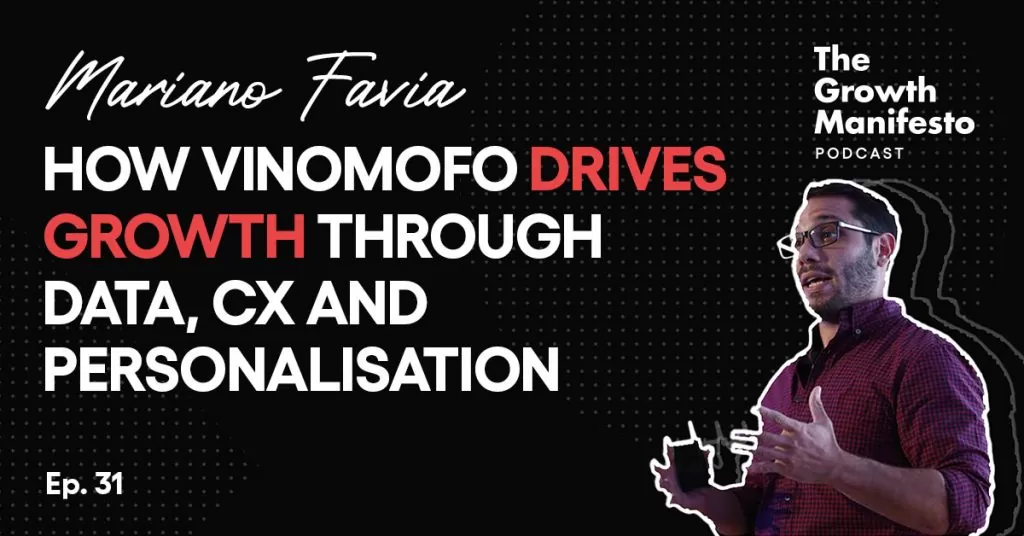


Overview
This episode is a discussion with Mariano Favia – Head of Marketing at Vinomofo. We talk about how to use data personalisation and customer experience to drive extraordinary growth.
Key takeaways
- Vinomofo's 100% happiness guarantee lets customers open two of twelve bottles, dislike them, and get a full refund within 365 days.
- In 2019 Vinomofo shifted from a brand-awareness strategy to a performance-marketing approach, measuring every campaign against return on profit.
- Retention drives acquisition: analysing first-time buyers showed they bought mixed cases, so Vinomofo built acquisition campaigns around mixed cases instead of guessing.
- Favia argues a database needs at least 10,000 customers before statistically significant A/B testing and personalisation become practical.
- He prioritises fixing checkout friction before testing top-of-funnel creative, because a better checkout funds further testing further up the funnel.
Chapters
- Intro: testing the low-hanging fruit
- Vinomofo's growth as a deal site
- The 100% happiness guarantee
- Shifting from brand to performance
- Building real-time data and reporting
- One-on-one personalisation and AI
- Minimum database size for testing
- How retention data drives acquisition
- Quick-fire questions and personal habits
About the guest
Transcript
Auto-generated from the episode audio, so expect the odd mis-heard word. Timestamps open the video at that point.
Test the low-hanging fruit because that will give you a quick sugar rush. Once you get the quick sugar rush, focus on the experience of the customer. How you test your onboarding process, your other process. But that's how I would start and that's how I've done it all my career. You're listening to the Growth Manifesto podcast, a Zoom video series brought to you by Web Profits, where we talk about how to drive business and marketing success. This episode is a discussion with Mariano Favia, Head of Marketing at VinoMofo.
We talk about how to use data, personalization, and customer experience to drive extraordinary growth. So, let's get into it. Today, we're talking to the Head of Marketing at VinoMofo, and his name is Mariano Favia. if you don't know who vino mofo is it's a one recommendation site it's also a subscription site it's also an ideals site and they've acquired over 500 000 customers in the last seven years
which is not a small feat especially in the wine space right because it's not like scaling up like other types of industries, right? Like other types of products. Like it's such a personal thing, right? It's really hard to scale up personal tastes like that. So we're going to talk about that. And we are going to talk a lot about kind of how Vino Mofo scaled up.
We're going to talk about their 100% happiness guarantee. And we're going to talk about like all the tech stuff, which I love as well. the data, personalization, the CRM strategies and so on. And so on. So look, I'm really looking forward to this conversation. So welcome. Yes, welcome, Mariana. Thank you. That was a great intro, Alex. Thank you. A lot of the buildup. That's great. Oh, yeah, you know. Well, look, I think I found out about Vino Merfo, it must have been five, six years ago.
And like all of a sudden it was everywhere. And I just heard about you guys everywhere. And there was something about the name and there were some creative campaigns that were happening. But like all of a sudden, you were just everywhere. I know. So maybe can you quickly start like, you know, just give us the quick high level of kind of the history? Yeah, fantastic. I'll try to be as sure as I can. Vino Morpho is an eight-year company, and it completely disrupted the wine industry in the country and grew quite quickly.
It started as a deal site offering wines that no one could offer at the price that we were offering, and it scaled quite quickly. and it's quite quickly because of the PR and the amazing management that it was at Vino Morpho like then. The founder, Justin, JD, is a techie geek as well. He loves wine and he takes care very well of Vino Morpho PR
and it keeps doing an incredible job with spraying the word of Vino Morpho. And not go into the tech side of things, but when it started as a deal site, it was a private deal site. So you needed to sign up in order to see what deals you were getting introduced to. And that strategy, which now feels crazy because that cannot happen anymore, but that strategy back in the day was very effective.
And the database grew exponentially. And that's what allowed Vino Morpho to gradually build the database and the customer base. Because once we did get the email address, it was very easy to target with a specific deal. And that went bananas. And that's how, in a nutshell, how Vino Morpho grew on the scale. Then competition changes in the market.
You see new competitors coming. And obviously, we encourage competition. Competition makes us better. But we noticed that it was a different space than the one that Vinomofo started. So back in 2019, we changed a little bit of the focus from a very heavily brand awareness company to a performance brand company. And that's how I see the future of Venomopho
scaling in the markets. Also Venomopho, going back to the other point, grew a lot internationally with offices in Singapore and New Zealand, and that also helped the Venomopho world. But again, be no more for realize that. Let's just build the performance now. We have an amazing database about how be more force, which that's how we want to call it. A happy more force. Let's just focus on what we do best is getting the best deals at the best
price, best price guarantee. And be very more effective with the media that we purchase and leverage data to construct a sustainable process for the future. And that's how I see Vino Mofo growing. And personally, I love it. I love Vino. I love data. I think it's a really great spot, to be honest. Yeah, no, great. And we did speak about actually, should I have a glass of wine as well?
Because I know at Vino Mofo, you're encouraged to have three tastings a day. Is that what you said last time? Yeah. Yeah, well, yeah, I mean, pre-COVID, pre-COVID, back when we were all working from the office, the office is, how can I explain? I think the summer is like a big, awesome bar. And we have a bar section, which is for wine tasting.
And we run, it could be more than three tastings a day. I don't even know how many it is, but there's always wine. There's always wine. And it's not my responsibility to taste. I'm not the quality guy to taste the vino, but I was very regular on those wine tastings. And I don't want to say we encourage drinking. We just encourage tasting good wine. And that's why it caught us to what we bought
because we only buy and sell wine that we actually love. As in many industries, there are different qualities. And that's what we call Vinomofo to this amazing retention rate where you know that regardless of your taste, you're going to get good fucking wine. That's what you're going to get with Vinomofo. And you're going to get it for the price that you love, delivery as fast as we can at this stage and an amazing experience with vino yeah sure um
and there's a couple of points i'm going to come back to on that but i think the first one which stood out for me um was your 100 happiness i guarantee yeah how do you guarantee happiness. Exactly. Well, it's a promise. It's a promise that we deliver to the customers. And that comes to what we call the Mofo value. I've been a Mofo and excuse me, I probably should have done some research, but I'm pretty sure that we are the only ones in the world that you can
return the wine after you open the wine. And if you order a box of 12, you can open two wines, say that you didn't like it. And in terms of, in the lapse of 365 days, you can return it and you get the money back. Wow. That is happiness guarantee. That's how we as Morpho value with And if our returns rate, there are returns, of course there are returns. Of course. But we don't have many.
We would just want to have happy more for us. That's what we want, happy more for us. And you've always had the guarantee or has there been a time where there was no guarantee and then you introduced it? No, no, no. It's always been happiness guarantee. And we deliver the brand promise with the returns, with epic wines and good wine only. That's the combination of the three things is what is building the happiness for our morphos.
And then how do you integrate... Yes, yeah, of course. How do you integrate that into your marketing? So where does the happiness guarantee get integrated? Because it feels like you would lead with that. But I've seen the website and I've seen some of your marketing. You don't really lead with that at the very start. No, no, no, no. It's more an invisible promise. You won't see us promoting free returns. I don't think there's any brand that would like to encourage returns,
but it's an option. It's an option you have. It's an option where you call Venomopho, when you write an email to Venomopho, you can return it. And that's a happiness. It's an invisible way to delight our customers. That's how it's embedded. That marketing strategy is embedded in the way we do stuff at the company. We don't think we are the best. We don't break up our value proposals. It's just we leave it. It's an ongoing thing.
It's not a marketing campaign. It's just a way to live the more for value. So when, because this is interesting, right? And let's just talk about this part for a second, right? Because I understand what it is to integrate something like that across the company. But a happiness, like to have a happiness type of guarantee, 100%, 365 days, where you can open up two bottles of 12 bottles and have them and send them back for a full refund.
That would be scary for a lot of companies, right? Because they'll be thinking of the potential loss, not the gain. But what are some of the things that you integrate across the company to ensure that there is happiness? Correct. Customer service, excellent customer service. We have an excellent SLA level of response. And we have a team, which is our wine brokers. and wine brokers it's a team inside vino mofo that ensures your um experience that vino mofo
is the best as it can be so you can call vino mofo you will be assigned with your personal wine broker that you can call at any time to ask and you can chat about anything you don't need to even talk about one i would love them to talk about one but you can talk about anything and that's how we have integrated two main areas in the companies as part of the marketing strategy. An excellent customer service and an amazing wine broker team
because those teams are the ones that are leading us to an amazing retention rate. Again, without much market research, Vino Morfo right now has 80 plus NPS score. And that shit is like Tesla level. That shit is Tesla level. You don't get many 80 plus NPS. Vino Morfo has it. Room for improvement?
There's obviously the room for improvement. I'm pretty sure that we do things very well. so so essentially the guarantee it kind of just sits behind the company's operations but from a marketing perspective it's not really part of the marketing side of things is it so what does the marketing then do because if that's what the the operations have to support right is that happiness then how does the marketing arm start that experience?
It's from a life cycle perspective because marketing, it's a lot of things. Maybe I'll explain more about how we do the lifetime experience of Venomophos. It's the moment that you sign up, from where you visit, you sign up and then you get your order. That's how we ensure the operations of happiness.
Having a discount, a welcome coupon when you sign up, ensure that that coupon always works. Ensure that after you sign up, you don't get one billion emails selling more than one because you haven't even received your first order. And that's how you see levels of retention going up when you focus on the performance side of things, and then you don't hassle the customer. Over, I think I was doing a report for Big Boss, and I reported that over the last month
compared to the month before, and it was even better than the last before, for email, we are getting 35% less unsubscribers, but also gaining the performance of email. And that's a metric that is also across SMS, which is another challenge that you can opt out. our unsubscribers are going down because we don't hassle them. We just don't hassle them. Like we offer them good wine
based on what they told us about they like about wine. If you bought Riesling, it's very unlikely that you get a Bonarda type of wine. It's very unlikely. It depends on the message, but it's very unlikely. If you bought Pinot Gris, you get peanut buttery. And that's how we ensure the retentions, right? And a good experience from the marketing side
to ensure retention. And therefore, the happiness and more for value. Make sense? Yeah, right. Yeah, for sure, for sure, for sure. Before you talked about you moved from a brand campaign or approach to a performance approach. so what changed in your marketing um a lot um first uh we needed to ensure that our reporting
was as dynamic as it can be to to take the decision as quickly as we need to get the sales events that correct for that specific time period i'm going to translate that into more tangible things. We need to get the fucking numbers right. If the numbers were not right, it's impossible to plan. So that's stage one. Get the numbers right. We got the numbers right.
Now, once we got the numbers right, we got the sales events right by creating specific actions that were leading Bino Mofo to ensure business goals. new customers, revenue, less unsubscribes, average of the value, whatever it is. We developed those sales events towards specific goals. But those goals needed to be filled by a really dynamic set of reporting.
Because otherwise you just chuck, ah, just do five bucks off, just do a sale on Shiraz. That's not how the way it works. That's not the way it works. So that's what I mentioned, change from branding to performance. Do all the decisions for our sales funnel leading by bloody numbers and stop with the gut feeling. And I'm not saying that wasn't branding. It was more like we formed MyTown.
There was a TV campaign. There's no TV campaign because there was no set of reporting that could say what's a return at spend combined within that TV ad. What's the point of doing a TV ad if you don't have the set of reporting to ensure success? So now we fucking stop the ball. We stop the ball. And the very first question that I ask is like, is this going to deliver happiness to a morphos? Yes. Fantastic. Can you measure it?
No, then don't do it. Can this deliver happiness? Yes. Can you measure it? Yes, do it. Can you measure it? Can you measure it? So then if something is an opportunity which you can't measure, it's a no straight away. It's got to be no for you. For a performance company, it's very important to have the tools needed to measure what you're doing. And I probably encourage this to everyone.
Obviously, some things are less tangible than others, but it depends what metric to use to measure the success. One thing is measuring NPS. What measures is another key P.I. could be sales. Different ways to measure it. And I think most of the things that we do, we measure it. all of it. It's very data driven team across the company.
Yeah, right. And so you talk about reporting, right? And to get the numbers right. Yeah. Are you able to talk through about how you report? Is it a spreadsheet? Is it like a reporting software? Is it a specific database that has the interface created? Is it, yes, what is it? If you can talk about it. Yeah, without naming, obviously, any partners,
because I haven't spoken to them about this. We, our engineering team is bloody awesome. What they ensure is they capture all the information within what we call admin, which is our own database. So I imagine without getting too technical, it's a D3 database, hosts whatever it needs to be hosted, and we gather all the data. That data has a scheme of a structure that flows into different data visualization software.
That data visualization software might not be the only source of reporting for multiple teams. So what we do is build apps that can integrate the data visualization with other channels, like, for example, SMS, to build another set of data visualization where it's my Bible, it's the thing that I see when I wake up, it's the last thing that I see when I go to bed, which is my Bible.
And this second data visualization for marketing purposes gathers information from our admin. It matches with, for example, Google Analytics. But Google Analytics also gets information from multiple sources, for example, cost. So I'm able to measure return on ad spend and return on profit real time. and in every bloody channel.
And we do it by different, we have macro goals and micro goals. A micro goal, for example, could be bloody sales. A micro goal could be leading people to the cart. And we use these micro goals to also optimize our delivery of the ads. so it's and the whole marketing decisions are taken as a holistic point of view no channel by
channel for example i'm never going to say drop google increase facebook it's just not this is not the way it works it's just a combo it's a combination of channels that will lead into a successful performance and so yeah so then of course thank you for sharing that and but that just gives insight and that was i'm sure that's going to be too technical for some of the listeners but it just shows the level that i guess the company is going into to get the data correct
right and that's what you were talking about i guess at the very start of saying you want to get the data right, assuming you get the numbers right, and that you get it and control the data completely. And then you connect with other apps and so on. But all the data is there and it's completely there at real time. Correct. You just said, and this is interesting, that you don't just look at one channel and say, this channel is working, this one's stopping, right? How do you approach that in terms of
your reporting system? Because this is something that people have been trying to do for a while, Attribution modeling, right? How do you do it? I've been a mofo. It's kind of like secret recipe, isn't it? Well, if you can say, tell us something which is not too secret then or tell us a secret recipe. I'm sure everyone loves that part. Yeah, yeah. It's a lot of work. I don't think it's too secret. It's, there's the brand, there's the stats, you know? Look, it's, at the end of the day, it's statistics. It's statistics.
the way I work is towards a lot of people at the company is agree on one metric that it's a main metric and that for example could be return on profit there's that metric it's A and as long as that metric is always A, you're doing a fucking great job. And then you need to be,
you need to consider the positives and the negatives from every channel to make a successful mix. And I'm going to go, for example, using SMS as a customer acquisition, probably it would be ability to see the idea. Now, using SMS as a way to tell the customer that the wine is on the way seems like a great idea. Using Facebook to increase brand awareness within
a specific budget, it won't work by itself. Asking Google not to, not to overspend on mobile, and this is just an example, probably it's a combination of things that you need to consider. It's not just Google, it's not just Facebook, it's not just this, it's a combination of things. And the most important thing is how, once you acquire the customer,
what processes are behind to retain those customers to increase your sales. Because you can have a fucking great... Sorry, I'm cursing a lot. No, it's fine. If you talk normally, curse away. It's fine. Okay, cool. Yeah, sorry. That's another mofo thing. Once you get the... If you get a great customer acquisition strategy, which is fantastic and the companies are doing amazing but if you don't have anything to retain
them what's the fucking point what's the fucking point like if you don't if you don't have the tech to offer in our case shiraz to a shiraz drinker what's the point of acquiring a customer what you're going to offer like a rizzling to a shiraz drinker they're going to return it and that's a lot of money so you create custom experiences for different people is that what you do it's completely automated is that what happens yep and it's what we are uh it's leading towards and it's
not you know it's a thing industry is leading towards uh uh almost like a dynamic one-on-one personalization experience because now and before and everywhere you can do personalization but personalization, it's costly because of the tools, because of the offer, but now there are new technology and you can call it bullshit AI if you want, but that can give you probably
what will be the right product to that specific user considering similar users to that one. And the tech that allows to do that, it's an industry thing. And I don't think it's been a model for industry. And so you just mentioned AI, but you said that with bullshit AI, because it's really just a bunch of decisions, right? Is that why you're saying that? AI was, I mean, AI was always there.
I mean, I studied statistics at secondary school. AI is a bunch of metrics analyzing how they correlate to find a specific pattern. That's AI and how AI put that into actionable outcomes. It's like a bloody robot. The robot fucking learns to do, or a human learns.
but it's learning about finding correlations oh the fire equals hot hot equals bad therefore I'm not going to touch the fucking fire that is age that's old now we have the tools to do that more dynamically and that's AI but you can have AI in Excel correlation I don't know the word English oh anyway you can do an Excel yeah I can't translate for you either no
no yeah I'll find it I saw a recent article in the CMO magazine they talked about how your 360 degree customer view basically helped to get so five times increase in engaged customers and 120 times return on investment? Is this because of the marketing technology which you've just explained? Is this how you've done it? Or is there more to it than that?
I don't know. It's basically that. It's the way we interact to the customer, knowing their behavior and trying to anticipate what's going to happen. and I'm going to translate that. If I know that Alex takes average, and this is an example, don't get me wrong. If Alex takes 10 days to drink and finish his case of wine,
I know that. And I'm probably sure that you will get a next communication from Vino Morpho. How do you know it's 10 days? How do you know? It's a correlation of of multiple that, uh, the touch points. So it's not Alex. It's a bunch of Alex. That's a scary. Yeah. Yeah. No, no, no, no, I don't know you Alex, but, but yes, it's just statistics.
It's how you determine, um, it's how you determine an action based on, a sample size of the population. And then if you have the tools that allows you to, and real time tools to tell you that specific outcome, then you know what to do. Offer more wine. And if you know that what wine is even easier. And that's what I was referring to,
the 360 customer experience. Because I integrate the customer behavior when you're browsing, when you purchased, how long does it take to repurchase, if you review it or not, if you review it positively or negative, and if you are less likely to purchase or purchase more.
Things like that, e-commerce, not even e-commerce, that again it's old it's old yeah sure and so you can do this because of the size of the because of the size of the database now right like so this would be hard in the very beginning to be able to do this predictive analytics yeah 100 yeah so what do you think is the minimum starting point you know say for example like if someone's on this podcast and listening to it like this sounds really good. What do you think is the data set required
to be starting at this level? The answer is always, it depends. That's a marketer's answer, isn't it? Every marketer. What's the CPA going to be? It depends. It depends. Like if you don't know the answer, just it depends. Are you familiar with A-B testing? And probably more than people would say yes. Lots of people, yes, yeah. For a result from an A-B test to be statistically significant, it needs to have a certain degree of confidence. And there are calculators that allows you
to know what's the optimal sample size of a population based on confidence ratio. Now, you can run fucking billions of A-B tests with five people, but it will take you a long time to determine a statistical significant outcome. So it depends the time. The more population you have, the less sample size you need,
therefore less time you need to make an accurate answer. so it did and it's really depending what also is the you the outcome that you want to to analyze it's not the same as analyzing traffic that's analyzing sales because the sample sizes are different the population is different so it really depends but to your question if you have more than
10,000 in your database, you can do cool stuff. That's a good number. I love numbers. I love simplifying things, you know, for people. But I gave you the theory. I gave you the theory. But the practicality is like if you have 10,000, you can start doing cool shit. If you have less, probably will take you less, will take you more time. And I think if the history of video mofo is a living example of it, at the beginning you can do A-B testing. You need to go through your bloody gut feel
because you can't A-B test because you don't have people to A-B test. And that's how you, for example, JD and Justin did very well. He knew the market. They know the market. So they know what works and what doesn't. So that simplifies the learning curve. So it makes you less dependent of A-B testing because what do you need A-B test if you know the outcome? If you know the outcome. so then if someone has 10 000 people on their database it's very different to 500 000 people
that are returning every week right so what would what would be one of the first things which you would do that cool shit that you were talking about yes what would be some of the things with 10 000 which is very small i would say right to start with but what would you do um i pick into the sales i see the sales funnel and i gather what i call the low hanging fruit um and the low hanging fruit that will get me to results is experience in the checkout process. So anything
that you can do to create a frictionless experience in the checkout processes, and you can test it, it will give you a very quick result into your bottom line that you can get sales if you improve the checkup by improving the sales it will give you enough oxygen to test shit on the top funnel and then you can test if red was better than blue or blue was better than green
for a bloody ad yeah i think and i made that mistake where you test things and then it's like what the fuck i want to test a dude versus a woman like why like why why i want to say yes It's more CTR of the woman, whatever it is. But why? Why? Is this going to talk? Is this, do you really believe that having a different character on the art will leave you to a better conversion rate?
Probably it's a combination of things. And then you need to have a lot of information, data, to analyze confidence, like very accurate, if the actual person in the ad will define how successful or not. So to recap, test the low-hanging fruit because that will give you a quick sugar rush. Once you get the quick sugar rush, focus on the experience of the customer, how you test your onboarding process, your other processes.
But that's how I would start, and that's how I've done it all my career. Just focus on the checkout first, fix it or test it, whatever. Yeah, so just on that point as well, that's really interesting. I think everyone who first starts off, you know, with A-B testing, they're so excited to just test shit, right? They're like, test this, test that, test that. And then as you get more experience, you want to know why things are working and what is the thing that we can use for all the marketing, not just for this marketing, not just for this campaign. Who cares about the button color, right?
You know, let's try to figure out something else. But I think in the beginning, you know it's so cool you can test things so you just want to test everything just testing everything the tools are ridiculously expensive like if you are a startup and then you want to go with these fancy a b test tools they're ridiculous i mean expensive it's it depends but if you if you just started it's like you you can't a b test because it's hard to afford that
like even more for itself like I think it's a very successful company and still I make the essential words like no mate this is just fucking expensive for us like in our in our maturity level like I wish I could be eBay kind of like test and learn tools that they have but at this stage it's not affordable do you think that eBay just goes I wish I was like Google you know everyone's got some FOMO of like if I had just that much traffic, I would do this.
Exactly, exactly. Yeah, yeah, yeah. Could just quickly on like improving the checkout, 10,000 people probably is not going to get that too many orders. Would you be doing the micro conversion test, like add to carts and then cart to checkouts? Like is that how you would optimize it or will you be going straight for the sale straight away? It depends, of course. i'm gonna call this podcast episode it depends it depends what the pain point that you're trying to resolve for example the hypothesis is
if you if you if we reduce the time on checkout is more likely to have more conversion right for example so therefore if you test an auto complete on the address field that it makes the address field goes quicker and that improves your hypothesis then i would not be executing towards the sale indirectly yes but the micro goal is going to the uh the next stage of the checkout
so it depends what the pain how which painful in your in your hypothesis a hypothesis you're identifying um and that's that's the most important thing like what the fuck i'm trying to resolve with the ab test um okay okay i mean have so many questions on the checkout but we could be in here for like hours so let me just oh there's so many parts it's really like it's so geeky to talk about
or techie or whatever you want to call it but i love it because the psychology it's really psychology psychology yeah 100 like upsell cross-sell and the checkout if and again going back to the roots of commerce if you go to a bloody chemist there's no there's obviously there's a reason why they put the uh the chockeys next to the the where you're going to purchase and it's obviously the reason why it just it's there it's just and then you have the person in the
service station saying do you want a chocolate it's two for three uh whatever it's always a reason yeah and that's why i try always do you think as well how do i see my improvement into the real life yeah so let me ask you a question then right let me ask you a question now this is a hypothetical that um you could talk to just in terms of experience or not right um would you
prefer to put an upsell before the purchase is complete or would you prefer to put something after the purchase as like an order bump you know what i mean because it's like before the purchase hey you could buy some wine openers or whatever sorry um some bottle openers or afterwards hey just add this button and get this you know for half price what's your preference obviously you named you just named this podcast it depends by the way it's not gonna but what would you start
with yeah like if you had to start before you had all the data and all that would you prefer to put it before the order or after the order i just don't want to give names but there's a very awesome retail in australia that's it very fucking smart and what they do is very cheeky great you have After you check out, you have 10 or 20 seconds or 30 seconds to add shit into your order with a specific discount.
And that's fucking shit psychologically great. It's fantastic because you made the purchase already. Do you remember those TV shows where you have 30 seconds to grab everything in the store and then you get it for free? it gets that rush it's like you have 30 seconds to get this at this price and it makes you feel like you're a fucking smart guy because you have and that's I think I find it very smart very smart
obviously there are brand impacts on doing that there are brands that can do it brands that cannot do it I don't imagine Apple doing that but I think my preference to your question, my preference is that minute after the checkout is fantastic. It's glorious because you just made a purchase. It's like after fucking research for this bloody wine,
I made the purchase and then you have in 30 seconds, you need to make another decision. You've already made a decision. yeah good one good one it's fantastic it's fantastic that's good thank you for answering that thank you yeah i don't know that cool example because i haven't seen that but um it is really smart you know and maybe it could get to the next level right you've got 20 seconds and it's 50 off then you got 20 more seconds it's 40 off and you're seeing it change right
and then 30 and then like that would work because you'd be like shit this is actually changing and you can't go back until you buy again to see it. And that's, yeah, I find it like glorious again. It's just like, it's like that sneaky thing, sneaky smart. It's like why I haven't thought about that before because it gets me. Like it gets me. I'm a heavy purchaser.
Like I'm a heavy user. It's for, I imagine for you as well. It's very hard to trick you with some techniques because you are heavy use. This is how you live your life. But when there's something that gets me, I was like, well done. Nice, nice. Well done. Well done. Well done. Well done. Cool. So we've spoken a lot about kind of what happens after their customers are acquired in some way, right?
so how does your acquisition team now connect with all of the data right because there's obviously going to be some people that are that are running facebook ads search ads they're doing email marketing that are doing the thing before you've got the person connected right as soon as you got their email you got them like and some of the cookie data as well before that point but how do you test things or yeah yeah yeah um yeah that's a great question um for a cow retention drives
acquisition and and excuse me that's my dog uh that's fine by the way yeah we're pet friendly company as well. I mean, everyone's at home now as well, regardless, but it's all good. So what we've done is we grab a specific period and we analyze it, the first purchasers of a group of uses. And we noticed what were they buying as for the first purchase. And we didn't,
Australians love Shiraz. We thought it was like, well, just fucking offer Shiraz. I love Shiraz. Especially from the Barossa. Exactly. That's a gut feeling decision. But what we realized is first purchasers, they were buying mixed cases. That's random. Because people are trying to test Vino Mofo. They're trying, they're new customers. So what we did is starting creating sales events toward mixed cases.
and that's probably and that's and that's how we increased how we leverage our retention information data for acquisition strategies what do they buy if that's what they buy just expose it more that's an example but so you then also will know because of all of the database information and so on, the demographics, the geographics, and maybe also some
psychographics, right? Like you can potentially predict what somebody might like, or what are some of their interests? Is that right? Like, and you will put that then kind of like into the targeting, like except for Google search is easy, right? Because they search for Shiraz, you pop up for Shiraz there's not too much involved in that there is probably some sophisticated stuff that you could do with search retargeting but I'm assuming it's harder in terms of the social ads and I would assume that is the growth the driver right because you can put stuff in front of people
is that correct or incorrect as an assumption it's partially correct it depends it depends on the cohort great question to do proper advertising you need to know the tools and the way Google and Facebook, for example, and other tools, they grab information to deliver your ads. And they are tools that require a lot of data points to successfully deliver the right ad to the right person.
If you go very specific, you're giving less information to this AI algorithm from the advertisers to deliver a great conversion rate. And then what you're doing at the end, it's probably people that are familiar with Facebook, it's Facebook telling you that your ad set reach, it cannot learn anymore. You need to increase the size of your audience
because Facebook needs more data. So it's a tricky one. So, and everyone can do it differently. And it's open. I don't have the answer, obviously. So do you do programmatic there? Like, is that the big thing there? Like, is the thing purchased programmatically? Or can you not say? Or is... It feels like, based on everything I've heard so far, programmatic purchasing of ads with all the data,
that it seems like that would almost be like a match in heaven kind of not really yeah yeah i mean yeah it all depends the the what you're offering like you can i can say uh you can be thirsty right now you want a beverage i can offer you and i i have Mariano 1, Mariano 2. Mariano A offers you water. Mariano B offers you a Coca-Cola.
You have your preferences. Both did amazing advertising by offering you something to drink because they know they're thirsty. But then this depends on the offer, the product, and a bunch of things. So, programmatic, it's bloody amazing, but it's not the only thing that will give you a good conversion rate, I guess. It's a combination of things. For us, because of our industry,
where there's a lot of people that like wine, we go with a volume game. And we don't go specific. We do certain exclusions. Obviously, we don't offer wine. First, it's illegal to someone that's underage. We don't do that. And no one should do that, by the way. But we, for example, in terms of the age group,
probably it's very unlikely to think that someone from uni will purchase $300 worth of wine. So yeah, I do those exclusions or inclusions. Got it. So your top of the funnel is wide. It's wide at the top. You just want to get their email. And then once you've got their email, then you've got lots of other things into the place. If you can get the, like, are you going straight for the sale straight away?
No, no, exactly right. No, never. Correct. So yeah, I go with, and that's why I leverage the good things about each tools. Facebook is fantastic for reach, for example, but probably for the direct response is not as good as other tools. And that's fine. That's fine. That's totally fine. And that's how I see my holistic marketing mix working together. One gives me good traffic,
eyeballs, relevant eyeballs, but maybe too early in their customer journey. So then they need another set of ads or another email, whatever it is, to make them from a desire to actually convert. So it's, and that's, but the metric that tells me that in my case is return on profit. That tells me how much can I spend on the, on the, on the, yeah. Return on profit as well. Fuck yes. Yeah. And if, if JD will listen to the book,
he will be like, my boy, my boy. He learned. Very, very good. Mariano, this has been a really good chat. I've got some quick fire questions that I like to ask everybody at the end of the podcast. Yeah, there's nothing too crazy. Just some simple things that will give some additional kind of information. People are listening. Yeah, you ready for it? Yes, it depends. If you had to use just one channel tactic for growth, then what would it be? focus on
recommendation from my existing customers. Okay, that's a good one. Ask, what book has had the biggest impact on your success? Well, you're implying that I had success. That's fantastic. Thank you. Well, I mean, this conversation isn't with like a junior, a beginner, you're like, you're running a pretty complex, you know, marketing team. Yeah. Strategy. I think there's no, and this is probably again from my background, there's no book,
but ADMA runs really good courses and mini MBAs of marketing. They're very fucking great. So probably should get commissioned on this, but that actually inspired me a lot. And also talking to customers
or people that know the industry more than myself, that is my real learning. Because technicalities, I kind of know them, but learning how to interpret, how to use those technicalities for the eyes of customers, It's asking questions all the time. At the VideoModal, we are doing more surveys more than ever. Okay. Yeah, and we are learning. We are learning. Okay, cool.
What's your number one piece of advice to hire awesome people? I would say for our industry and knowing where we are going, I would try to assimilate and learn how these people, how these candidates will interpret and associate data for a specific outcome. My piece of advice is try to identify, define a use case that requires a lot of data points
and make the candidate think how they connect the data points. because this creative thinking and connecting dots, it's a cross-skill for any share that we do. Advertising, engineering, anything, association of things, and Python. Python. If you know Python, that would be a plus. Great. Kus, how do you relax after a crazy day in the office?
I mean, you're in Melbourne, so I don't know how you relax in general now. but how do you relax after a crazy day in the office? Walking this guy for an hour or two hours. That's how, he is my down to earth guy. Yeah, that's perfect. Yeah, and if it's Friday, I'm not encouraging this at all, but I might put some wine in my coffee cup and go for a walk.
That's nice. Of course, what's your best productivity or time management tip? Your best productivity or time management tip? You need to identify champions within specific teams that you can rely. And those are the champions that they understand you the best and they will spread your message the best. But everyone should be across the macro plan
at least once a week. And I'll leave an example for that is at VinoMofo, we have a macro sales plan where the whole company knows it. The whole company knows it. Everyone has access. It's self-serve. But also, every Monday, we do a reminder. Every Wednesday, we recap what we did, what we are doing, and what we are going to do.
And it's my duty to report the outcomes to everyone in the team for my specific area. And every head should do that. So there's no tool that I specifically use. I don't use anyone. It's more about connect with the team kind of like real all the time. Yeah, no, that's great.
That's great. And, of course, what's the best piece of advice in business that you've received? best piece of advice in business that you perceived um I think it's from my very first post when working at Dell he told me that there are two type of employees then and they have people that
they need to be told what to do and there are donkeys with a lot of initiative. And he said that I was a donkey with initiative. And he said to me that, and this is the best piece of that. He told me like, Mariano, you have great skills. Think before you talk. Think, analyze before you make a rash decision because nothing comes great after a rash decision.
and I can relate into my, you can relate to your personal life as well or your business life. Nothing comes great after a rash decision. And he was very clear to me that, Mariano, great skills, fantastic initiative. Now sit down and think what you just said and come back to me later. Yeah, look, just on that one as well, it seems that thinking is the thing that's hardest to do, to stop and think, you know, but that's a great one. And last one, how do you have fun?
How do I have fun? Very easy. Yeah. So I just moved to a new house, which is 120 meters from my baseball field. And now in Coyote, it was a little bit harder, but I do play baseball a lot. And I'm a barbecue enthusiastic. My background is Argentinian. Oh. And yes, and I've been testing new ways to cook meat. And trust me, I get very excited with meat.
I mean, Argentinians can grill, that's for sure. I know the restaurants. Yeah, yeah, that's probably the one thing that we can't fail. Or we could fail, I mean. It depends. Yeah, it depends. Hey, quickly, what's the wine from Argentina called? Is that like Malbec? Malbec, Malbec, which is actually not Argentinian. It's actually French. oh is it i thought it was it's the popular one in argentina though is it yes correct so it's both in argentina and chile they're very good grapes in countries so how do you and this
is just this is kind of the bonus question let's call it right um shiraz or malbec you know so what's the preference now you've been in australia for a bit you probably like i'm sure you've had a lot of Malbec in your life? Like, how do you compare it? Yeah, well it depends on the situation, but if I have to choose one, my dad would not be very proud, but I think nothing beats a good Shiraz from Barossa. I know, I love
it so much too. Now I'm actually really thirsty. I wish I had one here now. But Mariano, which one do you have? I got now a Venomopho collaboration. Why? It's a Sangiovese. It's called Gusto Mama. It's, I think it's, if the head of buying listens to this, he will be like, what? But it is my top, top choice for Venomopho. It just never goes wrong. And Sangiovese could go well with a pizza,
could go well with pork, meat. Sangiovese for me is my personal opinion. is a more flexible, one of the most flexible type of grapes. Okay, great. Now for the wine lovers on the podcast right now, what would you like them to do? Come to the vinomofo.com website and what? Subscribe or get a discount voucher or check out the blog. Like what would you want if someone's now saying,
I'm going to check out this Vinomofo because I haven't heard of you for some reason. What should they do? What's the first thing that you'd like them to do? I would like them to go to the website, browse, write me an email, mariano.favia at vnomofo.com, and tell me why they didn't like about their website. And you can do that on LinkedIn or email, whatever. and I will do my best to reward that with a discount
or whatever they want. And that is 100% happiness guarantee. That's so great. This has been a really interesting podcast to really get into the tech side of marketing and to really understand how you can scale up at a whole other level if you can get the data right. But it's no easy feat. but it's been such a fantastic chat. Thank you so much, Mariana, for coming on the podcast. I'm super interested now in subscribing and speaking to some of the wine brokers
on the Vino Mofo site. Thank you so much for coming on the podcast. It's been such a great conversation with you. Thank you. Thank you so much, Alice. Thanks for listening to the Growth Manifesto podcast. If you enjoyed this episode, please head on over to iTunes and give us a five-star rating. For more episodes, please visit growthmanifesto.com forward slash podcast.