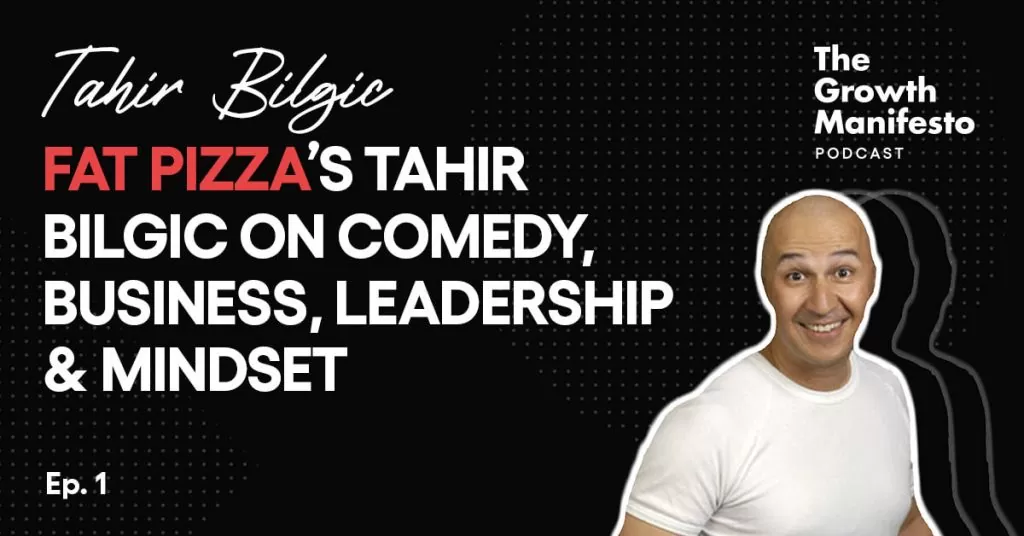
Fat Pizza’s Tahir Bilgic on Comedy, Business, Leadership & Mindset
Comedian Tahir Bilgic explains how stand-up persistence, self-promotion and a flat-fee franchise model built The Shed cafes and Ruby Little coffee.
 with Tahir Bilgic


Overview
In this episode, we interview Tahir – one of Australian’s leading comedians. Tahir is an actor, producer, writer and entrepreneur. He has sold out shows across Australia, has produced both movies and TV, and owns a chain of 19 cafes. We talk about comedy, business, leadership, mindset, and everything in between.
SHOW NOTES
Key takeaways
- Tahir treats every person as an equal, arguing that status or money never justifies demanding special treatment from others.
- He built his stand-up career by turning up to open mic nights three times a week for eighteen months straight.
- When creating a show, Tahir works backwards from the title and poster before writing any material, prioritising the marketing hook first.
- The Shed franchise charges a flat weekly fee instead of a percentage of turnover, so owners and franchisor share the same incentives.
- Tahir says genuine influencer marketing only works at scale, citing how a Chinese actress photographed in Dunlop Volleys revived the brand overnight.
Chapters
About the guest
Transcript
Auto-generated from the episode audio, so expect the odd mis-heard word. Timestamps open the video at that point.
You're listening to the Growth Manifesto podcast, brought to you by Web Profits, where we share inspiring stories of real people who've succeeded in the marketing and business world. Today we interview Tahir, who's one of Australia's leading comedians. He's an actor, producer, writer, and entrepreneur. He's sold out shows across Australia, has produced both movies and TV, and owns a chain of 19 cafes. We talk about comedy, business, leadership, mindset, and everything in between. So let's get into it.
Do a welcome. Do a welcome. You want to do a welcome? Yeah. What we do, we normally have an intro. So we've got a pre-recorded intro and then it'll just go straight into us having a convo. Fantastic to be here. Thanks, Alex. Yeah, yeah, yeah. Get on with the questions. This is fantastic. That's how it should be. But I'm actually really excited about today. And Alex, you are absolutely a role model of mine when it comes to business and growth and accelerated growth. And I've got Tahir, we've got Tahir today. And Tahir, you're a huge role model to me in the sense of stand-up comedy. You're somebody who's always been nurturing and always there for me
as a stand-up comedian. And we've got a few good stories around that, but I'm really excited having you today. Now, look, now you've got an amazing background. Not only you start off as a teacher, you went into comedy, then you became an actor, then a business owner, also a producer and writer. You're an entrepreneur and you're also a Logie nominee. So, mate, thank you so much for coming on board. A drug dealer. Drug dealer. No worries. No, they're just jokes. I play the drug dealer so often people think it's real. You do. You've got that stereotype so often, yeah? I don't smoke a drink. People get so disappointed when they find out the real thing.
Oh, really? Yeah, yeah. But look, honestly, mate, thank you so much for coming. Because I know time is precious for you. Yeah, yeah, absolutely. Alex, this is your first time meeting Tahir, isn't it? Oh, yeah, it is actually. Yeah, definitely. I'm going to follow him on social media straight after this. Definitely. Now, Tahir, just to let you in, Like the Growth Manifesto, the podcast that we're on today, it's all about business growth. And the idea is how to inspire others, you know, to become the best version of yourself or how to push through it. Now, you've done a lot of this kind of stuff. And I suppose what Alex and I are really intrigued in, I'd love to know, how does your journey start? How do you go from becoming an English school teacher
to a comedian to a business owner? Yes. Well, look, I was always interested in comedy. So even when I was at uni, I was always writing comedy, collecting comedy, watching, you know, I just loved it. Always loved it. And I remember in primary school, I used to get up and do these speeches, which used to make the school laugh, you know, the sports reports and things like that. So it actually started back then, which I had no idea, but I just kept it up. What school did you go to? Beverly Hills North and then Nawi Boys.
Oh, nice. Nawi Boys. Nawi Boys. Does that still exist? No. Got knocked down for units. I mean, that's all of Sydney. Exactly. Everything's getting knocked down for units. One of my cousins. so when I was teaching of course I love teaching I didn't leave teaching because I didn't like it I actually quite enjoyed it but the other things sort of took over and I used to use a lot of my classes everyone would say were your classes fun yeah they were fun but guess what they were under control too because I love psychology as well in business like I used it and I thought and I did a four year
teaching course not a bridging course so it was all for teaching so we did spend a lot of time on psychology and I think most teachers I think even in business I think more people should you know study psychology even with business I think they're very it's connected so you know I would students are smart kids are smart like they know what they can get away with so I used to be at the front door of the classroom wouldn't go in until it was silent I'd never walk in when it was all quiet and they were all talking I'd never go in when it was all you know talking and I hated that thing
when you walk in you say okay buddy settle down settle down calm down like I'd wait at the door they'd know the kids are cutting on it's all silent They're all waiting. Then I walk in. It's all peaceful. You know? I used to have the – the seating arrangement was very important, right? Very, very important. I used to have certain kids right around my desk. Not in the back corner. They didn't decide where to sit. I decided. Oh, really? So you took full control over – Full control. Yeah, yeah. I would never – like, you know, even when you – until you walk around, just put a hand on a desk. That's enough. Yeah. That's enough to – like, so – and I used to hear other classrooms
and they were noisy and the teachers were saying, shut up, sit down, quiet. How do you teach like this? You can't. Because what school, that was in Naui, wasn't it, where you were teaching? No, I went to school in Naui. My last school was James Busby High School. James Busby? Yeah. No. Yeah, great school. Really? Great school. Give me a little bit of, because I actually know this school. Sefton High School. I did Sefton. I did a bit of casual teaching. So Sefton was interesting because that was half selective and half local. Oh, geez, that's an interesting mix.
So I had a great experience. I had these gifted and talented kids and then just some local kids as well. The kids were really, really fully into their work. But how did you come about having that patient nature, talking about the psychology of things, is that you didn't judge these kids, you didn't belittle them or everything, telling them to sit down and shut up and do that in tradition because it's going to evoke something else out of a child straight away. That's right. So you actually tried a different approach where it was done with respect. So who inspired you to do that?
Look, honestly, I don't want to take credit, but doing the psychology, I just worked it out. I thought I don't want to teach like the other way. So the kids would enjoy my lessons. There would be a couple of minutes of humour. It would be like the David Letterman show. It's an eye check. So the first couple of minutes, especially for the seniors, would be like I would actually try these jokes and gags out. And it was amazing. You know how a letterman comes out and does a couple of minutes of just stand up? Is that what you used to do? That's what it was like, yeah. Oh, that's cool. It was really – And you got laughs. I got laughs, yeah. And those laughs were a bit like addictive, right?
Like, oh, wow, I can make people laugh. That's kind of a fun thing to do. Yeah, and the kids used to love it. And then they used to learn and they used to – and the thing is they want to do the work for you. It's like as a leader, even in business or sport, how do you want to inspire your workers or staff even, even when we ran the businesses? Sure. Alex, you know, you're a business owner. You could run your business several ways. Definitely. You could be a dictator. Yeah. The work will get done, but your staff will feel different. Yeah. Correct? Yeah, definitely. There's different ways to achieve your outcomes.
Yeah. So, you know, different people do different ways. So I just think there's always a better way for everyone concerned. You could be the worst boss ever, and you still get results, but people will be talking behind your back, and they're not going to give you quite the 100%. Yeah. And so how do you get 100% out of people? What's your approach? I mean, because obviously you've got students. That's one style of person to get 100% out of. But, I mean, obviously you've had some businesses as well, right? And so what's your approach there?
Because obviously you've got a fair few of the cafes, right? Yeah, we'll come to that. We'll come to that. Yeah, we'll get into the shed later. That's an amazing story. But I mean, how, but the psychology behind. Well, one of my rules in life, Alex, has always been treat everyone equally. And I know that's like, okay, it's not a throwaway statement. So I treat everyone. I don't think I'm more important than any other person. So one of my bugbears is when you see, I don't know, like a famous person think they're really important and they just treat.
Yeah, yeah, yeah. I go, hell, you're a human being. Like a big deal. You've got a bit more money. Who cares? And I'm not talking about, say, Barbara Strideson wants to have a white piano in her dressing room. This is part of a contract. Yeah, yeah, sure. In a dressing room, in a hotel room, and on stage. So backstage. Three, yeah. It's going to be in a hotel room. It's going to be white. Two. I say, good luck to you. If you're a legend, you want to earn that or you want to demand that and you've been successful, that's fine.
But that's different to treating people. That's a request. like you know if you want to do some crazy stuff request blue M&M's or whatever go for it but don't treat everybody you see differently because you're no more important than any human being like you know that's one of my approaches like so it really you know who do you think you are whether it's anybody doing any sort of job treating treatment as an equal human being so does that also then kind of set the same standard as well because because that's like on the side of treating them
kind of like certain I guess so say for example with like a respect at the same time is the expectation the same across the board and so you know if somebody isn't performing as much like a student yeah yeah or the students as well like is there like a certain standard like would you just set absolutely and if they don't hit that standard you just tell them like you tell everyone else the same way absolutely I would set a standard for sure Alex because I would actually turn up right and then I'd expect two lines like that
and I'd be so stringent on it. If anybody was out of line, bang, they'd have to be made an example, right? They'd do a few times before they learn, right? So that's a standard because students know what they can get away with. And there would be disappointment if they didn't follow, say they didn't hand a task, you know, I'd be disappointed. I would see that. How would you show you're disappointed though? Because you can show it in different ways. Lie on the ground and kick and scream. Oh my God. You've crushed all my hopes and dreams as a teacher.
They see it in my attitude and facial expressions and things like that. And it goes back to how – so, you know, it's like playing for a coach. Yeah. That's a good way of putting it. When you're playing for a coach in a sporting team, coaches, again, like a business boss, they inspire their players in different ways. Yep. So some do it through fear. Some do it through intimidation. Others, like, you know, in sport, some players say, yeah, I really want to play for this coach. I really want to try my best. Yeah. And that's the sort of feeling I wanted in the classroom.
So the kids would come in and they'd really want to try their best. And they'd want to do their homework and they'd want to succeed. I remember there's other teachers who did it through fear. I remember the kids would say. I had those teachers too, though. There was a maths teacher in particular, right, and he was notorious for it. Kids would do his work, but he got his results differently. And I thought, okay, that's one way of getting results. But at least he's getting results. There was other teachers not even getting any. Yeah, sure. It would just be muck up. But I agree with you. Every day screaming and shouting.
I said, no. Look, I think we can all relate to it because I remember being at high school, like maths wasn't my strongest suit, right? Either it was English or history. What was it, Tony? Woodwork. Was it really? I killed it. Really? Yeah, year seven and eight. Woodwork. But I've got a bit of a thing with a kid called Jackie Noong. Year seven and eight, I came second to him in both years. both years and I know I made a better pencil case than him I killed his pencil I swear you know Jack is listening to this I hope he does
Jacky I'm still coming after you bro I swear we're going to make trays again woodwork was great because I had two other brothers right we went all through Nawi boys so my parents worked out what's going on now we've got three ladders three coffee tables can you make them different colours now we don't need three of everything everything's coming through the old man would have opened up a shot you know what I'm really into you talk about inspiring others you actually are quite inspirational yourself and I want to know how you inspire yourself you started your stand-up comedy career in 1995 correct yep correct so you went out there so did you leave
two things did you leave um teaching all together when you did that good question no I didn't um I mean just to go on the stand-up comedy like I I kicked off at the Sydney comedy store uh on Parramatta Road right the olden days in Crystal Street Mykhart and I I've told the story before I turned up. I knew I wanted to get on because I found out there's this place where you can get. How did you find out back in those days? Because it was hard. Yeah, because there was no internet. Oh, there was, but it was the beginning or something. You used to talk to people and stuff or something, right? Actually, what we're doing now is amazing. No way.
Oh, my God. Somebody told me about open mic night when I first found out. I said, what is this? I said, anybody can turn up and just get up and do comedy in front of an audience. And to me, when I heard that, it blew my mind. I thought, oh, my God. I had to get down there. So that's how much you love comedy? Yeah. Are you like, oh, my God, someone will listen to me to stand up? Yeah, other people would freak. Like, they go, no, I'm doing that. I said, for me, I'll go, yes. Wow. Yeah, yeah, yeah. I had to get down there, right? But of course, I was nervous like everybody else, right? So I turned up to the scene of comedy, so I put my name down, and then chickened out.
No. Yes. Did you even have a set put together, or were you going to riff? Yeah, I had a couple of minutes. Okay, yeah, yeah. I had a couple of minutes. You chickened out. I chickened out. I said, no, I can't do this. I'm not quite ready. Well, what happened in that moment? Because obviously, in that moment, I mean, that happens across the board with everyone, right? They're like, hey, there's this thing I want. You go and you're like, I can't do it. I knew I wanted to do it, but I just, in my mind, I said, I'm not ready. I'm not mentally ready. So basically, did you shit your pants? Yes. I did. But it goes more than that.
So I turned up six weeks in a row and I didn't get up. Six weeks in a row, I didn't get up. week five I was mentally ready to get up I was going to do it but guess what audience numbers were so low they took the show out of the comedy venue and put it in the front bar so I thought the audience was that low so all of a sudden the stage was set up in the front bar with Parramatta Road buses going past a couple of old drunks just at the bar I thought nah
this can't be my debut this was like your first time standing up doing comedy. Yeah. Yeah, wow. And so I waited another week and then I finally got up. I had a couple of mates with me. It went well. I got the bug and I was away. And that was a bug. Do you remember any of your first jokes that actually landed on that gig? And just remember this is a business podcast. I don't know how funny they are. I might have done a few jokes around Bankstown where I grew up.
Yeah, yeah. it was a lot of my early stuff and I still, I might still talk about back down now, but yeah, a lot of the early stuff was about my parents and you Turkish background. Yeah. All that sort of stuff. But I look, I got up and then I came, I kept going and then I went to open mic everywhere for 18 months. I basically anywhere there was open mic. I went there. How many times a week? Three times a week. So three times a week. Yeah. People like I see new comedians starting now. They go, you want to go open mic? Oh no, no, not on. Who cares? Turn up. I just turn up. Can I get on?
No, okay, I'm going to watch. But it was a bit easy back then. I think there'd be more rooms there for now. But three times a week I would be at open mics, 18 months straight, hustling for gigs. Yeah, but I think that's a big one though because I think it's like people who really make it, they don't ask for permission. Yes. They just push hard as fast as they can consistently forever because they can't help otherwise. It's just like this thing and I think there's a whole conversation around like,
well, if you really want it, just go out there and do it for free and try to speak with people or ask this or just do that and just hustle like crazy because everyone else is kind of saying, oh, well, maybe I shouldn't and I'm not allowed and I can't do that. It's like, don't worry about that thinking. I don't know kind of how that thinking has been instilled in us, but it's there and it actually holds people back quite a lot. I'll just rock up and ask. Yeah. And a lot of times I say, no, it's all right. I'm going to watch then. And then you see people, like new comedians, like they do their set,
and they leave without even watching the MC or the headline act or anything. Why are you leaving? We should be watching. Yeah, it's true. Why are you leaving? I don't understand. They're just going to go. And then it just disappoints me. You really want to make it all. But your hard work does pay off. And this is an amazing stat. In 1996, you get voted Sydney Comedian of the Year. So you're in the game for one year. And this is at Harold Park Hotel. Now, for people who don't know. famous Harald Park. So that's apartments now too, is it? Yeah, it is, it is. But definitely, that was a birthplace of yourself, that was Carl Barron, that was Will Anderson,
that was Akhmar Sali, that was all those guys. A lot of comics. You become comedians. Robin Williams rocked up one night. No way. Yeah. Really. In his stretch limousine, he rocked up and did a set. Yeah, and it was Monday, I remember it was Monday nights. Incredible. Open mic nights. So you take out Sydney Comedian a year after. So from not getting, you've buckled most probably six times and then you thought, no way, I'm going to persevere with this. What was the thing? I never got my prize, by the way. Didn't you? It's supposed to be $2,001 coins. No way. I don't know if it's a joke or not, but I never got it.
Yeah, yeah. It's the worst joke. But did that confirm that you were a stand-up comedian at that point there? Like going on three times a week, persevering, then winning that award. What did that do for your comedy career? Look, it was really good. I was kicking a few goals. And then in that year, too, I did my first set on the footy show. in NRL when people used to watch. And it was live TV. I didn't know what I was doing. When I thought about it like years down, I thought, what am I doing? Like I could have easily just – but I just did it.
Yeah, I want to do it. But, you know, I didn't think about it being live in front of a national audience, whatever, because in that moment, if you do badly, everybody will know. Everybody will remember. If you do well, they go, okay, that guy's funny, pretty good. But if you do bad, like there's innate dangers there, right? There's innate dangers there. And just on the Harold Park on the business side, you'll find this interesting because this room was an incredible room. History, Monday nights, and then I'll break it into Friday, Saturdays. A lot of people started, Jamal, a lot of acts started there.
Then they decided to build units. It's a business idea, right? Fair enough. Rebuild the pub as well. So they rebuild it. they've got the bistro, they've got the pub area, they've got the poker machines, all the units behind it. Then once they build, they open it up right, then they thought, oh, my God, we need something to attract the people. What are we going to do? You had it. You had the goodwill. You had the room there. As a business person, wouldn't you say, right, this is iconic with goodwill for years and years, wouldn't you build a comedy room? The partners were already there.
I would have built a nice 200-seat room. have your have the bistro I'm not saying don't have that but as a business person like you thought you would have built and then you would have had all the people coming through on the weekends and they just threw all that goodwill away and then at the end then they thought let's bring comedy back and they I got invited it's too late I got invited back to the first show there I was excited oh my god comedy's back at the Harrell Park you know where they had it in the main bar shocking sound like you know this is a joke and people are trying to just have
we're trying to say be quiet these people here to drink and have a chat i don't blame them yeah yeah exactly it's not even a dedicated room yeah it's that's that's an example of you know business where they had the chance to build something beautiful and they keep the goodwill and they just you know it's too late they take the eyes off the ball that's that's what i've got to ask you about business at what point did you transition from looking at comedy being let's call it a hobby yeah at that time because it was amateur you weren't getting paid for this no at what point i was getting the odd um support
gig at the comedy store and i was pumped so let me like so it was early and late show right 60 bucks a spot yeah wow i think so big time right back then 120 bucks i lost 30 bucks a tax there's 90 bucks did you pay tax back then i did i still do now um so 90 bucks i thought this is awesome For me, because I was still teaching, I was earning income. The money wasn't important, but the actually ability to earn some money through comedy,
again, blew my mind. I thought this is just a bonus. I didn't even care about the money, but like, oh my God, I'm telling jokes and I'm actually getting paid for it. It's incredible. My last year of teaching, I was getting really busy. The comedy was getting quite busy. I was getting a few bookings and trying to juggle just two things. I was taking a lot of time off school. Yep. Were you jigging school? The principal didn't mind. I was jigging. I love that word. When's the last time you heard that word jigging? Back when I was at school. It's an old school term. I love it. Because I used to do these school plays
and I'd do a lot of extracurricular activity, the principal didn't mind. She knew sort of what I was up to. Teachers would come to my shows. Free tickets for them? Free tickets, yes. And I had like 22 days off the last year, right? And teachers would be relaxed, so I had the most days off. On top of World School Holidays, which is like an extra 50 days. Alex, come on Alex. The teachers deserve this. Do you know what they go through? Imagine being a student and he goes, awesome, he's not here again. He's not here again. Just on that too, like I used to be, at the start of the term,
I used to put an insane amount of preparation into the term and then the rest of the term was relaxed. So I'd do my prep. It's like business, right? It's the same sort of thing. I approached it probably with a business mind I didn't know at the time. And while I was doing all the casual teaching, all the different schools, I used to sponge all their, you know, what they've done, how do they do it? Because every school's got different ways to do things. And so all these different techniques and information and do a lot of preparation and then I'd be relaxed. So when the bell went at three o'clock, I was out before the kids.
Gone. Gone. Yeah, I'd be, yeah. And I'd see teachers hanging around. I felt like they needed to be seen to be hanging around like till five o'clock just doing work at their desk. I had nothing to do. I'd just leave. Yeah, well. And they'd get there early in the morning, like, what are you doing? My lesson's all prepared. I know exactly what I'm doing for the whole term. And I think a lot of them would approach it on a daily basis, which is a stressful way to do things. You think about things a lot, don't you? Yeah, I do, yeah. You plan things out, and you consider things,
and you love to learn, it sounds like, right? Absolutely. You're trying to sponge from everyone. That's what you're saying, right? I did, and I was, yeah. But I think that's a big part of your success as well, right? Like that kind of, it's like a hunger to learn, to be better, to find a smarter and better way of performing, like doing things, you know. And I find it intriguing when people are not that way. Same. What do you want to know? Like you want to become a comedian. Why not watching the other people? Like how do they do it? They've got different techniques.
So back to your question, Tim. But last year I thought, no, I've got to leave. So my brother and I. What year are we talking about now, roughly? It must have been the late 90s, early 2000s. Yeah, sure. Somewhere around that time, my brother and I, we opened up a smoothie juice bar, frozen yogurt bar, in the city. Sydney Centre Plaza, right in the city off, you know, Pitt Street Mall. Yeah. And this is before Boost Juice and all these other companies. Yeah, I was about to say, like, that's pretty good timing. Yeah, well, we were there, like, we had the six flavours of frozen yogurts, low fat.
We used to have a lot of celebrities to come through, like, you know, I remember the time. And then we used to have Juices, Week Rush, all this sort of stuff before anybody else was doing it. So we could have probably franchised, but we didn't know what we had. How did that go, that business? Really good. Really good. And so what it enabled me to do, my brother and I opened up the business so I could take time off. Oh, to support the comedy? Yeah. Yeah, right. So what would happen is I would tag off to festivals or I've got to go to here for a gig or there for a gig or I've got to get into state
and my brother would take care of business obviously and when that wasn't on, I'd go back to the business and work. So it was, we did that because at a school situation, I've got to, there's a responsibility. The principal stays off and- Juices you don't. Well, I take off and come back. I'm the boss. How did you make that successful, that first business? Because obviously it's the first business, right? Of course, I'm a school teacher. Now I'm a comedian. Now I've got to make some money to be a comedian.
Cool, I want to start this business. And it worked. It worked. But why did it work? How did it work the first time? Because most people that start a business don't make it work the first time. Yeah, that's true. How many people fail? Yeah, it's constant. So how did you – what were some of the things that happened? My brother had been running a seafood shop in the mid-city as well, close by, very, very close. And my mum was helping him out and different stuff. So I saw a little bit of business. And while I was a union, I'd always help out on Thursday nights. and weekends and do some shifts. I help out the family business. So I had a little bit of inkling, understanding
and a bit of exposure to it. But look, we did a bit of trial and error, honestly. We did a bit of trial and error and we set the business up. We set the business up when the food court was set up in 2000 or something. Right, yeah. And Pitch Street Mall, like in that one, that would have been expensive for rent. It was expensive. They charge a lot. I know it's got to work pretty much straight away to fund it. It did, thank goodness it did work. And I remember the first day, right, you'll enjoy this, Alex, my brother and I opened up the first day and we looked at our turnover
and I'll tell you the turnover. It was like $692, right? And then we looked at each other and we thought, what the hell have we done, right, for a day? We just looked at each other and we thought, oh, my God. So we started getting new products, different stuff, and then turnover, we just increased and increased and increased to go to a level where we're doing, I don't know, 15, 20K a week and things are going good. And, of course, in business, of course, it's not a success until you've sold it.
A lot of the ways people go, you know, sometimes you stay in business for too long. Yeah, sure. And then it goes downhill and then your business is worth nothing. Yeah, yeah. So when do you know is that time, right? Because there's a timing thing, right? That's a tricky period. I always look at the nightclub analogy, right, because people open up a nightclub, right, and at first it's always busy. Yeah. And it's pumping. It's a new club. It's hip-hop. Yeah. And you go, this place, it's just pumping, and the owners are going, that's it, we've done it.
We've struck gold, right? And at that moment, like, you know, that's when they should sell. But, of course, they can't because the turnover's there. It's great. It's pumping, right? And eventually, like, you know, there's another place opens up and then they lose a bit of business and then they get a bad reputation or, okay, that place, no, we've got a better place, a newer place, business starts going down, it goes down in numbers, struggling, turnovers, drops, and that's when they're trying to offload the business. Exactly. At that point, you know? So you've sort of, you've set it up for free, and you've got a boom.
So it's tricky, Alex, trying to get out on top, but always get out earlier than later if you can. I guess it's also about the passion, right? because I say, for example, if you had a comedy business, which I'm sure you do, you're not going to sell out of that ever because it's always there, right? That's a good point. Is that your passion now, right? Yeah, it's my passion. Of course, there's the passion business, which that's always there. Yeah. And then there's the money business. Are you saying web pages are your passion?
Yeah, yeah. Yeah, it totally is my passion. It is. The more you get to know Alex, that's what I love. I love digital marketing. It's my thing, like inside and out. Because I was going to say like – I couldn't do comedy. I disagree, Alex. I disagree. I think you'd be good. I think you'd be good. I'm like the head going, oh, my God, there's a stand-up place. But, oh, my God, there's a free course on actually how to market on the internet. Like I'm there straight away there, you know. Do you know one thing I am noticing with you, Tahi? You're a fantastic promoter, whether it's business, comedy, whatever it may be.
And I'll give you a really good example on this. In 2003, you bring out your own show called Lord of the Kebabs, right? Yes. Now you sell out. Now this is, check out these numbers, Alex. Over 100 shows around Australia, over 20,000 tickets sold in one year. Now that's huge. And I think what a lot of business people go through and struggle with is self-promotion or promotion of their business. Mate, how do you do it? Because it's to get numbers like, and then you've done it time and time again. The Melbourne International Comedy Festival, which is our prestigious comedy festival. You've got 2001 to 2006 sold out all the time.
And then when you went back again, you've just finished. From Lebanon Love, which is a play for me. They actually went off because we did that purely for the Arabic speaking. Okay. Even though my background's Turkish. I know. You sold out, didn't you? It was amazing. But I'll tell you how I work. I actually work backwards, which people find it interesting. So I actually look at the end result and work my way backwards. So the first thing we consider is what's a title? What's a catchy title? At that time, everybody loved it because Lord of the Kebabs,
the Fellowship of the Hummus, right? Yeah. I remember that. All the media loved it and everyone, the title would grab you, they'd have a giggle and then that's your first step, first hook. Yeah. So we always consider the title, the poster. So we're working backwards. We're thinking of the end way. People do it the other way. So we get title, what's the poster look like? What's the image look like? What's the marketing look like? Yeah. And then what's our lead in time? Where are we going to go? And then we write the show right at the end. I find that's the easiest part for me.
You write the show at the end? Yeah. we actually go so people do it the other way they write a show then right at the end they go okay let's come up with a poster and title hang on that's one of the most important parts for marketing of your show for marketing I was going to say we do that in marketing as well yeah we do that for all the content that we make we start with like the content idea and then we think about like the hook and then actually the people that we're going to go after and then at the end you just put the content in oh my god Alex I'm getting validation I love this yes this is the best so yeah but it's the right kind of thinking right
because like Like, it's to think about the audience first. Yep. Not to think about yourself first and then go, cool, so they'll just like it now just because I want them to. But you're doing it because you know what you're doing. I did it accidentally. I mean, I just did – we just sort of – something we just did. Like, you know, we sort of go backwards. And, yeah, the title is very, very important. Yep. And those live stage shows were fantastic. It's a great time. It really was. we did like we did the fat pizza tours as well
yeah that was huge you got a world record on that didn't you you guys did we did take a pizza around the world that's right yeah so here's a little bit of a goss just a bit of inside information for you for the people on the podcast but we the world record was officially broken no for what sorry so taking a pizza around the longest delivery of a pizza okay so it went it went from Europe to New Zealand which is the longest flight you can take yep and it was an official one
it was given to the rugby union legend John Alomu the late John Alomu so it was the longest flight you could take so it could never be broken so that was actually official but when we did the TV show of course it was a we'd pretend it was all this smoke and you know ice coming out of the pizza and all this cryogenics and all this sort of stuff but it was all fake we'd already broken the record but we so officially it was in the books but Yeah. A bit of TV inside information. Which is pretty cool. I love it. And you're most probably intrigued in this.
How do you get the confidence to self-promote? Because I think self-promotion is one of the most difficult things to do. I'm happy to promote you. I can promote Alex all day. But when you're promoting you as an individual, how does that work? What's the mechanism behind that? Yeah, it's a bit weird. It's a bit hard. But I do have a manager and an agent that looks after a lot of the stuff. And it is easy when someone else pushes you a barrow. Yeah, but in the beginning, like you were selling stuff for $60 a night and then all of a sudden you still have 20,000 tickets.
So there must be a part in between where you kind of fought like a manager. In the beginning. And an agent, you know. So what are those kind of the first parts where you're like, I've got to go up and talk about myself and sell some stuff about myself. Is that like kind of the thinking behind it or was it – so what was the process? early on like and I've got a good mate Joe Vardy the Italian comedian who's very huge he's big and he's one of the best comedians in the world in my opinion right and him and I and we both started the open mic together like virtually the same time so we've known each other a long time
we did a lot of work together we've done a lot of tours lately it's been fantastic you guys have got one coming up at the end of the year I know Joe's got one are you jumping on board with that yeah yeah and then at that time of course there was Akmar, there was Carl Barron there was all these people on the open mic it was a beautiful time right but Joe and I we became good mates straight away because he had a very business approach to comedy as well straight off the bat he had these business cards made up I know it's nothing these days but back then what? you got a business card you only had open mic night yeah these days
you don't even have business cards anymore because there's LinkedIn exactly you don't even have business cards but back then it was a big deal it was a big move and I remember he did it and some of the experience comics said who's this young kid he's got a business card who does he think he is? yeah they were actually put up on it but in my head it was like yeah good on him that's a great idea I want to know more about what he's up to so we became close and we'd approach it how can we promote ourselves how can we get some more work some gigs and all that sort of stuff
but it was early on the business approach to it there's no doubt having somebody there to support you in the process to speak about things was super important and I think that's something across all business, right, is that, you know, it's hard. It is hard. It can be lonely and especially the parts before it's successful, right, because at that point you're nothing yet, right? It's just like, cool, it's some person that's got a card. Oh, yeah, cool, fantastic, mate, yeah. Cool, nice work.
Yeah, well done. I should get some more business cards printed out. Yeah. Go retro. People still ask you, though, have you got a card? because I know I get a lot of cards and then what do I I take them back and I try to fight them yeah exactly I'll tell you another it's all attitude as well I remember doing comedy in the States right this is I went out for a competition what's it called Last Comic Standing I didn't enter but they asked they were doing one season you know seven seasons in
they said we need international flavour right so they asked all these comedians from Australia I went across I know TV so I knew it was a bit of a joke I went for the trip I went to a couple a couple of comedy clubs and these other comedians are taking the competition seriously against TV they'll do what they want you know what I mean yeah so I'm there like you know looking at their comedy clubs and looking around meeting these comedians from all around the world it's beautiful right but the thing is like over there the attitude of the American comedians is business
at the end of the show there's an MC there's a support act and there's a headliner and at the end of the show They're all lined up unashamedly with T-shirts on one hand, cash on the other hand, DVDs, right, and they just sell. Whereas in Australia we think, ah, don't be a tosser. Yeah, so in the US that's such a big thing because they're so kind of entrepreneurial, right? And they go, good for you, good for you. And I remember there was a couple of years when I think, should I sell my DVDs? Hang on. And I thought, no, hang on, snap out of it. Because, you know, take the effort.
I'll do the meet and greets anyway, which I enjoy. Yep. Set up your merchandise stand. and over a whole year it becomes quite substantial. It can become like 50K over a whole year. Yeah, so they're talking about DVDs. I've got your one here. Again, retro, retro, yes. And there's a story behind this. I don't know if you even remember the story. You actually, I saw you at Oatly Hotel five years ago and I said to you with these big bright eyes going, Tahir, Tahir, man, my name's Tony. I want to get into stand-up comedy.
and within three nanoseconds you reached into your bag, you had a whole lot of these and you go, mate, get up as much as you can. You handed me a DVD, didn't charge me, which I thought, what a top bloke. This guy's mates for life. Mate, and so that was unbelievable. So thank you so much for that. And you've had a really good career also in business. We're going to get into business and, mate, you know what I'm really intrigued in? This is an interesting one. Just on that note, I do like to give, when someone's like really pumped or excited, I say, here, have this DVD. And another one of my rules when I'm doing merchandise, I love this. when someone comes up and tries to pay in coins,
I never take it. I hate coins too. I've got like a coin ball at home. No, no, no. It's not that. I just say, listen, man, they're trying to get like two bucks on my bucket. Oh, yeah, sure. I say, man, just take it. I should buy property off you. If you don't have, yeah, yeah. If you come and buy property off me and come with all these coins, take it. Just go. Take it, man. Take it. You should take this. You need this. On a serious note, though, and this is something we can all relate to, guys, is, okay, your career's been great. it's been fantastic. What I really want to know is, and the truth behind a lot of good stand-up
comics and a lot of successful business people, there's a point where you start to fail or you feel like you're failing. And I know in comedy and in business, it's harsh. They're really, really dark moments. You don't have to share with us exactly what some of your darkest moments were, but what I'm really interested in is how do you deal with the failure? Look, there's been, in terms of failure, in terms of like gigs, like if you do comedy for quite a number of years, like I have, you're going to come across a lot of terrible gigs. There's no way around it. It just happens. You get booked for the inappropriate gig or you rock up
and there's no microphone or the crowd just doesn't like you for one reason or another. It just doesn't work. Because for comedy, you do need focus. You need certain things in place. And it doesn't always work. What happens sometimes is people come to a comedy store where it's all focused or a theatre. They see great energy and great feeling that people are laughing and go, oh, my God, this atmosphere's electric. I want that at my event. Yeah, yeah. So then that event's like a backyard party. So you rock at a backyard party.
Yeah, wow. And they go, oh, it wasn't quite the same. Yeah, of course, because we're outdoors. There's a lot of different stuff. People are walking around. There's food. There's drinks. So I'm a little bit different to other comedians. Honestly, Tony, I've had a great upbringing. you know yep you know I'm not I know there's a stereotype of the community being depressed and all this sort of stuff but I don't know I just enjoy I genuinely enjoy what I do and live stand up is a passion of mine I've had yeah a good solid upbringing
my parents worked hard yeah so in terms of that like you know I'm not carrying any demons like I just love it and for me it's about always reinventing like you know this is a key word in business of course you've got to reinvent like I did stand-up has always been my passion yeah so that before but then i did live stage shows live theater shows and i did some acting stuff and that went for quite a number of years a lot of touring and we did corporate events and there's different stuff i've been working on and then i started producing creating tv shows yeah again like a different sort of thing again yeah you got here
comes the habibs um there was a few few shows that you've got out yeah yeah and you've got street smarts as well and then reality shows i was on that jungle show most recently right I'm a celebrity, get me out of here. Yeah, yeah. Again, I did that because it was a great experience. Yep. So none of those had any issues in terms of success or failure, but they all just worked for you? Absolutely. I said, yes, I would love to do that show. And then you just went in there and you didn't mind how it went? I loved it. I actually embraced it.
If you watch a show, you'll see that I was thriving in there. I'm sleeping like a baby here. Yeah, yeah. I was losing it. I lost eight kilos in one month. It was just rice and beans, right? just a third of a cup, right? Oh, really? But people were going, I was worried about the hunger situation, but the first three days we ate rice and beans and only small amounts of water, and I was okay. And at that point I thought, I'm fine. If this is as bad as it's going to get, I'm okay. And then I was relaxed after that. But again, I did it for an experience. Not everybody can do that.
You can have all the money in the world, and you are not allowed to experience this. Your perspective actually has a big impact then across all your experiences because I think that's part. But also I think like you've started off pretty well, I mean in terms of your kind of hustle. And so then like it's gone progressively since then. And I think it seems like the baseline, I'm just happy to stand up in front of a mic and talk to people. And I think if that's the base, then everything is going to be upside from there.
Other comedians will be worried about, oh, I don't want to go on the show. What's it going to do to my reputation? I'm not thinking like that. I'm thinking that's an experience. It's enrichment. Like, you know, sleeping outdoors for the first time. That was the first time I've slept outdoors camping. Yeah. I was scared. There was noises. There was baboons making noise and all this screeching. Everyone's sleeping. How could you sleep? I'm the only one, like, awake just looking around. Yeah, yeah. It sounds like he's got the same mindset as Akmal Saleh, where he writes in his book, you know, he goes, your toughest gigs, your toughest gigs or business dealings ever,
if you can get through them they'll make you a better person because there's lessons to be learnt in that every time and that's what sounds like you're doing what's the lesson learnt here like what have I gotten out of there yeah and you enjoy the successes even more because you know the the downside you know you can you know the it can go uh yeah it can go it can go bad but as you know Tony my style is to not just say the jokes include the audience in my act oh like bring them into the thing. I guess maybe in business, like, you know, if you can, I suppose it's connecting
with your customers. You know, in comedy, it's almost the same thing. But they're right there, like them. Like immediately, right? It's like, we've got about 20 minutes together. We're going to connect. You should see that actually it worked really well for you the other night. I went and saw Tahir the other night at Fox Studios. Just the other day. This was, I thought it was scripted, but it wasn't. And so Tahir goes out and there's a joke about a pilot and about having a flight and everything like that and he goes out to the audience and he just looks at one bloke and what happens? Pick one random guy. What do you do for work?
Because I'm a pilot. So they all thought like this is just like full. No, they brought the house down. It's great. And then I thought this is just a gift, right? And then his girlfriend or wife was a hostess. So this is just beautiful. This is just beautiful, right? But sometimes like when people say, is that all like scripted and planned? and I guess I take that as a compliment because what they don't realise, it's actually harder to do that. I find it easier to improvise rather than saying, okay, Alex, you sit there, Tony, you sit there. I'll say this, you say that.
You know how that is? I'd rather just wing it and just off the cuff. It's actually a lot easier. Just riff with that. You've got to relax. Comedians don't, like, oh, I don't want to talk to the audience. Why? Because I've got nothing to say. I feel, just relax. Have a chat. If nothing happens, get back to your material. What's the worst that can happen? And so you've got a certain perspective of strength around that. I think there's like a lot of people have like, I guess, a fear, like doubts. Absolutely. And I don't think it seems like you don't have that innately inside you. Like it could be there, but it's very little compared to the it's fine,
just talk and it'll sort itself out kind of mentality. Yeah. Having that perspective. Yeah. The worst thing that can happen is that it's not going to be a funny exchange. All right. Well, you go back to your routine. Yeah, exactly. Do you know what he does really well? I reckon, Alex, this is what I perceive. You actually have, and you were talking about connecting with people before, you have a genuine want and desire to connect with others. So when you see Tahir work with an audience, there's not much resistance when Tahir goes out, so what do you do for a job, this, that, the other. There's an openness because the threat response has gone down.
He's not going to hammer me. He's not going to lie. And if it is, it's very light, and it's a beautiful exchange you have with your audiences. So, you know, well done on that. I keep it light I keep it generally we're just having a conversation here and the audience knows that it's just happening on the spot and you get a different reaction to that definitely absolutely now Tahi look let's be up front here we've talked about comedy it's been good it's been funny we had some funny bits there didn't we? absolutely did you have some funny bits there? you know what I want to find out really
is you've got 19 cafes called The Shed right correct? correct me on those numbers Yeah. And you've got a new one called Little Ruby coming out. Now that's a new one. Ruby Little. Ruby Little. Yes, yes. For the business owners out there, this is where I'm really – like some people struggle with one, right? Well, look, I mean you guys would know. Alex has been like in business. So we started this cafe in the city, my brother and two other mates, and one of them before I've previously been in business before. And it was called The Shed, a good little concept.
like you know just rustic stuff everything's freshly done nothing's just displayed and um a little quirky things like you know there's a lot of quirky things about the shop but um and the coffee that the boys take seriously like that's all they talk about and for sydney that's critically important oh my god yeah like we're coffee snobs oh my god and like so quick to like that to me yeah my brother's like a gun bruce he's one of all like that's all they talk about like just the beans where they're going to get saucer from and which country and and how it's going to be extracted and how it's going to be thinking the taste.
Well, that's too – so all day. And then we get the best machine you can get your hands on and not just – And they're expensive machines. Yeah. So there's like – there's coffee machines like 10,000, 15,000. Like our machine is like 30 or 40. It's like the Ferrari of the coffee. So we get the best machine. They get the best beans and try to give the consistent product right. Then we said, okay, let's franchise this. We didn't really want to franchise. We didn't actually want to go down the franchise road. but what had happened is people, the data had already been set
so we said let's just go to like a licensing, you know, right but our legal advice was, you know what, this franchising is already set all the laws and legal legislation has all been set so we said okay, we'll just use, we'll call ourselves a franchise and so we went down that path because we technically So it's a franchise It's a franchise but like in behaviour it's different We don't charge for marketing and… You don't? Yeah, promotions. Why not? Alex is like, no. No, because that's my franchise model, right?
Yeah, yeah, that's right. But then how do you do it then? Well, we have a flat fee, right? It's a flat fee every week instead of a percentage of the turnover. And this instantly puts both parties on the same team, same side. So one team's not trying to hide turnover or, you know, hide different ways. Because that's what happens in a franchise. Let's be honest, right? Like people go, if you're paying 10% of your turnover. You're taking cash in. You're going to take, yeah. Or are we going to try to play that down a bit? Once it's a flat fee, they relax because we're on the same side.
Like they say, they tell us exactly, we've got to all automate anyway. We know that turnover, it's all, you know, there's apps and all that sort of stuff. Yeah, sure. It's all different. You're supplying all the coffee to the shops as well? We do coffee and packaging. Yeah, yeah. So we make our marriage on that obviously. Yes. But so they have a bit of freedom, a bit of liberty to choose their suppliers in terms of like fruit, vegetables and different stuff. We supply all that. And the marketing and the promotions is a bonus. We just throw those as a bonus. Like we have these ideas and things we can do.
But that separates us. So we call it a franchise, but we're not really a franchise. So people come and they go, oh my God, this is great. So we set a business up. You've got no idea for a better business. Everything's set up. Full training provider, turnkey. you rock up and then the whole, they go through the whole training process. Are you doing shop set up as well? Yes, absolutely. Really? We build it, everything's built, set up, they're trained. Yep. And then they go. So people go, oh my God. So because we've been on both sides. Yeah, yeah. We've seen both sides and we think the franchise system,
I always thought was just not fair. Yeah, sure. And of course, as you know, like you see the franchise now, they're struggling, they're closing down. Yeah. Gloria Jean's Michelle's all these sort of Max Brenner's gone yeah all these the system's not fair they're robbing people like you know in their set up how do you how can you charge like pay your rent pay 10% of your turnover 3% marketing so 30% of your turnover not your profit
your turnover gross and then pay your rent wages and then still of course people are not going to make money yeah sure they're not going to struggle It's just two one-sided. So we actually bucked the system. People couldn't believe it. We made a lot of noise. And then people that came in, all the shops were going really good, you know, touchable, of course. Yeah, yeah. And they want, you know, we want longevity, right? They want second stores, third stores. And everything we did for a longer-term approach. We could have gone in there, been cowboys,
set up 50 stores really quickly, made a bit of money, and then just taken off. but I don't want people to invest $300,000 and lose it. Yeah. So the people that purchased kind of the first store have purchased like a second one now and a third one? Like is that what's happening at the moment? Yeah, some have purchased a second one and they want more. Yeah, okay. But we're very like – so we have parameters on our site. So we have things like if the rent is not in our parameter, the size of the shop, the location,
if it doesn't tick all our boxes, we say no. We've rejected a lot of sites. So what's a good location? Because I know this is a thing which everyone that has like a shop, they hear about the word location and location. Ask, how important is it? What is a good location standard for you? The location for us is some of the shops around us, what's around us? Who's there? What's happening? The flow of people, the way they walk. Like human beings, we're in a shopping center. and we naturally walk in certain flows and directions.
So you go there and actually have a look beforehand. Yeah, we look at all that and there could be – we have like a little play area built in our little cafes as well. So the mums, they can sit down, there's a chalkboard and the kids play and they can just relax. So we look at other shops like Cotton On. There's usually Cotton On around us, different stuff. So it all sort of feeds in sort of well. But it's important, like all that stuff's important. and we don't, a lot of people just, just because someone said, Alex, like you've got a great business now, I want you to open up here.
That gives them a big head. Oh my God, I'm a good businessman. People ask me for another shop. So what? Like they're just leasing agents. They just want to fill the shopping centres up. You know what I mean? Yeah, yeah, yeah. Big deal. So the key is saying no. We've rejected a lot of sites that haven't met our guidelines and all the boxes. So why would we say yes to a site if we're not happy, We're not prepared to put our own money into it. That's the question we ask. Would we put our money to open that shop up? If we said no, then why would you ask someone else to put their money into it?
Now the track record is high now as well. So now for the next person that purchases something from you, it's a high chance of success, right? Absolutely. So there's a good kind of strategy there. There's a good sales pitch almost. It's funny because we just had someone look at our business. I forget. I remember my mate Steve, one of the partners, a saint telling me, but I think it was a legal entity or somebody looking at it and said, this is amazing. We actually have a clean record. No shop closes. She goes, I can't believe that in business. It's pretty rare.
No disputes. No shop closes. Everything's going really well and we're very careful. We only open up. Because we spend a lot of time on the back end, getting the paperwork right, getting our systems right, make sure it's fair. we spend a lot of time on that so now we do between three to six stores a year and we're sort of amping it up now so it's been slow growth long term approach, that's always been the way and so you started with
one store and then that was it and then you franchised the rest or did you create a second store franchised, all of them were franchised so all of them are franchised we got one company store which is the legal requirement so you need to run one store successfully and that's the for a franchise but our point is we're not some of the stores have been gun sites we know we could have done well we said no sell it move on off it goes to someone else it seems though that like the passion for coffee
yeah that was kind of the same as the passion for comedy but it was just like the brother that had that for the boys but I think that's a critical part of any successful business absolutely is just to have that person in there that's so passionate about it that they're optimizing it because they love it. They love it. And they're talking about it just on the weekend because they just can't help but talk about it, right? And that passion, that sets a standard. And that standard is what actually I think can help a company actually succeed over the long term. Absolutely.
We've got that balance of we're there helping them, but they've got a bit of autonomy as well, a bit of freedom. Because in the franchise you feel you're closed in and there's just you're limited by everything you can't do anything you can't do anything there's no I mean these people are business owners give them a bit of you know let them show what they have as well a bit of creativity and some of them have which has been fantastic and we do our own coffee as well we don't just buy our coffee and change the labels and things like that you're roasting now we roast our own coffee
we have someone doing it especially for us the Ruby Little brand is different as well that's another business all together yeah So we have the Shed business and the Shed coffee purely for the Shed, and it's a good, strong brand and good, strong coffee. But the Ruby Little is just a coffee brand, basically. So that's for the coffee trade. So if you've got a cafe, Alex, you're not going to say, listen, I love your Shed coffee. You're not going to put the Shed coffee in there. Yeah, that's right. Because that's our business. It's like a cafe putting in Gloria Jean's coffee.
That wouldn't do it. What would you do that for? so the Ruby Little is an independent coffee and again the boys spent over a year just getting the flavour right yes my friend he started this it was a coffee brand called Single Origin this was like 10 years ago Dion yeah and he's like man I'm getting into this thing he was a property developer and then he got into this thing and then he ended up basically the corporate side of things became kind of the biggest thing,
just the supply thing. So it sounds like that's going to be like your kind of – We did that because we've been doing it. We know the area. Yeah. We know about the roasting, all that sort of stuff. We learned a lot about it. And we thought, again, like, well, how can we get – maximize these opportunities we're getting? And all our contacts and different stuff. And the volume play there is amazing because it's just now just product you just sell and it's not like kind of the stores or foot traffic it's like how smart can we be with this? How good is the brand?
And if it is as passionate and as fantastic as what it is you're going to just be You got it Alex, you better come on board You sound like a good businessman Thanks to hear So do you Sorry, one more quick question just because the thing which you said before so when it's kind of on the way up right you got 19 and you're about to go into the other thing how hard is it now in this moment now to think
is this the time or is it going to be at 100 stores or is it going to be when basically we're wholesaling across the US and to Europe and actually we're wholesaling back to South America because that's us you know so how are you going to actually approach something like that good question I mean the coffee trade gives us like obviously a separate business which it is and if that gets really busy, like, obviously that's what we'll concentrate on. We'll just get out. But I think, I don't know, like the shed is like our little baby as well. That's what I'm saying. It's like a passion thing now, right?
Yeah, it's become our little baby. For your brother especially. Yeah, and all those. It's a good question. We do have a couple of, like, different plans, and really it's like everything, Alex, like every business for sale, isn't it? But it's interesting because, like, you found the perfect kind of hybrid, right, where kind of the business is selling businesses. So it's like you made the hack, like you found the hack around, okay, cool, so you can sell constantly. Yeah, that's true. Yeah. Sorry, Tony.
No, no, no. I was going to say, so I was going to leave in with you, Alex, in the sense where with Ruby Little. So now we've got a coffee company, coffee bean company, right? So the question is, how are you going to market it and how would you market it? If you had to go out there and you've got your own coffee bean company, how would you do it from a web profits point of view? Yeah, first I have to understand kind of- Coffee. The customers, right? Cafes. The audience. So is it the cafes or is it the corporates? Because I know the corporates have got like this massive amount of just constant flow of coffee beans that go into these buildings.
All right, cool. Who is it, Tahir, if you're going to- It's a very good question. Come on, man. It's an easy question. Who's your customer? Customers, anybody who drinks coffee. So the customer is the cafes. Okay, so all cafes, yeah. All cafes, definitely. And, of course, the corporates for sure. But you need a bit of – you need some contacts in there to get in. Like, obviously, a place like Star City or Qantas, you know, they use certain quantity. You did Qantas launch. For example, with banks.
Banks are a big one. Basically, all the buildings in the city. Yes. All right. They all drink coffee. I've got cafes. I've got corporates. Who else we got? so we've got cafes corporates and we've got people who want to take the packs home as well okay so at home alright Alex go for it retail packs this is on the spot now Alex you've got a coffee company no no no this is good you watch we'll get mad strategies out of this this is what Alex does really well this is perfect because I can also basically edit it afterwards if it's not good yeah yeah okay so Alex
you've got you're gonna we should put a thing like two months later all right let's go cafes corporates and also at home so that means people just take home packs thank you how are we going to market to them i mean what's the budget is there like a budget limitless limitless budget yeah you're going to have some sales people actually you know to find the cafes and to go there and give them samples for free okay so on foot sales yeah and free samples yeah um you probably have some other sales people that are going in to some of the
big offices, trying to find the people that are actually ordering the coffees and just doing it like that. You probably have the people at the shed already that work at specific organizations. You start to hand out stuff to them just to take back. So maybe they can start to get kind of a gorilla strategy. Do you have much stuff on? I'm giving so much stuff away for free. It starts from the inside. No, I'm saying, yeah, yeah. But that's the- I know, yeah, yeah. Of course, if there was like a budget around it and you have to sell it,
you have to be really, really tight on the customers that are going to buy it first at the level that's going to be profitable. Yeah, right. Because the fastest thing is to find a salesperson. Now, that might be like your brother to start with, right, because he's so passionate about it, right? So that's the passion, right? But then he's going to figure out a system on hiring a proper salesperson who will just go out there, right, and just expand out. a team, right? Now, he might just be able to hustle it all the way, right?
Because it's going to be out there, some big contracts, you know, just for kind of supply for coffee, you know? Yeah, yeah. And so, but also the brand is going to make a difference, right? And so having a proper brand out there, that is awesome. And people say, man, like I love the Ruby Little kind of brand. Yeah, yeah. That's going to be like a part of it too, right? So it's a full strategy, obviously. But if you're just going to go out there just to sell to cafes, you've got to find the ones that aren't happy
or to find the super passionate people and then have your brother speak to them and have him just explain exactly the process that he goes through to actually construct the roast, right? And because that passion, they'll be like, okay, we're talking the same language right now, right? And if you get the high volume spots and they start ordering, then that's going to be like step one. Do we back it up with a digital platform as well? The digital platform is hard because they're not going to go online
to search for a supplier for coffee, especially the ones that are absolutely into their coffee, right? You might get some of the receptionist or whatever that have to find a coffee brand, but they'll already have some of the contracts already sorted, right? I'll become a salesperson. Because I just go up to the receptionist. G'day lady, how are you? This is gold, I love it. do I have to pay for this session no no it's podcast do I have to pay for this session no it's good no Alex is there hey thanks man I appreciate it I like that so you would be targeting
more like the buyers so from a social media point of view so who are the buyers so is it the receptionist I probably wouldn't be targeting them on social media at all I'd be going like you would have like a search some search ads on Google just in case they're looking for a coffee supplier right but you kind of want to buy the people that are doing all the volume and the people that are doing all the volume they're getting already a lot of approaches from all the coffee brands, right? So they're not trying to find it, right? Is that what you're finding hard? Well, look, I mean, we're sort of just doing organically anyway. Some people find it,
but everything Alex has said is spot on. Oh, thanks, mate. Honestly, like spot on, all that stuff. I mean, I don't know if you... No, I don't have a coffee business, just to be clear either. He's just about to buy one now. Yeah, we're going to get into business. Because things are in place. It's a pretty, it's a cutthroat business as well. There's no doubt about it. There's a lot of people out there doing a lot of stuff. And, of course, you've got people like Vittoria Coffee who hired Al Pacino. Yeah, yeah, yeah. Right? Yeah. Now, they paid him like megabucks.
I don't know what it was. It was millions. But guess what? Business went up by like 23%. Globally. Globally. Really? Yeah. It's like George Clooney and the Nespresso. Yes, yes. Yeah, the Nespresso. Like, man, like, you kind of want to drink it because his face looks cool. I don't even like him that much. I'm like, look at him. He looks so stylish. I'm going to have a drink of coffee, but it's not like the good coffee though. And that's the thing. The brand makes a difference. Yeah, exactly. But that's interesting from marketing as well. I'm going to say politely, the lesser quality of the brand,
the more you've got to promote it and the more of an influencer you need. So you need your George Clooney's or you need your Al Pacino's. That's a good model because the Nespresso model was like, they used to give the machines away for free. Yeah, have a free machine. Really? A free machine? Yeah, you get it for a machine, Tony. But guess what? Now you've got to buy all those pods. I'd sell it on eBay. You've got to buy all those pods now. Yeah, that's right. Hang on. This is smart because they're giving these machines away. But now they've got all these – you have to order all these pods that didn't work in their machines. Yeah, sure. So it's an ongoing business, right? Yeah. One pod at a time.
Yeah, but I think in terms of the influencer stuff – Yeah, yeah. So that's when you want to go to the mass market, right? Because it's hard to sell everyone on something. So they'll be at home people. But they'll be like, oh, that's Al Pacino. or Brad Pitt, or George Clooney, right? And that's how they sell it, right? Because it's fast and it's instant and it's everywhere, right? But in the beginning- Maybe you look at Pauline Hanson. Ruby Little. What's the slogan? Wake up to yourself. Thanks for that part, Tony. All right.
So that's a really important part. So when we're going out to the masses, we need influencers there. I think so. I think that's what's already happening out there. But it's expensive, right? And so before you do that, there's like 100 to 1,000 steps first, right? You know, just like how are you going to focus on like your area first? Yeah. Start with Sydney. Yeah. Then go like in to say Melbourne, right? Because they love their coffee too, right? And then you have a strategy that is extremely focused because then everyone starts to talk and they've got it and so they have it and then you start to leverage off each other.
Oh, cool. Yeah, well, they just bought it. Yeah, yeah. So would you like the same thing? Yeah, nice. Snowball effect. And that can happen. But the influencer thing in business is interesting, isn't it? Because, I mean, for me personally, I mean, unless you're the megastar, I don't include you as an influencer. Right. Yeah, yeah. Like, oh, you see some model. I'm an influencer. Really? What have you done? Walked the catwalk. How many followers you have? Whatever, 50,000. Big deal. Yeah, but they don't spend money because of a post and so on. You know what I'm saying? If you're a Kim Kardashian and you've got millions, okay,
I understand that is an influencer. and when she says something, things happen, right? And, you know, I get that when you're at that level, but I think a lot of people, I read about the Dunlop Volley brand. Did you read that story recently? No, I didn't read it. It was magnificent, right? Because you know the Dunlop Volley was about to go out of business. Okay, no, I didn't know that. I mean, I don't know how, like this is within the last 10 years. Right. And it was about to go out of business, and this is a good business story. a famous Chinese female actress,
like someone, I don't know, but like she's really well known. She's got millions of followers and she divorced her partner, snapped in the airport, casual clothing, and she's done a lot of volleys. Overnight, the sales went crazy. Yeah. To the point of the company came back, they went global, they set up stores everywhere and then they started getting to, then I realised okay we've got all this market and Dunlop Volley's then they started getting other shoes we can't rely just on this shoe which they've been
for many many years right you can't what are you going to just do premature tennis players that's not enough right so Dunlop Volley came back as a fashion you know fashion item and then they went beyond that like so you know they went to all the other shoes but that one moment being snapped in an airport yeah that's a proper influencer from a genuine influencer yeah genuine influencer turned that business around yeah and they were close to being shut down it was an incredible moment like in business right but to pay for that it's very expensive I think I think is it a good deal as well though
Kylie Jenner yeah she charges $200,000 for one post or more I think and a percentage maybe but it's at least a couple of hundred thousand for a post yeah but then she'll sell she'll sell everything that works her followers she has 130 million followers that's like six Australians following her right Like if you see the likes, it's like five million likes on a photo. Five million people doing that. Like I like to say like, oh, cool. I got like 60 likes.
Just imagine hers like just streams. Oh, gee. But if you've got a product and you really want to get out to the global market. And you can afford it. You can afford it. It's great. I mean like that China's actress, right, you would pay her like – imagine if she came up and said, okay, I'll wear your Dunlop volleys and you give me $10 million. And the company would have said, what? Like now it's worth millions of – like you know, do the balance like you know I mean yeah and my point is if it's a proper influencer yes I don't count some person with oh you got 50,000 followers big deal yeah like I mean how much reach how much
how much impact you're gonna have on your followers are they just following you because you are someone or you have you know so how about this then flash your body because how about this then right so there could be you know you know what I'm talking about Tony smaller smaller influence Say, for example, the baristas who have other baristas who follow them, right? And so you could potentially have somebody like that become an influencer to say, hey, look, I tried out this coffee. Fantastic. And, you know, just like they're talking about the flavor and it's got this texture
and blah, blah, blah. That works. That could work. And that's really small. So I think there's like the big ones and the really small ones. The ones in the middle are the ones that I think have best been kind of have lost a lot of effectiveness over the last two, three years because they've tried to extract as much money out of kind of everyone as possible and said, look, I'm now advertising some fly spray and now it's like some shoe polish and now it's like this. It's like, seriously, like- There's no integrity. Can you stop? I haven't done one. I mean, I have been approached a few times,
but I just don't know. I just- You could do a new show. You could do one now for the shed. Yeah. You could be like your own influencer. That'd be a little bit weird for me as well. but yeah it's just weird like a company says okay you want to promote this like I got I don't know those biscuit snacks different products like you know and I'm thinking I'm going to get all this trouble I'm going to record this thing and what are you going to pay me a thousand bucks or two like who can be bothered enough for that little money but for more you could find
like a way to make it funny just to be clear if someone's listening he'll do it for more and it will be funny as well like it will be like almost a show because I know like a couple of girls. I was just thinking it was like Tahir in Ubers doing coffee. You know what, Alex? No, because that's the way to do it, you know, because I've seen that happen before. Well, I mean, look, the point is that the company, what's weird is I actually create, write, produce, and perform, right? So companies don't understand. So I remember when we, as a Fat Pizza Group,
we did some commercials for Autobahn. Yep. Again, it increased. we said you're much smaller than some of the other bigger ones. When I say small, they've got 100 stores, right? But comedy always sells and people remember stuff rather than saying, hey, we've got all these car parts, okay? It's another commercial. People just tune out these days. There's a lot of noises out there. So we did the comedy angle with the selling thing. Business went up by 30%. We did another commercial the year after. We did our own stuff and they were surprised.
So that's how the good influencers are actually performing. especially if they can do something that's funny. Because if it's funny, now it's something which is engaging. And they can remember it, right? And if you know that it's like a product style engagement, you can actually kind of talk about that and make fun of it. Absolutely. And that's fun because it becomes like, man, that's real. It's kind of like the Ricky Gervais thing
of how he promoted Optus, was it, or something? It was some phone. I forget the company, but he was like, so I just got paid a lot of money for this. Yeah. And that's it. And it was so good. And it went extremely viral, right? And so I think there's like an honesty component. I just forgot who it was. Failed on the last part. No, it's absolutely true. Comedy will get us everywhere and it will sell us a product. Tahi, you've got amazing things happening at the moment. So you've got Street Smarts. You've got second season of that coming out. Is that correct? No, we'll just do one season of that. in the one season.
Okay. And where do they watch that? So if someone is listening, is it online? I think it's... Template. Template. Template, yeah. I'm not sure if it's there. Just search on Google for Street Smart. Yeah, everything's online. Yeah, it is. Actually, I was watching the episode the other day, so it is. It's a great show, so congratulations on that. You've got a whole lot of gigs coming up. You've got Ruby Little coming out, and you're going to promote that more and more. The Shed. People want a business, like, you know, a key-term business with nothing about it. Yep. And for the corporates who want to get some coffee beans that are probably passionately,
extremely kind of fantastically made. That was a bad description. No, no, it was beautiful. I'll personally turn up and deliver it. You know what? That's a big one. Yeah, that's a big one. Talking about that, are you still doing corporate gigs at all? Are you still doing- Absolutely. Yeah, okay, cool. So if there's anybody listening that can actually get in touch with you, where's the best place to get in touch with you? Well, I'm on social media, at Tahir Comedian. So, but, you know, T-A-H-I-R. yeah that's how you spell the name so tahe.com.au as well but I do
it's funny because over the years I've because of the fat piece and houses all that sort of all those shows I've done so the corporates are really weird because the book the person who books the act thinks I'm going to turn up in a tracksuit doing dodgy stuff and like stealing and knocking off some stuff you know it's just a show but you play it really well oh like you know like I turn up and they don't realise I've got a degree, all that sort of stuff. And, of course, the punters, the audience, they know who I am. It's just the person booking.
And I've worked hard over the last sort of 10 years just to get past that. Now all the booking agents know what I do and I turn up on time, do my stuff, engaging. I take it seriously as well. I think even in business you apply that same approach. Like some comedians rock up, do the show and leave. And I always believe turn up, have a chat, engage, you know. Yeah. same way in business like there's you know you don't just make your money like stand up alright see you later yeah so it's not a big deal for me like I'd never leave
the back door I always do a meet and greet like after shows we always do a meet and greet when we can Tahi you're beautiful with that and we had what was it a charity event that we did that we hosted yeah your charity event was great that's like Tony this charity event was fantastic yeah it was super but you are an absolute gentleman because I remember doing that gig and everybody's excited that you're there and And it wasn't too bad. We raised $13,000 in one night. It was incredible. I loved it. No brain. But you actually hung around after and you spoke to everybody and you engaged and you really showed this genuine interest. I got kicked out. I was the last one.
Yeah, yeah. But do you know people – And it wasn't because you were drinking either. You don't drink. No, he doesn't drink. Alex, the thing is, look, we're hanging out there and I'm still getting – 12 months later, I'm still getting people going, man, Tahir was awesome. Are you going to do this night again, et cetera, et cetera. So you leave that such a beautiful impact with human beings that you show a genuine interest. and that's the lovely thing about you. And I was going to ask you if you had one bit of advice just to somebody starting out, what would it be? But you've already answered it really. Comedy? Yeah, anything, business, comedy, or just following your passion actually. Absolutely.
With comedy, I guess it can be similar in business, but with comedy you've got to get up as many times as you can. I know I've told you this. Oh, my God. You've got to get up. It's not about reading books. And the same thing in business. You can read all the business books you like, but you've got to get up and make a few mistakes, but you've got to actually do it. Get up and do it. You can't learn business in a, you know, I mean that's just like an idea or different theories as well. It's like comedy. You can't learn comedy. You can read a comedy book. There's books on how to perform stand-up.
I've written courses as well, like beginners and advanced, right? But ultimately you've got to get up on stage and experience the different environments, the different audiences, and come across all the different things that will be thrown at you and when you first start, you've only got your little set. Eventually, you build a set and you've got a lot more to draw from and then if someone throws you something, you can go a different way. So you've got a lot more tools to deal with the things that will be thrown at you and to do your job absolutely to your best capability.
But that's like a pilot who gets his hours up. Yeah, sure. It's a nice way of putting it. It's the same in business too. Business, same thing. You've got to stand up and you've got to just try. you gotta stand up constantly and it's gonna hurt in the beginning cause you're probably not gonna be as good are you absolutely and then you get better the more you stand up you gotta get there and give it a go there's no other way and it's like me I knew I wanted even when six weeks it took me to get up I knew I was still gonna do it and get up I was scared like that's normal it's normal to be scared
in business or comedy whatever but in the end you gotta get out there there's no other way the curtain's gonna open and you gotta start I'm really curious, did you actually see your life panning out this way? No, I did not. No, I did not. I mean, as I said, I enjoyed teaching. Yeah. And I was quite content. I didn't leave teaching because I hated the job. I loved it. I actually quite loved it and it was quite fun. But I knew there was always more. I love chatting business. I love talking business.
I remember early on I was dealing with setting up a teaching, what do you call it? like teaching students at home. Oh, okay, like a home ed. Yeah. Like I was going to set up one of those courses. I was mucking around with that sort of stuff, you know. Years ago, again, like so these are the things I haven't talked about before, but I came up with this business idea, right, this little toy animal in an egg, right? This is – I'm talking 20 years ago. A kinder surprise. Hang on.
That's what I was thinking. It's been done. but not when I first thought of it so I was going to call it a pet egg right so the egg opens up and I was trying to go around and get the prototype made for it I couldn't find anyone to make it yeah sure this is years ago before the Kinder Surprise but all these other little cabbage patch dolls all this sort of stuff and before Alibaba I could just be like yeah yeah cool here's 16 options yeah I couldn't find I knew this could take off I just didn't have the tools or the funding at that time but I knew it was a good idea
but I just didn't know where things have changed now people can get out there and things can happen like as you know Alex like there's so many opportunities there's so many different ways to do it the social media side of it the market and you mentioned it's just limitless now really it's just I think because we've come from a place where that wasn't there before and we know what that was like we appreciate it but now like if you kind of had this you know kind of constantly yep it becomes just like well that's fine
but like it's quite hard still but it's like well not compared to not having any of it but I think that thing is just kind of something that I think everyone has to kind of overcome is the fact that oh well I can do it all but it's still hard it's like yeah but you can do it all like it's so much easier today than it was 20 years ago just to find information like 20 years ago before Google what do you do? it's like do I go to an encyclopedia like is that like how you find information like there's no internet yeah
what did you do I forgot what it was like yeah that's right what did we do do we just go talking and we just kind of hope that the person I spoke to yeah it's true I don't know how you find like yellow page yellow page is coming back by the way I was trying to set up a home turing the thing is like how did you do that back then like it's like I was trying to but one of the things I do is I work on multiple projects and like Right now I've got – I'm writing a book. Oh, really? What's the book on? Just my book. It's like an autobiography? Yeah, yeah. Wow.
Working on that. I'm working on a children's movie, children's book. Because you've got kids now of your own, right? Two in every state. What about territory? No, no, no. How old are your kids now? 11 and 7. Beautiful. Nice. That's perfect. So I've got different projects going on all the time, and I'm juggling. Like I said, whatever's grabbed my attention at the time. a TV series as well, like working on that sort of, you know, on the background. So, don't be scared on working on different stuff and you, you know, you do a little bit
here and there and sometimes some, it's like planting little seeds. Yeah. And one flower's a bit more and then that takes your attention and then you bring that to all the other ones are going as well, like something in business. Yeah. I don't have that many things going on here. Sure. I'm just being sarcastic. I've got to like, I understand. I was trying to be sarcastic. I'm not very good at Sarcass and I'm going to work on that but the point is people shouldn't be afraid of that you've got that many plants going there's not funny but people say oh you've got to be focused on one thing yeah I get that and that's true
but you've also got to have these different stuff happening as well and don't be scared of people people freak out oh my god I've got too much no just don't worry relax it's the flowering analogy yeah it's a beautiful analogy and give you that attention other things you have time so I'm sure you've got a lot going on yeah it's kind of similar to you you'd have to work every day from certain time to certain time i'm sure there's lunch break now it's not like we all stop at the same time tahir you have been absolutely beautiful today thanks
for coming on board you've been an inspiration like always um what i've what i've taken away from today is you know follow your passions and just do it really that's the biggest message and you like the organic growth like take your time make your mistakes keep on going whether it's comedy, whether it's business, it doesn't matter what it is and also have that passion. So thanks so much for sharing that. It really means a lot to me and I'm sure everybody else. Yeah, thanks for here. It's been cool to have a chat with you as well. Thank you, Alex. And thank you, Tony. And I hope the people get a bit out of it. So thanks for having me. Yeah, awesome, man. Awesome. Thank you. Thanks for listening to the Growth Manifesto podcast.
If you enjoyed this episode, please head on over to iTunes and give us a five-star rating. For more episodes, please visit growthmanifesto.com forward slash podcast. Bye.