
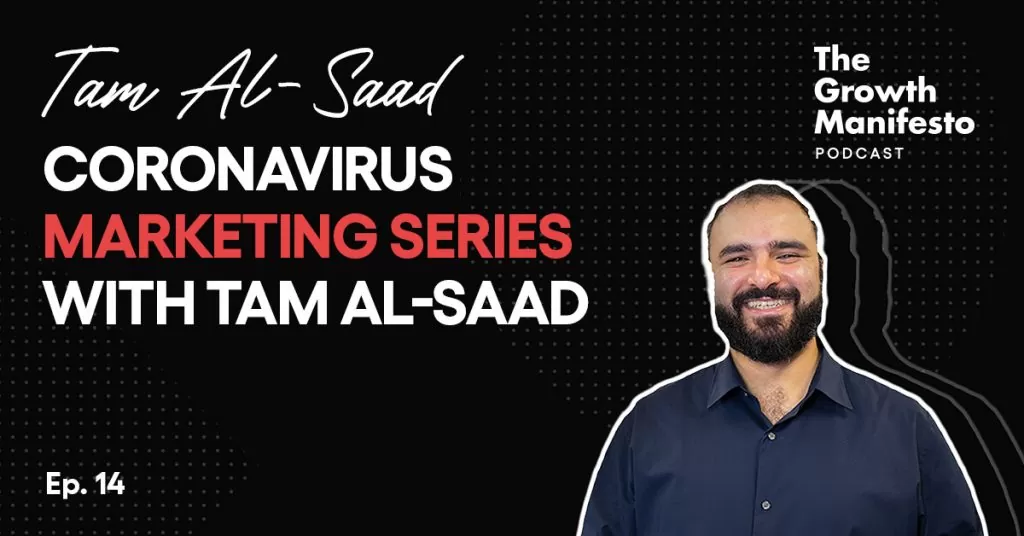
Coronavirus Marketing Series with Tam Al-Saad
Web Profits' Tam Al-Saad explains how businesses should adapt operations, message with empathy rather than fear, and market on a reduced COVID-19 budget.
 with Tam Al-Saad


Overview
In this episode we speak with our Head of Growth, Tam Al-Saad, on how businesses can adapt their business and message to stay relevant through COVID-19.
SHOW NOTES
—
Key takeaways
- Tam argues that businesses must adapt what they offer before writing any message, since messaging only works once the underlying change is real.
- He says messaging built on fear looks opportunistic and invites backlash, while messaging that alleviates customers' fears earns their trust.
- Tam reports Facebook CPMs on client campaigns dropped between 15 and 70 percent, making paid advertising cheaper during the pandemic.
- He recommends partnering with businesses that share a similar customer base, citing Web Profits' partnership with My Umbrella as a working example.
- He advises combining a simple landing page, Facebook ads and daily value-adding emails as the fastest way to generate leads on a small budget.
Chapters
About the guest
Transcript
Auto-generated from the episode audio, so expect the odd mis-heard word. Timestamps open the video at that point.
You're listening to the Coronavirus Marketing Series on the Growth Manifesto podcast, a Zoom video series brought to you by Web Profits, where we talk about how to drive marketing and business success through the COVID-19 pandemic. This episode is a discussion with our Head of Growth, Tam Alsad, on how businesses can adapt their business and message to stay relevant through COVID-19. So let's get into it. today we're talking with our head of growth at web profits tam al-sard hey tam how are you
good how are you doing good mate we're all working from home and yeah this is our series how to market through covid19 to zoom it's a zoom video series that's what i am referring to it as it's all about kind of having conversations around actually how kind of how to approach marketing side of things and the business side of things like in this extremely challenging time and We're having a lot of conversations at the moment with companies that are just struggling right now and they just don't know what to do. So I figured potentially that's the place where we can start because I know that we
just had the webinar last week, right, Tam? And we got quite a lot of challenges that were shared with us. And so are you able to maybe just start off by just talking about some of the top challenges that companies are having? Because I think that's a fantastic place to start just to let the viewers and the listeners actually know that they're not alone, right? So what were some of the top challenges that were shared with you? There are a number that we kind of looked at and categorized them as. I think one of the biggest ones was people being unsure about their messaging in a time like this. And specifically kind of how they can continue to advertise, you know,
put things out on whether it's on social media or display a programmatic advertising, whatever it may be, how they can put an advertising message out there. and not, you know, not anger people for wanting to market right now. I think there is a backlash against some companies who are perhaps putting out insensitive marketing or being opportunistic, you know. It's like the advertising equivalent of hoarding toilet paper, just jumping on a bad situation and making it worse. So there was a lot of companies who were very scared about that.
And I think it's been holding them back from actually advertising at all because they don't know what's a safe message to put out there. For some businesses, they were struggling to understand how to adapt to the current environment. I think they were still coming together and trying to piece together what the current environment looks like and how their business can play a part in that. A few of the smaller things were people not sure about what resources have been cut, budgets have been cut, and they don't know how to necessarily spend that money wisely
or kind of looking for free or cheap marketing tactics. And then strangely, there were a lot of people who were really interested in, you know, how do we plan for recovery? Which I think is probably premature, to be honest. But, you know, how do we plan for what happens when the lockdowns are lifted and the pandemic's over? But what's interesting is that by and large, the biggest kind of challenge, if you will, is just, it was a very generic one of everything.
You know, people were really, really lost. We'd ask what the biggest challenge was and people would say, it's just marketing right now. There's no other information, you know, or just it's my strategy or how should I change my strategy? And they just have no idea. And it was really interesting to see that that was the case across businesses of all sizes. So, you know, we crunched the data and looked at, okay, the small organizations have a different problem to larger ones and they don't, at least not according to the data that we've got. that's really interesting and i think it's um it's kind of like what they're saying
that we're all in this together but in the worst possible way as well you know yeah we're all stuck but i think like as um professionals in business we're all kind of having to face the same challenges and you know the thing i was super interested about um or that i found interesting sorry was just the consistency of those challenges i think you know those the four challenges that you just kind of shared is like quite consistent
across the 3,000 or so people that kind of had subscribed to join the webinar, right? There were other ones in there, obviously, right, across that. But I mean, across those four, they were pretty consistent, right? Yeah. Well, look, I think the problem everybody's having is that this has never happened before. and you know marketers are great at being clever and being creative but we and businesses as well but we build a lot on what we've seen in the past and the reason why case studies are so popular
no matter what industry you're in it's because people want to see this is what we did okay how can we do this but for our business and that those case studies don't exist there's no there's no rule book you know there's no no way of knowing what to do right now and so the challenges we face we're all sharing them together. And that's really, really interesting. Like just in terms of the case study angle, right? Because, you know, I think from the marketing perspective, you know, especially I think as an agency, say, for example,
we sell on our, like on the performance that we've done, you know, for other companies, right? And we show the case studies and now like kind of overnight, the case study that we had before, they're just not relevant anymore. And so now what we're doing, like we're shifting pretty fast and we're looking to create some of the case studies of some of our successes. And, you know, like we're working on it, but it's been about four weeks, right? There are some case studies there. So I think the relevancy of everything at the moment is super, super important. And so I think that's a good transition to the first point, which I'd just like to go into, where like a big challenge for organizations kind of is the message.
And I know just for ourselves, you know, that we've had to adapt extremely quickly. The part that's taken a fraction longer is creating the case studies of the stuff that we've done. Right. And so, you know, so we have our own challenges, but I think we're a little bit ahead of, what's it called? The curve, the curve, like just, just a little bit, not that much, but just like, but just a fraction. Right. And I think, but that's extremely difficult, you know, for us, right?
Like, and we're at the front line and, you know, we're transitioning fast and, you know, we're moving at extraordinary speed, right? And we're just still just, I think, just a fraction ahead of it, maybe. And I'm still not 100% sure. I think we are to a degree. But I think one of the big reasons why is because we work with clients across a range of different industries. And so very quickly, we could see the results that, well, we could see the impact that the pandemic was having on our clients results across so many different businesses, right? And it was, from that point on, it was, it was like immediate, really. It's like, we can't, we can't avoid this. We can't ignore it. This is going to happen. And it's going to, it's, it's going to cause some problems. So how do we adapt? And I think that insight into other kind of, other companies and what they've been doing or how they're performing in this, in this, in this situation, gave us the insight to be able to move forward.
quickly you know and i think that's that's absolutely key when um when it comes to figuring out what you need to change is seeing what's happening to your customers and seeing what your customers want and what they and you know what they what they're asking for what they value what they don't value i think because we've had those conversations fairly quickly we've been able to be maybe you know a step or a half a step perhaps in front of um in front of where other businesses are but the other problem is it's constantly evolving you know things are changing all the time and I think maybe it's settled a little bit more in the last week or so but
there's news coming in constantly and and it's kind of you know always affecting what your clients want and so that change is very difficult to deal with and it's got to be a kind of a level of agility within your marketing or within your strategy certainly a level of flexibility to allow for the fact that sometimes you're going to have to move um you know what you've been working on for a week all of a sudden could be could be wiped out because of a legislative change or because of something that's going on in the in the media yeah i think that's um that's a fantastic
point so i think i asked you about the messaging side of things but it seems like first you have to figure out how to adapt before you even start to think about the message is that right yeah and they go hand in hand right what are you communicating if it's not how you've adapted or how you can promote your value. Almost every business has had to do, you know what, I will say every business and I'll tell you why in a minute, but every business has had to adapt what they're doing, at least in the short term or the long term. I was speaking yesterday to
a marketing manager from Stan, you know, the online streaming platform. And I said, well, you guys must be, exactly. Yeah. I said, you guys must be absolutely rubbing your hands together that right now and and she said look we kind of are but we know that our time is up soon you know we've only got so many months or so many weeks uh however long of of new content they can't they can't produce anything right now so they know that the longer this goes on the more they're relying on their old content to keep existing users wow um so although there's a huge spike in acquisition
right now because everybody's bored if there's not any new stuff coming on then people are going to be bored again in three, four, five, six, 12 months time. And we'll want to leave and cancel their service. So even for businesses that are succeeding right now, they need to think about logistically, right? How can I even get more supply out there? How can I continue to change my product? How, how are things doing? And so regardless, I think of what your business is at the moment, adapting is going to get you the best results. There are going to be some companies who will do nothing, you know, who, who are going to continue doing what they did before and we'll see
some success but it's not long-term success you know it's it's very kind of short to medium term so then even then you need to be thinking about how how the current situation impacts you and then if you're not that impacted right now how are things going to look in the future you've got a you've got a bit of a a lucky break there that you can think about the future there's a lot of businesses right now who are stuck in the here and now and and that's what they need to focus on So it seems to be that every company needs to adapt. Some have to adapt for growth and actually how to handle the increase in demand.
And others have to adapt to survive and to stay relevant. And I think the latter, survive and stay relevant, is what the majority of organizations have to go through. But the former, you know, to handle the demand is also a big challenge. Like I just saw yesterday that Amazon can't keep up with the demand for all the stuff that is kind of across their store, right? And so they've now had to prioritize essential products. And then everything else is just on the back burner.
And this is Amazon that has probably, well, that has the most advanced like shipping processes and systems and logistics. And that's them. so there's kind of challenges on two sides and so cool so the first part is you got to adapt and i think that is kind of having a look at internally how do you stay relevant and how do you kind of change the thing which you're selling and how you're selling it to talk to people now you know so we have changed actually our entire kind of offering kind of um the resources are the same
And kind of how we operate as a team, that's the same. That's all the stuff that's kind of behind the scenes. It's how we leverage the resources that we have to help clients in their current challenges. That's how we've adapted. And I think that's how other organizations have to adapt. They already have the resources. They already have the people and they already have these assets. Of course, how do you take those same things and focus them a little bit differently to help to solve challenges at the moment in the current times
are you asking me how do we do that no no no i guess it's kind of like it's more of a statement right like this is the question that organizations have to be asking themselves right because they're like look i'm stuck i got all these assets i got all these people have all these costs but no one actually wants them anymore or it's kind of like it's it's a lot less now and so now like i either have to cut a bunch of costs significantly or i need to kind of adapt and create something else out of the resources that i have or both i think look the reason
businesses uh exist you know the reason why they you know why a specific business exists and their purpose and their you know we go back to simon sinek's why which we have our profits but their why shouldn't change um that should still be the same you know your purpose as a business should still be the same right now but there's just a lens of this pandemic and and and how that affects how you deliver your product or service to your customer your core should still be the same thing as if it's a very strong core and you've got it right that should still remain as it is now but
So it's a question of how do we continue to deliver that in the current environment to our clients? And I think the best way to do it is to just speak to people, speak to your clients, speak to your customers, speak to your former customers if you don't have any right now. And just say, look, what is it right now? Like, what would it take for you to be a customer again? And if there's absolutely nothing you can do, then all you can do is continue to nurture that relationship. right if there's if there's no way that anyone's going to pay you any money right now all you can do is is support them yeah provide them with information uh kind of be there to
to help them out and help answer their questions yes and trust that in the long term that relationship will come good and and and we'll you know we'll eventuate in revenue for it cool so that's the first part so now this is like a process now so part one is you need to find a way to adapt to with increase of demand or to staying relevant, right? And so now like you've got the bones of this, right? You're like, cool, so here's what we're thinking, right? This is what it is. Now you're thinking, okay,
now I have to get the message out there, right? Now this was, I think this was the top challenge. I think it should have been the second top challenge because I think you should be adapting first, but I think the message is where everyone has been stuck, right? And so what I would say to that is start by thinking about actually how to adapt first before you think of the message because the message talks to how you're going to help people, right? You can't start with the message, right? Because you actually have to understand challenges,
challenges of the organization, challenges of your customers, their biggest pain points, right? But once you understand all that, you can go into the messaging. Now, how should organizations approach messaging? Because everyone's scared. So what would you say to them? I think I said in the webinar that the key word around messaging in a time like this is empathy. You need to be empathetic into what your customers,
what your clients need and what they want right now, what their motivations are. I think fear is a very strong motivator for most people, if not everyone. It's just kind of ingrained in us. but if you play up people's fears right now then look you're likely to get some success but you're going to be called out on it you need to be prepared to be called out on it because what you're doing quite frankly isn't isn't particularly ethical in my in my opinion and so i think it's balanced though right because like you can't just ignore what's going on and i think what's happening is that there's a lot of organizations that are scared of even talking
about anything to do kind of with the virus, right? Yeah, and I think that's too far, obviously. That's too far, right? And so where's the balance? The balance lies, I think, in how you position yourself in regards to your client's fears. If you're playing up people's fears, then you're going to look bad. But if you can help alleviate those fears, if you can speak to those fears and say, you know, this is why you don't need to worry. We're here to help you. We're here to support you. Not do this. Otherwise, this is going to happen. And this is going to happen. It's not implied, but people know that. People understand the gravity of the situation now. And so it's just a case of showing your customers that you care. And that isn't just discounts. That isn't just messaging them and saying, are you social distancing or washing your hands? It's providing genuine value for people.
if you actually provide value for your customers they're going to value you as a business and and that's where custom comes from right that's where why people buy things and i think that's a super point because i was because i've seen and i've unsubscribed to hundreds of companies that have just thought i'm going to start in my marketing now because there's a pandemic and i'm going to say we're still open we care we're clean it's like seriously like stop clicking my inbox no but but But see, there could be a confusion where, you know,
talking about this, hey, let's be empathetic. Let's tell people that we care. They're doing it from their perspective, not from the person that they're actually trying to engage with. So I think there is a little hook on that to say, focus on the person who's reading your stuff and how you can help them, not kind of how you can tell them what's happening with you. Yeah. I think you don't, just like any kind of relationship, you don't tell people you care about them, you show them. You've got to show that care and that respect for people.
And I think that's what comes through. The worst, I mean, not the worst thing, but the most boring thing you can do is say, we care. Show that you care. Yeah, the company is still operating and we're still here. Everyone's okay. I'm like, I didn't think that there was a problem. Now I'm concerned. Why are you so desperate to send me an email that everything's okay? Is everything not okay? Like, you know what I mean? It can easily be seen as the opposite. So I think just from the messaging side of things, focus, of course. So, you know, we've started off in terms of you need to adapt kind of how you approach everything,
understand the pain points. Then you need to engage and actually have like a message that talks to the pain points. And yeah, you can try and sell, but what you want to do is solve problems. Yeah, so you want to understand customers' problems and then you want to solve them And kind of how you talk about that will depend on your brand and depend on what you sell. But you need to focus on trying to give something first, kind of add some value in their lives, not about your company and what you're doing, unless that is extremely relevant in an example
of something which you're helping them with. But don't just talk about you, speak about them. And look, there's nothing wrong with selling. I think that needs to be made clear, right? There's nothing wrong with trying to sell right now. it's how you sell that makes all the difference. You know, just in my house, we bought so many things here in the last few weeks that we wouldn't normally buy. You know, we've bought a whole bunch of board games. We've invested in alcohol that we don't normally make to buy to make cocktails, you know, foods that we're trying for the first time, a whole bunch of different things that we, we never normally spend money on, but we're choosing to now because they're valuable to us now, you know?
And so people are spending, not everyone, of course, you know, spending is not anywhere near where it was, but, but people are spending and people do want things and people need need a whole range of things to get them through this pandemic and and you know businesses shouldn't be scared to to meet that demand it's just a question of yeah being being tactful and being empathetic as you in the way you approach it yeah super point super point um and the third part of this um this interview because you said basically how to plan for recovery and then everything right like and i think of
course everything yeah that's a challenge that you know we're all trying to face right um how to plan for recovery let's try and get through this first right like i think like we don't know when the recovery is going to happen and i think actually maybe we can go into this just super quickly but don't wait till there's a recovery and think that that's just going to happen everything is going to go back to normal because we don't know it might not and if it does that's easy because you just you just go back to how that was before right like it's not going to be exactly the same but like you had something that was already working but we we're just kind of in a point
now where it's not like that we don't know how long it's going to be everyone's got i can guess and even if the social restrictions are up are basically opened up has consumer behavior changed like how bad is the recession how bad is the economy so i think that's a bit premature right Wouldn't you agree? I agree. Definitely agree. But the last one is, how do you work with smaller budgets and be wise with it? Because that was like a really big one as well because everybody's had their budgets cut now, right? And they're being a lot more frugal, right? So what do you do in that scenario now, Pam?
Look, I think if you were to Google low-cost marketing strategies, there's a ton out there. My top tip is content. Content marketing is the most effective thing. You know, like I said, plus Facebook ads, right? Like we need to combine them. I think, well, I think that's a, that's an element of content marketing. And it doesn't necessarily need to be the only one, but Facebook ads are relatively cheap right now. Um, you know, the, the, the CPMs that we're seeing on our campaigns that we're seeing on client campaigns have dropped 15, 20, 40, 70%, some campaigns,
depending on who you're targeting. And so, um, there is, as much as it is a dirty word right now, there is an opportunity there. Um, to try and market yourself and to promote your content or promote your business. But it's not the only way. You talked about companies emailing you, saying their hands are open. That's a complete waste of email, as far as I'm concerned. People's email databases are one of the most valuable assets that they have, right? And particularly if it's been going for a while and it's linked to a good CRM,
you've got so much information. There's so much data about what your customers like and dislike, well, mainly like, I guess, and what they browse and what they look at and what they've purchased you should be using that data and that information to to send people the right things if you see that they've bought loads of a certain type of thing before and that thing is relevant now you should be emailing about that product or service whatever whatever you know like just as an example but there's guest posts there's um you know there's blogging you know guest blogs there's partnering i think you know
one of the best things we've done in this pandemic so far in terms of our marketing is is to partner with my umbrella um and just say you know we want to we share a user base here um you know a lot of your customers are a lot of our customers so how can we work together to deliver something to both sets that's going to be of extreme value and that's worked really well for both parties and we're very happy with this so you know i definitely suggest leveraging any existing business partnerships that you have don't necessarily go out there and try to convince people to work with
you because you want to basically, you're just going to look desperate. But if you've got companies that you've been working with that are willing to work with you in order to benefit you both, then I think it's definitely worth investigating and having a conversation about at the very least. Yeah. Look, here's my two cents on that because I do agree with you. I think in summary format, the stuff I'm seeing like it's working, you should be email marketing and it should be like as often as possible with extremely high value content. that's kind of free because you have like an email list hopefully um you could um you should
be advertising on facebook the content and maybe some type of like a lead magnet to get some people to be in to your email list um and yeah for sure the partnership side of things but that does take a bit of setup so that's not for everyone and you need to have something to offer the partnership so both sides do but if you don't which i don't think a lot of people are going to have that like in place you can achieve quite a lot with facebook ads a simple landing page and basically email
marketing yeah like those three things right now oh so and some awesome content right like you need to be giving value through content you know like it can be like as simple as personal email every day that adds value in some way right it could be like a lead magnet which is a checklist or like a video or something like that or like a webinar you know they're super powerful but i think these things are working right now um from the b2b space anyway and from the b2c space the volume is massive and if you can supply that facebook ads is the place and google ads are pretty cheap now
as well so like if you're the company that is marketing right now it's going to be a lot easier to be profitable in that marketing and so that's my two cents in the whole thing you just wanted One thing to add on the Google ads thing is, you know, cost per clicks are down there as well, right? Because people, not as many businesses are advertising. And if you're worried about how to generate customers right now and you're not doing Google ads, there's something fairly foolish about that, right? Like these are people with very high intent. You want to try and capture as many of those people as possible. So, you know, start with that really and, you know,
make sure you capture those before you start looking to generate demand for your product or service. super tam listen this was a short and punchy one um it's been fantastic speaking with you again like i miss seeing you in the office but i'm seeing you a lot on zoom and i'm this is the screenshot i'm seeing of you um but look i hope everyone um has enjoyed this episode um you know we're trying to be extremely punchy extremely value-writing everything that we have still in this video is kind of what we're doing as well right you know we're trying to lead by example
to support the business community and just to add value and to figure stuff out ourselves as well. And we're kind of continuing to share everything that we're learning in the process. So thanks for watching. Thanks, Tam, for joining and talk to you soon. Thanks, Alex. Cheers. Bye. Thanks for listening to the Growth Manifesto podcast. If you enjoyed this episode, please head on over to iTunes and give us a five-star rating. For more episodes, please visit growthmanifesto.com forward slash podcast.