EntrepreneurshipStrategyPersonal growth
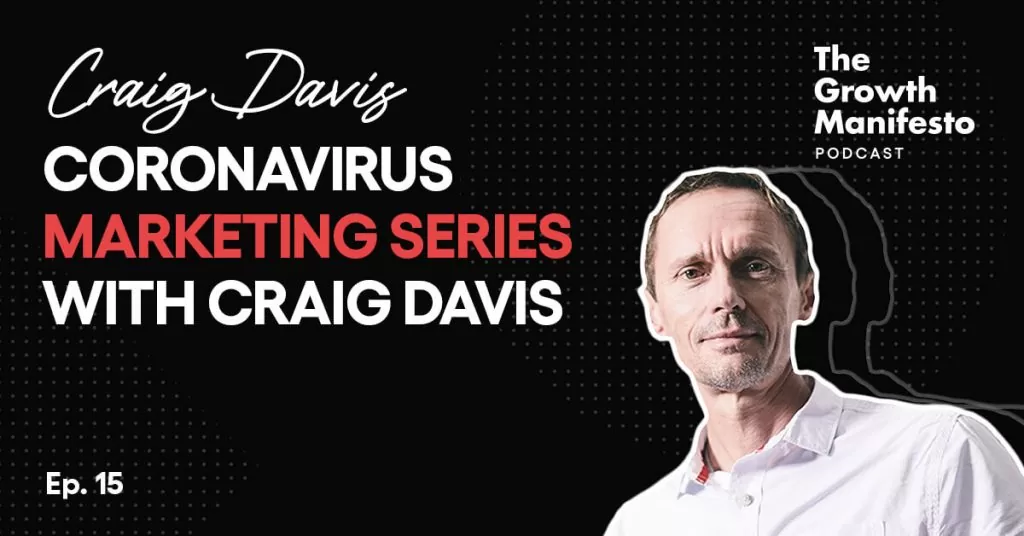
Coronavirus Marketing Series with Craig Davis
Sendle co-founder Craig Davis on navigating COVID-19, testing product market fit, and why founders should focus on customers before products.
 with Craig Davis


Overview
In this episode we interview Craig Davis, Co-Founder at Sendle, Advisor at KPMG High Growth Ventures and Adjunct Professor at UTS Business School.
SHOW NOTES
Key takeaways
- Before taking a product to market, at least 30% of surveyed customers should say they would be very disappointed if it disappeared.
- Sendle only found its real opportunity after realising small businesses ship parcels 10 to 100 times a month, far more than consumers.
- 97% of startups fail, largely from unexamined assumptions and unconscious bias, so founders should ask tough questions and seek critical feedback.
- People hang onto bad experiences roughly 5 times more than good ones, so wins need a deliberate 15 to 20 second pause to register.
- Businesses should focus first on understanding customers, then on looking after their people, before making decisions about products or services.
Chapters
About the guest
Transcript
Auto-generated from the episode audio, so expect the odd mis-heard word. Timestamps open the video at that point.
You're listening to the Coronavirus Marketing Series on the Growth Manifesto podcast, a Zoom video series brought to you by Web Profits, where we talk about how to drive marketing and business success through the COVID-19 pandemic. Today we interview Craig Davis, co-founder at Sendall, advisor at KPMG High Growth Ventures and adjunct professor at the UTS School of Business. So let's get into it. Yeah, thanks for coming on the podcast. We're living in interesting times.
I'll just do a quick intro for you and then we'll get into it. Today we're speaking to Craig Davis. He's a co-founder of Sendil. He's an advisor for the KPMG High Growth Ventures Arm, plus also like an adjunct professor at the UTS School of Business. And how did that come up just quickly? Because how do you become an adjunct professor? I don't really remember, Alex. I think when I came back to Australia a few years ago, I was introduced to the Dean of the Business School and he seemed to think it was a good idea. So I think it's about that simple. That's great.
Yeah. That's great. I mean, I'd love to get one of those. Yeah, like if there's any people out there, you know, that are offering them up, please let me know. I'll let you know. Yeah, but like in all seriousness now, this is a series that we're trying to help business owners across the world to handle this extremely challenging situation that we all find ourselves in. You know, like I just saw the news last night that the Prime Minister of Australia has confirmed that the lockdown is going to continue on for at least another month. And that's assuming that there are specific things
that have to be put into place. And so we've already been in this thing for almost like a month now. It's another month that's about to happen. A lot of businesses are just struggling across the board. They're devastated, right? There's a few that are doing well and there's a few that have adapted, but the majority are kind of stuck. And so, you know, this is kind of a conversation to help the stuck people, but also to help the companies that are just looking for kind of some inspiration and some positivity, like in this extremely challenging time. Yeah. But I figured because you have so many parts and so many kind of areas where you have expertise.
Right. And you're seeing this kind of unfold through like a number of different lenses. Right. Because you've got like the co-founder lens and then you've got the advisor lens. And I'm sure the network of kind of entrepreneurs that you probably have like around you kind of have like a third lens. And what are you seeing in terms of the sender lens?
Yeah, because obviously it seems like for Sendall, this would be going up, right? Like this is probably a good time for Sendall. Is that true or not? Yeah, look, Alex, it's an excellent question. If I can start, I'll answer it from slightly earlier in the question, which is what's going on. And like the honest answer is I don't know. And I don't think anybody knows. and I don't think anybody has any kind of crystal ball here.
So there are so many unknowns. And I think what we all need to do is deal with kind of what's in front of us and look at data and make intelligent, hopefully intelligent, guesses. As far as Sendall's concerned, the business is going, yes, very well. There's a major shift to e-commerce. and I think that a lot of that shift will stick. So there's me making a bit of a prediction, but I think that for a lot of people,
it's sort of the introduction to e-commerce. So it's not a new thing, of course, but for a lot of people, they've been fond of going to the shops, buying things from traditional sources and buying things online or something they haven't really done before. I think, you know, now that everybody's doing it, a lot of that behaviour will change on a permanent basis and who knows when shops are going to reopen, bricks and mortar shops are going to reopen and how the behaviour will shift back with that. So I'm going to ask you pretty direct questions.
If I ask you anything that's kind of uncomfortable, but you just say, look, no, like I prefer just to not share, but I'm going to ask the questions that everyone kind of wants to know and you feel free to either answer or don't answer. to you but you're seeing kind of e-commerce from the lens of the shipping companies right and so you actually get to see or to feel the volume the change in volume what are you seeing in terms of that volume at the moment you know like since this whole thing started is it yes please yeah look it's
it's ramped up pretty significantly so in the in the u.s the team launched in the u.s um on black Friday, I think retail day in the US. So that was the beginning of Sendall as a service in the US market. That's good timing for now, I guess, because, you know. Yeah. And look, and all these things, you know, nobody knew what was coming along and certainly not us. But the business is going very well there.
It's well ahead of forecast. and then since January the business has grown in pretty spectacular fashion both here and in the US. So, you know, there are some companies that are essentially beneficiaries of this crisis and, you know, that's wonderful. But let's not forget that it's a crisis and it's not wonderful at all And it's really challenging or catastrophic for a lot of people.
And there's a lot to deal with. So, you know, here and there, Zoom and Slack, you know, online tools. We're using Zoom right now. I'm sure if we were doing this three months ago, two months ago, I would have been in a studio with you. Yes, exactly. And so everyone's having to learn to work remotely, all those sorts of things. And there are businesses that are arrayed around those kinds of shifts that are going to do well out of this. but I think for the most part it's just very challenging and even in businesses that are in a position to do quite well in these circumstances I think it's still
nevertheless challenging there's still you know there's still the rest of your life that is you know that is going on yeah the work in different circumstances you've got probably you've possibly got financial pressures that you didn't have even if your business is doing okay because in order to managed through this crisis um i think most businesses are well advised to to really look after their cash uh and to minimize minimize their their costs wherever they can and if you're a
startup to minimize your burn rate yeah it feels like um there's two parts of um the pie right now right or two pieces of the puzzle um where like either like it's going extremely well for you and And so you have some cashflow issues, right? Because you shouldn't be growing too fast. That's what they say, right? But then there's also on the other side that like it's not going well for you. And so there's cashflow issues, right? And so I think that at the kind of like at the center of all this
is like a lot of challenges around the cashflow side of things, you know? And I think it's challenging on the two fronts. But I did see, what was it the other day? that Amazon can't handle even the demand in orders. You know, like that's kind of how much of a shift has happened in terms of e-commerce, right, where there's so many people trying to buy stuff that even Amazon that has the most advanced logistics, I think, of any organization is only prioritizing the essential items
now across their websites. That's Amazon, you know. So what kind of demand is out there where a company like Amazon can't even fulfil it. Well, all those things that people liked to buy themselves and now they're buying online, excuse me, out of necessity. And I would say out of necessity and for some people now out of choice now that they have a taste of the convenience and they've got over some trust issues around e-commerce and, you know, am I going to get scammed here?
Can I rely on things that I buy on marketplaces or that I buy from Amazon? and so the demand and there'll be good data around this pretty soon I think because of one of the great advantages of e-commerce and online businesses is always a there's always plenty of data so I think that the NAB produce an online retail index in this market I think that comes out monthly I think you know that'll be visible soon you'll see there'll be a massive uptick in
in those things and even in payment methods around that too. So people like Afterpay, 80% of their business is in online purchases. And even though their share price has bounced around and they're constantly providing market updates, I think what it does indicate is there's a lot of, there's plenty of indications of a lot of activity. So shipping is one, transaction volume is another. So people like Stripe who are handling online payments, I'm sure their business is booming as well. And, of course, the giants like Amazon and eBay.
I'm sure they're both doing very well. So we'll see numbers in the next few weeks that will confirm all that. I'm pretty confident. Yeah, right. And are you seeing kind of like any specific industries that are just like a lot more successful than others in terms of almost online shopping? because you probably have industries across the board where you're like, wow, that's interesting that that one is performing so well where this one is not. Is there anything which you can share in terms of that?
Yeah. Because I know this is all really interesting, you know, like trying to understand this. Yeah, there's data around this too. Actually, there's some Australian data that was published a couple of weeks ago or maybe a week ago. It's hard. Actually, time is one of the things has become very elastic. It has, hasn't it? It's really interesting. I thought it was really interesting. It feels so long and so short at the same time. So I said two weeks ago, it's probably only a week ago. It could have been four days ago.
It could have been. And there was some data out of the US even more recently than that. And some of the things that are doing quite well are people in the sort of beauty and cosmetic space. so that's um that's an area that's doing well obviously you know things anything that's travel related is doing badly at this point um alcohol is doing well you know there's a thing i've got some friends who are actually um in the in the beauty and cosmetic space and the skin care
skin care space and they were telling me about the lipstick lipstick index which is a phenomenon that's been around through a few crises. Okay. And that actually lipstick sales often go up in times of chaos and uncertainty. And I think the psychology is that, well, there's a lot of things I can't do, but one thing I can do is I can take care of myself. And so cosmetics is something that quite often in a crisis does okay. Yep. But clothing is not doing so well because people don't feel the need
to dress up you're not going out you're not you know having to impress anyone you're not having to put on your sort of professional outfit yeah sure go to work so clothing sales are not typically that great at the moment yeah i was thinking about actually like i was like should i wear a shirt for this or should i just wear wear a proper st-shirt i figured i mean everyone is in you know like these t-shirts now um yeah i think i think the basic question each day is pajamas or not yeah yeah i think because of the amount of video calls it's like pajama bottoms or not
you know um that's really interesting um it's it's it's an interesting shift that's happening i believe right now where like we were already heading towards um the digital revolution yeah like it started in 2000 or whatever it was um i'm that old now that i basically but i can remember the boom and the bust you know um and i thought i kind of like had um had missed
the wave yeah i started like back in 2003 or whatever it was and i was like oh no you know like it's already now past it's now 2020 and it's almost just starting again now but it's but it's such a big immediate shift that's happening right now um and i know that as um the advisor of um the KPMG high growth ventures you're probably having quite a lot of conversations about this at the moment is that correct yeah look I think I think there's lots of shifts that
are going on at the moment Alex and again I um I say this because it's just my point of view it doesn't mean that I'm right and again I'm trying not to prognosticate but um I think one of the big shift is that kind of all bets are off and a lot of the things that were working well for you may not work well from now on so so profound is the change i think now you can look at that as being um intimidating and threatening or you can look at that and i would advise everyone to
look at it this way uh with a with a kind of a positive and open and optimistic mindset it's a chance to rethink a lot of the bits of your business. So what I'm saying here is, you know, a shift back to first principles. So whether it's digital or not, digital or analog, I think is less significant than taking the time and taking this opportunity to go back to first principles. And what I mean by that is, you know, what's your product like?
So the product that got you to where you are may not get you to where you need to get to. And there's a lot of businesses that have had kind of mediocre products and that's been okay. You can get away with it. If you've got a mediocre product with brilliant marketing, for example, you might be able to skate away with that. Right now, my advice would be to go back to your product and have a really hard look at it and challenge all your own assumptions. And, you know, one of the things that I spend a lot of time
in the startup space and one of the things about startups is that, you know, they're always living with an existential crisis. You know, they are by nature, they're bootstrapped, so they're spending, you know, money that the founders have saved and there's only so much of that or maybe they've raised some investment and now you're accountable to a whole bunch of other people and they don't give it away for nothing and there's very high expectations that are attached to any level of investment. and so you need to in startups you're constantly having to examine your product and you're trying
to figure out whether your product is good enough to take to market and that's a you know it's a very high bar and so for a lot of businesses that have been around for a while I think they need to ask those same questions is my product or my service is it really good enough to for this market does it fit the needs of the market now because those needs have changed and the best way to navigate all this uncertainty is to totally double down on your customer understanding what do you know
about customers what's important to customers and and let go of your own preferences in that not what you want to be important to customers but what actually matters to them. And so, yeah, that's a very tough test and they're very hard questions to ask and genuinely have an open mind when you hear the answers because often people are going to say they're going to call your baby ugly and you've got to be prepared to hear that publicly
and you've got to decide what you're going to do. They all liked that comment, weren't they? Yeah. Yeah. Yeah. There's a great, there's a great kind of rule of thumb about product market fit in early stage businesses, but I think this applies to all businesses. And, you know, if you ask people, you know, indirectly say through a survey and, and you said, look, if, if my product went away tomorrow, how would you feel about it? And your choices were very disappointed, somewhat disappointed or don't really mind. unless you've got about at least 30% of people saying they would be very disappointed,
then you wouldn't take that product to market. And you're not asking everyone. You're asking the market that you've already identified. So if 30% of those people aren't going, I'd be really disappointed if this product disappeared on me, then that's an indication that you're probably pushing water uphill or maybe you're flogging a dead horse. So I think it's a really good time to go back and to ask those questions, really examine what it is that you're doing for customers currently
and how valuable that is and what you're not doing for customers that they consider to be important or valuable. Yeah, right. And so in the startup space, like it's kind of the same as it was before, but it's like now everybody is a startup almost. Is that kind of how you're seeing it? Like, because startups, they always have a hard time. Is it just as hard? Is it like a bit easier now? Like, you know, like what, like, but how has it changed for startups?
Oh, it's harder for startups. You know, I think this is going to be a very, very difficult time for startups because, you know, the advice that most of them are getting from investors is that they need to be managing their cash burn rate or their runway. and they need to be scenario planning to the end of next year in the expectation that there will be no more money. So whatever you've got to work with,
you need to make it work until the end of next year. Now, that may be a totally worst-case scenario. Yep. But that's kind of the advice that's coming out of the top tier venture capital firms and advisors, which is you need to expect and plan for that scenario. And if things get better, that's great. Thanks for sharing. And that's great information. I think from the rest of the companies out there
that have got past the startup stage where the majority of them now have potentially a service or a product that is just not in demand anymore, that is not at all relevant anymore. And that just happened overnight, right? And so, like you suggested before, that basically all our businesses should take the startup approach. Yeah? Is that right? Like, is that what you were kind of like to think about? Yeah, I'm not saying all businesses should take a startup approach,
but what I am saying is there are things to be learned from the startup community that are relevant for these other businesses. The product market fit conversation. Yeah, and some of those businesses will essentially be starting over because what they've been doing, there is no longer a market for it or that market is much diminished. And so, you know, classically, you know, in startups, they call that manoeuvre a pivot. It's a fancy word for going, there's opportunity.
Someone's moved my cheese. Where do I need to go now? and we've seen examples of that in small businesses who have gone from making artisanal gin to making hand sanitizer, for example. So, you know, there's lots of examples of people going, aha, so here's an opportunity. Not that alcohol, as it turns out, is a dying business at the moment. It's not at all, is it? But still there's a need that's been identified
and there's some expertise and some resources that could be turned to address that need. And so I think being highly adaptable in the way that we think, being agile in our thinking, flexible in our thinking, you know, there's businesses that are all of a sudden creating personal protective equipment or screens for supermarkets and for your barista to work behind. They weren't in that screen business before. there wasn't a screen business and so yeah i think you know you can look around and you can probably
see uh opportunities for new products or maybe to to refocus your business on an entirely new area yeah yeah yeah for sure i think like i was having this conversation the other day um with someone um with noah kagan actually and um we were just saying like that we're currently in the pro like the economy is pretty tough right now and it's in a state of contraction so there's less money that's going around and so that money that's actually left over there's a fight for it right
and so not every business is going to make it through this because they can't because there's just the spending is less yeah the government subsidies are going some way to help in the next say four or five months but at the end of that there's going to be a like a massive cliff that we'll see how that kind of turns out but what is some advice that kind of like um what's some advice i would you would give to businesses on how they can can be one of the survivors you know because not everyone can
yeah totally so um and i've heard that um from a number of investors and family officers who are all saying, look, competition for capital is fierce. And for a lot of people who are professional investors, what they're doing first is they're looking after their existing portfolio. So if they've already invested in companies, they're going to do in their best judgment what they think is going to take care of those initial investments. If you're a small business, that's different
because you probably haven't taken investment in the same way, but you might have loans from the bank and they may be secured against your house and all that sort of stuff. So, look, my advice is, and we've touched on this before, my advice is that the best way to navigate all of this is to focus on customers. You've got to look at, you know, you've got to deeply understand your customers, what's changed for them, what's shifted for them, what's valuable to them, what problems that they have, what pain points they have, what triggers and drivers they have
that you can work with. and a lot of those things, some of those things may not have changed, some of those things may have changed in a very significant way. So understanding that, I would say, is the number one thing. The second thing is look after your people. So if you're a sole trader, you've got to look after yourself. If you're a small business with five employees, then five or ten employees, you need to look after those people. You've hired them for a reason.
You've decided to keep them for a reason. They're valuable. They provide leverage in the business. And you need to be getting the best out of those people in order for you to have the best chance of being successful. And as a result of those first two things, you're in a better position to sort of reconsider your products or your services. So now you've got good data and understanding of customer needs. You've got a team or yourself who is being well managed. you're in a position to make important decisions around products.
And if you get those things right, then you've got a, you know, better than most chance of that turning into some kind of traction and success. But, you know, this is a crisis and not everyone behaves well and thinks well and makes good decisions in a crisis. And so that whole thing about taking care of people, taking care of yourself is really significant. That's not about just kind of being nice to self. That's about operating at something like your best
because you just don't want to be making more, you don't want to be making poor decisions at the point. You want to try and be making really good ones. Yep, that's super advice. What timeframe are you suggesting these things happen in? You know, because I know there's like quite a lot of companies is that the thought of that process is so big because the company that they had kind of at the start,
the start of this crisis is completely different to what it should be now, right? And so there's this conversation of, is it better to just wait a bit more and see? Like, you know, how far should I be doing this? Like, you know, what would you say to that side of things, you know? Look, one of the things that was true before this COVID-19 virus and I think will remain true is the world's getting faster.
And right now, you know, we're confronted by that in a very unfortunate way. but there's a there's a an expression that says it's it's no longer the the big that eat the small it's the fast that eat the slow and um and so the answer to your question is when should this start happening it should already have started happening and for a lot of businesses that i know it started a month ago you know at the at the early signs of this um making good decisions and making them
quickly is part of what you need to do in order to manage a business well in, even in the best of times, but certainly in the worst of times. So, you know, it's not a, it's not a good time to procrastinate. It's, it's a good time to think things through and make decisions and then act on those decisions, you know, now.
So I wouldn't be, you know, I don't think anyone is sitting there thinking, oh, look, I'll just ride it out. I reckon it's going to be okay again in a week or a month and I'll just kind of suck it up and see what happens. I don't think that's good practice. I think what is good practice, as we've said, is, you know, take this opportunity to understand what's happening to your customers and what matters to them. figure out if there's other problems you can solve for them, look after yourself, look after your people, and then make some decisions around are there, you know,
are you actually going to develop products or services to satisfy those needs that you've identified? And if you're going to do that, get on with it. And if you are going to do that and get on with it, then get on with it in a way that, again, is disciplined. So test. So develop something, test, learn, iterate. you know don't bet the farm on a harebrained scheme that's like a one degree shift from what you're doing but apply some some real discipline around this you know you've got a hypothesis i understand my customers i've got a hypothesis i'm going to try this out in a small way do it
quickly i'm going to see and learn i'm going to gather some more information and data and feedback out of that i'm going to tweak it a bit and do it again and if it turns out at some point that it was just a really bad idea then you can just cut it off and come up with another one yeah i think um um i think the companies that are going to struggle the most are the ones that are um the least open to change or the most resistant to change and i think that's more from kind of their structures their products and their internal cultures but it still has to happen like it
can't not happen i mean that's just an extra challenge to have to face i think you seem to maybe um kind of have um like a lot of people um and organizations kind of um who you speak with that are in the digital space that are already kind of like that way but there's like there's also quite a lot that are kind of stuck outside of the digital space so what do you do like if you're out of that space like like and you have to now say well you know i can't advertise outside
anymore like like i can't i can't deliver um my product anymore in the way that i did before and i now need to move to digital like how do you advise a company like that to move to digital you know so what would you say um to somebody like that i think the principles are still the same Alex and so for sure I mean I spend more time with companies that are technology driven or or they're delivered digitally but I'm working with a company now
which is a it's an advanced manufacturing company okay so they're they're working half their team is working remotely half their team is on site because the nature of what they do they have to be in the building they're working with you know expensive and highly calibrated physical manufacturing equipment, they can't do what they do unless people are in the building. But the principles in that case are the same ones that we've been
talking about, which is now is a time for real focus. And that focus has to be not a focus on what you want to do or what you hope might happen or on what has worked before. So it's not that those things aren't of any value, but you need to recognize them for what they are. Your focus should be on what our customer needs now and what are the best opportunities now and what are the biggest problems that customers have now
and then are we equipped and do we have the capability or the capacity or could we develop it to solve those problems? And so, again, it doesn't matter whether you're digital or analog. I think those principles still hold. So in the case of this particular company, we're, you know, we're looking at the strategy for the company and in particular, we're looking at the sectors of the market where we absolutely need to focus.
And we learned this with Sendel early on. You know, Sendel now is, it's a technology company, but it's a delivery business. And in the beginning, you know, we first developed a marketplace, a two-sided marketplace for sharing things that were still useful. It could be, you know, I've said of these coffee cups, I don't use them anymore, so I'd like to give them away. I'm not going to try and sell them. I'm just going to try and give them away. I'd be happy if they went to another home because otherwise they'll just end up in landfill, which is what happens about 95% of the time.
Definitely. So we built a marketplace to do that. And then Sendal was born out of the requirement that people have 30% of the time to send this thing they wanted to share to someone else. So if you and I live in the same neighborhood, if we both live in Newtown in Sydney, then I could post this and you would go, hey, I really like those. Can I have them? And I'd say, yeah, sure. Swing by and pick them up. But if I'm in Newtown and you're in St Kilda in Melbourne, there's a lot of friction in that.
And am I, I'm just trying to share it and give it away to you. Am I going to go to the post office and wrap it up and pay to ship it? And then you're going to send me the money for the shipping and, you know, what a kerfuffle. And so Sender was born out of all that friction. And it took us a long time to figure out exactly who the service was for because we came from this marketplace where it was essentially it was consumers sharing things with other consumers. but that wasn't really the opportunity for Sendhil.
So even though that's where it started, the opportunity was consumers send things once or twice a year. Small businesses send things 10 times a month, 20 times a month, 100 times a month. So for a bunch of quite smart people, it took us a long time to figure out that the opportunity was in the small business space and everything looks obvious in hindsight. and it took us a long time to get there. So, you know, that's an example of really thinking
about what to focus on. And who do you service now? Small businesses. Small businesses and specialise with the commerce transactions or is it basically across the board? Some of these people have got a, you know, they've got a corporate job and a side hustle and they're selling things on eBay. Yep. Or they might have a Shopify store that they've set up. um they might be just selling stuff um you know drop shipping and and putting stuff on gum tree
um all the way through to more sophisticated businesses that have got you know a real brand and they've got a classy shop front and they've got a whole story and maybe they've had a hand in the in the formula or the making of the product um but you know what we're clear on now is who we're for and who we're not for and I think that's part of what we're talking about here strategy is about making choices and about deciding what to do and by definition what not to do and now's the
time to be really figuring out what not to do in order to focus your more limited resources for most businesses on the things that you need to do and do brilliantly and if ever there was a time to to you know there's a disproportionate level of reward about solving problems brilliantly like If you solve a problem just kind of well, that's great. But it's not good enough to generate a real flywheel effect and word of mouth and kind of virality in the business. You need to solve problems brilliantly.
And when you do, people will go, hey, Alex, I just discovered this thing. It's so amazing. You must try it. You must try it out. And that's like the oldest marketing trick in the book, except it's not a trick. Yeah. You can't pay to make that happen, not efficiently. You have to do the work on the product end. And to do the work on the product end, we're right back to understanding customers. It's interesting. Like, it's such a fantastic point because today,
like in the COVID-19 world, you can't create a need and then try to fill it. You know, that was, you know, a couple of months ago, right? It's like, hey, look, I've got this thing. I'm going to have to create the need first. then I'm going to have to feel the need. Now you just need to feel actual needs, you know, like you just have to understand this. I think this comes back to your point, which is speak to your customers, speak to the market, actually understand, you know, what are the real pain points and then try to solve them.
Because then you don't even really have to sell that much to sell it because there's the pent up demand for the solution. And I think that's what you've been kind of explaining over this podcast is that you kind of have to just like to understand your customers at a level that you may not have done before or that you may have done, but it's now shifted. Yeah. Yeah, I think that's totally right.
And, you know, listening, as simple as this sounds, listening in all its forms, observing in all its forms, paying attention in all its forms has never been a more valuable skill right now because, again, because we're all slightly arced up because of this crisis, because all of us, to some extent, are emotionally impacted by this. You know, I was reading this guy called David Kessler, who's one of the co-authors of the five stages of grief,
which is now a pretty well understood framework around grief counseling in psychology, and he's just written a new book. And he was talking about in this interview, I think it was Harvard Business Review, he was talking about how anxiety doesn't really do justice to what everyone's feeling currently. So, of course, anxiety in a clinical sense exists as it did before COVID. But he said it's not quite the right word for what many of us are feeling most of the time now. And he said, I think it's kind of, and he called it anticipatory grief.
He said, we have this expectation that even if nothing terrible has happened yet, that it will, and it's already happening in a health sense to many other people and in a business sense to many other businesses, or if not in my business, in this market, in other businesses, in other markets, and so on. And he said, you know, all that has us, we're all kind of on edge. We're all a bit jangly around that. And so just understanding that's really important because what that will do is going to affect the way that you hear things from customers to go right back to customers.
It's going to affect the way that you look at data if you have data around your customers and their behaviours. And so being aware of it and then trying to bring some real clarity to it and so that you're not just hunting around for things that confirm your own viewpoint, that you're actually open to looking at what's really happening. There's a thing in startups that says that most startups fail, like 97% of startups fail. Right. And two of the biggest reasons are unexamined assumptions.
People go, I know what the answer is and I've done this myself. a great expense. I can see what the problem is. I know the answer. I'm going for it. That's essentially an unexamined assumption. I think we've all done that, by the way. I've done that so many times. I think with age, you realize, wait, just get a little bit slower. Ask a few more questions. Save yourself two years of pain. And ask the right people. Don't ask people that you kind of know are going to say nice things. That's a great idea, Alex.
You always have great ideas. That's not useful feedback. You want the tough and critical feedback. And the other reason is unconscious bias. So we're hunting around to confirm our own suspicions. And those are very dangerous practices now. And that's sort of my point. And that comes all the way back to self-care and looking after your team. You do not want to be operating in that jangly heightened state where you're not really listening and you're not really observing.
Which is hard sometimes when you're going through something so significant as what we're going through right now to keep that level head, to keep that the right kind of thinking. But I think that comes to your point to look after yourself first. so what are some kind of tips or something like that or advice on like how do you look after yourself right now you know so what are some of the things you know would you do you know uh so look i i'm right into this for a variety of reasons that we probably don't have time to go
into but um uh but i spent a large part of my professional life with only one real strategy which is, you know, I need to just work harder than everybody else. And because there's other people who are smarter or more talented or whatever. And so the way that I need to compete with that and succeed in that environment is just to work harder. And that kind of, that's okay as a strategy for a time. And after a while, though, that comes at quite a significant cost to health,
both mental and physical and spiritual and to relationships and to a few other things. And so I was, you know, propping myself up on a whole bunch of stuff, which wasn't particularly healthy. And so I learnt the consequences of that kind of brutish strategy a few times over and quite painfully. And so some years ago when there's got to be a better way of operating in the world and not trading off ambition, but figuring out what actually is supportive and sustainable.
And so, you know, exercise is important. Nutrition is important. Sleep is important. And then developing practices that help with emotional intelligence are important. Like what? Well, meditation is one. Okay. Mindfulness and meditation, just any form of attention training. because that will help build self-awareness. And neurologically, it starts to change the way your brain is functioning
and over time even the structure of your brain. Self-management, so how you work with your emotions, how you regulate those, how you handle triggers, some strategies around that when things are triggering for you. And I think it's tools like journaling is a really powerful tool around that. We have time for it too, right? Yeah, totally, totally. And, you know, without getting, you know, right into the weeds on this,
but understanding your own motivations and values and your sense of purpose is really important. And I know this is surfacing a lot for people now because it is a crisis. and they're going, what am I doing? Why am I even doing this? How important is this to me? Is this what I want to be doing with my life right now? And for some people that's an easy like, yes, absolutely. Hell yeah, I love this. This is exactly what I want to be doing. And for other people it's like, yeah, well, actually,
I've always wanted to be a stand-up comedian or I've always wanted to, you know. I bought the Udemy course. Like I think I bought one on singing, I bought one on guitar. I've bought a bunch of them because it was a sale obviously they got a sale on but yeah yeah yeah and the whole notion of you know we we live in a culture often where the idea of looking after yourself is kind of considered somehow you know a flaw or a weakness you're not you know you're not made of tough enough stuff and we often think we just need to row harder
you know like we're in some kind of galley ship um but actually looking after yourself is a smart strategy and i you know again i've just i've learned this the hard way you have to take care of yourself um you know my wife is a nurse and she has to deal with some pretty confronting stuff and you know she's just now by default just goes i need to i need to take the dog for a walk you I need to go to the beach and have a swim. If I don't take care of myself, I can't take care of other people.
And I think that applies more broadly. If you don't take care of yourself, you can't take care of other people, customers, employees, investors if you have them and so on. I think, yeah, like I think there's, again, some super points. I'm also of the perspective that I'm not the smartest and I'm not the best, but I can outwork everyone. But if I just work 24 seven and I think I did that for most of my twenties, half my thirties. And I think as you get older,
you have a bit less energy, but you, but then you have a lot more kind of responsibility because like you've achieved something after that amount of work. And, and so I think the work ethic is critically important. I think on the other side of it now with the crisis with like, like like if you're at home you need to find some structure um and to be like disciplined and i've started to work in the morning from half past five until three and i just stop at three and it's very very difficult and then i might you know like start again like at seven like i've
checked some emails and some slacks or whatever but like like i really try to be extremely productive like to work at the peak of my ability, but to stop and then to walk and then to move because I realized very quickly like on in this pandemic that there were a couple of days where I only stood three times the whole day. And I went to bed, like, cause I got the couch, the kitchen bathroom, and I drove to get my coffee. And I was like, wait, this is,
this is very very um um this is extremely risky right now because like if i'm not as healthy as i can be as structured as i can be and if i don't have space then i won't be the leader that i need to be to ensure that you know we we kind of survive this thing and hopefully thrive and so yeah look i can i totally kind of hear you on that side of it and it's really really challenging to find that balance and it really is one last question um and this is i think the hardest one
people i well um professionally trying to face especially if they're achieving success is how do you celebrate success right now right because everyone but because i already have like quite a few people that are saying hey we shouldn't be marketing right now we should be because of actually how about all of this stuff in the world is and i'm of the opinion that we need to market to ensure our staff stay employed and so the government like isn't the only answer out of all this but then if you succeed and you want to celebrate it how do you celebrate like in this
environment right when it's kind of difficult but it is really important to celebrate the small wins because otherwise we all just kind of end up just being depressed right but how do you approach that because you want to, yeah, like I'd love to hear your thoughts on it. Yeah, it's an excellent question, Alex. I think we need to be, we need to watch out for our natural disposition. So, and what I mean by that is we're kind of hardwired towards the negative.
We're all, as a species, we're inclined towards the negative. There's a great, there's a guy called Rick Hansen, who's a very accomplished psychologist whose life works around this space. And he got this great expression that says, we are Velcro for bad and Teflon for good. So true. And, you know, he says that roughly about, you know, we hang on to bad experiences about five times more than we do to good ones.
And the way that you should compensate that. And he said, that's all rooted in our kind of ancient brain that was, you know, is still configured for saber-toothed tigers and other kind of marauding, man-eating animals. And now we're dealing with, you know, Slack messages and emails. But what he would say is, you know, we need to be, we need to make a very deliberate effort to open ourselves up to those good experiences, these things, these sense of achievements, these wins, these successes.
and very definitely kind of drink them in and let them kind of settle in us. And so, you know, he argues that within, I think he talks about 15 or 20 seconds, if you kind of just sit with it and it could be as simple as a compliment, like those glasses look great on you. Or it could be, hey, we just... Thank you, Craig. Total pleasure. Thanks. We should pause now for 20 seconds while we just bathe in that. Or it could be a, you know, a win in the business of some kind that,
that we do need to take the time to recognize that and appreciate that and go, Hey, we did great. Or I did great. We did great, whatever it is. And so that's hard now because we're all working remotely and it's a bit trickier on zoom, but still, you know, it's not that hard to set things up and go, Hey, it's Friday, four o'clock, put on a funny hat and let's get yourself a drink, a cup of tea or a, or a cocktail, whatever suits you. And we'll gather around the Zoom table and we'll talk about the things
that went right this week. Or even, you know, there's a nice simple framework about good, bad and ugly, which I'm pretty used to now and gets used a lot in startup accelerators, which is, you know, what was good this week, what wasn't, what was bad, and what's ugly, what's really hard, what's really challenging. And it's a way to surface all these things and it's healthy. And actually one of the things, you know, I think one of the assumptions around remote working is that some of these connections start to unravel.
But actually, and I've noticed this in calls too, I think in a way people are a little more open and honest and pay attention, listen a bit harder when you're coming through this sort of channel, this remote working channel. than if you're just sitting around a table in the office where it's one meeting after another. Yeah. And people can often drift in and out of those meetings and not pay attention. So, yeah, just some simple new rituals,
rituals for remote working. Yeah. Great. We, I mean, just as an aside, Sendel has been a remote company from day one. So from the very, very beginning, our dev team, they're all onshore in Australia, but they're scattered from Adelaide to Hobart to Byron Bay. The support team is remote. There's no kind of headquarters, really. There's in Glebe on a, there might be a dozen people in Glebe
on any given day, but most of the company is scattered around the planet and working remotely. And so I think it took a bit of getting used to and it took a bit of design. But celebrating things is something, you know, we have, they're called assemblies. We have assemblies and part of the agenda in an assembly is to talk about some of the good things that have happened. So you just need to ritualise these things. Yeah, that's fantastic.
That's fantastic. It's a really challenging time right now for a lot of organisations, you know, to say the least. You know, I think what I think is good maybe to end on is just like, it's okay to win right now. Like I think there's like, well, it seems from, from some of the conversations, not from all of the conversations, but from like enough of them, there's a guilt to winning right now. There's a guilt to doing well, you know, just when there's a pandemic happening. Right.
And what would you say to that point? Because I know I have very strong opinions, but I'd love to know, you know, kind of the advice on how do you kind of handle that guilt of succeeding in an environment like this, especially when other people around you are saying, well, how come that's happening right now, you know, you shouldn't be doing that. I think inspiration is really important and let's not forget that people and I'm assuming that the people who are watching this, you know, they're in businesses and people who start businesses
over-index on optimism, positivity, openness, kind of breadth of interests and other stuff too, like bipolar disorder and ADHD. But they kind of come together because those are important qualities in order to be an entrepreneur, in order to be someone who starts a business and leads a business and wants that business to be successful. They're really important things. And so back to your question about success and guilt right now, I think there's sort of a responsibility that if you're lucky enough to be kind of winning or having some success at the moment, to share that with great humility and in the context of obviously a world that's very troubled and chaotic and in crisis.
but that's inspiring for all those other people who are much as you are, those things, positive, optimistic, curious. It's kind of important, I think, that people can see that it's still possible to be successful, that everyone is not totally overwhelmed, not everything is going south, that there are examples of businesses and people
that are doing really well in this, that inspiration is an important service, I think, to other people. So share it, you know, and share it with the people that are immediately involved with it that you're working with and find a way to share it that's not annoying but beyond. I think that it's important for all of us that we can see bits of that. Great. I think that's a fantastic point to finish this podcast on.
Thank you so much, Craig. This has been a fantastic Zoom chat. I've been having so many of them these days. I'm sure so have you for your whole life. Sendle.com. So if you need some shipping done, then go to sendle.com. That's highly recommended. So again, thank you so much and have a good day. And you. Thanks, Alex. Thanks for the chat. Thanks so much. Bye-bye. Bye. Thanks for listening to the Growth Manifesto podcast. If you enjoyed this episode, please head on over to iTunes and give us a five-star rating.
For more episodes, please visit growthmanifesto.com forward slash podcast.