StrategyEntrepreneurshipLeadership and culture
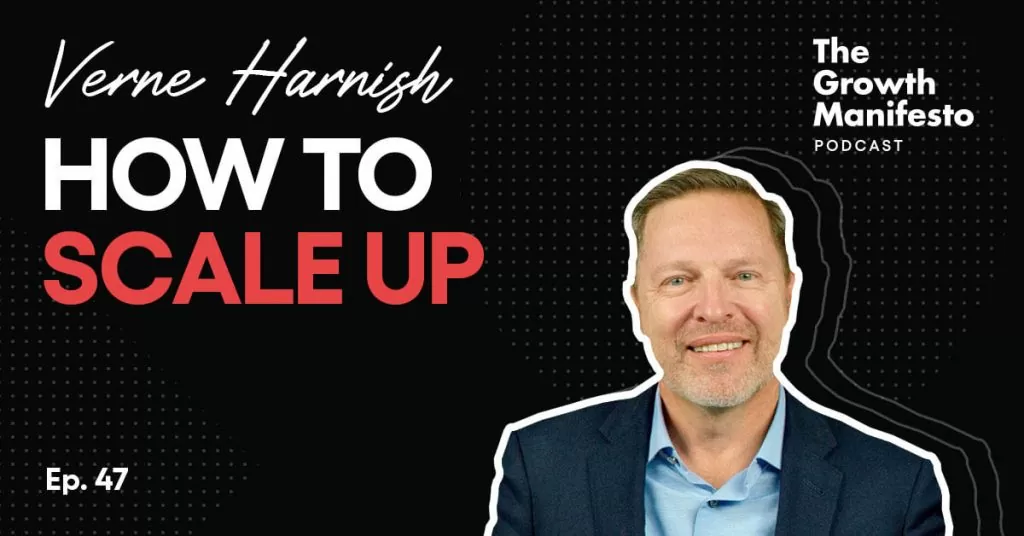
Scaling up with Verne Harnish
Verne Harnish shares pricing psychology, marketing-led growth and the reading habits of leaders who scale companies from a million to 100 million.
 with Verne Harnish


Overview
In this episode we talk with Verne Harnish about how to scale up a company in today’s world.
Key takeaways
- Reversing a wine list to put the most expensive bottle first is pure psychology, and one restaurant used it to lift revenue by 26 percent.
- Offering three pricing tiers instead of one, a good-better-best model, took Dell EMC's service contract revenue up 300 percent.
- Marketing, not sales, is the single most important function in scaling, because its job is finding the best customers and their real problem.
- Leaders who scale a company from 10 million to 100 million share one trait: they read constantly, like Bill Gates' twice-yearly think week.
- The ideal team size stays around four to five people, because adding a sixth or seventh member drives productivity down and costs up.
Chapters
About the guest
Transcript
Auto-generated from the episode audio, so expect the odd mis-heard word. Timestamps open the video at that point.
To me, this is the number one trick that you are, you've got this hunger and thirst to learn. It was even that way with Elon Musk. He's like, all right, I want to go to the moon. I want to go to Mars. So he reads these books on making rockets. And as the story goes, the guy that wrote the book, then Elon reaches out to him. And this guy is like, he's literally a rocket scientist. He's like, I can't believe that this entrepreneur is actually, you know, picking my brain and talking to me and all of that.
Elon, like Mark Cuban, Mark said, I won in the IT space because I was willing to read the manual and nobody else would. And then I just started implementing all those new technologies. You know, Elon just read a book about how you do rockets. So it comes back to learning. You're listening to the Growth Manifesto podcast, a Zoom video series focusing on what it takes to drive growth in today's competitive business environment. Brought to you by Web Profits, a digital growth consultancy that helps global and national businesses attract, acquire and retain customers through digital marketing.
In this episode, we talk with Vern Harnish about how to scale up a company in today's world. So let's get into it. today we're talking with verne harnie she's the author of two books the first book is mastering the rockefeller habits the second book is scaling up he's the founder and ceo of scaling up a gazelle's company and he's the founder of the entrepreneurs organization today we'll be talking about how to scale up a company how a few companies make it and the rest don't and just quickly before
we get started make sure to go ahead and hit that subscribe button so that you get the latest episodes as soon as they're released. Now let's get into it. Welcome, Vern. Well, glad to be here, Alex. And you know what, let's, you and I were talking, let's just hit a topic right away and that's pricing. You know, one of the ones that I think business owners never focus enough on is price. We're so, you know, hung up on the cost side of the business. And we have for 50 years because there was actually more demand than supply. And so look, if you just kind of showed up. You got the business, but now there's more demand. I mean, there was more supply
than demand. Now there's more demand and all the unicorns people are always talking about, all right, how did these companies get to a billion, you know, in about half the time it used to take. And one of the things that's unique is they're all focused more on the demand side, Alex, than they are on the supply side. They don't actually supply anything. And it's their deep understanding of the demand side, the customer's need, where they were just before they're about to buy your product. And they use that knowledge in order to set price. So if you look at the
wealthiest guy on the planet next to Putin, Jeff Bezos or Elon Musk, who's right up there right now, price is changing by the minute. My book has varied in price from like $16 and change to, It's sitting at a ridiculous $23 right now, and it's a paperback, but there's such demand that they know that they can actually command that. And so we've really been encouraging business leaders to really focus instead of just licking their finger and putting it to the wind and get more focus on the price side.
And the reason we get it wrong is because we're selling to people, even in a business to business. We're selling to people. And guess what we've learned? People are not logical. They're psychological. And so I've got a couple of stories and resources, but let me let you jump in there. Oh, no, no, no. Please. Let's start with the stories. Let's start with the stories straight up because I've got a few questions, but I want to hear this story first. Yeah. So, you know, the godfather of influence, Robert Cialdini, and I do hope all of your listeners and watchers have read his book, Influence, these six ways that you actually
influence anyone to do anything. And they looked at a wine list at a typical restaurant. I was down in Lyon, Mexico a couple of months ago out to lunch with one of our clients and they gave us a wine list. And sure enough, it was listed from least expensive to most expensive wine. And what Robert found is all you had to do is reverse the list and put the most expensive at the top and the least expensive. And revenue would jump on average about 26 percent. You didn't change a wine. You didn't change a price.
And then if you anchored that with two or three really expensive bottles of wine, you could pull Alex revenue up like 250 percent. It's it's not logical. And so just before this crisis hit, I was in Shanghai again. I go I go to China once a year. And a year ago, we launched this book in Mandarin. and my day chair was a guy named Adrian Wall. And we can talk about how you need to state
your strategy simply. He's got a very simple strategy, a taste of New York in Shanghai. And so he's gone to New York City and made friends of these iconic families that have these iconic single brands like Joe's Pizza, where there'll be a line out the door even right now because of takeout. And he convinced him to let him bring these iconic brands to China. And so the first he did was Joe's Pizza. And so the year before I had mentioned this pricing
thing. So when I saw him about a year ago, he said, I got to take you down to the pizza restaurant. I said, all right. And he says, you've got to look at the menu. He said, we used to list it from least expensive vegan to most expensive meat lovers. And he said, all I did was reverse the list as you suggested, as Robert Cialdini would. And we didn't get 26%, but we got a 15% boost in revenue. Didn't change a slice, didn't change a price. And that's how psychological it is. If we
look at business to business, two years ago, and I'd encourage everyone to Google it, I'm sure you can send the link out. Harvard Business Review had a really stunning piece on pricing called Good, Better, Best. And that was really focused on business to business. And as you read through all of the detail, you find as you get down to the end that Dell EMC, now called Dell Technologies, when they went from a single price in terms of a service after sale contract to a good, better,
best, revenue only jumped 300%. And so we went to that in the crisis when we launched our virtual summits, we said, let's not go to a single price, which we normally had. Let's do a good, better, best. And by the way, the difference between good and best was 10x. And it was amazing the psychology that we learned and the revenue that we generated by being just that much more sophisticated. One last example, we have an e-commerce client that in 2019 generated about
8 million in EBITDA last year in 2020 by just getting more sophisticated around pricing. We actually brought in Herman Simon's firm, Simon Kutcher. They were able to, and we caused them to shred literally 2 million catalogs. They were getting ready to go out in four days. We said, look, this will be suicidal. Shred those catalogs, move your pricing online. And their EBITDA only increased from $8 million to $40 million, a five-fold increase in profitability just by getting
price right. So I beg folks to get focused on it. So where does this fit into the four areas which you talk about in your book, right? Because you've got people, strategy, execution, and cash. Does this fit into strategy or does this fit into execution? It does. No, no, you're right. It's It's strategy because our view is marketing strategy equals strategy. And in fact, most founder CEOs are the default chief marketing officer of their company,
like Steve Jobs was for Apple. And if you have a CMO, they're really there to kind of sit side by side with you, because what's more important in the four P's of marketing? Product, price, place, and promotion. And if you look at those four Ps, three of those, you've got to spend money before you make money. But with price, and you add a dollar to the price, and in general, that'll go right to the bottom line. And it makes you money immediately. So good, better, best is what you see on all the software company sites, right?
You've got the three options. Education is another one that you constantly see. does the better option pretty much always sell the most because you don't want the most expensive, but you don't want the cheapest. So is that what you found personally or across the companies which you've analyzed? You know, it was interesting in terms of our revenue, there was an equal amount of best and better. And that was some of the things that we learned as we were watching some of our pricing matrices. So I don't think there's a fixed rule there.
There is something about obviously the anchoring by having that higher price, but where it really plays out, we're big fans of Northwestern University professor Victoria Medbeck. She, our view is the best professor, teacher of negotiation. She has some small clients like Goldman Sachs and others. And one of the things that she really teaches is in a practical sense, B2B, we're often asked for a proposal. Even if we have an existing client, it may be the five-year
renewal. We'd like you to resubmit. And you know, they're going to go out and get some other counter proposals just to kind of keep you honest. And what's fearful if it's competitive is that you've got these ankle biters, you know, these low bidders that don't want to come in, steal the relationship and you know what's going to happen. Once they're in, they're going to start jacking up the price or the customer is going to suffer. So how do you play this game? And she recommends that you, and we've won so many contracts using this technique. She says, you always submit three
bits, even if it's an existing customer, if you think it's competitive at all. And what you do is you vary the price based on your strength, your difference. So let's say it's response timers, design, or the customer service, or inventory turns, or whatever it is, speed. Whatever that difference is, what you want to do is you want to shine a spotlight on it and vary price around it. So you want to submit a proposal that matches what you think is going to be the lowball proposal,
And then you detail what all they're not going to get. Because one of Cialdini's principles is more to avoid a loss than to get a gain. Hey, we can offer you this price, but you're not going to get same day. You're not going to get customer service, but FAQs. You're not going to get a turnaround of a design, but maybe for two weeks, you're not going to. Then you say for this price, maybe it's the better price, you'll get next day response, next day terms, next day design.
But if you want it in two hours, and this is where data is helpful. And you can say in the last five years that we've worked with your firm, your people have required a two hour response in order to serve your customers 86% of the time. If you still want that, this is what the price is going to be. And now a couple of things happen. If you submit three bids, you get it out of the hands of the purchasing agents because they don't know what to do with this. And so they're going to escalate it. And you always want your deal escalated inside the organization.
Number two, you're going to get them to start to question the low bidders. Wait a second. you didn't mention anything about this laundry list of other stuff. And you know, they haven't, they're just hoping it doesn't get brought up. And so you cause those conversations to occur. And then number three, if they go ahead and go with the low bidder, you know what it tells you, they don't value the difference you bring to the marketplace. So go find customers who do. and you don't want all the customers anyway, but the most major companies in the world only have
seven, eight, 9%. Apple at 2 trillion only has 14% global market share. 86% of folks still don't get their phones. So, and other devices. So go after the customers who value what you bring to the table and use pricing to really sort that out. That's genius. First of all, I have been in business for a long time and I've never heard that for a proposal strategy because it's always the case where you know they're going to be bidding less than you and they're going to be
offering a lower service in terms of the features and the quality of the service and the support and so on and yet you're kind of always stuck trying to guess and so how would you because I obviously have like a bunch of questions but I'm super interested in this topic at the moment but how would you approach pricing it so that the range between them is sufficient enough to be able to win the deal? Well, it depends on the industry, but the range isn't as much as you would think.
They say you can generally premium price by about 13% without really having to justify much more than that. But that's when you're kind of comparing apples to apples. If you've got just that little bit better, but we've seen where, look, they're going to go with you and you're twice the price, but it's clear that the value is 4X because you've really laid it out clearly. And that leads to another topic, if I can. And that's around the complex sale. We just launched a
masterclass with Jeff Toole around mastering the complex sale. And the reality is all sales have become complex in this environment. And what it suggests is, you know, sales 1.0 was you show up and throw up. It was the old talking brochure. Sales 2.0 was my dear friend, Neil Rackham's spin selling, where you went in with some very intelligent questions and you kind of dug under the, you know, got under the hood and helped them really see that this massive problem you've got is
this costly. And so our price relative to that is a great value. But Jeff really suggests that we're now in sales 3.0, which is, look, they don't have any time and they probably are clueless to all the problems that they're suffering because they don't have your product or service or the quality of your product or service. So you actually have to know more about the problem and its cost to them than they even know. Asking them a bunch of silly questions when they're clueless is just
frustrating. And that's where I want to come back to it. The single most important function in scaling is marketing. If you had to throw all the others out, it's first and foremost marketing. And marketing is not glorified sales support. Marketing's job is to go figure out what are the best customers, who's got all the money, and what is the data behind the problem that we can solve. And we want to walk into that client and we want to present that in a way that they're like, you seem to know more about us than we do.
and as a result that's how you really gain trust and they know that hey i guarantee you if you know that much already about us you're going to solve our problem so that's really sales 3.0 that requires really strong marketing support and that's um sounds similar to account-based marketing you know whereas there's a focus on a specific large organization and they're a focus it seems like it's similar to that, the level of research that's required to be able to present a simple
message, right? And so when you talk about marketing, you're talking about the research to the point of starting the promotion, but as well as the promotion itself. But the majority of that time is spent on the research, isn't it? It is. To get it right. Yeah. And figuring out who is the right customer and who should we target. And it is an analytical function. That's why we believe there's no such thing as a VP of sales and marketing. When we run into a client and they say that they've got this human, we know right there is an issue.
Because I've not seen one human be able to do both of sales and marketing well, because there are two different personality types and two different skill sets. Yeah, right. Yeah, right. So many questions for you now, Vern. you got me started now um when should a company then like even start considering pricing strategy like is that at a certain stage of growth like but in the beginning trying to figure stuff out
you hit the one million dollars annual then you got something at 10 million you've got now like an operation like at what point should pricing strategy start yeah well you know it's easy to say at the very beginning. But look, that's this idea that what got you here won't get you there. In the beginning, you're going to just do whatever you can to get to that first million in revenue. You just got to sell like hell. And we know that you may have had to get into the market by being
the low ball price or by giving it away, just getting a foot in the door. I mean, we can use every cliche in the book. The challenge is when you do cross that chasm, you forget to lose those bad habits. And you continue to think that you have to be the low price competitor in the marketplace while as you scale, you're piling on all these other costs. And so what ends up really happening is your gross margins get squeezed. So you may have the revenue, but your margins gone. And
And that's a death knell. There's a number you got to watch closer than anything else. It's gross margin. And because it's in the middle of financial statements, it tends to get ignored by most CEOs and executive teams. So it's when you have finally figured out after selling to every customer that you think will buy it, who's going to be your easiest, next best customer from a margin perspective and enthusiasm to buy your product or service.
And then you begin to laser focus on that core customer. And now you can begin to play with pricing. But think about it again. these unicorns let's take uber or lyft you know a regular taxi is going to charge you the same per eighth of a mile it may have a night charge or an airport charge but it's pretty much the same uber and lyft they're demand-based pricing you know they i remember a year ago you could get a
cheap fare down to denver from boulder but it was 235 if you want to get back they knew you needed to get home. And even if you drove down, you've left your car and you got to get back and they're going to charge you for it. And it's like the airlines. The seats used to be all the same price. Now, if you're on an airplane, I guarantee you no two people paid the same price for what's essentially exactly the same product. A seat on that time, on that airplane, heading from point
A to point B. And I think all of us have got to get more sophisticated and be a more demand-based pricing instead of fixed pricing. Yeah. And before you spoke about to focus on the gross margin and kind of how important the selection of customers are. And I think it was Michael Porter and his book, Competitive Strategy, that spoke about this in so much detail about to know the place that you can compete where customers are going to pay you an amount of money that will allow you to
compete and to scale faster you know and so it's really interesting that process of trying to identify that because now you have to choose and again it comes back to research again you know like again is to research it's basically the the data and that's something which you speak about quite a lot is to have that data, is to have that information to guide the company forward. Yeah. And you need just not quantitative data, you need qualitative data. One of the areas that
we really push our clients is to literally on a daily and weekly basis, do what you should be doing, which is that market facing activities of talking to customers, talk to employees and shopping competitors. What Sam Walton did in his pickup truck and later his airplane as he was scaling up Walmart. And Sanjeev Mahanti, you know, it's a story we've shared in the book. Sanjeev was given a job of leading Benetton in India, already, you know, a brand that hasn't
been doing well. And it was really bad in his country. He had 104 stores and he's competing with Levi Strauss, the number one fashion brand in the whole country. And so Sanjit came in and said, all right, I want to displace Levi Strauss. Now, this is a crazy notion because it's kind of this specialty brand that's going to take on this general brand. But then he called us, you know, send us a box of books, come on in, Vern. And the key thing we did is I recognized that he and his
team had really lost, had no contact, no sense of what was really happening in the marketplace. and what was going on in his 104 stores. And so he put a card together at each cash register, had his picture on it. It said, look, if you have any problem, concern, idea, complaint, suggestion, email me. And here's his email address. And it was meant as much for the employees as it was the customers. And to a surprise, he was starting to get like 200 a day. Now he's got, you know, tens of, you know,
hundreds of thousands of customers going through, but, you know, he's getting 200 a day. So we really did three things that I thought were key. First, put a team together to look at all of those. Obviously, you want to respond to them. Number two, he looked at the subject lines of every one of those emails coming in. It's like Warren Buffett reading the headlines of the newspapers around the world each morning to give him a feel for what was the psychology of the market. But Sanjeev started to get a real feel for what was dynamically going on every day within his stores, depending on which store and employees or customers.
So then, number three, he would choose one that caught his attention. And he would email the person and say, hey, can we have a phone conversation? And look, most folks, to have a chance to talk to the CEO of kind of any company that's a brand, you know, is going to relish that. And one of my favorite stories, it was a Saturday and the subject line is acid wash jeans falling apart. Well, obviously that caught his attention and he sees it's from like one of the top ministers of the country.
So it's like, hey, there's an opportunity for me to kind of reach out. And he does. And they have a great conversation. He built a relationship there and also discovered they must have had a manufacturing problem with that batch and got him pulled off the shelves quickly. But the long story short, he took that so-so brand and it became the number one fashion brand in India in less than 24 months. In fact, about a year ago, he won the Retail Icon Award in India.
Now, who'd this upset? Levi Strauss. So where is he today? Levi Strauss. They're like, all right, that's the guy that beat us. And so they hired him. And today he runs half the globe for Levi Strauss. I suspect he will be CEO possibly sometime in the future. First thing he did is he called me up, Vern, need a box of books. When can you get to Bangalore to train our team? And I was set to be there last April. But, you know, some things happened.
But it's that qualitative gathering of customer and employee input like Apple gets every day at their stores. And Roger Hardy did when he created the largest e-commerce deal in the history of Canada. That habit is so critical. And so for the complex deals, it's because they are often going to be the business to business sales. And so you need to get now in touch with more senior decision makers in a company to get like, and to interview them or to find a way to find out, you know, their challenges, their problems, you know, the things which they want.
Have you seen any kind of interesting approaches to get in front of them? Because they're probably being kind of hounded every day by every supplier that wants to sell to them. Have you ever like seen any interesting approaches there? Well, you know, here we're really talking about your existing customers. And so your existing customers, they're really open to having these conversations because particularly of what you provide them is mission critical. The key is in a business to business, even though you sell to one person, your product or service is probably impacting, you know, dozens, if not hundreds of people inside the organization.
And so I remember Raymond Roberts with a company called Citizen. They worked with seven large government agencies in Washington, D.C. So in a way, they felt like they had seven customers. But the first thing we did was we put a theme together called CSI, Customer Satisfaction Investigation. We use the theme of the crime series CSI. And they began calling 20 people inside every day, every day inside each of those government agencies that they felt were touched, you know, frontline employees and others that were touched by the technologies that they were building, including the citizens that they serve.
That's why the company was called Citizen. And it was crazy. a diet of that for 90 days. And at the time they were about, you know, 20 million in revenue, 15 million, 20. They were on their way to a hundred million. They didn't know if they could get there. After a diet of this for 90 days, they said, the big thing we learned is there's about $87 million of additional business that we could possibly get within our existing seven clients. We don't have to get an eighth, ninth, or 10th. And what a eyeopening experience that was. By the
that launched them and they were on their way to a hundred million and then had a chance to exit beautifully, which we love to see as well. So it's existing customers. I don't, you've got to gather the intel in a different way if it's a prospect, because you're right. Otherwise you're going to get bugged a lot. So what if it is a prospect and you're trying to get into these kind of more complex sales and you want to give them your three pricing strategy approach just in case, like it's off, right? How would you approach prospective companies?
Yeah. You know, it's interesting. You can intuit a lot of stuff by looking at their job postings on LinkedIn and other data scraping. So I think in Galveston, Neumann in Barcelona, you know, they're an SEM shop. And how many SEM firms are there? Like one on every street corner. Exactly. They decided first they wanted to be the luxury in that space. And first they do everything different. They only hire PhDs in physics and mathematics. They're bringing a quant, like a Wall Street quant approach to the SCM space, which means that they don't maximize
10,000 or a hundred thousand keywords. They'll maximize upwards of a million plus. And so what they do before they go into like cars.com, which I can tell you, you know, they land at a $4 million a month account and they want it on their first meeting. They were up against 23 other competitors. They won it on their first meeting. They go out and they scrape the internet for what they're already doing in SEM and intuiting the results they must be getting and the traffic they're getting and all of that data analytics.
And they walk in with a report this big that shows the tens of millions that they're spilling because they're not maximizing enough. And then they do some simulations and show what could be. And I'm telling you, they know more. And what they've learned is they can only go after clients that spend between two and eight million a month. If it's more than that, then the company thinks they're smarter than them and they get embarrassed by the information.
If it's less than two million, it's not enough keywords for them to really work their magic. So they've even learned what is their ideal core customer in this process. But that's kind of the backdoor way that you gather this intel. The other one is through your sales teams. It's amazing. One of the questions that we encourage salespeople to ask when they're out on a customer call or talking to customers or even in your own team is, what do you hear about our competitors? and I remember I'm calling Bill Ritchie one day a client of ours and good friend and I'm you know
just checking in with him I try to call one customer every week and I'm like so Bill what are you hearing from our competitors and he goes well Vern it's interesting you ask I got this proposal in from and it's amazing how if you can find people that do business with the company that you want to go pitch, often they can give you real insights into that organization. So there's different ways that you can get a kind of, remember, all wars and all markets are won through
Intel. Whoever has the best Intel wins. And that's what we're talking about here. that's great that's great um such a good point um thank you for that like i do want to come back to your point before about um when you go from zero to one and from one to ten and from ten to a hundred plus you need to shed the old habits the things that got you to that stage they're not going to get you to the next stage and so what are the key stages let's start with that and then
the habits that people need to shed. Yeah. It's interesting. It's less revenue, though there's a correlation versus number of employees. And so, 76% of the companies in the US, and I think those numbers are mirrored in other parts of the world. 76% of the companies in the United States are run by the lone entrepreneur. They don't even have a second an employee. They're a solopreneur. And we like to kid some of those companies are even overstaffed.
In other words, they ought to just go out of business and get a job. But that's the bulk of companies. Then you get up to kind of about 10, which generally is a million in revenue, what it takes for you to get into EO, the entrepreneur's organization. And what's interesting is between zero and a million. If you look at the four key numbers, revenue, gross margin, profit, and cash, you know, I often ask audiences between zero and a million, which one
of those four is most important? And a lot of them guess cash because, you know, you're always cash strapped, but not really. It's revenue. You just got to piece together as many deals as you can to get some momentum, to get off the launch pad. And cash, are you kidding? You know, hopefully one of your partners keeps your day job or you're married to somebody who's still working or you've borrowed from friends, families, and fools or whatever the case is, you're just going to try to piece it together, hold it together, tape it together
until you get to a million. So revenue is sell like hell is the thing. From a million then to 10 million, The next one that kicks in is actually cash because growth sucks cash. A million to 10 is 10Xing. And for you to 10X again, you got to go from 10 million to 100 million. And that gets you into a rarefied space. So the million to 10 is when you really want to figure out your cash model. How are we actually going to fuel this thing? through customer deposits or Costco, through membership fees or advanced deposits or, you know,
our SaaS offering, we're collecting the entire monthly, a year in advance. You know, how are you going to go about, or you get deep pockets like John Ratliff did with his bank in order to grow through acquisition. So, but you're expected between a million and 10 to figure out the cash flow model. Then from 10 million to 50 million, the focus is gross margin. Because as I mentioned, about 10 million or 50 employees, and you know, everybody's name. Once you start getting above about 50, it gets crazy. And you start piling on costs, and you got some middle management. And
now you're getting price pressure, because you've proven that there's this market for what you do. And now competitors are coming in, and your margins really start to get squeezed. And by the way they squeeze about 4%. So if you're getting, if you're running 53% gross margin, it drops to 49. It doesn't seem like much, but 4% of 10 million is 400,000. And that's the money that you need for the better computer system or to get a upgraded CFO or bring in some more talent in
general or training and development or better office space. And you need that in at 50 million, that's an extra 2 million, the bottom line. So what we like to see is really push companies to get an extra 4% gross margin, a lot of it through pricing and clever pricing strategies instead of lose that 4%. So it's an 8% that is real money. And then at 50 million, not that profit hasn't been important all along, it sure wasn't important at Amazon for a long time. But where you earn,
we like to say the medium bucks, is creating a consistent profitability. By $50 million, you're expected to have this thing so figured out that you can create a consistent profitability in a wildly inconsistent market or world like what we've just experienced. And that's when you know that you have a deep understanding and control of the business that you're running. So revenue, then cash then gross margin and then profit in terms of focus and those are just some of the
things that change the evolutions and revolutions as the organization scales super interesting i like your pricing strategy point of you can get it through pricing strategy because i think the first thing that people would think about is we'll have to change something in terms of how we operate what you just said just before is with more sophisticated pricing um you can actually just get that increasing gross margin like immediately um just by being able to present price like in a way that robert cialdini suggested you know yeah to give them the option that's really interesting
um the other place the other place is then on process the other the other issue with scale-ups that we deal with is they get so focused on trying to get these great running functions. You know, we've finally got a well-oiled marketing machine and sales and operations and HR and IT and finance. But what they don't realize is that's not how the customer experiences the company. The way it's experienced is through processes that cut across those functions.
And I have to say that as entrepreneurs, we're sloppy. And in the first place we're sloppy is we have a tendency just to throw bodies at the problem. We just throw people at it. And as a result, that's why our gross margins get crushed and the complexity goes up. So I'll tell you a quick story there. So Ken Sim, who ran for mayor of Vancouver, lost by a thousand votes. My buddy Kevin Dom, who I was just on with, has been coaching him and he's going to go
back at it again and see if he can make up those 900 and some votes and become mayor. But he runs, founded a company called Nurse Next Door. It's one of our fastest growing franchises in North America. It's one of these businesses where you have an elderly parent. You'd rather have a nurse come to their home than put them in a nursing home. And so he's doubling in size. And at the point where he had like 28 employees at headquarters, had hundreds of nurses in the field, his head of payroll comes into his office.
And this is what happens to entrepreneurs every day. His head of payroll comes in and says, Ken, I'm buried. I'm trying to keep track of these hundreds of nurses and get their time cards in and get them paid. And I'm working 80 hour weeks and you want to double the company again in size. I need some help. Now, any rational CEO is just going to say, well, go get somebody, but not Ken. Ken goes, all right, let's bring in a lean consultant. And I'll give you a long story short. A year later, they doubled in size, any way you want to measure.
Yet their headcount dropped actually from 28 at headquarters to 23. They didn't fire anybody. They lost a couple through natural attrition happens when you're growing at that rate. And a couple others said, hey, I'm just going out in the field. and the great day was when there his payable clerk his payable head of payroll payroll comes in and says Ken not going to believe it but I can barely find 30 hours now to keep me busy what else can I work on and that's what you want they they literally were doing twice the work
in less than half the time it was a forex and it wasn't just in payroll they would struggle Alex and trying to bring on one new franchisee a month. Once they streamlined the process of doing that, they could bring on five a month without breaking a sweat. And so we literally have this much slop inside most of our organizations because we've just been throwing bodies and not cleaning out the closets, the hallway closets and garages, which is the analogy I use for process. You clean
the garage, you clean the closet, give it six months, it's junked up again. And you need a bigger closet, which is going to crush your gross margin or clean it out. And so that's why process improvement is critical. And I noticed that at the different stages of staff size, what it took to get to 1 million is different to what it takes to get to 10 million in terms of however you made it happen is messy. It's just messy. And then you get to a point when it doesn't work anymore and
you have to change because like it cannot support that size of revenue in terms of the older systems. And so there are key points that that happens. And is that at staff size? Is it like at 10 staff, 25 staff, at 50 staff, where you need to change how the staff are actually communicating with across the teams and the processes around it? Is that kind of what needs to happen, that there's certain shifts that happen at certain stages of growth?
It is. And a lot of it has to do with the team size. It's why Jeff Bezos, you know, often kids about the two-pizza team, but you really don't want a team getting bigger than what two pizzas can feed. We've learned that the ideal team size is about four to five people. And if you start to have that fifth, sixth, seventh, all it does is drive productivity down and costs up. And so those are the kind of things in organizational design and others that you want to be cognizant of.
And what's interesting is most folks haven't been educated around just these kind of fundamentals. And that's what you end up learning it the hard way is what happens. So, yeah, staff size is the size and the number of people really is a key driver of when you need to make certain changes. Let's jump to the people who lead these organizations. Yeah. But what are some of the characteristics of the leaders who succeed at scaling from 10 million to 100 million?
Yeah. Well, special individual usually. And it's a special team, obviously. But if the leader is not there, like it's like the founder leader or whatever. Right. Then things don't happen. And so what are some of the characteristics of those people who succeed? Um, we, you know, I don't, I can't say this is scientific at all, but what we've observed and we've actually now select based on it is first and foremost, they're learners. We've, you know, leaders are readers. You know, it was in my second book, uh, greatest business decisions. I,
I highlighted a very important routine of Bill Gates, which was his think week. You know, we have this tower of guilt like everyone else does. You know, these books that people send, you pile up and, you know, read this article, watch this YouTube video. It's just, it just flows in. I've already thrown a lot at your audience. And so Bill would twice a year go hide out for a week, 18 hours a day, seven days straight. He would plow through these PhD manuscripts, white papers, his teams would write on certain topics, books, articles. His record
was 112. He actually kept track of it, measured it. 112 books, manuscripts, PhD, theses, white papers. And it was out of those that came the key ideas that it continued to keep. And to me, this is the most important word that kept Bill and Microsoft relevant. And that's what you're trying to do is maintain relevancy to your marketplace, both as a leader and as a company providing products and services that are relevant to the current conditions. Eric Schmidt said the
key when Michael Milken asked him on stage and I'd shared the stage with him, how did you keep up with the Google boys? He said, I shut my Blackberry off and read a book or two. I don't know if you saw BlackBerry is coming back in terms of a stock price. So it's not even an antiquated example. Mark Cuban, who I just emailed and asked for kind of a favor, Mark, this crazy billionaire that we think may run for president of the United States and whatever. I've known him since his
early days running a little IT company in Dallas. And I didn't know until I read his book that since his 20s. He has read on average three hours every day. And all he's doing is looking for one idea that can help one of those 150 plus companies either owns or is invested in. Even Mark Zuckerberg, you know, picked up on Bill Gates' habit. And Bill's got his 50 books. He always puts out every year, book a week. Mark's did a book every two weeks. But it was Warren Buffett, you know, when on the 50th anniversary of Berkshire Hathaway, they asked his partner, Charlie Munger.
So Charlie, how's Warren done it? How did he crush the market by a factor of 10 for five decades? Now, his last decade hasn't been that great, but we'll see. And Charlie didn't hesitate a moment. He goes, it's because of Warren's, no matter advanced age, his number one priority on quiet reading and thinking time. And we think that's absolutely one of the most important key performance indicators of leaders within organizations.
So to me, this is the number one trick that you are you've got this hunger and thirst to learn. It was even that way with Elon Musk. He's like, all right, I want to go to the moon. I want to go to Mars. So he reads these books on making rockets. and as the story goes the guy that wrote the book then elon reaches out to him and this guy's like he literally a rocket scientist he's like i can't believe that this entrepreneur is actually you know picking my brain and talking to me and all of that elon like like mark cuban mark said
i i won in the it space because i was willing to read the manual and nobody else would and then i just started implementing all those new technologies, you know, Elon just read a book about how you do rockets. So it comes back to learning. So learning is the key point there. Because no, as in, like, because I was thinking, oh, there must be other characteristics. But I guess if you are, I'm sure there are. But I think that if you are continuing to learn, you're continuing
to grow you and you're opening up the context of the thinking that is brought to the table every day. And as long as you take action, which I think people who read a lot of these types of books do, that's the key because it's the fact that people have to change actually who they are at certain stages of their growth. And it's hard to just do it. It's so much easier to have other kind of external inputs kind of help you to get there. So I think that's a fabulous point.
I would add, so when Scott Fuqua endorsed my book, Atlassian, you know, and Mike and Scott, they were in my first workshop I ever hosted in Sydney in 2005. Back then they only had 50 employees, if you can imagine. And today, 3,500, unless I check market cap of 56 billion on the way to keep touching 60 billion now. You know, the guys still own 75% of the company. You guys know that story better than anybody in Australia. But when he endorsed the back of the book, he said,
really, the two key characteristics were discipline. So you really have to be disciplined and focus. And there's, they seem to be such trite concepts and generalistic concepts, But that's what we really unpacked in that first book, Mastering the Rockefeller Habits. I really saw John D. Rockefeller, the wealthiest guy in the history of the planet still today, in measure of percent GDP.
First and foremost, being an accountant by training, he was super disciplined. And then it's this ability to know not the 10, not the five, but the one thing. The one thing. Get done today. I mean, literally the one thing you got to get done this week, the sprint, if you would, that drives Silicon Valley. And ultimately, what's the one thing you want to get done in the next 10 years of not your life? And that discipline and focus tied to a thirst for learning, I mean, makes for a nice combination.
Yeah, I mean, I would agree with that. Sometimes it is hard to focus. I'm sure that everybody knows that, especially in the world that we live in today. Let's talk about that world quickly just before we wrap up. In today's world, which is full of uncertainty and which is full of challenges and where there is change happening in how consumers are spending and buying and what they are finding important and there's so much changing. but what advice would you give to companies that are trying to figure out the best approach right
now the best thing to do right now to set themselves up for the next two to five years depending on you know how long this thing goes for yeah well we have a tool for doing that that we've actually been taking you know hundreds of companies through and it's a tool i developed called the SWAT. Everybody knows the SWAT, strength, weakness, opportunities, and threats. And that's good for middle management to look at when you're trying to just fine-tune your own company and your own industry. But in this case, you often have to build or rebuild the
whole firm. And I use the analogy of building. And I thought it was interesting at the beginning of this crisis, Andreessen Horowitz, the number one VC in the world, said, Mark came out with a blog and says, it's time to build. And in fact, they changed. I just noticed it recently. Andresen Horowitz has changed the tagline of their company to it's time to build. And so if you're going to build something physically, a building,
there are two things that are critical. You got to get the peers down to bedrock. You got to really know what is solid foundation. Got to build it on that. And then you got to get the roof on as quick as possible. And once those two things exist, you can kind of take your time if you need to, to build out the interior. And the equivalent of that is what we call the sweat, your core strengths. What is it you're really good at? And then by understanding that, then you know how to pivot. And number two, what are your core weaknesses so that you avoid going
and doing stupid stuff? It may look great, but you have no competency around it. That's the foundation upon which you have to build the future plan. And then what's the equivalent of the roof? It's what we call the trends. All right, where are the trends? Not in your industry, but in general. And then you want to match your core competencies to those trends and say, all right, now, what's the real opportunity that's available? And so that's really an exercise that we've been taking, again, hundreds of companies through to great success.
It does. Yeah, that's great. And so where can people find that information? um so what um you can go to scaling up.com yeah and the name of the book and you're going to see a picture of the book right in the banner and next to it are some free links there's free chapters our barriers chapter a chapter on how to do strategic planning with the sample one-page strategic plan and you're going to see a link to the growth tools and there are 19 languages uh just click on that you do have to kind of give us your name and stuff so we can track it but it's
free in all those languages. And you're going to see the sweat and our other tools that we're well known for right there in a packet that you can use for free. We're an open source company. Yeah. And fantastic information. I can highly attest to. With the change happening right now, not everybody can win. That's just how it goes in competition in business. And so what are going to be the characteristics of the companies that win? well first i want to i want to it's first they have a mentality of winning versus playing not
to lose you want to continue to play to win and by the way we've all seen it with our favorite sports teams you know here they've got a significant lead and then what do they do they start playing prevent defense they change their game and they get slaughtered they end up losing that soccer match or whatever it might be at the very end. So you've got to continue to play to win. So that's number one. Number two, I do think we need to keep all this in perspective. You know, the global GDP was only about 34 trillion in the year 2000. That was just 20 years ago.
um the 2019 it was 88 trillion it was on its way to tripling and even if it were to collapse by 25 and it hasn't anywhere in the world you're still looking at a gdp that's twice what it was just 20 years ago it's there's so much business to be had that i think it's only those who give up uh and that's why this ability to persevere if you want to add one of those characteristics to
the people because bad stuff always happens always and it's the folks that are always always that's the one that's the one consistent in business i can one i can definitely say that yeah and so we got a friend right now going through it and if if she doesn't get like 150 grand by tonight and we're all like, you know, scrambling to help her out. But she's going to get it done because that's who she is as an entrepreneur. Now, what do you, and to me,
the folks that are getting through this, and it's a piece of advice that I still think we're practicing because really, I don't even know if Stumpy's might have to close tonight because of something that happens that the governor announces. I mean, that's how crazy the world we are in. And Stumpy's for the people who didn't hear the pre-show chat is? I've taken my daughter to a properly named place called Stumpy's owned by an EO Philly member where you do axe throwing. Okay, cool. Otherwise, that would have been a strange
example, like in all the other examples. Down in all the Stumpy's. My daddy-daughter day, we're going to go through axes tonight. Awesome. But but anyway, what we've and I think it's a good practice anyway. And that is to just be clear, everybody in the company, including yourself, what is the number one thing I have to get done just in the next hour? Like for me, it was like, all right. And I literally look at my day that way in terms of chunks of hours.
and then said, I just have to get this across the finish line in the next hour. And then I got to get this across the finish line in the next hour. And then I'm going to look up and see what the heck has happened next. And then I'll decide the next hour. So that's number one. And then number two, and Susan David, we had on one of our virtual summits, she made a really strong point that most of us are suffering PTSD and we don't even realize it. We have been shell-shocked. And she gave me kind of a quick test. And sure enough, I was suffering some of the symptoms of PTSD and around
sleep and all kinds of stuff. And she said very specifically how you can deal with that is pick three times in the day. It's best if you can just make it a routine and do something fun for yourself. So I have this dirty little secret. I actually like to play solitaire. So I literally have given myself permission when I got done with that hour of accomplishment to just take a break and play a couple of games of solitaire.
I know you're a piano player. I can take you around the corner. I got my keyboard right over here. Sit down and play something. Right now I'm learning salsa. And so I'll get up and I'll practice a little bit. And doing just something for yourself two or three times during the day really allows you to kind of push through all of this pain. So I'm being very literal about this process.
And who explained a little bit to us was Nate, one of the co-founders of Airbnb. They described how, you know, when this crisis hit, they lost a billion bucks like overnight cancellations. And so the first thing they did is they all went into, and our competitors don't teach this, and it drives me crazy. They went into the daily huddle. You know, that routine, and many companies in the crisis went to twice a day. Their senior team met every day, seven days a week. And that was the key, they said, to be able to get through all that.
And as you know, about a month and a half ago, they went public very successfully. yeah and that daily huddle i mean you know like i said at the very start um that the book actually has influenced the success of web profits um we've had the daily huddle since we attended your conference in like heart or something 2007 or 8 and every day since then and it's helped us except for weekends you know like we're not doing weekends um but every weekday and it's been super super helpful but just to summarize the first part um to win like in this challenging environment is
to play to win um the second part is to complete stuff you know just to complete something constantly the third is to reward yourself because there's enough stress out there anyway and it's something to look forward to um and i think what's what's what's been interesting is that the world's continuing the world hasn't just stopped and just like your point about the gdp that's really fascinating. Like the money's still there. It may be changing, like kind of how it's being spent or produced, but it's still there.
You got it. Yeah. Yeah. And we've got more people continually coming into the middle market around the planet. Um, yeah, right now we only have about 4.2 billion of the 7.7 billion. We still have, you know, we can still have three and a half billion worth of people yet to bring into the middle class, which just, you know, opens up an increasing pie for everybody. I think that's the, that's the great news. Vern, that's a fantastic point to finish on. Thank you so much for coming on to the podcast
today. For the people that are listening, check out that website that we spoke about earlier, subscribe to get all the tools. His content is fantastic. It does change companies in terms of how they operate. I mean, I'm sure you've heard about him, but if not, you should purchase the books. They're fantastic. And they're highly recommended. I can't speak highly enough of you. Thank you so much for coming on the podcast, Vern. It's been a pleasure. Alex, thank you so much. Fantastic, mate. See you later. Bye. Thanks for listening to the Growth Manifesto podcast. If you enjoyed the episode,
please give us a five-star rating on iTunes. For more episodes, please visit growthmanifesto.com forward slash podcast. And if you need help driving growth for your company, please get in touch with us at webprofits.io.