Leadership and culturePersonal growth
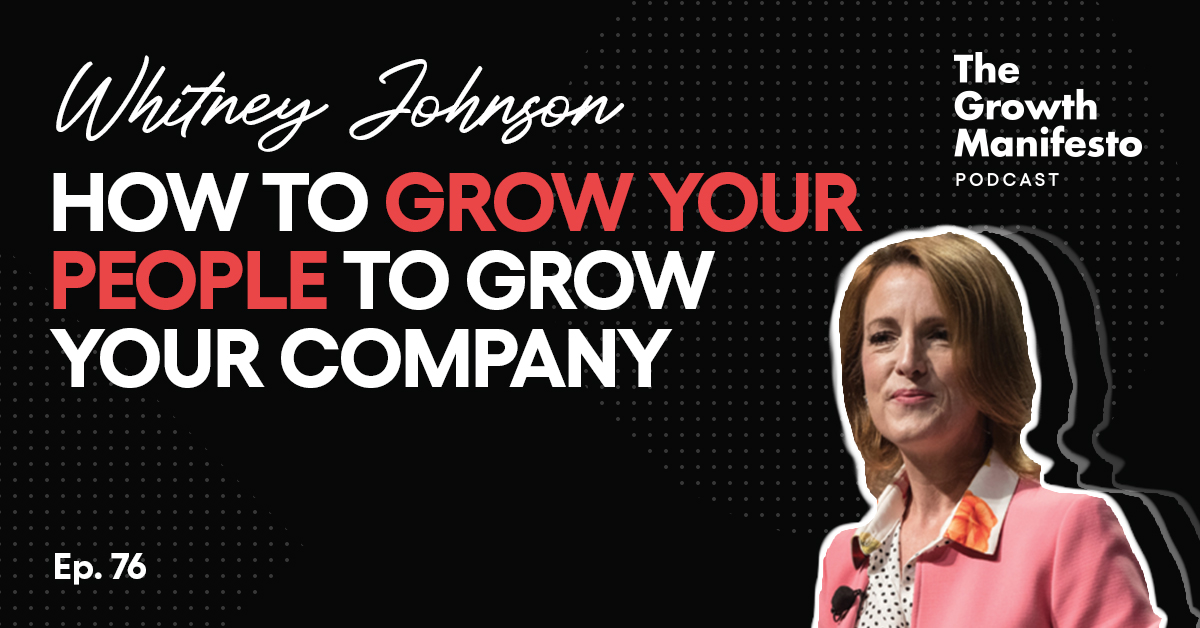
How to grow your people to grow your company
Whitney Johnson maps the S-curve of growth, from the great aspiration to the ideal 60-20-20 team balance for keeping people engaged.
 with Whitney Johnson


Overview
This episode is with Whitney Johnson – CEO of Disruption Advisors and one of the 10 leading business thinkers in the world as named by Thinkers50. She’s an award-winning author, a world-class keynote speaker, and an executive coach and advisor to CEOs. In this episode we talk about the concepts in her latest book – Smart Growth: How to grow your people to grow your company. Find out how the S-Curve applied to the people in your team can help keep them fully engaged, improve employee retention, and ultimately drive company growth.
Key takeaways
- What looks like the great resignation is really the great aspiration, because a period of severe stress often triggers post-traumatic growth in people.
- Growth follows an S-curve that feels slow at the launch point, fast in the sweet spot, then slow again in mastery.
- A healthy team keeps about 60% of people in the sweet spot, with no more than 20% at the launch point and 20% in mastery.
- Gary Ridge stayed in his sweet spot for 20 years as CEO of WD-40, growing its market cap from $250 million to $3 billion.
- Setting ridiculously small daily goals, like five minutes of exercise, spikes the dopamine that builds momentum at the launch point of any new S-curve.
Chapters
About the guest
Transcript
Auto-generated from the episode audio, so expect the odd mis-heard word. Timestamps open the video at that point.
What I believe is happening is people are looking at their life. They're saying, I want more. I want something different. I want something better. They're aspiring to more. So it's the motivation. It's not the great resignation. It's the great aspiration. You're listening to the Growth Manifesto podcast, where we host in-depth interviews with business leaders, authors, industry experts, and entrepreneurs with a singular focus around business growth. At the end of each podcast, we want you to walk away inspired, to think bigger, and to have actionable takeaways you can apply to improve your business.
Each episode is like a masterclass on a key topic. So make sure to browse the episodes to find the topics that are most relevant to your biggest business challenges today. This podcast is brought to you by Web Profits, a digital growth consultancy that helps challenge your brands drive growth in a complex and fragmented digital landscape. You can find out more about Web Profits at webprofits.io. Now, let's get into it. This is Alex Kleanthus, and today we're talking with Whitney Johnson.
She's the CEO of Disruption Advisors, and she's one of the 10 leading business thinkers in the world, as named by Thinkers50. She's an award-winning author. She's a world-class keynote speaker, and she's an executive coach and advisor to CEOs. Today, we'll be talking about the concepts in her latest book, Smart Growth. growth, how to grow your people, to grow your company. And just quickly before we get started, make sure to go ahead and hit that subscribe button. So you get the latest episodes as soon as they're released. Let's get into it. Hey, Whitney, and welcome. Hi, Alex. It's nice to
be here. And I'm realizing I need to do that too and invite people to hit the subscribe button. So good for you because then people probably do what you tell them to do. Well, we hope that, right? But sometimes it's just a reminder. Some people just watch content And they may miss that on the awesome content that we produce in the future. Hint, hint, nudge, nudge. Anyway, look, let's get straight into it. And let's talk about smart growth. And so where did you get the idea for smart growth? I had written two prior books in the series, Disrupt Yourself and Build an A-Team. And in both of those books, I had talked about something called the S-curve of learning.
And the history behind that is many of you, many of your listeners will be familiar with the S-curve. It was popularized by the sociologist Everett Rogers back in the 50s and 60s. And we used it at the Disruptive Innovation Fund that I co-founded with Clayton Christensen to figure out how quickly an innovation would be adopted. At the base of the S, the growth is slow until a tipping point is reached or the knee of the curve and you go into hyper growth, and then you reach saturation with a product or a service, et cetera. Well, the idea that came for me is that in both Disrupt Yourself and Build an A-Team,
I used the S curve, but it was always a supporting actor, a backup singer, if you will. But as I talked to people, whether I was coaching or doing workshops or speaking, they would continually come back to the S curve and they would want to talk more about the S curve. And I started to realize that disruption, which is something that I was talking about most of the time was the mechanism by which we grow. But what people really wanted was this map of what growth looks like. And the S curve, the aha that I had was that it wasn't just about
a product. You could also use it to help us understand how we learn and how we grow. And that whenever you start something new, you're at the base of that S. And then you eventually, as you put the effort, you moved into the sweet spot of your growth. And we can talk more about this in a minute, but then you reach mastery and you've gotten very good at something and then you start all over again. And so the reason for this book was that people wanted to understand it. And I hadn't really done a deep dive on the idea. And so this is my attempt to do a very deep dive,
make this the leading singer of here's the map. Here's what growth looks like. It traces the emotional arc of growth. And once you know how you grow, then you can increase your capacity to grow. you should see what's feeling inside me right now the feelings i'm getting very excited about this right because um you know what's interesting is that um a lot of people um will question themselves right um and we're going to be speaking about this a fair bit but about like their passion on something or now they may start to feel a bit bored right and then there's like leaders who
are thinking you know how do i support the team the most right and there's been all these things that are kind of like around you know speaking to the team supporting them actually how they're manage, but there's not a lot that talk about the detail of the skill-based approach, right? And we're going to get into this, but it seems that this book has been written at a pretty opportune time because since 2020, with all the changes happening in the world, some people call it the great resignation. You referenced it as the great aspiration, right? And I think, you know,
So what seems to be happening is that, you know, like it seems that since 2020, the work has come to the fore, right? So before there was company culture and there was all the things and we'd travel and, you know, like there'd be a place to go. And sometimes that place would balance maybe the passion of the job wasn't there and the fulfillment. And so I think this book seems to really touch on this part of it, right?
So could you just speak about the reason it's called The Great Aspiration and not The Great Resignation? Because I just thought that was a really interesting perspective. Absolutely. Yeah. So as you were saying, we're in this really unusual time. time. And, and I think that there's a huge opportunity for us because what psychologists have found is that any period of severe stress, like a pandemic leads oftentimes to tremendous
growth and they call it post-traumatic growth. And so we have this, this period where people were doing a lot of reflecting on what do I want in my life, in my career. We were all on an S curve and we were pushed off the S curve that we were on onto a new one, whether we liked the old one or not, we were all on a new one. But what happened is that we started to build this muscle of, oh, I just got disrupted, but I actually know how to disrupt myself. I realized that I'm pretty
good at this. And as I've had to reconfigure my life because of circumstances, I've noticed that there are some things that I want more of and other things that I want less of, and I want a better, more, more, um, well-rounded life. And so as I look at what's happening in the world, and I understand that there is burnout and there have been some very difficult things happen. I also believe that in many instances, what people are doing when they're resigning from work, they're not giving up. We are not giving up. So to resign is like, Oh, people are giving up.
They think they can't do it anymore. What I believe is happening is people are looking at their life. They're saying, I want more. I want something different. I want something better. They're aspiring to more. So it's the motivation. It's not the great resignation. It's the great aspiration. Yeah. I think that's a fantastic point because like it, it puts the role up front and center, right? And so now it's like, well, am I just loving the work that I'm doing, right? And I think, you know, this conversation is going to be pretty interesting because there's quite a
lot of people who work from home now, right? And, you know, like Zoom is the standard and in between Zoom is the work. And then, you know, it's ensuring that there's something there that they can go towards. But let's jump straight into the S-curve specifics, right? Because you talk about the six stages. Are you able to just quickly provide a quick overview in terms of the six stages of the S-curve? Yeah, absolutely. So let me, I know I kind of glossed over this earlier. So let me
do a little bit of a primer and then we'll go into the six stages. So whenever you, you asked me earlier why I wrote this book. Another reason I wrote this book is I'd made this, what some might argue was a vast intuitive leap of applying this, not just to products, but to individuals. And part of the purpose of this book was to look at the neuroscience, to look at the biology, to look at the psychology and make sure that the research backed up what I was my hypothesis. And in fact, it does. And so whenever you start something new,
you start a new job, you start a new role, you start a new day, your brain has this hypothesis about what is it going to take for me to be successful here? What's it going to take for me to get to the top of the mountain? And so when you first start something, you're at the launch point of the curve. So that's the first phase. Your brain is making a lot of predictions, many of which are inaccurate. And so your dopamine drops. And so as your dopamine's dropping, you're also in this place where you're trying to figure out, you're trying to map the terrain that
you're on. Look at what the base of this mountain looks like. So your brain is literally making memories. It is therefore cognitively very taxing. So you're exhausted. And oh, by the way, you're doing this new thing. So your identity is like, well, who am I if I'm not who I was? So that's the launch point of the curve. Now on the launch point of the curve, I talk about two different phases. There's the explorer phase, and then there's the collector phase. And the explorer phase is, Hey, I landed on this curve. I didn't expect to be here, or I did expect to be here,
but now I have to decide, do I want to stay here? And so you're exploring, you're asking yourself questions like, is this curve in sync with my identity? Is it hard, but not too hard. And just do I want to do this and you're exploring, and then you're going to make a decision. No, actually I don't. I'm going to go find another curve because I got pushed here. So I'm going to go do something new, but you might decide, yeah, I do want to stay here. And so now you go to the collector phase. And if you're thinking about products, this is like the product market fit. Yes. It's the product that I want, but the collector phase is, is there a market fit?
Like, yeah, I want to be on this curve, but in fact, will it work? So I can decide, you know, I want to be a UFC fighter, right? I might want to do that. It might be in sync with the identity that I aspire to have, but the ecosystem is probably not working in my favor. There's probably not a great product market fit. So I'll collect the data, the quantitative data, the qualitative data, and probably decide, no, that's not going to work or yeah, let's do this. So that's the launch point. The emotional part of this curve is that you're going to feel thrilled. You're going
to feel terrified. You're going to feel overwhelmed, discouraged, impatient. So again, I talked about the emotional arc of growth. All of those things are happening at the launch point of the curve. And so, um, so that helps you when you do something new and you're having all those feelings to say, well, this doesn't mean that I can't be good at it. It just means that I'm doing something new. All right. So everybody, we want to zoom back out. We're going to go back to the major part. We talked about the launch point. We dove into that, but now we're going to go to the sweet spot.
So here's what's happening in the sweet spot. So in your mind, you want to picture the steep, sleek part of the curve. And in the sweet spot, what's happening is your brain is running that predictive model and your predictions are now becoming increasingly accurate. And as they're increasingly accurate, you're getting lots of dopamine, lots of upside surprises. And so you're like, this is amazing. I love being here. You feel exhilarated. You feel this thing of it's hard, but not too hard. It's easy, but not too easy. And this is the place unlike at the launch point where growth was happening, but it felt
slow because of all those experiences you were having. And the sweet spot growth is fast and it feels fast. So that's the second part of the curve. And that's why at the launch point, it's hard to get started. And the sweet spot, once you get started, it's hard to stop. And then in mastery, this is the third part of the curve, your predictive model, you figured it out. You know exactly what you're doing, but you're no longer getting dopamine. you're bored, you need a challenge. Growth now has become slow. So you've got slow at the launch point, fast in the sweet spot, slow in mastery. That is how you grow. It traces the emotional
arc of growth. And when you understand what it looks like, then you know where you are, you know what's next. Thank you for that. So you have basically the two stages per section, right? Correct. For the beginning, there's the explorer and the collector. Also for the sweet spot, it's the accelerator and the metamorph. And then for the mastery, it's anchor and mountaineer, right? Is this curve, is it the same for every skill or is it the same for every specific like role
or per responsibility area? You know, so where can this S curve apply? So no, no theory or framework is foolproof, but what I have found is as a starting point to think about growth and development, it works really well. Of course, there are going to be things that you're going to, you're going to tweak it. So for example, if you're, if you're studying to be a neurosurgeon, you might get the launch point longer than if you're figuring out how to work at McDonald's, but as a starting point
of like, there's the launch point, there's a sweet spot and there's mastery. Yes. There might be different durations depending on what you're doing, but you will find once you have this map in your head, as I said, at the outset, it can apply to your life. It can apply to a day. It can apply to a project. And so use that as your starting point and then tweak it depending on the circumstances or conditions, whether you're, like I said, trying to become a rocket scientist versus working in retail or fast food. Okay. It seems to be that the best performance
is found in the sweet spot, right? But the sweet spot, it doesn't often, I guess like last that long. Is that correct or not? Like, is that like an incorrect statement? Because it seems like that some people could be basically like in the sweet spot, you know, for their entire life, but then they might start to get a bit bored, right? So they can't actually stay in the sweet spot, can they? Sorry, I think I answered my own question, but yeah, I'm just wanting to have the conversation. You kind of are, but let's, let's, let's tear it apart together. So what I would say, Alex, is that the sweet spot is this
place of optimized tension because you're it's, it's definitely hard, but it's no longer too hard. So at the launch point, you've kind of had too much stress, but in the sweet spot, there's this place of optimized stress. You know enough, but not too much, et cetera. Now you do want to stay in the sweet spot for as long as possible. And it is possible to stay in the sweet spot for, for a very long time. And I'll give you an example. Gary Ridge, who is the CEO of WD40,
who's a fellow Australian. He he's been the CEO for 20 years and he's been able to take that company from a market cap of $250 million to $3 billion, significantly outperforming the S&P 500. So you say, well, wow, he's been the CEO for 20 years. Is that possible? Because I thought he would get into mastery. Well, what you can do is once you start to say, okay, in my role, if I feel like I'm starting to move into mastery, but I want to stay in this role, for example,
you're the founder or the CEO of a business, you're not going to go to a new curve if you continue to love it. What can you do? What projects can you take on? What launch point experiences can you put together so that as a portfolio of curves, you stay in the sweet spot. So you might be getting into mastery. Like let's say you've been podcasting for five years and you're like, you know what? I feel like I kind of got this and maybe I'm feeling a little bit bored. Let's do it video now, or let's start, you know, adding, you know, live streaming it or whatever.
So you continue to do things that put you at the launch point, continue to stretch you so that in aggregate, you have this balanced portfolio of curves that allows you in your career or in your role to stay in the sweet spot for an extended period of time. To answer your question, if you're having an experience of I'm feeling bored, I'm feeling like I'm dialing it in. I'm feeling like, hey, that's not how we do it here. That's a signaling your mastery. And that starts to be a danger point because your plateau can become a precipice.
So the question you have to ask yourself there is, do I jump to something entirely new or do I actually want to be on this curve? And what do I need to do so that it's a summit, not the summit and push yourself back into the sweet spot? Yeah. It seems like, um, so like if we talk about the career of somebody, right, you know, they find a job and hopefully that's the kind of industry that they want to be in. but sometimes it's something that we fall into. They spend a couple of years, they get past the first part
and now they're in the sweet spot. And now they're there for a while, right? And that's the place where they start to maybe get some promotions and so on, where they start to perform like above the standard across the company, I'd say. And that's where stuff can start to get exciting, right? But then they stay there for too long and they're doing the same specific job per day, every single day, and it gets to a point where they just understand it completely and they've gotten to mastery, but they haven't actually questioned their position on the S-curve
or to see if there's a bigger S-curve that they should be on, right? And so they maybe just are stuck in the same specific role. And so that's the challenge, right? It's like, cool, so I've done my job. I've basically just gotten a promotion, a raise and all that. And I've just now been doing it, you know, just for quite a long time. Now for the company, that's where that staff member is going to be producing the best kind of ROI because that's where they're excited and that's where they're performing. But then there's the tension between the ROI for the company and the fact that that the
team member is going to get bored and that's going to be potentially the great resignation or whatever that starts happening. Hey, I'm just doing the same job every single day. I can't see anything that's going to shift in the future. And that's maybe the danger zone, right? Like, is that- That's absolutely right, Alex. So, what happens is that you now, if you look at as a manager, you can very easily say and observe exactly what you just said. As you look at an employee and you say, wow, they're doing a fantastic job. They are considered a
high performer, they're killing it. And then you look at it and you talk to them about what experience are they having. So we have an assessment tool that people can take. And what you want to know is where do they think they are? So it doesn't matter if I, as a manager, think I have an employee in the sweet spot. If they think they're in mastery and they're starting to get bored and they are having the experience of feeling like they're dialing it in, what's going to predict their behavior where I think they are or where they
think they are. We know the answer that's going to predict their behavior. And so one of the things that we have found is, let me just give you an example that I think will be useful in this is having a conversation with a company called chat books here in the United States. And they, um, they, they turn Instagram books into photo books. And one of the things that they did is they had us come in, they administered the insight tool because they had a number of senior executives who they thought, you know, they've been here for six or seven years. We've got a great culture, but I'm concerned, you know, it's been a long time. And in fact, when we administer
the assessment, three out of the four were showing up or presenting in mastery. But then what, here's what happened because they now had this language of this S curve, which is so simple and therefore useful, they could have a conversation. And there were three very different outcomes. The first conversation went like this. Chief marketing officer says, oh, that's what's happening. It's not that I don't like working for chat books. It's not that I don't like working
for you, the CEO. It's that I'm not getting dopamine. And if you look at this S-curve, it's basically a dopamine management exercise. She's like, I need to do something new. There wasn't a role for her. There wasn't something new for her there. She'd been doing it for seven years. So she jumped to a new curve at another company, but because they now had this language, it was amicable. It wasn't this sense of betrayal. It was just, oh yeah, let's look at the data. Here's what the data, dopamine data go somewhere else.
So that was the first outcome. The second outcome was you had a person who was the president and he was presenting in mastery, but he'd only been in the role for about a year. So what was happening? Well, he had a conversation with the CEO who had said, I'm going to go jump to this new curve. And when I jumped to this curve, you're going to be here president in this curve all by yourself. But the CEO hadn't quite jumped to the new curve. So he was still doing some of the president's job. So the president's like looking up and he's saying, well, you told me
the mountain was 10,000 feet, but it's actually only 5,000 feet. So it led to a conversation to re-scope the roles and responsibilities so that in fact, the president had that headroom that he thought he was going to have when he became the president. So a different conversation about carving out and scoping things properly. Third conversation was CTO taking on a bunch of new responsibilities, this idea of the portfolio that we mentioned a minute ago. He's now doing a bunch of launch point stuff. He's a CTO. He's supposed to know everything and he's feeling kind
of dumb some of the time, but this gave him permission to say, Hey team portfolio vest curves. I'm doing some new stuff. I'm going to be kind of awkward, uncomfortable, and you might be doing some new stuff too. And then it makes it comfortable. It gave him permission to be at the launch point so that he could then present in the sweet spot. So, so that's part of what can happen when you have people mastery and the kinds of conversations that can take place. And the dopamine part again um because this is a super point the dopamine part is in the middle section
in the sweet spot right because that's where like because in the beginning it's really really hard and it's like really hard sometimes right and then at the top it's boring a little bit right and so what's interesting is that and i think anyone um that employs staff will basically know that the riskiest parts are the people that have just started and the people that have been there for a while right and like the part that's right the part in between is fine because they're being completely engaged it's hard for them but not too hard like and they're getting good feedback and
they are learning right so this is a really good framework for even having those types of conversations in the scenario um where um you're finding a person who's part of your team is starting to be a bit like bored, right? You know, what's a way to engage with them about the S-curve? Because it's a fantastic tool, but how do you even have the conversations about this, right? Because obviously there's a part where, you know, it's a kind of like a reflection on their existing role, but then there's a part where we're talking about the things that are next. And this is kind
of, I think, so you call it the explorer, right? So now they're masters, but then I also have to start exploring some other areas. So what's a way to do that where, I don't know, there's a higher chance of success that they're going to choose the next thing. So first of all, any manager who has that conversation with someone on their team is going to be deemed the best boss ever, right? Because they're basically saying to them, I believe in you. I want you to continue to grow.
I'd like you to grow with me. I'd like you to grow in our organization, but I just want you to continue to grow. And so I think that's the starting point. The second thing that I would say is that one of the things you can do is you can draw this out and say to them something like, well, actually, let me tell you a quick story. There was a Kara Golden who owns a company called Hint Water. And here in the United States, it's very popular. And she had a person on her team and she went to him and she said, hey, you're doing a fantastic job. Have you thought about
what your next role is going to be. It's like, what do you mean my next role? Do you think I'm not doing a good job? She's like, no, I think you're doing a great job, but I know, and she didn't use this language, but I know that you're going to get to the top of your curve and you're going to start to get bored. And so we need, you need to have a plan for what you're going to do next. And so I think it's there, there's that, that conversation of here's what's going on in your brain. Once you get to the top of the curve, you've got to have a plan for what you're going to do either to continue to stay in this role and to thrive or to do something else. And if you're
going to do something else, you need to be thinking strategically about backfilling, who's going to take on that role behind you. Now, what I thought you were going to ask, oh, and by the way, this is just a reminder. This is why for anybody who has ever said to themselves, I'm really good at this, but I can no longer keep doing it. That is why it's the dopamine. Oh, yeah. I forgot my point about the dopamine. Yeah. That's super important too. Right. That's what's going on. So now more often though, what's going on is that people get to the
top and they're like, this is pretty comfortable. Like their identity's intact, status quo. They're a little bit bored, but doing something new is kind of scary and they don't want to do something new. So you now, as a manager, have this person who you're saying, they're starting to underperform. I mean, they were doing a fantastic job, but they're kind of dialing in and I'm not sure what to do now because I'm starting to feel resentful. And if they underperform for too long, then our
relationship's going to fray and I might have to fire them. And you don't want to do that. So again, you can use the S curve to have that conversation to say, here's what's going on in your brain, dopamine. And by the way, because you're not spending a lot of cognitive capacity to map new memories, that means you've got a lot of latent innovative potential because you've got capacity to learn and to grow and to stretch. And so I need you to figure out what you're going to do to challenge yourself, because if you'll challenge yourself, that means you're going
to help challenge the team, which means you're going to help challenge the organization. so what do you want that to look like and so that's where i would start that conversation in the pandemic times if the world is falling apart and then the the role is not providing any type of satisfaction or happiness because they're complete masters right um then obviously they're gonna be like well the whole world is just not a happy place so the thing i can change is i can change my role right and so i think that's a really good kind of reflection but i
think then and now at the mastery stage so maybe now they're starting to lose some of the dopamine and so now they have to start something else and so that dopamine is going to take a while to start to hit again right like is there a way to kind of to re i guess to reignite the dopamine faster you know what i mean there is there is there okay so there's a couple of thoughts so um so in mastery there are two phases. There's the, there's the anchor phase, and then there's the mountaineer
phase. And so when you're in the anchor phase, that's basically, I'm at the top of the mountain, I did it. And so if you can take a moment and celebrate what you did and what you accomplished, emotions create habits. And so that celebration, this is something that BJ Fogg, who's a behavioral scientist talks about, that is going to give you a little bit of dopamine as, as that willingness to just stop and say, look at what I did and honoring and anchoring that behavior. Now as Mountaineer, you're going to have this thrill of I'm about to climb.
So that's exciting, right? I'm going to do something new. We all think about new school year, new job. That's exciting is anticipating that even though it might be a little bit scary, but once we get there, we can do that. The challenge is, is that once you've made that decision and you're actually starting that new thing and your dopamine is dropping, what do you do there? And what I recommend there is this. Now that we know that launch point dopamine drops, sweet spot, it's spiking mastery.
It's flat. What can you do at the launch point to get your dopamine to spike? And here's the hack. You set small, ridiculously small goals. So yeah, it's maybe going to take me six months or a year to get off the launch point overall, but there are things that I can do every day that will allow me to get that little spike. And I'm going to give you a very simple example, which is I decided that I wanted to start running
and I didn't say I'm going to run 30 minutes a day or even 15 minutes a day because I wasn't doing any of that. And the odds that I was going to keep doing it, given what I had allocated my time that wasn't going to happen. So I said, I'm going to run five minutes a day and 30 seconds running 30 seconds, walking. And I'm going to increase it by 10 seconds a day. And this was building on James clear as work when we had him on the podcast. But what that did then Alex is that I'm at the launch point thinking, I want to get to run a five K I couldn't run a five K then, but by doing those super small goals, I was going to meet it every day. And chances are,
I was going to beat it if I wanted to. So now all of a sudden in this short timeframe, I'm getting all this dopamine and the dopamine is building. The dopamine is giving you momentum to move into the sweet spot. I like that. It's like those small little steps every day that can push you towards something or that can just take you closer. I'll come back with an example I have just for myself because- Oh, I want to hear one. Yes. Hey, like it's not solved yet. This is a part of the S curve challenge, right? So, but we'll come back to that. So I read that the ideal place in terms of the team allocation
is to have 60% of the team in the sweet spot, that it shouldn't be a hundred percent, it should be 60%. So could you talk about that? Because I thought that was a really interesting point. And I think it's something that kind of can help just to put this together for people. Yeah, sure. So one of the things that, as we've been talking about this up until now, we've been talking about using the S curve to demystify personal growth. We've been talking about using it as a talent development tool, as a retention tool. Because if you're thinking
about where people are growing, they're less likely to resign. But you can also use it to build a team and to optimize your team for growth. And so what we recommend you do as a starting point is to think of a standard bell curve distribution and say, okay, I want to think about having 60% of my people in the sweet spot of their growth. Why? Because they're asking questions of why do we do it like this? But they're also competent enough that they can
answer questions like, well, here's what we've tried before. Why don't we try this? And so they can really wrestle a challenge and do it competently, but do it in an engaged way. So you want 60% of your people there as a, again, as a starting point. Now, I also recommend that you have 20%, no more than 20% at the launch point. Why? Well, on the one hand, they are very capable of asking questions like, why do we do it like this? Whether it's a brand new college graduate or a new CEO. They're looking with fresh eyes. They're not blinded by familiarity.
And they require training. They require encouragement. It's a heavy lift to help. There's a lot of support that's required in order for someone to build momentum off the launch point of the curve. So if you've got 60 or 70% of your people there, that's a challenge. And by the way, That's what happened in the world back in March of 2020. All of us were at the launch point of a, how do we deal with a pandemic curve? So it was tough for all of us, even whether we were directly or indirectly affected by
it. So then in mastery, you don't want more than 20% because on the one hand, you have people who can very much anchor everybody else and say, here's why we, you know, here's why we do it like this. And they have the institutional memory. but because they're getting a little bit potentially bored, they're answering questions, but not necessarily asking questions. And also from a team organization configuration standpoint,
if you've got 80% of your people in mastery, and this is what's happened over the past couple of years with all the baby boomers retiring, you've got a pipeline problem. So you're optimizing for growth with this 20, 60, 20 in terms of asking and answering questions about innovation, but you can also use it to think of it from a pipeline perspective of we need to have enough people at the launch point so that over time they can move into the sweet spot and we don't all of a sudden have a whole cohort of people depart because they're all in mastery. So for companies
that have extremely fantastic retention rates, there's a danger of having a lot of people in the mastery level, right? And that's when they've been in the role for too long and the role has not changed. And potentially the company is not growing that fast. And so the roles are kind of becoming static, right? And so what you kind of need is to be proactive in this process and so that the company can stay competitive because if everyone in the company now starts to perform at 70%, you're never going to win in the competitive landscape that it is in 2022 and
beyond. And so it's a really interesting concept to really be proactive in helping the team to continue to grow. Is that right? That's absolutely right. And again, you can take the assessment tool, but you can also just draw it out and be like, okay, where is everybody? And these are conversations that we have with people on our team of saying to them, in fact, a contractor that we're working with, and you can do this with contractors as well, because presumably you bring in a contractor because they are in mastery, but have a conversation with them and say, Hey,
I hired you because that you're in mastery and you can do this thing for me. But what is it that you want to do? What are some launch point things that you want to try? Because if you know that, then there's this, this contract that you're having with them of you're going to help me grow and I'm going to help you grow. And if I can help you grow, then you're going to get the best work from people because they're going to feel like, again, there's growth upside and growth upside is a very strong predictor. As we talked about earlier, the great aspiration, that is a very strong predictor of how long someone stays in an organization.
Yeah. And it seems to be that it's a skill for like a leader to be able to ask the right questions and to be able to be proactive in the kind of questions that they ask, right? And I think that anyone who asks those kinds of questions basically is a leader, right? So they could have just started at the company, but that kind of thinking, that kind of openness to thinking, what is the opportunity and how can we fit the team and, you know, the people and so on to be a part of that, right? And to kind of start to engage on these conversations, right? Because
what's interesting like especially i think across the board is for leaders um there's no kind of like set way of doing anything right like it's just completely creative work right and the questions which you ask how you ask those questions how those questions then lead to to to the direction of the company and how that can be fluid so it's this really interesting concept right um Can I add one thing, Alex? I think to this idea of asking the questions,
I think one of the things that's really important when we're doing that is that when we're asking, you said this idea of open, we need to genuinely in that moment care about their development. Because if you're asking what they want, they will smell, because business is so inherently transactional, they will smell from 10 miles away that you're trying to figure out how to move around the chess pieces. And so they need to, they, you need to, when you're asking those
questions, know that your intention is to help them grow, believing that if you help them grow, they will help your company grow. So I just wanted to say that. So on that point, then ask what are some other things to watch out for as a part of this process or to be careful with right so that it doesn't fail or it doesn't start the wrong kind of conversation or but i'm not sure i'm just asking like if there are any other things yeah to watch out for it's a great question so i think the other thing to watch out for is not for the employee but
for you. So, um, so for you personally, one of the things that can sometimes happen when you, uh, you will know that you're at the top of the curve is if you find yourself saying, that's not how we do it here. We already tried that. And, or you find yourself feeling resentful of other people who are coming up along the curve. Those are all signals to you that you are stagnating in some form or fashion, because when we're, when we're growing, we feel the
sense of abundance. We don't, we feel like there is enough for us, but if you're starting to worry about other people and what are they doing and what's going on, then that's a signal to you that you you're, it may be the top of the curve. It may be the wrong curve. It's just something to be aware of. And then also, I think the other risk is just, um, you know, you know, you know, you know, sometimes when you jump to a new curve, because it's scary to be in that new place. And I alluded to this earlier, we tend to want to hang on to our old curve, but by hanging on to our old curve,
we all not only are not growing, we are limiting the people who work for us from growing as well. So just be aware that if you're spending a lot of your time doing things that are really easy for you, it probably means you're not delegating and you're not only stunting your growth, but you're stunting the growth of people that work for you. So those are a couple of other watchouts. That's awesome. And that's a great segue into the last part of this conversation, which is actually how do you manage yourself in this process? And I have an example about myself, but I think the best thing, but I think the most common challenging area that I consider is when
a producer who's fantastic at their work, they get promoted into becoming the manager. right and i think this is this is a very common kind of s-curve shift right it's like hey i'm a complete master in terms of the work now i have to become like a leader it's a whole nother level of skills it's like nothing at all it's not even about the work anymore it's all about the people right so what are some um suggestions or recommendations for what people can do just
when they are kind of having that transition? Because I think that from what I can see is one of the hardest transitions for most people to make. Yeah. It's such a great question. I think the first thing I would say, Alex, is just make sure that this is what you want. I think there's a tendency to think, I want to be a manager because I perceive that being a manager will raise my status when in fact, that is not what you want to be doing. Some people are good at
managing. They enjoy managing. They're expert at managing. And some people are not, and they don't want to do it and they're not good at it. And so I think that would be the first thing I would say is really ask yourself the question, is this what I want or do I want to be an individual contributor? So that's number one. So that goes back to the idea of exploration at the launch point. is this a curve that I want to be on? The second thing that I would say is assuming that you've made that decision that you want to be on that curve and the ecosystem is going to work for you
to be here is to recognize that from an identity perspective, this is a huge challenge because you have gone from being the person who is delivering the good, the person who is getting the props for delivering the good and your identity and our, our society is so based on that. So it is so rooted in that you are now, I mean, so I sometimes call it the PE ratio,
the puke to excitement ratio of jumping to that new curve. Your identity is undergoing this massive, massive shift. And you're saying, who am I if I'm not generating revenue? And so that would be the next thing I would say is just be really gentle and patient with yourself of saying, okay, I understand what's going on. This is really hard. This is really hard for me. And so I need to give myself some grace around this and also talk about it out loud about what's happening. And then the third thing I would say is that you switch your metrics.
So your metrics are no longer how much revenue did I generate, but how much revenue did my people generate? And what did I make possible for them to do? And the other metric I think is really important is that ability and a learned skill of talking about and advocating for your teams. Because it's not like you can't just go from, hey, we delivered this revenue and to not anything. you still have to talk about and advocate of here's what our team is doing. Here's what we
pulled together. Here's what it looks like. Here's what we're building. Here are our metrics, but it's we, we, we, we, we, we, we, we. I sound like little pigs in all the way home, but that's awesome. And so then, okay. So for people that are at the mastery stage, that think that potentially that the next stage is some kind of the leadership role of some sort, right? Should they now start to listen to some podcasts about it or start to read some books
about it and see like, if the content itself is actually interesting, like, is that a hint to this is something that, well, that that's the right path, right? Because sometimes it's like, hey, look, I want to be this. And then I transition. It's like, actually, I just like doing the work and I'd rather just do the work, not actually the people stuff, right? Because the people stuff's not for everyone. And I understand that, but is there a way to test it? to trial it in a way? Yeah. In some organizations, there are opportunities where you can do some type of secondment briefly, but I do think that you can start trialing it without trialing it is
just observe how you spend your time, right? If you look at your day right now, and even when you're not yet a manager and all of your day is focused on tasks and that's where you get your dopamine, that's where you get your enjoyment. That may be a signal that this may not be as fun for you. Whereas if you, for example, if you played sports, right, that's another signal for you. If you, when you were growing up, you played team sports versus solo sports, that may be an
indication that you're more interested or, or not in, in building a team and in leading a team. Um, and then also look at like, do you get satisfaction when you're able to have that conversation and help people move forward? Um, not the inspirational conversation, but the blocking and tackling conversation and the logistics of how are we going to do this? And how are we going to put this person here? And what's that going to look like? Those are all starting point indicators for you that maybe you'll actually really enjoy the process of management as opposed to, and I've met many leaders who are like, I love
inspiring people, but I don't like managing people. And so that's another question for you to ask yourself. And these are really good questions for the managers of the new managers to also kind of have as well. Right. And I think, yeah, I think that's a fantastic point. Okay. Let's jump to the example, which I wanted to talk about. Right. Which is about myself. Right. And this is about a stacking S curves. Right. So, and this is, but I figured this could be a good way for the listeners to kind of understand some of the challenges and to talk just through the process
right so i've been basically in the marketing game for 20 years i've started a business back in 2003 and four and five and so on and so i have this level of kind of mastery right but there's also there's all these kind of innovations out there that could kind of like disrupt like all the skills i have right and the big one at the moment like is artificial intelligence right so i've been trying to get into learning about AI, but I'm so at the beginning and it's such a big
shift from the mastery I have across all these other things. And all these other things actually produce proper results in the world that have value. And now I have to go back to AI, but I can see the future of it and I want to prepare myself and have some skills on it. and it's just really really hard right and because every time i start it gets kind of overwritten you know by something that is either a lot more urgent um maybe not as important but it seems important uh basically to now right so and so i know this is going to be the future but
trying to carve out time right and so i find it really hard at the um what's the first at the explorer stage because i'm exploring i found a few courses i like your point about cool so i'll just do, I'd say five minutes a day, right? And I would just start a course. Is that the best way to approach it? Is something in this that I'm not kind of, you know, understanding? Is there something that I just don't want to do it because I haven't started doing it? Do you know what I mean? Like, yeah, it makes complete sense. And I love this example because I think this is, this is, this
is how disruption happens, right? You're, you're getting paid, you know, you know that it's there, but your value chain is not set up to make time for it. So I think, first of all, your suggestion or idea of, okay, right now it's really hard for me to start this, but I know I need to do it. So I'm just going to commit to do it for five minutes a day. Because you know that the momentum will start to take over eventually. And so I think that's one thing that makes a lot of sense to do.
The other thing that I'm wondering as I hear you talk about that, and for you in particular, is there a project that you can take on or a piece that you can commit to write that will require you to get up that S curve faster? How do you create some type of deadline or deliverable that will force you to incorporate that or promise it to a client that you're going to do it? The other thing too that I'm thinking about, and I think this happens, I was having a conversation with someone the other day about cryptocurrency. And I remember this happened 20 years ago with
wireless is when something's new, we feel like we need to understand how it works. Like I need to understand how wireless works. I need to understand how crypto works. I need to understand how AI works, but you don't necessarily need to know how it works. You just need to know how to use it. And so that's the other thing that I would be thinking about is, do you actually need to know how it works or do you just need to know how to use it and how to apply it in your work? Yeah. And I guess the reason I'm happy about this example is
this could be something that is a common challenge for people that have had a career for longer than 10 years, right? It's like the identity and the value is super high, right? And so because I, in terms of the marketing space, I understand basically the full scope of all of it. it feels like I need to understand the full scope of AI, which is like the coding and the databases and all that. But what you're saying is that, hey, you can just stack a smaller S-curve on the applications of AI. You can find people who understand that part.
They've spent their whole lives on that. And are you going to compete with that as effectively as like, yeah, like someone else that has been doing it for 10 years already. And then there's like a smaller S-curve that could be the way in. And if, because it's about the way in, right? Because, because, because that's what starts, the momentum, right? The hardest part is starting because it's full, like it's hard thought. It's all new. It hurts. It's going to be in the morning when like, you know, it, it hurts the brain sometimes. And so, okay, that it's helpful just to have this story, because I think this is
a story that, that quite a lot of people at the master stage are going to have, Hey, listen, I'm here. I could learn there, but there could be something else, which I should be, should be doing. And it plays. And the thing is, Alex, is it plays out over and over and over again in our lives. And one of the things that happens is the older that we get, the more adept we become at never doing anything new. You can, when you're young, you cannot insulate yourself from new curves. You're there, there, there, there de rigueur, but as adults, you can get so that you
never do anything new. And so part of this is also just flexing that muscle. But one thought that I just had that I think could be really cool. And it's like, what if you've got a t-shirt on that says web profits, but like, what if you got a t-shirt that said web or AI profits and just like play with that, just, you know, from a priming of the brain standpoint and finding, but again, that five minutes of the day that will start to get your, your head where it wants to go, but you don't need to understand all of it. You know, and you think about from a business perspective, like I don't, I don't hire, I don't have to understand all of marketing.
I don't need to understand all of IT. I hire an expert to do it, but I need to know how to plug it into what I'm doing. Awesome. We're out of time. What a great conversation. This has been an hour. That's gone like that. There you go. I mean, I seriously have so many more questions, but this has been such a good overview for the people listening to the podcast. How do people start to follow you? I know that you have a podcast. The book's available on Amazon, Smart Growth. It's highly recommended for any leader across their organization just to be competitive and to be proactive about their team.
And who wants to hire someone, spend all that time, and then lose them because of a few conversations and a few supportive kind of directions, right? So that's highly recommended. Smart growth on Amazon. But you've got a podcast as well? And is there any way where else that people can subscribe? Yeah. So it's called – I love that. Subscribe. So it's called Disrupt Yourself. And yeah, I run that podcast and I like to talk to people who are trying to figure out how to disrupt their own lives, disrupt industries.
I do a variety of guests on there. So that would be lovely if you came and listened and subscribed. And then like you said, we have the book out called Smart Growth. So yeah, super fun and exciting. Fantastic. Whitney, thank you so much for coming on the podcast and talking about smart growth. It's such a good concept. And I'm sure that everyone is going to get quite a lot of value out of this conversation. So thank you again for coming on the podcast today. Thank you for having me, Alex. Thanks for listening to the Growth Manifesto podcast. If you enjoyed the episode, please give us a five-star rating on iTunes.
For more episodes, please visit growthmanifesto.com forward slash podcast. And if you need help driving growth for your company, please get in touch with us at webprofits.io.