Crypto and financeSaaS and tech
A deep dive into NFTs
Rarible co-founder Alex Salnikov explains what NFTs are, how they work on the blockchain, and why community drives their value.
 with Alex Salnikov


Overview
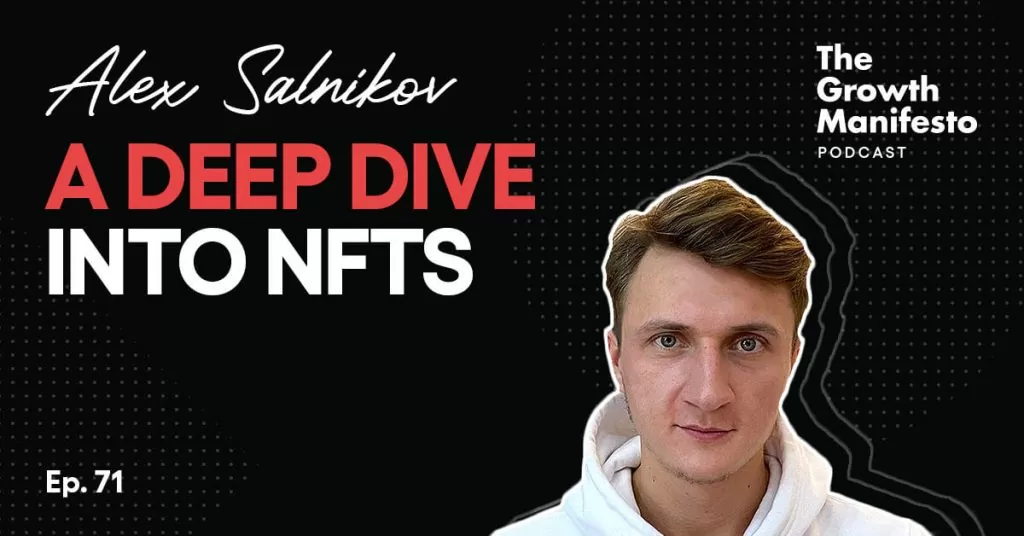
This episode is with Alex Salnikov – Co-Founder and Head of Product at Rarible, one of the biggest NFT marketplaces on the planet. In this episode we go deep with NFTs including what they are, how they work, their different applications, and where they are going in the future.
Key takeaways
- Salnikov calls Bitcoin digital gold and NFTs digital diamonds, arguing most real-world assets, like houses and cars, are already non-fungible.
- An NFT is a number and metadata recorded on the blockchain and assigned to a wallet, a standard any creator can extend.
- CryptoKitties became popular because creators extended the NFT standard to encode DNA, letting owners breed new, unique kitties from existing ones.
- NFT value comes mainly from the community and people behind a project doing real work, not from scarcity alone.
- Beeple's $69 million NFT was 5,000 daily digital art pieces made over 13 years, combined into a single image.
Chapters
- Intro: NFTs and digital diamonds
- From Bitcoin whitepaper to blockchain career
- Defining an NFT and fungibility
- Insurance NFTs and Uniswap liquidity
- Why NFTs are having a gold rush
- Profile pictures and community value
- NFTs and the metaverse
- How to create an NFT on Rarible
- Rarible's protocol and the Rari token
About the guest
Transcript
Auto-generated from the episode audio, so expect the odd mis-heard word. Timestamps open the video at that point.
and most of the assets in the world are non-fungible your house is non-fungible your car is semi-fungible there is a lot of cars like yours but in the same time they're all a little bit different uh and for example the website like blue books in the united states that tells you how much your car is worth is where the nft market is actually going for example so most of the most of of the items in the world that you have, your chair, any physical item that you have is actually
a non-fungible token in the physical world. You're listening to the Growth Manifesto podcast, where we host in-depth interviews with business leaders, authors, industry experts, and entrepreneurs with a singular focus around business growth. At the end of each podcast, we want you to walk away inspired, to think bigger, and to have actionable takeaways you can apply to improve your business. Each episode is like a masterclass on a key topic, so make sure to browse the episodes to find the topics that are most relevant to your biggest business challenges today. This podcast is brought to you by Web Profits, a digital growth consultancy that
helps challenge your brands drive growth in a complex and fragmented digital landscape. You can find out more about Web Profits at webprofits.io. Now, let's get into it. This is Alex Kleanthus and today we're talking with Alex Salnikoff, co-founder and head of product at Rarible, which is one of the biggest NFT marketplaces on the planet. Today we'll be going very deep into NFTs, including what they are, how they work, their different applications
and where they're going in the future. And just quickly before we get started, make sure to go ahead and hit that subscribe button so you get the latest episodes as soon as they're released. Now let's get into it. Welcome, Alex. Welcome. Thank you for having me, Alex. Yeah, there's two Alexes. I mean, that can only be a great podcast right now. So, but look, let's start with, for the people who don't know, what does Wearable do? Yeah. So, Wearable, it's an NFT issuance platform and the marketplace. So, it's a platform where you can easily create, sell your NFTs and eventually we'll get into that,
create your own NFT experience using the developer tools of Aribble. So it's kind of a one-stop shop for every person that wants to do something with NFT starting from your first NFT ever created to a lot of NFT sold to your own NFT project. That's, by the way, the usual path of people who start doing that. Yeah, awesome. And NFTs, they're blowing up right now, right? They're everywhere. Everyone is doing it. I think even like Gary Vee saying it's web 4.0, 3.0, 4.0,
I forget which one it is now, but it's like the future of the digital industry, right? Now, how did you get the idea for it? Because it seems like, you know, you've hit some pretty good timing, but from, you know, like I read through the research that you've started in the blockchain industry back in 2013, is that right? Yeah, that's more or less the time, 12, 13 are the time when they started. Yeah, so what was the journey from there to launching an NFT marketplace? And how did you just kind of hit the right timing?
I think it's hard to tell, but let me try to get you to the story. In 2012 or maybe even 2011, I met several entrepreneurial friends. We started to circulate ideas and they were like, Bitcoin is crazy. And I was like, what's that? And I read one or two articles before, but when I started to hang out with the guys, I read the Bitcoin white paper. And it was a fully immersive experience in depth explaining what the blockchain is, why it works, why it's powerful, what stands behind it.
And for me as a technical person, that was a revelation. As soon as I loaded up that information in my mind, there was an understanding again, that should work. and people in 2011 they're like okay this is the future everybody's going to use bitcoins countries are going to use bitcoins companies are going to put bitcoin on their balance sheet we're all going to transact in bitcoin and the supermarket and i was like i might be not but the the mere idea of of like let's try to create a new financial system it was
like how could you start working on something else when somebody offers you to to try to rebuild the financial system like what can be better no uh i tried and with the friends we've built like multiple projects at first they were mostly technical financial um like what should you do of course let's try and sell bitcoin right it's it's obvious right and and you couldn't do much except for that um so so like exchanges training robots i think everybody should build
exchange once in their life, the centralized exchange. You learn the false tech, you learn how people behave, you learn tech, you learn blockchain, how they have confirmations weighted and stuff like that. And you learn legal, you learn finance, you learn marketing because you need users. So we're doing that. And eventually, over the course of these years, we had more and more people on board into crypto. In 2011, it was basically whoever you met, they didn't know what
that is. So, they needed to explain what it is, why it's cool. And slowly we onboarded more and more people into that. So, some design friends of ours and technical. I think people who lived with me in an apartment are all done some blockchain work and at some point that was a wild ride and 2017 obviously boom of blockchain creating more and more tokens uh everybody was doing that
that was cool and then there was a like an aggressive crypto winter and everyone started to go low and thinking, well, maybe that wasn't a good idea to do so. And the sentiment was really bad. I remember going to San Francisco Blockchain Week in 2019, and the sentiment was low. So long story short, in 2017, there was a lot of noise on the market, and I started
to pay less attention to news because it was hard to tell. But in 2018, I subscribed to a bunch of newsletters. Shout out to all the great guys, Bankless, Week in Ethereum, ETH, all sorts of great newsletters. I subscribed to them and started to listen to the market. I had an understanding somewhere on the back of my mind that, okay, probably the space is more ready to the consumer now.
It's not as crazy as it was before. I can at least explain that to my friends. And, okay, what does the consumer want? And somebody told me this feedback that all the projects that we were building are so complex and difficult to use. And I was like, maybe it's time to do something fun for the soul. something engaging, emotional, something that would just put the joy
in your heart when you use it. And we sort of brainstormed with the team. We met with Alexei, the CEO, in 2017. And that was summer 2019. We sit and brainstormed like, okay, we should do something. We should do something cool. And the NFT was always on the radar since 2017, since CryptoKitties, everyone knew about NFTs.
And I think we all came together and there was a shared understanding. We had the head of design who's working out Rarible in this first brainstorm. He's very much into visual language and all sorts of visuals. That's why Rarible is so intuitive and visual. So we had a CTO who is super technical and worked with blockchain. So we sit together and out of that, the variable was born as this consumer-ready NFT visual thing.
No, this is good. I'm just trying to kind of hear the story because through the story, what I'm also hearing is the journey of the market through crypto land, right? Let's call it, right? You know, if you had some blockchain, some Bitcoin back in 2010, 11, 12, 13, and you kept it, you'd be worth who knows how many millions of dollars right now. Now, not everybody's stuck with that. Things change, you know, the FOMO all happened. And then there were some evolutions that happened, right? And not all the evolutions actually led to anything, right?
What's interesting now is that you've gone through that journey. So as a developer of product, right? Like as like a founder, as an entrepreneur, a product, right? So you've seen, you've tried trading robots, as you said, exchanges and so on. And you landed on something and your team actually just made the right, the right gamble, right? At the right time, right? And so there's some foresight there. Like we won't go into that right now, but what we're seeing today is NFTs is becoming the way that it seems that crypto and blockchain is going into the mainstream, right?
And so it is good to hear that journey because I think that that's basically been the journey of Cryptoland. And so you've kind of, you know, just been on that ride. Now, let's jump quickly now to just for the people who don't understand and even for me to get a bit more clarity. So what is an NFT? Okay, that's a great question. So let's start with the blockchain. I think the evolution of thinking blockchain was, okay, at first there wasn't even the distinction between the blockchain and Bitcoin. It also was like it was blend together in this single magical mining blockchain, internet mining stuff.
And then over the course of the years, there was an understanding, okay, the blockchain is a public, openly accessible database where you can put anything there and assign the rights to edit that information only to the owner. and at first we put there some balances and that's how bitcoin was was born and then ethereum was born like let's put there let's put code into blockchain and let let's execute that code and
let's see what what gets in the result so like basically let's put anything in the blockchain and see what what's what's going on out of all this so nfts is literally putting not very much information, but the very precise amount of information on the blockchain. It's like, what is the object? What's the description of that object? What's the metadata of that object and the number of the object? It's funny, like every NFT has a number inside it. That's how they are created. It's a unique number and assigned metadata to it. So it literally just says
an object number six with the metadata at the link of HTTPS, WW, blah, blah, blah, belongs to the wallet number seven. So that's simple. Item number six belongs to the wallet number seven. And only the number seven can now change the ownership of that item. So it's literally just the publicly accessible registry of who owns what, of what is a unique object,
not like a dollar bill when you can exchange it with any other. Those are called fungible tokens. They're more like money. Well, NFT stands for non-fungible token. It means it's a unique singular object which ownership over which records on the blockchain. Okay, I'm going to try and summarize this for the listeners and for me. But just before I do that, so fungibility, I should have looked this up before this this podcast right but like because fungibility like is the ability to what you know
how would you explain uh fungibility because i understand in concept in terms of same money because it's the same money it's like 100 million of them 100 billion of them um and it's all the same thing is that kind of an example of uh fungibility like how would you explain uh fungibility that was a really long question that's that's the definition of fungibility more or less like replaceability. That means that something is not unique. It can be replaced with something else. Got it. Cool. So a non-fungible token is something that is a non-replaceable
and the token part is because it's connected to the blockchain, right? Through a smart contract. Is that right? Anything. Yeah. The concept of a token basically means a thing. and the concept of the token on the blockchain there are several types of tokens and more or less what that means is something that you can own something that you can transfer the ownership of to another person and something that can be like checked on your wallet it's more or less the combination of properties of a token
it's something it's like the token that you put in the metro I know if you're familiar with that yeah yeah yeah no for sure I mean, I'm that old now that I remember putting tokens in it. But like these days, it's all, but there's apps now. You just put an app and you just kind of hit a few buttons. But look, I do remember tokens. But look, this is really good just for the people that have heard the word NFT, that know it's on the blockchain, they don't understand what fungibility is and, you know, kind of how tokens work. So this is a really good summary. And it is connected to a digital item.
Is that correct? Like it's got to be digital or can it be physical? Cool. Well, that's a really deep question. Well, maybe we'll save that for just a bit later then, right? Because let's talk about the applications first, right? Because what I'm trying to get to, right, is the first part is understanding it, right? So it's the ownership, the rights to something that is coded on the blockchain that is confirmed through the metadata of that thing, right? And what seems to be happening like a lot these days is a lot of the nfts are like images um and their visuals um is
that right is that the majority of nfts these days uh yeah that's that's the majority of nfts but there is kind of more to it so let's try to uh dive deeper this uh so when we said that it's an ownership over uh over the item with the number and the metadata uh it's it's the standard actually So, and the standard says that it should absolutely have this metadata, it should absolutely have the number, it should absolutely belong to some person, some wallet.
Now, that's only the part of the NFT. So, basically, going from there, any creator of the NFT can extend the functionality of that standard. So let's say in addition to the number and the description, let's put some more information on the blockchain. And for example, what is the cryptokittia? Cryptokittia was a picture of a cat recorded on the blockchain and belonging to you. But there was more to it.
There was actually some code that was saying that, okay, you can take two kitties and you can breed them. Or you could even breed one kitty. I don't exactly remember, actually. It was a long time ago. But what basically was happening, that there was a DNA of a kitty also recorded alongside this number and this description. And when you bred that, there was like a random mutation going on in that DNA, and you got the new kitty. So the standard was extended to have more information about that.
And that was the reason why CryptoKid became so successful, because you can extend the NFT standard and you can put more meaning. So the NFT is a standard of how can we take all those items? And if we don't know whether that's a CryptoKid or something else, how do we see them as unique things? When you open up your wallet, you see all of the items. You see all the items that you have. And because they all follow the standard, even if the wallet doesn't know that this particular item is a cryptokitty that has a DNA or something, it knows that, okay, there is a number five kitty and it has this metadata and metadata means picture.
So that was fairly technical. And that was good. No, no, no. That's really good. And so you've got the standard. And the standard, so there's a standard in terms of NFTs and how they're created. But there's an ability through NFTs to add or to code some additional kind of options to that specific NFT. And it seems like, and this is getting complicated a little bit for me to understand, but through the smart contract, it also can allow for future variations of that that is kind of dependent on the original NFT.
Is that correct? Not only the variations, basically anything. So you can extend that with any functionality. What are some examples of how kind of outside of the visual side of things that this could be used? It's something I spoke to you about kind of before that I said, you know, that maybe we'll speak about later. But look, I do think it's important for the listeners and the viewers to understand how the NFT is actually structured. because I think through the understanding, that's where you can start to see the possibility.
I think at the moment, it's just this word with everyone kind of trying to sell it and it's majority celebrities and everyone just converting their Bitcoin and transferring it over to celebrities and hoping that that goes up. But I think there's a lot of applications for how this can actually be used in business. So just for the listeners, I know it's getting technical, but through this discussion, my aim is to get everyone on this podcast to really understand and to see the value so let's go a bit deeper now right what are some other ways that it can be used kind of outside of just
the visuals let's go straight into the dip so it's also easier right yeah uh let me try to give you these two examples uh they are they are fairly complex but uh they they might explain things so The first one would be the insurance NFT. Back in September 2020, we launched this partnership with the Yarn when the Yarn came up with insurance NFTs. What that was, you could go to the website and you can buy an insurance
that protects you from the smart contract faults. For example, you have $2 million locked in in some smart contract. Like let's say it's an exchange or it's a deposit that earns some yield. And this smart contract, it can have an error in it and somebody can hack that and drain some money. So there is a company that provides an insurance over that situation. And you could buy an insurance.
Now, when you bought an insurance, they gave you an NFT. That was an NFT laying in your wallet saying it's an insurance. number 251. And the metadata was just simple. It was just a picture of shields, let's say. And the real meaning was that you can take that NFT and the event of the smart contract hack, you could go to the insurance smart contract, another smart contract, present that NFT that your wallet has it and say, okay, I have that NFT. It's encoded. It has this number, it has this
metadata but also it has the information about the insurance amount about the insurance and date and this this this insurance smart contract was checking okay if that's a valid insurance policy okay that is a valid insurance policy let me pay you some money uh so in in reality and you you can start to understand that this number and the metadata is It's more like a standard as how can you display an NFT. But the utility of that, it can be anything.
Just to give you another example, there is a Uniswap. Uniswap is a DeFi decentralized finance application, which allows you to change one fungible token to another. Let's say I want to change Ethereum to Rari token. as everyone should and the rarity token is a token that was created by rarible and we'll jump to that like a bit later in the discussion so this uniswap uniswap exchange they provided this uh cool functionality that you when you have a spare funds when you that you don't use
you can pull them into the exchange so they create some liquidity and they allow anybody else to trade more freely uh so that's like a third uh role on the market and not as the buyer or seller but as the supplier uh and when you supply in the uniswap version three when you supply the liquidity to the to the pool to the uniswap pool when you supply those spare money in exchange they give
you an NFT that again represents your deposit and you can later redeem that in the exchange. And when you go inside your mobile wallet, you see all the NFTs and because mobile wallet knows that an NFT has a picture and NFT has a number, then they can display that as digital items that belong to you without even knowing that oh this was a pool nft this was an insurance nft and it's they
can stand in they can display that in a standard way it's just like a card an item got it so i want to give an example see if i got it right so just so i can deposit um some of my crypto and to get the yield back from that right just uh through somewhere like the uni swaps of the world right And so they'll give me an NFT, right? Just to confirm that deposit. Then I can go to an insurance company and I can get like an NFT to insure that NFT, right?
And so now there's an NFT insuring another NFT. And now we're starting to see how it's really, it seems to be really taking the functionality of the blockchain, especially with smart contracts and really creating like a business environment that a consumer can use, right? And I think now because there are so many people in the world that have wallets, I think, look, for better or worse, in the crypto winters and the crypto summers
and all the journeys and the ups and downs, everyone has a wallet now pretty much, right? Like there are so many wallets in the world. So now because there's so many wallets, this opens up the possibility of transaction-based events that are recorded on the blockchain, right? And that seems to be just the evolution of crypto through NFTs. Is that a good summary of an example, if I understood what you were saying? It's a very good summary, yes. So the core, to me, over this time in blockchain, the core value proposition of the blockchain, let's abstract away mining, let's abstract away everything.
I think one of the realization that they had is just let's give everyone a digital signature. What the wallet effectively is, is just a digital signature. And then let's start to use those digital signatures on all sorts of transactional data. I want to pay my friend $5 and I put my digital signature in it. And then we created a blockchain. And blockchain is just a database that actually stores these digital signatures for everyone. And now everyone can go to this database and say, oh, there is the person that wants to pay another person $5 and they put a digital signature on it so that they confirm that they want to do it.
And now, again, a lot of people have digital signatures and they can do all sorts of transactions. And it's just automated processes, automated financial processes is the core proposition. That's really interesting. Now, I think that's a really good understanding of like pretty high level understanding. Like it can get very technical. I can see that. But it's a very good kind of understanding of how NFTs work. Now, why do you think there's been such a gold rush for sites like Rarible, you know,
that have all like the visual NFTs, the simple ones that we spoke about at the very beginning? It's a picture with some metadata and some other information that goes on the blockchain, right? why are they so popular right now you know what in your opinion is causing this massive i don't know it's like a gold rush it feels like again it's like the beginning of bitcoin in 2016 17 right it feels like that again like what's happening that's causing this um at the moment uh it's very very good and deep question so i think uh what is happening put simply is an
innovation, something that was never here. Let's try to distill that into the several points. The first one is like, I recently tweeted that out and it was received very well by the community that Bitcoin is digital gold and NFTs are digital diamonds. And I think that explains the concept really well. So we all got used to this narrative that Bitcoin is digital gold. It's all the same
properties, some scarce item, some scarce resource that everybody can mine and use. And NFTs are the same scarce resource, but each of them is unique. You can't have any more of those. And eventually they also became the store of value and you can have one as just an asset and most of the assets in the world are non-fungible your house is non-fungible your car is semi-fungible there
there is a lot of cars like yours but in the same time they're all a little bit different uh and for example the website like blue books in united states that tells you how much your car is worth is where the nft market is actually going for example so most of the most of the items in the world that you have your chair your any any physical item that you have is actually a non-fungible uh talking in the in the physical world uh and the same is just was brought to the
in 2017 the fungible tokens were brought to the blockchain world and 2020 there was the world of of non-fungible tokens brought into Bitcoin. Now, a lot of things, not to Bitcoin, but to crypto. A lot of things actually happened to make that true. And that was the part of the journey in 2018 of researching this space. So in 2018 already, every major wallet had this tab inside it that was called collectibles. And they all integrated that standard.
And the trust wallet, the Metamask wallet, the rainbow wallet, all of the wallets, They already integrated the standard. There was a wallet that allows you to just, an affordmatic wallet, for example, allows you to create a wallet without remembering these 12 words and being self-custody. So a lot of infrastructure was built, a lot of on-ramps, like wire, when you can just Apple pay $500 to your wallet without ever touching anything else.
Just go to the Rainbow Wallet, put AdCash, double tap on the Apple Pay and that's it. So a lot of infrastructure was built. The standard was built. The wallets adopted the standard. And yeah, basically the infrastructure, the tech that allowed NFTs to be born was there. A lot of hard work by a lot of developers. And then the 2020 and 2021 was the exploration of use cases. Okay, let's try to do something with it.
and some people understand that it's a valuable thing. A lot of people earn some money and now, okay, it's a gold rush because everybody now wants to make money and the real innovation is just behind all that. Yeah, sure. And there are quite a lot of NFTs that are being traded on Rarible, right? What are you seeing as the ones that get the highest values? And are they linked to celebrities or is it something else at the moment?
At the moment, yeah. It's a very, very good question. So 2020 was a lot about crypto art. We started as the crypto art platform because that's one of the easiest things to put on the blockchain. You don't need to write the code to add additional information or just put some content on the chain and say it's my content. So the image name and description, and that's it, just create. So 2020 was a lot about crypto art and everyone got this concept that was a gateway drug to NFTs, let's say, because you know the concept of art in the real world.
Again, now you understand the concept of art in the NFT world. It's a digital item. There is only one of those. You can be an owner. Okay, good. Then 2021 is all about communities. It's all about this super popular trend. It was called PFP, the profile picture NFT. And I actually found this to be very descriptive of how the NFTs actually work. So whenever somebody asks me, like, what's an NFT and why everybody buys an NFT,
I try to put the person in the context by doing this. I open up my Twitter feed and just scroll through the Twitter feed. And I say, okay, this person has a $100,000 avatar originally from four years ago and is known as a crypto punk. So when you see a tweet from that person, that means something. He's been four years in crypto. He understands something. So it's a club. Now this guy has a board ape that's $50,000 at least, maybe much more avatar, which is more fresh and young and born in 2020.
but it's still one of the blue cheap NFTs. But this one is like 10,000 NFT avatar which is the most fresh and now it represents a right to vote in the DAO. So that almost feels like you went to Miami party and you see all those people with expensive cars and watches. And it just sends you a social signal and means you're a part of some club and the people who are in the same club,
they usually represent some sort of values and there is an increased trust between them and they signal that to the world. Those NFTs tend to have the highest values to this day. Understood. So, and I've got a few questions on this one. I think the first one is, so just to be clear, just for me as well as the listeners right now, people on Twitter, well some people on twitter and we'll call them like uh the people that are deep in the crypto
community that understand probably this stuff right have profile images that are worth between ten thousand and a hundred thousand dollars for their their profile image is that right yeah uh it's totally right between ten thousand and let's say 11 million that 11 million 11 million as the highest ever CryptoPunk sold. Yeah, cool. It was in Sotheby's. Wow. So that's the first part, right? And now, so the other people that understand that, because obviously that value is based on the demand for that thing, right?
And someone that is prepared to pay for that, they know that value. So that's that two sides of the marketplace, supply and demand right now, right? So we're talking about on one side, you've got people who want that. on the other side there's someone that that actually has it and then there's a common understanding of the value of that right this is kind of how anything has value right and so that's happening like in the digital space right now and it seems to be that it's more or it's very specific to communities that understand it right now right that's i think
like an important part i think but there's like a quick side question um is this what people did I think that he sold some crypto art. Was it 60 million, something like that? $65 million? Or did he do something different? He did something different. That was an NFT. That wasn't a profile picture. So that NFT was called 5000. And what Beeple is famous for is at some point he said,
okay, I'm the digital artist and I'm going to have this challenge of creating a new digital art piece every day. And he did that for 13 years in a row. Every day, putting a new digital item, a digital art piece on his Instagram and Twitter. He's got millions of followers for that. He's got an incredible fan base, an incredible amount of work done. And then he combined 5,000 of those into one picture,
one big NFT and that was sold for like $69 million. Okay. And so cool. What's good because to the people who are not across this, it just seems like there was some artists who just put up something and he made $69 million. But the story behind that is it's 13 years of him posting something every day. And it's a combination of that. So it's literally 13 years of his life, right? And he had a community of people who actually liked him, right? Now this takes me And back to the first conversation, and thanks for that quick sidebar.
For everyone else now, for the mainstream, who may not really understand crypto punks and what the value is, but everyone's now starting to play. I don't know how many people I've spoken to in the last two months. I just bought an NFT. I don't know what it is, but I just bought one. And everyone is purchasing them, right? But what do you predict that the next evolution of the valuation of NFT is going to be based on?
Because it seems like the crypto punk side of things and there's certain kind of communities that are very kind of insular. So if you're outside of that space, it doesn't make any sense to you, right? But there's certain areas like art, which is kind of a bit more open, right? So where do you predict that the value of NFTs is going to be the greatest in the future? For the newbie investors and for people that are probably already a bit more experienced, what do you think?
It's a very, very good question as well. So I often have these thoughts being in a space so abstract. It's literally numbers, non-existing things sold for non-existing money somewhere on the internet. Sometimes I feel so detached from the real world, like literally just floating in some outer space there. and almost in that abstract world, almost anything you can abstract it away.
Okay, like blockchain is database. Here's the database. So what you cannot abstract away is just the people. So basically NFT represents a community of people usually. It's a project that is started by somebody. There is a team or there is an individual creator who is really great and there is a community of people around him. And more or less, what these people put into the meaning of NFT will be the value of that.
So if you want to carefully assess the NFT, just look at the people who own it and look at what are they doing. If that's a lot of people who just bought it and are doing nothing, it's not going to be an actually good NFT for you as an asset. So this bored apes, the phenomenon of bored apes, it's actually very much can be described by the initial group of people who got them.
So there is a Pranksy who is like anonymous NFT overlord. It might be he or she. Nobody knows who that person is. Well, somebody probably knows, but not me. He minted a lot of supply of board apes. And then he sold a lot of those to basically his friends in the NFT community. And this was this very strong people who've been long time in the NFT space.
And they all came together and put a lot of energy into promoting that. If you went to the NFT NYC just like 20 days ago in the beginning of November in New York, you could see bored apes printed all over the city, the banners on the taxi, on the Times Square, uh graffitis uh it became a cultural moment and all was like eventually done by the people who are behind that nft and now the nft is evolving into even more formal version of that
this group of people can even create the royalty stream of their nfts and to put that into the common wallet into the treasury and to collectively decide how we're going to spend that So, for example, they can put like from every Bored Ape NFT sale, we take 5%, we put that in our common wallet and we spend that on marketing to put more values into Bored Apes. So, NFTs evolve into community creation tools.
The people behind NFTs are those who do work. And because of that work and that value, it gets accrued to the NFTs. You want to look at the people. You want to look at the people who are great, who you can trust, who are cool. And my general prediction is that we will have more and more values built in into the NFTs. We started with a simple crypto art concept because that's one of the most easiest one to grasp.
And now we're going deep. Okay, this NFT means I can have insurance. This NFT means I can have an item in the metaverse. I can own the land. I can be a part of the community and really put somewhere on chain my preference over how should we do something. So this layer of what NFT is as a standard, the number, the metadata, it has the constant width and the depth of what's behind is getting just bigger and bigger and bigger.
Got it. So it does require supply and demand, but supply and demand in the NFT space is an interesting concept because it is, it's really hard to make any statements to summarize it because it depends. But it's something which is, it's a want, right? It's something that people just want. It's not something that they often need for their lives, right? there's some examples with the insurance and so on but for example of the art right that's an
example where it's it's something that because people all say this is worth that much money it's worth that much money right you can't eat it you can't drink it you can't go you know like you can't live in it it's just like like it has a value you know just like art does right and so it feels like if you are looking to invest in nfts you need to look at communities that are very engaged, that are very passionate. They will spend their money on that above food, right? Like they love that that much. And that's how the value will go up. Is that a good way to think
about it? Like in terms of like, if you're investing, like trying to understand the macro level? The macro level, yes. It's all about people. It's all about the work actually done by the people. So the work might be marketing or communications or coding that can be key. NFT can be key to something. It's quite a literal analogy to the physical items. When you go to the store and you buy a knife, it's something that you can live without, but it also can interact with other items in the real world.
You can take your knife and you can slice a bread with it because there are some physical properties of that. So it's quite a literal analogy in the digital world. You can take an NFT, you can live without it, and you can go to another NFT. You can do something with two NFTs. Bored Apes at some point created a serum that allows you to mutate your bored geo ape and create a mutant ape. And now you've got another NFT. So it doesn't have a floor.
There's no limit, is it? And this is what's so interesting. It's pure creativity now that is led through community engagement. Let's just quickly now just quickly touch, and I think we can only touch on it, right? The metaverse, right? Now, it seems that NFTs are going to be a really kind of integral part of the metaverse. I heard that Nike is creating some NFTs just for their shoes or something, right? And, you know, there's other fashion brands like Dolce & Gabbana
that are running ads inside of the metaverse, right? I'm assuming that is paid through some type of smart contract or so on, right? So with the growth of the metaverse and the fact that Facebook has now changed their name to Meta, it seems like putting any kind of investment into things that can be used within the metaverse is going to be a good kind of idea, but that's just a pure assumption. And I'd love to know your thoughts on that. we touched on a very important big topic, I think.
So metaverse, we are all to some extent already living in the metaverse. Metaverse is more or less just the digital universe. And when you spend 10 hours a day in your phone as the teenager in the United States or as a person who works in the internet and calls a day, Uh, so your, your life basically consists out of this digital objects.
You have the tick tock on your phone, uh, and that's a pieces. That's just the stream of pieces of content. You pro so that you have Facebook, you have all sorts of things like that. So you already live in the metaverse and this metaverse is built by this, um, by the big companies and the today's metaverse, it has this weird thing that you don't really own anything on the internet these days. Everything is being custodied for you by some companies and this is okay.
What's not okay is more or less that you don't have a choice to change anything. You can't just take all your content and put it in your pocket and go away to another platform. They're kind of protective and everybody can understand that. So the metaverse that everybody talks now in the blockchain and Web3 space, it's the metaverse built on another principles, on principles of being self-sovereign almost as a government.
You own your data, you own your items, you own your money, you own your NFTs, you own everything digital on your digital identity. It's only yours. And nobody can take that away unless that's specifically stated in a smart contract. And everyone can check what's stated in a smart contract and say, okay, we're okay with that. uh so nft is is just uh and the the core the core difference is that the system is open
uh like the physical world if you have something in the physical world that is yours you you can literally like hold it in your hand it's it's a sovereign thing like if you don't like you can say i won't give it to anyone i can i can protect that with with the force with with my brain with all of that. So now you have the same properties in the digital space. It's something that you can protect no matter what. And you said about NFTs that can be used in the metaverse as good NFTs. And yes,
those will be the good NFTs. I think the only thing you need to pay attention to is the fact that the metaverse works differently and there is less scarcity. So in the physical world, if you buy a piece of land, there's no more land in New York. In the metaverse, there can be created much more items. A lot of land, you can teleport between stations that kind of brace the notion
of centrality and you can be everywhere so the the land in the metaverse is less scars the items you can always create a lot more new items in the metaverse so you you want to look for things that are scars and that's why like i said about the community is that and that's what really scars the brain power behind this the the people who are behind this because otherwise you can you can replicate a lot of stuff even though they're non-fungible but you can just create more and more new things i did see on rarible that there was some some um some digital land for sale
25 000 or something like that right where was that land actually just going to be placed or you know so what was what's the land that's for sale like is that within a specific kind of app is it within in a specific area? Like, where is the digital land at the moment? Okay, so the digital land, the important digital land is the land that has traffic through it, basically.
So it should be in a game that people play, that people visit, and the more people visit your land, the better that is. Again, scarce resource, just people attention. We're getting back to this all the time. And the most popular things right now in the metaverse are like several games. The most popular probably is Decentraland. Sandbox is very popular these days. So Decentraland, it's a browser game where Barable has an office,
where it can be exhibit some crypto art, NFTs, where all sorts of other people have office. I think even they recently even told that there is a country that opens up an embassy there. It's totally crazy. That's awesome. The Sandbox, the Cryptovoxel, one of the earliest ones, which is like kind of pixelated as for like Minecraft. There is a Somnium Space VR, one of the most advanced probably from the gameplay perspective.
in the VR, you can go into the club and there will be a dome with some music playing inside. So those like the centralized sandbox, Somnium Space, just CryptoVoxel. Yeah, those are the things to look at. There is a lot of them. Yeah, and so again, and this is for the listeners and for the viewers, is that people and attention is the key point here for the future of the NFT value. there's people who want it and if there's attention of those people that's what's going to drive the
demand because of the scarce resource that it is right and be careful of um the metaverse that has unlimited places where they can just create land because that land is not going to be worth a lot it's just unlimited right so it's the scarcity that's important but also on the scarcity plus the people and attention and that's going to be really cool now let's just jump quickly to So, cool. How do I create like an NFT? Because I know that you can create one through wearable, right? And I think it's not too difficult. So can you quickly explain how someone can create a simple NFT,
like a visual one? Of course. So in 2017, the only way to create NFTs was, okay, I need to write a smart contract to code that database to say, okay, this will thing that will be representing this and to deploy that. So you need some developer power to do. to create an NFT. Most of the people were just creating the forks of CryptoKitties, the copies of that. So when we came to the space, there was like a question like,
why is it so hard to create NFTs? Isn't it should be easier? And there were a couple platforms that allowed you to do so, but most of them were kind of permissioned. You needed to fill out the form, wait for three months until you got the permission to create NFTs and then start to create them. And coming from this Web3 background that we had, the permissionless approach is what we all have in mind. Like, why don't we allow anybody to create NFTs?
Just with your wallet, we just written the piece of software that basically does it for you. It deploys your own NFT to the Ethereum that belongs to you from your wallet. And it's just a tool. It's not our NFT, it's your NFT. It gets created directly in your wallet. And this tool is fairly simple. So the first version of that was, okay, let's put a picture, the name and description and the create button. And the connect wallet button, you connect your wallet, you fill out that and you hit create, you pay some gas prices and that item gets created.
now since then we went much further we created unlockable nfts you could put inside the nft arbitrary content um you can go you can now create nfts for free even without the gas price the gas price will be paid only when it's sold we put multiple editions you can create a hundred nfts of the same but only 100 it will say that there is only 100 things like that you can put royalties it's a it's a it's a it's a cool concept of nft is that like every subsequent sale of that
nft will get some percentage of that to the initial owner um so but still it's just the form you go to the website you connect your wallet or you create a new wallet you fill out the form you hit the button and don't even need money for gas prices to create it and you hit create and that's it you now have an nft and now it's actually listed on the rareable marketplace and someone can come to buy it and once they buy it it transitions the ownership to their specific um to their
specific wallet and it codes on the blockchain through a smart contract right yes i'm getting it i'm getting it cool um and so um so for the things which are uploaded does it have to be the digital art or can it be a sketch or you know so what are the things that are happening like these days with you know what's being created uh you you can upload either a jpeg or an mp3 or the video mp4 on these days also the 3d files and some programmable javascript code can be put
as an NFT. So that's the basic primitives of what you can put as a digital content inside. And then the creativity is just the sky's the limit for you. What can that be? It can be a batch. That means, okay, you're a part of the community. It can be key. It can be the avatar, the same profile picture created by individual creators. Those are the most popular ones, actually. it can these days also a lot of people like communities the badges and the t is that means
you're a part of some dao are super popular these days yeah okay and the visual is the representation of the meaning you put inside it again it's not only a piece of content and there is a lot of celebrities just that put a piece of content inside the nft and sell it right away and that's what is the shallow part that everyone like listens and hurts about NFTs. But there's a deep side too. And the deep side, which you explained through CryptoKitties,
which I didn't understand before that it actually had some DNA and they can actually start, I was about to say to procreate, but to... Yeah, great. Yeah, right. And so if a company or if a business is looking to maybe create like an NFT, like the insurance one, right? That's not done through a similar platform, right? that requires some form of a developer to actually code it. Is that right? Exactly right. Yeah. So the platform, it allows you to create more or less standard NFTs that has a metadata to it,
like pictures, images. If you want to add more features to the NFT, what you do is you need to describe how this works. You need to literally write in the Spark contract. If there is a feature like that, if the NFT is golden, that means X, you can deposit that and do something. And that description of what it can do, it needs to be coded in the smart contract language, Solidity or any other blockchain language. And you need a developer who will do that.
Got it. Okay. And that's the part, right? And so for the businesses that are wanting to create some NFTs to actually support the community, you're going to have to go find some really smart developers um now they're scarce there's a scarce resource um you know some blockchain developers that are good that haven't got like their own startup right so that's that's cool um but i think so let's talk quickly and this will be the final point right um the future of rarible you know so where you're going to be taking the platform
and why you created the token that's being uh traded across all the exchanges okay the future Verbal, a great question, not a simple one. Let's try to unpack this. So we started with like create your NFT and this was really great. Where all a lot of crypto art adopted the platform and then we really put down on the marketplace part. So we added all sorts of trading mechanics, the auctions, the bidding offers, leaderboards, popularity contests, all sorts of things like that.
and we created the Rari token, which is the governance token, which you can earn while trading on the marketplace. We created that as a liquidity bootstrap mechanism. So at some point, there was like a lot of items on wearable, but not enough of the buyers. So we just started to incentivize directly people who trade on wearable. And that was a massive success because it distributes the ownership over the future of the platform to the people who are the users of the platform.
And the next step we're taking wearable tool is like there are like two paths of development now. The first one is the marketplace development. Like just a couple days ago, we rolled out the direct messages feature. You can now send the message to the people in wearable. So the part of the marketplace development will be more like a social. Like who are the people you want to buy NFTs from? You follow them whenever your person puts an NFT on sale.
It's a part of the community. People are cars. All sorts of things that I just told kind of go into that direction. So you want to pay attention to the people. That's why we're developing this marketplace into the social commerce platform. And another big step of the development is the protocol. So we said that if the business wants to create an NFT, they need some developer power. And we've been doing the NFT marketplace for two years, and we created a lot of infrastructure.
So we took the infrastructure behind the marketplace. It's a set of smart contracts. It's a set of API on the backend that allows you to understand everything about NFTs, when they were created, how many NFTs user owns. So that's an NFT protocol. That's a wearable protocol. It's a set of developer tools that you can use to create your own NFT application experience or a game. So this is our two direct paths. and the future of of nfts is like right now most of the nfts are on ethereum on the ethereum
blockchain and the world is massively turning to multi-chain so there is all sorts of other chains like flow that was done by the it's a blockchain created by the team behind cryptokitties they created their own NFT blockchain. Solana, Tezos, all sorts of blockchains that are more fast and are more suitable for the NFTs. So you go at some point in the future, you go to the Rarible,
it's multi-chain, it's connected to a lot of blockchains. You don't even know which ones. You just have your wallet connected to all of them at the same time. And whenever you want to buy an NFT, it gets breached from one blockchain to another, to your wallet. And there is a Rarible protocol that powers all that. And you can create your own NFT experience, again, multi-chain, abstracted away, all this difficult stuff from the user for the business. This is more or less all sorts of things that we're doing now inside Rarible.
That's great. So if I purchase a token, and this is me and this is not investment advice, I keep hearing people say that so I'll just say it too but like if I purchase the Rari token what does that mean that I'm a part of the growth of the platform is that what it provides me because because at the moment the market cap I think as of like a few days ago was about a hundred million dollars um so like like is purchasing a token to be a part of the growth of the platform or is it more a trading kind of token for the platform itself right now literally it's a governor's
talking and it's a governance talking for the protocol firstly because protocol is the most open part it's open source it's decentralized it's a set of smart contracts and uh so this infrastructure it needs to be resilient uh and for it to be resilient it needs to not have the single like point of failure for example like us as the team that controls all of it and can change and change the fees say like okay now it costs you like half of your money
so the this infrastructure uh it's it almost works like a public good that we have in the governments now it's like the roads or stuff like that that everybody needs and it needs to be governed the same way by the people who own it by the people who use it that's why this where we're talking like we give it out to projects building on top of the protocol we give it out to users trading variable so they can like govern the platform and the governing the platform means voting for the future changes voting whenever the team wants to roll the new update or another team
wants to roll the new update that's how the like blockchain works so right now it's literally like the rights to decide how the platform will evolve and no more than that and no less than that And so is it, and without going to tokenomics, because that goes very deep as well, but is there a fixed amount of tokens or is it a bit more flexible than that? It's a fixed amount of tokens, yes. It's 25 million RARI tokens and 30% of that are to the team and the early supporters.
and 70% of that is actually committed to go to the community in some form, like either for your participation or for usage or for something. So it's literally like, and this 70% distribution is deemed to happen over the course of four years. And we're only like one or 1.5 years ahead of that. Not ahead, but one or 1.5 years into that. Into it, yeah. So there is like more, like 2.5 years more.
This is basically means that when that happens, the platform and the talking, the protocol, it's not ours, it's everyone's. And that's the deep goal here. Alex, what a fantastic conversation. I thought I knew something about blockchain until I started speaking with you, right? And kind of NFTs and so on, but this has been really eye-opening. I think for anyone who's listening, they can tell how much you're into the community, like into the spirit of the reason that blockchain was, that kind of the crypto industry was created.
It's really interesting to hear your journey and to see actually how you think about things and how you're actually creating tools to allow kind of the creators and the businesses to actually launch these, the NFTs without understanding code, right? And so you're helping to take crypto to the mainstream. And I'm so happy that you've achieved success by just kind of hit like, because here's the thing, right? You hit the timing right after working at it for 10 years almost, right?
It's like, you know, hey, you got lucky. It's like, well, I was working on it for about eight years before I got lucky, right? But it's so nice to hear a story like this. It's so nice to speak to someone who's so about the community. And I just congratulate you on your success, brother. I mean, it's been fantastic. And thank you so much for sharing everything about this space. I know this is going to help a lot of people. It certainly helped me. Thank you so much. Thank you so much for inviting me. Thank you so much for diving deep. the questions are so awesome you're going into understanding
you're summarizing this I enjoyed it it's just perfect, thank you so much Fantastic IO.