MarketingStrategyLeadership and culture
How to use Movement Thinking to become a purpose-driven company
Strawberry Frog founder Scott Goodson explains how movement thinking turns a company's purpose into action, with cases from Jim Beam, SunTrust and Pampers.
 with Scott Goodson


Overview
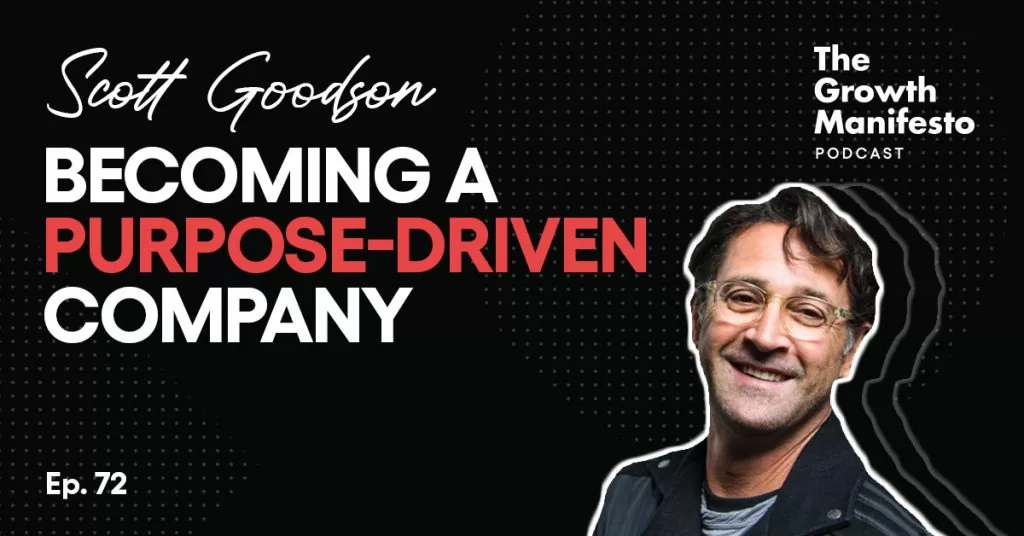
This episode is with Scott Goodson – CEO & Founder at Strawberry Frog and co-author of the book Activate Brand Purpose – How to Harness the Power of Movements to Transform Your Company. In this episode we talk about how to use Movement Thinking to become a purpose-driven company.
Key takeaways
- Doing nothing is the riskiest move for a brand under pressure, as Jim Beam found when it repositioned toward equality and won younger, female customers.
- A purpose is the higher order idea an organisation stands for, while a movement is the plan that activates it inside and outside the company.
- SunTrust's abstract purpose became the On Up movement against financial stress, drawing 6.5 million participants in 3 years against a 5-year target of 5 million.
- Movement thinking works in B2B too: a Swedish pharmaceutical company used its Out the Monster movement to challenge an 80% market leader in opioid treatment.
- A genuine movement doesn't need a large budget: it can cost the same as an ordinary campaign, since thinking and action matter most.
Chapters
About the guest
Transcript
Auto-generated from the episode audio, so expect the odd mis-heard word. Timestamps open the video at that point.
So purpose is a bit theoretical and movement is about activating that purpose, like a social movement, any movement, you know, of like, you know, women's movement or, you know, the Black Lives Matter movement, whatever movement you can immediately go to, that's kind of what a movement is. So how do you take a strategy, like a purpose, turn it into an activation plan that people just genuinely and intuitively feel like they're a part of it, they get it, they're emotionally connected, they're passionate advocates. That's kind of what we're doing with this movement thinking. If you're a leader, you just really need to make sure you have a strong personal connection
to the movement you're participating in or you're leading. You're listening to the Growth Manifesto podcast, where we host in-depth interviews with business leaders, authors, industry experts, and entrepreneurs with a singular focus around business growth. At the end of each podcast, we want you to walk away inspired, to think bigger, and to have actionable takeaways you can apply to improve your business. Each episode is like a masterclass on a key topic, so make sure to browse the episodes to find the topics that are most relevant to your biggest business challenges today.
This podcast is brought to you by Web Profits, a digital growth consultancy that helps challenge your brands drive growth in a complex and fragmented digital landscape. You can find out more about Web Profits at webprofits.io. Now, let's get into it. Today, we're talking with Scott Goodson, the CEO and founder at Strawberry Frog and co-author of the book, Activate Brand Purpose, how to harness the power of movements to transform your company. For more than 25 years, Scott's worked with companies like Google, like Emirates,
like Heineken, Coca-Cola, and Mercedes, and he invented the concept, the concept of movement thinking, which is what we'll be talking about today. And just quickly, before you get started, Make sure to go ahead and hit that subscribe button so you get the latest episodes as soon as they're released. Now let's get into it. Welcome, Scott. Thank you. Very nice to be here. Yeah, yeah. It's fantastic to have you here. Let's jump straight in. You talk about brand purpose and this concept that's called movement thinking. What do you mean by these kind of ideas? Well, it's very simple.
It's using the principles of social movements in order to activate a purpose so that people like employees, as well as consumers really understand what you're trying to do and want to be part of driving that change. So it's connecting to kind of something that's already happening in the world. Is that correct? And then I mean, you can, yeah, yeah, you can have a, you can have a movement that is about driving a, you know, a form of positive change. It doesn't always have to be that way. You could certainly have a movement of cultural engagement where
people are participating in a, you know, mass participation in a, in a cultural idea that doesn't necessarily have to drive positive change, but more often than not, uh, it is about identifying something out there that is wrong that you want to write, uh, you know, or some monster out there that you need to defeat. So it is connecting to something, right. And I think the best example of this, I think that everyone is across is Patagonia, right. You know, that seems to be the poster child of what it means to be a purpose-driven company. Is that correct? Is that
an example of a purpose-driven company? Absolutely. A company like Patagonia? Yeah, I think it's a very good example. I think it's through the lens of sustainability and taking a stand against any political or business decision that is jeopardizing the climate, that would be a perfect example. But I think there are a lot of other examples out there that are not necessarily connected to climate. There are ideas about all sorts of things.
And in small ways and big ways, those ideas can drive positive change. For example, a few years ago, we did a movement for Jim Bean, which I know is very popular in Australia. It comes in cans. People drink it at the beach. It comes in bottles too. And Cousin Bottles, too. We did a movement against the patriarchy and for equality. And we had Mila Kunis as the first spokesperson for an American whiskey. That was a pretty big move for equality. And the net result of that was women felt the brand respected them and validated them.
And as a result, they rewarded the company. And today, a significant, I believe a majority of the consumers are under 45. And there's, you know, at least 40% of them are women. So, you know, companies that do drive positive change are typically rewarded, especially these days with young consumers, generally consumers. okay um let's just go into that that example quickly um how did they choose that like in terms of their brand purpose because it seems like that would be on it feels like that that
would be on the risky side because you know the gym beam like the look and the feel is very masculine you know like let's like across the past 20 30 to 50 years like like it has had quite a lot of like masculine advertising and so on, like imagery, the concept. So it feels like taking that stance could have been pretty risky for them. So, you know, so what kind of considerations are happening like at the time that there's a purpose that is being selected? Well, in the case of beam,
the risky strategy would have to be to do nothing. I mean, because they're, you know, compared to Jack Daniels, which is more or less equivalent, you know, it's a American whiskey, corn-based whiskey. One's a bourbon and one's a American whiskey in Tennessee. And one could argue, you know, what's the big difference and so forth. But from a macro perspective, they're both American whiskeys and Jim Beam was having their clock knocked by Jack Daniels. You know, Jack was $12.99 a bottle for the same liquid and Jim was like $7.99 and
two free shot glasses at the bottom shelf in 7-Eleven. So they were in really bad shape. The average age of their customer was in the late 60s, all male. And so, you know, when you're up against the wall, you've got to make some bold moves. And, you know, in today's world, we're living in a world of constant, you know, a VUCA world, volatility and change, you know, you're faced with a lot of issues all the time. So I would say any move is a bold move. Doing nothing is a bold move. Doing nothing is probably the riskiest move. So in that particular case,
they had a real business objective, which was to grow the business and increase household penetration, raise the price. And to do that, you had to completely rethink who the consumer was. And all the research we did here in the United States, in Germany, Australia, and the other core markets where Beam has been around for a long time, showed that there was a lot of room for growth among women. And that proved to be accurate. And you're not going to attract women with a very traditional male,
you know, patriarchal message. So nothing better than to take a page out of a social movement, giving women a platform and using that as a movement for being, and then hiring this woman, Mila Kunis, and having her as a poster child of that. And the result was, as I said, the business turned around and today actually they're doing better than Jack Daniels. Okay. So the right kind of connection to the right kind of movement can have a, like a very positive impact on the company's success, right?
How does a company start to think about the kind of the cause, the movement, the purpose that it should be connected to? Because it seems like, yes, it's definitely risky to not take action, but that's kind of the known entity, right? To take action in a specific area feels like it would be very scary for lots of executives, right? And so how do you start thinking about, you know,
so how do you connect the brand to some purpose? Well, I think, you know, so let's just define, get some definitions down first, if we can. So purpose is, you know, what is the higher order idea that you, your organization is working towards that is beyond dollars and cents. Like it's typically like, what's the soul of the organization? Why are you existing more than making money? And you'd be surprised at how many leaders out there actually are really passionate about climate, sustainability, mental health, financial well-being, like real issues that they come across through their employees or their customers or the communities within which they work.
Those things are pretty normal. And I think today leaders realize they've got to be aware of these issues. And not everybody is able to activate it actually in a genuine way. But increasingly, I would say leaders are pretty good in that space. If you are a leader and you're trying to turn a purpose into a movement. Now, a purpose is that higher order strategy. The problem with the purpose is it can typically be either toothless. In other words, it feels so opaque and, you know, just like, you know,
we want to drive some form of good for the world. Like I hear that more often than you. You know, we're positive people. We're positive. We want to help. It's like a little bit more than that. We're going to continue to make a million of these units a year, but we want to help. Anyway, movement is, so when I started working with purpose back in the nineties, I lived in Sweden at the time. And as soon as we got out of the Nordics and we started to market outside in Eastern Europe, in Asia, and even in Australia, where we launched, for example, Ericsson mobile phones I was working on at the time.
And Ikea was another company. We realized that purpose was just way too theoretical. It was like taking a university course, a uni course, as they say in Australia. So they don't say that elsewhere? Is that just an Australian thing? University. In the U.S., you say college. We shorten everything here. Different names, yeah. Uni. And I love how everyone in Australia says, like, you're bathers. Well, you're bathers or you're sunnies. You're sunnies. Sunnies. They're called swimmers, not bathers.
Swimmers. Bathers. Or bathers, yeah. Swimmers, yeah. So purpose is a bit theoretical, and movement is about activating that purpose, like a social movement. any movement, you know, of like, you know, women's movement or, you know, the Black Lives Matter movement, whatever movement you can immediately go to, that's kind of what a movement is. So how do you take a strategy, like a purpose, turn it into an activation plan that people just genuinely and intuitively feel like they're a part of it, they get it, they're emotionally connected, they're passionate advocates. That's kind of what we're doing with this movement
thinking. But getting back to what you asked me to answer your question, you know, if you're a leader, you just really need to make sure you have a strong personal connection to the movement you're participating in or you're leading. And a movement usually, as I said earlier, involves a wrong that needs to be righted in the world. So it needs to be something that you're super passionate about and that you have a personal affinity for. And also importantly, you can connect back to your organization in some way. It could be something you mildly agree with.
But you just got to be careful that it's not just something that you stick on the organization. There was a company in the United States called Planters Peanuts. And recently they came out with a purpose, which was something about, you know, being something about your energy, which made sense because, you know, nuts are protein and gives you energy to do great things. And then they did an ad where they talked about paying women the same as men, you know, and saying, like, if you don't pay women the same as men, it's nuts.
And it just feels like an opportunistic ad that has nothing to do with peanuts. You know, it'd be like, I don't know if you have like, like in Australia, it would be like pay women the same as men from Foster's beer. Like what? Like, how does that have anything to do with Foster's beer? So you have to have some connection to the organization, to what they do, to what the leadership care about and demonstrate. demonstrate because the consumers are sitting there waiting for an organization to say they're
going to do something and then do nothing and just you know have an ad so you've got to do something you've got to activate it seems that there's a whole industry here it's called superannuation it's like a 401k but there's this whole thing um in terms of um the ethical uh superannuation companies that only invest like in ethical kind of companies and so on right and it's you know seen like some huge uptake in Australia through social media and, you know, just through connecting
to, you know, what the audience actually, you know, um, are trying to change in the world. And they are voting, uh, basically, uh, with their superannuation dollars, right. That they have to put somewhere, right. Like, and that seems to be like a whole industry that's been created, um, through movements, right. It's been so hard to differentiate between superannuation funds, you know, for quite a long time. And now this whole thing, I mean, in terms of this idea of ethical investing has opened up a whole area, right?
But for most companies, they can't change their business model to create something that like is about the movement. And so they have to start to figure out, you know, so what are the things which I can connect with, right? So let's start by just quickly trying to pull it apart for a second so that the listeners can start to get the concept in terms of execution correct, right? So you've got the brand purpose, right? That's part one. And that then leads to movement thinking, right? So if I'm trying to figure out the brand purpose, who in the company needs to be bought into that?
Because it feels like the bigger the company, the more stakeholders, the more opinions, the more diverse the possible purposes could be, right? So what's a way that companies can start thinking about trying to identify their brand purpose? Well, to answer the first part of that question, it has to be the very top. It has to be the CEO. If the CEO is not bought in, if the CEO is not part of it, it's not going anywhere. And these days, CEOs actually do want to be part of these conversations.
And, you know, sometimes other C-suite executives or board members want to be part of it as well. And, you know, how do you go about finding it? Well, like I said, it has to be somewhat related to what you're doing. So, for example, here in the United States, there's a very large financial institution bank called SunTrust. and they hired BCG, which is a big consulting company, to come up with their purpose. And I mean, there are a lot of companies out there
that will do this for you. We do it as well, but honestly, it's not our expertise. Our expertise is in activating purpose. But in the case of SunTrust, they worked with BCG. They developed a purpose, which was called Lighting the Way to Financial Wellbeing. Lighting the Way to Financial Wellbeing. That was their purpose. and it's a bit of a mouthful, hard to remember. Keep in mind that a lot of tellers and banks are high school educated. So what does this mean to me?
What does it mean to my family? Lighting the way to financial wellbeing. It's a bit theoretical, perhaps. The good thing about it is it's about the consumer. It's about the end user. It's about lighting their wellbeing. It's about steps towards helping them achieve financial well-being. So there's a lot of good things in there, but the phrase is a bit heavy, hard to remember, difficult to share in a peer-to-peer world internally inside an
organization. So we came up with a movement called On Up. And the On Up movement was against financial stress and for financial confidence. And we set out to help Americans find financial confidence. And we said, we are going to generate 5 million participants in this movement within five years. We ended up generating 6.5 million in this movement in three years. So it was a huge success for a bank. I mean, can you imagine a bank actually starting a social movement to drive some form of positive change in society?
So it can actually happen. and that that should give you a good example what i mean by a purpose can be a little theoretical that then is activated with a purpose that's right yeah with the movement okay so just for clarity the purpose is the idea right the purpose is the idea of what we stand for right and there might be a few ideas which a company could stand for right the movement side of things the movement thinking side of things is then the actions which you're going to take to activate it. Is that right?
Yep, correct. And it seems like, and this is just from what I've seen in the world, you know, so where a lot of companies fall down is they may come up with a brand purpose, but then the movement is not really, they don't really invest in it like it's a movement. They invest in it like it's a little campaign on the side, right? And it seems like for a company to really be a purpose-driven company, it needs to be part of the company, right? And so can you talk about quickly, you know,
so, you know, so what does activation actually mean and how kind of integrated within the company should that activation actually be? It's got to be throughout the organization. I mean, we developed a tool called the Purpose Gap, which measures how well a purpose is activated in an organization from the very top, the moment the C-suite launches it to rapturous applause to three years later, how well is it being used at the bottom of the organization?
And that's really what it is all about. Like, if you're launching a purpose and you're activating in a way that engages people through actions and or communications, it should have a meaningful role in the organization 18 months later. And, you know, the main, I guess the main way of thinking, the main framework of a movement is the difference between like top-down leadership, do this because I tell you to do it, and cross-company leadership, let's do this because we all want to do it.
Because it's something that really matters to all of us, all who work in this company. And that's really what it's about. Um, and you know, if you are launching a purpose inside your organization and you're measuring it over time and down through the organization and there is nothing happening, then you haven't really activated it. Well, it starts internally. Right. Um, so the purpose always starts inside, right. And then it expands outside. This is something which you're speaking about in your book. Right. And so, you know, what's the, what's like the rollout like of an activation, right?
cool. So we figure out the purpose, we identify the movement, you know, so what are like, not all the steps, but some of like the key steps involved in, you know, to roll this out effectively. Yeah. That's a great question. I mean, in the book, activate brand purpose, that's really what we talk about. Um, the basic premise of this is a brand or company can identify and crystallize a mass movement. You know, that's the basic idea.
And we've got plenty, you know, we've been doing this for 24 years. We've done it for Google. We've done it for Emirates. We've done it for Heineken and Holland. We've done it for LG in Korea, lots of different, you know, Mahindra in India, lots of different companies. We've been working with Afterpay, which is an Australian company, or used to be, just recently sold. Yeah. Um, but, uh, you know, once you have a cultural movement, you can do anything in the changing media environment and a culture movement is, you know, when an idea on the rise inspires
mass engagement by the culture. And, you know, the way you get going is first, you have to kind of, you know, the strategy has to define the change you want to make, you know, this includes what kind of behavior you want your customers to have in relationship with the company or what kind of social change you want to drive. And it has to be relevant to your business, as I said. And then the second thing you need to do is you really have to understand your target. Why do they behave as they do? What's important to them in the category that within you work, but also in their lives?
You know, what are the fundamental human truths that you need to identify? And then equally important as understanding your target, you have to understand the culture. What's going on in the world? What's happening in society that's relevant to the purpose, to this idea that we're trying to launch as a movement. And then, you know, understanding that people want to be part of something bigger than themselves. And that's kind of what we're designing for, right? That's the framework we have.
Of course, this strategy has to serve the benefit of the company, you know, drive, like with Jim Beam, drive share harder. or ultimately serve the equity, benefit the equity of the company in some way. But to begin the movement, you really need to start with your own people. So you start with the employees and then you also try to provoke a discussion. The biggest challenge you're trying to overcome
is complacency. And this requires you to kind of turn deep human thoughts insights into sharp instignation, something that galvanizes people. If you're not galvanizing people, then whatever you're doing is not working. And companies are full of communication that employees never read or just line the walls of lunchrooms. No one ever cares about that stuff. Then you want to build a community space where people can gather. Typically, that's a digital
place, but it can also be a physical place. Think of it as your sort of movement hub, where ideas are shared, people come together, communities built. Then you want to develop your own must-share content, storytelling, language. The more that you can create your own buzzwords and phrases, the more they're adopted by people. And then you want to have influencers and opinion formers involved so they can get great content out or at least help share your content with others.
You need to have the opportunity to launch some kind of an action, something that people will disproportionately be receptive to, you know, that really lives up to the movement that you're trying to bring to life. And once you've done that action or a couple of actions, then you can start amplifying that to a wider audience. And you can do that through social media. You can do that through paid advertising. You can do that through all sorts of different mechanisms, digital tools as well.
And then social media becomes like the oxygen. It becomes your cultural oxygen. So social is very important both as a tool for consumers, but also for employees. Employees get their cues from social media of their colleagues. They don't actually get it from internal communications anymore. So you've got to use social even to reach your employees. And then you're nurturing that movement in real time. So you're able to watching where sparks start and engaging with the conversation so the fire keeps burning.
Does that make sense? Yeah, it does make sense. And thank you for that breakdown. That was a fantastic breakdown. What I was going to ask then is, I could be wrong here. I probably am wrong. but it seems to be that this tends to be targeted more for consumer companies that have quite a large audience that can kind of create a movement. So my first question, is that true? Or can kind of the smaller, kind of more niche kind of organizations that don't have such a big audience, can they still have a brand purpose
and a movement or is that kind of overkill because of like... but the amount of actions that have to happen, you know, because that kind of outline seems like a lot of time and resources for kind of helping the world, but also for upside potential to the company. So it would seem that the movements would have to be quite large to get that uptake. So like, is there a certain size organization, certain kind of like type of organization that this would be more suited to?
so um that observation is not accurate so thank you for that that's what i wanted to put stuff out because there's gonna be people thinking about it including myself right um i'm like well i do like b2b is this the same or i do that now b2b works for sure i mean i'll give you an example we so we worked with a company called uh uh rexo it's a swedish pharmaceutical company that wanted to enter the U.S. market. And they make something called, it's like medically assisted treatment.
It's medication that people that are addicted to opioids take to try to get off opioids. It's a medicine you take. If you've never been on opioids, you won't know what I'm talking about. But anyway, it's a company that came to the U.S. They wanted to launch here. And it was a B2B problem they had. They wanted to sell their product to doctors. So they would prescribe the medication and other buying groups for medical organizations.
And there's a major 80% of the market is run by one company called SubSalt. They make something called Suboxo, which is a 80% of the market is that product. And these guys were coming in with a better or uses of the product was better. So, it would use less of the medical medicine to solve the problem. So, it was good because you don't want to take too much of this medication anyway. So, you know, how do you come into a market? 80%, you have this massive existing company that runs the market.
80% is this company. Plus, you have a market that nobody really wants to engage in. So their position is pretty secure. So what we did was we said, this opioid epidemic in America, nobody wants to talk about it, which is true. And the reason they don't want to talk about it is because it's accidental opioid addiction. It's doctor prescribed, pharmaceutical driven, right?
Now, of course, everyone's aware of it. But five years ago, nobody talked about it. No articles existed in the magazines and newspapers, TV. No one talked about it. And yet, you know, there was a jumbo jet of people falling out of the sky every month, people dying every month, 500, 700 people dying because of this accidental opioid addiction. I'm not talking about choice, not people that choose to be heroin addicts. I'm talking about Johnny who plays cricket falls down,
breaks his leg, goes to the doctor and is given oxycontin. I don't know what brands you have in Australia, but no Percocet or something like that. And 25% of patients are immediately addicted to the medication, 25%. And of that 25%, 5% become heroin addicts because they can't, it's just because their chemistry, chemistry that makes them immediately addicted. It's very, very hard to get off of it. So what we did was we created a movement called Out the Monster. And the monster was accidental
opioid addiction. It was about this whole issue of doctor prescribed opioid addiction. And we launched that movement in America. It completely blew the market upside down. It made this new company coming into the market, not only they were small, but it made them immediately the thought leader. They became the place of authority. They challenged the status quo of the sector. They started building momentum with the doctors. And it was a classic case of how you usurp the established leader in the category.
And we did all that through movement, driving positive change. So that was a B2B campaign. And, you know, the cost of that program was as much as it would cost to do a traditional B2B marketing campaign. It wasn't more expensive. It's just a different framework. So I thank you for that story because that kind of helped to understand the concept a bit more. With this movement thinking approach, it is still talking to the consumer.
it's impacting the B2B side of things potentially or the consumer side of things, right? Like it's more just starting a conversation across the people that matter within the industry or the people which you're trying to help. And then. No, no, it doesn't have to be, it doesn't have to be the consumer. It doesn't, you can engage the consumer, but it doesn't have to be the consumer. So I'll give you another example. We did a movement for a company called Capgemini. It's a big tech consulting company in Paris. They're global. And years ago, they acquired Ernst & Young's tech consultancy.
So they merged the two. So it was called CGEY for a period of time. And we did that merger. And Capgemini is this huge company. They do everything like outsourcing. They do technology consulting. They're a very highly regarded consulting company. And we said, well, we did some research. The leadership said to us, we've done this new acquisition. We really want to get out there and tell the world what we do. And we went out and we spoke to buyers of Capgemini
services, i.e. C-suite leaders of big companies. And they said to us, we went in there, we put brochures on the table and we said, hey, you want to know what Capgemini does? And they're like, we don't have time. We don't want to read brochures about what they do. And then we said, all right, that's fair enough, which they don't like which CEO has time spent reading a brochure about a company that does tech consulting. So then we said, okay, we have three photographs here. One picture was a super sharp looking young Harvard grads. In fact, it was a picture of Harvard.
The next was a picture of guys look like lawyers, quite boring looking. And the third room picture was a room of broken furniture. So we asked these people, which of these is Accenture? Which of these is McKinsey? And which of these pictures is Capgemini? And everybody pointed to the Accenture guys as the Harvard guys. And everybody pointed Capgemini as the broken furniture. So we went back to the leadership. We had all this on video. And we said, your issue isn't that people don't understand what you do. The issue is you're irrelevant. You've got to be
relevant. So we created a movement called Defy the Economy. We took all their products and we put it into a packaging called the Adaptive Enterprise. So we said, if you buy the services of Capgemini, you become an adaptive enterprise. Our product is called the Adaptive Enterprise. Your organization becomes adaptive. And that means you are part of the movement to defy the economy because the economy is a bit like a manic depressive. It's one day is up, the next day is
down. You can't really predict what the economy is going to do. So don't spend time trying to predict it because you can't. Instead, you've got to be able to get out there and become an adaptive organization. And that was a pure B2B play. No consumers involved, but we, you know, I guess you could say it's consumer language, consumer sentiment, consumer mentality. You know, IBM for years said they always tried to bring the consumer mindset to their marketing, even though it was B2B, and they did a pretty good job.
Most B2B companies are doing a horrible job. They try to be boring on purpose. And buyers have considered purchase equipment or services. They don't want boring partners. They want partners that can make them feel excited. They want partners that make them feel like they understand where the world's going. and more importantly can break through the wall of indifference what i like about this conversation is all your examples are so like different in terms of the movement but they're all the same
kind of thinking so it's really stretching my mind in terms of you know what is a movement and if you're stretching if you're stretching my mind i'm sure it's stretching the mind of the listeners too that kind of potentially aren't across this kind of thinking right so it does seem that it it should be linked in some way to what you do, right? That's, is that a fair saying? Cool. That's a fair statement. It should position you in some way that can make you stand out from the competition. What are you doing that nobody else is doing? That's the question, right? Yeah.
What do you, and then it should be bold enough that it can help to galvanize your staff plus the market, right? You know, to get some conversations started. Yeah, because it's got to do two simple things. It's got to increase the willingness for people to work for your company. And it's got to increase the willingness of people to buy from your company. That's all it's doing. And what's interesting is that, you know, I think when people think of brand purpose
and movement thinking, they think of Patagonia. They don't think of the adaptive enterprise, right? And that adaptive enterprise, that is still a movement, right? Now, trying to find the movement that talks to your organization, that seems to be really, really quite challenging, right? Because you've got to pick something which you care about. Then you have to pick something which is a real challenge, like a challenge in the world, like in the industry or whatever. And then you have to create the frameworks internally and the message externally to communicate it.
And then you have to keep investing in it for a long enough time. Is that right? Like in a kind of nutshell? I'm still trying to just confirm that I get it, right? So if it's wrong... I think that's right. That's right. It's right. I mean, it can evolve over time. Like, for example, we did a purpose for Pampers, the diaper. Yep. Before we worked with them, basically, they were the best engineered poop catcher. And we created a purpose called baby development.
And baby development changed the game for Pappers because it gave them a really relevant idea that they could define their reason for being, but also create new types of products, new types of services that parents need. And that could include also communities of parents, tools that parents could use to become better parents. And, you know, as a result, they transformed their business. They were behind the market leader here in the U.S. called Huggies.
They ended up usurping them. We ended up launching in China. We did, you know, Eastern Europe and Western Europe. And so that simple idea of baby development, it's completely relevant to Pampers, of course. And, you know, during that program, the movement, we launched a product that was two times thinner. You know, that's classic P&G, two times thinner, two times drier.
The new diaper was a feat of engineering, really quite extraordinary. But what we did was we positioned it as a performance enhancing diaper. Like your Australians are so good at the Olympic swimming. So like they wear that sleek glide enhancing textile. That's like what happens when you wear Pampers with Drymax, this new product that we launched.
And we connected it back to baby development, which was the fact that it's thinner allows the baby to move freely. And that stimulates the brain. which is part of baby development. So everything we do is in the service of driving a better form of baby development. And it just helped the company focus and grow globally. And that's kind of it. Like it's, it's that, and then activating it. You know, we did, for example, with Pampers, we, I went to the leadership and I said, you know, you, you advertise to mothers
after they've given birth. Because P&G as a company never spends a dollar advertising to non-customers. So by virtue, a non-customer is a prenatal mom. However, prenatal moms are truth seekers. The minute parents find out they're pregnant, they're scouring the internet for anything they can get their hands on, which is when you want to be out there. So we came up with a strategy called Capture at Conception, which was all about building tools and utilities out there that once you become pregnant, you can actually find Pampers.
And we build a relationship because if you start building the relationship nine months out, they're going to stick with you longer. And one of the biggest business problems that Pampers had at the time was parents, they start off using Pampers because it's insecure. And then after about a year, they go, you know, I'm actually pretty good at this. I don't need Pampers anymore. and they switch to a cheaper diaper. You can use the cheaper diaper from the beginning, but Pampers has created this mindset that if you don't buy Pampers, you're a terrible parent.
So nobody dares until they build enough courage after a year and realize that Pampers actually is great, but there are other great ones out there too. So we were able through capturing conception to actually lengthen the time that parents use the product. So you mentioned before that the cost of something like this, like, isn't like, like it can be similar to any kind of campaign that you launch, which means that it's really the thinking, it's the messaging.
It's kind of like how you talk about the brand now. It's how you integrate it into what you're already doing. So it doesn't like, it seems in hearing this conversation that this is a very expensive process. Right. But from what I understand and correct me if I'm wrong, it doesn't have to be, it can be of course, but, but it doesn't have to be, it can just be kind of how you change, how you talk about yourself and how you change kind of the messages that you put out to the
marketplace. Is that correct? Well, it's not just how you put it on the marketplace. It's your actions that are driving some form of positive change. you know, it would be like, I was looking at something from Australia. There's a guy I know, his name is Brent. He's a CMO of a company in Australia, a big insurance company. And they came out with a program called NRMA insurance. Yeah. I think he's a CMO of that
company. And he did this movement and it was all about, it's called a fire inside. There's a fire inside all of us burning desire to help. And it was an amazing program, a significant project, including a feature length documentary and book to create a national movement in partnership with the Mindaroo foundation to mobilize Australia's largest contingency of volunteers to prepare and protect Australia from future natural disasters. that's a really great example of a movement.
Like here's an insurance company that, you know, is saying, look, there's a fires coming every year. It's not going away. We're going to need a new way of thinking. We want to drive that conversation in society. And we're going to bring lots of people together who otherwise wouldn't be connected, but have a personal stake in seeing this succeed. And that's basically, and by doing so, But by virtue of being the ones crystallizing this movement, that organization, the NRMA
insurance group, are going to be generating a lot of fans and a lot of positive feedback from their employees. They're going to walk taller. Their families are going to love them more. The CEO's children is going to know and appreciate what their father or mother is doing. Because most children of CEOs don't know what their parents do. all the positive things in life that's great yeah yeah um but so thank you for clarifying that but on um the the like investment side of things right it doesn't have to cost significantly
you know like like it doesn't have to be large it the intention and the action kind of have to be completely aligned right and so you don't need to spend significant amounts of money to have or to create the brand purpose and to maybe activate it. Is that right? Yeah, that's correct. That's right. And so what do you need that is critical to make this successful? I think you need an idea that's going to be relevant to your people and that they're passionate about. And then you need to crystallize it in a way that feels it's original
and different, and I haven't heard it before. And then you need to activate it in a way that really makes an impression, a positive impression and people feel like it's credible and then you need to continue to do that. And it's a bit like, you know, a tornado, what that is, what that is a tornado. Yeah. It's if you think about traditional advertising, it's kind of very linear. You kind of you shoot a message out there, you pay money to run an ad. And when you stop paying for it, it kind of just
stops. Awareness drops. No one remembers. But a movement is a bit like a tornado. It's like got built-in sustainability. If you kind of push it every once in a while, it's constantly churning. It's constantly building energy up because the energy is coming from the people. It's not a fake idea that you're doing a really great creative ad and pushing it out there, which is in effect manipulation. This is what people already care about. You're simply crystallizing energy that's
already in the world and you're connecting it back to your organization in a credible way. That's what this is. You're not making it up. It's existing. Your organization, your people already care about it. They just haven't been able to understand because you haven't articulated it very well. If you go back, it's funny. When I talk to CEOs, was I asked them, like, you know, this idea, is it so new? And most of them are like, you know, not really. We actually did this a few years ago, but it wasn't so clear,
it wasn't so well done. We didn't ask people to be part of it. We didn't ask them for their ideas. We didn't ask them to help drive this or, you know, to help spread it among our people. So I think the tactics are really important. You know, how you frame it, how you crystallize it. that that's really how you make a movement is there a certain size organization um that is required before they start thinking of this kind of approach except for the ones that kind of have
the movement kind of like um like built into the product the companies that have like a the product or service and then they're trying to create a movement so for those types of company, is there a certain size that they should be before they start even considering this? No, you can do it from scratch. You can be a startup and do it. You don't have to be a company that is a billion dollar company. In fact, I would argue that the best, the companies that are best
at this are startups. You know, I think that's the, I mean, the biggest opportunity today, I think, is to be solving world problems. You know, you're more likely to create a successful long-term business if you're not just creating a company that makes money, but you're actually trying to solve real world problems. You know, there's some great examples out there, companies that do that.
Okay. That's great. And so it can be done from the startup stage. And if you've got your purpose kind of like baked into the personality of the company from the first day, that certainly will make it easier to attract people that think the same way and to attract clients that think the same way as well. And to kind of care about the same issues as you. Is that right? So that's a core part of it. Yeah. Movement thinking, like we said in the book, activate brand purpose, movement thinking has changed behavior and minds for generations.
And now it's time for startups to apply this to the core of their business, to drive tangible change. And, you know, entrepreneurs will be rewarded, you know, for it. The world's full of problems to be solved. And, you know, each one of those represents an immense opportunity for startups. Why focus on an idea the world doesn't need when you, you know, there's great business to be had in solving real world problems. And there's a company actually owned by an Australian guy who lives in the U.S. called High Bar. And he addressed the issue of plastic pollution and created a movement.
And it's basically a shampoo that comes as a bar, like a soap bar. but it's high quality, like a salon quality shampoo, but comes in like a brick and you use in your hair. So there's no plastic, zero plastic and, you know, clean ingredients, high performance, and they're just killing it here in the U S and they started the company to do away with plastic because people are fed up with plastic in the oceans as you, you know, and eliminate single use plastic. So, you know, people, especially younger generation these days,
are really passionate about it. There's another company from Paris, another startup that I was part of called Courbet, C-O-U-R-B-E-T. That is the world's first man-made diamond jewelry brand that uses repurposed gold. So the diamonds are made in labs, not blood diamonds. So they don't destroy the earth. They don't have slaves digging it up for nothing. This is lab grown.
And it's super hot right now among French millennials, young kids, youngers who, you know, you can't be beautiful unless you do good. That's kind of the philosophy of Courbet. If you go to Courbet.fr, you'll see what I'm talking about. And that's a really appealing idea to a lot of young people these days. why should I buy a blood diamond when I can buy a diamond that, by the way, is a currency. Diamonds
are currency, right? Like gold, like platinum, like titanium. So it's a man-made diamond or a human-made diamond or a blood diamond. The value is the same. In fact, once you cut a lab diamond, you can't even tell that it's a lab diamond. So if you want to buy your fiance something amazing and save the world in the process, look at Courbet. That's the main point, like do business, but try to drive some form of positive change in the process.
Yeah, sure. And I think, you know, and this has been such a fantastic conversation. I think it's really kind of understanding, you know, what the company stands for, you know, what is a problem in the world that needs to be solved? And what is that company prepared to do to follow that movement through? Is that right? Yeah, exactly. That's the thinking behind it. Now, this is the kind of work which you do at Strawberry Frog. So just for the listeners and the viewers, ask what kind of companies, what kind of organizations
does Strawberry Frog actually help? And how do they get in touch with you? First of all, if you want to find out the answer to those questions, you can email Megan at strawberryfrog.com. She interacts with people that want to find out whether we can help them. Megan at strawberryfrog.com. I would say, you know, my personal objective is to make the biggest impact as possible. So large organizations are great. But I also like working with startups that are well-funded and want to do something genuinely positive before the cataclysm comes.
Something positive. That would be great. With a really cool product that excites us would be great. So I would say both of those types of firms. And even companies, if you're a leader and you're listening to this and you're like, well, we make widgets and God, we're really boring. Well, no, you might have something really valuable to say or do in this world. I mean, there's a lot of big issues we're dealing with right now, right? There's mental health. There's financial issues.
There's issues that have to do with the community, the local community, as well as the global community. There's issues about education and there's issues about toxic food. I mean, there's so many issues out there, honestly, that regardless of what you do, there's ways that you can drive some sort of positive change as well. That's great. And just for the listeners, so for the people who like this conversation, you've got to check out his book. It's called Activate Brand Purpose.
It's not too long. So, like, it's kind of quick and punchy and will just kind of explain exactly what you need to do. And it's such a good idea for all companies to consider because if you can link the success of your company to actually helping the world, what better initiative is that? And so, look, Scott, thank you so much for coming on the podcast and talking through the ideas of the brand purpose, the movement thinking kind of ideas. These are extremely contemporary right now. And there's a lot of organizations that are thinking about this, but they're not quite sure the place to start.
And so thank you so much for explaining this. Absolutely. It's a pleasure to be here. You know, I'm passionate about this. And we definitely need to, all of us need to try to do something to make, you know, these problems at least emphatic as they are. And, you know, I mean, there's so many issues now with quality and inclusion and issues around sustainability. I mean, there's just so many issues out there. There's issues coming out of COVID. people are, have been through such difficult times, communities, employees. So for me,
it's a personal commitment, something that I'm really passionate about. I've been doing for 30 years. And, you know, we did, and by the way, the book is great, but if you really want a great experience, check it out on audible because the audible, we have this guy who's read it and he does all the New Yorker readings. If you ever listen to New Yorker magazine. So it just sounds so amazing. Like the book is well-written, but when he reads it, it's like 10 times more. So try that one too.
Well, I'll definitely get it after this. I mean, I bought the book and I normally like Audible, but yeah, like I'll check out the book as well because now I'm really interested. Scott, thank you so much for coming on the podcast and we'll talk soon. Have a great day. Thank you for inviting me on. Love it. Fantastic. Thanks for listening to the Growth Manifesto podcast. If you enjoyed the episode, please give us a five-star rating on iTunes. For more episodes, please visit growthmanifesto.com forward slash podcast. And if you need help driving growth for your company, please get in touch with us at webprofits.io.