
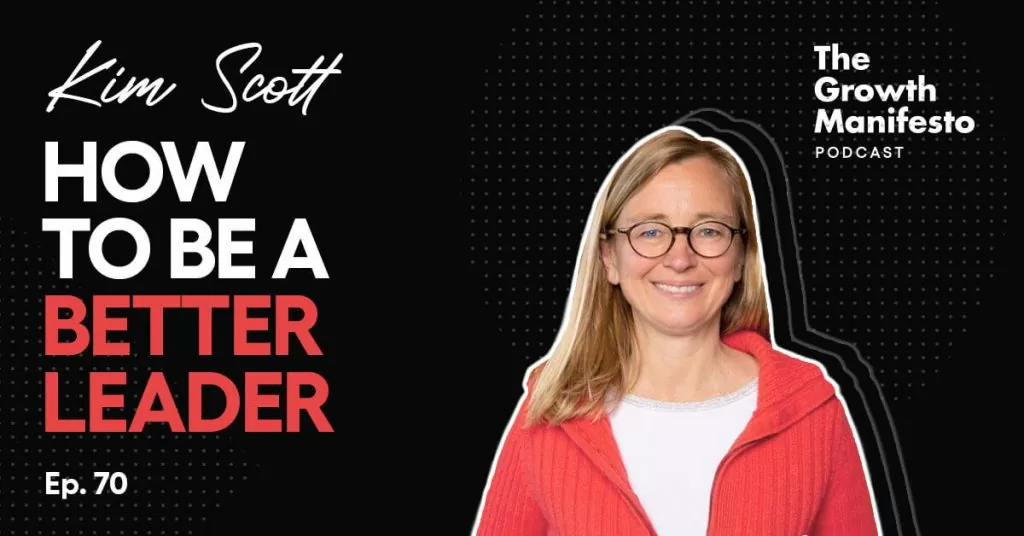
How to be a better leader
Kim Scott, author of Radical Candor and Just Work, on caring personally while challenging directly and dismantling bias, prejudice and bullying at work.
 with Kim Scott


Overview
This episode is with Kim Scott – author of bestselling books Just Work and Radical Candour. Kim was a CEO coach at Dropbox, Qualtrics, Twitter and other tech companies, and has led the AdSense, YouTube and DoubleClick teams at Google. In this episode we talk about how to be a better leader, discussing concepts from her books Radical Candour and Just Work.
Key takeaways
- Radical candor means caring personally about someone while challenging them directly, not just being blunt or nice.
- Avoiding a hard conversation out of ruinous empathy can cause more harm than the criticism itself, as her employee Bob's firing showed.
- Soliciting feedback well means asking a specific go-to question, then staying silent for six seconds to let the answer come.
- Bias, prejudice and bullying are distinct problems needing different responses: an I statement for bias, an it statement for prejudice, a you statement for bullying.
- Teams build bias disruptors through a shared vocabulary, a shared norm for responding, and a shared commitment to flag every instance.
Chapters
About the guest
Transcript
Auto-generated from the episode audio, so expect the odd mis-heard word. Timestamps open the video at that point.
unconscious bias often creates sort of an invisible tax on the team because let's say i mean i don't think you would do this but let's say you call me honey and so now you probably don't mean any harm when you call me honey but now i'm a little annoyed that you i feel like ah is alex taking me seriously so i didn't call her honey by the way just for the record yep but it but now it's It's like this thing in my mind and I'm not doing absolutely my best work.
Or let's say that you interrupt someone and that consistently the women on the team are being interrupted more than the men. The more often it happens, the more irritating it is for the women on the team or they just shut down. And so now they're not doing their best work, but also the team is not getting the best ideas out of the team. There's a lot of evidence that shows when everyone on a team participates roughly the same amount that the team performs better.
And so if you're sort of consistently interrupting or shutting down some members of the team, it hurts that person, but it also hurts the whole team's performance. When we're being biased, we're not respecting one another's individuality and we're not going to collaborate as well as a team. You're listening to the Growth Manifesto podcast, where we host in-depth interviews with business leaders, authors, industry experts, and entrepreneurs with a singular focus around business growth. At the end of each podcast, we want you to walk away inspired, to think bigger, and to have actionable takeaways you can apply to improve your business.
Each episode is like a masterclass on a key topic, so make sure to browse the episodes to find the topics that are most relevant to your biggest business challenges today. This podcast is brought to you by Web Profits, a digital growth consultancy that helps challenge your brands drive growth in a complex and fragmented digital landscape. You can find out more about Web Profits at webprofits.io. Now, let's get into it. Today, we're talking with Kim Scott. She's the author of the bestselling books,
Just Work and Radical Candor. And I'm sure that you've heard about those books. She's worked as a CEO coach at companies like Dropbox, Twitter, Qualtrics, and she's led the AdSense, the YouTube and the DoubleClick teams at a company that you may have heard of called Google. And today we'll be talking about how to be a great leader in today's world, which is a complex world. And just quickly, before we get started, make sure to go ahead and hit that subscribe button so you get the latest episodes as soon as they're released. Now, let's get into it. Welcome, Kim. Thank you so much.
It's great to be here. Yeah, fantastic. I'm excited about this conversation, but I do say that every time, but specifically because I know that there's been quite a lot of people at WebProfits even that speak extremely highly of your books. And there are so many people I've spoken to as well. that just love your work. But let's get straight into it. You've been a CEO coach for a while, and you've written a couple of books on the subject, but how would you summarize your approach on leadership? So the key to being a great leader is to know how to build
great relationships with the people who you work with. And it was very hard to write. When I first started writing Radical Candor, I thought, you know, it's hard to write a book about leadership when I hate the word leadership. I hate the word manager. I hate the word boss. Like, what do I call this even? Because there's such a bad feeling in the world about this role. And the fact of the matter is, it is a job. Being a manager is a job. And it's a job for which you get held accountable.
and it is not a value judgment. So the sooner you can lay down your power to the extent you have any and form good relationships with each of the people who you work with, the faster you're going to achieve better results. The faster you can lay down your power and build better relationships. That's an interesting one, right? So that does seem to talk to people who first start out their journey as leaders may have an incorrect view on, you know, what it means to be a leader. You know, they think that
they are the boss, right? Yeah. And it's their way or the highway. That's kind of just like a more kind of old school statement. But, you know, like you think, cool, so now I'm the boss. Now I have to be the boss, right? But what you're saying is that it's more about now establishing a relationship with the team, essentially. Yes. Yeah. Right. Absolutely. Absolutely. So a great mentor of mine, Richard Tedlow, who's a wonderful professor at business school. He said, do you want to be a boss or do you want to do the things that bosses do? And so what are the things that bosses
do? They solicit feedback. They give praise and criticism. They encourage, they gauge, they understand how what they're saying is landing for other people. And they encourage teams. So they build this culture of feedback. They build teams on which everyone can take a step in the direction of their dreams. And they achieve results, of course. And they do all of that by creating what I call a just work environment. And just both in the just get stuff done, but also in the justice
sense of the word, a fair and reasonable working environment. And that sounds, it's easy to say all those things, really hard to do all those things. And most of what I learned, I learned by getting it wrong. And we did speak about that quickly in the discussion before the podcast started, right? And so, look, I think we'll get into the details around this, like in this podcast, right? But am I right in saying, so yes, it's about relationships, but at the core of that is about trust? Yeah. And the question is, how do you build trust? How do you build trust?
And I would argue that you've got to care personally about each of the people who you're working with and at the same time challenge them directly. And that's kind of the definition of radical candor is when you're caring personally and challenging directly at the same time. Now, I love a good two by two. I think all of life's hardest problems can be boiled down to a good two by two framework. So let's sort of imagine a vertical axis on which we've written care personally and a horizontal axis on which we've written challenge directly.
Sometimes the mistake we make is we challenge directly, but we forget to show that we care personally. And that puts us in the bottom right-hand quadrant of noxious aggression. And in a first draft of radical candor, I called that the asshole quadrant because it seemed more, I don't know, radically candid. But I stopped doing that for a very important reason. I stopped doing that because I found as soon as I did, people would use the radical candor framework to start writing names in boxes. And I beg of you, don't use this framework that way, because these are mistakes that all of us make.
Sometimes I, too, I'm obnoxious. I try really hard not to be a jerk, but I land in that obnoxious aggression quadrant at least once a day. And there's a bunch of problems with that. One of them is that the biggest of them, of course, is that I harm someone else when I'm obnoxious. But in addition to that, the other problem is that when I realize I've landed in obnoxious aggression, it's my instinct that I have to fight against to go the wrong way on challenge directly. It's not my instinct to go the right way on care personally. If I did,
I'd wind up in radical candor. But instead, when I go the wrong way on challenge directly, I wind up in the worst place of all, the dreaded bottom left-hand quadrant, which I call manipulative insincerity. And this is where passive-aggressive behavior, political behavior, sort of backstab things that make, that destroy trust. This is where they creep in. And, you know, it's fun to tell stories about obnoxious aggression and manipulative insincerity, because this is where
the drama occurs. But in my experience, the vast majority of us make the vast majority of our mistakes in this upper left-hand quadrant, where we do remember to show that we care personally, but we're so worried about not hurting someone's feelings that we don't tell them something they'd be better off hearing in the long run. And that is what I call ruinous empathy. And ruinous empathy can also destroy trust. That's where people are sort of marching through their careers, and they know something's not going right, but their boss is not telling them what it is. And that also
destroys trust. Okay. So for the people listening, I'm sure they have already self-selected the place that they would be in, right? And I would say potentially for myself in the past, I would have been in the bottom right-hand corner, which you call obnoxious aggressive because I wasn't really in touch with my feelings so much. You know, there's something I've had to work on over the year so I could be a better leader is actually to know how to care while still pushing the challenges, right? And so, look, I'll put myself out there just for the listeners and just for the
podcast just to say, look, you know, but no one's perfect, right? And it's a journey, right? But it's kind of to be aware of it and to know that the goal is the upper right, right? And you will be defaulting to probably either the bottom right or the top left. I think if you're in the bottom left maybe that's um maybe that's is that too hard to come from like if you're being in no no is that just kind of easy to do as well i'll share with you my own hero's journey to manipulative
insincerity because we all wind up there some of the time so this happened shortly after i had joined google and i got into an argument with someone about an adsense policy and i sent him an email, sent it to him and about 30 other people, you know, we claim we want to organize the world's information and make it universally accessible and useful. But if it'll make us a buck, it turns out we're willing to create clutter sites that muddle the world's information. So this was not really my most politically astute moment. So why did I do such a thing? This is obnoxious
aggression. And the reason I did it was that I believe, like probably all your listeners, and there's a special place in hell for people who kiss up and kick down. And I was, you know, I was kicking up. But actually, it turns out that kicking up is not any better than kicking down. Like, common human decency is the one thing we can offer to everyone. It also turns out that that was not what got me in trouble in this situation. This executive that I sent that to
actually thought my email was kind of funny. The problem happened, and here comes the hero's journey to manipulative insincerity. The problem happened in what I did next. And what happened next was a friend of mine called me up and said, that was really obnoxious. Why'd you send that email? And I thought, gosh, you know what? That really was obnoxious. Why did I send that email? And then the next time I saw this executive, rather than moving up on the care personally dimension and sort of saying I was sorry, I lied. I said, oh, I'm sorry. You're right. I'm wrong.
Two problems with that. First was I was lying. The second is that it was pretty clear I was lying. This guy, like most people, had a pretty good BS meter, and he kind of glared at me and stalked off. It was one of those cringe moments where the guy sitting next to me looked at me and said, I think he likes it better when you disagree with him. So, so don't make that mistake when you realize you've landed an obnoxious aggression, but I'll tell you, there's another way we get to manipulative insincerity. You want another, you ready for another story? Okay. So, so this
happened. I had hired this guy. We'll call him Bob. And I liked Bob a lot. He was smart. He was charming. He was funny. He would do stuff like we were, we were at a manager offsite and we were playing one of those endless get to know you games. Nobody really wanted to be playing it. Everybody was stressed out. It was a startup. There was a lot going on. And Bob was the guy who had the courage to raise his hand and to say, you know, I can tell that everyone is stressed and would rather get back to work. I've got a great idea. It'll help us get to know each other and
it'll be really fast. And whatever his idea was, if it was fast, we were down with it. And he says, let's just go around the table and confess what candy our parents used when potty training us. Really weird, but really fast. Weirder yet, we all remembered. And then for the next 10 months, every time there's a tense moment in a meeting, Bob would whip out just the right piece of candy for the right person at the right moment. So Bob brought a little levity to the office. One problem with Bob. Everybody loved him, but there was one problem. He was doing terrible work.
He would hand stuff into me and there was shame in his eyes. He knew and I couldn't understand what was going on because he had this great resume, this great history of accomplishments. I learned much later the problem was he was smoking pot in the bathroom three times a day, which maybe explained all that candy that he had. But I didn't know any of that at the time. All I knew is that he was doing terrible work. So he would hand stuff into me and I would say to him something along the lines of, oh, Bob, this is such a great start. You're so awesome. You're so smart. Everybody loves working with you.
Maybe you can make it just a little bit better, which of course he never did. And this goes on for 10 months and eventually the inevitable happens. And I realized if I don't fire Bob, I'm going to lose all my best performers. And so let's pause though, before we get to what happened. Why did I say such a banal thing to Bob? It obviously wasn't working. And I think part of it was truly ruinous empathy. I really liked Bob. I really cared about him. I really didn't want to hurt his feelings. But if I'm honest with myself, there was more than a little bit of manipulative
insincerity in there. And the reason was that Bob was popular on the team. And Bob was also kind of a sensitive guy. And I was afraid that if I told Bob in no uncertain terms that his work wasn't nearly good enough, that he would get upset. He might even start to cry. And then everyone would think I was a big, you know what? And so the part of me that was worried about my reputation as a leader was the manipulative insincerity part. The part of me that was worried about Bob's feelings was the ruinous empathy part. Anyway, so this goes on for 10
months. And eventually I realized I'm going to lose all my best performers. So I sit down to have the conversation with Bob that I should have started 10 months previously. And when I finished explaining to him where things stood, he looked me right in the eye and he pushed his chair back from the table and he said, why didn't you tell me? And as that question is going around in my head with no good answer, he said, why didn't anyone tell me? I thought you all cared about me. And that was about the worst moment of my career because I realized I thought I had been
not being nice to Bob by not telling him. And now I'm having to fire him, having not given him an opportunity to fix the problem not so nice after all and so that to me is sort of a cautionary tale about how some combination of of ruinous empathy and manipulative insincerity can cause you to really harm someone who you're just trying to protect actually and it can happen so easily and it can happen from the best intentions and that's the part right because i'm sure that you
had the best intentions from it and you thought, Hey, I'm being a nice person. And you made all these assumptions that kind of ended up, you know, just not being right. Yeah. For Bob and then for the team. Right. It's kind of the natural kind of instinct thing. Right. So what, what can people do to move themselves up to the top right quadrant? You know, what are some things that, that people can kind of hold onto to say, all right, I'm doing that or I'm doing this, or I should be doing that more or not. So there's a definite order of operations to radical candor, and it all starts by soliciting
feedback, especially if you're the boss. But no matter what your role is in the relationship, you want to start by soliciting feedback. Don't dish it out before you prove you can take it. And so and what what do I mean? How specifically can you solicit feedback? Because if all you do is you say, do you have any feedback for me? You're wasting your breath. The other person is going to say, oh, no, everything's fine. Nobody, with the possible exception of your children, if you have them, they really want to give you feedback. But nobody else in your life really will eagerly give you feedback.
So you've got to do four things to ask for feedback. The first is you've got to come up with a good go-to question. And if all your listeners do as a result of our time today is this one thing, is write down your go-to question. what is, take out a pen, write down on a piece of paper, what are the words that are going to come out of your mouth when you want to ask for feedback? And so I'll give you a, but I'm not going to tell you what they ought to be because the words have got to sound like you, not like,
if you sound like Kim Scott, people will think it's a bunch of phony baloney. So you want to make sure that you ask a question in a way that can't be answered with a yes or a no. Like, do you have feedback for me? The answer is no. So for example, I like to ask, what could I do or stop doing that would make it easier to work with me? But I was talking to Krista Quarles when she was CEO of OpenTable, and she said, I could never imagine those words coming out of my mouth.
She said, the way I like to ask is, tell me why I'm wrong. Okay, that's fine too. You've got to ask in a way that works for you and crucially for the person who you're talking to. So, for example, I started this company, Just Work, with Jason Rosoff. And after we had worked together for a little bit, Jason said to me, you know, Kim, I hate your go-to question. It's too open-ended. It makes me nervous. And so I've had to adjust it for him and ask him more specifically about a meeting that I was in.
How, you know, did I interrupt him too much or whatever? Tell him what I'm working on and give him more time-bounded. So come up with your go-to question. If all you do today is write down what are the words that are going to come out of your mouth, this will be a really great use of your time. Okay. So there's three more parts to soliciting feedback. Okay. Well, let me just kind of just say the one point then, right? So then it seems like for most leaders, they will have like their one-on-one. So this could be like, is this something that they would have as kind of the beginning of
their one-on-ones if it's say once a month? Like, is that how it would work? like or like would it be done separately how would you advise like where should they be using this question yeah when yes so i recommend at the end of your one-on-one and i recommend that you have a one-on-one with everybody once a week so so so that's the answer you if you're if you're someone's manager and you have a one-on-one with them you want them to set the agenda you don't want to set the agenda. You want the other person coming to you with their thoughts, their ideas,
their new, you know, the things they want to create, whatever's on their mind is the main agenda of your one-on-one. But you want to save five minutes at the end to solicit feedback. Another good, really good moment in time to solicit feedback is when the other person is mad at you. Because people are more likely to tell you what they really think when they're mad that, but, but if you're like me, like if somebody is mad at me, it's my instinct to avoid them. And so you want to, you want to sort of challenge that instinct in yourself and try to
be willing to talk to people. If, as long as you yourself, if I'm furious, then it's better for me to avoid that person because I'm, I'm going to wind up in obnoxious aggression in that case. Sort of the other three things that you were going to say now. Okay. So, so now you've asked your question, the bad news, no matter how good a question you come up with, the other person is still going to be uncomfortable. The other person is still not going to want you, you want to put them on the spot with your question, and then you want to embrace the discomfort and you want to make sure that you just close your mouth and count to six.
I only made it to three just there. And I can tell you were about to jump in and say, No, no, I was, because I knew that was a test. So I was like, I'm not going to talk now. You passed the test. But most people will not pass the test. Most people will say something. Six seconds is a really long time. So now you've dragged this poor soul out on a conversational limb they never wanted to go on. They've said something. Now comes part number three. You want to listen with the intent to understand, not to respond.
because even though you just asked for feedback, when you get it, you're going to feel a little bit defensive. And that's okay. It doesn't mean you're a lesser mortal. It doesn't mean you're shut down to feedback. It just means you're a human being. So you want to extend yourself a little grace that you felt defensive, but at the same time, you want to manage that defensiveness. And so the best way I know of to manage your defensiveness is to be prepared to either repeat back what you think you heard or to ask some follow-on questions. So for example, my daughter
said to me recently, mom, I wish you weren't the radical candor lady. And immediately this huge wave of parental guilt washed over me. I thought, oh, I'm spending too much time at work. And then I felt defensive, but I've tried. And then I thought, well, I should pause and ask a follow-up question and make sure I understood what she's trying to tell me. And so I said, well, who do you wish I were? And she said, I wish you were the lady who minded her own business. So it was a
totally different form of fact. I could spend more time at work, in fact, as far as she was concerned. So you want to make sure you're listening with the intent to understand. And then last but not least, you want to reward the candor when you get it. And that means if you agree with the feedback, you want to fix the problem and ask the person, you know, did I go too far? Did I go not far enough? And if you disagree with the feedback, and this is really important because I think a big reason why people don't solicit feedback is they don't know what to do when they disagree
with it. And so what's the radically candid way to deal with feedback that you've just solicited that you disagree with? The first thing to do is to demonstrate that you're not defensive by looking for that 5% or 10% of what the person said that you can agree with and give voice to that. And then the next thing that you want to do is you want to have, say, can I get back to you and have an honest, open conversation with them about why you disagree, respectfully, not, you know,
in a bullying way. And at some point, you know, you've got to listen, challenge, commit. You can't argue endlessly, but at least the other person, at least you've made your listening tangible. The other person has been heard. That was awesome, by the way. And I think for all of the leaders out there, I think like at any stage of their career, this is going to be super valuable, right? So check the transcript and, you know, have a look at this part again and just take the notes down because like that was just literally the guide to kind of how you can start to be a better leader, right? So yeah, four simple things. Go to question. You want to embrace
the discomfort. You want to listen with the intent to understand not to respond. And then you want to reward the candor. I'll summarize in case you don't have time to go back to the notes. Because everyone's so busy these days. So let's jump to building and managing a team, right? Because a big part of the book, Just Work Now is kind of like how to avoid the biases and prejudice and the discrimination and the bullying and everything in there that actually will stop the team from performing well, right? So it's like, cause it's such a big topic, right? Yes.
Where did you get the idea for this second book, Just Work? You know, so where did that idea come from? Let's start with that. Cause that might give us some context of how to kind of lead the conversation. Yeah. Sure. Absolutely. So if you write a book about feedback, you're going to get a lot of it. And indeed I did. And so the most valuable feedback I got came shortly after the book came out, I was giving a presentation at a tech company in San Francisco. And the CEO of that company is someone who I like and respect enormously, and one of too few black women CEOs in tech,
or in any other sector, frankly. And she pulled me aside when I finished giving the presentation. And she said, you know, Kim, I'm really excited about rolling out Radical Candor. I think it's going to help me build the kind of culture I want. But she said, I got to tell you, it's much harder for me to roll it out than it is for you. And she explained to me that as soon as she would offer someone even the most compassionate, gentle criticism, she would get slimed with the angry black woman stereotype. And I knew this was true. And as soon as she said it to me, I had sort of
four revelations at the same time. The first was that I had not been the kind of colleague, the kind of upstander that I want to be, that I saw myself as. I had failed even to notice the extent to which she had shown up at every single meeting I had ever been at with her, unfailingly cheerful and pleasant. Believe me, in that period of time, she had what to be pissed off about at work, as we all do, but she couldn't show it. And I didn't notice and didn't help create a better environment for her. So one, I hadn't been an upstander. I hadn't intervened on her behalf.
Two, I had been in denial about the kinds of things that were happening to me as a woman in the workplace, kind of a hard thing for the author of a book about candor to admit. But I had had a hard time acknowledging to myself the extent to which I had been a victim of any form of workplace injustice. And the third thing I realized was that even harder than coming to grips with my role as victim was coming to grips with my role as perpetrator. As a white woman in the workplace, I had sometimes caused harm to my colleagues who were not white. And that was something that was important for me to come to grips with.
And then the fourth thing I realized was that as a leader, so these are roles we all play. We play the role of the observer, the upstander, the role of the victim, the role of the, you know, or the person harmed, the person who causes harm. And then last but not least, the leader. And as a leader, I realized that I had not always created the kinds of environments in which everyone could just work, could both just in the justice sense of the word and also just in terms of the just getting stuff done sense of the word.
And so that was what really prompted me to to write Just Work. And as you said, it feels like such a big monolithic problem. So one of the things I wanted to do was to break the problem down into its component parts so that we can fix the problem, so that it doesn't feel so intractable. And so one of the, you want to talk about bias, prejudice, bullying? Okay. Yeah, well, yeah. Well, like I think the big one is kind of how do we be aware of it? You know, how does it happen without us even knowing?
Yeah. How does it affect the team? And, you know, how do we kind of start to change it? Because maybe it doesn't just change with the click of a finger, right? And so it's not going to it's not going to change just because we want it to change. So to me, the thing that is most helpful is to break it, break the problem down. And so for me, the root causes of workplace injustice are bias, prejudice and bullying. And these three things, we often conflate as though they're the same thing.
And they're not. They're very different and the responses need to be different. The way that we respond as upstanders or as people harmed by these things are different. And the way that leaders can respond are different. So let me offer some super fast definitions. Bias, I define as not meaning it. It's usually unconscious and it's not really a belief that we believe when we examine it. Whereas prejudice is meaning it. This is a stereotype that we do believe that will stand
behind. Whereas bullying is being mean with the intent to cause harm. And so how can we respond? First of all, how can we distinguish between the three? Because it's not always totally clear. So I'll give you, you want a biased story? I'll tell you a biased story. I mean, I want a story for all of them, actually. Okay, I'll give you three stories to help distinguish. Yeah, because I do think like, you know, the words are very emotionally charged words, but I think the practical element of them can happen super subtle, right?
Like it can happen without you even knowing it's happening. And it can be, it could be bullying and you're trying to be funny, right? And that like, it can happen super easy, right? So like, I'm super interested, like in unpacking it because the words are big, but I think that everyone probably has something that they're doing that they don't even know they're doing. So yeah, the stories I think would be super helpful just to really get people understanding it a bit more. Yeah. So one of my favorite examples of how an upstander can change bias in a situation comes from Aileen Lee who founded Cowboy BC.
And she was going into a meeting with two colleagues who are, who are men and she had the expertise that was going to win her team, the deal. And so they file in and Aileen sits in the middle of the table and her two colleagues sit to her left. And then the other side comes in. First person sits across from the guy to Aileen's left. The next guy sits across from the guy to his left. And then everybody else files on down the table, leaving Aileen dangling by herself at the end. And so very often that's how bias manifests.
It's just in where we sit, the assumptions we make and where we sit. But Aileen was not to be deterred. She's a determined person. And so she started talking. And when the other side had questions, they directed them at the two men who she was with and not at her, even though she was the one talking. And it happened once. It happened twice. It happened a third time. And her business partner stood up and he said, I think Aileen and I should switch seats. And they did.
And the whole dynamic in the room changed. So that was all he had. That's what I call an I statement. That was all he had to do to help the other side become aware of what they were doing and to stop doing it as soon as they became aware. And he did it for two reasons. One was he cared about Aileen and he didn't like seeing her get ignored. But two was he just wanted to win the deal. And he knew that if he couldn't get them to listen to her, they wouldn't win the deal. And so that is a simple example of an I statement that invites the other people in to understand
things from your perspective. This is for bias, right? For bias, yeah. This is sort of an I statement is a good response if you think what you saw was bias. Okay. So basically, so we're talking about the bias and we're saying, cool. So if you notice it, right, that's the first part is to notice the bias. But then to solve the bias is to say, hey, I, and you finish that sentence, I think this should change. I think that is something to happen. How do you be aware of the biases? Because that's a good story, but that's a story of one thing that we see.
Where are the other things that we don't? It's unconscious. So almost by definition, we don't notice it when we, this is why I think, and this is something that leaders can do. Some people can become more self-aware and stop their biases that way. Most of us need other people to point them out to us. And so one of the things that leaders can do, because I had to think a lot and talk to a bunch of people to get to that Aileen Lee story, because it doesn't happen. More often than not, nobody says anything.
And so one of the things that leaders can do to help it become more likely that upstanders will stand up to bias, we'll point it out, is what I call to create a system of bias disruptors. And there's three parts to bias disruptors. The first is you want a shared vocabulary. So what is everyone on the team going to say when they notice bias to flag it? So some teams that Trier Bryant, my co-founder and I have, some teams that we've worked with
have used phrases from Daniel Kahneman's thinking fast and slow. Others have used, I don't think you meant that the way it sounded. Others have just said, yo. And so as soon as somebody says, yo, everybody else knows that's some bias. Trier recommended to me that we use a purple flag. So now I've bought these purple flags. And whenever someone on our team waves a purple flag, we know that it's a friendly purple flag, you know, and someone has said or done something that's biased.
So one is just a shared vocabulary that makes it more natural for everyone to point it out when they notice it. The second thing is a shared norm about how to respond when your bias has been pointed out. Because it's one thing to point out someone else's bias, but I don't know about you, but I always feel profoundly ashamed when I realize I've said something or done something that's biased. And so helping people move through that shame and respond productively instead of defensively
is really important. So basically, you get two choices. Either thanks for pointing it out. I get it. I'll try not to do it again. Or thank you for pointing it out, but I don't know what I did wrong. Can you tell me after the meeting? And that second one is really hard. Because now I'm doubly ashamed. I'm ashamed because I've harmed someone and I'm ashamed because I'm ignorant. I don't even know what I did wrong. And so that's tricky. And so letting people know that that happens to all of us with some frequency and that
you need to respond by... I'm not going to tell anyone how to feel, not to feel ashamed, because you probably will feel ashamed. But you need to move through that shame and not let the shame sort of prevent you from responding well. So that's the shared norm. And then the third part of bias disruptor is that you need a shared commitment. And if you get to the end of a meeting and no bias has been disrupted, you need to pause and think about what you didn't notice that you should have noticed.
What did people not feel comfortable pointing something out? because there are so many different kinds of biases and we're all learning together. And the more sort of quickly we can point them out, the faster we'll learn. And it doesn't, the more often we do it, it's not that big of a deal. So two questions quickly. First one is, you know, so what are some of the biases that can happen? Because you said there's a lot, but if you could just list a few of them. And the second part is,
how do the biases actually affect the team's performance? Yeah. So let me take the second question first. Unconscious bias often creates sort of an invisible tax on the team because let's say, I mean, I don't think you would do this, but let's say you call me honey. And so now you probably don't mean any harm when you call me honey, but now I'm a little annoyed that you, I feel like, ah, is Alex taking me seriously? So I didn't call her honey, by the way, just for the record.
Yeah, you didn't. Yep. But now it's like this thing in my mind and I'm not doing absolutely my best work. Or let's say that you interrupt someone and that consistently the women on the team are being interrupted more than the men. The more often it happens, the more irritating it is for the women on the team, or they just
shut down. And so now they're not doing their best work, but also the team is not getting the best ideas out of the team. There's a lot of evidence that shows when everyone on a team participates roughly the same amount that the team performs better. And so if you're sort of consistently interrupting or shutting down some members of the team, it hurts that person, but it also hurts the whole team's performance. When we're being biased, we're not respecting one another's individuality, and we're not
going to collaborate as well as a team. So that's the problem. So what are some examples of bias? I'll give you some of the ones. So one of the things I did when I wrote Just Work, because I know that I exhibit bias like everyone. So I hired a bias buster. I hired someone to read through the book and to point out problematic language that I was using. And one of the things that you pointed out is that I tend to use sloppy sight metaphors. So the first chapter of the book is now called, We Can't Fix Problems We Refuse to Notice.
But at first it was, you can't fix problems you don't see. And of course, I didn't really mean physically see, I meant notice. And so it was an ableist, sort of ableist language. and I knew that it was right. And I care about words, like words matter to me. So I wanted to use the right words. And I realized that I was probably frustrating one of the other editors of the book who's blind, one of the clearest thinkers I know who notices everything, but he's
blind. And so I really cared about fixing this and I really thought I had fixed it. But when I turned the book into the publisher, I thought, well, I should do a quick control find and make sure. In a 350-page book, guess how many times I had used sloppy sight metaphors? 99. 99 times. Yeah, okay. And so I was shocked. So this can be, you really need to be persistent with yourself.
Be patient with yourself. Like I didn't need self laceration was not going to help solve the problem, but I did need to be persistent about my efforts to fix this problem. So that's an example of biased language. So, but it seems that it seems that it is linked or it should be linked to your values, right? If there are things which you value, so for example, like that you valued how that person actually was basically understanding the book and how that segment was understanding the book.
And so that kind of led you to be open to it, right? So it does seem to maybe start from, you know, what's important to you and that can then lead you to being courageous enough, I would say, to see how you are. to notice your, I say again, I say to notice how you are, right? Because it can often feel maybe sometimes overwhelming to people like who are listening to think of all the possible things that they could have some bias in, you know? But how do they know the place to start, right? Because
like if you gave a list of all the possibilities, it would be like, whoa, okay. It would be daunting. Yeah. I mean, I will tell you that the bias buster who I hired gave me a list of eight words that I tend to use that I would be better off not using, that I needed to re-examine. And yeah, I'm kind of ashamed to admit this, but my first response was, no word in the English language is safe. And it was eight words. There's like, I don't know, 250,000 words. And so it was a tiny fraction. So I think that this is why I like the notion
of bias disruptors. You don't have to fix all the world's problems all at once. You don't have to make an exhaustive list of biased terms would not be helpful. But what you do need to do is to be willing to hear about it when someone when you've when you've said something that that bothered someone else that harmed someone else in some way that reflected a stereotype that you don't believe when you stop to consciously think about it and so if you're willing to sort of take it as it comes
then it's not that big of a deal okay so it's being open to it um so when it pops its head up and it will pop its head up and if you're open to it then you'll notice it but if you're not open to it it would just be that defensive mode right um that can happen yeah yeah yeah absolutely you you want to and you want to notice your defensive but it's natural like i i wrote in fact about my defensive no word is safe in the english language i think it's important to recognize that and not to
not to sort of judge yourself or other people too harshly, but to recognize that this stuff is hard. I was working with a CEO, for example, and he was trying to stop standing up in front of the whole company and say, refer to everyone as guys, because the whole company was not guys. There were women who worked there and people who were not binary who worked there. And so you wanted, he was really trying to say folks or you all or whatever, but it took a long time. Some of these habits are deeply ingrained. And so you want to like a word that I say that I really am trying not to say is crazy.
and and so you want to well because it's usually what i mean is something more specific and it's not really fair to people who struggle with mental illness legitimately it tends to conflate people who are being irrational or people who are being super aggressive with mental illness and those things are very different things and so so again i mean look i'm But being careful with language is really, really important, right?
Words really matter. Yeah, being specific with what you mean and not trying to find a word that summarizes everything into how you would see it. And this is a conversation I have with my friend sometimes. He says a word, and I'm like, I really don't know what you mean by that word. Could you use a few more words, please? And it's a bit lazy sometimes with language, you know? Yeah. And then he says it. I'm like, wow, I wouldn't have got that from what you said. That word didn't match that sentence at all, you know? Yeah, yeah. And it's, I mean, it's a helpful thing in communication to question one another's words
and to try to be a little more precise. This conversation is going like very quickly for me, but I am just noticing time's flying. So I'm going to try and just cover a few more points in the time we have left. But you talked about prejudice kind of is a more conscious conversion of bias. Like, could you talk about that like a bit more or just expand a bit more? Sure. Sure. So a great way to explain this is in a story that Trier Bryant, my co-founder, tells. She was in a hiring meeting and everyone who had interviewed all of the candidates agreed
that the best candidate for the job was a black woman who had worn her hair out naturally. And the hiring manager said, well, we can't extend an offer to this candidate. And Trier said, well, well, why not? She said, well, we can't put that hair in front of the business. And believe me, nowhere in the job requirements was hair. And so this was, she was very consciously defending her decision, her prejudice about this candidate's hair. And so this is where an it statement is
helpful. And an it statement can appeal to the law, it can appeal to an HR policy, or it can appeal to, so it is illegal, which it was in the state where they were working, not to hire someone because of their hair, or it is an HR violation, not to hire someone because of their hair, which it was at that company, or it is ridiculous not to hire the most qualified candidate because of their hair, like what is wrong with you? And so, so that is what is useful, a useful response to prejudice when you notice it. And very often, you're not sure what to say. And so,
my recommendation is start with the word it and see what comes out of your mouth next. And other times, though, there's no belief at all. It's just bullying that is happening. The person's just being mean. And so, in those cases, I think a use statement is the right response. You can't talk to me like that or or something along the lines of what's going on for you here. And I learned this from my daughter. She was in third grade and she was getting bullied on the playground.
And I was advising her as her teachers had advised her to say to this kid, you know, I feel sad when you blah, blah, blah, blah, blah. And my daughter banged her fist on the table and she said, Mom, he's trying to make me feel sad. Why would I tell him he succeeded? And I thought, that is a really good point. And so the idea of a you statement is you're no longer in the submissive role vis-a-vis the bully. You're sort of saying, you can't, you're pushing back. You can't talk to me like that.
Or what's going on for you here? Or even just change the subject. Where'd you get that shirt? So now they're answering your questions and you've created kind of a consequence. And if you're the leader and you notice bullying occurring, it's your job to create consequences for bullying because bullying works for the bully, but it's bad for the collective efforts of the team. And part of your job as a leader is to optimize for collaboration. And so
you want to create either conversational consequences or don't give, you want to create compensation consequences. You don't want to give them bonuses or career conversations. You don't want to promote your bullies for example uh there's a point i joke in every company's history when the assholes begin to win and that's the point when the company begins to fail i think so you want to make sure the culture goes toxic uh failure often takes a little while longer to
manifest but so but so is there um with bullying like it's obvious that you know like i don't think any company wants it. And the overt examples of it are obviously obvious. I mean, that was a weird statement, but they're obvious, right? But are there like the less obvious versions of it where it doesn't look like bullying, but maybe it is because of how the person is actually feeling? Or is that more prejudice? Like I'm just trying to understand just where it could be bullying,
but potentially like it's not easy to see. Yeah. I think one example is what I call the bloviating bullshitter. And so, so this is the person who, am I allowed to curse? Yeah, you can curse. You can curse. I should have asked in the beginning. No, no, no. It's fine. Curse away. So there's, there's, there's often this person who comes into a meeting and takes way more than their fair share of the airtime. They talk, you know, there's 10 people in the meeting and this one person talks 50 or 60% of the time. And that is,
so often that person gets rewarded for dominating and, and what they should be getting, what should happen is they should be tamped down. And you often that person doesn't intend that, they don't think they're being a jerk. They think they're making a great contribution. And more times than not that person is not underrepresented. Because if you do that as a woman or a person who's not white on a team, then you do tend to get shut down. Whereas if you waltz in and you look like
the management team of your company, then you tend to get rewarded. And so I think that's an example of a kind of bullying where it's not necessarily intending harm, but it causes harm, and it's taking advantage of over-representation. So that's one example. There are other times when people don't intend to act like jerks, but they do act like jerks, and they do harm others. And
And so they are mean without meaning to be mean. And it's really important for that person as well as for the person that they're harming to point out this behavior so they can stop it. Like, is that what condescending is? Is that like a version of bullying is, you know, to condescend someone? Is that like, because that's something that people can just do without even knowing they're doing it. But if someone's watching it, you can see it happening. It doesn't feel comfortable to see it. But the person who's doing it sometimes doesn't even know. Like, is that a version of it? Yeah, absolutely. And I think condescension is a version of something that managers tend to do
without realizing. They think, ah, you know, I'm in charge. And then they start to behave differently towards people than they did before they became managers. I mean, another version of it is very often people who have power feel more comfortable physically approaching and getting close to others. And that can be a form of bullying as well, usually unintended, sometimes
intended. And sometimes it goes all the way to one of the things I talk about in the book is you get bias, prejudice, and bullying. And then when you layer power on top, bias and prejudice become discrimination, sort of bullying plus power becomes harassment and physical touch plus power, whether it's positional or you're just physically larger becomes sort of a physical violation. And so you want to make sure that you're taking care to create checks and balances on power in
your organization so that you don't get discrimination. Okay. So the people that are listening, right. And they're hearing this and they're like, well, I don't want this in my company and I'm a leader and so I don't want this in my team she just said a lot of stuff and obviously everybody should go to buy the book right yes buy the book read the book but some in terms of high level stuff you know so what are some things that the listeners can do today or you know like the few things to get them started because this does feel like a very large topic it feels like we're trying to climb like a huge mountain you know what's the base camp you know
What's the first thing? Yeah, Basecamp, I think, are the bias disruptors. So get your team comfortable disrupting each other. Start with yourself. Get them comfortable disrupting your biases at the very least. And if they can do it for you, they're much more likely to do it for each other as well. In terms of preventing prejudice from manifesting on your team, you really want to think about having a code of conduct that explains to everyone there's a line.
And on one side of the line is everyone's freedom to believe whatever they want. And on the other side of the line is they're not free to impose their beliefs on others. They're not free to do or say. And every team, every company draws that line in a slightly different place. And so the more explicit you can be about where that line is, the better. And then in terms of bullying, you want to make sure you're, again, creating these consequences for bullying, that you're not promoting the brilliant jerk on your team, that you're not
giving people a big bonus for achieving results but harming the rest of the team, that you're learning how to shut down the bloviating bullshitter in the meeting so that everybody has a chance to talk. So those are three things that leaders can do. Bias disruptors create a code of conduct and create consequences for bullying. That'll really begin to chip away at these problems. And I think that's really, really, the second book is like a really good kind of like addition to the first book because the first book could be like, well, I'm just being candid, right?
Yeah. And actually, well, now you're actually going against, maybe you're being biased, maybe you're being, so I think it is a good combination, I think. And that takes you more to the caring part of it, right? This is, you've got the challenge side talked about, but this goes into the caring side and actually trying to understand how everyone actually experiences the workplace. And especially now where everything's on Zoom and starting to become like a lot more like decentralized and global. Be careful, you know, having a team that's overseas
and trying to make a joke that you think's funny and it's not funny. Like it can, it, it can kind of happen without you even, you know, knowing it because of how things are changing in the world. Yeah. Is that a fair statement to say? Absolutely. I mean, the core thing is to being open to learning about it, to, to take a growth mindset. I think very often Carol Dweck wrote this great book mindset and, and it's very, it's sort of, it's hard to have a growth mindset, even about math skills, you know,
to relish getting the problem wrong because you're learning something. It's even harder to have a growth mindset around these issues because it feels like when I realize that I've said or done something that is biased, it feels like my morality is being judged. But as my sons, well, let's end this with words of wisdom from my son's baseball coach. He said to the kids on the team, he said, you can't do right if you don't know what you're doing wrong. And so all of us
want, I'm going to assume not all of us, but the vast majority of us want to do right. And so we've got to be willing to learn what we're doing wrong if we want to do right. Kim, what a great conversation that flew by. We just touched the surface in terms of the content that's in the books. And so for the people that are listening, you have to get her books about this topic. It's called Just Work. And obviously you probably already have the Radical Candid book, but if not, check it out. You just got a small little kind of taste of the content in there, but the book goes into a lot more detail with a lot more information and frameworks and lots of
different outcomes. But Kim, if there was one thing that you wanted the listeners of this show to do a site, to visit somewhere, to subscribe, anything, what would you want them to do? Go to Just Work Together. And there's a place on the site where it's justworktogether.com where you can submit your story. I think the more we are able to tell our stories about bias, prejudice and bullying, the more we're able together to really create change in the workplace and to be able to just work in the sense of justice and also getting stuff done.
Kim, thank you so much for coming on the podcast. This has been like a very enlightening and very topical discussion. And I think it's going to help a lot of the leaders in the world just improve how they lead, including myself. So thank you so much for coming on the podcast today. Thank you so much. Really enjoyed the conversation. Awesome. Thanks for listening to the Growth Manifesto podcast. If you enjoyed the episode, please give us a five-star rating on iTunes. For more episodes, please visit growthmanifesto.com forward slash podcast. And if you need help driving growth for your company,