
How to develop a digital strategy for 2020
Webprofits' Ben Fitzpatrick shares a 10-question framework for building a marketing and sales strategy through an economic contraction.
 with Ben Fitzpatrick
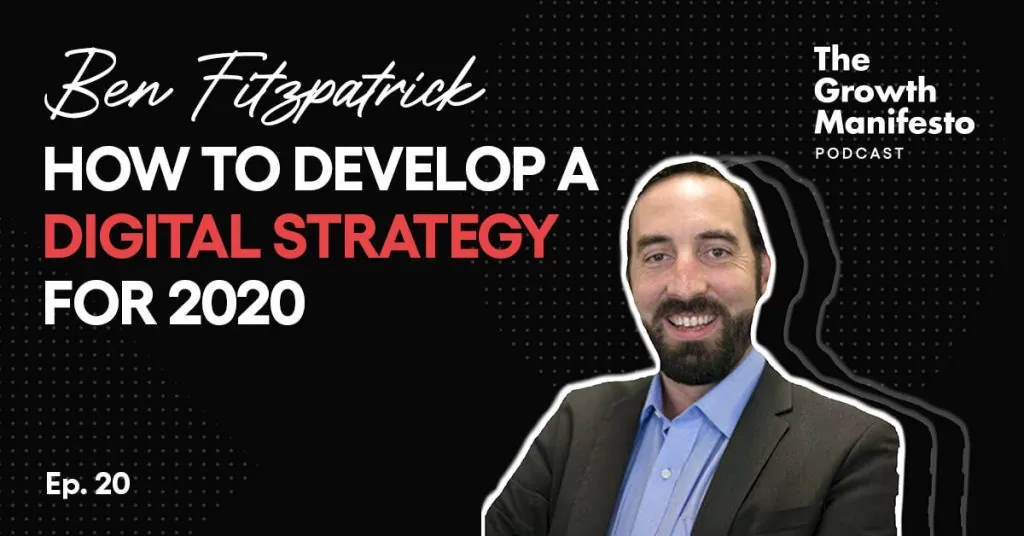


Overview
In this episode we speak with our Head of Strategy, Ben Fitzpatrick, on how to develop an effective strategy to drive growth through an economic contraction.
SHOW NOTES
—
You’re listening to the 2020 Marketing Series on The Growth Manifesto Podcast, a Zoom video series brought to you by Webprofits where we talk about how to drive business and marketing success through the rest of 2020.
Key takeaways
- Fitzpatrick argues businesses should rebuild the fundamentals of paid search, organic SEO, social ads and email before launching bigger campaigns.
- Documenting messaging and campaigns internally lets a business stay consistent and pivot quickly the moment something starts working.
- Businesses scale more effectively by finding one offer that breaks through and expanding it to new audiences, rather than trying to scale everything at once.
- The biggest competitor is not another business but a consumer's instinct to save money, so an offer needs to deliver clearly outsized value.
- Sales and marketing teams need tighter integration, sharing feedback on lead quality since old sales processes can't be assumed to keep working.
Chapters
- Intro: strategy for the rest of 2020
- The 10 questions framework begins
- Question one: your unfair advantage
- Question three: riding market trends
- Question four: shifting audience segments
- Pricing for value, not discounts
- Building an aggressive market offer
- Adapting the sales process
- The final question: one big bet
About the guest
Transcript
Auto-generated from the episode audio, so expect the odd mis-heard word. Timestamps open the video at that point.
Today, talking with our head of strategy, Ben Fitzpatrick, who leads the biggest campaigns across the company, and he's basically the head of strategy across all of the client campaigns. There's a lot to introduce about Ben, but I think we'll just leave it there right now. But needless to say that he's at the forefront in terms of actually how strategy is created at WebProfits.
And so today, we're just going to talk through strategy, through the COVID-19 pandemic, through the recession that is sure to follow, and just through the rest of 2020. because I think the conversation is now starting to shift to what do we do for the rest of 2020, you know? And so what's interesting is we were talking about some campaign ideas just for ourselves last week. And Ben was like, you know,
there's actually still like eight months left of 2020. And I think it's really easy to forget that, isn't it, Ben? Yeah, well, there's been a lot that's happened, that's for sure. So it's, yeah, there's lots more to come. And I mean, we're just at the start of this, really. I think that's the thing that is kind of reinforced for me. Like the calendar year is, you know, relatively arbitrary timeframe, but it's just kind of a reminder that, you know, this really just happened. So the repercussions of it are going to be, you know, are going to be ongoing for quite
some time and that needs to affect you know how we uh how we act as marketers yeah and i think um it's been such a challenging two months you know i think like if you think about just a second ago we were having um to deal with the bushfires i forgot about the bushfires like i don't quite sure about you like but you know yeah like that was at the beginning of this year totally and i I'm here in New Zealand and we had this big month of drought,
like one of the worst kind of months of drought we've had in quite some time just before COVID-19 hit. And I mean, you know, I haven't heard. It's like a different life almost, you know. But yeah, just two, three months ago. Yeah, and I think like so much can happen in, let's say, what is it now? so we're recording this on the 5th of May right so if you think about that's only four months
since the first of the year yeah so since the beginning of this year it's only been four full months right and if you think just how much has happened in the last four months right and then you say to yourself okay well there's eight months left of the year so if we could replicate two times how much stuff has gone into to marketing to business it's like like that could give it some context right because it doesn't seem like a lot of time
like if you say there's eight months left in 2020 right you're like oh actually it's not that much time but we've only gone through four months so far of 2020 like whoa okay well like it's I think also like, look, hopefully there aren't big, terrible global events, you know, more terrible global events that happened in 2020. But certainly for businesses and marketers to succeed for the rest of the year, they're going to have to perform in the way that they've had to perform in the last four months just to get to where we are.
because it's going to get harder and it's going to get more competitive. And, you know, some markets are going to shrink. And yeah, I mean, like, it's going to be a really tough year. So regardless of kind of the global, you know, picture, the reality is like we know that there's going to be a lot that we need to do to succeed as marketers in the year ahead. And I think that should frame kind of how everybody looks at it um because it's easy to kind of think okay we made it through this and now we can get back to
back to normal or back to kind of like so a lot of people talk about new normal and stuff like that and like i actually think that's kind of probably a dangerous framing um why is that because when you think of normal you think of uh i mean i would i would kind of uh related to kind of ideas it's a bit easier or you know, you can, there's not as much pressure or there's, you know, you don't have to keep up the intensity.
And like, it's been such an intense period that I think everybody would like to, to pull back on that. Right. Like it'd be nice to, you know, just have a couple months where we, you know, we have our plan. We work to our plan and optimize within it, you know, and report on what happened, get some good results. You know, like that sounds great right now. That sounds great. But I – and it might happen.
You know, it might happen, but I wouldn't plan for it. I would plan for it to get harder and more competitive and everything that, you know, has started to work right now for that to evolve as well. Yeah. That's just how you have to look ahead. Yeah, sure. And I think, let's say like in the last two months since the pandemic hit, there's been a lot less competition online because everybody's been so stuck. Yeah. And I think as part of that stuckness, quite a lot of people or of companies
have now started to consider the digital space, you know, in terms of advertising. And so now there's a lot more people that are about to start advertising online. And then everybody that had kind of stopped advertising because of the uncertainty, they're about to start advertising as well. So it's about to get really crowded, right? And it's about to get crowded, I think, at a time when everyone's like, okay, cool. So now we're back online again now. And now we have to make this all work, right?
And so I think that's a good transition to kind of the topic of this podcast, which is actually how do you create a strategy in that challenging environment where everyone's coming online? It's not status quo. We don't know what's going to exactly happen across the globe. I mean, in terms of the pandemic, but then also in terms of the economy, right? and like that's a difficult place to compete that's a that's a challenging place to live you
know um and you know like in a couple of my emails i've been talking about survival of the fittest right where it's a contracting economy um the pie is still there it's a smaller pie there are the same amount of people who want to eat that pie and so how do you actually try to um to carve out a piece of that pie just for you right and so look i think in that email that i sent the other day i shared 10 questions and i figured you know we could talk about those
questions in this podcast you know um i think and so like i have a little bit about the like the overall approach that a business needs to take and there's kind of a couple of things that I think are important that everybody keeps front of mind. The first one is that like business, the business side and the marketing side, it's never been more important that they're directly connected because you really need to be open to evolving, you know, your offer,
your, even your service or, or, or your product to what's going to work. And I think we've seen that across, you know, a number of clients of ours, you know, and businesses, you know, globally where, you know, they've been able to evolve their service in a way that really fits the moment. And they then their marketing has immediately been able to evolve with that or potentially the marketing led that evolution. And I think that's something like as a core, like principle, like
businesses should, should try to maintain, which is, you know, where marketing is successful is going to show you where the market is. And so if you're, you know, if your product is kind of just right next to that, like move it over into it. And that's like a lot, you know, smaller businesses are better at that. Bigger businesses generally really struggle with it. But we've seen some great examples of, you know, larger businesses kind of developing whole new, whole new services just for right now. And that's, I think, something that shouldn't let up
because we just don't know where the market is going to be, you know, what consumer, like I remember we talked about at the start of this, I was saying, look, consumer habits are going to change dramatically and all these things. And you were telling me, we don't know that. We don't know what's going to happen. We don't know, like, you know, how there's going to be changes. There's going to be repercussions, but we have no idea what they are. And I think it's important to keep that mindset. So that's kind of the first one that I've been thinking about. The next is that like a lot of businesses have pulled back on different parts of their marketing.
And so I think a lot of businesses potentially have lost some of the fundamentals in the process. Like to me, the fundamentals of digital marketing are paid search, organic SEO, social ads, and email marketing. Like that's pretty much to me, there's rarely a case of a business that I wouldn't, you know, push to try to do, you know, something across all of those. You know, the balance between them changes a lot between different industries and businesses.
but you know a lot of businesses will have pulled back on the you know turn off search or turn off facebook ads or something like that and as they come back you know i think it's important that they take a step back and actually make sure that they do have you know all of the fundamentals in place before they try to do something big you know like don't run a big campaign if you don't have the you know all the ad strategies to um to get the most out of it um and then the last one is one that I've been thinking about, which is a bit strange, but it's to document everything
because there's so much change going on in terms of messaging. And it's really easy to, and products and services and what you're marketing, but it's really easy to have, you know, one place in your ads that you're saying something completely different. or you may find an opportunity and really want to pivot everything over to that opportunity really quickly. And if you don't have documented what you're doing right now and what you've previously done,
then it's really difficult to go out across all your digital and find it and know where on the website to change and know all the different search ads you need to change. And I think consistency right now is more important than ever. You know, like if you have a message that you want to put out there, it's important to be consistent about it. And part of that is actually just having, you know, having that kind of internal documentation and organization to know this is what we're doing right now. So that when you decide what's going to work, you can move right on to that quite quickly.
That's kind of the, those are the three like big things that I've been thinking about, you know, as I would kind of plan for the year ahead. yeah super point super points um you know what's interesting is that um two months ago it was all about um changing the message right like and everyone was scrambling to change the message and i think you know there's still a lot of organizations that haven't changed their message and they're just kind of holding off and they're just kind of seeing how it goes
but there's a lot that have like if you watch any of um the ads on tv they've all shifted essentially you know there's quite a lot of change that's already happened right and so i think you know we assume that the message is right in terms of this podcast right now you know like we're not there to talk about the message i think we've we've spoken about the message quite a lot um yeah the message is just um the cost of entry like if you're not relevant in terms of the
thing which you're saying like start there there's some other podcasts that we've done that's there right and so we're assuming that the message is now um correct right this podcast we will now speak about cool so now actually how do you stand out when everybody's adapted when everybody's now talking to people at home or basically online or in 2020 or whatever is the scenario that's there and then how do you now compete right so i'm going to go through some of the questions right and
um hopefully we can answer them pretty quickly um but it's just kind of um it's more of a discussion right now you know it's the first question to ask yourself i was where are you the best right now And what products or services have you got an unfair advantage over your competition? Yeah. So let's talk about that one. How important is this, Ben? I think this is the start. This is what I was just saying about being ready to evolve your products and services.
The first step of that is actually understanding which of your products or services are the most relevant right now. You know, in like, I've been, I guess, unsurprisingly over the last month doing a lot of the work on e-commerce because e-commerce businesses are, a lot of them are doing quite well. And, you know, in that context, it's often about like, what are the products or services or what are the products that we can build offers around? And then, you know, those offers are what we can really use to scale your marketing
up. But that principle really applies across all, you know, all of marketing. And it is looking at like everything you do and determining what's going to what's going to have the biggest impact of breaking through because you build your marketing around that. You know, I mean, there's in search, there are opportunities to just like build out campaigns for every single service you have. Right. Like that's that's definitely something you can do. And if the volume is there, it could drive conversions. if the volume isn't there, you're not going to pay for it. So, you know, that's kind of fine.
But across everything else, you really need to focus on, you know, what can, what can break through. Um, yeah, I'm sorry. I got you off. No, I'm sorry. If you don't know the answer to that, like that's, that's where you start, you know, and there's, there's lots of ways to do it. You can talk to your consumers. You could, I mean, put up five ads with five different services and, and see which one gets the most engagement. I mean, like, but that's where you start. You got to figure out, you know, the, the best is important though. Right.
Because I think like in a contracting, um, in a contracting environment, um, contracting economic environment, um, you need to be the best at something and you need to have an unfair advantage over the competition to really be able, um, to thrive right now. And it may just be like in the mind of your consumer, but there is a difference to your product than to the competition right now again it's not that simple oftentimes but you need to have something super high quality it could be a product or
service or a product range or a suite of services that offer extreme value compared to the competition in some way or another you should assume your consumers are going to be more discerning right like there's just there's less money out there and people i mean people still have to to buy stuff they're going to still need services but they're likely to to take more time to think about it and so that just means it's more important that you know you can differentiate yourself question number two where are you most profitable and where is the most demand you know and i think
profit actually makes a difference to how much you can afford to pay to acquire a customer right and demand is where the volume is right and hopefully you can combine the two but oftentimes it's not exactly aligned so if you had to go to this is a hard this is a harder question um it is to where you're more profitable or where there's more demand where would you go i mean i think it's complicated i think this is a question every business has to understand
for themselves. You know, I mean, like businesses can be really profitable by using loss leaders to bring in customers and then, you know, build up the lifetime value over time. So it's really understanding the overall profitability model across your marketing. Like I think if you, if you overly focus on, you know, this is my most profitable service. And so I just, I just want to sell that, you know, you can take yourself down the wrong path. That's, that's for
sure. And so that, I mean, it kind of ties into what I was talking about in terms of the business side and the marketing side really need, needing to be fully integrated right now. Because that's kind of, it just needs to be the ongoing conversation, right? Like if marketing is driving, you know, a new business, but all of those businesses are unprofitable, and then they don't go anywhere, like that needs to change fast, right? Like that's not, that's not sustainable. But on the other hand, if it's just kind of a directive of you have to sell this,
and whatever that product or service isn't, isn't profitable, that's going to fail as well. So this is, this is one of those questions that I mean, I would say it's like, it should probably be part of like, your weekly meeting, you know, like something around, you know, what is the profitability of our overall marketing look like right now. And it should be measurable. I think that's a super point. And this is something that we've been doing internally and with clients as well, is having kind of the regular catch-ups on kind of what's happening in
the market. You know, where's the demand? What are the leads saying? And what are the conversations kind of happening out there? You know, what are the biggest challenges, the objections, you know and i think keeping your ear to the ground is going to make a huge impact in how quickly a company can adapt right um to be able um to capture a piece of that pie but next question so what are the trends in your market and how can you ride that way and and how can you ride that
wave and i think um this kind of links to the previous one but there's trends that could be increasing right now and i know this is something which you're spending a lot of time on right now aren't you ben in terms of you know what are the trends for different clients across their industries and it's like what are you seeing right now but i just in terms of your research you know um because i know this is something that we're looking at right it's like of course where are the trends actually going so a lot of that i mean i guess we're kind of looking at trends in two places
is we're kind of seeing trends in search overall, like just to get an idea of what do people want, what are they interested in? And then we're seeing trends in kind of the marketing platforms in terms of like, how much is this costing? You know, what's the cost per impression or click, but then also per conversion. That's kind of the two main areas that it's really straightforward with digital to see trends. um i think with with uh with search what i've seen is there was the initial phase when like
the trends were relatively predictable it was kind of like people were figuring out how to work and live from home you know um and uh i mean i guess everybody lives at home but all the time usually but uh uh so there was that kind of phase and you know when you looked at trends like there wasn't anything uh yeah there were some funny ones like you can see that you can look up the trend for how to cut your own hair and there's just this massive spike up right like stuff like that
i've searched that um but um but now by the way there's jokes um but uh but now there's uh there's some interesting stuff going on you know there's um i was looking into um furniture um and you know there's some really strong increases in search volume for things like couches, things like, you know, living room or like occasional table, that type of stuff. You know, stuff that is not
necessarily like isn't the first thing you think of as kind of trending up, but like, actually, there's a huge opportunity if you're in that market to double down, you know, in that space. And so I think now some of the trends that we're seeing are less predictable and they really need to be more like, all right, this is my industry. This is kind of all the products and services across it. Let's go out and start checking these and see if we can find anything.
And you can do that, I mean, you can do that through something like Google Trends, but you can also do it just going into your ad campaigns and kind of seeing if there's anything it's really, you know, whether I mean, it could just be that it's used up all its budget much quicker than usual or something like that. In the in the cost side, it is harder, like on the cost of advertising, it's harder to fully know where we're at. At the moment, I definitely think that
it isn't a matter of every industry being the same. So like overall costs seem to be down, costs are down overall, but there's definitely audiences that are probably a little bit more expensive or more difficult to reach. And that, you know, and so I think that is the case where that's probably gonna change quite a lot in the next month or so. And so I wouldn't depend on the cost or the price that you see right now as being there ongoing.
Because, you know, I mean, I don't like there's a lot of businesses that when they do activate their marketing, again, this is an assumption, but I think they'll probably activate digital first. It just makes sense. and you know as that starts to happen then you know the the the prices are gonna are gonna go up just naturally so yeah sure you know and there's I mean there's search campaigns that I don't think really ever went down you know like businesses just left those on you know and
you know that that's been a place that has been much more steady yeah I think but they're like in that respect I've seen on some of the campaigns I'm across as well where they left the campaigns on the search volume just went off a cliff right because it was in the event space or it was in the travel space or whatever so like you know the impressions have just stopped right and so then i mean comes back again um and then the campaigns are all working again but i do think um there is a trend towards online you know that's something that we've been seeing quite a lot of as well in
terms of you know people trying to buy stuff online i do think um that everybody actually being stuck at home is going to push a lot more people to be online and to have at least an online presence so that I guess if a business is ever stuck again like in this scenario they can still sell they can still have a business right and you know because not everybody unfortunately has been able to run their business in this time you know and I think that fear or that experience
is going to cause a level of trauma that will kind of cause people to kind of, I guess, ensure themselves against this happening again and have an online kind of experience. But also the shoppers are just going to become a lot more comfortable shopping online because they have been for the last two months, you know? So that's going to kind of increase the life. And that actually, that kind of brought up something that I've been thinking about as another trend. This is a little bit more of a market trend, But I think there is a trend towards local as well.
You know, people really like I found it. Maybe this is more anecdotal, but I have seen it across a lot of my personal experiences, talking to other people and where possible in campaigns where, you know, because everybody knows what businesses are going through right now, being able to support local businesses seems to be a priority for a lot of people. And those businesses, a lot of them have tried to go online in one way or another, you know, in the last month. And like, you know, some of the ways they've had to do that is like there's a business near me where it's a restaurant and you have to send them an email with your order the night before, transfer the money to their bank account, and then you can go pick up your order the next day.
Right. Like they don't they just don't have any other way to do it. But like people are buying from that restaurant because they, I mean, it's nice to be able to get some, some takeaway food, but also it's nice to support locally. And I think that like, if I was predicting, that would be something that I would think will continue. And so, you know, where you have an opportunity to talk to your local community, I would, I would look at that as, as something to prioritize. Super point. Next question.
um so what are your audience segments um who are your most valuable clients and have they changed this is a question that we ask a lot of our clients right oh yeah there's something that we've asked every client and that we ask everybody who we work with because whatever it was pre-pandemic might not be the same post-pandemic right it just might not be that you know we don't know right now yeah and it's gonna be oh this is so hard you know i mean i think if you've had a lot of customers through the last month, then you are able to see how
they've changed from the period before, but a lot of businesses haven't, right? So this is going to be kind of a little bit of like, they need to explore this question to find out, has their market changed? Is there a different opportunity out there? I would certainly, if you have no idea the answer to this question, I would start with the market that worked before, right? Like that is that always start with something proven before you go to, you know, something that's based on assumptions. But yeah, I think this is a really hard one. And I don't think it's one that,
I think it's one, you know, web profits as an example, like we're exploring this question a lot right now to find out, you know, what are the types of businesses that, that want to work with us right now. I mean, we can definitely see that like a lot of the businesses that are the most interested in marketing right now are in the e-commerce space or want to be in the e-commerce space, right? So we've definitely seen that segment of our business become more prominent, but I'm not, I'm like, I'm not under any assumption that that's going to remain the same
in two months when, you know, things have, you know, have started to change quite a bit. I think that's a super point as well in that the audiences may change. And I think depending on where you want to be at the end of 2020, right? And if we have that as kind of our lens for this discussion, right? Like it's not what's it going to be like in three years. We said we have eight months left and how do we make the most of it?
And if we consider the four months that just passed, how long that felt, if you were to double that that's how long we have left right um your audiences may change a few times in that period right it may be a certain kind of audience which you can adapt to like in this pandemic stage at the next stage when things start actually opening up there might be some like it could change again at that point and then at the end of this year or at the beginning of 2021 it may go back to normal you know like to what it was uh prior but um the advice i'm giving
um like in the conversation i'm having across the board with business owners with clients and so on is do you really want to wait and see or would you want to be the company that adapted fast that found a way to grow that question everything and that put in the extreme amount of hard work to make it all happen yeah i think because if you're not the competition is going to do that someone's doing that i mean i would assume any business i was in right now literally i mean i
can't think of an industry that that this doesn't apply to i would assume that there's somebody at home right now like planning you know how to disrupt that industry right like there are a lots of really smart people with a lot of time right now that are seeing this as an opportunity to really come in to markets that have been pretty well protected. And, you know, I mean, that's always the case, right? But like, all of a sudden, everybody, well, a lot of people have a lot more time. And, and their ability to collaborate has just, in some ways improved
quite a lot because all of a sudden there's, you know, this global collaboration, which has been made possible, you know, through the tools and also just the fact that, you know, more people have time to get involved with stuff. And so I, I think that's like the, if I, if I was going to have something that I just live with the, you know, the fear that motivates me as a business, I would be assuming, you know, that, that, that that's coming. And I want to have the intensity to to make sure that I'm kind of building out my strategy and plan
to be to be strong not just you know not just strong when I get back to what I think it's going to be in January but strong through the the rest of the year. Super point I think that that um strength um the grit the determination um the amount of time and effort and everything that that you put into it is going to make a huge difference right now like like i was speaking
to somebody i think even just last night just saying like and they're asking me like how has um the business been with all this and i was like you know in that first two three weeks was the most challenging time i think in my professional career the the things that we had to do in two weeks from the time that the lockdown hit and it got bad really quick to the time that we changed everything from the product the marketing to everything
to then being kind of back into like a more, to seeing some growth, that period was very challenging. And not that we've kind of relaxed at all, but the pressure's a little bit less because now we've transitioned already, you know, like a bit. And so now we understand what's involved in that process. But before was like, we have never had to just like that, change everything. question everything, shift everything, you know?
And I think that, that kind of approach, that psychology kind of has to be a thing inbuilt across the board, like in every organization now that kind of, you know, the speed of adapting, you know what I mean? That like, um, the agility behind it essentially. Right. Um, but anyway, I digress. I was thinking the word that I really liked was grit. Um, It kind of speaks to the moment a little bit in a way that I think is powerful.
Like a lot of people are, you know, a lot of businesses aren't able to have the kind of standard of design or, you know, just take like making a video right now or something like that. Right. Like people understand what you can and can't do and that you may not be able to put together like a massive product shoot and get everybody together and do this to that. but the but grit is something that I think people value a lot right now like seeing
seeing businesses trying seeing businesses that you know kind of are are owning this moment in a way you know that is hard working but but proactive like that feels like you know if I could instill values in a business like that would I think that would be one of the the core ones um that that would serve them well um yeah for sure for sure so the first few questions that we've asked uh the first four questions actually that we asked were about the market about the
audience about kind of the business right we're going to now shift um to more specific questions around um kind of how do you get people to spend money with you right because assuming now you know where you can compete and where you could be the best and you have hopefully like an unfair advantage you know where you're the most profitable and or where is the most demand right now you understand the trends in your market and you're trying to ride that wave and you've identified the audience segments right like you kind of know these are the audience
segments that i can do business with all right and i need to experiment on those now it's all about course now i have that and it's time to go to market right now how do you adapt your product or service to offer more value at a lower price yes can this be a loss leader you know and i think just to start this conversation it's going to be hard to get people to spend money just in general like your competition is not the other um the other organizations that are competing
to get that same dollar that is part of your competition but i think the biggest competition is people just wanting to save is people just wanting to not spend money you know and i think yeah thinking about because how do you like um start to like uh to adapt what you sell so that it provides extreme value compared to the price now they're like well that's a really that that's solid right i think the value part of like an offer at the moment or the value part of
the sales and marketing process is critically important and it's only going to become more what do you think of of that statement i guess or that i think question yeah i mean i definitely agree with it i think that um one of the first steps to kind of figuring that out is probably understanding so we've talked about kind of like a hierarchy of of needs that people have um and understanding kind of where your product or service fits in those hierarchy of needs right
like you know food shelter and heat is like those are the the fundamental ones right like you're but um you know you're going to be able to convince people much easier of the need um in those spaces and you know and I think you can that there's like more direct marketing that you can do around there as you kind of move up into things that are more you know things that people will
enjoy that they want you know that are I guess moving to more luxury then I think part of it is like breaking expectations, right? Like when people have an expectation of something in this space is going to cost this much, or you can only ever get one of them, or, you know, shipping always takes eight weeks, you know, like something that I think you really need to find the place
that you can just shatter those expectations, because then you kind of start to build that momentum of, you know, of kind of demand. Yeah. Psychologically. And it doesn't have to be price. Like, I think that's one of the things like the easiest one that people think of is I cut the price in half, right? But like, there are other ways to go about it. It really is just thinking, you know, what are the what are the main considerations that consumers are going to
have in the process of purchasing, you know, this, this product or service? And how do I really surprise them somewhere in, in that process? I think that that's kind of the, the way that I would approach it. Yeah. And, you know, it's, it's something that you can test a lot on, which is good, right? You can, you can put different kind of offers out there and see what breaks through because I do think that like everything's changed but like I do come I come
back to this kind of not even just in this moment but like the fundamentals of marketing don't really change right there's like fundamentals of kind of execution which is all the different channels and then there's the fundamentals of like marketing you know which is a lot more psychological and you know those those still apply it's just a matter of you know how you can break through is changed and gotten harder. Yeah, for sure. And I think that then leads us to the next question, which is how can you make it as easy as possible to do business with you? And that could be pricing,
that could be guarantees, that could be the terms of payment, that could be anything. And I think this comes back to exactly your point right now, right? This is kind of like old school marketing at its best, right? Where it's like, you need to make an offer so good that they can't say no. Now that might not, now that, it might not always be possible to make something so good that they can't say no. But the closer that you can get to that point by questioning everything
about actually how you charge and then how you offer it and then how you position it will have a huge impact. Yeah, like, but I think too many companies just say, well, this is my price. This is how much it costs. It's X amount per year. It's $150. It's $16,000, whatever else it is. Rather than saying, well, yes, it's $16,000, let's say, but you can start for $500. And then at this point,
you can get a guarantee saying that, I say, for example, if you're not happy for whatever reason, We'll give you back your money. That's just like a really small example, right? Versus it's 16 grand, right? So just thinking about, you know, how do you make it as easy as possible to do business with you? Yeah, and I think that's like, it is thinking a little bit about your business model and being willing to shift it a bit
to make sure that you're leading with more value, right? Like that's kind of another fundamental principle of marketing is, you know, successful marketing is about delivering value in everything that you, that you do. And you're going to have to find ways to, to lead with more value right now. And the best thing you could possibly do is find a way to deliver a lot of value at a pretty low price point that makes it easier for consumers to just go for that. And then they'll buy in and
then they'll see what they're going to get from working with you. And then, you know, you can move into where you're profitable. I think that's like a model that can work for a lot of businesses, you know, other businesses may have more of a kind of traditional, like, well, we want to sell them this product. Once we get them to sell this product, then we're going to move them on to some, you know, recurring product that's going to build up their lifetime value or something like that. But I do think that finding, if you can't find a way to lead with a lot of value at a low price point, then think about what you can give away, right?
Think about, you know, like sometimes it's as simple as if you have a service and you're trying to get businesses to come on for that service, you may need to give away some consulting time at the start, which is going to add a lot of value. but then they're going to be able to see what it's like to work with you. So that's kind of, you know, I think that's the approach that businesses need to take. I don't want it to be, I don't want people to come away thinking, you know, what we have to do is just cut our prices or what we have to do is just give
away our products or services, right? Like it isn't about that. It's about value, right? Like if your product or service right now already showcases the value that consumers are going to have or businesses are going to get from it, then go with that, right? Like, you know, don't break something that already works. I think that should be the first thing we always say. But it's, you know, knowing that it's going to get harder, you just need to be open to evolving. yeah and i think um you know like in an environment like this where you're trying to
to make it like as easy as possible to do business with you and you're trying um to get them in the door you need to have something awesome if it's not awesome none of this is going to work so that's just like a default expectation that the first question that we posed which i mean where you the best right now really really important to link this to because if you make it super easy to do business with you on something that isn't that good that doesn't kind of have that much
value yeah it's a um it's a dangerous place to be because it's just going to expose everything yeah i've been in those conversations where people are like oh we can give that away and then what we'll do is we'll just like cut out these parts of it and um you know and it'll sound really good and people will buy it and it's just like no that's not like the point is not to get people to buy something the point is to get people to buy something that they're going to get a lot of value of and want to buy the next thing from you more things exactly and that's um i like i
think that's a mistake a lot of businesses make yeah next question question number seven what offer can you create to promote aggressively in the market the better the offer the more traction you'll see and i know this is something which you're doing um across the commerce clients that we have um so i mean let's start there yeah you know i mean i think like what we we have a framework that we use to look um to to build out offers which is basically you know um product audience
message, right? Those are the three kind of core parts of an, of a successful offer. And, you know, when you build your offers around kind of an understanding of like, this is who we're trying to speak to, this is how we're going to say it, and this is what we're going to deliver. You know, you can really, you can build a successful marketing strategy around that quite well. But I do think that it's something I've been thinking about a lot recently, which is that like, one of the ways that you really scale is you scale through an offer. You know, a lot of businesses
like to try to think about, you know, scaling everything. And that's really hard, you know, because that means like you need to find a way for every single part of, you know, thing that you sell or service that you have for all of them to really be growing ongoing. You know, the more straightforward way is to, you know, test out a bunch of different offers, find the one that can really break through the audiences it can break through, then go find new audiences that, you know, that it'll work for and grow that way. And so I think that's, it's, it's simpler, you have
consistent messaging, you can ensure that it, you know, it aligns with your brand and, you know, and what you're able to deliver much easier, because you're really just focused on the one, the one thing. If you're e-commerce, you can plan for fulfillment, like all of those types of the business side of it. You know, you can be ready for the scale. But I think it's a way of thinking about your marketing that's more important now, but has always really been, you know,
the way to go to market. Yeah, for sure. And I think just to add to that point as well, you know when I talk about offer I'm talking about you know something that they're going to spend like spend money with you on it's not something free you know of course they're important as well you know but you know creating an offer which like that's what you push that's the thing which you sell and it takes into account everything that we've already just spoken about right in terms of pricing and value and kind of the segments and let the audiences and kind of how do you fit in that
and then how do you create like an offer that's so good that they can't say no to but that adds value that is hopefully profitable for you and so on right um and it's just a way um to get the foot in the door you know um question eight um where are you getting the best performance from your marketing where can you double down where can you dominate the market and how can you be effective with your advertising spent you know what i mean like this is kind of the marketing well this is the marketing question right now right and so everything up to this point hasn't really been
about marketing it influences marketing and it's going to help your marketing this is the first time that we're actually saying where is the marketing actually working right now you know And this is, I think you touched on it earlier on around, just have a look at your current campaigns if there are campaigns actually running. And kind of have a look at the search impressions and the spend and stuff like that and see the places which are already performing, right? I think that's right. I also think that I have a hard time giving advice
to just double down on one platform or another. Because we know from experience on our end that when we do lots of content marketing, for example, we get a lot more leads through other channels. And when we pull back on our content marketing, we don't get as many leads. But at the same time, with exceptions, not a lot of the leads come directly through the content. you know um and i think that if i'm a a business especially a business uh in service or in a high
priced uh you know a high price point e-commerce i'm going to assume that the uh the consumer journey has lengthened that people are going to take more time to uh to consider um and so for that reason i'm going to assume that like i need to be on all like remarketing to them across all channels and having an email strategy in place, you know, all of that is going to be working together, potentially even more than in the past. So really, I mean, I think, you know, there's kind of the simple answer to this question, which is like, Facebook's really cheap right now.
Everybody's on Facebook, like, just go for it, right. But like, that is, and yeah, I mean, I, I agree with that. But I also think that if you're just going for it in one place, then you're not going to succeed. Like it needs to all be part of a strategy across those kind of core digital, you know, fundamental areas. And without that, you know, it's just competitors will beat you. I just believe that very strongly.
If I can just on that point, maybe add something is, yes, you need your foundation across all the channels, right? Because yes, the consumer journey has lengthened, I believe as well. Especially like on stuff that's a bit more expensive. Like if it's over a hundred bucks, right? Just think it's going to take longer. So you need to be everywhere and you need to be retargeting. But you might find that you get a lot of your volume in through Facebook or through search or through LinkedIn ads, right?
Say for example, right? Like, and so if you're getting all your leads out of LinkedIn ads, just put everything into there until the point where that's not actually viable anymore right um um you still need all the other channels to be there supporting that but there may be a core channel where you are getting the better performance right and so i guess i just kind of like adapt my question just include the foundations have to be there you can't just be like well i'm only doing search and i'm not doing in my marketing you know i think it's like you uh you're one of the most like
agile marketers I know, right? Like you see something working and you're just like, we're doubling down on this and we're going to make this work. And, and I think that is like, you know, very, like that's very effective and we've seen the results of it. And I think my, in general, my tendency is a little bit more of like, I want to make sure I have really strong focus on, you know, the foundations and then kind of evolve above that. I actually think it comes a lot to like the experience we have as marketing you do a lot of marketing um with uh you know with
other entrepreneurial businesses and with web profits where you really own it and can kind of move as fast whereas I've done a lot more marketing with businesses that are trying to move into digital um or you know or haven't done any marketing before um and so you know setting those foundations big brands you work with and huge huge organizations with a lot of stakeholders and so on which yeah and you move fast for them you know but it's still a process it's still a process it's still a process and a half but look i do think like but on the marketing side of things
almost like you need to be good at marketing yeah and so everything that that we've just spoken about you can promote effectively right like like if you can't communicate that message effectively across all channels to the right audiences and say the right things and create the right automations. You're not going to actually, it's going to be very difficult to close that loop, right? But let's move on just from this point to the next part,
which is sales. And the question is, what changes can you make in your sales team to capture every opportunity and extract as much value as you can from your marketing? Yeah, I mean, I think that, you know, marketing and sales have a, I mean, they are directly connected to each other and they have, there's a lot of tension between them always. But the main thing would be to to not assume, first of all, that your sales process that worked before is going to
keep working, you know, to respect every lead with maybe a level that you wouldn't have before when you had more volume, you know, put more time and effort into every lead. I think for any sales team out there, you know, past leads that didn't, you know, that didn't go through to a sale is like a huge opportunity to come back to right now because it's going to be hard to find,
you know, the volume of new leads that, that you previously had. And then I think the last one is kind of like, it's almost like sales marketing, which is like the messaging you're using through your sales process needs to, needs to fit what consumers or businesses can say yes to right now. And that's one I've worked with a number of a couple of businesses that their marketing has shifted a lot and their sales team is looking for the exact same kind of leads uh and conversations
that they had before and i think that's a recipe for um uh yeah um i don't want to say failure because i think we're going to make businesses but it's not going to work um so yeah yeah look i think um just on this point here um you know um the sales and marketing departments usually don't agree especially if it's on lead quality um if it's in commerce this is probably not the question for you but but outside of the commerce right it is when you actually have
to have a conversation with a prospective client um and sell them on something um there's always been the conversation of lead quality to lead volume and all that type of jazz and you know I think there's responsibilities on both sides of the fence, yeah? Marketing kind of has responsibility and sales has a responsibility as well. And I think the sales and marketing teams need to work better together
to really understand everything about what's happening in the market. You know, what are the leads that we're getting? You know, how is the quality of those leads? you probably are going to need the leadership team across that because you may need to adapt certain things to take advantage of certain opportunities. You need to be hunting down people who download like lead magnets even, right? Just to have the conversations. Now, this is all assuming that you're not getting the sales which you need. If you are getting the sales,
great then this question like is not for you right but there aren't many organizations i know that are getting the sales that they want to be getting right and so the sales and marketing machine is always on and there's always that um um the friction between sales and marketing i think you know it's so hard to generate leads right now just in general right of people who want to spend money with you that you need to be extracting as much value as possible right but then the feedback on those conversations has to get back into marketing again right and so that's that kind of
account-based marketing approach but across everything right where kind of the sales and marketing teams are integrated right because it's going to be difficult it's going to be challenging and everything that we've just spoken about with the offer and you know the guarantees and the pricing and all that the sales team are the ones that have to pull that all in and close that deal right and so these are really hard right and i just i guess the question is more you know um how do you change the processes at the sales level to really extract every opportunity right
because sometimes i've seen it as well you only want to talk to the good leads you don't want to talk to leads that that haven't specifically requested a phone call sometimes right because it's a little bit harder to cut through right and i'm um the companies that can cut through are going to stand out and this is this is a responsibility on both ends but like make sure the sales team know what's going on in marketing right like they need to be able to speak to the offers and the messages that have been you know out in the market um and especially
with how fast things are changing um it's pretty easy for for people to get left behind um so that's definitely another part yeah and also to all the marketers out there because you know just in case it seems like I'm skewed towards supporting the marketers and the sales team, right? There are bad leads. There are poor quality campaigns. You know, conversion is not enough. Quality of conversion is important as well. And so getting the feedback loop and then having to change things to improve
quality is the marketers, um, like it's what they have to get done. Right. And so it's on both sides, right. And it's that partnership between sales and marketing that just has to be extremely tight, which is extra communication. But it's going to be critically important because, because the companies that can do that are going to get that piece of that pie. Right. And that's what this kind of whole point is about. Final question. If you had to make a big bet, if you had to make a big bet on one offer to go to market with and to rally
your team around what would it be and my the question here is just to get you thinking about this right you only need one good offer to scale a company to millions and millions of dollars right and everything supporting that has to work the sales and the marketing and the product like you know the service and the delivery of the service and all that has to work but you only need one good offer right and so you know so like you know just up to this point we've talked about
nine questions and um like if you go through and answer all of these questions you're probably going to start to get a vision like in your mind of like i think it could be this right yeah this is the hard part now because you need to actually to make a choice right now and if you had to choose what would it be and how do you make something that good that it could scale everything around i like the idea that the part of that question where you talked about like rally your
you know your team um because i actually think that like one good indicator is what everybody gets excited about you know um we've had we've had conversations about you know um we're only going to do produce really great content on something that we believe in that, you know, that we're passionate about. And that applies to businesses as well. I mean, it depends on culture. It depends on a lot of different factors, but for, for the right types of businesses, like how
your, you know, how your employees and everybody in the business react to, you know, what you want to take out to market is, is, uh, I think a really good indicator of, um, you know, what can succeed. So I just kind of that part of the question I, um, I like because, uh, you know, it's pretty, um, it's, it's a pretty amazing thing to be part of a business when everybody gets excited about something and is pushing towards a common goal. Um, and so I think, you know, that that's one thing to keep in mind and if you can create, then that's awesome. Um, the others would be, I mean,
I think I think it is a matter of taking the time to think about these things um everybody's moved so fast um that people and maybe this kind of ties back to like the overall theme that we're trying to get to is planning for the year ahead you know I'm in the last month um or two we've been planning for the day or week ahead usually um and um and that's been necessary um I I do think we're kind of like,
there's a few different phases of what we're going through. I think there was the first phase, which was just like everybody kind of paused and pulled back and tried to figure out what's going on. And then there was the phase that we probably are maybe towards the end of, which is kind of like, how do I market, you know, specifically around kind of like COVID-19 and you know, and this kind of very intense stuck at home situation.
We're slowly, you know, and who knows where the dividing line between is, we're gonna be moving into, you know, what we've kind of like marketing during a recession, marketing where everything is online. It's different, right? It isn't as specific to kind of the circumstances the circumstances of the last month and it doesn't have to be like you can't leave the house or anything like that but now that we're in that transition I think it's the right time to actually
spend the time to think about you know maybe you don't need to think about what you're going to do for the whole year but you can start I think thinking about the next couple months makes a lot of sense and you know and these questions are a really good frame to go through and build out that kind of plan because it'd be easy to kind of just keep going with what you've built from the last month. And we've kind of talked about it.
People are getting pretty tired of some of the marketing that they're seeing right now because everybody's speaking to them being stuck at home or COVID-19 or what they can't do, all of these types of things. and they're going to want businesses to be inspirational, to be creative, to be visionary on what's coming, like all these types of things. Now that we kind of know what we've got,
now that we know what the situation is, yeah, I think people want to be looking forward. And so now it's kind of a good time to build out that framework. Yeah, for sure, for sure. And I think that these questions you should be asking yourself every month right now just to make sure that it's happening. Because what we know for sure for 2020 is that it's the year of change, you know. And I think in that environment, it's pretty tiring to be in a business and to try to make it successful.
And it's easy to go down the wrong path oftentimes. times the good news is is that when you go down the wrong path the revenue quickly shows you so you could you get to quickly kind of see the response from that and so i think asking these questions on a regular basis is something healthy something that every company should be doing it's something that we're doing and it's something that we're asking all of our clients to do as well like we're doing it with them um ben thank you for joining me on a podcast today again um this has been a fantastic conversation i've asked i've had fun um hopefully you've had
fun too and um yeah um thanks for joining and talk soon see you mate see you thanks for listening to the growth manifesto podcast if you enjoyed this episode please head on over to itunes and give us a five-star rating for more episodes please visit growthmanifesto.com forward slash podcast