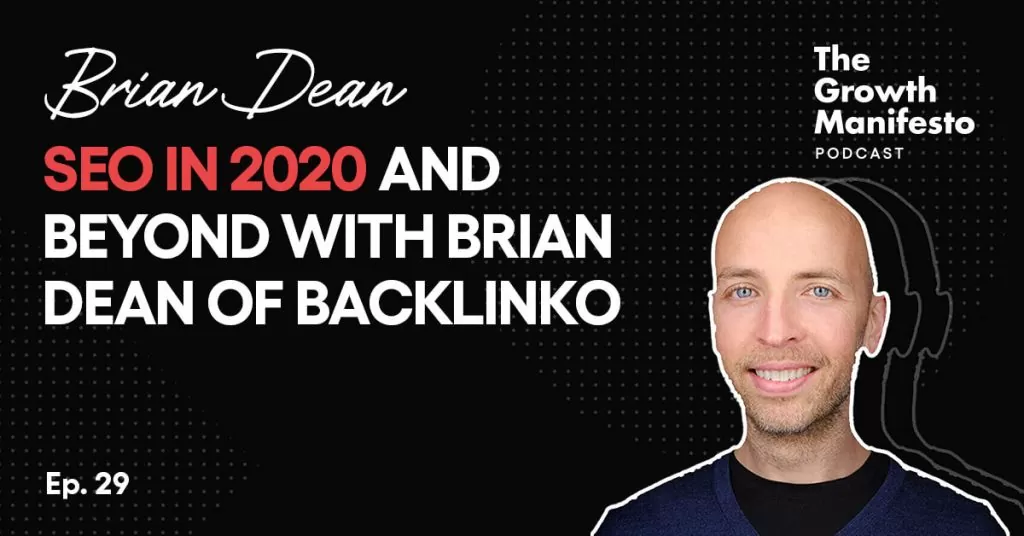
SEO in 2020 and beyond with Brian Dean of Backlinko
Backlinko founder Brian Dean on which SEO ranking factors still matter, the skyscraper technique 2.0, and why an expert beats a freelance writer.
 with Brian Dean


Overview
This episode is a discussion with Brian Dean – Founder of Backlinko (one of the leading SEO blogs on the planet) and Co-founder of Exploding Topics. We talk about what’s working today, how to rank a website from scratch, how big brands can leverage SEO, and where it’s going in the future (plus a lot more).
SHOW NOTES
Key takeaways
- Keywords on the page and backlinks still matter for rankings, but Google now weighs user experience and search intent far more.
- Skyscraper technique 2.0 adds making content sticky so people stay on the page, not just earning links through sheer length.
- Hiring an expert who has actually lived the topic, like a plumber, produces better content than a freelance writer who has not.
- For an established site, the first move is trimming or redirecting pages that have backlinks but bring in no traffic.
- Core web vitals, launching in 2021, continue Google's multi-year push toward page speed and mobile-friendly design as ranking signals.
Chapters
About the guest
Transcript
Auto-generated from the episode audio, so expect the odd mis-heard word. Timestamps open the video at that point.
I mean, I have a expression that I like to say for this sort of discussion. Should you hire a freelance writer? Should you hire an expert? Whatever. It's if you want an article about how to unclog a toilet, don't hire a freelance writer, hire a plumber. Because their article, even if they can't write, is going to be way better than the freelance writer. We've all read this. I'm sure you can relate, Alex. You go to a page and you can just tell it's just some freelance writer who's never done there's no idea what they're talking about they just opened eight tabs regurgitated
what they read it's already ranking and that it's past this coffee scape that's the article you can create something truly original in the real original content sense of the word by hiring someone who's actually lived through the thing you're listening to the growth manifesto podcast a zoom video series brought to you by web profits where we talk about how to drive business and marketing success this episode is a discussion with brian dean founder of Backlinko, which is one of the leading SEO blogs on the planet and co-founder of Exploding Topics. We talk about what's working today, how to rank a website from scratch,
how big brands can leverage SEO, and where SEO is going in the future, plus a lot more. So let's get into it. Today, we're talking with Brian Dean, the founder of Backlinko, the co-founder of Exploding Topics and creator of SEO that works. Is that still the case? Yeah, it's still you, right? That's all you. And that is by far the best SEO training program on the internet. So if you haven't seen it yet,
I would highly recommend that. That's something to check out, yeah? So I think I saw your, I think the first time I heard about you, Brian, was on the OKDork blog. I think it was something with Noah Kagan at the time, yeah? So just quickly, let's start by how did you get into SEO? So I got into SEO from basically trying to rank my own sites that I had back in the day. So I launched my first website ever in 2008. And I did everything backwards.
You know, today, if you want to launch a site, or even back then, the smart play was to build an audience, build an email list, create a product based on what those people want, beta test it, get feedback, but I didn't know what I was doing. So I did everything backwards. I created the products first. I had no idea if there was demand for the product. There wasn't. I had no idea how to get people to actually go to the sales page or buy it. So I just created this huge sales page, a product, upsells, everything except traffic. And I had no idea how to get traffic.
So when I looked around, it was kind of like SEO is the thing to do because it's basically back then there was still social media, but it was more or less like pay-per-click and SEO were the big two things you could do and I was like well I'm living my parents basement so paper click is out so let's go with SEO that seems a lot more accessible so that's that's how I started getting into it and when was that is that back in 2008 and then according to your LinkedIn because like I was trying to think the first time I heard about you but I was like that's not going to be
helpful so I checked out like your LinkedIn it says that you that you found a backlinker back in 2013 is that right yep so in the five years between that point and the starting the basically the founding of backlinko well what happened in that the five years a lot of hard learning hard learning the hard way basically yeah um so after that product didn't do well yeah i was like but from reading all this seo stuff i got sort of introduced to this
subculture of niche sites and ranking sites that were designed to rank for one keyword exact match domains, AdSense, that whole world. And that appealed to me a lot because I had never built a business and I was like, this just seems so easy. Like a lot of people, that's how I really started getting into SEO was like trying to rank these little niche sites. And I had some successes here and there but for the most part it was a struggle of like going up going down and in
between these sort of low points I would I was a freelance writer so I would do freelance writing freelance copywriting to pay the bills and then when things were good I would stop doing that stuff and I would just make money from AdSense but it was very peak and valley until the summer of 2012 is when I finally sort of put the pieces together and launched a successful website of my and I was like oh this is cool like I used white hat SEO for the first time I was like oh that's really cool let me uh learn more about this whole white hat SEO thing which I never paid attention
to but I couldn't really find anything out there about it and I realized that there was probably a gap in the market there so I created backlinko as the blog that I wanted to read yeah right and so that was seven years and eight months ago roughly according to the LinkedIn you seem like you're know better than me yeah yeah yeah no for sure for sure um well you know i like to do my research um but quite a lot's changed since that time but there's also stuff that hasn't changed right
so let's start with of course what hasn't changed what hasn't changed yeah what hasn't changed because obviously there's some there's some core fundamentals i think that have been the same since i started i mean how long ago now yeah but so yes what hasn't changed let's start with that the first thing that hasn't changed is the importance of targeting one keyword having a keyword on your page having keywords on your page like the traditional on page stuff the way google evaluates a page it's more sophisticated now but it's very difficult to rank for anything
competitive if you don't have that exact keyword on your page and i think that'll probably always be the case no matter how sophisticated google gets um the other thing that hasn't changed is the importance of backlinks, that Google still upranks pages and websites that have lots of backlinks. So it's something that is probably a little less important than it was seven years and eight months ago, but it's still super important. And we ran a big ranking factor study earlier this year. We analyzed 11 million Google search results and we found that links still correlate with
rankings really highly. And that links to a page correlate the whole domain authority of a site, So all the links that point to the site, that stuff hasn't changed one bit, I would say, except for the fact that links are probably a little bit less important and you don't need to go crazy with the exact keyword on your page as many times. But those fundamentals, as you called them, which is absolutely correct, Alex, haven't really changed at all. That's great. That's great. And you just mentioned, I will come back to backlinks for a second.
Yeah. But what has changed? let's say in the last three years right because like because obviously the things have changed i think you just kind of spoke about you don't need to get like kind of like as many links anymore like is that the one thing but yes what has changed in the last three years the biggest thing is probably google's ability to measure uh search intent and whether or not the results are giving people what they want and moving things around accordingly like back in the day it was you know you could search for a competitive keyword and the top 10 results would be
more or less the same for months you see one you know from one go from four to three one go from one to two there'd be some shuffling around but because it was based on links you know it wasn't there weren't these dramatic changes like one site would get like a thousand links in a day and it would change but now google can measure whether or not the search results are giving people what they want and the results are moving accordingly so even in real time like if you search for something that just happened like on tv google will shuffle the results based on how people are
interacting with that results like with the results so like the last game of thrones for example if you search for game of thrones the day before the the end it would be a certain set of results and the next day it'd be a completely different set and part of it is because new pages are coming out but a lot of it's because people aren't clicking as much on wikipedia or on or hbo they're clicking on the deadspin article about it they're clicking on all the the people that were poo-pooing on the episode, Google is measuring that and they're putting, they're matching the results accordingly. So they're really good at figuring out, are these results making people happy? And
if they aren't, they're perfectly happy, completely rearranging the results until they have something that makes people happy. Yeah, right. And so you have had some pretty, pretty awesome success like in the SEO space, right? Like not only have you been able to rank our website and get a bunch of traffic you know from seo but you ranked it for the keyword seo which is probably like the hardest keyword to rank across any of them right because there's so
many people trying to do this right but then there's like you in the basement of your parents can't afford ppc trying the niche sites and the ad sense i mean i did that stuff too right like trying to kind of arbitrage AdWords, trying to kind of just do the make money fast stuff, right? But what do you think it was like with your approach that kind of worked? Because something which you've done has led you to become the foremost expert in an extremely competitive industry. Yeah, I mean, it's a combination of things looking back now and reflecting on it.
it's a combination of things, but I think the number one thing that helped me was that I did something different in the industry that hadn't, that a lot of people weren't doing at the time, which was giving people really tactical, actionable advice on the blog. And the reason I say that's so important is because that's one of the reasons that people link to Backlinko and considering links are so important. The way you get those links is a big reason of why a site succeeds or fails. And in my case at the time, a lot of S most SEO blogs were like vague advice. Um, a lot of
like high level crap, you know, don't build links, build relationships with people. And it's not like they were wrong, but it was like, you'd read it and you'd be like, okay, no, I still don't really know what to do now. And I was like, let me do the complete opposite and just get rid of all the fluff and all the high level advice and just give people like really tactical stuff you could do right now to get higher rankings. Now, if you just did the tactical stuff, it's probably going to get you certain results. But like you found with SEO that works, it is helpful to have like a whole plan and a program, all that stuff. But for the sake of the blog, I focused on the
tactical stuff and it seemed to resonate with people. And I would say it's the number one thing because it did double duty. It helped me stand out in the space, like you said, that's super competitive, but also those things rank really well in Google because of the things I mentioned before with the search intent. If you're searching for like SEO strategies or SEO techniques or a keyword like that, and you land on a page and it's like, build relationships, create great content, all this fluff, you're going to bounce back to the search results. And then you're going to land on one that has actionable information. You're going to stick to
it. And Google is going to measure it. And across the entire website, if all your content is like that, then it's going to have all the good engagement signals that Google wants and your topics going to go up yeah right and i think like i remember um your first article it was like the it was like a hundred packed i forget what it was exactly but it was some huge big piece like it was the biggest piece of content out there around the topic of seo and i think that was the advice which you were providing at the time is to create a piece of content that's so good that it's far
superior compared to anything else out there yeah like is that right like is that what yeah i would say that's i think that's still very much the strategy but yeah at the time that was kind of my claim to fame thing was that was your claim technique yeah the skyscraper technique that's the one i think yeah that's the one yeah it was it was like i mean there's there's a case for creating something totally original but there's also a case for seeing the landscape seeing what's out there and just improving on it and that was the approach that i had recommended that people
take and and branding in that way also helped because it was something we could all like people could reference and link to and talk about and that was one of the reasons that it ended up six that strategy ended up getting some spread but yeah that's still i mean it's not exactly that strategy anymore but there's there's a 2.0 version that's on my blog skype paper technique 2.0 but yeah the same 1.0 still 100 applies so high level you know what's the difference between the 1.0 and the 2.0 so the 1.0 is all about creating content to get links so the idea is that
you find content that that's ranking well but also more importantly has a lot of backlinks and then you create something better so then those people in the future who would have linked to the first piece of content will now link to yours. The problem was with that approach or the part that was missing was that user experience stuff we're talking about where, yeah, if you have a lot of links, it can help you get to the first page, but to stay there, you need to have content that's going to have people stick to your site and stick to your page and not bounce back to the search results. And then 2.0 is about applying the same philosophy, but to making your content
sticky for people that are searching for that keyword. So they stay on your page and Google sees that as the best result for that search yeah right so like i was having a look at um the advanced seo factors the 17 advanced seo factors which are awesome just by the way so anyone that's listening you should go check that out on the backlinko blog but um you talked about actually including stuff like animated gifs because it keeps people kind of like engaged right it keeps people there because it's so interesting um how did you come up with stuff
like that you know because i mean this is like interesting stuff that you're experimenting with right and like you're doing it on a site that if you get it wrong you lose a lot of traffic yeah that's that's a good point luckily i don't think of it that way but you're right um that i'm sorry to do that so never think about that please okay now i'm paranoid i'm not gonna do anything now i'm not gonna try um the animated images thing actually came from something where it completely unrelated to SEO. It was just something we wanted to try for the sake of creating cool
stuff. So what we're doing before was for any sort of like step-by-step process, we either have like a bunch of screenshots or a Wistia video that was like a couple minutes long. And we're finding that the problem with the screenshots is that you have so many that the pages get enormous. And it's kind of almost harder to follow in a way and then having the wistia video was like people would never click on it so there was this new format called svg it's kind of like an animated gif but
more sharp because animated gifs tend to be kind of blurry so it was like you could just take a video clip put it on a page and it would automatically play and it's great because they're gonna animate gif but it looks really nice so we started using those for a little tutorial steps and as it turned out people really like them and i noticed that pages that had those people would stick to the page a little bit longer which just makes sense because as you're scrolling down it catches your eye you're more likely to stop watch it and then not hit your back button which is what you want
you know as few people to do as possible yeah well because i can attest that like as i was scrolling through the advanced seo tactics i saw some animated gifs and i lingered on them i was like this is interesting i haven't seen it before right and so there's the whole thing of if something's fresh it gives you an advantage right but if everybody starts to do it then you're going to find the next thing um but just quickly just coming back to the content right like is to find
the content that's already out there that has a bunch of links and make something better now that was the skyscraper technique that is still the skyscraper technique but since you started talking about the sky's trapper technique what was that like six seven years ago or eight years ago even um the the size of content has just gone out of control like there's some pieces of content that are just like 30 to 40 000 words long right and so it's getting harder to compete in some
spaces right so how would you compete in something like that when there's there's awesome content already out there but you have to make it work somehow right like i say for example it's like a bet right it's a bet and like like uh the goal is to rank above that that specific so how would you do it so yeah it's a good point you're right and as more as the technique has become popular yeah
the bar just keeps getting higher and higher um so what i'd recommend if you find yourself in that situation where you're like, I want to create something better, but everything's already so long, so thorough. How can I do it? And I would recommend trying to compete on a different dimension than that because content length is one way to compete. If you're like, okay, this one's not that thorough and I'm going to make it thorough, but there are other dimensions you can compete on besides just making it more thorough. Like for example, design, you can make your content just look better than what's out there. And for me, that's an easier
one because so few people invest in their content design that they'll have like this huge long wall of text that has no animations or no visuals or no charts no screenshots and it's just kind of dry and you can create something that's really nice looking really nice design helps people with different with like videos and things of that nature infographics and that's one way you can compete. Another way to compete is to make your content, write your content, or I should say,
have your content written by someone who has done the thing they're writing about. And that sounds like an obvious thing, but you'd be surprised how many keywords you search for. And nine out of 10 of the articles, the person has no idea what they're talking about. They've never actually done the thing. So just by having someone who has real life experience, your content's going to stand out. We've all read this. I'm sure you can relate, Alex. You go to a page and you can just tell it's just some freelance writer who's never done, has no idea what they're talking about. They just opened eight tabs, regurgitated what they read. It's already ranking
and that it's past this coffee scape. That's the article. You can create something truly original in the real original content sense of the word by hiring someone who's actually lived through the thing. So, you know, let's say you're writing an article about the keto diet. Well, you should hire like someone who's done it or a dietician who believes in it or someone who's a scientist in the space. That's going to have a lot more pop than a piece of content written by a freelance writer who's never dieted, has no idea what it is, just learned about it today when they got the
brief. So that's another dimension you can compete on. So I would look at if someone has 10,000 words i wouldn't be like well now i need to do 20 000 words yeah because at some point it gets ridiculous and it also doesn't help with search intent because if i'm searching for something i probably don't want 20 000 words so there are other dimensions you can compete on besides just writing a big long piece of content yeah right and so you just mentioned something super interesting um you mentioned actually just going and hiring experts like and so not hiring people who write but kind of hiring people that are experts who can write right and so is that a part
of like your workflows let's say for example like if you had to to rank a website in a specific uh specific like niche for example like is it to find the expert to help you to create that content first then create the content after that is that how you would yeah for sure man absolutely i mean i have a expression that i like to say for this sort of discussion should you hire a freelance writer should you hire an expert whatever
it's if you want a an article about how to unclog a toilet don't hire a freelance writer hire a plumber because there is going to their article even if they can't write is going to be way better than the freelance writer because they have the real life experience they can draw on They know how it actually works between the lines. Like they know the details. They can even say, Oh, one time there was this clogged toilet and I use this thing and got it like, yeah, that's that's, that stuff is gold. That's content gold. And you can't get that from someone who has eight tabs open is putting it into their head,
regurgitating it, and then putting it into slightly different words. So yeah, I have had a couple of projects that I've worked on since backlinko. I write everything for backlinko myself, but for other projects. And I always look for bloggers in the space that are writing about it because those people are usually living it. Like for nutrition stuff, there are tons of mommy blogs where the moms are like feeding their kids different diets or have all, you know, they're eating this diet and that diet. And they're perfect for that sort of thing. Arts and crafts, people that have write about the arts and crafts and sell their stuff on
Etsy. That's going to be a lot better than a freelance writer. It's a little bit like it's less convenient because you can just go on Upwork and just be like freelance writer for 500 words and like look through all of them find the best deal you know their reviews and all this stuff so it's a lot more back and forth but if you really care about creating something special and you're like oh man we're in this competitive space how are we going to compete the number one thing i would recommend is have experts write your content and they don't even have to necessarily write the final draft like if they suck at writing that's okay let them provide the details you can even do an interview like this
extract just the knowledge from their mind and then you can clean it up later with an editor to make it read well yeah right and so would you outreach to the blogger or would you call up like the local plumber for example if you can't find a plumber blogger say for example how far would you go to get that content how far would you go yeah i mean if i would do whatever I basically wouldn't publish content if it wasn't written by someone who knows what they're talking about.
Now, there are exceptions to this rule, I should say. If you're writing about the news, then you're not going to find an expert on every single topic under the sun. Or for exploding topics, we have a blog there. And we write about the fitness industry trends. We write about the SaaS industry trends. We write about streaming services industry trends. for that we do more journalistic approach we look at different stuff and we cite other people other experts work we don't have a fitness industry expert for one because then it's just unwieldy but
for most sites they have one niche like this that's a weird case because we cover all different niches but most sites cover one thing like plumbing or home decor or uh diy or marketing or health or nutrition like they cover one niche so then you only really need to find one or two experts and you're good to go so i would go whatever length it takes and the key is what do you say to them i thought yeah no yeah i just say i want to hire you key is really what then let's not stop that point the key is really well the key is really just to have them involved it can be it how
the the relationship works can be will be different depending on how it goes like if you want to hire a plumber maybe they don't have a lot of writing experience or writing online so in that case you may just want to do a phone call, extract as much, be like, if you were writing an article about this plumbing situation, what would you tell people? Or someone in real life is searching for this plumbing solution. What five things would you give them? And then have them explain it, transcribe it, and then you can turn that into something. On the other hand, you might be in a niche where there's
bloggers that write about it. In that case, you can just go directly to them and be like, I want to hire you for a project how much would you charge for a blog post like this one that's already published in their blog and it's kind of like upwork ghetto upwork you can reach out to like eight people see which ones reply how good they are and then choose one based on a combination of like their writing style their price and all that stuff yeah like the thing i like about that and this is kind of the approach which i've always seen succeed like it's the approach i've taken anyway like and it's but the approach i've seen across the board is if you prepare to go that
extra step a bit like and to work a fraction harder than everyone else is um that's where the best results are and it seems like what people are thinking is like well the extra step is just more words but it's not it's improved quality it's improved kind of stuff on the page right and so it could be a shorter like it could be a piece of content that is basically shorter but that's better right and it's kind of to do the harder things right like and
to take those steps first right yeah yeah absolutely it's more about content density right it's like the plumber is gonna just cut right through the bs because they don't even they don't even under like the plumber doesn't even know to write fluff he's like why would i do that i'm just gonna give people the shortest stuff right it's only freelance writer and seo people who are so like jaded and like we have this bizarre outlook we're like oh we need to write like 2 000 words the plumber would just be like here's a boom boom here's exactly what you need to do exactly okay cool so next question um so if you had to start again um start again from scratch
and you had no personal brand. So what would your approach, like, could you talk about the approach that you would use to rank in a competitive space? Yeah, so the number one thing I would do is that a lot of people skip over is I would create like a brand from my blog. And the reason I say that is because everyone's going to jump right into content and keywords. And one of the things that helped me with Backlinko, and I've seen it happen in other niches too, where people enter competitive niches really late, is they create a little niche for themselves that help them stand out.
So let's say you have like a services company. Your services company is going to have a brand. And your blog can just be an extension of that, as opposed to just a collection of articles. And it sounds like a minor difference, but it's actually really important. because if you think about like the mo like moz for example their software they had their company has this whole mission and blog and their mission their staff product all that stuff their blog also has its own personality its own usp and people visit it for that reason they link to it for that
reason so i would do something like that i'll look at your blog like a product or like a marketing campaign and think of how do the opposite of what everyone else is doing everyone's writing long stuff write short stuff everyone's writing short stuff write long stuff if everyone is doing text do video if everyone's doing videos do a podcast and of course you still want the foundation of any seo campaign is going to be text-based guides and articles and that nature but outside of that what else can you do and one of the things that probably not as many people are doing are like
videos and podcasts like you're doing Alex it's it's you're probably finding it's competitive but much less competitive than the SEO world. And in your niche, it's going to be different. Like what people are doing and not doing, but that's going to be the key to standing out is figuring out a platform or something that's going to help you stand out. And it could also be a niche. You could just write about one tiny niche for a while. Like when I started back link, go I only wrote about link building for like a year and that helped me stand out from the other SEO blogs. Cause the other ones are talking about on page SEO and human research and all
stuff. And I pretty much stuck to link building for a year that helped me stand out. And then from there, you can just, you can expand out into two more stuff that way you're known. This can help your brand. That's the blog about whatever B2B sass. You know, that's the blog about keto diet desserts. If you have that little niche, it helps it stick in people's mind. It's like that 22 mutable laws of marketing to talk about that. People only have space for like one or two brands in a category. So if you can be in that category, you can get some mind share as opposed
to being the hundredth blog about marketing or the hundredth blog about weight loss. Cool. So that's fantastic advice. And so now I've got the brand, I've got the blog, I'm doing the topics like around like a niche. How do I get those fantastic links that everyone keeps talking about? You know what I mean? Like, cool. But I've just started out now, right? And So I don't have relationships. I don't have all these people that I know that have, you know, articles and blogs, like how would you start? You know,
so what's the first thing that you would do in that scenario? Well, it's funny. I was in this situation a few months ago because when I started exploring topics with my co-founder, Josh, he had no audience. No one knew who he was. And I really wanted to use that as a way to see exact, to answer this exact question without me being involved. So I didn't do any outreach for that site. I didn't do any link building for that site. I had him really handle it using my strategies to really put them to the test
with a new site with no anything, zero starting from absolute scratch. So one of the things that he did that worked really well was going on podcasts actually for building links because he reached out to podcasts, targeted podcasts, and he gave them a great pitch about why he would be a great fit for that specific audience and even though no one knew this guy like he was these emails are coming josh they had no idea who this guy was and he had like a 20 conversion rate on his outreach because what he did was
he really focused on he made each pitch tailored for each podcast so if there was a podcast about how to create a software a piece of software he would really focus on that part of the thing how I created this software from scratch. If he had another podcast about acquisitions, he'd be like, how I got Brian Dean to buy my product. If he had an, it was a different podcast about marketing. He'd be like, how I got on the front page of Hacker News. And he would tailor that story for everyone. And he would go on and be like, I'll tell the story to your listeners. And because no one knows Josh, it's almost even better
because you're going to be the only guy who has a story versus if you have me on other than 150 podcasts. So it's good, but it's not like having this, even though he's not you know well known he has a unique story to tell so people were surprisingly receptive to him and those are great links because they usually go on pretty authority sites and you get a link in the show notes so that's something that really worked well another thing we did that worked well was broken link building where we found broken links and then pitched
exploit the exploring topics tool as a replacement for the dead link so does that still work because like i've seen so many of those things just done poorly um what's involved in doing it well then because like geez it's it's just being done again with a shortcut way right like it's all just like not quality so how you know so what's the strategy they're just quickly you know just super high level the the key is to really find um places where your link would replace the dead one because
what a lot of people do the mistake they make is they're like you have a dead link on this page can you link to me from this totally other page it doesn't make sense what you really want to do is add value with your broken your broken link building outreach you want to make it actually make their site better at the end so what you do is say this is a broken link to this thing here is something that's very similar that way they don't have to find a replacement you're actually making their life easier the mistake a lot of people make is they use it as a way to get their foot in the door like oh you have a broken link can you also link to me from this other random
page. So that person still has to find a replacement for the dead link and then find a place where your link makes sense. So the key is to send fewer emails, but make sure that wherever that broken link is, you can just slide right in there. And that is going to work a lot better. And that worked really well for us. Those are the two things that worked the best. That's great. That's great. Thanks for sharing that as well. The others, cool. So they're completely out of the end of it, right? the big brands right that already have tons and tons and tons of links if you step in now
to advise them on their seo right because they want to rank for their top say phrase say for example it's a home loans company and they want to rank for home loans and not rank for home loans but they've got all these backlinks and they've got all this authority but what would you advise them as a strategy to kind of increase overall traffic and sales and you know all the parts well the first thing i do with a big site like that is look at how many pages they have and see if we can trim that down a little bit and especially redirect some old pages
to higher priority ones that's usually the best first move because what happens is when you take on a new site you're usually dealing with like it's almost like a like a patient in a hospital like they've had a history of problems. You got to get to their, you better go back to their whole medical history to get to today. So what you can do, what I recommend doing is looking at all the pages on their site and seeing which ones don't bring in any traffic. And especially those that have links, but don't bring in any traffic. Those are gold because those pages are basically collecting dust,
not really doing anything. And you can redirect them to relevant pages on the site that you're actually trying to rank. You're also going to have tons of pages that don't have links. and don't bring in traffic, call them zombie pages, you can delete those. And just by deleting those, you can increase your site's rankings because you're gonna condense your page rank across your site. And also Google has even said that just, they prefer to rank sites that have fewer higher quality pages. So it's not to say you needed like a tiny site with 10 pages,
but if you have a lot of other pages, they're dead weight that's holding you down. That's always the first move that I make with sort of a big brand that I work with. And what's the second move? Cool, so that's now cleaned up and now it's time to get kind of proactive on creating stuff, right? So that's kind of shrinking or kind of reducing. What's the next part? So what would you create then? Is it going to be like a link building strategy,
a content strategy? What's the strategy which you would do for them? It's kind of hard to say because it depends a little bit on the site, but in general, I still wouldn't even get it to the creation yet, honestly. I would look at those home loan landing pages that you talked about and be like, why aren't they ranking? Like what's wrong with the actual page? Is it not optimized well? Is it slow? Should it have some functionality that other pages have? Like if you look at the top 10 results, do they all have a calculator and you don't have a calculator?
You just have a form for people to submit. Stuff like that. I would basically look at the search intent for the keyword and be like, why isn't this page ranking? If the site has all the links and it's, you know, trimmed up, this page has a good chance to rank, but what is it about the page? And I would look at each of those pages individually and figure out what they're missing or what they have extra, maybe the two long, but what is that missing variable? Like I've worked with a lot of brands and you go through the top 10 results. The pages are almost identical across all the brands. And then they have one that's like an odd man out.
it doesn't really fit now. And just by tweaking it and making it match a little bit, it can do a lot better. I've seen this happen time and time again. And usually for a lot of loan, that kind of loan personal finance industry, it's a calculator. It's a function of some kind because the landing page, the person that did the landing page is a conversion guy usually. And they're like, Oh, what we need to do is like put a format above the fold and then people will land on it to the form. But that's not how actually people get a loan. They calculate it first, they see the rate and then they might reach out and the other brands that do this best are going to rank
and you're going to have a great conversion rate but you're not going to have any visitors so that's the first the next thing i would do so it's kind of easier and kind of harder it's easier because you don't have to create as much stuff but it's harder because you need to kind of to like diagnose what is the problem and it's like a doctor like it's like the more experience the easier it is to diagnose. But if you're a beginner, you're not going to know what the issue is, right? So it seems to be easier, but it's also got its own separate challenges, right?
Especially with the site size and everything else that could be happening on it. Like I saw this interesting thing the other day because I conducted like an analysis of a website and I'd seen that the whole blog was no indexed. Yeah, like it wasn't like no follow. It was just like no index, but they were ranking at the top just for these extremely valuable words. But all of the content was that, but it was created, I'd say a couple of years ago.
And it was all that, you know, the thin content, right? But they basically provide more business loans, right? And their content was like, cool, so how do you do like LinkedIn marketing? and it was like you know extremely short they had all this stuff and i was like but they now indexed it and i was the first time i'd seen a company put that across their whole blog and still have ranked so highly so have you seen that before like this whole thing of to not actually
index it but it still passes authority as far as i could tell to the main page yeah no i've seen um not that but i've seen people no index content as an alternative to deleting it when they don't want it around right and that way it still exists people can read it but it's not but does it have value yeah that's sort of the idea so it's not really it's still followed though it's just no indexed right i don't know it's like yeah i mean google crawl it but then they're
going to see it's no index so then they're not going to index okay okay i would say it's not really do unless because another thing that can happen is all the pages were indexed before the no index was added recently so it hasn't kicked in yet it could take weeks for that to actually kick in because google has to crawl the page and see the no index and all that stuff yeah right hey yeah look yeah that was something i saw and i was like look i'm gonna ask yeah i'm gonna speak to brian so i'm gonna ask him on it um yeah that's weird um a few more questions
around SEO just because that's basically like your specialty. Can you take down a website's rankings with toxic links? Do you think? I mean, probably, but it's really hard. It's really hard to do. It's really hard to do. Like it used to be a real problem and negative SEO as it's called, but Google has over time become more chill about paid links and shady links. And the reason for that is because their algorithm before was how to talk deciding whether a link was legit or fake
and when in doubt they would consider it legit because they had no way they had i mean they were able to filter a little bit but they weren't that good at it so what they did was when they found a site that was definitely spamming they would penalize them and that was what the google penguin update was all about and they would penalize them and that would send a message to everyone else that don't do this and actually worked uh people spammed a lot less after that but what happened was people were like this is great you know now i can just spam my competitor
who's ahead of me and then they'll get knocked down and they're gonna get you know go from one to ten and i'm gonna replace them but which was happening it was a real issue google over time has been able to just ignore bad links and i've said several times in the record now that bad links and unless you're doing like a paid link campaign they'll bust you with that and they'll give you an unnatural links penalty but if you're doing like kind of general spammy stuff it's very rare you're going to get an algorithmic penalty because google is really is going to have
a hard time saying it was actually you or one of your competitors trying to do it it how to how could they ever even know that so lately they've just been ignoring bad links so it's probably possible in some if you're good at it but i don't even know enough about it but in general it's very rare you see a site that gets penalized from from that cool so like blog networks they used to be a thing and like do they still work like or is that just something it's like toxic it could be fake
could be helpful is it something that still works probably to a certain extent but it also depends a lot on the blog network like if you have a friend who runs his own private blog network of 10 sites that he's run for years they're all on separate uh hosts and all that stuff and you pay him one-to-one for a link that's probably going to help you i wouldn't recommend it necessarily but it's probably gonna help you a blog network that's public and anyone can buy a
link on it that's just going to get busted eventually and i've seen it happen time and time again because they're just footprints that you have that it's all the big blog networks always say we have no footprint we have no footprint google is able to figure it out and those usually those links usually get removed because the sites get the index and sometimes the sites who participate in that work get penalized who got links from it so i would say it's probably it's not something i would recommend doing because the risk reward ratio just isn't there and it's also
that shortcut that we've just been speaking about you shouldn't be taking because like if you put in a bit more effort and like if you do it the right way it's going to be long term because the part which i think everyone that hasn't achieved svo rankings yet should kind of understand is that once you get them and you get hooked on that traffic it's one of the only ways where you can get so much free traffic and money without spending money and so once that happens now all of a sudden
you're really scared about or what if it goes down this is my whole lifestyle i pay for my family and my kids school or my sports or my holidays and now all of a sudden you've got bills that are now relying on those seo rankings right and now like every time there's an algorithm update you're sweating you're sweating big time you know and because i've been like around now with this game for around 20 years right so i've been through florida and panda and penguin and all of the
animals right and i've seen people come and go right like this is like it's in it like an extremely big business that was extreme that was um what's the word um extremely um what's the world of reliant on the search traffic and then when that goes they don't have a business anymore you know it's like so that's just kind of the word of warning you know to people out there that are thinking about doing the shortcuts because they work and then they work too well sometimes and
then all of a sudden you become reliant on it and it just hurts that's bad yeah i've been there you've been there i think we've all been there right um if you've been like in this space and You've experimented just for a while. In terms of SEO in the future, how do you see it changing in the next three to five years, let's say? Yeah, I would say the number one thing that's going to change is that Google is going to get even more invested into user experience stuff outside of the things they're already doing.
For example, they have a new set of ranking factors that are going to go live in 2021 called Core Web Vitals. and this is like the logical progression of where google has been going the last couple years because for the most part how they used to operate was like passively they would be like okay we'll index the web and then whoever has the most links and the best stuff on the page will rank them but then they sort of started realizing they could just dictate what happens online so for example they gave sites that had um secure that were ssl secured a boost in the rankings
and guess what happened millions of sites all of a sudden got around finally got around to doing it they had an update for page speed that sites that were slow got a down ranking guess what happened everyone started improving the speed of their site they had another update that targeted sites that weren't optimized for mobile devices guess what every site started switching to mobile devices so they're becoming like they're dictating the next move that all millions of sites are going to take and the reason for that is because from their point of view they want to rank sites that
give people a good user experience so the next thing they're doing is the core web vitals which is which are three like kind of mini ranking factors that are more or less like how fast the page loads and how quickly you can interact with it. And that is going to go live in 2021. And I think that whole core Web Vitals brand will be multiple things in the future. It's only three now, but I could see it being 10 or even 20 things in the future that whatever Google cooks up as important, they're going to put it under that umbrella and then everyone's going to start doing
it. So, but all of them will ultimately revolve around having a site that's like easy to read, easy to access loads quickly optimized for different devices like it's not it's not anything crazy but they're moving more towards that and away from some of the traditional stuff yeah right yeah right i think yeah that's really interesting and like what about kind of um what was it called like the voice search thing because like what was it like six seven years
ago like it was going to be the future like it was going to be the number one spot because all of the search results were going to happen on like you know like on the series and you know the google homes and all that but that never really happened right like it didn't really become that thing people still like to search on like their phones and on computers right that didn't change like it's like so like is that going to change you reckon or not yeah well i think dude the thing have you done like a voice search on your phone not really no i kind of ask like what's the weather
what's the time what's the time here you know yeah it's i don't know why it hasn't caught on because i actually think it's it's much better than typing for a lot of keywords like you said it hasn't caught on at all but like if you use it for certain key for certain searches it's so much faster than typing and it's more accurate than typing because that's the other sneaky bit about typing is that you make tons of mistakes at least i do like i'm like i just rely on autocorrect so but the voice like recognition technology that google had is ridiculous it's so good
like 99 it's way better than apple's if you try to do the composing a text message and i message is terrible google's is really good so another thing that i think is going to get big though is the visual search um google has already talking about how they have something called google lens that is basically searching with a picture. And people are doing that more and more. They already have a billion searches on it and it just started. So if you open the Google app on your phone, there's a little like square thing
and that's Google Lens. They haven't done any promotion, but it's already sort of taken off. And the reason for that is because it's really good at image recognition now. So you can take a picture of almost anything in your room and Google will be able to search for similar things, identify what it is and then search for similar things. So I, I see that being big for like, it's basically like baby AR, you know, baby augmented reality. I can see that being like a real thing. And that's like a more in the five-year thing where we're wearing like a Google glass, but like a 2.0 version that just augments stuff you're looking at.
I don't think that's far off because if you use Google lens, you're going to be like, this is the future. Yeah. Like Google lens, they launched Google lens. It's like, it must have been 10 years ago or something. everyone freaked out because it was you know extremely invasive on everyone's privacy i think we've come quite a long way since then and i think everyone's going to be okay with it now especially if it's a hundred dollars um which is i think it was like 500 bucks at the time that's interesting um youtube like a couple years ago you started to go into youtube as well and
said all right i'm going to try to figure out the video ranking algorithm it's like cool so i figured out you know search results and now i'm going to go in to video and you figured it out like i've done your course i've got your course i've got all that stuff i highly recommend that um course is that available for sale still that course uh yeah but it's we only launch it about once a year once a year okay well you should subscribe and yeah we have a way to pay for it if you're in to video stuff um but like how did you figure out that side of it because obviously it's very
different to search right they have completely different kind of things which they look at and so you know why the transition and how did you figure that out well the why was because we're talking about before like you got to do the opposite of what everyone's doing and no one was doing video in the seo space at the time like if you search for seo stuff on youtube it was all marketing gurus talking about niche sites and you know ranking and make money online there was no like legit
um seo stuff on youtube now there's tons of them since i started it but back then there was done so i did it more as just a as a way to stand out from the other blogs in the space i started in like 2014 when i i started in 2013 i think i put my first video but i really got into it like late 2014 early 2015 so it took me a while to like really get into it but once i did i was addicted because i noticed how many views you could get and how valuable these views were people are
watching you on video your brand you're sticking in their mind like it's such a powerful medium compared to text um it's kind of like podcasts like you're in their ear there you know you're kind of with them as they go through their day super powerful medium so sold on it from that point of view um and then in terms of figuring it out i mean it took a long time my first few videos didn't do well at all and they looked bad i actually took one a couple of them off youtube because i was just embarrassed to even have them there they're so bad i've done that too by the
way i took it down all my old videos i was like oh wow because i've it got so much better recently so yeah i hear you yeah even if they get views i'm like i don't i don't want them to get views so took them off youtube and just in terms of how to figure it out it was just trial and error it's just like with with seo for google it was just trying a bunch of stuff and i discovered that there's a lot of youtube ranking factors like you had mentioned alex it's a totally different algorithm in fact a lot of ways it's the opposite of google because google wants you to get like a
quick answer and then go about your day. That's a win for Google. With YouTube, they want you to stay on YouTube as long as possible, right? Watch more videos, watch more ads, they make more money. So the better your video can keep people engaged on the video and on YouTube in general, the better they're going to do. And yeah, there's like, there's of course keyword optimization and things of that nature are important, but at the end of the day, your video needs to keep people on YouTube to keep people on your video and once i figured that out it was just a matter of figuring out how
to do that then i was like okay that's the key how do you keep people on your videos for as long as possible and that's what i invested most of my time and energy into and that's like in the structure of the video right so there's kind of exactly the quick intro and then hey this thing's coming up soon and at the end of the video i'm going to share some awesome stuff blah blah blah like that kind of stuff where it's more like you're keeping them there so that's kind of the part which kind of like is that the part yeah like like yeah exactly it's keeping them there there's a bunch of stuff like around that like on what the topic is what are the keywords on you
know what's the length and all the other stuff what's but that's at the core right is just create create something that's super interesting to people right exactly yeah and structure it like you said the right way like and how this structure that is proven that people are going to continue watching and you said you already mentioned a couple of things i can work well like mentioning things that happen later in the video the short intro or the compelling intro and getting right into it um those they're kind of simple but they work really well especially if you follow the
structure it also makes videos a lot easier to make because when i first started making videos i didn't really have a structure i just knew what i wanted to talk about and i would just fire up the camera and just start blotting on it was frustrating the videos came out terrible and then now that I have a structure and I just, it's so much easier to actually make the videos. Plus they come out a lot better. Yeah, sure. And so if you had to choose between, uh, what's the word? Like, um, a top ranking on search or a top ranking with a video,
you know, what would you prefer? Oh, search like a thousand times. It's not even close. Why is search so much better for you than video? Well, cause they land on your website. You know what I mean? So it's like that you can get their email, you can, they can buy something from you. There's a, there's time they can link to you. They can share it. There's tons of possibilities on YouTube. There's basically one possibility. They watch your video. Now a lot of them will click over to your website and we'll search for you in Google. There's a lot of benefits to getting views on YouTube, but in terms of just
like dollars and cents, man, I would definitely choose getting someone on my site from Google. okay yeah great cool um just quick let's jump to exploding topics um can you just explain what that is because i've seen it but i just like just to hear the high level you know quick intro it's a tool and newsletter for finding exploding topics before they take off and what's the purpose of it like why this business you know so why did you do this
business of all the next businesses to do right like you know why this one yeah well it's it wasn't really planned to be honest I I wanted to build a trend tracking tool myself because I had seen firsthand how helpful it is to find topics that are trending and getting in on them early whether it's for a product whether it's for a piece of content whatever but there wasn't like a resource for finding these so there's google trends which is good for like confirming things you already know
so if you want to know if like ramen's increasing you can go search but if you've never heard of ramen it's not going to help you because there's no discovery element in google trends it's just confirming stuff you know so i wanted to create something that could help people discover things they didn't even know about yet that are trending and i started building something in the in the back end i hired a developer to work on it and while this was like sort of going through the beta testing, alpha testing, I came across this site called trend.co. And I was like, oh man,
this is like 10 times better than anything I imagined. Like it's way better than I was building, way better than I could even picture. And I reached out to the founder of that, who is Josh Howarth and ended up acquiring it from him. So since then we've been working on it together. And about six months ago, we took on another co-founder, Kyle Byers from Growth Badger. he's our head of growth so it was sort of an accident and then once we parted up like he was already doing great with it and then once we parted up it started doing a lot better because i was able to give him resources and things like that we rebranded it it was called trend now it's called
exploring topics so it's a lot easier for people to share and talk about and it started doing well so i was like wow this seems like a good thing to uh to keep keep going with but yeah at the time it was definitely not planned. It wasn't like, my next thing is going to be this. It was more like, I'm building something on the side, sort of a side project. And then when I saw a trend, I was like, no, this is exactly what a trend spotting tool needs to look like. And how should people actually be using it? Like, is it, yeah. Like, could you explain, you know, like how this should be used?
Because I'm assuming it's for SEO. It's not really for SEO. Like people use it for all different reasons so our biggest use case are from investors and people in the like vc world because they want to see like what's coming next like the next trend the next big thing because then they can invest in that space so if you know they get a company that comes to them with three you know kids with hoodies and they say they're in this space that they've never heard of they're not going to take they might not take them seriously and they sell an opportunity but
if they read on exploring topics that this space is blowing up and these people are in it they're like perfect so the main way people use it is actually from the email newsletter we have like 70 000 subscribers including kevin kelly the founder of wired people from apple slack and dreeson horowitz are all subscribed and basically what we do is every week we send people kind of a collection of some of the trends and then how you use those is up to you like yeah a lot of do use them Alex for SEO and content and finding trends.
I've used it myself for that. Like I've ranked for tons of keywords that I found from there that were so early, but we're trending up and create a piece of content and ranked like instantly. And now they're at the time it wasn't getting much traffic, but every day they're getting more and more. That's definitely one way to use it. And it's one way that I personally use it, but there's all different use cases. We have people from e-commerce who are like, I'm a Shopify store. I want to create, get a new product category. so air fryers might be blowing up i want to create air fryers category on the e-commerce site so
kind of a lot of different use cases um for the product but they all have one thing in common that people want to see what's next before it becomes like mainstream yeah right hey right um well i've subscribed to 70,001 um subscribers you can add like web profits in yeah to that list some awesome companies yeah next time i mention all the people that are kevin telly that's perfect man um cool so just some big fire questions i like to ask at the very end yeah
this is going to be a simple question it's the first thing that comes in to mind yeah so let's start it's going to be really really standard question it's nothing scary or anything like the more you say that the less i'm thinking it's going to be a standard question if you had to choose just one channel or tactic um to drive success or growth aside from seo then what would it be not seo you can't say seo well i would say probably google ads then okay cool okay fantastic because what you love search still right is that right yeah
but i mean if not it would be facebook it would be whatever like scalable you know scalable strategy course what book has had the biggest impact on your success uh probably the four-hour work week because even though i don't like use it on a day-to-day or any sort of practical level now it was the first book to introduce me to entrepreneurship okay yeah very cool yeah because i read that book i was like oh my god i get it i can work for four hours per week now
and that's it and it's like i've been working 100 hours of work ever since so yeah that's exactly what i meant when i said i didn't use it practically yeah exactly cool so what's your number one piece of advice to hire awesome people i'll work with them first as a seth godin quote i need to work with you before i can work with you so there is you know awesome people are relative like you know someone who's awesome for you might not be awesome for me and vice versa so i recommend going with a tiny trial project even if they're
full time you can hire them for 20 hours a week temporarily and just see how it goes when actually working with them because i've found tons of people that i thought were great and then when i actually work with them they weren't and i had people that i was kind of so so with when we actually got into a project and actually you know had problems that came up they were great at solving it and the only way to find out is to work with them first okay that's a fantastic one i like that one cool how do you relax after a crazy day at the office or at the home office or at the seo ranking factory yeah no there's a lot yeah there's a lot of stress at the old
backlinko headquarters my number i actually play tennis a lot so that helps because i usually i usually schedule the sessions towards the end of the day and you just get outside you're with someone you're not in your home office like i am most of the day and you're hitting a ball and you can't you can't even simultaneously play and think of problems so it's pretty therapeutic in that way yeah the game this evening actually i got oh nice i got smashed so hardcore but it was good because like he's so much better than me and that's how you get better but no that's how you get better
man i didn't check my phone once because i was just like come on it's it's basically what's it called the winner psychology come on man you can do it there's a skill level replied too there's a skill well because i'm losing oh okay so you're competitive then i'm competitive without the skill to okay to win like i'm okay it's a tough combination yeah no no hey like i didn't say that it was like like a rational thing um yeah what's your best piece of advice in terms of
productivity or time management i would say having maker time and manager time there's this uh article by paul graham who says you should split your time of day into maker time and manager time where you're 100% focused on creating stuff and then 100% focused on managing stuff. And that's helped me a lot because I used to get up and check email first thing or check social media. And then I'd be like, okay, now I need to write something. And my brain is just fried. It was way past the point of no return. So now when I get up, I have maker time
and I write uninterrupted for hours. I mean, besides breaks, but I don't check stuff. So I would say that's the number one thing is having that set time for maker time and manager time. Well, and that would take you some time to get into the habit of that because how hard is it to check your phone in the morning? Far out. It's hard, man. The number one thing I've struggled with this and what helps me whenever I get off the wagon is five minutes. Being like, I'm just going to not check my phone. I'm going to write for five minutes.
Because there's really like no matter what happens in the internet world, it can wait five minutes. Five minutes isn't going to make a difference. so and then what happens is after five minutes you're like that was great why don't i do this more often let me do 10 minutes like you're not gonna even want to check your phone after five minutes so that's how i usually get into it as opposed to be like yeah you need to schedule four hours for writing on day one that's pretty overwhelming for sure um second last question so what's the best is a business advice that you've ever received uh double down on what works
that's from my friend Noah Kagan that it's really tempting and I'm tempted of this a lot too is when you're something's working you have a business that's doing well is to be like now this is working let's try something totally different you know SEO is working let's go on Twitter you know Google ads are working let's do blogging and a lot of times your best bet is just to double down on what works and if you look at companies that have grown really quickly like Uber and Airbnb and unicorns it's usually down to like a couple things they did over and over again and
they scale that up as opposed to like doing a million things so that's I would put that as number one yeah great and I think that's a really good one because um it's easy to get bored as an entrepreneur it's easy to get bored when things are working it's and it's easy to just want more without having the expertise to get more it's like my tennis game like I want to win but I Ain't got the skill to beat that guy. Anyway, cool. And what do you do for fun? You know, apart from tennis.
Yes, that's how you relax. But apart from that. I'm a big reader and cooker. So for me, fun is cooking for the wife and reading a book while it's on the stove, to be honest. That's a nice way to wind down on nights that I'm not playing tennis. Oh, that's awesome. that's it Brian mate it's done thank you so much for coming on the podcast this has been a super enjoyable conversation
I got to ask all of the geekiest questions around SEO that I could possibly ask you know and thank you for sharing across the board on the topics that we discussed because I know that we went into like a lot of different areas and like I appreciate actually how open that you've been so thank you so much so for anyone that's listening subscribe to brian's site at backlinko.com and check out explodingtopics.com.co.com explodingtopics.com and backlinko.com i get excited so the starter comes out especially
when i've got the quick fire questions i should call them the slow fire questions actually so i can relax a little bit towards the end yeah yeah i always get nervous with those because a lot of podcast you have no idea what's coming like usually you know the beginning is normal then they're like okay we end with some rapid fire yours were totally normal but sometimes people ask them wacky questions for those well maybe i should ask um a couple of wacky ones in there but that's not my style like i just want the content you know the insight um so brian thanks so much
for coming on the podcast mate and um we'll talk soon thanks for having me alex bye thanks for listening to the growth manifesto podcast if you enjoyed this episode please head on over to iTunes and give us a five-star rating. For more episodes, please visit growthmanifesto.com forward slash podcast.