
How DigitalMarketer drives growth for SaaS and education
Justin Rondeau of DigitalMarketer explains why most A/B tests are wasted effort, why attribution debates don't matter, and what does drive conversions.
 with Justin Rondeau
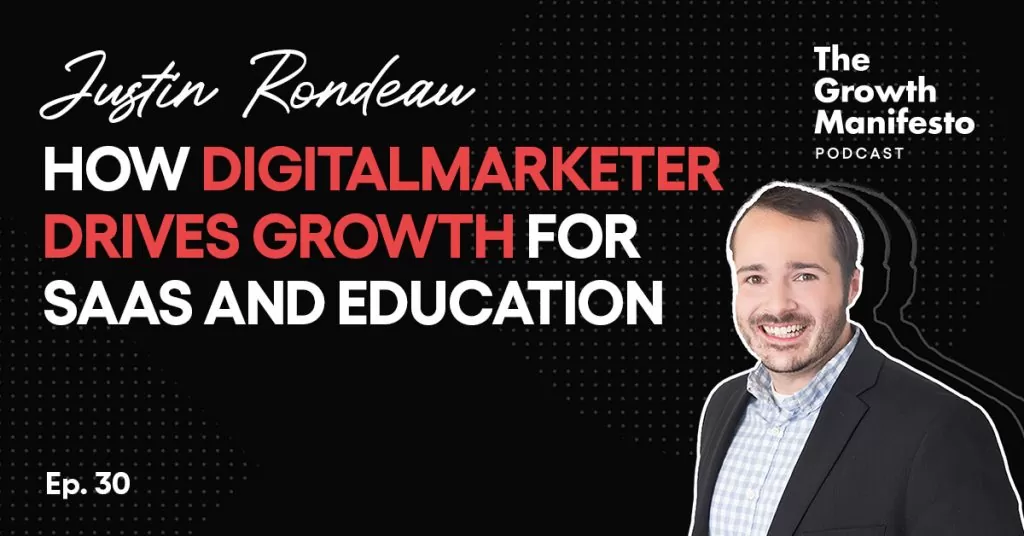


Overview
This episode is a discussion with Justin Rondeau – Marketer, conversion expert, speaker, and Head of Technology & Operations at DigitalMarketer. We talk about conversion optimization, attribution, the latest digital growth strategies and everything in between.
Key takeaways
- Rondeau argues attribution debates are largely pointless, since Google and Facebook both optimise their pixels for last-click credit and will never agree.
- He hasn't run a true split test in about two years, since most sites lack the hundreds of conversions per variant a valid test needs.
- Around 70% of split tests return a null result, usually because marketers are testing button colours instead of the underlying value proposition.
- A confidence rate of 95% means only that a result probably isn't statistical noise, not that the exact lift will repeat once rolled out.
- DigitalMarketer's five-day challenge funnels, run at a low or free entry price with a pitch at the end, generated close to seven figures per launch.
Chapters
- Intro: the attribution mess story
- Info products versus SaaS marketing
- Conversion optimization pet peeves
- What a true A/B test requires
- Confidence rates and null results explained
- Building the customer avatar
- Why attribution debates are nonsensical
- Setting budgets across the funnel
- Challenge funnels and conversational marketing
About the guest
Transcript
Auto-generated from the episode audio, so expect the odd mis-heard word. Timestamps open the video at that point.
I was chatting and I was saying, Hey, like, how are, how are things going? Blah, blah, blah, blah, blah, blah, blah. He's like, Google saying we're killing it right now. I was like, it's not saying that in the bank. Like, I am not seeing any of these sales that you're telling me that you see. And I went away for TNC because this was for a campaign to sell the recording. So I was like in communicado to which a hundred thousand dollars in ad spend was spent over those three days that I was incommunicado because they were using the Google algorithm to optimize
through these things that never actually existed, which means it's just getting more people who are less likely to convert. And it was a mess. It was like a complete $100,000 mess because people just relied on like what one thing was saying. There is no single truth except for what's in the bank. Okay. So there's no single truth in data. Are you seeing these things come through? and always think trust but verify always always always that's why this this whole attribution debate just seems nonsensical to me and it just sounds like a lot of people who are really bored
right now who are trying to justify their positions in something you're listening to the growth manifesto podcast a zoom video series brought to you by web profits where we talk about how to drive business marketing success this episode is a discussion with justin rondo Marketer, conversion expert, speaker, and head of technology and operations at Digital Marketer. We talk about attribution, conversion optimization, the latest in digital growth strategies, plus everything in between. So let's get into it. I wish we were in the same time zone.
I would start drinking now too, but it's like 9.55am right now in Sydney. I'm sorry, like in Australia. When's that stopped you before? but yeah well hey listen um usually when i'm seeing you it's at a conference and yeah it doesn't stop me then because really i'm like well well in sydney it's this time right now so that's fine you know normally at that time how you been bro i've been good i've been good um i've been just same old stuff kind of down in austin uh bought a boat that's fun um like that's been
super fun been seeing the same girl for a while uh been together almost two years now so that's kind of congrats congrats yeah level of um consistency there which is good yeah yeah that's good that's um i don't know how important that is that's for sure yeah yeah yeah definitely and yeah i'm good at you know this whole world is upside down right now and you know we're just um you know we're just doing the best we can like in chaotic situations um yeah there's opportunities is in there um there's lots of challenges in there um there's lots of challenges especially
around you know just being kind of stuck at home like you haven't gone back to the office yet you know we've yeah we're done for the year we haven't gone to the we're not going to be in the office for at least the rest of the we actually we declared we're a remote first company now um but we have the office lease for another two years so it's like that yeah so we're also like yeah that's um the same thing that we've done yes we've changed our approach now as well and so we are also a remote first company um we just signed up to we work and so now we're just basically just
kind of embracing the full um the option to go somewhere if you want but not the requirement you know and so people still there's still a lot of collaboration that happens side by side right um where you just don't get that just being on kind of a back-to-back you know you know zoom is great but zoom is just not the same as being side by side with someone zoom fatigue's a real thing like i remember because i worked remotely forever before i moved down to texas and i remember
also like not just from a working perspective but even like when you're doing like a stage presentation versus like a webinar a webinar is far more draining because you have to build up all that energy still and like when you don't have all kind of like the the standard kind of like in the room with somebody to collaborate on like zoom fatigue is absolutely real because you have to keep yourself like hey yeah how's it going and then you turn off zoom you're like that's right i'm just here again at home yeah yeah the shift it's almost like if you were down shifting like
a manual like or like and just going like all the way in this uh it's not it's an interesting it's industry in turn not not a terribly big fan of it but no not a terribly big fan of it either but hey let me just do a quick intro because look i started recording this is probably going to be kind of we'll probably have started the podcast just from a few minutes back when i said i wasn't going to be drinking because it's too early and then you judged me so that's a good place to start but today we're talking with justin rondo who's a marketer conversion expert speaker and head of
technology and operations at digitalmarketer.com, which is basically one of the leading companies across the digital education space. And I first met Justin and I had to have a look at this. This is back in 2014 at the Witch Test One conference in Austin, Texas. I was there with Duncan and we were there for the pre-show conferences. And we heard you talk about conversion optimization um and you just kind of opened up to us um kind of the thinking just
behind the volume to the quality game and you kind of changed our whole approach and so we came up to you afterwards we were like mate that was so good do you want to have a drink and that's when we hit it off because you were like hell yeah let's go we ended up just going back every year for the next three or four years. We went to the Conversion Excel Conference and we went to the Digital Marketer Conference in San Diego. That's a couple of years ago now, three years ago, two, three years ago.
And we've become pretty close friends since then. But you're one of those people where you've got this unique ability to explain complex ideas in a very simple way. Yeah. And you're also pretty down to earth. And so I figured it'd be great to have you on this podcast, right? and we get to talk about all the marketing stuff. This is going to be like a geek out session, I would say on, you know, what are some of the things which you're seeing like that's happening like at the front lines. We will probably talk about some conversion strategies
and kind of the theories behind them. You know, like I want to touch on attribution and how you think about that. Oh, I can't wait. I can't wait for that one. That one's going to be fun. Because that one, I've been asking a few people about it And I'm kind of stuck with it. And I'd love to hear your thoughts on that. And then we're just going to talk about, you know, kind of some of the tactics which you're seeing, you know, because I know that you guys have the unique benefit of being able to experiment with a bunch of traffic that not many other organizations have, you know.
And I think, yeah, that's the intro. Like, I'm excited to have you here. And it's been a while since we've spoken anyway. So this has been like a good way to catch up too. Oh, absolutely. I'm really excited to geek out I've been in such like a the last maybe six months or so such in like this more operations and software development mode and kind of like like kind of taking something from nothing to launch uh and then marketing that out it's it's fun to kind of go pure marketing again to like talk about some of those things because that's
that's truly like my passion what I've been doing the last 10 years and then specifically on um on the conversion rate optimization more data-centric side of things but um being a digital marketer for damn near six years now. I learned a lot in terms of kind of the acquisition side as well, where there's neat stuff going on, specifically some of the stuff that we've done recently, that's gonna be really cool to talk about. And then, yeah, when we get to attribution, we have some of those things. Oh, that one's gonna be fun. I have an opinion there. As you know, I tend to. Which is why I love you. And you have an opinion that's based on reality, which is great.
It's not based on theory. And I think that was kind of one of the things which kind of, you know, stood out to me at the very start, the first time, because I'd done so many courses and conferences and all that type of stuff. But you're the first person that said, hey, it's just like that. And I was like, oh, it's so good. And so that's what we're going to get to. But can I quickly ask, Kusa, you've moved from kind of the head of marketing role to head of operations and technology role. Yes. So what changed in terms of what you do every day? because I would just really like to understand that
just so we can set kind of, I guess, a foundation, you know, that everybody else can understand about you. Yeah, so, I mean, I, yeah, well, I started going kind of all the way back with Digital Marketer. I came in specifically to work on the data and optimization side on all of our campaigns. So I kind of had, but I was doing all the split tests, kind of finding all the opportunity areas, kind of finding the best ways to get the most out of the traffic we were sending to the site, whether that was pay-per-click organic or anything like that. Um, I moved down to Texas a couple of
years after joining digital marketer to run the marketing team. Um, so I had a small kind of lean team of marketers. We're just trying to, and then covering everything from, you know, paid acquisition. Um, we'd actually, at that time, we didn't take SEO organic all that seriously. That was a big change that I added in when I, uh, when I recruited people for that team and then email marketing. I think we, we, um, we're not shy to email if anybody's on the digital marketer list, you know that um i actually i actually remember being um talking at your office alex and and when you're
like hey some people don't want to email i was like if you're not going to email you're not going to make money so like there's i mean obviously you don't want to kind of hit people all the time but um there's definitely a delicate balance that you can hit there that's worth doing and email is not dead it's not dying whatever anyway so um we'll get to that too by the way because i want to Yes, yes. And then we had a lot of success and growth at Digital Marketer during that time when I was asked to actually run the company.
So I ran the company as an interim general manager for nearly a year. And that's when I was doing I was kind of doing more of the marketing strategy on one side and working with our director of marketing there, kind of working through all that stuff, working on the product line. And then also a skill set that I have, which comes from kind of, I think, the rigorous analytic side in those things and being kind of step by step by step and process driven was that I migrated all of our back end systems over a period of time while I was managing the company.
And I've also launched a software company with a friend a couple of years back that Digital Marketer acquired. It was one of our portfolio companies. So they knew, I understand operations. I understand software. We wanted to start launching and releasing more pieces of software and getting it to market. it uh get product market fit and then start scaling some things out so they in the last six months that's where i've moved and started focusing um and doing a tour of duty there um as i'm kind of building that that out so i've done damn near everything in the marketing and almost and now getting into the business world too and stuff i've done so i do have a long view
on a lot of this stuff yeah great and we're gonna get into all that but um can i just confirm then And so before you were marketing the education programs and then now you're transitioning to creating technology and kind of transitioning into SaaS marketing essentially, right? And having all those lovely conversations around CAC and LTV and all that type of jazz. Is that kind of the big transition? Yeah, that's accurate. And I think that's the bigger transition. Good job distilling that one down because I said a lot of stuff.
No, no, no. But that was really good for just kind of the history of you as well, you know, because like, yeah, like you've been done quite a lot. Yeah, but it's funny too, like the conversation, anyways, when you're talking about the conversation, it's always like LTV to cat ratio and all those other things. I'm like, yeah, what problems are you solving? Let's talk about that first. Then we can talk about what's going on there. That's a whole other thing to do. We're going to get to that too, because we have a section on kind of metrics to cover as well. So look, there's a lot of parts that we're going to be talking to, right? But can I just start with kind of something that's probably kind of relevant to your current
role? What is the difference so far between kind of SaaS marketing and product marketing? You say, for example, education marketing. So what are the things that you're seeing as like the difference? So what you're doing on more of the educational side of things and information. So education and information are so very distinct because the marketing is actually kind of born out of you have to build a product to then market, right?
So you're creating like, like you'll see these challenge funnels popping up all over the place, which are highly successful. But a challenge funnel. So a challenge funnel is when you kind of set up a five day kind of almost event. And how we do them is with like Facebook groups or those things where you provide like, hey, do this each day and people sign up at either no cost or low cost. And then you have a pitch at the end. Right. And so you generally like for the ones that if you're gonna have a pitch at the end, that's a high ticket offer. You probably want to get people buying into the challenge at like a low dollar price point to show that they have some skin in the game.
then you provide the most insane amount of value over the next five days in terms of like a maybe 30 to 45 minute like topical like piece of information that people can work through and then by the time you get to the end of it then you have kind of that profit maximizer upsell at the back end um and that's that's a pure info model that's how you do it right and these things you're seeing them everywhere at this point in time and we had i mean we've we've had several um close to seven figure challenges that we've put out over the last three months.
They're really great. They get people involved. It turns people rather than being like an active learner into a like, I mean, a passive learner into an active doer of an action. And when people start seeing movement, that's when they start believing. Right. And so that's why those work so well. And so that but if you think about information and education and training versus software, that is like what that is, is the product, right? You'd use those types of mechanisms to drive to
a software product, but you can, you can't do it at the cadence at which you do it for an information type product or anything like that, where anything that we put out at digital marketer or any of other brands that's information based is going to be more like, it's going to be a splinter of another offer of another offer. So we'll have our core subscription offer and we kind of break things down so there's always a an information path to the um either the one-off purchase or the subscription for sass everything kind of and those can all vary for sass it's all
ending at that particular product right you're not seeing as much stuff on the product bundling side of things or anything like that and the just the the cadence for discussion with people is a little different you pretty much like you have a period of time when someone can like gets on your list for a SaaS product before you lose them. Similarly to, um, a, um, or if they sign up for your product or anything like that, like they have a half-life, they're going to go for the information side of things. You always have something new to talk about. So that's why it's, it's the same, like that we've been saying for years, even back when we had like content and
commerce summit and those things like, like e-commerce requires content for it to thrive, just like SaaS will require content there. But it's a very different product model in terms of how you start putting things together. I think it's more cut and dry on the backend for SaaS. And it's far more important for a SaaS marketer and anybody doing product marketing there to make sure that they're doing a lot of work within the product and creating, and they need to be more of a technical marketer. They need to have copywriting skills and those types of things,
but they need to be a technical marketer and they need to know people that start like building BD deals with for like tech integrations, media integration, media partnerships, and those types of things. On the information side, where you still need that type of thing, you can create a product out of nowhere with information, right? But you have like a quadruple churn rate, average churn rate than what you'd see for SaaS. Like the kind of the industry standard acceptable churn rate for an information product. and I have this little, like I have a more academic like theory on this in general, but,
and I'll get it, I'll say it and then people can scoff or like roll their eyes or comment or whatever. But, um, I mean, you're looking at, if you have a 10% churn rate for an info subscription product, you're looking good. And that's that. And if you told that to a SAS marketer, they expect to be in like 3%, right? Like then 3% is like, ah, you're okay. Right. that's how different those markets are because you have to keep creating the new and then in the U.S. like there's there's one type of loan you can't default on and that's your student loans
right because when you sell someone education it's consumed you can never give it back so when somebody learns something it's always about what have I learned lately from them right and it gets even more tricky because if you think about how people learn in general how people learn is they don't recall the first time they learned something or the first time they remembered something. Every time you recall something, you're recalling the last time you recalled it. That's why things get hazy and things like that. But when you think about information, there's going to be a time where it's like, oh yeah, digital marketer taught me that. Oh yeah, digital. And then it's
going to be like, I taught me that. And eventually it gets to that because the recollection is a recollection of a recollection. So that's why you see such high turn rates kind of in the info space there because it's really what have you done for me lately and that's why you have to create more products and product bundles and those types of things there and so what are you saying then that's working from a sass marketing perspective that's i've moved over all over the place with sass marketing um uh we we've tried a bunch of
different freemium like we've done the freemium model and those types of things but if you don't have your onboarding in place like within the application you're hosed like you're just dead in the water. And I personally hate freemium. I've watched a bunch of companies just lose big on that. Because the amount of effort it takes to get someone to put a credit card in once they're using something, they can just have like good enough syndrome. That sucks. I think credit card trials are kind of the way to go. Like when you're putting those things together. I could also see
just, you know, pay up front 30 day money back, especially if you're like in the B2B space when you're doing a SaaS product, like generally, especially a low dollar SaaS product, if you're doing anything sub 500 bucks or something a month, like you're generally going to be able to get them. And if they don't like it within 30 days, they could refund or you can do a trial level there. But because that's generally like discretionary funds and those types of things. But I've been like, I like to add a bit of friction. I want to get people who are going to take the next step.
It's not all about kind of just getting all those kind of freeloading users because, and the second they get in and they don't understand something or, or they don't see immediate value, like they're gone. Like even if they see value, they could just disappear. Cause they're like, Oh, well I have no reason to keep using this thing. And I, and you can talk about things like, okay, well maybe you're onboarding, needs to do it, or maybe your app needs to be more intuitive or those types of things. Or maybe you need people who are motivated. Um, and how you get, and people show motivation through their wallet and their time. Um, So I think that's a fabulous point there.
I think that's a super important point is like, like you can't conversion optimize a person that's never going to buy from you. Right. And so this is potentially, this would be a good transition to conversion optimization talk, right? So this section is on a CRS stuff, which is kind of the first time that we spoke, it was our first date. We had a conversation about conversions. It was great. um but there's so many let's start with um pet peeves of yours just when it comes to conversion
conversion optimization around you know like you spend so much time couldn't like kind of optimizing a page that nobody actually visits or you're split testing stuff which you shouldn't be you know so what are some of the mistakes that you see people make just when it comes to conversion optimization or i think uh yeah optimization or however you want to call it Oh, I'm so I'm glad you said that because I want my biggest pet peeve is anybody who talks about the damn acronym who cares move on it's fine like CRO people get it. Stop talking about like, is it this or is it this it we all know what this is.
really okay we're trying to like we're trying to maximize engagement whether that be a level of generating more leads more sales or even more kind of micro conversions that kind of the click through level if you don't have enough you know sales coming through on the back end to uh to do something that's statistically significant i think my my biggest pet peeve is just people just saying like just straight up you should test that or it's like no one knows you should just test that it's like here's we have so much data on things and testing is and and here's the here's here's the
crazy thing i haven't run a true split test in probably like two years at this point because i've lost i haven't seen the value i've needed to get from it over that time um historically like you can start looking at things and say hey such and such person is acting in in this way and you can generally diagnose it with all the tools we have out there like true conversion hot jar those types of things to help you see what's going on on the page. You can look at your analytics and see if something's broken relatively easily. There's a lot of opportunity there. And then the real thing
is, if you're going to test something, you want to try to have kind of, you want to be able to theoretically use those learnings and apply them to everything else on your site, but it's all contextual, right? It's contextual for that point of time, for that particular page, for those sources of traffic. So what you need to be thinking about is how do I develop, like, how do I make sure and ensure that my value proposition and everything kind of on the pages is understood and do they know what to do next? If you have those types of things down, you're looking pretty
good. And I wouldn't even do like a standardized, like split test at that anymore. I'd probably look at if I was going to set something up, it'd just be like mostly like headline tests or those types of things these days to see what hooks work and what things work there. I've avoided massive kind of redesign tests. Those ones are silly. I think if you have a theory of a template you want to try, it gets too dicey. And generally when people are doing tests like that, it's like they're trying to do a do no harm. They're just trying to validate their own assumption that this
new challenger should go there, but they're going to tell a data story anyways to put that challenger there anyways so i think my big my actually probably my biggest pet peeve now that i'm talking about it uh because actually i i wrote a post about how i was done writing blog posts about split testing and done this stuff like it's on dm like i just kind of lost it i was like i'm done i'm done like all the information's out there it's it's okay and i love your rants by the way like especially on linkedin as well you did some you did some good linkedin rants it's great uh yeah i've i've i've i've pulled back from that i'm trying to be a bit more positive but like
These are, this is like, Oh, this is deep, deep rooted. But I think, I think the real problem is, is that they're used to validate. They're not you like, so you have an assumption and you're like, Oh, well, let's just test it. You're not trying to improve much. You're either trying, you're, you're trying to like almost validate your ego or your thought that this thing was better than that. You also lose out and kind of the, like kind of like the, the gains, right? There's a, there's a, there's a cost to running these tests because you're splitting traffic.
And then if you're going to try to do any sort of risk mitigation and run it at like an 80, 20 split or anything like that, it's going to be harder to run that thing. So you're, you're, you're effectively saying half my traffic, I'm going to send you to something. I don't know if it's going to do better than that. Right. But, and I think it made more sense back in the day to run tests because less people were as data driven, but we have lots and lots of data at our disposal here. We, and we have lots of ways to analyze things. So I think the opportunity cost now is just too high
for what people are looking to do, especially if they're using these types of things on like for like a launch model or anything like that. If you're putting something out there that's only gonna be going for like seven to 10 days, you're running like a true like, or like seven to 14 days, you're running like a true launch. Don't get into just split test mode, like run things, see what it works, tinker and then move on. Like that's where sequential testing actually kind of makes sense. or you could just do like a multivariate setup and just pay attention. And like, I used to say, you know, don't, don't look at the test until it's done. Like let it cook, let it cook. But
in like a launch mode or in anything like that, don't let it cook. It's going to burn. You need to be able to maximize those, those, those types of conversion. That's why multi-armed banded algorithms and things like that work. Right. And if you can use something that if you you have a piece of software that can do that type of stuff, good on you. But I think we're tripping my sales, head of sales is going to laugh at me so much for using his quote that he says all the time, but I roll my eyes at, we're tripping over pennies to pick up dollars. I screwed up
because it's not mine. It's not my quote. The idea is we're just like, hey, look at all these pennies. We're missing all the dollars. And that's what's happening a lot, I think, in the optimization world where they get into this, well, what if the button color still comes up? Well, what if the button text was different? It won't matter. Like, is it clear what you're offering? Is it valuable? And do they know what actions to take next? And then if you're really good at it, are they, have you anticipated, can they anticipate what they're going to see next?
Right? So if they're going to click through on something, are they seeing a checkout page? Are they seeing just an add to cart are they what's going on at that point so you need to kind of cover those types of things if you do that all the testing in the world is only going to be a like a kind of incremental gain if that it might even just be a phantom win at that point so there's there's there's a lot of better things to be looking at and especially at this point in time so then which is such a fantastic point and i think you know
like the big thing that I came way after the first conference back in 2014 was I came up with Duncan I was like cool we're no longer doing A-B testing anymore we don't have enough traffic and the speed to to the result is too long and so we just yeah and so the value of it's completely gone um to that part of it please yeah because that I walked away was like all right so yeah Like, could you just explain the environment that kind of is required to do a true A, B
test? Yeah. And it's funny because yeah, you went to a split test conference and you're like, we're not running tests anymore, which I think is amazing. But yeah, I mean, it's all about, it's all about test because you'll hear a lot of people talk about test velocity. And whenever, if you're ever at a conference and you have like a, even low to moderate traffic website and they're talking about test velocity lead there's no reason for you to be at this conference because the topics that they're going to be talking about have nothing to do with you they're only for like kind of the top one percentage that are going to be in in the room
um but what what what really what we noticed here i actually have a chart i could probably send you the screenshot of that thing because it was just like how many conversions you need per variant and how long it would take to get to those types of wins but i mean you need to you don't ever look at just pure traffic, right? Cause you could have a high traffic website that has a low, low conversion rate, like maybe like a content marketer that has a pure content site. They probably have less sales coming in as much, as much as they have like readers or even leads, even subscribers to which I'd argue what they would optimize there for subscribers at that
point, because that's, then they're going to be able to use email marketing and kind of pull that stuff. But yeah, it requires, I mean, hundreds, like, like, so I think what, I think how I showed to you is i mean you need hundreds of conversions per variant in order to pull this thing off and when you're running that's part one that's part one that's part one of the things you require because it's hundreds of conversions per variant yep yeah not not not hundreds of visitors hundreds of conversions per variant and then it's almost like exponential as you're adding more variants to it so if you're a low to moderate website running a um running a split test you don't want
of have multiple, multiple variants, you're going to be doing A to B. And so then if you're, if you're like, oh, hey, let's test this headline variant, it's likely not going to be big enough or, or it's not going to be a large enough swing to have a large enough impact, right? So what you need to start looking at is how much of an impact can you expect to have between the two variants? Because that's also going to dictate the number of conversions for it to be statistically significant. So it's a, you need far more conversions per variant to have a 5% lift
for something that's a 5% lift than for something that's like a 30%, right? And then you have to ask yourself as you're selecting things, can I expect to get 30% growth, like a 30% jump off of the stuff I'm about to do? And if you, if you ask that question and you say, no, don't do it like at all. So you need to be looking at like, what's the potential impact you're expecting to have knowing that bare minimum, you need to have hundreds of conversions per variant, right? So you have that and then you get into time. This was what messed with me the most.
I mean, time is, it's tricky with this because it generally, when you're running a split test that you want to be able to have scalable results for, you want to be able to run them for entire business cycles. So the more, the less conversions you have, or the less impact effect that you're going to have, the longer the period of time you need to round up for a week, or at least, to close out, at least if you have like a light business cycle. But I like to fact, I like to round up any type of week, because you can get a kind of, you know, day by day variance and those types of things. I mean, you're looking at going from like, you can go from something as much as
that was going to be like a, say you had like, if you had a test that was getting moderate traffic, moderate conversions, and you just said A, B variant, you could probably pull off and you expect it to have a big impact that could take, you could do it about seven to 14 days. But if you don't expect to have that big of a lift, that thing can jump all the way up to being up to a month, month and a half. And if you're spending, then you have all these other things with like, like if you're going past four weeks, then you have like cookies resetting. I mean, I mean, the testing industry is going to be really interesting with all in a post cookie world. I'm really curious about that. But you're getting all sorts of you're adding all sorts of other exteriorities and variables, if you're going longer than a month. So then it's not going to be a worthwhile test of the day is going to be tainted. And then here's the real kicker. That's just for the test. How long is it going to take for you to roll out your learnings and then also validate those learnings. So not only are you going to be taking, like, you're going to
have these variants that you like, you're going to be like, great. It took us four weeks. We did it. How do we roll these out across the board? Do you know what you're probably, you're not going to do it. The fact, you're just not, it's going to stay on whatever thing you just did there. And you're not going to roll those things out. If you're doing it for like multiple landing pages, or, um, maybe if you can, if you're, I guess it's not a complete fact, I guess if it's a checkout page or something, you might, you might, but you're still going to have all this legacy stuff in there and it's just going to have diminishing returns. And then it's just going to regress to the mean again. So it takes way too much time to split hairs when you're doing, if you have a
low traffic, even moderate traffic site, and especially if you're looking at the wrong pages too. Yeah, right. Cool. So we basically have hundreds of conversions per variant. We've got the predicted uplift, and then you've got time, right? And time has a limit. And what's the upper limit of time in terms of any test that somebody should be looking at i used to get i get twitchy at anything over three weeks like personally now um i used to in in trainings i used to say go up
to at least six but i that's like uh i even put it in red like danger zone like super danger zone like um and and i think i've become more i've pulled back more from that because i i don't believe a lack of data is a problem wrong data is a problem inaccurate data is a problem and it creates false beliefs, which then can hurt your business. I got fired from a gig one time because I got into it with their CTO about, I was doing a webinar and I was talking about, you know, split test results. And someone asked me,
can you do split tests on a small site? I said, don't just don't do it. Here's a whole thing. Here's the thing. Like, and I have this whole belief of like, you know, best practice or best practice because they're common. What's common to a user is always best. So that that's how I look at things. um i saw that talk at the conversion excel conference uh yes years ago yeah yeah that was a good one actually that that was a fun one that was a real that one was so out like that audience didn't want to hear that talk i remember doing that one that one was that was interesting um but yeah i i and i i get a i get a phone call and they're like hey we're
releasing a split test feature to this application and you just completely told like a good amount of our audience not to use it. And I just went, Hey man, it's just math. Um, to which I was fired. Um, but it's true. Uh, and I think inaccurate data is the worst thing, uh, that you can have, especially in kind of this data driven marketing landscape. Yeah. Um, yeah. Could you talk quickly about the null result?
What's the null result? Because this is something else that I was like, oh, yeah, that explains so many things to me about why my split tests weren't working. Really. Nearly like the 70% of tests that happen come out and null. People look at tests that they think two things can happen when you're running tests. They think you're either going to get this uplift and it's going to be great. And we're all going to be just popping bottles. Or are you going to get this like down, like this just super loss. And then you're like, but Hey, I learned something.
Here's the kicker. Most of the time. And this is why it's a kind of a risk that becomes a risky game. It's not, it's not even though they're a, b tests, it's not like you have either. It did something or it did something. And most of the time it does nothing. And the reason that most of the time it does nothing is because people aren't aren't kind of testing the right things. They're not looking at the things that matter. That's kind of the big thing. Cause I used to say as a joke, like, Oh, look, look, you're done testing and nothing's going to change anymore. It's like, that was always kind of tongue in cheek, but it is good to know, like when you need to stop working on a page and move on.
And that really comes down to the amount of effort going into it versus the potential result that's going to be coming from it. Like similar to it all comes back to what's your, like, what's your perceived impact. And if someone's going to be listening right now and say, well, Justin, I have no idea what it would be. Take a guess. Do you want to know how we come up with ideas like at digital marketer? And we're looking at like, we are not ideas. Like when we're looking at benchmarks or anything like that for, for ourselves, if we don't have data, we go, we think it's about this and then we just do it and see if it happened. There is like, sometimes it's worth showing a dart and I,
I hated it whenever Ryan and I, Ryan and Richard and I would be in a meeting. They'd be like, Justin, I need you to tell us what like potential uplift on this one thing would be. I'd start flop sweating being like, I need to be the most accurate. And then they, they pretty much beat that out of me when they're like, no, just pick something, pick something, pick something. And it was really hard for me to do, but it was a muscle that I needed to start flexing. And so that's, that's really important when, when you're thinking about kind of the tests you're running and kind of the,
the stuff that you're focusing on and really what's, what's worth doing. And cause that's really all, all this is. It's like, and it's opportunity cost as well right it's opportunity cost it's time of that this is not of something else yeah could you imagine running something for four weeks and it's a null i've done it it sucks and you don't learn a lot all you learn is oh shouldn't do that again maybe i don't know like null results null results are the vast majority of tests that happen can you also talk about there because there's something else that happens as well right is that and speak to me
about confidence rate like because there's always a confidence rate it's like this this um specific variations one at this level confidence what does that exactly mean because it's got a loophole in there which if you're not careful and you don't understand it you're then confused why is this not actually increasing my revenue yeah yeah so um confidence rate like i've heard a lot of things And then, so I'm not, I'm not a trained statistician. Just going to throw that out there. But I'm, I, I know my applied statistics well enough.
Just want to make sure people know that. But when you're looking at the confidence rate, what it's not saying you have like a, like a 95% chance of getting that result. That's not what it's saying. It's at all. It's saying that the result isn't due to statistical noise, that it's not a false positive. Right. So the higher your confidence rate, if you're like at 95%, that would mean that there's still a 5% chance that the lift you're seeing is erroneous. That it happens to be like due to other things.
So that means I think it's like, what is it? At a 90%, that means there's a 1 in 10 chance that you're just kind of off there. So it gets a little tricky there. It's not a matter of like, oh yeah, we expect to see this rate at a 95% sure that this is the exact lift we're going to get. That's not what it is. It's saying, hey, this change is only like 5% of false positive. And so there's a chance that it doesn't have any impact on the revenue numbers at the end of that.
So it could kind of increase conversion rate possibly. And then you have to- Maybe not as well, right? But maybe not. And it's only talking about that snapshot of time too. So that's another important factor. Like, are there any other things happening that could have influenced any sort of changes or those things? Are you seeing different traffic source influxes? Are you a seasonal business that's out of season or in season and those types of things? But yeah, the confidence rate, And then you have confidence rate and you have confidence interval intervals getting more into like, you can expect to see like this, this percentage when they're like, if you're like, Hey, you have a 15% lift, but then they're like, but it's because we don't have enough conversion data.
It could go from nothing to like a loss to like a big win. Like, and you'll start seeing those in testing statistics now. And I mean, it's way more refined than it was when we met. they've refined those things they do a pretty good job pretty good job visually to kind of show that but there's still just there's always a risk you get that null and then also like even if it's like hey yeah bingo you there's other again variables and there's also the chance that it's still due to that type of noise and if again if you're running like if you're not one of the if you're
not even digital mercury we have a hard time doing some of these tests and we have tons of traffic like i'm talking if you're not microsoft soft. If you're not those types of companies, that's when they can start doing these types of things because, and kind of at a small, like it's a large scale, but do small scale changes and small scale implementations because they just have so many numbers or just so many visitors, so many conversions that are happening. Whereas you could have something that says, yes, this is a 95% chance, but it could also not have that many, you could have just a big potential, a big
lift between the two variants. So one thing to know is whenever you start a split test in general, I like you should probably ignore like the first two days anyways of data because there's going to be this natural variance due to like just tech implementation as well as um novelty and um was it novelty effects and I forget the other one off the top of my head but there's a bunch of stuff happening there so you'll see nearly all split tests they go like this yeah and and then like that that's just kind of due to uh due to a bunch of different things there so I generally ignore
the beginning part and then I average out from when we start seeing actual repeatable differences but say for instance you have a test where you have and you have 15 conversions in the control variant and 10 in the challenger that's a 50% level right or 50% difference that's a big difference and the numbers aren't going to be looking at them they'll say now like oh the sample
size is too small or whatever but it's going to say a high confidence rate on that one because of how because of the just the delta between them so that that's where that's where even having a certain rule of thumb of like just hundreds per variant those types of things and there are a good spot check to be like am i jumping to conclusions because the worst thing you could ever do is take a look and go oh yeah we're 50 up and it's only five like five sales and then tell and then and then tell your boss oh yeah if we if we put this out for the rest of the year 50 increase in
sales across the board let's get crazy that's just not gonna happen that's it yeah that's um that's um the conversation of a junior optimizer we'll call it right the people who just start They're just like, they're so about the numbers, right? But let's quickly then jump to, okay. So we know that most of the time now you shouldn't be doing A-B tests because A, you probably don't have enough conversions. B, you're probably not going to get the results fast enough, right? But you want to increase the performance of your site, of your funnel, of all these things, right?
How do you approach it instead? So a lot of how I approach it, a lot of it comes from historical knowledge. I look at, I do a lot of research in terms of like what other people are doing. And I know there's a lot of people now, like I know Pep is all about like sea of sameness and those things. He's trying to get away from that. I still truly believe that if you don't have to retrain somebody to, to interact, you have a much better chance of getting, you're no longer having to like teach them how to use your site or how to navigate it. And they can stay hyper focused on your message. Right.
um and then really really how it comes down to when we're looking at different funnels there i we do use testing or not even really testing we do use we we set certain baselines between each step of the funnel where we're like hey we'd expect x number of people to to sign up for this lead magnet or we'd expect so like we expect so many people on day one of this promotion to add to cart and this many people to this so we have those like that benchmark data and if anything's below it, then that's when we start doing kind of qualitative analysis to see like,
what are they doing on there? See, are they like, like, with, like, are they scrolling through the page? Are they, are they hanging up anywhere? Is our value proposition wrong? It's, it's more or less, are we meeting the expectations we set because we have some historic, we have a ton of historic data. And then if we're not, what things, what, like what, where we have, we, we become detectives to find out what needs to be shifted quickly. And that's where some, some short scale tests can come in because if we can see a quick jump or anything like that
between them, cool. But, but that data is going to be useless to, to scale out anywhere. It's more or less a reaction. But more or less, it's like we pick, we draw a line in the sand of this is what we expect if it's not happening we have to figure because eventually at some point you go our offer is just wrong and then we pull the promo um then we have to go back to the drawing board and figure that out and it happens it happens it happens a good amount the best like i mean i've always said that we have a better batting average than most but we've whipped whipped hard on some
things and it's about knowing the indicators of when you have something that you need to put all your money behind or where you need to pull back that's that's really how we look at things now versus like we gotta have several variants of this for the landing page and the upsell needs to have this and then blah blah blah it's like nah how about like we say we get 40% offends on all of our lead magnets if something sub like if something is like at like 30 all right let's figure out why is this why how are people interacting differently it's in most of the
time here's the kicker has nothing to do with the page it's mostly the audience going to it it's normally an audience mismatch or something like that. Or it has to do with like how we set up the email or how we set up the ad. It's the page. Most of the time is probably fine. People know how to use the internet. So cool. So it's on that point there then, because what you're really talking about is understanding the value, which you are kind of offering the audience. Right. And I think a lot of times when people are looking at kind of,
kind of like on kind of um how to improve the performance of a website they just look at the website and they don't actually think of the audience but actually if you understand the audience you know the one thing to say to them that is the best hook to get them across the line and then everything else on the page is just kind of supporting that hook yeah to prove that that hook is not a bunch of lies right yeah exactly is that kind of the best way to kind of explain kind of how do you step into something which you may not know right because say for example now
right you have all the history and all the data but but like but you might have to step into a campaign that doesn't have all the history yeah right but how would you go about that like is it about the audience first like is that where it's at it's absolutely about the audience first it's it's who are we talking to let's say we so we'd run like we have like we we run a for any new product or anything that we're trying to promote, we put together, one, we do our customer avatar worksheet as well as our before and after grid. And that'll pretty much do everything for you.
So if we know who we're talking to and we know what they're going to have, how they're going to feel, how it's going to improve their average day and how it's going to change their status, if you can talk to all of those things and they're become more important, further down you go, because have is just table stakes. Then you know what they're getting, right? How they're going to feel okay you're getting a little bit better there but the only way for you to know how to talk how to like talk about those things is to know who you're talking to in a lot of cases know who you're talking to based on where they're coming from as well so it's going to be like hey if they're coming
to like a um like one of the things like an easy an easy shift on a page for us would be if we're running like a flash sale like we're just going to talk about like we're all we're going to be hammering home is they're going to feel upset that they didn't get this because it's more expensive now that's what we're going to hammer like and and then there's times where that doesn't work as well and we have to rethink like how we want to make people feel on those things um and then i mean when we launched our certification model of things like we were telling like hey like you're going to have this status you're getting a badge like i think like what is
it there's like a napoleon quote that's like the like like people like people will follow or do something people will do all sorts of things this is the terrible paraphrase of it but people will kind of do whatever for just like for like a ribbon or a badge of honor of some kind they're always going to do it um so and that's why status is so important there so i think it would be like okay if i was coming into a new campaign i'm like who are we talking to and if they don't know that i'm like all right we need to find out because like if and when people are like well i don't
want to like i want to talk how do you find out by the way um you start looking at like um so one if you're starting brand new brand new like you should have an if you haven't done this before for example right like it's your first time you kind of probably you kind of think you understand your customer you kind of think you may not have created all the segments or you may right yeah let's say there's basically like a few segments that you know of course i'm going to target say for example it's business owners that make between basis x and x and then i'm going to
target you know kind of this specific segment and then that segment and stuff like that yeah so how do you then expand out the customer avatar yeah so there's there's great ways to do that one of the ways that we do um let me pull up this one thing real quick let's see if i can pull it i probably could pull it from memory but let's do it this way yeah that's good up on my screen um so generally like you have your standard stuff um like we're saying like you know like are they business owners are these things like we start looking at goals and values like sources of
information challenges and pain points and then kind of the objections like those are the big things that you want to be thinking about so like for um like and i'll share like one of our customer avatars that we have for digital marketer we're for gold like and this is we have a product that's just for agency owners, right? And so like goals and values, they want to scale their business, get larger retainers, train their team. And so all these things can get, can start being used in terms of the messaging when you're talking to them. And that's where you can start trying to tweak how you talk and how you,
how you fit your offer together. So delegate more to team, let go of the day-to-day, work more on the business. So less work more on the business, less in the business. Values like family comes first, work-life balance for company, grow and empower employees, surround yourself with those you admire sources of information and when you do sources of information this is going to help you when you're picking your actual when you're trying to find like find these people doing kind of cold outreach what where are they hanging out what are they interested in so like i feel like agency owners would have like we have books like lean in story brand
they'd be following seth godin um then magazines hbr forbes her blogs and websites like they're on Facebook, they're on LinkedIn conferences, they go to inbound on like entree leadership, gurus, and then kind of any some, some other stuff that you'd have there. So that's going to tell you and then like, where they are and what they're interested in. And then you can start doing like, you can start putting social campaigns together with that, where you can start getting into the social chatter, where you can start kind of doing things there. It can also like,
you can look at like, how people how people write in those and kind of talk to them in the way that there used to be talked like there used to be talked to um then you know your goal is then you get into challenges and pain points like what are the challenges and then this is where you kind of dig into the before and after side of things they have these challenges and pain points how are you going to deal with them right uh and how do you figure out the challenges and pain points because everything else so far you could find online you could do some searches um but kind of understanding
kind of the inner workings of someone to give them the right answers to the things that they're thinking that maybe they don't even know they're thinking oh maybe they do how do you find that out facebook groups like join join stuff where people are talking about these things um like communities follow finding the communities where people are chatting is the best way to do some type of research there. If you have any customers, interview them. So you can either be kind of a lurker passive person, but you always have to be active on things. So interviewing people,
looking through any, if you have, like, if you're an established business, like looking through your customer care inquiries, talking to your sales team, seeing what the, like what sales pitches work, what don't, because they're going to test other things out because they, no matter what script you give them, they're going to go off script at some point. They're going to find a way to tweak things that work for them. So always interviewing them. But I mean, especially with how open different communities are now, specifically on Facebook, like just join a couple of communities that like your key audience would be in and just start listening and searching, like search for
like different challenges, be like having a hard time or those types of things where people are asking questions. That is a goldmine. And it's going to be a great way for you to start filling that out and finding holes in the market for your company and also in how you'd articulate things as well. That's awesome because I think this is the biggest one I think I have learned over the last few years, right, is really just understanding the audience. Like, you know, like kind of at the very beginning, I was all about the button color. This is like 10, 15 years ago, right? Button
color, button color, like a button shape even. Jesus, that was some time ago, right? And then was like all right forget button color now it's all about kind of the bigger changes on the website right all right cool let's make just bigger updates but not really understanding kind of who the updates are for just focusing about us and not about the person actually on the site and then we move to understanding the actual audience segments you know per segment understanding it changes the game yeah it changes the game because now you know what they actually want and that's what you can actually provide them and no conversion optimization the world is going to
get you there without understanding the audience it's not going to do it is it no yeah it's like i have to make i optimize it from zero to one infinite lift like we did it we did it and so yeah like if there was one piece of advice that i um can put out to people on the podcast is just spend more time in the audience understanding i call it um kind of like i forget who said it but it's like eating your vegetables right it's like kind of understanding the audience is like having
your greens right it's you don't want to do it um but it's really really good for you right it's really really good for you and the dessert is the split test setup or the software which you do at the very end that's the dessert right um that plays super awesome and i love the point which you just said on the facebook groups and the community that's the first time i've heard that one actually and i think it's it's just so smart because they're sharing they're sharing exactly what they're thinking and it might not be perfect but it's a lot more insight than what you're going
to have kind of outside of that yeah yeah and they're sharing and they're sharing in a way um and so i have this i break down qualitative data in two camps you have um like you have passive qualitative data and active qualitative data um active being that they know they're in a state they know that their information is being recorded essentially. So people who take surveys and whatnot, but people who are more of a passive state, they, not state, but it's passive user data
because they're hardly passive in some of these things, would be things like customer care, would be things like Facebook groups, would be those where they're customers in the wild. They're people in the wild. They're acting as they would as if there's pretty much no repercussions right and that is the most unfiltered unfettered piece of data that you can really use to give you an edge yeah that's awesome that's awesome um i think we've had a good chat on conversions right and we could keep going for days and we have gone for days before but let's just jump now to the next really challenging topic um in the world today which is attribution yeah right
attribution like trying to figure out what basically every tactic as part of a strategy plays in converting somebody to spending money with you i'm getting a drink for this one yeah that's for sure all right um and i hope that the intro was there before but um normally we'd both have a drink right now but it's like pretty early in the morning here in australia so um and it's a Wednesday. It's evening in Texas right now. It's evening in Texas right now, but
just as a quick intro, you know, attribution, you know, just understanding, you know, how each channel plays a part in the acquisition of a customer is something that people have been talking about now for years. And there's been some kind of platforms that have been introduced, but it's not there yet, right? And so what are you seeing over there, Justin, in terms of attribution? What are you guys actually just doing to tell, you know, should we keep spending, you know,
this much money on this channel versus that much money on that channel? Don't do it. Don't do it? Don't, don't. Who cares? It's all in it. Here's why you shouldn't care really all that much about attribution right now, because a lot of the people that are doing it are also going to be looking at it more from a paid channel perspective. and being like, hey, do I put more in Google? Hey, do I put more on Facebook? Here's the thing. Google and Facebook are both, they have PhD peeps that are just focused all the time
at making sure that their pixel gets last click attribution. That's what they're shooting for. That's what they're, so they're at odds with one another. And anytime you're doing any sort of data analysis or any sort of work there, the truth is kind of in the middle as it stands. So like, yes, look at what Google's saying. look at what Facebook's saying, look, look at those. And then they shouldn't be all that wildly different to be quite honest. Like if they're super wildly different than one, you set something up wrong or two, they're being disingenuous. So I like how I look at it is I'm, I'm pretty old
school on stuff. Like I look at Google analytics. I look at my source medium report and I go, oh yeah, that, that looks about right. Like email, emails are the driver, like email and paid media are our biggest drivers. Organic's grown since we really invested in organic over the last couple of years. But you can't expect, like, do you really want to be like, all right, so the general path is someone comes to two posts, comes to one post paid, three posts organic, then they get an email and buy. Boom. So all we have to do is optimize to get those,
to all those things. Or it just doesn't work like that. It just doesn't. And it's so interesting to me that people are so hyper-focused on this because at the end of the day, are you making more money than you're spending when you're doing these things, especially if you're looking at paid channels? Because I'll tell you, this one hurts. Okay. So I'm going to tell you this one. I don't think I don't think I've told this story outside of digital marketers so I might get who knows if
I get in trouble um so we were marketing one of our conferences and we had a uh we were working with a a outsourcer uh not outsourcer we were with an agency for our our google ads um I was chatting and I was saying hey like how are how are things going blah blah blah blah blah blah blah. He's like, Google's saying we're killing it right now. I was like, it's not saying that in the bank. Like I am not seeing any of these sales that you're telling me that you see.
And I went away for TNC because this was for a campaign to sell the recording. So I was like incommunicado to which a hundred thousand dollars in ad spend was spent over those three days that I was incommunicado because they were using the Google algorithm to optimize through these things that never actually existed, which means it's just getting more people who are less likely to convert. And it was a mess. It was like a complete $100,000 mess because people just relied on like
what one thing was saying. There is no single truth except for what's in the bank. Okay. So there's no single truth in data. Are you seeing these things come through? And always think trust but verify. Always, always, always. That's why this whole attribution debate just seems nonsensical to me and it just sounds like a lot of people who are really bored right now who are trying to justify their positions in some things like that's what it sounds like to me and it's so crazy that it's like ah it's one of those just I just don't care I just don't like at all so okay
um same by the way because I I do think of it similarly but trying to put like a budget to a tactic for example right yeah we know there's a funnel for a lot of businesses right and we know that there's basically a stage of awareness where you probably want to use some content and ideally track uh say for example um like in a quite like an email address or maybe it's just a view on facebook and then you're going to retarget them with the consideration and to get them to become an email right yeah how do you then approach setting that budget because you know you can't
just focus on conversion because they haven't got no the funnel's too small you need it you need to be able to build out your pixel audience, you need to be able to build out more things. Like there's, there's a lot of factors. And, and this is something I used to get into a lot of arguments about like internally, where they'd be looking at. And so we'd be running and like, we run pretty, pretty large scale paid media budgets. And I'd be asked to justify the, I was, I was asked to measure the effectiveness of our top funnel, like awareness campaigns based off of a bottom funnel
conversion. And that, that took about a solid eight months of arguing on my point to be like, you're asking a fish to climb a tree. Like we can, we can know what that looks like and see this through. And that's not even going to be that accurate. Or you could look at what are we willing to spend on an email address? What are we willing to spend on a demo request? What are we willing to spend on a trial? What are we willing to spend on a click to the site? And if you start looking at
it like that, and don't just think of that in terms of CPC, think of that in terms of everything. So say if you're, so we were doing this partnership with ActiveCampaign, it's actually going tomorrow, this just works. That had such an insane value to us. There was no payment between the companies or anything like that. Like we worked together, partnered on this project together and did, you know, standard like, hey, we're running this thing, like lead generation for the two companies, right? Right, of course, yes. I know how much our leads cost us. And I know how many unique leads we got from that.
And that to me was worth, let me just do a quick math. I'm probably not allowed to say this anyway. So if you want to, you should like beat me out. Adrian, you got to beep this part out if he wants it to be beeped out. And Adrian's the video guy, by the way. That's not like a rock. Adrian. right there um so i look at i look at the actions that need to happen and if we're not seeing the volume for what it's worth then it's not worth doing so like if we're not seeing like if i know
i'm i'm happy at like if i if i look at all of our clicks and value and i was okay let's say 50 cents let's just say that like i'm picking a number because i i don't go down to the click level i look at i look at email subscribers um free accounts demos and trials and what i'm willing to spend there and all those are just based on kind of back-end numbers i know with the trial like if i get a trial at 200 bucks uh we we make that money back in 45 days and then we're profitable we're profitable for 45 days on that and i'm willing to float that um i know that
leads i want to keep them five dollars or less yeah i got it okay so everything that you do across every stage of the funnel is tracking the numbers no i i how about for the top you how about for the top let's start with the top because like it's it becomes much easier just when you start tracking emails and all that and like like as soon as you start this will come down to the bottom of the funnel like you're actually like getting them to take action but what do you do for the top of the top part before there's action that you care about this one's fun and this is again a correlation
and we all know correlation isn't causation and it's actually it's a it's a lagging correlation which actually makes me think it is causal um whenever we go why are we spending this much money on content whenever we do that and then we pull back our lead costs in three weeks will spike every time every time and so it really comes down to looking at like like we know we need to pay to play in those levels where it's that's just that's just table stakes because you need to have that
lead flow you need to have just those eyeballs coming in to build retargeting audiences to catch that because that's what you can start measuring retargeting audiences the second someone comes to your site like you got them you have that bit of information you can start getting them again so you need to have those things in place also some like on-site retargeting stuff like you know strategic pops for those types of things that you don't don't be a dick about it but like strategic pop-ups for those types uh for for new visitors that are coming there if they're leaving um but
really it comes down like i i know the causal relationship there and i know what it happened i think anybody will say that every time that's the first area to get cut every time like my budget would get cut so like hey they'd be like hey let's cut content i go no um and then i was i was i'd lose each time until until i was able to show them after like three iterations of that it's Like, look how much lead costs went up. Look like, like we, like, and one of our wildly important goals was hitting like, like 30,000 leads or something like a month.
And I'm like, do you know how much that's going to cost us now? Like, it's going to cost us a lot of money. But it's also, it's also a good way to start thinking about, like, when you think about the value journey, if you know what you're willing to pay for like an email, what you're willing to pay for even a website visit at that level, even if you can get to granular to the level of what you're willing to pay per click, that becomes extremely powerful when you're trying to set up partnerships with other companies. And it also gets more powerful
for if you're going to build an affiliate program because then you can have all these stats and then more people want to work with you. Know those numbers. If you know those numbers, you win. You don't have to worry about attribution anymore. You just know what these things are. So from a content perspective then, because just this part here, look because I just want to just confirm this a little bit more um would you be tracking would you be tracking the next step in the funnel so for example if you're running advertising on content would you then confirm performance of that by how the retargeting audience is performing
is that like is that what you're doing yeah yeah so that's not not not completely so that that's an indicating metric for me. I think it can be a little volatile, but it's a good checker to be like, hey, of these people that are coming in, are we maintaining our CPL, our cost per lead? Are we maintaining that with this stuff? Because if the CPL is going up while we're spending more on content, it means we're bringing people into our content that don't give a shit about us. Right. So that's a good like kind of checks and balances. For me, it's more about, especially
when it comes to content um no i actually kind of nailed it it's it's mostly about how i can get retargeting on how i can build new retargeting audiences if i can do it cheaply um and some yeah and some of it comes down to like hey like we'll spend a lot of money on on video production we have a really big video team and we spend a lot on that and we do different types of um retargeting strategies based off of people who view x percent of our videos and those types of things so content for us one is meant to be valuable um in and of itself but it's measured upon
um the percent new visitors coming to the site as well as a a cost a um kind of a checks and balance of like are we maintaining our or maintaining or improving our cpl yeah no got it got it got it um and then is there a budget which you like or a percentage of the budget which you would just like at the beginning of the campaign or just kind of like in general essentially where you said 15 percent 15 percent on just content kind of advertising yeah or content
promotion um and this this whole conversation kind of is a conversation that we've been having internally for years right well we know when we publish a specific kind of content and we promote it heavily all our leads will increase from all channels yep and we're like but the people and we track all this stuff but the people who subscribe aren't the people who saw it like it's just it's so hard to correlate the like the data to say this piece of content has led to this lead
because yeah because it has this effect this effect that you know somebody might share it and then they might see it. And then, I don't know, it's like, it's really hard to really get specific on it. And so there is, I guess, an element of just, you see it happening, yeah? You spend more on this, this happens, right? And then you need to kind of make somewhat data, I think, like around it, which is what kind of, to this conversation, like it's talking about, you know, having the data.
Yeah, of course. When we spend this money, this is what happens. And when we stop spending this money, that's what happens, right? Um, yeah, and that's the best thing that we've got so far, right? Cause there's nothing really apart from that, is there? It's last click mostly. And if you're going to be running any ads, like if it's on Facebook or Google or whatever, they're, they're working, they're working against each other and they're working against each other to make sure that they can get that click. So they're, they're, they're, they're incentivized from Facebook and Google side. This is me tint, like a aluminum foil, like hat, like, they, they, like Google wants to
be like, Hey, look at it's Google ads that have done this. Facebook wants to be like, no, it's Facebook ads that did this. So they're going to be at odds with each other. And they're like the Joker and Batman. I don't know which one's which, but they'll be doing this forever. It's like an unstoppable force. It's an immovable object. Like it's going to be happening like that for quite a long time. So don't fret over that. Know your baseline metrics and what you're willing to, what you're willing to pay. And then that'll tell you when to start pulling back or putting the gas on okay cool all right now let's just jump um to tactics now right because you got a lot of tactics
right where or which platforms are you most excited about currently that is getting your performance currently are you talking about ad platforms or just what well yeah so it could so it could be ad platforms or could be kind of channels or tactics you know so what is the thing at the moment like in the digital space yeah which is working best for you that that challenge funnel game man that's the that's the one it's getting a little saturated right now but it's not too saturated especially in spaces outside of like the information space
but the concept of doing a challenge launch over a five-day period with a with a and you could have a low dollar upsell on the back end too of just being like hey do this thing but it goes back to everything we've taught forever and done forever at digital marketer which is value first so it's free to low dollar entry they they come in so the funnel kind of goes like this like you sign up it's either free or low dollar whatever it's going to be um if it's a low dollar one you set it to be a two-step um uh sign up process um with your privacy policy on
the first one there so if you collect their email address and you can re hit them back up you're like hey you didn't finish you showed interest and do that type of thing especially if they're paying um comes in then you have uh you can you can offer like a a vip portion to it so you go hey we have this challenge oh well of all these things we're like we did this thing called the napkin challenge um if you go to like digitalmarketer.com slash it's it's closed now so this isn't even a plug it'll just be there um slash lp slash napkin you can see what the page looks like to see like
how it was put together yes um but it's really like hey by the end of these five days you're going to have this so it's by the end of finite period of time five days like three to five days we're going to keep it you will have x that's the statement and then you have for each day you have a themed day about what you're going to be talking about and we did this we did this all through um for one of our challenges are probably best performing when we didn't even use zoom for we just didn't like a facebook video thing but we do them in like zoom calls and those things
and then we usually have like a facebook community that you then archive after it's all said and done too so it's like there's there's there is a open and close for this in general and then you have a different like so yeah yeah and how it worked for for dm was we had facebook feed only if you did VIP, which was a $95 upsell on it, then you, then you had access to the Zoom room where you could ask where your specific questions would be answered. And you had an extra 45 minutes with the
instructor at the end of each call. Yeah. And then the last call is then the pitch. Then you have a, like a follow-up sequence at the end of that to crush that out for DM that did us, that did probably about 300,000 in revenue. And then for, for one of our other brands, the first one did just under a million. Wow. Yeah. At the end of the seven days or 14 days, whatever it was. Yeah. Yeah. And so, but outside information products then, could a smaller business that
has like a service, could they use it or could like a bank use it or could, you know, so like, you know are there specific kind of businesses where this would work for than others i think i think it could work for i think it depends on the angle on how you want to do it like say if you're like um say if you're let me i'm trying let me see if i can riff on one um bank would be really hard because they have finance things so outside of the bigger ones let's say accountant could an accountant use it or like an electrician or like an agency you know
just like ourselves like you know like how would a service provider use it or how would an e-commerce provider potentially use it you know so i think i think for for an agency how it would work the best like how you could kind of work with like what you'd want to do because your idea what you're trying to do is you want to try to find clients right so like ideally as an agency you're trying to find new business so what's and what i'd ask you then is what's like the first thing when you're bringing clients on board like what's like the first thing they have you do more often than not
and then if there's something if you whatever your quick win is there that's your challenge and you do it like that um and you do like understanding for example audiences yeah yes it's like it's yeah you do you yeah you do like rock star audience challenge and then you work with people through like and like by the in five days you'll have the you'll have the audience that will buy from you from like again and again and again boom there it is and you work them through that um like electric like i think trades and like electricians and those they'd have a harder time
with those types of things because it's more of like hey we're going to do this they want people they don't want to train people as much they want to do it for them um so anything that's completely done for you. I think agency works the only one, like digital agencies, it works for you. Creative agencies do too. They can work for this. I think this works. This would work like software. This will kill. If you do like, it'll just absolutely kill. It's a matter of what, and what that does is it bridges that information gap that we talked about at the beginning,
where info products have a way to talk with people all the time because they're always creating always creating a piece of software anybody who signs up for a list has a half-life on there how do you keep them engaged something like this yeah sure okay that's cool cool cool so the first one is challenge funnels and check out the challenge funnel at the dm site because what else is um performing right now like i saw um some stuff on your twitter or on your linkedin around conversational marketing you yeah you go stuff around um for example um the push
notifications chatbots is that all just kind of just kind of fancy stuff right now is it just kind of there's there's some ads with email understand mostly the old the old school stuff works there those are those are to me complementary things um i think having like my rule like i have I have a really important rule when it comes to chatbots. It's if you're ever intending to hand off that chatbot to a human, make sure a human's available and make sure you make it absolutely clear. Like always let people know it's a bot. Don't, don't try to fake people out.
You're not going to pass the Turing test. Machines are dumb. You can never anticipate like what people are going to write in those things. It's insane. I thought I could, cause I'm like, Hey, I'm, I'm smart. Not that smart. um so chatbots i think are great on even i think they're great on like product category pages when you have like a support chat um they're good on high ticket pages they're great on thank you pages as well they're great on like webinar playing pages so like if you have a chatbot on there if you're not using something like ever webinar or anything like that um i do like those for that
but you also need to have people to man those things like you like i don't like using them for lead generation. I like when people, when, when it was said like, Oh yeah, like forms are dead. That's stupid. No, you need to be able to get people's information. Um, one thing that's, we've been testing out. That's pretty cool. It's, um, almost like premium low dollar content on our site. So we like block, like we use, um, we've been using a tool called member press to do this on one of our new brands, um, where we have a certain membership level, but we use their short
code to like block off key articles so they can start reading so we almost take like a new york times model to it like hey like not like you've read too much but we just kind of stop it we're like hey become a member to read this type of thing and that's that's worked really well for us we took something from no mrr to like 20 000 mrr just that wow um so kind of so kind of think rethinking the model there and that's like ten dollars a month so that that's a significant number of people who signed up. That I've been, I've been really, one of the things that we've,
and it's not because it's a new thing. It's just because I, we haven't done it at Digital Marketer enough. And I think people forget this part of the viral loop, so to say, and it's coming up with a solid, like I've been using UpViral a lot to mess with referral programs. They're awesome. It generally, it goes back to whenever someone sends us like verified leads on that. I remember, I know like a lead leads worth about five bucks to me every time I get one. So that's just free leads at that point. So I can start really calculating that stuff out. So digging,
digging into referral programs that we've been basing off that we use for our, um, our marketing newsletter and newsletters obviously are like kind of the big thing right now. they're getting a little saturated so if like you're not too late yet especially if you're outside of the information space um but it is way saturated in ours but like if you're like even in an e-com space or anything like that if you have something interesting to talk about something interesting to share like people people love valuable stuff coming to them um and then i think whatsapp there's some cool stuff going on with like whatsapp newsletters
we don't do any of that I've only heard um it's something I've like wanted to dig into but that's definitely more of an outside the U.S. thing um but like people have been looking at how to monetize their their WhatsApp newsletters as well um and kind of that type of stuff but that's something I can't speak to like at all I'm just now thinking about the different types of like I'm thinking about the medium by which you can send um a newsletter because it's not like I don't think newsletters are oversaturated yet but I think them coming in email is starting to I think if
you can find a way to get to a different medium um it would still follow there like uh what is it there's um we don't use this but um in Austin Texas they have there's this like called like do it's like what are they called they just sent me a text it's called nudge or something like that and they nudge me to do like they're like hey this is the stuff happening this week and they send me a text, I read it every time. So there's, there's different ways to do like, kind of like, SMS marketing as well. That's, that's starting to become more and more acceptable. It's, I think
it's more on the cutting edge still, like, and there's a lot more risk at that. And also asking for a phone number is like a, oh, like people don't like giving their phone numbers up. But if you like marketed like a, hey, we're going to send you this, like, get like, sign up with just your name and phone number, we're going to give you, like, you'll get a weekly text from us that's saying, like, XYZ things, or if, like, you're going back even to your example of, like, an electrician or something like that, get, get, get, like, weekly electrician tips to your text inbox
being, like, hey, how to check a faulty thing. That'd be, that'd be useful there. So, really, what we've been trying to do is find new channels to generate leads and then new consumption for new consumption channels for our media that's where we've been spending a lot of our time of course where are you most excited about in terms of the digital space in the next two three years like is there like an area where that says that's the thing which you're like excited about
or is it all kind of just the same but just a bit more competitive and i think i think with it's gonna get super it's gonna get more competitive in the next six months um like covid didn't like made everybody remote and everybody's looking for information everybody has the time to consume information um but it's also having and i think information most of the time and whenever you're building a media site or an information site or anything like that in the
digital space um you're reacting to the technologies that are coming out so i think what's exciting to me is just i i read like the chief martech blog and all that stuff to see what's hot and what's kind of going on and then that's going to help me like think about okay where do i need to spend my time like in terms of investing my like and learning new technologies or learning how things come together and then also is this uh something that's valuable for the company um i think we're going to see some interesting tech innovations over the next 8 to 12 months in response to
um this now remote world and i think what that's going to do is create a butt ton of innovation of opportunity and it's almost like it's going to create a lot of opportunity in the SaaS marketing world. I think the SaaS marketing world's boring. Just completely boring. You've seen the e-com marketing world in the last couple of years. They've gotten really exciting in terms of how they understand brand voice and those types of things. SaaS doesn't have that. That's what's going to really shift. I think it's going to be
really cool to see how it does. Yeah, for sure. But that's what I think is going to happen because of just the influx of like need for information the amount of information and that information and those types of things is all is derived from technology and and things that and and need that it's going to be a really really cool uh cool landscape in the next couple like next six to 12 months i think so everything that we just spoke about is going to be even you know well it's going to be critically important you know actually understanding the audience understanding
how does kind of assign some budgets understanding actually how to track performance of the funnel and understanding actually how do you actually improve the performance and don't just think about a b testing and so on right because that's not going to be enough um like in such a world that we live in a few quick fire questions right if you had to choose just one channel or tactic for growth then what would it be if you had to choose brother you got to choose one what would it be i i still would use
would use kind of facebook ads and content like i could build you can build a lot of stuff with that um it'd be yeah kind of like the the one-two punch of facebook ads for lead generation email for kicking in like that that just works cool um so what what book has had the biggest impact on your success if you can pick one it's not like so i don't read that many marketing books um i read a few it doesn't have to be about marketing it's just any book so there's this book called the
troctatus logical philosophicus by ludwig wichtenstein i read it when i was in university college um and i did a whole seminar on the guy uh unbelievable thinker um wanted he like as for as much as I talk, I never learned one lesson from him that like brevity is what's most important. He has a forward in the book that's like what is said, what is not a mere utterance, but it can be said in three words. He really changed how I think about how I think about things systematically.
He was my entrance into kind of like more advanced kind of mathematics and those types of things as well. So unbelievable thinker, genius, troubled. There's also another great book about him. if anybody's familiar it's called um the duty of genius it's by ray monk um that was it was kind of the first time i saw like you got to see the guy the man behind the genius too which really kind of you see the juxtaposition of like like people aren't this just idea they are people and i think between those two it's just fantastic awesome i'm gonna feel like i'm gonna what of
course a i'm gonna have to listen to that segment again so i can figure out how to spell it but Thank you. Thank you, Google, for auto-suggesting. Yeah, it's going to be great. Cool. So what's your number one piece of advice for hiring awesome people? For hiring awesome people, it comes down to culture. Will you like working with the person? Talent is incredibly important, but um i i had a candidate when we were hiring for a paid media role that i was like i want to
hire this guy i'll hire him right now but we had a process to make sure to like check culture like they meet with the team i would like everyone like no no no no no no no and it would have been a trainer um so i mean obviously talent and those things are important but it's like can you work with the person because you spend way more like you spend so much time so much time yeah no that's fantastic and i like the um the process there yeah like you have to actually meet kind of other people in the company right that's yeah a part of the process that's great how do you relax after a crazy day in the office which is now home office but i guess yeah which
is now outside the office but like how do you relax so i'm i'm almost embarrassingly good at the NHL video game franchise um it's it's a good way for me to chill out um it's that and then now my new hobby of voting uh which is like I'm I feel like kind of lame saying that it's like such a look at me and how much I do voting and things like I feel like crappy about that but it is how I spend most of my time if I'm not at work that's awesome and um you are like a hockey fan and
you've had a version of the Bruins hat yeah like of that hat since I met you and I think you gave me one one year and I did like I had it it was the bee so I know the Bruins I don't know many um kind of hockey teams but that's one of them um cool um so what's your best tip for um management or productivity do um chunks on your calendar and actually put them in it uh so like my calendar has is covered in just like it has i have things that just even say focus
block on it which at the beginning of the week i fill in what those focus blocks are going to be so it just doesn't stay that way but all standing meetings all other things like you have things like like i don't go to this level where it's like check email and those things like i i should because that'll get you kind of pulling off of slack and email as well but i i thought it was the lamest thing in the world to do that stuff with calendars but oh my gosh it protects your time so much from other people and then you just kind of know so that that's that's the big one there and that's what i do as well by the way and that's an awesome one um and then i make it
private so people can't tell that like it's a fake meeting you know like oh that's your focus time that's fine let's have a meeting in that time no problem like no no no yeah private exactly um what's the best piece of business advice that you've ever received? I think it, I think it just comes back down to what I, what I said when we were talking about attribution, do you have more money at the end of the month than you do at the beginning? And looking at that, like there's one sort, like that's the one source of truth when you're looking at the effectiveness of something, don't get blinded by like all the like bells and whistles that
exist out there. Like, are you, are you growing, you'll know if you're growing it, if you're not, there's going to be no surprises down the line at that point. And also pay your taxes. That one too. Thank you. IRS, ATO, you know, you know, whoever is the tax authority in your country. We love you. Sorry. Everything. Nah, I just kidding. And I think you may have already answered this, but I, but I still want to ask it. So what do you do for fun? So I play music. I've been playing the bass guitar since I was in seventh grade.
um i like to go to concerts i love karaoke like love it that's the first thing i'm doing once i'm allowed to go places again but also like it's gonna change karaoke forever because like i don't want to share the microphone with somebody now like i never i like to be fair i never wanted to share the stage with anybody else but let alone a microphone yeah um and then yeah and then kind of some of the stuff i talked about earlier just kind of like hockey like watching hockey like video games. Just overall fun guy. Yeah, and I can confirm that. That's how we met. We had a lot
of fun. And yeah, we're similar in terms of how we think about life. So if somebody wants to get kind of in touch with you, how do they do that? LinkedIn is an easy one. Twitter, I don't really look at all that much. My email is justinatdigitalmarketer.com. If anybody wants to reach out that'd be awesome but um those are just kind of the best ways to do it cool justin mate thank you so much for taking the time this evening i wish i could have had a scotch with you um or
whatever you're drinking right now it looks like scotch um it could be bourbon it's bourbon hey look um it's been so good to speak to you about all of the geek stuff uh that we love um and yeah just thank you so much for coming on the podcast today no thanks for having me this is awesome. Thanks for listening to the Growth Manifesto podcast. If you enjoyed this episode, please head on over to iTunes and give us a five-star rating. For more episodes, please visit growthmanifesto.com forward slash podcast.