StrategyLeadership and culture
How to use the 4DX system to drive growth
4DX co-author Chris McChesney explains how FranklinCovey turns strategy into weekly team commitments at firms like Marriott and Coca-Cola.
 with Chris McChesney


Overview
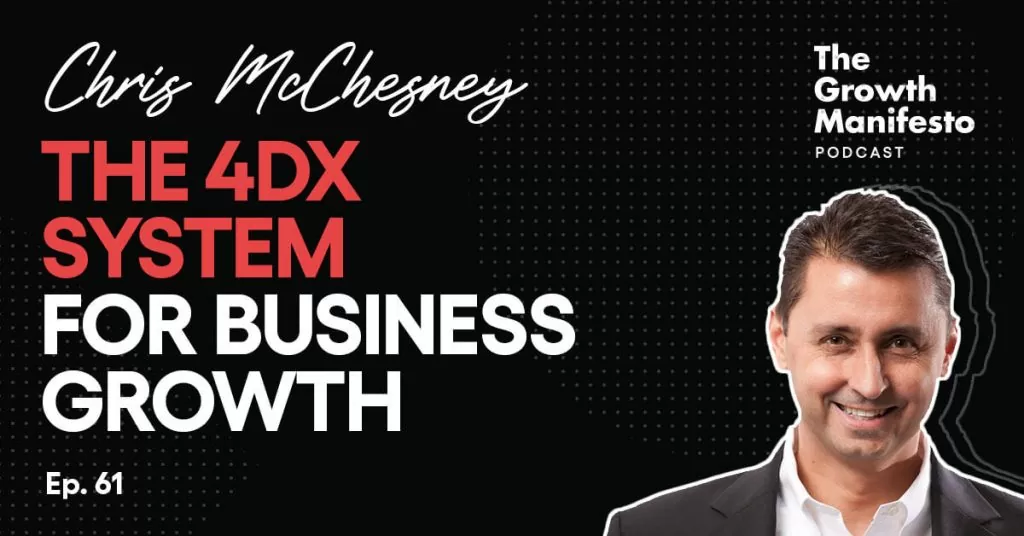
This episode is with Chris McChesney – the lead-author of the best-selling book in the world on strategy execution – The 4 Disciplines of Execution (or 4DX). For nearly 20 years Chris has been the Global Practice Leader of Execution for FranklinCovey and has led FranklinCovey’s ongoing design and development of these principles, as well as the consulting organisation that has achieved extraordinary growth in many countries around the globe and impacted hundreds of organisations. Chris has led the implementation of the 4DX system at companies like Marriott International, Ritz Carlton, Coca Cola, Comcast and Lockheed Martin. In this episode we talk about how to use the 4DX system to drive growth.
Key takeaways
- Strategic intent splits into 3 buckets: stroke-of-the-pen decisions, life-support operations, and breakthroughs that need real human engagement.
- Frederick Hertzberg's 1960s research shows employee satisfaction and engagement are separate, and engagement depends on winning at something that matters.
- Leaders get commitment not by winning agreement but by giving teams a say in setting their own goals.
- At Marriott, a regional VP told his general managers that running the day job kept their job, but bringing a targeted result got them promoted.
- The 4 disciplines run on weekly individual commitments, not annual planning, so strategy execution happens team by team, every week.
Chapters
About the guest
Chris McChesney
Chris McChesney is the lead author of The 4 Disciplines of Execution (4DX) and Global Practice Leader of Execution for FranklinCovey, who has led the implementation of the 4DX system at companies including Marriott International, Ritz-Carlton, Coca-Cola, Comcast and Lockheed Martin.
Transcript
Auto-generated from the episode audio, so expect the odd mis-heard word. Timestamps open the video at that point.
They would just get so consternated and embarrassed. And instead of just, rather than, you know, beating people up with terminology, these are bright people. They didn't, our CEO has an expression. If you see a person on the top of a mountain, you can be pretty sure they didn't fall there. These are not stupid people. You don't do yourself many favors by treating them that way. Yeah. And they got to where they got because of some either conscious or intuitive genius. And so, you know, we try and really understand where are you trying to go?
What are you trying to do? And the less boxes we put them in, the better we sort of start to understand that strategic intent. You're listening to the Growth Manifesto podcast, where we host in-depth interviews with business leaders, authors, industry experts, and entrepreneurs with a singular focus around business growth. At the end of each podcast, we want you to walk away inspired, to think bigger, and to have actionable takeaways you can apply to improve your business. Each episode is like a masterclass on a key topic, so make sure to browse the episodes to find the topics that are most relevant to your biggest business challenges today.
This podcast is brought to you by Web Profits, a digital growth consultancy that helps challenge your brands drive growth in a complex and fragmented digital landscape. You can find out more about Web Profits at webprofits.io. Now, let's get into it. Today, we're talking with Chris McChesney, the lead author of the bestselling book on the world on strategy execution, the four disciplines of execution or 4DX. For 20 years, Chris has been the global practice leader of execution for Franklin Covey and
has led Franklin Covey's ongoing design and development of these principles, as well as the consulting organization that has achieved extraordinary growth across many countries, across the globe and impacted hundreds of organizations. He's led the implementation of the 4DX system at companies like Marriott International, the Ritz-Carlton, Coca-Cola, Comcast, and Lockheed Martin. And today we'll be talking about how to use the 4DX system to drive growth and how to think about strategy and execution at times of uncertainty. And just
quickly before we get started, make sure to go ahead and hit that subscribe button so you get the latest episodes as soon as they're released. Let's get into it. Welcome, Chris. Thanks, Alex. Delighted to be here. I'm excited about this conversation because you seem to have as much energy as I do and as much curiosity. And, you know, you don't mind just going to the detail. So that's right. It's going to be a fun one. Anywhere you want to go, we're game. You got it. Yeah, of course. Let's just start kind of high level. And just for the people that don't know, and I think a lot of people are going to know, but just for the people that don't know, what is the 4DX system?
Okay. In a nutshell, it's a way to execute on the hardest part of your strategy in the face of competing priorities and distractions. And that part of the strategy almost inevitably revolves around a significant change in human behavior or something that requires a high degree of human engagement. so that's a that's sort of a capsulized you know yeah sure definition go anywhere you want with
that yeah yeah sure so so we're talking strategy plus execution right so it's combining the two parts right and so and so within the system what would you say is harder is it harder to create the strategy or is it harder to execute or are they just both important yeah well what's interesting, Alex, is the longer we looked at this, we saw that they danced together all the way through, that you have a very difficult time. There was even an HBR article written on this a few years back, that you have a very difficult time delineating where strategy starts and where
execution begins. But in a general sense, if you just said to someone, what's harder, strategy or execution, people get what you mean by that. There's the planning and then there's the, okay, we got to put legs on this thing. We got to get it off the ground. And what's funny is that's how this whole thing started for Franklin Covey 20 years ago was Ram Sharron was working with our executive team. And he asked us two questions, what's harder strategy or execution? And we said, Execution? No, he didn't say what's harder. Execution does sound harder, right? It does,
right? After. Right. He said, what do leaders struggle with more? Do leaders struggle more with strategy or they struggle more with execution? And we've been, you know, Franklin Covey, you know, Seven Habits, Stephen Covey. We've been deep in leadership development. And we very quickly said, oh, they struggle way more with execution. And then his next question got us. And his next question was, what do we educate them in? What do we teach them? If they get an MBA, if they go to business school, do we teach them about execution? And it was like, that was the shot that just sank. And we just started dedicating more and more energy and resources to that
question. Because it does seem that many leaders can create strategies, right? You know, like, I think some people create a strategy every week. Some people create a strategy per day. But the missing link in strategy is executing on it effectively, right? And so, I do think it's a combination of that. So, let's just kind of unpack that quickly, right? Yeah, great. Thanks, Alex. How do you define strategy? There are a lot of definitions that various people use, but the The very technical definitions we found aren't that helpful because they're not that well understood.
And so I find myself actually softening the term strategy rather than trying to put sharp lines on it just so I can relate to people. So I will soften it by saying, asking people to talk to me about their strategic intent. And one of the ways that I do that is I get them to think about the difference between all the energy required today to maintain the operation versus where are you trying to go? and that little delineation gets them to open up a little bit. Like if I ask for a Bain or McKenzie definition of strategy,
their brains lock up, right? They're like, oh, I'm going to screw this up, right? And I've read Michael Porter and I'm still going to screw this up. Right. But if we soften it and I'm like, sometimes I'll even step away from the word strategy and I'll just be like, what's the plan? Where are you trying to go? What's the direction? Where are you trying to, like every leader has got sort of two things. They've got to keep the operation going and profitable and healthy and surviving. And then you got to be taking it somewhere. And it's the where are we taking it that seems to encompass strategy.
I really like that thinking because, yeah, we did a podcast recently with Roger Martin, right? And he's a strategy expert. And it's really, really good. But it's also really, really daunting to think about that level of kind of thinking of strategy and like the downsides and the risks and ups and downs and all those different parts, right? And I do like the simplicity of like, so where do you want to go? You know, so that's such a simple question. We went the other way. Ask yourselves, right? Nobody can, you know, they would just get so consternated and embarrassed.
And instead of just rather than, you know, beating people up with terminology, you know, these are bright people. They didn't, our CEO has an expression. If you see, if you see a person on the top of a mountain, and you can be pretty sure they didn't fall there. I like that one. These are not stupid people. You don't do yourself any favors by treating them that way. Yeah. And they got to where they got because of some either conscious or intuitive genius. And so, you know, we try and really understand where are you trying to go?
What are you trying to do? And the less boxes we put them in, the better we sort of start to understand that strategic intent. Because this is the part, right, is that, I think all leaders inherently know what they, in quotation marks, should do, right? But like in your book, you talk about the whirlwind, right? Which is about like, you know, it's all the stuff that's in an organization that just keeps everybody busy, that takes away time from thinking, from being proactive, from
being intentional with actually how they spend their time, right? And so this way of thinking about, of course, where do you want to go really is a conversation and it takes away a lot of the pressure, right? Which I think is fantastic because everybody can have that conversation and they don't need a framework behind it. But if they did have to have a few little things, like a few little questions, what will be some of the questions that they should be asking themselves? So one of the things that we've found very helpful is a, and it's, we call it a framework for execution.
So just sort of, let me say it this way. we, we, even before we get into the disciplines, we, we take a look at that strategic intent through an execution lens. So we say like, if, if all of your have to do directional intent sort of lived in a big bubble, if you broke that bubble into three categories, let's dissect it right let's break it down let's say and this these these categories are more
from an execution perspective than a strategy perspective but it it's interesting just the exercise of breaking it down you can feel the blood pressure in the room lower like yeah lower just sort of like okay because when it's all together it's overwhelming like we want to do this but we don't even know how to do this and before we can do that we got to do this thing and we know that's contingent on this and we don't even control those factors. And then their ears start bleeding. You know what that feels like. And we say, okay, so in terms of all the stuff
that you know, you got to do, let's start to make a list of those elements that are going to be executed through what we call a stroke of the pen. Now it's not as easy as a stroke of the pen, But they're things that require management, leadership authority or financial resources. We're going to, OK, we've got to restructure. We've got a critical acquisition. We discontinued a third of our product line. We were moving the manufacturing process in this direction. All right. These are things that are kind of going to happen because we said so.
So we sort of D, right, we sort of take a number of elements out and set it over there and they go, yeah, big consequences. takes brains, takes guts, but it's going to happen. Okay. Then on the other side, we say, okay, now give me those elements of the plan that are necessary for life support, that are necessary just for sustaining the way that the thing runs today. So these are things that are associated with your existing KPIs, with existing metrics. They don't have a hard time with
this. They go, yeah, yeah, that's new, but it's really just a variation of this. And that's going to happen in conjunction with something else that's going on. And so they start to parse between these two worlds of, you know, management authority, stroke of the pen, right? Chess moves. Yes. And life support, vital signs work. And so as they start to make these two lists, there's this empty, there's this third column. And the third column is for the stuff that doesn't fit. And if it doesn't fit, because it can't get done there. So yes, we've changed the
product mix. But just because we did that doesn't mean the Salesforce is going to actually follow us. Because in order for this to work, the Salesforce has got to change who they're talking to. And I was there someplace yesterday, a software company, and they're in a beautiful spot. The whole thing hinges on the fact that 100 people have to start talking to somebody new, And they don't think they're scared to death of that. Or, and it won't happen. It's like, it can't happen in the day job. Like, cause the existing inertia won't make it, won't allow it to happen.
And we can't buy it. And some of it's funny. Some of it's like, I'd spend the money. I'd write a million dollar check if I could get this. Of course we all would. The kids, they can't buy it and they can't mandate it. And it's, it's the, these things in the middle, this column we call breakthroughs. and they're things that require. So just by that very simple breakdown between stroke of the pen, life support and breakthroughs, you feel the blood pressure start to go down
because they go, yeah, you know what? Okay, I can see this now a little clearer. So just so I can confirm that I've got it right. So the stroke of the pen are the things that the management team would normally be doing to say, hey, it's that they reckon, it's this thing, it's that thing over there. that every, it's almost like the cliche of the management team. They have like a fresh idea every week, right? It's like, here's another idea from management, another idea. Like, is this going to be executed or not? Okay. Now it's not always, it can go there. Is it like that kind of thing?
That can be the ugly form. But think about it like resource allocation. So where are we going to spend our money? Who's going to report to who? Hardline change. It's sort of like the stroke of the pen bundle. It's sort of like, yeah, structural, solid stuff. Got it. Are we going to buy that piece of machinery or not? Are we going to outsource that function or not? And it's sort of the stuff that if you've never been a leader before, it's the stuff, it's what you think leaders do. It turns out it's only a part of what they do. It's only a part of it, yeah. Right. But it's all the stuff that you can, it's kind of going to happen because you said so.
And it can happen at the executive level, but it can also happen at a frontline manager, like the frontline manager changes the schedule. And we're not going to operate that machinery with three people anymore. We're going to use two people and we're going to use a rover to move back and forth. Like they can make stroke of the pen choices at high levels or low level. I understood. But it's going to happen because we said so. Okay. So let me try again now. Let me try again. Yeah, please. This is good because this is what it's about, right? So stroke of the pen stuff is the things that management does that change the direction of the company or the change how the resourcing of the company kind of progresses, right?
And then you have the other side, the life support is all the tasks that the team are doing that are progressing, like their roles. If it's sales, it's KPIs, it's cold calls, whatever else it is. If it's production, it's all the work, it's, you know, it's quality control. It's all that type of stuff. And the part in between is connecting strategic direction with execution. And you're calling those the breakthroughs. And this is really the challenge where most organizations fail is that the operation is there without the breakthroughs.
But the breakthroughs are what kind of help a company take that stepped improvement of quality, of competitiveness. Is that? Yeah, you're saying it really well. So let's throw another metaphor here. Yes, please. If overall financial success or market share success or those high level metrics of success sort of represented like the title of a book. Mm hmm. Every book's divided into chapters. OK, now some of those chapters are going to fall under stroke of the pen stuff. You know, they took us in a different we went in a different direction.
We we reallocated resources that those got consequences. A bunch of those chapters are under life support or the day job kind of components of what we've evolved into. Yes. Right. And then there's almost there's a couple of chapters or, you know, one that's sitting there in the middle. is like, I can't get it with the current inertia of the business and I can't buy it. And it's good. And it was always have those breakthroughs in the middle. They always seem
to be associated with a high degree of human commitment. Like I can, compliance is really useful on both the wings, but this stuff in the middle seems to only respond. Like it's sort of like the leader sits there and looks at it and goes, you know, if they don't care, it's not even worth doing. Like if they're not in, if they're not into this, we're pushing a rope. It's one of those, it has that sort of feel to it. It's funny though, because, um, you know, it seems that
because, and I think you touched on this before, right? Is that, you know, what leaders and managers think they should do is the stroke of the pen stuff, but what it actually seems to be, and this something which I've had to work on over the years is how do you actually get the most out of the team you know so the team's already there the team's trying their best you know um like assuming that the recruitment is good and all yeah yeah yeah right but they're trying their best and so then kind of how do you actually help change the foundation so that like their lives are improved
through a collective movement towards a certain direction and we'll call this one the breakthrough right? And so what would you say is a way for a leader to think about how to communicate or lead these breakthroughs? Because I think this is the part that separates the really experienced leaders from the ones that potentially haven't had as much experience or as much kind of, let's call it pain that they've had to get through, right? So how would somebody approach the breakthrough side
of things as a leader? I'm going to say something that's not in the book or the second version of the book. This is exciting. Don't underestimate the power of small wins. Don't try and force the title of the book into the breakthrough. The really nailing the critical chapter, putting disproportionate effort against the strategic bottleneck is often enough to tip it because you've got the wings working for you.
You've got smart allocation of resources and good decisions and assets over here. And you've got an existing process that's sustaining and supporting the organization today. And it has cultural impact too. All right, so here's the idea. I wanna go back to a little piece of research that was done in the 1960s by an industrial psychologist named Frederick Hertzberg. Some people will recognize this from their studies. And Hertzberg separated the stuff that satisfies employees from the stuff that engages them.
You got to get your head around that for a second. There's a whole bunch of stuff that will directly affect employee satisfaction that has no bearing on employee engagement. Satisfaction is whether I like the job. Engagement is whether I give a damn about the work. Don't blur these. they're as different as they can be. Satisfaction. Do I have a best friend at work? Do I like my boss? Do I like my work conditions? Do I like my benefits? Am I making good money? There's like a whole litany of stuff. On the engagement side, there's two things.
Am I part of something that's winning? Am I progressing? Am I winning? And does the thing against which I'm winning at, does it matter? just those two things and you can do this like in in some of the conferences if i'm feeling brave i'll have 2 000 people pick a partner and in 30 seconds tell each other where they were in their careers when they were most lit up when they were most engaged couldn't wait to get out of bed in the morning and then i'll get them back and i'll and i'll list all the satisfaction stuff and i'll
say maybe it was there maybe it wasn't there's no correlation you may or may not been making good money. Won't correlate. You may or may not have liked your boss. Won't correlate. You may have hated your boss. Still was my best time. You can list all those things and they're all looking at each other. You see these big smiles. And then I'll ask them to raise their hand if in that moment they felt like they were winning at something that mattered. And all the hands go up. It's amazing. You can literally do this research live. So I say all of that. Sorry for the long answer, Alex. I say all of that to come back to your question and say, if we could add anything
to what Hertzberg said, it would be this. You don't have to be winning at everything. Parts of the existing operation could be absolutely brutal. There could be things in the environment that are out of our control right now, and we're getting handed our head because of something that happened in the environment. On and on and on and on and on. Like 80, matter of fact, 80% of it can be hell. But give me something, give me some piece of sanity. Give me something that I can win at and feel like it really mattered
and you get all the engagement lift you want right there. So I think some leaders get discouraged because, well, I can't make it a winnable game because of X, Y, and Z, and I don't control this and I don't support the resources. And yeah, we get it. That's okay. But find the small win, find the strategic bottleneck and create a breakthrough. The first part of it is the strategic bottleneck, which you just mentioned, right? Just for the listeners, could you just quickly define that statement? Yeah. So sorry. Yeah. I just threw that in there. It's kind of another way to say-
That's a really important part, right? Because this is where pain is. Yeah. It's sort of another way of saying, where's the breakthrough? So whether you view it like moving towards a result or moving away from a problem, whether you see it like an opportunity or the bottleneck that's holding you back, It's the small one that finds itself in the middle of those three elements, right? That is the thing that requires a high degree of human engagement or a change in behavior or it's not really going to happen.
And every team seems to have one. But do you need to be a visionary leader to be able to help the team to get through these breakthroughs or even to identify the breakthroughs and to have the will and the optimism, right? And the drive to kind of help everyone just progress through it, you know? Alex, can you do all my podcasts? I would like you to be my interviewer. I see why you're listening, people. He's very authentic. He's really got his head into this. I really have my head into this.
About you at all. You're really into this. All right. So here's what we've observed. Like we don't know anything of ourselves. We've just observed certain things. The short answer to the question, I think, based on how you're defining the word vision, I think the short answer to the question is no, you don't. We tend to see these breakthroughs show up in one of two ways. And we nicknamed them perform or transform. So a perform, and the term we use in the book is wildly important goal or wig, right? Sam,
I was calling it a breakthrough or overcoming a bottleneck. This is the wildly important goal. So the breakthrough is the wig. That's the way that, that, that breakthrough idea, when it's given a starting line, a finish line, a deadline, and it becomes a target and discipline one, it becomes a, it becomes a wildly important goal or a wig. One form of that is called a, we call a perform wig. And that just means it's something we're already doing. We want to perform better at. So there's seven components to really getting this production process right.
And we're going to double down on step four right now for the next five months. We're going to perform better at that. we think that's going to have a ripple effect. And we're betting that if we can perform better at that, and I'm a sales organization, we're going to work on performing better at prospecting new accounts. We're going to perform better at moving upmarket into a new demographic of client. Or, right, it's that, right? It's something we're already doing. We're just going to make
a leap in progression. And we tend to kind of gently move organizations in that direction. if it's sort of their first go at this operating system. Because it's easier to get into, right? Because I can just, yeah, the system's already there. Just focus on that part. Yeah, yeah. Then the other one is the transform. And it's like, oh, we're going in a whole new direction. And we're reinventing this thing. It's not a pivot. It's not a performance. Like we're transforming. This is new turf.
We haven't gone here. And those transformational wigs are different in nature. But those, I think, are the ones that typically there's a visionary leader behind this with some guts and faith in what they're doing. Got it. I understand. So the good news is that you don't need to be a visionary like a Steve Jobs to be able to actually kind of to affect change within an organization. and you just need to identify, you know, what's the strategic bottlenecks?
What's the thing that is holding everybody back from truly winning? And to get that point of like, I'm satisfied because I'm winning and I'm kind of having an impact to help free up the thing that is holding everyone back. Because, you know, I think a lot of times, especially with organizations, it's not a grind, but it's the same thing. And it's always like we're just kind of trying to incrementally get a little bit better. And it sounds like what this is about from the perform perspective is, all right, so we're doing the sales process.
And we know that if we can prospect a bit better and if we can only jump on maybe 50 calls a day more each for a month, right? Let's see how that goes. And it's almost like as a leader to really communicate that message and to help them to get to that point, right? So to identify the one thing almost, right? It's like the one thing that collectively everybody can focus on. Is that the way to think about it? Yeah, yeah. And it can be very different by function. So depending on the team, the one thing could be different. So let me say this because we're going to be moving back and forth between an organizational perspective and a team perspective.
Okay. And I want to be a little bit deliberate about this. Okay. Yep. the four disciplines methodology really is a team by team based where the work happens methodology if you look at the four disciplines of execution as a book and compared it to a lot of other I could start naming off other things that sort of go into this space most of them have kind of a top-down perspective and we sort of went bottom up not deliberately
That's just sort of how it happened. Okay. Now, so the primary focus of the four disciplines is, you know, team by team hitting critical objectives. Sometimes in some organizations, those all go to one common idea. Like the whole organization's got to go here and everybody is aligning to that one thing. You know, we got to put a man on the moon by the end of the decade and return him safely home. and there's three sub-wigs, which is navigation, propulsion, and life support.
And your team better be aligned to one of those. And it's all got to roll up. So they're highly centralized because of the strategic imperative. Other examples, on the other end of the continuum, some leaders look at it and go, I want the team's closest to the work to decide what their wildly important goal is. I want them to optimize. I don't want to dictate that to them. Okay. So I just want to put this out there and then everything in between, sometimes half the
organization has autonomy. The other half has to be lined up to critical strategic priorities. So that's how this methodology is used. If that was clear at all. Yeah, it is. It is clear. I think, you know, because I mean, I've gone through the program, I've got the books, you know, um, you know, we've kind of integrated it, uh, within our company, um, differing successes, right? Cause it's like, yeah, yeah, yeah, yeah. Like what you said, it's nowhere near simple to execute effectively on a strategy and get the whole team involved. So, like, I do have a few questions about this.
Yeah, let's go here. Yeah, let's do it. Yeah, because I think the first one is how much time is spent on just getting the team aligned before they even know what is the thing that they should be choosing? You know, like how much time resources as a leader should I be thinking about like, this is what I should be putting aside for the team. It's like a day, a week, for a month. Or how much time would you say is the first part, right? Because this is the hard part, right?
Everyone's so busy, right? Trying to get them to be bought in, trying to get them to say, I understand and to stick with it. It's different at different levels and it's different for different sizes of the organization. it's not a ridiculous amount of time let me can i let's go let's get into the steps okay a little bit yeah this might help and then that'll make i think that'll help the question out a little bit yeah awesome so let's let's take a scenario that's very simple and we'll just sort of walk through a simple scenario rather than trying to match every situation that's the best
way all right so let's suppose we've got a president ceo we've got half a dozen vps and underneath that half a dozen vps we've got oh 30 you know director manager types with single team responsibilities yeah okay yep mid-size mid-size organization not too big yeah yeah small to mid-size organization how this might look it's funny because it'll seem a little bit like I'm going to talk out of two sides of my mouth. Some of what I say, it's going to sound a
little top down. And some of what I'm going to say, it's going to sound a little bottom up. And, and, and this has been stuff we've played with now in over 3000 organizations for 20 years. And the originator passed away 13 years ago. The books are dedicated to a gentleman named Jim Stewart that was a Deming Duran student of total quality and kind of grew up in that vein, big contributor to this stuff I'm explaining. Let's say that the CEO president person has some ideas on where this thing needs to go and block some time with the executive team.
Let's say they map out kind of their existing work in those three categories, right? Stroke of the pen, life support. And there's a decision. Do we double down on this one key operational quality issue. It could open up some doors, allow us some new buyers, right? Then there's also a market opportunity. Do we go here? We could pursue this. Like there's two or three things that really could sit nicely in that breakthrough bucket in the middle. And
at this stage, there's debate, there's discussion. The CEO at this point is sort of holding court a little bit, listening to everybody's argument. And then, um, here are the, here are the attributes we really like to emphasize. Transparency, curiosity, and involvement. Okay. And we're going to, we're going to do this at this level. Then we're going to take it down and we're going to hit the director. So it's going to be a little different. Okay. So transparency means if I'm, if I got really strong feelings, I share them. If I've got really strong feelings and I'm really
freaked out about a couple of things i share that too i don't burn here's the one you didn't hear me say you didn't hear me say persuasion god this is really hard for me personally but i believe this to my core stop selling them we know you're good at selling we know you're very charismatic we know you're very persuasive just stop you don't have to you get to make the decision anyways you get the final call. They're going to nod their head if you push hard enough. We get it.
Instead, let's go back to the three terms, transparency, curiosity, and involvement. So transparency, put all your cards on the table. Let's not play three hours of what is the CEO really thinking, an involvement-based leader. Love that. Okay. Number two, curiosity. All right, Julie, everybody rolled their eyes when you said that. And we all think we know what you meant, but I'm not sure we really do know what you mean. I want you to say it again for us, Julie. Because I don't think we're listening to you.
All right, Marcus, what are you hearing Julie say? She's onto something and I think she's talking about it. I don't think we've been listening to her. She's been trying to say this for six months and I don't think we're hearing her. And I think that data we saw last month is actually backing up what she says. I'm curious. Guess what we found out about curiosity? the greatest desire stephen covey said this 35 years ago stephen covey believed the greatest need of the human soul was to be understood if you are honestly curious about what they're what they think you don't have to agree with them
they would rather be understood than agreed with no he didn't do i think he's crazy not doing what i but i'll support him because he really wants like they get that right they want to be right so you see in the dynamic here just on this part like you know this part here this is this is this is the hardest thing for leaders to get to where they can get to the point where they're transparent you know where they're curious and where they listen and they facilitate right and they don't just put like right they don't try to sell their idea it takes it takes time to get
there i think as a leader because that's not how you start you think i'm a leader now and this is what I have to do, but it's like through time, you get to learn that actually ask questions, actually listen, actually. Okay. So, okay, of course I'm getting it. The hardest thing for me in the, in the leadership roles that I had was just suspending my own biases, like wanting to chew my own tongue off. Like, Oh, okay. I'm not going to go there. I'm not going to, I'm just going to listen. Like you have to be in a good place emotionally to just listen
on a highly charged topic that you know you know all about. Yes. Okay. That's something I'm still working on personally, by the way. Thank you for saying that. Well, it's a lifelong journey, right? To like be that person, right? And it's hard because we're so passionate sometimes. And, you know, it's just, it's not simple. Even if you struggle with it, they will give you points for trying. Even if you're lousy and clumsy. And if you have just like, okay, forget the last four sentences. I went on a rant. I'm going to roll it back. Julie, tell us again. Like you get full credit for that. Intent counts
more than technique. Yeah. Okay. Now at some point, like the group's going to solidify. And then we tell leaders, Hey, there's a point it's time to make a call, but you can, once you've done this, once you've listened, you can make, so let's say the group comes together and let's say that they decide after the dust settles that there's one wig, one of these key goals is kind of aimed at a transformative effort. And it's going to take about a third of the functions in the organization to work on that. And then the other is going to go after this quality issue. And it's going to take about another third of the organization. And then the other third of
the organization, it can aim at whatever it wants to aim at. But everybody's going to have one breakthrough in addition to their day job. Now here's where it gets fun. Can we go a little deeper? Yes, please. Because at the moment, it's just kind of a high level direction, right? We don't really have the execution sorted yet, do we? So now we bring in the directors. Now, If you've ever been in this room before, because you got half a dozen executives, this is the magic moment, right? You know what I'm talking about. You got half a dozen executives, you got 25, 30 director manager types, and they're ready to listen, right?
They're at tables, right? So here's, I'm going to lay out like four steps, what this meeting looks like. Step number one, first of all, the ground rules are laid out. So this is really important that you lay out the ground rules up front. and part of laying out the ground rules is to let folks know we're not here to cast a vote and we don't need a consensus yeah we're not here to vote and we don't need consensus a lot of people think we all have to be on the same page no we don't so that's not what this is
about what this is about is we want to understand the best we can before we make some decisions so you see two things happen the first thing you're going to see happen is those two primary goals get ratified. And then you're going to see the 20 teams pick goals that are going to support them. So there's a two step and the two steps are very different. So the first step is the, the, this, the, the senior level leaders lay out. Here's why we picked the two wildly important goals that we picked. Here's what we're concerned about. We don't, we're not trying to persuade you because
we're nervous about this here and we see problems with that there, but this is why we chose this. This is why we didn't do this. This is why we didn't do this. We still are apprehensive about this, this, and this. So here's what's going to happen at your tables. Directors come up with all of the clarifying questions you can come up with. No one's allowed to give feedback right now. We're not going to give feedback on something we don't fully understand. You can only ask clarifying questions. I like that. Right. So now, and every time somebody starts to go, well, why did we do this when we didn't? That's not, that's feedback. Do you have a clarifying question?
Yes. When you say 75% by December, is that a rolling average or is that the, is that 75% in December. Does that include like you, these statements you think are so nobody can, they're completely concrete. And then you, then you handle 30 minutes of clarifying questions and you're like, well, they weren't as clear as we thought they were. Well, I like the clarifying questions approach because this is, this is always the hardest part, like in putting something forward to a team of people that are extremely motivated, extremely ambitious and that they care as well.
Right. You know, just as much as you sometimes. Right. And so it's like finding a way to, to engage is really good because oftentimes people would just respond. And I did the same sometimes, right? And it's just, by asking more questions, you get context. And then at the end of all that, like, is that when they get to, that's when they get to do feedback. So I watched my mentor do this. 20 years ago, he would just ring every clarifying question out and three quarters of the feedback went away in the clarifying questions. Like they really got what's going on. And then, okay, now,
Now go back to your table and now feedback. And so what we were kind of coaching that, you know, we coached the leadership team. We're sort of on the side a little bit when this is going down. And then what we would coach them is don't sell. Don't argue. You don't have to sell and you don't have to argue. You're the bosses. It's your choice in the end. that stuff that a man convinced against his will is of the same opinion.
Still, you're going to win the argument. You're going to listen and you're not just going to listen to look like you're listening. You're going to try and understand some things. These people know stuff you don't know. You got a beautiful opportunity to vet your thinking. You got a whole bunch of assumptions that you guys are making that you now have an opportunity to really see if those assumptions hold up. And so what we would see a lot of times is those goals would change based on the feedback. they said you know tanya is bringing up something like we talked about it but then i don't know
where that went but she's right it can't be a rolling average and and um yeah let's let and i think there's a third wig over here that we're you're right if we don't accomplish that none of this it makes sense tommy i i don't know how we didn't see that right and then and and julie you're making a really valid point we talked about that too but here's why we're not doing that and so So we're just going to gather as much as we can, give us a recess. We're going to tighten this thing down one last time and we're going to put it to bed. Now, most of the feedback didn't get adopted, but it got understood.
So we're going to come back and we're going to give you. Now, this is one of the craziest things that's happened in my career, that I've ever observed happens right now. And I had to watch it happen multiple times before I believed my own eyes. Some of the feedback in certain cultures gets really testy. And I am sometimes shocked at the level of audacity of sort of junior officers at an organization and how nasty it will get. Okay. So I think about my own organization and then it becomes it comes back to me and I've seen it.
Yeah. So you will have people will give me liberty or give me death kind of statements. Yep. And I'm thinking, oh, it's not going their way. This is going to get ugly. gets put back, gets put to bed. Executives come back. Here's where we landed on these. This is what we've changed. This is it. No rah-rah. All targets, by the way, no inspiring language. That's not where we're going to get engagement. We're going to get engagement, folks. We're not going to get engagement by flowering up
the goals and making them sound pretty. It's all just targets. Okay. Now here comes the magic. We're on to the next step. And in the next step, here's what we need. We need each of you leaders to think of one outcome from your area of responsibility that would have the biggest impact on one of these wigs. We might veto if you can't sell us, but we won't dictate. We won't tell you. We'll just send you back to the drawing board. Okay, so right now we've got a little bit. Before, the directors were in a sort of a consultative role.
They were consulting the senior leaders. now we've switched it and they're taking the lead and we're in an approval role but we're on their goals not our goals they don't get to say what the hell my goals are they didn't get they didn't get elected vice president i want their input but i'm gonna make the we're gonna make the decision at this level right it ain't a democracy but now i'm in their world you want to piss people off start mucking with their world we're not going to do that you
know your operation. You see where we're going. And then this is the part that freaked me out. This is the part I had to see happen multiple times. Jonathan and Suzette looked like they were ready to quit about an hour ago. It didn't go their way. And they're totally like on board and they're totally coming up with goals. And it's as though Jonathan and Suzette were saying, if there was a thought bubble over their head, the thought bubble would say, well, it sure as heck isn't what we would do. But as long as you're asking for our help, we'll help you get there.
I'm like, were those the same people that were, I heard talking in the bathroom and they were so upset and they were now all of a sudden they're, they're, they're, they're offering an objective to help with the strategy. I'm like, I had to watch this happen multiple times before I realized it didn't matter that they weren't agreed with. They know they're not the boss, but they got their, people don't have to have their way, but they have to have their say. and then then this new goal all of a sudden now it's theirs and they got there they didn't get there because you convinced them that you were smarter than they were they're gonna ever believe
that they got there because you invited them and you said is there in addition to that 100 mile an hour whirlwind that you all manage and we are so grateful that you do can you give us one can you give us one objective and sometimes the teams would start that the leaders would start coming up with objectives, I go, we would never have asked for that. But if you can, seriously, if you can deliver that, you know, by June, we're in a very good position right now. And, and, and you see the difference, this isn't change management. This isn't getting
Novocaine before the drilling starts, which is how so much change management. We're going to drill. We're going to numb you up real good before we do. Right. You're, you're pulling, you got to put, you got to pull these teams into the breakthrough. This is what we've learned. So anyways, I'm sorry, long answer again, Alex. No, no, because this, because this is, I mean, you essentially just talked through the system essentially, right? Discipline one. Yeah. The first, this teams up each team to then, yeah, you're exactly right. I talked through what that could look like in that scenario. And there'd be a couple of vetoes and a couple of teams that have to try again,
but then the executives look and follow this, Alex, they're not looking at a plan. If you think we're describing planning, you're missing it. These are targets. targets we've translated strategic intent into targets and that's why they're um extremely numeric right they are yes that's why starting line finish line deadline each one is a single lag measure that it's not the normal behavior the normal behavior is to have a strategic idea get a bunch of part people smart people in the room and then start planning which is just
dictating down to the organization what everybody needs to do and there's some stuff on the stroke at the Penn side, you got to do that with, but not if it requires commitment. See, because the lower you get the targets, the closer the targets are to the front line, the more you can start to create engagement and not in some artificial rah-rah way. But now the teams, each team is running its own experiment. So you say, how do you get buy-in? How do you get engagement? Well, don't solve the damn puzzle for them. It's their puzzle. They're bringing you this gift. They're
bringing you this result. Let them figure out the lead measures. That's discipline two. Let them come up with the scoreboard and how they track it. That's discipline three. Let them make the weekly commitments on a weekly basis. Your job as a leader is to make this feel like it's a big freaking deal and we're putting a spotlight on it. And it's interesting because I think there's a lot of conversation out there about the importance of getting everybody to buy in. But what you're saying is that you can buy in without agreeing. It's possible to be part of it
without fully agreeing. I think I was just listening to the- I'm so glad you said that because you just nailed the whole point of the whole thing. Because if I think it's about buying in, then I'm going to talk you to death. Yeah. Right. And if, and if my bladder is stronger than yours at about hour number four, you're going to start agreeing with me just so you can go to the bathroom. Right. And so I was just saying like, like I was just listening to the Jeff Bezos book, um, invent and wonder. And he talks about like this theory or this approach
that they use at Amazon, which is to disagree and commit. So it's like, Hey, we disagree, but we're going to commit to this specific outcome anyway, you know? Um, and I really like that thinking where you don't need everyone to say yes and everybody to be happy all together because that's very difficult to do. You need months maybe of time. Let's go back to what you just said. So, so step one was a lot of us are going to, a lot of us are going to agree and commit. Some of us are going to disagree and commit. We're all going to commit, but then watch
this step two, where I say, Alex, bring me one. I'm not, I'm not assuming, Hey Alex, I'm smarter than you. That's why I determined strategy. And I'm going to tell you what your objective is. Alex, nobody knows your operation better than you do. I'm not even going to pretend to assume I understand your operation like you do. You understand where we're trying to go. What can you bring us? And it's saying it's one thing, right? Because this is the part, right? And so now- This is the execution capacitor. Yes. Right. So let's jump to the
execution now, right? Because let's say they all come with one thing, right? And again, you know i've gone through this and so sometimes you you might bite off too much the refinement of the thing which you're going to do is not very clear and it's like yes it can get a bit messy right and so right good like what are some of the things that company can do or the leadership team can do to really refine this next part so that because it feels like if they get that part wrong they don't win they don't get that satisfied uh that engagement right and so it's kind of important
Yeah, yeah. You're describing this really, really well. Because if you've heard what Alex just said, he sort of hit the key points, which is one, it's got to be impactful enough to matter, but it can't be so big that it's unachievable. It's like if you took achievable and impactful as circles, right? Some point those two things overlap. You want to be in the overlap between those two things. But let's be clear about something. Sometimes that team hasn't been given direction from above. And sometimes they're just like, okay, procurement, you tell us.
Like, what is it? And in that, when there is no strategic alignment, what you have to be careful of is that they don't try and eat the whole elephant with the breakthrough. Right? It's not the title. It's a chapter. Yes, we know overall net savings is why your organization exists. But that can't be a focal point because it encompasses everything you do. Right. If it encompasses everything you do, it ain't a focal point. Right. Okay. It's multi-year obsolete deals.
Yeah, right. We got to change. Right. Okay. So say more multi-year obsolete deals. You're going to move that from $7 million down to three. You could do that. You have $4 million there. By the end, you do that. You have more than contributed enough. Can you see what I just said? I had to take you from a title, which is 17 things, half of them out of your control, down to a chapter and you give me the best chapter that's cool but that was done sort of in a vacuum where you weren't really tied to any strategic thing above if you're in that it's
actually a little easier when you're linking to something else yeah sure okay so this is where just kind of having that first conversation with yeah yeah yeah get that on board then get them to come up yeah right so now yeah right you could you can now start to frame those those they can see okay this is what i'm gonna do hey can i share a funny story yes please love stories all right this is this is a doozy so you mentioned marriott in in the and there are like marquee account right like they they got me this job like because like 12 12 years okay the the the number
two person at marriott behind arnie sorensen's guy named dave grissin he just retired a few months Dave and I have worked together on this for 12 years, thousands, tens of thousands of leaders into this process. Like they are machines. I think it's in the system. There's an online web portal that tracks the commitments. I think they're north of 10 million commitments against best satisfaction that are recorded. They've got catalog of lead measures for all different types of results. They're just, Marriott's not good by accident. And for 12 years, every year,
Grissom beat the prior year's guest satisfaction score for 12 years in a row, right? So he's legit. Early on in the process, he's not the number two person at Marriott. He's a regional VP over the East Coast of the United States. He's got a bunch of GMs, about 18 general managers and hotel managers in a ballroom, and they're about to start four disciplines. I'm in the room, but it's his show. I'm just listening. And he says one of the funniest things I've ever heard. I thought it was awesome. I've never forgotten it. He says, I'll let you in on a little insider baseball, saying this to his general managers.
he said uh in in other okay i don't know if that inside baseball tracks but it's like the inside scoop right he says you want to keep your job at marriott just take care of the whirlwind just take care of the day job just run the operation we will never fire you we'd be crazy to fire you because the person that replaces you might not run the operation so like everybody got what he said but everybody's looking at each other like this ain't the whole story. There's another. This is the punchline.
He goes, so if you want to keep your job, just take care of the day job. He said, but if you want to get promoted, bring me one, bring me, bring me everything in working order. Bring me a rival experience. Bring me food and beverage quality. These are chapters. And don't go claiming some result after it happens. Call your shot. Yeah, I like that. So they, we said this in jest, but then afterwards they got thinking about it. They go, that was really good. And they started to institutionalize it.
So when you went for a promotion, the first question was, all right, show us. What was the result you targeted? All right. At the Bethesda Marriott, we moved arrival experience from a 64 to an 82 in six months. Here's what we did. Right. I like that approach, that conversational approach. You know, it's so, so transparent, so direct and it's just how it is. Right. Like, and it's kind of nice. It's like a natural law. It's like whether we say it or not. Yeah. It's refreshing. I like that. I'm conscious of time and there's so much more I want to talk to you about.
We can do a second. We can do a second episode if you want it. Yeah. Fantastic. Let's just jump quickly down to commitments because the commitments is now where the work, where it happens now. Right. because everything to this point has been strategy, planning, thinking, and just choosing the direction to go. But to walk in that direction is the commitment. So can you just quickly talk about commitments and kind of how they work? And yeah. The quickest way for me to do it is to use an analogy. Let's suppose that your wildly
important goal was actually weight loss. Now in business setting, it would never be that. It would be a rival experience. It would be food and beverage quality. It would be net new clients. It would be something like that. Now, your lead measures for weight loss are diet and exercise. The parallel for that would be, okay, we're going to make sure the profile for each guest is accurate five times a day. We're going to do pre-interviews with 80% of first-time clients.
we're going to like, these are like lead measures. That's a whole conversation we haven't had yet, but a lead measure is a bet. Right. So they're, they're the same kind of bet. Like diet and exercise is a bet that I'm going to lose weight. Yes. Right. I'm going to, the bet is if I run five miles a week and reduce my calorie input by 400 calories a day, I can maintain this level of weight loss and I can be at 185 pounds by November 30th. Right. So it's the same kind of,
so it's, it's, it's, it's a, it's a similar thing to that. Okay. I haven't gotten to commitments yet. That's just the strategic bet. And that strategic bet shows up on a scoreboard. That's discipline three. So discipline one is the targeting. That's what we've been talking about the whole time. Discipline two is like diet and exercise. It's the bet. Discipline three is how you see it and discipline for these commitments that are made every week. So the best way to do this is to go back to diet and exercise. I'm going to commit to something this week. In addition to all the stuff I got to do,
there's all this stuff in the whirlwind. It's got, it's got me, got me by the throat. It's got to get done. But in addition to that, what are the one or two things I could do to absolutely ensure I get the miles run and I get the calories right. So I make good on the strategic, I execute on the strategic bet. So I know it's going to rain next week, all week long. And I hate running in the rain. I know I won't do it. I'm going to buy the treadmill. I'm pulling the trigger on a treadmill. There's a commitment. You know what? I'm getting the gym membership. There's a commitment. You know what?
I'm calling Sally because she loves to run in the rain and she will get my butt out all week long. Whatever it is to make sure five miles have got to happen next week, no matter what, give me your commitment to make sure it happens. I'm going to go to Whole Foods and buy those ingredients because I've been eating like crap lately. I don't care how much it costs. I'm going to buy that. I'm going to buy that stuff so I can. Right. What do I do this week? OK, so I'm going to meet with Marcus and Sonia and we're going to, you know, I'm going to I'm going to walk four guests to their room with them in order to ensure that leave.
What am I going to do to make sure we're getting the leads right? Now, here's what's interesting about that. It's sort of just-in-time strategic planning. So rather than strategic planning happening at the beginning of the year from the people at the top of the organization, it's literally happening every week by the people at the bottom of the organization. You've heard the expression force against leverage. The lead measure is the lever. The commitment is the force against the leverage.
So this is what runs the four disciplines is a little bit of force every single week against each team's unique leverage points. It has it's how Marriott, one of the biggest hotel company in the world, beat their guest sat numbers every year for 12 years. And do so does the team create their own commitments? Is it like the directors and the VPs, they say, this is what I'm going to do. Is that what they do? Yeah. So here's what it has to, the rule, there's a couple of rules around discipline four. So the meeting has to happen at the same time every week. You got to be out of the meeting in 20 minutes. You're not allowed to discuss whirlwind during this meeting. Each person says that I, has to say if they did the thing they committed to do the week before. There's a little app that'll show it, right?
I got to review my scoreboard and I got to make commitments for next week. And the commitments are individual. And they come from the person, not from the leader. But the leader has veto power. Is that like what you said before or not even not at the commitment level? Sometimes. Yeah, it is. The principle does hold up. So in certain situations as a leader, you might say, Alex, help me understand why that commitment is going to help our lead measure. And usually that's enough for you to go,
oh, I see where you're going. Yeah. Yeah. Cause the tendency will be for the commitments to start becoming whirlwind objectives that you were going to do anyways. And that's a nice way to sort of veto it back into play. Sometimes they'll say, well, listen, if, if I don't move those racks to the back room, we've got way too much clutter. And that's why we're scoring so bad on our appearance scores. Oh, I get it. Okay. Yeah. Move the racks to the back room. I thought that was whirlwind, but you just made a good argument for moving the racks. Yeah. Good. I love that thinking. I love that thinking. Listen, we're at time, but for the listeners, the 4DX, yes, this is the book
it's available on Amazon. It's available online. You know, just have a look at it. Highly recommended. Yeah. There's a, it's very simple, this approach, but it's not simplistic. This is what you say, right? But it's highly recommended. So make sure to buy this book. It will just give you a lot more insight into the conversation that we have been having today. Yeah. But Chris, if there was one thing that you'd want the listeners of this podcast to do a site to visit somewhere to go connect on LinkedIn, what would you like them to do? Thanks. So if you can, I guess my name's on
the, on the chart there. If you can remember Chris McChesney and the letters 4DX, chrismcchesney40x.com is a great website um for all the different things uh webinars uh videos um youtube we got a lot of videos on youtube on just about every topic that we talked about here um but that that my name 40x.com is a great place to go it's kind of a hub resource chris what a high energy engaging conversations what a pleasure it's been to have you on the
podcast today. Alex is doing all my podcasts from now on. This has been great. Thank you so much for coming on the podcast. And I look forward to having another chat sometime in the future. Let's do it. Thanks, buddy. Thanks for listening to the Growth Manifesto podcast. If you enjoyed the episode, please give us a five-star rating on iTunes. For more episodes, please visit growthmanifesto.com forward slash podcast. And if you need help driving growth for your company, please get in touch with us at webprofits.io.