
How to turn your business into a profit-machine
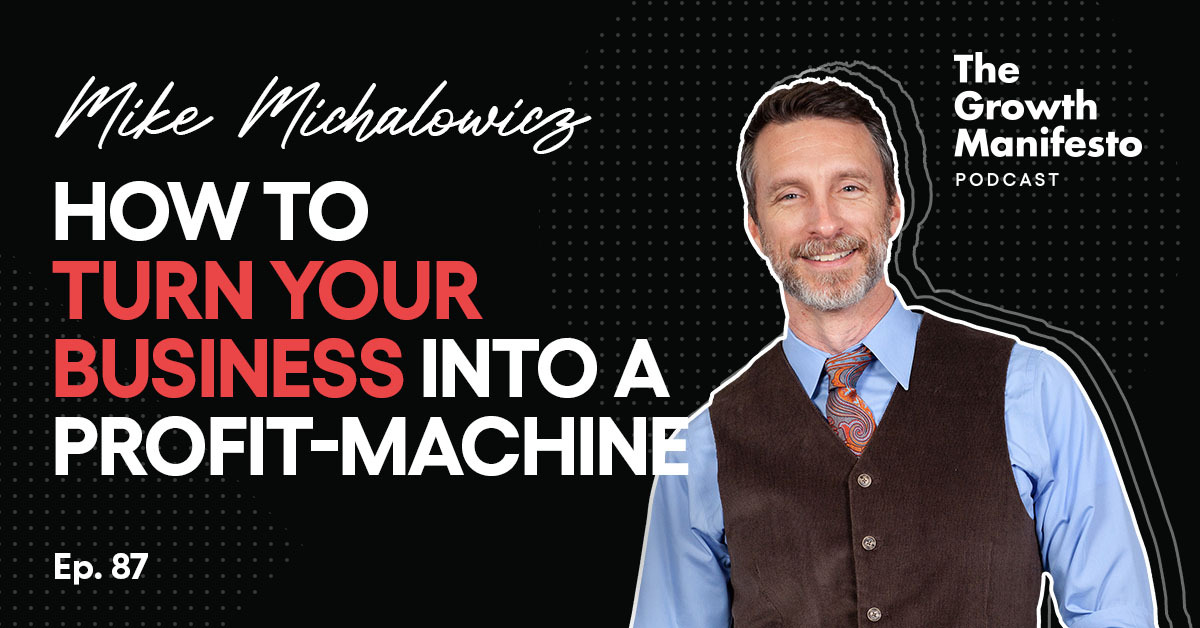
Mike Michalowicz explains his Profit First formula: take profit from every deposit first, then run the business on what remains.
 with Mike Michalowicz


Overview
In this episode we talk with Mike Michalowicz – author of the book Profit First – about how to build a profitable business using his Profit First Formula.
Key takeaways
- Profit is a habit built by taking a fixed percentage the moment money arrives, not a reward left until year end.
- Splitting income into separate profit, owner's pay, tax and operating expense accounts stops businesses spending money they don't actually have.
- Businesses that take their profit first end up growing faster because reduced cash forces more critical, ROI-driven spending decisions.
- Established businesses should start with just 1% of each deposit set aside as profit, then increase the percentage gradually.
- Cutting 10% of costs is a no-brainer for almost any business, but going as high as 20% starts cutting into the muscle of the business.
Chapters
About the guest
Transcript
Auto-generated from the episode audio, so expect the odd mis-heard word. Timestamps open the video at that point.
The rule of thumb is this. If you are logging into your bank account to see how much money your business has, Profit First will serve you. Some businesses, because they're being cash conscious, have a little slower start than if they did the alternative of just pushing money around. But they've built the discipline. I like to say that profit is a habit and not an event. It's not something that happens eventually magically. There's no switch that one day, if you simply grow, grow, grow, that all of a sudden everything falls into alignment and your business is permanently profitable. We think it is, it's gonna happen that way, but it's not.
We need to build the profit habit from day one. You're listening to the Growth Manifesto podcast, where we host in-depth interviews with business leaders, authors, industry experts, and entrepreneurs with a singular focus around business growth. At the end of each podcast, we want you to walk away inspired, to think bigger, and to have actionable takeaways you can apply to improve your business. Each episode is like a masterclass on a key topic. So make sure to browse the episodes to find the topics that are most relevant to your biggest business challenges today. This podcast is brought to you by Web Profits, a digital growth consultancy that helps challenge your brands drive growth in a complex and fragmented digital landscape.
You can find out more about Web Profits at webprofits.io. Now, let's get into it. this is alex klyanthus and today we're talking with mike mccallowit the author of the book profit first about how to build a profitable business with his profit first formula and just quickly like i came across this book the first time maybe five six years ago and somebody said to me check out this book it's a really interesting way to think about business because there's a lot of things that we think are how a business should scale, but they don't actually have to be that way.
So every subsequent startup I've started has started, I've said start three times now, have started with the profit first approach. And it is a really simple way to think about profit as companies scale. So I'm excited about this one, but without further ado, hello and welcome, Mike. Hello to you. Thanks for having me, Alex. It's a pleasure. And I think this is such a good topic because it's at the core of every business, right? Is to create profit. And so this is a really kind of interesting insight that it seems simple.
But before we get into that, how did you actually come up with this? Because it's such a simple yet, I guess, not a revolutionary way, but somewhat. Maybe, maybe. I mean, I did take the idea from what's been established around forever since BC. It's the pay yourself first principle. I never saw it applied to business. The reason I came up with this is I too am an entrepreneur. I've struggled with profitability. I've had the blessing of building and selling companies, but they're never profitable when I run them or ran them.
And subsequent to selling my businesses, I was like, oh, this is the mentality, pump up a business, dump it off, make your money at the very end. That profit and the money you take home is an eventuality. But my subsequent businesses didn't do that. They weren't sellable. And I was running more and more debt and I lost all my money. And it was a tough period. I lost my home. I lost my possessions. I lost everything about my family. And I went through depression and struggled with it. But I did constantly ask myself,
why am I not profitable? I also heard a study, and this was the biggest eye-opener. It emanated out of the US, became a global study. There's 30 million small businesses in the US based upon US dollars. That's a company that does $25 million or less. That's a pretty big small business, 30 million globally, just 300 million small businesses. Here's a statistic that blew me away. 83% of small business is in check to check survival. The reason almost all of us got into business was to accumulate wealth, to experience freedom, doing what we want when we
want, but not to worry about bills. But 83% of us are worrying about bills. That confused me. And so I was like, what's wrong with us? I kept on repeating that. And I was like, oh, holy cow. One day I was looking at the foundational formula, sales or turnover minus expenses equals profit. I was looking at that and I said, oh my gosh, we all use this. And it tells us that profit is the year end or the bottom line. It's the final take. It's the final consideration. And it's human nature. When something comes last, don't do it.
It gets pushed off. It's like, oh, that's the problem. We need to take profit first. I tried it for myself. I've been doing it now for over 10 years. I've had 49 consecutive quarters of profit distributions. And all I did was every time a deposit came in, I paid my business first. I took that money as profit, hid it away. And then my business was forced to live off the remainder. I was always profitable and I always ran my business more efficiently. And I actually started to grow faster because the remaining money I had after I took my profit, I had to be very prudent, very thoughtful about how to deploy that money.
Yeah. And it's really interesting because it sounds simple to take the profit first, but there is a system behind it. It's not just the money comes in, I take the profit, and then it's done, right? I mean, it is kind of like that, but it's not exactly like that, right? So could you talk about the core concepts? Yeah, sure. Of course. The underlying principles take your profit first. But some of the core concepts are this. It's a behavioral-based cash management system. So it's not an accounting system. It works with any accounting system. This is how we manage cash. And what I notice is most entrepreneurs revert to using their bank accounts.
That's how I run my business. I don't log into my accounting system de jure, look through it, figure out the profit and loss statement and the balance sheet and the cash flow statement. It's just too much. And it's too confusing. Honestly, I don't really don't know how to analyze those numbers effectively, but I do know how to log into my bank account. And if I have money, I can spend it. And if I don't, I won't. So this is a bank-based system. We set up multiple accounts at our bank. I suggest ultimately in the full deployment, five, but you can even just start with one, which is the profit account. I think there also should be an account for the owner's compensation.
This is the money we use to pay ourself, which is different than profit. Profit is a reward. Alex, you started a business. Thank you for contributing to the global economy. That's a reward for doing that, and you get that quarterly. Owner's compensation is for the work you do with inside your business. So if you had to hire someone to replace you, what would you have to pay that person? Probably a lot of money. Well, guess what? You did hire that person. It just happens to be you. We have to pay you that salary that you deserve because you would pay it to someone else. different than profit. There's confidence for the work you do, profit is for the risk you took. Then tax is another account you should set up
to pay your tax bill. The number one biggest bill associated with the operation of a business that a business owner is least prepared for is taxes. But your business can pay it. And there's different structures of businesses and different ways to do it, but your business can reserve that responsibility and pay for it. Then the final typical account is called operating expenses. OpEx is where you pay your bills for the operations of the business. Also, the fifth account's income. That's the source of money. So money flows into income, but then gets carved up on percentages to these different accounts. And then when you have OPEX, you see what's truly available to run your business.
If you want to have a, say, 10% profit, if you want to pay yourself fairly, if you want to not worry about taxes, then you'll know what you have to run your business off of OPEX. So you're reverse engineering the profitability. Yeah. And what's interesting is like, as soon as I read that book, the next day I just went and opened up, I think I opened up seven accounts because I think we talked about actually seven accounts in there, but because there was a couple of extra ones. Yeah, I love it. Actually, yeah, but what's interesting is that like I've really only been using the five. So that's a really good point just to focus on. And I think what's interesting is like as soon as you start to move the money around,
all of a sudden it looks less. It's like because it's such a large amount together. And then when you put the tax to the side and you put the expenses to the side, you put your comp to the side and you put the small amount of profit, But it's like, oh, wow, operationally, that's what I have now. And that's a really reality check kind of moment, isn't it? Yes, it is. And it is in a good way. Because before we saw an illusion, say $1,000 came in. I'm just picking a number. We used to say, oh, I have $1,000.
And then our mind goes, well, what can I spend this on? What do I need to use it for? I need that new computer that's $1,000 or whatever. And then we make that purchase. And then payroll comes the next day. And we're like, oh, my gosh, what am I going to do now? So it's this check-to-check survival. But by carving the money up first, you see $1,000. That $1,000 has multiple responsibilities, profit, paying the owner, paying the taxes. Maybe there's $700 left or $400 left. Now you're like, well, I can't necessarily buy a computer. And if you do the advanced process, maybe like set up a payroll account and so forth,
then you see the money carved up and pre-allocated to its intended use. And you see for a capital expenditure, maybe you have $200. Now, here's the beautiful thing. You can't buy the computer now where before you were spending erroneously. Now, you know, well, I have to do this five times over to get that $1,000 before I buy the computer. It forces hard conversations today as opposed to when you have no money, tons of debt, then you got to figure out how to fix it. Yeah, it certainly stops that, oh, no moment. Oh, no, there's a tax bill or this bill or that bill and so on.
So the concept is simple enough. execution becomes a little bit harder, right? Because, okay, so everyone who's listening will open up the five accounts, we'll start to spread out the payments across each of them. But then there's not enough for everything. So this is that hard part of actually having to make the harder decisions because before it was kind of couched in the overall, basically all the money is in the one account. And now, all of a sudden now, it's like, oh, actually, I can't put profit aside or wait, I don't have enough for the tax man or wait, I thought I had more for this.
So what happened like in that scenario? Yeah. Well, the reality is you never had enough. We just thought we did because it was all glommed together. It was all packaged together. So now that's spread out, you understand where the money is going before you spend it. My mother, she's from Germany. And when she came here as an adult, when she moved to the US, she brought with her the envelope system. So my sister and I were raised on this and she worked at a local factory, actually not too far from here. And her income was volatile, right? Sometimes you work longer hours or overtime. Other times you don't. When she'd come home, she'd cast her check and she
would divide that money up into the food, giving back to our community and church, paying for the mortgage. My father and her pay for the mortgage of the house and so forth. It was interesting when she went food shopping, she described the food envelope. So now she's at the food store. She always had enough money, which is not the same as having the same amount of money. She had enough. It was variable income. So even though it was a percentage, sometimes it was less money. And then she worked within the confines of that, lots of rice or whatever. When she had more money, well, then it was like liver versed, which by the way is horrible, but you know, the Germans. I've never had that.
So she would splurge on that. So she worked within the confines of what's available. The same principles with our business. As you pre-allocate money to its intended use, now you're proactively think about what you can consume. In the prior scenario where everything's packaged together, you just start flippantly make a choice. I want this. I can get because I have the money. But then you're hit by the stark reality. The next moment, like, oh my gosh, there's no money left. And we start going to this panic. Profit First removes that panic check to check survival, that impromptu shoot from the hip decision-making. It forces you to intentionally
use the money for its purpose. And it does this by reallocating money to its intended. So this makes sense for smaller businesses and startups and so on. Is there a point where this, I guess, like is less applicable? Like, is there a certain amount of, say, revenue? Yeah, there is. I mean, a company gets big enough where you have a comptroller, controller, CFO, a real one. You know, I've been in a small business. I've met small businesses and they say, oh, it was my CFO. I'm like, you have three employees. That's not a CFO.
Most CFOs make a million plus dollars and they work for companies that have 5,000 employees. That's where a CFO comes in. So micro businesses can live by this. The day the business stops living off of bank balance accounting and goes to true accounting, Profit First won't yield much benefit. I found these businesses that are $10, $20 million, they're still using Profit First. And here's one interesting thing. There's a public company. I can't disclose their name because of compliance reasons, but they use profit first in an interesting way.
They do it at a divisional level. So they have a project manager, for example, who lands a project and they say, okay, this project is a million dollars. But instead of saying it's a million dollars, they say, you have a project that's $800,000. They took the $200,000 profit out first and hit it and said, run this project. And what they found is their project managers run the project just as well if it's a million or 800, but they always use all the money. So now by taking the profit out of the project first, the business is permanently profitable. So I have seen it deployed in a kind of hybrid fashion in these larger companies.
That's great. So I'm sure that you've had like thousands and thousands of stories since the book was written. What is the most common challenge that people have starting to execute this system? There's a few. here's the most common challenge, which is kind of mind-blowing, but many people are resistant to set the bank accounts. They say, I'll do this on a spreadsheet or on my accounting system. And the problem is if that's not where you go, you're not intercepting your behavior. Where do you go to look at your money? If you're looking at the bank and you have it on spreadsheets,
you're never going to see the spreadsheet. It's of no benefit. And there's always reasons why not to do it. Say a bank account takes a few hours and there might be fees and stuff. All that stuff is navigatable. The first step is you've got to get your butt to the bank. It must go there to intercept your behavior. I think the other thing too, is there's a mythology where people say, but if I take profit, I won't grow. That's absolutely not true. So we have over 600,000 deployments of profit first. There's lots of research on this and it's interesting. It's actually the reverse in that businesses that take their profit first consistently outpace their
contemporaries in growth. It's kind of confounding because I didn't understand why either. I looked into it. What happens is these businesses take their profit, they remove it from their business, they have less money available in their operating expenses, and then they start becoming more critical of how they spend their money. They evaluate, they actually determine an ROI. What I notice is most businesses that every dollar comes in, goes back out the door, they don't get a measurable ROI. They simply say, I think Facebook ads are good. Everyone else is doing this. I should do that too. I need to hire someone, but they're not quantifying it. These businesses become much more financially
accurate and critical, the ones that implement profit first from day one, which when you have financial accuracy and are critical of it, you then start applying the money in an effective way and you actually grow faster. And I think what's interesting about that is that it seems that the initial stage could be a bit slower, but after maybe the first or second year, there's a lot of cash in the business, right? And so that's the trajectory because the alternate is that you spend everything that basically will come in towards the growth of the business.
And then if things aren't exactly what you thought they were, that's when there's problems, right? And the thing that we know in business is it's never exactly what you do. Yeah. I look at business plans regularly and I've never found one to be accurate ever. They project the future. And I'm like, listen, you can project the future for years of a small business that hasn't even been created yet. You probably can project the stock market for one day. And if you can, you are by default a billionaire. So no, we can't project the future for our business. And you're right. Some businesses, because they're being cash conscious, have a little slower start than
if they did the alternative of just pushing money around. But they've built the discipline. I like to say that profit is a habit and not an event. It's not something that happens eventually magically. There's no switch that one day, if you simply grow, grow, grow, that all of a sudden everything falls into alignment and your business is permanently profitable. We think it is going to happen that way, but it's not. We need to build the profit habit from day one. And it's such a true point because that habit stays and it can stay for years and years and years. There's so many businesses I know that they're still trying to get to that point.
And it's like this constant stressful chasing of a point that seems to just keep being a bit further away than when you're going forward. It's like the carrot on the donkey, right? You just put a stick on its head, I'll keep walking forward. I've had, I'm in business now, is it 12, over 12 years, I've had 49 consecutive quarters of profit using the profit first system. And my business collectively, we're about $6 million in revenue. I have friends that started their business the exact same time, they're less in revenue, and they have no profit and they're pulling their hair out. And here's the good news.
You can still implement profit first. It's not something that if you didn't do from day one, you're in trouble. Any business can be turned around, but they're going to have to go through the pain of correcting their business. It's like going to the gym. That first exercise, you're going to come out and you're going to be a little bit sore. So unfortunately, some businesses that are established, it feels more comfortable to keep doing what's not working well than it is to try something that potentially could transform them because it's just painful to make that change. And that is the big part, isn't it? It's painful to make that change. It seems that what's interesting, right, is that this conversation is going to resonate the most
with people that have existing companies that have been around for a while because people that have never had one, they're very optimistic. Right, right. Everything's gonna be perfect. It's fine, right? And so the people that actually have a successful organization, this is going to resonate with. Now, what are some of the hard choices they will have to make as soon as they start to see their actual position? Inevitably, when you start taking your profit first, you won't be able to pay all your bills. And if you can't afford your bills, that means your business or something fundamentally flawed
in it. So it starts exposing your flaws right in your face. We call it the business speaking to you. There's only two ways to fix this. One is to reduce unnecessary costs. I find that in the businesses we've supported 10% to maybe even 20% of the costs can be cut. 10% is like a no brainer, almost any business. 20% you start cutting into the muscle of the business. Every business can increase margin. And so when you implement profit first, you're going to probably reveal a margin problem that you need to fix, amplify those prices, find those efficiencies so you can bring it about. And you're going to make some hard decisions in cutting costs, decisions you should have made eons ago.
Now, there's another thing we've done, and we found that implementing profit first in its full glory, those five accounts, all the percentages that we suggest, it's such an abrupt change for many businesses that they give up. So we found a really easy way, start slow and let it grow is what we say, is if you're an established business, set up only one account, a profit account, and allocate only a meager 1% to it. And the reason we're doing this is we need to win over the philosophy and overcome skepticism. Maybe you'd be skeptical, and I get it. I was skeptical of this thing.
I didn't think it would work, but I needed something, I was desperate. So we start with 1%. Now I'm saying if a $1,000 deposit comes in, 1% is $10. You run your business off the remainder, which is $990. And if you can run it off a thousand, you can run off 990. There's no question there. But perhaps for the first time ever, we'll see a $10 cash deposit sitting in the profit account. And the next time you do this, 10 more dollars or whatever it is goes in there and starts accumulating. That's where we start building our own internal confidence. What if that 1% profit was two or 3%? We start amplifying.
What if I rolled out these other accounts? Of those 600,000 businesses I referred to you, The vast majority started slow. They let it grow. They took six months to a full year or two to do a full deployment profit first. But they did start that one account immediately. That's really interesting. Just the point there as well, which you said, is start with 1%. Start with 1% is such a good place to begin, right? Because surely everyone who's listening, people that have companies and so on, can put aside a percent. And if that 1% is a challenge, then obviously there's something that is kind of-
Then we're in real trouble if you can't even do 1%. Then we're in imminent danger of collapse. To me, it's kind of like a gym. There's a lot of parallels between physical fitness and physical fitness. What I found is I go to the local gym here, and sometimes you see these guys walk in who haven't worked out in years, and they go right to these machines, and they put on God-awful amounts of weight. They make this herculine effort to do the bench press or whatever. and really what they're doing is trying to show up for their friends or for themselves.
But what's interesting, but not surprising is the next day they don't show up or the day after they're back home, milking injuries and pains. They went too far, too fast. And I know those guys will never show again, but the people who become the stalwarts are the ones who show up. And the first day they're simply doing the stretches. They're getting form. They take a blank bar, you know, no weights on it. And they just practice the form. I know that person is going to show up the next day because they're not going to injure themselves. They're mastering the process. And slowly they'll put on those weights. Now, success part. Cool. So what does success
look like now? Especially for the people who figured the way to turn their businesses around, they've started at, I'd say, for example, the 1%. What is the goal? And then what does success begin to look like? Yeah. So it depends on the size of your business. I did my original research, studied a thousand different companies, industry agnostics. So we were in all different types of industries and found what the fiscally elite do in any category. So if it's a smaller business, say it's under a million dollars in revenue, the owner's going to take a disproportionately high percentage of the revenue as their owner's compensation. So the percentage may be on a
million dollar company, 20 or 30% for the owners and just their pay plus a profit of 10% and so forth. So I roll out these numbers and many people, then they see these numbers, they go, no way is that's not possible. Well, this is possible. So what the elite 1% are doing, we want to get you there. So to get you there, we move incrementally. We started that 1%, maybe in all these different accounts. And over time, maybe a year or two, we roll it out. So I get feedback literally hourly. I'll get an email from someone about profit first, even every 15 minutes or so. And the emails that used to surprise me the most, but it's the
most interesting expression of success is when tax day comes around. So in the United States, April 15th is the big day. Other countries, we all have our time, but taxes are due quarterly or at the year end, I get celebratory emails. I never expected this in my life. People are saying, I can't wait for tax day because my business has reserved the taxes for me. First time in my life, I'm not gonna pay the taxes. The business is caring for it. Now, logically, it's just carving money and putting in buckets. So logically, yeah, you are paying for it. But the fact it's not catching you off guard,
the fact the business has had the discipline to reserve this money in advance is a massive relief. And we suggest quarterly profit distributions. Every quarter, I get emails, pictures. Someone takes an amazing vacation. Someone buys a car they've always wanted. Someone goes out to an amazing dinner because it's their first profit, and they had $75 of profit. But for the first time, the business is paying for it outright. No expensing, no nothing. It's just, here's a gift. Other people are taking care of their personal debt or saving for their future. But it's all celebratory.
That's the key around profit. Profit does not get plowed back or pushed back in the business. If you use those terms, they're nasty terms. That means that's not a profit. It's an expense. Played a little game. Enron played the same game. They called it a profit when they were losing money. We're taking profit and we're putting it back in the business. That's an expense. Profit, and the only definition of it is money equity reserved for the shareholder and then ultimately distributed to the shareholder. It's all it ever is. So true profit is a reward to the shareholder. And I love seeing the celebrations that happen every quarter.
Mike, thank you so much for the high level overview and, and actually the full system, pretty much. Um, I think it's such a powerful thing for every business owner, especially up to the 10 to 30 million mark even. Right. Because you know, there's still kind of similarities all the way up. It seems that the 50 million marking up, it would seem that maybe that's the point. That's probably, yeah. And that's actually at 50 million in the book where, where that's where I cap it out. Some businesses exit. The rule of thumb is this. If you are logging into your bank
account to see how much money your business has, Profit First will serve you. That's a great point. So how do people subscribe? Because I know that you have a podcast. Look, I think everybody should buy the book. It's available on Amazon. It's called Profit First. It's super easy to find. It's super easy to read. There's formulas in there. There's instructions in there. It's just, it's a simple guide. So highly recommended basically for every business owner out there. But how do people start to subscribe? Yeah, yeah, yeah. You want to dig deeper to your website, you know? Yeah, if they want to dig deeper, you could go to Mike Michalowicz.com.
The only problem is no one can spell Michalowicz. So here's the shortcut. Go to MikeMotorBike.com. A nickname in grade school. My only G-rated nickname was Mike Motorbike. I got other nicknames, I can't repeat those. But if you go to MikeMotorBike.com, I used to write for the Wall Street Journal. You can get all those articles there. I have now eight books in circulation. You can get free chapter downloads so you can experience them. I do have a podcast too, all at mikemotorbike.com. Mike, thank you so much for coming on the podcast. Such a fantastic topic for all the entrepreneurs
and all the business owners out there. And thank you so much for coming on the podcast and sharing your story and the system today. Alex, thank you so much. It's been a joy. Thanks for listening to the Growth Manifesto podcast. If you enjoyed the episode, please give us a five-star rating on iTunes. For more episodes, please visit growthmanifesto.com forward slash podcast. And if you need help driving growth for your company, please get in touch with us at webprofits.io.