How to make better, faster decisions on things that matter
Decision scientist Alan Barnard shows how comparing worst case benefit against worst case cost, not gut feel, leads to faster, safer decisions.
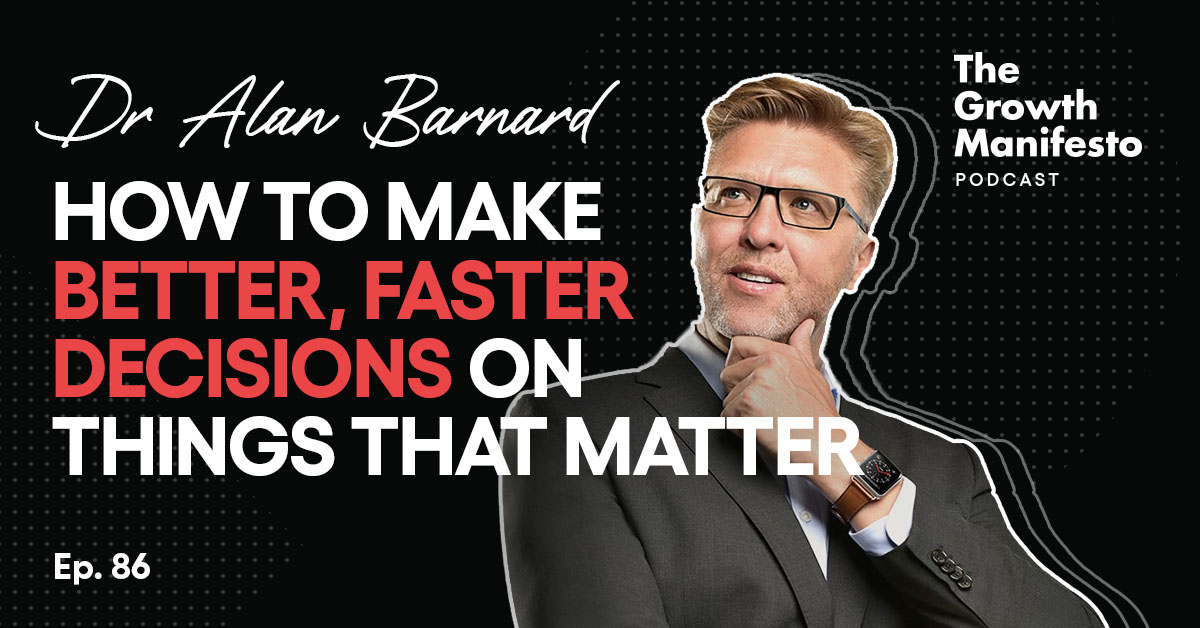
 with Dr Alan Barnard


Overview
In this episode we talk with Dr Alan Barnard – one of the leading decision scientists and ‘theory of constraints’ experts in the world. His clients include companies like Microsoft, Nike, BHP, Cisco, SAP, Intel, Penguin Random House, and Fujitsu – about how to make better, faster decisions in business.
Key takeaways
- A good decision has a big upside if it works and a small downside if it fails, independent of the outcome.
- The safest choice is one where even the worst case benefit outweighs the worst case cost, not just the likely outcome.
- Recovering a 50% loss requires doubling your money to break even, which is why so many businesses collapsed during COVID.
- Decisions can be made 90% to 95% faster by asking whether more information would actually change the choice at hand.
- Trust intuition only once you have built it through experience; otherwise ask someone who likes you but not too much.
Chapters
About the guest
Transcript
Auto-generated from the episode audio, so expect the odd mis-heard word. Timestamps open the video at that point.
But a really safe criteria would be what's the worst case benefit versus the worst case cost. And if the benefit is still better, then go for it. Absolutely. You're listening to the Growth Manifesto podcast, where we host in-depth interviews with business leaders, authors, industry experts, and entrepreneurs with a singular focus around business growth. At the end of each podcast, we want you to walk away inspired, to think bigger, and to have actionable takeaways you can apply to improve your business. Each episode is like a masterclass on a key topic, so make sure to browse the episodes
to find the topics that are most relevant to your biggest business challenges today. This podcast is brought to you by Web Profits, a digital growth consultancy that helps challenge your brands drive growth in a complex and fragmented digital landscape. You can find out more about Web Profits at webprofits.io. Now, let's get into it. This is Alex Kleantis and today we're talking with Dr. Alan Barnard, who's one of the leading decision scientists and theory of constraint experts in the world. His clients include
companies like Microsoft, like Cisco, like Nike, like SAP, like Intel, the list goes on. And today we'll be talking about how to make faster and better decisions in business. Hello and welcome, Alan. Hi, Alex. Thank you so much for the invitation. Yeah, I am extremely excited to speak with you because I was referred to you by Jay Abraham, who I respect extremely highly. And so he speaks extremely highly of you. So this should be a really great conversation. But let's get straight into it because it says within your bio that you're a decision scientist. Now,
what does that actually mean? Let's start with that quick definition because I've never heard of that before? Yeah. So decision scientists just study why people make bad decisions, which of those bad decisions were avoidable versus unavoidable. And of course, for the avoidable decision mistakes, the ones that we can actually do something about, we want to understand why we make these and what are simple strategies that we can use to try and avoid those mistakes. All right, cool. So we're going to get straight into it then with this one. Okay, so what is a bad decision? Let's start with
some definitions. Yeah, I think that the first thing to look at is you shouldn't confuse a good or bad decision with a good or bad outcome. So you could have a bad decision that results in a good outcome. For example, you go out, you know, and you have a couple of drinks of alcohol, and you feel okay, and you decide to drive home, and you arrive home safely. Was that a good decision? No, it was a terrible decision, right?
Because the outcome could have easily been different and destroyed your life and maybe somebody else's life. So even though the outcome was good, the decision wasn't good. You could also make a bad decision with a good outcome. So that's the first thing is we can't just judge a decision based on the outcome. We have to judge it based on, am I considering all the facts that I have in front of me? And do I make a decision that is a very likely probability of giving me a good outcome, an outcome that has a big upside if it works and a small downside if it doesn't?
That to me is kind of like an option, you know, that you are exercising any change that you can make in your life or in your organization is like an option. You have the right to do it, but you don't have an obligation to do it. So how do I decide which options to exercise, which decisions to make? a really good option is one with a big upside if it works, small downside if it doesn't. A really bad decision is one that has a small upside if it actually works and a big downside if it doesn't. So that's a slightly different way of thinking about what is a good or bad decision.
We can't just judge it based on its outcome, but based on the probable outcome, looking at that from that perspective. That's a really interesting definition. And it kind of makes sense as well, obviously right but then there comes a point especially in business where the possible outcome is high but the possible uh downside is also high and we're talking about you know some of the hardest choices in business are which direction should we go or things aren't working something has to change or you know there's a big opportunity but they're asking for a huge um what's called um
the discount that they're asking for is very high so the margins are going to be cut now What does that then lead to? So there's so many not so simple, I guess, choices or decisions that companies have to make, right? And so at that point, what are the criteria for a good decision and a bad decision? Because it's a bit more confusing then, right? Absolutely. And it's complicated, right? When you are making the decision to a big degree, you are predicting what the outcome is going to be both positive and negative, right? And we are just not good at predicting the likely outcome.
but it turns out that we're pretty good at predicting the best and worst case outcome. So like I mentioned, a great decision is one that has a big upside if it works and a small downside if it doesn't, right? Now you might say, well, what about one that has a big upside, a really big upside if it works, but also a big downside, but still less than the upside? Should I go for that decision? Well, that all depends on how much buffer you have, right? So if you have a
lot of cash in a bank, you can make those type of calls. But if you have a small amount of cash in a bank, even a small downside can end up, you know, destroying you. So that to me is kind of a way of thinking about it is to say, the best possible decision is one where the worst case outcome is is still greater than the worst case cost. The worst case outcome is better than the worst case cost.
So you're going from... So let's say you're launching a new product, right? And you don't know exactly how much you're going to sell, but you probably would have good intuition about best case and worst case. So you say, look, best case will sell a million, worst case will sell 200,000 this year. You say, okay, so let's look at the cost. What is the best case cost? Well, the best case cost would be $100,000. The worst case cost would be $150,000. If the worst case cost is still less than the worst case benefit, don't even think about it.
Just do it. And that to me is kind of the universe is always asymmetrical, right? So when you find that those two things are close, you know that you've made a bad assumption. That's kind of how I was trained by my mentors, you know? is that the world is not symmetrical. If you find that the cost and the benefit are similar, you've made a mistake somewhere. You're either over- or underestimating the benefit or over- underestimating the cost. So that to me is a very practical way is go and make those checks. What's
the best case, worst case benefit, best case, worst case cost. And if the best case benefit is much, much greater than the worst case cost, you know, that's one criteria. But a really safe criteria would be what's the worst case benefit versus the worst case cost and if the benefit is still better then go for it absolutely so it's really about reducing the risk of a bad decision this is it seems like this is at the core of the thing i'm understanding right now is that if you
can reduce the number of life-threatening choices which you make yes and you've got the buffer to make a lot more positive choices. Is that a good summation? I think it's, you know, one example, I had an opportunity to meet with Nassim Taleb, who wrote anti-fragile, fulpa, randomness, etc. And he was the person that kind of planted the seed in my mind about thinking of decisions or changes as options that you can exercise. And an interesting example is imagine your parents
retired, and they had a million dollars. And the question is, they have two very different options to invest that million dollars. One option would be to invest it in a low risk portfolio, low risk option, right, where you might only get 10% interest. And you think, okay, that's the best way to do it. But the question is, when I'm thinking about not the likely, but the worst case and best case, it might change my mind. Because if I think about that option, what's the
best case, I can get 10% interest, right? So my million would become 1.1 million. But what's the worst case? Even though it's a low risk option, the worst case could be that I lose everything, right? Now think of an alternative strategy that says, I'm going to take 900,000 of that million and I'm going to put it into an investment where there's zero risk or as close as I can to zero risk, where the chances of the whole thing being wiped out is almost zero, like property or gold
or something like that, right? And the other $100,000, I'm going to invest in something that can give me a 10x return. And now you think about the best case, worst case, right? Worst case is I can lose the $100,000. The best case is I can turn my $100,000 into a million and I end up with $1.9 million. So it's just a very practical way of thinking about it to say, forget about trying to predict the likely outcome. We just can't predict the likely outcome, but we're actually pretty good at predicting best case and worst case. I have a lot of questions now just on this
point, which is exciting, but I just want to take a quick step sideways and just ask, it seems so simple but I haven't really heard this kind of thinking before where did this start or where did this come from because it's really it makes sense now that you hear it but it's like that counterintuitive kind of thinking that you need to hear it first for it to make sense so how did you come up with this kind of thinking um I was very early on very lucky to have read a quote that have kind of inspired and haunted me at the same time
I'm sure the listeners and viewers all have those type of quotes, right? So mine was from this physicist called Jean-Baptiste Perrin. And he said that the aim of all science should be to substitute visible complexity for invisible simplicity. So if you think about E equal to mc squared, mathematically, it's difficult to think of a simpler correlation, right? Right. Anybody can understand it, but it explains a huge amount of visible complexity.
And that to me is the essence of decision making. When you think about it, there's a lot of visible complexity about decision making, right? We all make decisions in a fundamentally different way. We apply different weightings. We have different risk tolerances, et cetera. But there is this profound, inherent, but invisible simplicity. and that is what has driven my research is to find that invisible but inherent simplicity that can make decision making easier for people it's so interesting and especially that example which
you just gave around if you had a million dollars put 900 in somewhere extremely safe and then take a hundred thousand and put that something extremely risky because the worst possible downside is worse than the worst possible upside, right? And so that's a really interesting way to think about it. And then on the other side, the 10%, the 100,000, the best possible upside is much better than the best possible downside. Is that right? Or the worst possible? Is it the worst possible downside on the best side? Yeah, I'm looking for an option that on the one side,
the upside is much, much greater than the downside. I'm looking for something that has a big upside small downside. But if I want to be ultra conservative, right, then I'm looking for a situation where the worst case benefit is still greater than the worst case cost. But then what about on the other side? So for example, that 10%, the 100,000 that's going to have a 10x return. Yes. What's the criteria for that decision? It's fine to be this risky because
How would you state that? Because the worst case scenario for me is that I lose the $100,000. I still have $900,000 left. And if that is enough for me to maintain a relatively good quality of life, I can take risk up to 10%. Some people could maybe take risk up to 20% and say I'm willing to bet 20% and earn $2 million from that if it pays off. And worst case, I'll be left with $800,000. where it becomes really scary is people that save up their whole life.
They go and make an investment in what they are told is low risk, but then they lose everything. That's not low risk. That is not correctly defining what low risk means. Low risk means you can't lose everything because that is hugely high risk. Even if there's only a 1% chance that I could lose everything, it's still a massively high risk that I can't tolerate. Really, I'm starting to get really clear right now. So to be safe, the worst possible upside has to be better than the worst possible downside.
But then for the upside percentage, say, for example, back to your example, that 10%, the best possible upside has to be much better than the worst possible downside. And the ratio, it's a 10x risk. So it's worth it. It doesn't make sense if it's a 6% compounding per year for 20 years, but there's a risk to lose everything. So starting to get the correlation to the downside. Yeah, there's another example that the listeners and viewers
can try out themselves and maybe even teach their kids about it. So I wanted to take a calculator and put in 100, right? And to think about what will happen if you're trading this $100 and you make 20% gain when you win and you lose 20% when you fail and you have a 50% chance of winning or losing. In our mind, that sounds, well, as long as I play long enough, it should cancel out, right?
And I should end up with about the same as what I started. it. If I could lose the same than what I can gain, it should cancel out. But there's kind of this mathematical quirk. So you take 100 and you add 20% to it. So say you win your first transaction, say you're selling homes or you're selling something on eBay, right? As we're looking at trading, you're trading. So what's going to happen? So you make 20%. Now you're at 120. but let's say the next trade you lose and you also lose 20% 20% of 120 is 24 so now you're down at 96
you've just lost four and that's kind of counterintuitive right and it's very interesting because I discovered this principle very very early on in my life and I wanted to find out like how much do you need to win on a transaction, whether you're selling your time or you're selling goods or houses or trading shares, it doesn't matter. How much do you need to win to compensate for loss? And it turns out that the mathematical formula, it's again,
one of those things that's inherently beautifully simple. It's the loss over one minus the loss. So if you could lose 5% on a transaction, right, then it would be 5% over 1 minus 5%. That will be 5.2%. So as long as you make 5.2% on the next transaction, you'll be break even. But imagine what it is like when you could lose 50%. So 50 over 1 minus 50 is 100.
So you would literally have to double your money just to break even. And that's why so many businesses during COVID ended up going bankrupt. Because if you lose six months worth of sales, you're dead, right? You'd have to, and even if you had the cash to survive it, just to break even again, you would have to double the sales from the previous period. And there's just not enough of demand available. So those are the type of things that we, what we've learned from where
this inherent simplicity is, is stay away from things that have a big upside, big downside. I call those hell no decisions. Stay the hell away from them. The only reason why you would do something that has a big downside is if you have a lot of cash, a lot of buffer, but else stay the heck away from them it's really really interesting so the key is to stay away from the decisions that
have a big downside and even if that big downside this is this is the part which i heard from your example even if that big downside has just a one percent chance of happening because that one percent chance is still a chance absolutely it could wipe you out that's really interesting and so to the starting point of our conversation we talked about actually making uh faster and better decisions now how does the speed component happen now because i'm sure especially in business and
i'm sure i'm an example i'm sure i'm sure so are you so many there's like there's a significant amount of choices that have to be made every single day sometimes you might not know the ones that have the big downside or not because there's so many happening in the day so how do you start approaching this from a daily perspective now? So there's two things that I want to cover. The first one is making better decisions. What does that require? And the second part is how to make faster decisions. So I'll start with the second one. If we are in manufacturing or in operations,
and we look at, somebody says to us, look, they want to reduce the time to do something. So say it's a Department of Home Affairs. There's currently a big backlog with passports, right? It's taking people like four months to get a passport. Now, I might not have any intuition about passports, but I want to be able to commit to this customer what improvement is possible, right? So what I do is I say, okay, it's currently taking four months. Tell me, if you had nothing else to do, you had to just produce one passport.
How long does it take you? What do you think? A few minutes? Pretty fast, right? Yeah. Right? Okay. So that's the improvement potential. It's the difference between four months and, say, four hours, right? So I want to track where are the delays happening and how can we reduce those delays? Because that will get me back closer to the four hour. And, of course, if I can get back to four hours, you can imagine how many more I can get done with the same amount.
the resources. When it comes to decision making, you can ask yourself the same question. The last time from the moment that you knew you had to make a decision until you've actually made a decision, how long was that period? And it's often that it's not just days and weeks, but it could be months and years, right? Then you ask yourself, well, once you had all the information that you needed, How long did it take you to make the decision? A few hours, right? That's the improvement potential,
right? As we have the ability to reduce the time it takes us to make difficult decisions, not by 5% or 10%, but often by 90% to 95%. We can go much faster. But then we have to, it's like, what am I waiting for? What is the critical information I need to make this decision? And this is something that, again, going back to the visible complexity, we are often put in environments where we will never have all the information, we'll never be able to predict
accurately what's going to happen, right? And yet you have to make a decision. And the only way to get out of that trap is to ask yourself, by getting more information, will it change my decision? So a good example of that was, you know, people that were panicking during COVID. Oh, I don't know what to do, et cetera. I said, like, what can you do? You can decide whether to wear a mask or not, right? That's it. Like, what additional information do you need to get, right, to decide whether to wear a
mask or not? It's a good idea. Wear a mask, right? That's it. The fact that we don't know how long it will take to get a vaccine, the fact that we don't know how much fast it's spreading in which areas. None of that information is actually going to change my decision to say right now, it's safer to wear a mask. And that's something that you overcome that paradox that says, what information do I actually need to make this decision? And that's why I come back to, we are very lucky in that even though we are never able to accurately
you predict what will happen, we generally have good idea about the best case and worst case. And that's almost all the time, the only information that I really need. And if you don't have intuition about that, go and ask somebody that has intuition to say, what do you think could be the best case and worst case? And now, once I know that, I can make a safe decision. So that's on doing it faster. The potential to do faster decisions is enormous. If we take consideration of how, you know, I have to decide what to go and study, like how many months did it
take me? And finally, what was the information I needed to say, at least let me go and try this. If after three months, I don't find it interesting. Now I know, right? When it comes to making better decisions, I think Daniel Kahneman, you know, he wrote a book, Thinking Fast and Slow. He provided But again, beautifully simple framework with a lot of visible complexity, right, of how we make decisions. And he says we have only two modes, system one, system two. System one is fast and automatic.
It's essentially using our intuition, our instinct. And system two is slow and deliberate. It's using our cognition is when we're actually thinking about it. So my advice is always, if you're facing a decision where your gut feel tells you that this is important, right? There's a huge benefit if you get it right. There's a huge risk if you get it wrong. Then you will always benefit from slowing down your thinking and not going with your gut feel.
That was going to be my question, especially around intuition. I, you know, as a decision scientist, I shudder when I hear people say, oh, you should always trust your gut. No. You know, Daniel Kahneman, his whole research was all the cases where you shouldn't trust your gut. Our intuition sucks when it comes to real life situations. So don't just go five, four, three, two, one, decide, right? Rather say, let me slow down my thinking. first of all, is this problem important enough for me to actually have to make a decision now?
Is it important and urgent? If so, what are the options that I have? What are unique pros and cons of each of these options? Not trying to predict the likely, but best case, worst case. And is there an option that I already have that clearly has a big upside if it works, small downside if it doesn't? Just go with that. If you don't have such an option, then try to develop one. Try to see how I can modify my options that I have to turn them into an option that has a big upside if it works and a small downside if it doesn't, or at least where
the worst case benefit is still greater than the worst case cost. The worst case benefit, yeah, this is really, really, really good, simple approaches to decision making. And I really like, and I think I have to get the words right because it's hard to say it, but the worst case benefit has to be better than the worst case cost. That's how to avoid our bad decisions. And if there's an important decision, slow down, slow down and get all the information which you need
because intuition and your gut may not always be helpful in making that smart choice because you need the right kind of information to understand the worst possible downside and the worst possible upside and the worst possible outcome, right? And that's what you need to be preparing it against. People often ask me, like, when should I trust my intuition? And my answer is very simple. When you've actually developed the intuition. That's the reason why it takes us 10,000 hours or 20,000 hours to master something,
right? It takes many, many mistakes to build up the intuition to know just instinctively whether it's a good idea or not. But if you haven't invested that amount of time, don't trust your intuition. Go and ask somebody that has got the intuition. You know, Daniel Kahneman gives great advice. I love it. He says, like, who should you ask if you can ask for advice, right? He says, first of all, ask somebody that's developed the intuition, right? This is their job, right? a married scoundrel that's been doing this for 20 or 30 years, if you want to ask for some
relationship advice, whatever. He said, second criteria is it must be a person that likes you, right? Because if they don't, they might give you the opposite answer, but not too much. And that criteria I really like is the third criteria is ask somebody that likes you, but not too much, right? You want them to be brutally honest with you. And that's unfortunately often what we do is we go and seek out advice from people that will agree with us.
We don't seek advice from people that are likely to disagree with us. And yet that's the thing that we should do. And there comes a point, just to your last example, where you do have intuition, right? And let's just say that we're sitting around the table, it's a board meeting, everybody there has 15 years experience they all have intuition they still need to go through this process though right because this process because intuition it seems that even if you have 20 years
experience still might falter is that right that's true and it's partly because of two reasons right the one is you can still be wrong right what yeah what no you can't still be right because you might I've developed expertise in that one case. It's the first time that you've seen this case compared to, you know, I've seen this a thousand times, right? So it might still be that you could be wrong, but there's another thing, which is probabilities. I've just been working on a
really interesting little problem. It's called the Monty Hill Hall problem, right? You're on a game show and there's three doors and they tell you that behind one door, there's a car and behind the other two doors, there's goats. And you make your selection, it's kind of a third, third, third probability of success. And you pick door one, right? And they come to you and the host says, I'm going to give you some more information. I'm going to show you that behind door three, there's a goat. Do you want to change your mind? So your two options, stay with door one,
or go to door two, what would you do? Are you asking me the question? Well, it's a real question. It's a very, very hard problem to solve mathematically. For many years, there was lots of disagreement about what the right answer was. Until the woman that has the highest known IQ in the world, Marilyn Vos Savant, she gave a beautiful explanation that solves the problem that says, look, each of the doors have a third probability of success, right?
So your door that you selected, door one, had a third. The other two had the two thirds. So if they tell you what's behind door three, the whole two thirds probability of success now comes with door two. You should say, thank you very much. And you should switch and go to door two, because two thirds of the time, it'll be a good decision. Does it make sense? It does make sense. However, there's another factor that we should consider when making decisions. Because it could be that you just unlucky, you switch and they go, oh, it's behind door one.
How would you feel? So that's the second thing that we teach when it comes to decision making is, yes, there's, you're trying to predict the likely outcome, right? The benefit versus the cost. But what you should also consider is how it will make you feel. Best case, worst case. because there's still a chance where you've made the right choice which is to switch because in two-thirds of the time by switching you'll end up winning the car but what happens if you just
unlucky and you're playing this game only once right and you switch but they go it's door one and and that to me is an important consideration to say listen if you are okay with it and you say okay, I was just unlucky. I still made the right decision, but it was a bad outcome for me. I can live with that versus I'm never going to forgive myself that I allowed this guy to manipulate me to change my choice. If that's your mindset and we all know each other ourselves well enough to
be able to predict, then my advice would be to say, ignore the mathematics, stick with the one. great alan this has been such a great conversation i didn't even consider the depth and the simplicity of actually having a framework for how to make smarter faster and better decisions this is super interesting um and thank you for sharing so how do people actually start to find out a bit more about the programs which you have the thinking which you have pro con cloud you know like there's
quite a body of work behind you. How can people start to find out more? So my research lab, Goldwood Research Labs, that's what we do. We do research both for personal decisions, but also business decisions to find out why good people make and often repeat bad decisions. And for the avoidable decision mistakes, we've developed a whole range of apps to help you make better, faster decisions. So for the viewers or listeners, they can go to harmonyapps.com. And that will show the range of decision making apps that we've developed.
All of them I've got to try now, you know, before you have to subscribe to them. They range in price from just a couple of dollars to, you know, a few thousand dollars if it's for business decisions. But they can also subscribe to my YouTube channel. We are constantly, you know, sharing insights on our YouTube channel. It's got hundreds and hundreds of hours of key insights from ourselves, but also some of the other leading decision scientists in the world. And that YouTube channel is just drallenbarna.com. And I'll put the links into the show notes as well. But Dr. Allen, thank you so much for coming onto the podcast
and actually helping people to make smarter and better choices and decisions in business. Because I think it's such an interesting time happening in the next six months or so, where I think there's going to be a lot of pretty big decisions that companies are going to have to make. So this is pretty good timing for such a good conversation. So thank you so much for coming on the podcast and sharing this thinking today. You're so welcome. And thank you again for the invitation. Thanks for listening to the Growth Manifesto podcast. If you enjoyed the episode, please give us a five-star rating on iTunes.
For more episodes, please visit growthmanifesto.com forward slash podcast. And if you need help driving growth for your company, please get in touch with us at webprofits.io.