Leadership and culturePersonal growth
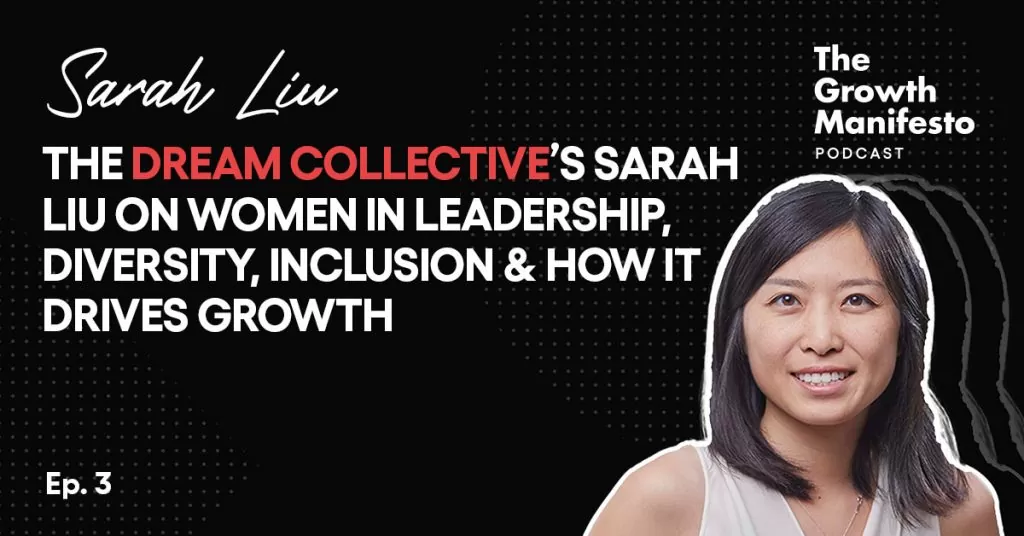
The Dream Collective’s Sarah Liu on Women in Leadership, Diversity, Inclusion & How It Drives Growth
The Dream Collective's Sarah Liu breaks down 4 unconscious biases against women at work and the 5 pillar process she uses to fix them.
 with Sarah Liu


Overview
In this episode, we interview Sarah Liu, Founder and Managing Director of The Dream Collective, a corporate training organisation that empowers women leaders and encourages diversity and inclusion in the workplace. Sarah is an international thought leader, speaker, trainer and facilitator on next-generation leadership, diversity and inclusion and the future of work. We talk about unconscious biases in the workplace, women in leadership, and why companies need to embrace diversity to drive growth.
SHOW NOTES
Key takeaways
- Liu argues successful women face a likability bias where success and likability correlate positively for men but negatively for women, across both genders.
- She says women tend to apply for a role only once they meet around 90% of the criteria, while men apply having met about 60%.
- She cites IBM's automatic tap failing to detect dark skin and early YouTube uploads landing upside down as evidence of design teams lacking diversity.
- Her consultancy tackles workplace bias across 5 pillars of the employee lifecycle: hiring, training, evaluating, promoting and flexible scheduling.
- She says she built her book featuring 30 Australian business leaders, and much of her business, simply by asking people directly rather than pitching them.
Chapters
- Intro to Sarah Liu and Dream Collective
- How Sarah Liu founded Dream Collective
- The likability bias against women
- Performance evaluation bias in hiring
- Performance attribution bias and credit
- Maternal bias after returning to work
- Design failures from a lack of diversity
- A 5 pillar process for inclusion
- Building a career by just asking
About the guest
Sarah Liu
Sarah Liu is Founder and Managing Director of The Dream Collective, a corporate training organisation that empowers women leaders and encourages diversity and inclusion in the workplace, and an international thought leader, speaker, trainer and facilitator on next-generation leadership, diversity and inclusion and the future of work.
Transcript
Auto-generated from the episode audio, so expect the odd mis-heard word. Timestamps open the video at that point.
You're listening to the Growth Manifesto podcast, brought to you by Web Profits, where we share inspiring stories of real people who've succeeded in the marketing and business world. Today, we interview Sarah Liu, founder and managing director of the Dream Collective, a corporate training organization that empowers women leaders and encourages diversity and inclusion in the workplace. Sarah is an international thought leader, speaker, trainer, and facilitator on next generation leadership, diversity and inclusion, and the future of work. We talk about unconscious biases in the workplace, women in leadership, and why companies need
to embrace diversity to drive growth. So let's get into it. Alex, how are you, mate? I'm good, thanks, Tony. How are you, mate? Mate, I'm very excited today, actually. And one thing I love doing is actually traveling around the world. And if I was going to ask you one question, what's your favorite place, being the tech guru that you are, what's your favorite place to travel to on the planet? Because I quick side note, so Tony preempted me to say Silicon Valley. Really, Alex? Because people who know me will know that wouldn't be the place that is my favourite place.
It is. I definitely like going there. I'm definitely inspired by it. I think my favourite place is like Mykonos or something. Sure, Silicon Valley is what I heard. And what I'm really excited about today is we've got Sarah Lewin today from the Dream Collective. Now, Sarah, welcome to the show. Hi, Tony. Thank you for having me. Hey, it's great to have you on board. Now, Sarah, you've just come back from Silicon Valley, and I actually saw you do a talk not long ago, and it was called Your Learnings from Silicon Valley. That's right. Yeah, yeah. So I'd be really keen and interested to know that. But I'm just going to go through your portfolio at the moment.
You are the managing director, you're an entrepreneur, you're a speaker, and you're a passionate advocate for women in leadership and also diversity. Now, that's pretty extreme. I've got to ask, how old are you, Sarah? So I'm actually 33. You're kidding me. You have written three books as well, right? That's right, I have. Yeah. And we are actually in preparation for the fourth one. Wow. Yeah, for release next year. That is amazing. That is really, really inspiring. And listening to you as a speaker, I've got to say, you are a beautiful speaker. You're so well articulated and you just got out there and you had – we were there for
30 minutes listening to your story about – you know, sharing your story about what happened in Silicon Valley. And you had everybody on the edge of their seat. Oh, that's good to hear. Thank you. It's always reassuring. And it was early in the morning too. That's right. And so I was super excited, it's not the right word, but I was like, man, this is awesome. This is really good. And I think that's exactly right. I think if you're not having fun, then people are not having fun. So I think it's very much about just being relaxed and share things that are actually genuinely interesting to myself as well. And I'm sure that'll be the same for others.
Well, that's what we're gonna find out today. Now, Sarah, tell me about your story. How did you become the managing director and the founder of the Dream Collective? How does that story come about? So I actually come from a background in marketing and branding. And throughout sort of my career, I've always been quite ambitious and wanted to climb the corporate ladder very quickly. And throughout my journey, I was confronted by the lack of development opportunities for women in business, particularly, I think, in that early to mid-career stage. I found that a lot of the development opportunities happens in that executive
level. But quite frankly, unless you actually work with a pipeline of emerging female leaders, we won't see the landscape change. And if you only invest in that top end, it's too late. So what are some of the unconscious biases? Because I think this was the thing which I started to really understand is the things which you can't see. Yes, absolutely. That are there. So yeah, just expand on that if you could. So I might just quickly talk on, for example, the four biases that's most prevalent to women in the workplace. Number one is likability bias.
So likability bias is when success and likability are positively correlated for men and negatively correlated for women. So successful men are more likely to be liked, whereas successful women, the unconscious bias is that people tend to find them less likable, more intimidating, and therefore it creates a misperception in the workplace. Across both genders? Across both genders, yeah. So successful women are not liked by both men and women. Wow.
By women as well. By women as well, that's right. Why is that? I think there's a lot of, it goes back to behavioral science and all that. I think when it comes to unconscious bias, we all have it. And it's actually not possible to remove it because human, even when it goes to as early as the Stone Age days, hunter-gatherers, we as humans need to make decisions in a split second. And that's based on assumptions, filling in the gaps, past experiences,
informing color and present decisions. So we all have unconscious biases, but when we translate that into the workplace, it starts to have a really negative impact on certain demographic and women being one of them. What did that do for you, for an individual who wanted to climb the corporate ladder, be the best version of yourself and make a difference on this planet, but you couldn't actually get through there? What impact did that have on you? I think for me, it's not necessarily that I felt I couldn't get there, but actually a sense of how much harder I need to be focused on getting to where I need to get to.
I managed to channel it in a very positive way, which is great. You know, I stayed focused and, you know, turn that into a positive energy in terms of creating a business that will help, that will propel other young women forward as well. Did you have a mantra or did you have, what did you do to get through that? Because everybody's got a different strategy on how you push through. I think for me, it's always believing in yourself because the more you believe in yourself, the less you need others to believe in you. And I think- Yeah, but how do you believe in yourself
when you've got so much doubt thrown against you? I mean, like you got self-esteem and then you're just getting it knocked out, knocked out, knocked out all the time. So where do you find that? I think there's a couple of ways around doing that. One is having a bit of a support squad around you. Surround yourself with not only role models, who's been there, who can encourage you in a very meaningful way, but actually surround yourself with partners, with friends, with colleagues who share similar values and can support you. I feel that's really important because, once again,
you're the average of the five people you surround yourself with. So if they are naysayers, then that's the route you're going to go down. But if they see the possibility they have been there and they can coach and support you through it, I feel that makes a tremendous amount of difference. Yeah, nice. And that's where the Dream Collective can help, right? And this is a plug for the Dream Collective, but this is actually there to support women and actually have a good support network around? That's right, yeah. So that's where we very much started as a sort of collective and women getting together.
We run workshops and seminars, but since it has evolved into more of a B2B diversity inclusion consultancy because what we found is that it's no longer enough to just empower and equip women, getting women together. we do work with businesses to actually change the landscape, change the way we hire, to change the way we promote women, to change the way we retain women in the workplace. So that's why over the past years we've started working with businesses such as Google, Adidas, Lego,
to help them attract, retain and advance women in the workplace. And how receptive are they to this? Sorry, Alex, you were just about to jump in. No, because I just remember she said they were basically… basically um four pillars we've got to one yeah the first pillar and i was like because i don't want to forget to finish it because i don't want to get some comment that's what i've been down hey you cut her off after the first pillar you're such a typical male i'm sorry i'm just excited alex what i've done is in preparation that i actually wrote down there's four yeah we've only hit one yeah just want to make sure that yeah
Yeah, yeah, yeah. So what were the other pillars? Yeah, because the first one was likability. That's right, yeah. And the second one is performance evaluation bias. So performance evaluation bias is where men are more likely to be evaluated on future potential and women are more likely to be evaluated based on past performance. So what that means is, for example, a man and women are going for a job, even though neither of us have had the experience, you know, operating in that capacity,
it's more likely for people to go, oh, to see a man and go, you know what? I actually think he has got the potential. He's got what it takes. Whereas it's more likely for them to see the women and go, actually, you know what? Like she hasn't got the experience and the evidence to prove that she can do the job. And once again, it happens for both men and women as well. So we see that, you know, actually translating in some really salient stats where women will only apply for a role when she probably fulfills 90% of the criterias. Whereas men are more comfortable
putting themselves forward for position when they tick the boxes about around 60%. Sure, so how do we change the landscape on that? So I think a couple of really practical ways is one, making sure that the language used in our job ads are more inclusive. So for example, language is like a must have 16 years of experience. If this person has 15 years and a half Are you going to reject it? You know, so it's making language a bit more inclusive, right? And making it more value and culture driven, you know,
and output, you know, driven rather than past track record performance. So highlighting on what you need this role to fulfill rather than what you need this role to have done. And it's not just like a gender thing. It's actually, it just helps us attract the best and the more diverse talent possible. So one of the things that we did here was, this was after last year's International Women's Day we had the senior women in our team actually have all of the job ads, make sure that it
spoke to them as well as to the men because sometimes we had like some templates that we had from a couple of years ago and so even though the women are the people that actually have posted those ads, maybe they weren't speaking the same to women as to men and so we made some updates I'm not quite sure actually how much that's changed but I could see the difference in how the language was written. It was a bit more about the experience and it was less about the stuff. Yes.
It was quite interesting. I was like, hey, that still says the same exact job role but it sounds a lot more positive. It was weird. It was kind of hard to put. That's right. So all that is the unconscious bias that is really hard to actually pinpoint but in fact creates a huge difference. So, you know, our client Google and, you know, some, you know, startup actually have created basically a system to try and remove biases in job ads, you know. It's almost like an auto-correct, you know, mechanism that you can have.
Sure, they've got some software that does that as well because they Google. They're like, no, no, no, we'll get the AI to do it. Yes, yeah. I mean, like, when we look at Google and Facebook, you'd like to think that they've moved with the times where they would have chosen different ways of employing and recruiting staff and whatnot. not so wording, but they're actually looking at just now of changing. Like a couple of organisations that I've worked with was with government organisations where we're looking at like it's state, New South Wales Transport, where they're looking at having 50% of women in management by 2024
and then the changes that they've gone through. And I think it's quite positive for a government to actually support that. And if you have a look at Labor as well, Labor's got 50% of their benches or females as well to get that. So there is a shift happening there, but I'm surprised that Google and Facebook need to shift as well. I thought they would have already jumped on board. They are. And they're very progressive and very advanced in that space, but they are at that next level where they are thinking, well, firstly, they actually have a very much harsher target for themselves,
you know, compared to the rest of the industry. But the second thing is that they are now at a place where they are thinking, how can we lead the way? How can we drive thought leadership in that space? doing well ourselves is no longer enough. How can we change the industry? And that's why we've sort of come together to create some initiatives and content and to support different businesses to develop thought leadership in that space. Nice. Okay, so that's number two. Now we're going to get on to number three. I'm on to it. I've got this. Yes, and the third one is performance attribution bias.
So what that means is men are more comfortable attributing success to internal factors and women are more comfortable attributing success to external factors. So, for example, how that plays out in the workplace is a woman gets promoted. She's like, oh, I have a supportive boss. My team was great. Everyone else but me. Whereas a man is more comfortable owning that success saying, well, you know what? I actually worked my ass off. Sorry, can I say that? Yeah. Sarah, you should hear me off the mic.
That is so PG right now. Yeah, that's a fine one. So it's Tony that's not allowed to say anything because it's a slippery slope. It is. Because as soon as I let the first one go, that's it. Yes, that's right. So I will send myself. So, you know, men are more comfortable owning their success and saying, hey, you know, I've worked really hard for this promotion and I'm really glad that, you know, my contribution is recognised. So what that means, and this is not to tell women to go,
hey, from now on, like, don't be a team player. don't attribute success externally. But I still find that balance because if we constantly, if we continue to not own our own successes, then people can't recognize it, you know? And that's a real challenge. I'm going to go from a DNA perspective here. Females are natural nurturers, which means I look after others, I love her. And like, you think of mums, like my mum, like she's the best person on the planet. She brought myself up, my sister up,
and she put up with my dad. And she's never taken credit for that. But you know that she's the backbone of it. And I see females in the workplace do exactly the same. They do so much. They put their heart and soul on. They'll give credit to everybody else. And themselves. Yeah. And then whereas dad, dad would come home and tell us how great he was, how much money he earned, how the family would be nothing without him. And it just goes on and on. Do you know what I mean? So now we're going against almost, and I don't know if this is a condition thing or if we're actually naturally programmed
like this as human beings to be one way or another. So you're actually asking females to maybe go a little bit against the natural way and say, hey, let's take some credit for the good work that we've done. So how do you do that? Because I find that quite intriguing. Well, actually, I think firstly, let me just qualify that we're not trying to pit men against women. Like it's not about sort of highlighting the difference, but about sort of acknowledging and embracing the difference. I think as much as it is for women to go, hey, you need to start owning your success a lot more, it's also for the men or women like female managers to understand, to go a little bit
deeper sometimes. When, for example, if I have a team leader who performs really well, but is not owning their success, you know, how do I support them in their development to claim and to own that success a lot more comfortably? Because the reality is when you have a senior leadership executive roundtables, you know, reviewing who's going to get promoted, they're not going to look deeper. They're just going to remember the last conversation they had with someone who says, hey, I did all that versus someone who they don't know if contributed to the end success. So I think it's not about going against the nature or going against the grain
necessarily, but it's more around having a more balanced conversation around both men and women to acknowledge the teamwork well done and also to make people aware of your contribution in that success. And so systemizing the performance process, process yeah the performance review process that's a way that systemically a company could do it right because the one way is that you just trust everybody will try their best but that's going
to be more fallible than say for example actually having a process that will ensure as equitable that's right and just review as possible right exactly and just consideration sets you know so So this is very much for a message, I mean, for not just the men and women, but actually for business leaders to go, hey, as we evaluate success, you know, can we make sure we always look at the external factors and the internal factors? How do we get people to feel comfortable with that? And I get that because I agree with what you're saying, Alex. You go through that process and then you go for your performance reviews, whatever you may be.
But now that individual has to actually get comfortable with saying, hey, I did okay. I did this really well. How do you go with that? because that's another ball game altogether. It is, it is. And that's exactly what our programs are designed for. Nice segue into that, isn't it? Sarah, do you like how we did that? I didn't even know. I know, we didn't even plan this. That wasn't even scripted. This is not on these notes here, all right? That's right. And these are the kind of things that you can't even script it because that's the reality that we have so much insight into what will help women succeed in the workplace
and what will help businesses build a diverse and inclusive space. So we've actually designed our program to actually really support women, especially in that early to mid-career stage to really owning that success. So it's about, you know, one, like practically giving them some tools and languages and sort of, you know, assessment metrics to help them owning that. But also in terms of building confidence around having courageous conversations. So some really practical tools where people will come in and also understanding the value of it.
Because I think a lot of people feel, why should I own my success? You know, women tend to think, oh, am I just bragging? But it's not bragging if they are facts. You are simply sharing facts with people. The motive is not to get a promotion or make yourself look fantastic. The motive is because you wanted growth within the team or you wanted something like that. When you go into, so when you identify their values or their strengths, especially with females, do you find that there's always either values of family, community, connection or things like that?
Whereas a male might be something like? I actually think as long as you're a human being, regardless of a gender, those are the core. I have yet to come across a male manager, a male leader to go, you know what, family and community is not part of who I am. Yeah, but what you're saying, and you identified it quite well before, I think males can tend to be superficial. So when you ask First Lassen and their leadership values, they'll go, it's strength and it's leadership and it's, you know,
It's all these things like being part of the military and leading my team forward and all these positions of power or authority where their values lie. But I absolutely agree that as human beings, our true core values is connection and community and love. Yeah. And I think you've touched on a brilliant point because that's in essence what diversity and inclusion is. It's not about like, you know, women or gender necessarily, but actually how do we give men more permission, you know, to embrace other qualities and other strengths that they have?
Yeah. Look, I remember many moons ago, I actually did a course as a Lifeline counsellor. So as I was doing it, and one of the most interesting things was we were sitting down and we were doing training as counsellors and our teacher goes, we're going to talk about Phil's statements now. And I think there was three guys there and the rest were all females, about 16 females. and the three of us looked at each other and go, what's a feel statement? And the teacher goes, you're going to talk about how you feel about certain things. A feel statement, not feel. I was like, okay. So we're going to talk about emotions.
And for us men, we struggled with the concept of talking about I feel like this or I felt that or whatever. We will always talk about I think of this, I thought of that. And for us, it was such a struggle. So what you're saying, there's also training in there for males as well to bring it back in. So I was, because we operate globally, you know, I was actually not long ago in Japan, actually activating a training on gender equality and diversity for 40 Japanese male directors. Right.
Yeah. And that was a fascinating experience. But once again, it's also just about opening up the conversation. You know, people talk about how women can't have it all, but the reality is men can't have it all either. Any individual who wants to actually pursue a certain level of success in their workplace make sacrifices with their family and vice versa. So the sacrifice is for everyone. So I think we really need to, the healthy conversation when it comes to D&I, diversity and inclusion, for us to have is including men meaningfully
in that equation as well. Can we get to diversity in about 17 minutes? Because I want to get onto pillar four. No, because I'm really intrigued with diversity. And we've spoken about this before, Alex. I mean, like, I open this up every time. I'm going to come back to it in 17 minutes. Let's go fill a four. I know, but I mean, everything that we- He's joking about the 17 minutes, by the way. So if you're listening to this podcast, I mean, you can see how long it's left. That's right. But the reality is actually, you know, everything that we've talked about so far
has been in the realm of, you know, diversity already. The fourth pillar that, you know, I want to talk about is maternal bias. So what maternal bias means- You left this to four? I'm glad you didn't open this one up because I'd be stuck. I'm such a big fan of this conversation. Yes, so what maternal bias means is that when women enters motherhood, there's an automatic assumption that they're going to be less committed to work. When the same assumption does not happen for men when they enter fatherhood.
In fact, I think, you know, from what I've seen, people assume that men are now going to work harder because they've got a family to support. But, you know, so the bias goes the other way. But what a mingles. That's so interesting. That does sound true. You know, that does sound like something which. It does, but there's BS to it. Not to sound like that's what it is. It just sounds like that is like a bias that happens out there because that kind of whole thing of like, oh, well, now it has to make more money to pay for the children or something like that. The research is ridiculous on it.
So I think, you know, whilst we might sort of look at it and go, oh, yeah, like it sounds quite benign. how it translates in the workplace is, for example, when a woman returns from maternity leave, the manager might actually, well-intended, okay, probably, but might decide to actually take her off projects that requires travel, that requires more intense work hours, etc., assuming that they're going to be less committed to work or giving her smaller accounts. And that's the things that we see.
It's like a demotion. Pretty much, that's right. and you know we're not saying that you know every you know women like everyone wants to you know continue a trajectory of becoming a CEO but what we're saying is that we need to be mindful that this bias you know exists so that we need to have conversations and we need to have transparency around understanding each individual's desires career appetite and inspiration when they come back instead of having that assumption correct so the thing about unconscious bias is that it's okay that we all have them
okay there's nothing wrong with it because that's how humans need to make decisions and that's fine. But what's not fine is if we leave it as it is and not have conversations around it. So all that is around unconscious bias is that we need to be aware that we have those biases and those four biases in the workplace specifically can hurt a woman's career very significantly. I think not only females, but males as well. Because we're moving, society's moving, the world's moving. We want to be more united. We actually respect each other's roles and we understand if a job's going to get done it's just whoever can really come up
and step up to the plate it doesn't matter if it's male or female it doesn't matter what country they come from or anything like that I think I'm quite excited with Gen Z coming through now and they're more diverse they're more gender included and it's really really nice but I think it's for the guys like my age and past the ones that could be struggling I mean I was quite lucky growing up in a liberated family like mum and dad always said, you know, a woman's just as good as a male, et cetera, et cetera. And it was quite good even from a cultural perspective as well.
So I was quite fortunate in that sense. But I know there's a lot of people out there that struggle with these four pillars that you're talking about, the unconscious bias, and it's so deeply ingrained. So at Dream Collective, do you actually, especially in Japan, I was going to ask you, did you notice there was a cultural difference between males in Japan and also in Australia? Yes, absolutely. I think cultural differences is definitely there. And I think the social conditioning and all that is real and prevalent. I think Australia is a lot more progress when it comes to, you know,
just the perception and the sort of social hierarchy of men and women. But it's really interesting you ask about the differences because having operated across the region, what we found was that there are actually more similarities than differences across the region when it comes to diversity and inclusion. because I think ultimately the human need, okay, to be included and the fact that unless you include people, okay, your workplace, unless you can have an inclusive environment,
people can't actually thrive in that environment. That's correct. What you get as a business is always going to be maybe 60% at best, you know, to its full potential. So once again, all that is actually very universal. It's interesting as well because outside of the inclusion part of making sure that everything is kind of as fair as possible across all the genders, it's actually helpful to the business's success as well. I mean, I remember at the talk at the growth marketing mornings,
you had a few examples of kind of how some companies had just got it so wrong. Absolutely. And so actually this can help success in terms of the business as well. So like are you able to just talk about a couple of those examples? Because I think if they hit it on the head, I was like, oh, wow. You know, I didn't even consider that that would be a context. Is this the favourite place you like going to, where you like to travel to? Silicon Valley? Yeah, that's right. Yeah, so I think, you know, I'm really glad you brought it up
because that's the thing around diversity and inclusion. I think in Australia, it's being very much kept as a bit of a HR side issue, whereas it's not. It's a business issue. Diversity and inclusion is the only way, in fact, we can actually feel and drive growth and innovation. And I'll provide a couple of examples. Wait, before we get that, can we define what diversity and inclusion is, just so we're very clear on that? So diversity, which is diversity in terms of diversity of gender,
making sure the workplace is represented. So our world, our society consists of people of different gender, different ethnicity, different cognitive and linguistic capabilities, sexual orientations, age, all of that. So does your workplace, does your company reflect that? So for example, if your company is full of men men or your leadership team is full of men, white men, that's not diverse. If your workforce is full of people between 22 to 35 and nothing outside of it, it's probably an issue long-term when you
don't have that diversity. And inclusion really is how, so how we talk about it is diversity is about having a seat at the table, right? Making sure that people sitting around the table are diverse. Inclusion is when people around the table can all have a voice. Inclusion is when people can all be heard. So it's not just about having representations, but it's about having their voices heard. How do we create that space? And that's inclusion. So that's about understanding one is overcoming some of those unconscious biases, bring awareness to that. And two,
I think it's about really understanding that we don't have to be the same, you know, for us to develop empathy. It's actually embracing and celebrating differences. That's so interesting as well because, you know, I started liking business some time ago now. In the beginning, I was like, why do I have to get everybody to buy into things, you know? It's so frustrating. I know that's the path, right? But in time, I realised that there's something to the positive friction that happens
that there's people who all agree in terms of the outcome but don't actually have to get there. And I think if people are passionate about it and there can be a productive, I guess, a discussion, it actually improves things overall. It's just not easy. It's just hard in between because you have to go back and forth and be heard and have some harder conversations around, you know,
trying to solve specific issues. Yeah. And so I think that's a hard part of the diversity and inclusion part is that it increases complexity of just getting stuff done sometimes, right? Sometimes, yes, but I think there's complexity regardless, you know. And I think that's the thing about having diversity is because that actually makes better decisions. You know, there's the affinity bias, which is, you know, people tend to hire and work and like people who are similar to ourselves.
But people who are similar to ourselves means that we solve problems the same way. We approach challenges the same way. Our risk appetite is the same, you know. And when you have a business that's quite homogenous, that is a huge problem. So which leads to, you know, the example that you asked me to share. So for example, you know, when I was in the Silicon Valley, you know, IBM actually shared that when the automatic water tap is invented and created, black Americans actually couldn't use the water tap.
Why? Because the sensor was not programmed to pick up dark pigments. So that's like what? Like a good 35% of your population unable to use your product. So that's a huge problem for business. But what it shows is that they didn't have diversity probably in the design team. And so inclusion by design, Like, you know, that was a clearly missing part. YouTube talks about when the YouTube platform was first created, about 10 to 15% of videos that are uploaded were upside down. They couldn't figure out why.
And what they realized was that they forgot to actually take into consideration people who are left-handed, who films, you know, content, you know, upside down, you know, with their left hand, and therefore it was uploaded upside down. So things like that just goes to show that diversity and inclusion, having diverse view, having diverse representation is merely a representation of your market and your user. And unless you include those views and those needs, it's simply your business cannot succeed beyond a certain point.
What I love, Sarah and Alex, I love the word inclusion because what we're saying is one of the basic fundamental needs that we have as human beings is a sense of belonging. And inclusion came in because the only time we ever felt safe as human beings, if we were the same, so if you're like your Chinese background? Yeah, Taiwanese. Taiwanese. How close was that? Yes, good. Good job. Five points for me. So you would feel more like growing up in a country town,
you'd feel more comfortable with Taiwanese people. But if you went overseas and you saw somebody else from Taiwan, you would feel safe straight away because you recognise a similar person. And your background, what's your background? Greek. Greek, of course it is. Same thing. So you'd feel more comfortable with Greeks because you belong to that. You understand the culture. You don't have to do it. I actually feel more comfortable with Australians if I go overseas and I hear the accent. I'm like, oh, my God, an Australian. Yeah, it's an Aussie, but that's what we do, right? I can't talk Greek that well, so I'm like, please don't talk to me in Greek. Yeah, yeah. But what it is, it is built in to a degree.
I think we're conditioned to be that way, but we need that sense of belonging. The thing I love about inclusion is now we're saying we all belong to the planet Earth. Can we all get along? Can we have a sense of belonging where we're all the same, we're all equal, and we've just got to get along as simple as that. So we're not divided by borders anymore. Yeah, exactly. Exactly. And I think for businesses as well, you know, we get together because we are collectively trying to solve a problem. Collectively, you know, let's say at WebProfit, you know, we are trying to grow the business, serve our client, you know.
So we need to come together. And unless we have a diverse team representing diverse view, okay, we can't service our clients the best possible. So it's actually just a very clear business case there. And I think that's why I really want to always encourage people to think about diversity and inclusion beyond like a HR, nice to have like an international women's day sort of topic. But in fact, it's good business practice. Unless you have it, your business cannot grow.
Makes sense for the organizations that are larger. What do you do if you're a smaller company? Yeah, like and you've got, I say, for example, a couple of staff or four staff. How do you start to think about there? How do you start to get the same asset benefits? Because it's almost easier for larger organisations in some ways because of the size of their staff. But if you're smaller, how do you do it? I think you can hire the better in a larger organisation, to be honest. You can hire the better, but there's also a lot more things
which you can do to change, right? If you're smaller, you don't have that many staff. So then how do you make sure that you get parts in? Is there some hints, some tips or something? Yeah, yeah. And I think the first part is being aware of it. So I'll use our business as an example. You know, we're relatively small. And so, you know, we're not at the 200, 300 mark. We've got about 12 staff around the region. But you're dealing with small companies, Sarah, like Adidas and what was the other? Hey, but you know what?
That just goes to show that it's about diversity because big companies need smaller, lean, agile, startup, entrepreneurial organizations to actually service them. So once again, you're seeing that diversity and that complementary element. But I think with small businesses, sometimes actually it's easier for us because once the leader makes that decision, it goes all the way. Whereas big businesses, we actually find that change management piece is quite hard. You might have a CEO who really buys in and the board is like totally bought into it.
But you get what we call the frozen middle, which is that middle management people who just are stuck in their old way of doing things. So I actually think businesses have different challenges, that's all. Smaller businesses, sure, you know, it's harder for us. You know, we actually struggle to actually find male employees. So we've had to go on very intentional in how we hire, you know, how we position, you know, our brand in order to attract the male talent. But once again, it's about being aware, being intentional, because that's the thing about unconscious bias.
If we're not intentional and deliberate in our effort in addressing, adjusting the way we do things unconscious bias which is always lead us to a place of bias absolutely how do how do we with an unconscious bias an unconscious conscious bias is going to be a pattern over time so it can be a whole lifetime so now what we're asking to do is we're asking people to to get rid of a pattern and replace it with a new pattern right so at the dream collective how do you actually go about that because let's say you know that frozen middle management bit that that's the bit that's stuck how do you how do you give them awareness so it comes into their
conscious realm and then how do you give them the tools to actually pick up when they're falling into an old pattern so they can actually pick it up and then adjust on the fly yeah so it comes down to two things though that's how we actually work with businesses as well so they client that's exactly the brief that client would give to us going hey we've got this frozen middle we've got this dni problem what do we do so usually as a first instance you know we go in and sort of understand where we're seeing the gap um get a sense of where people's maturity and understanding around D&I are, right?
So almost understand where we sit so we know where and how far we can go. But usually, you know, through, you know, we do some workshops and sort of focus groups and what we call immersive learnings where we actually get people together to create a safe space for them to ask questions. Because that's the other thing. I think, you know, a lot of times men don't feel they can ask questions, you know, around diversity inclusion. You know, if I question anything, does that make me sexist, you know? Oh, really? Yes, yes. So I think that psychological safety around,
you know, even just asking questions, you know, understanding why are we paying so much attention on women leadership? Like, why, you know? And we need to actually make sure that we have an environment where people are comfortable asking those questions. So a lot of times those are the first step when we go into the organization. We get people together, explain, you know, run some unconscious biases training workshops or actually, you know, like the Japanese client I was talking about, where we actually get their leadership together, management, taking everybody on the same journey,
understanding where we are and where we want to go tomorrow and why diversity and inclusion, share those case studies and example with them to open up the conversation. And then it's about, so that's like the cultural piece. And then we need to make sure the process reflects accordingly. So we then help clients work on what we call so like a five pillar process. I'm looking at hiring, training, promoting, evaluating and scheduling. So it's that flexible work and looking at those five pillars of your work life cycle
to make sure that all these pillars are addressed and we remove any biases and making sure that those five pillars that actually basically covers all the life cycles in your organisation to make sure that they can help you build a diverse and inclusive team. Just go through those five pillars again for me. So hiring. So this is around, you know, the job ads, is that inclusive? Hiring- Yeah, exactly what you're doing, Alex. Yeah, process, yeah. Yeah, hiring and also on the interview panel, do we have representation on the interview panel?
So that's hiring. Sure. So training is, for example, unconscious biases. Are people getting the kind of training they need to be better managers, to build inclusive team and also access to trainings? For example, high performing, high potential people, usually other ones that's more outspoken. Are you overlooking? certain demographics of people because they don't put their hands up, you know, themselves. So training and then evaluating. So that's around, you know, performance evaluation bias, removing
those, making sure there's very strategic and systematic, you know, processes in place that helps you remove biases. So is there more 360 degree sort of peer reviews going around to actually do that or what's the tool that are used around there? It's not so much a 360, it's more around making sure the different metrics and the different evaluation pillars are fair. So for example, potential versus experience. Okay, yeah.
Are we addressing both on this evaluation template or are we just going, leaving a little bit blue sky, you know, give me your evaluation of Alex rather than- No, thank you. I think Alex is fantastic. Don't do it. That's for later. And that's when we have an ambiguity like that, that's when we leave room for biases, you know? So rather than just, hey, give your evaluation of Alex, we actually go, hey, give your evaluation on Alex
based on his performance and his past track record performance for the last 12 months versus give me an evaluation of Alex's potential. Where do you think he can go in the past 12 months? I love that because that's a totally different mindset altogether. That's right. And you're going back to as well. and what I like you do, what you do really well, Sarah, is that you're, especially the one in Japan, and I know you do this globally, but the way you actually introduce the subject matter is you put them out there and you go, this is the goal, this is what we're trying to obtain here. So let's have a look at the roadmap of how we get there, opposed to saying, this is where the issue is,
and then trying to shift them into the future. Exactly. Where you shift them into the future straight away and something like this, we're going, well, where do you see this person in the future? Now that's totally different because in a present moment, If you've got, I don't know, ill feelings or you're upset or you're having a bad day at the office or whatever, your judgment's going to be really skewed. I mean, you would have done this as well in the past, but then you start to future pace yourself and start to go, oh, I can see the good in this person. And it's opening up that and it's getting rid of that bias that you may have about that person straight away. Yeah, yeah.
And then, you know, the fourth one is promotion, so rep promoting. So that's really looking at, are we promoting a certain type of people? and in performance measurement and promotion reviews, sometimes that can be hugely biased. It's about whoever that speaks the loudest, whoever that talks about their performance the most and et cetera. So once again, it's about, are we promoting people in a very holistic way? If they are a great team player, but not necessarily like out there shouting to the executive team
about their individual contribution all the time, are we overlooking that group of people? What about, how do you deal with this there? And Alex, you might have this come up as well. Let's say a female gets promoted within an organisation and there's a possibility where people go, the only reason she got promoted was because she's a female, right? With the current climate that we've got at the moment. How would you tackle something like that? Yeah, so that happens a lot, right? So I think sometimes we need to make it less of a divisive thing.
Okay, firstly, no business in their right mind would simply promote someone because of their gender. Sure. Like that just doesn't happen. Yeah, I was about to just jump on that point as well. I think it's really hard to find two people that are the same in general. You know, like it's hard to find that person, that person, and say, well, they're all exactly the same, and so therefore that person actually kind of had the advantage, right? But that's something I've kind of struggled with, actually understanding so i understand the unconscious bias part but it's more i think it
does come back to the point around um um just making the environment open to both and like i think you probably have a lot more experience in more kind of traditional established organizations that potentially have that kind of thinking that happens there i mean yeah we don't experience that much here because there's no two people the same yeah yeah yeah but that's a real challenge you know for businesses and you know we hear you know men say that a lot you know does she or sometimes women doubt themselves oh my god did i actually get this role because i'm a woman really yeah
that actually happens yeah that's a common thing common thing guys we're insulated here no i i actually one of my clients got um an employee of the australasia asian region right great award leader of the year blah blah and she actually had doubt on why she received that and she's just is it because I was only a female this that and what she does is absolutely amazing her work is I'm not going to go into details but you know it was Elon Musk like yeah that's the way I put it
yeah but you know what's really interesting is that I've never heard a man say that hey I only got this job because I'm a man you know yeah I've got only got this job because hey I played basketball I played rugby with the hiring manager oh Sarah that's such a good point I know it happens all the time, but no man ever says, oh, I only got that job because we went to the same high school. They own it. They step into it and they go, you know what? Hey, I deserve this role. So I would say that- They justify it, right? They go, absolutely. Of course we used to play footy together. I know. It's got nothing to do with it.
Exactly. Exactly. So it has actually, in fact, everything to do with it. Yeah, yeah. So I would say, like one thing is like no business actually in their right mind would actually just promote someone because they're female. There needs to be a certain level of performance or potential to show for. So I think just everybody just chill out, understand that that is what happens. Okay. But even in the unlikely case that a woman gets promoted just because it's women, I think we need to understand that, you know what? Like in order sometimes to restore balance into a team,
that's what's required. So for example, if you ask me for the next employee that comes through my organization, would if all else being equal, which already is an unlikely event, okay. But all else being equal, I would actually prefer the men. Because right now for our organization, we need a man. You need more diversity. We need more diversity. So there's actually nothing wrong. So similarly, if you go, hey, we've got a really young cohort in our workforce and we really need more maturity or like more seasoned professionals.
You prefer that over the next batch of your employee intake. There's nothing wrong with that. in order to create the right dynamic, there'll be seasonality in and out. So even if that is the case, which is unlikely, but even if that's the case, I just want to reiterate and emphasize that it's fine. That's okay. Yeah, cool. Because that sometimes is what's required, what needs to happen in order to build a diverse and inclusive workforce. Give me a good example of somebody who you know, a role model of yours has actually done that,
had that whole process. Jane Huxley, I don't know if you know of her, but she was the managing director for Spotify, who was actually relocated to London to head the Spotify email market. And her experience is not quite the same, but what she really shared from her experience was never take things personally. And that's the good and the bad and the ugly, right? So I think that relates to that a little bit in a sense that don't take things personally.
Sarah's got this thing, okay, how did you become successful? She goes, you just got to ask for stuff. And I'm like, what do you mean? You just got to ask for it. Yeah, so you want to expand on that a little bit? No, no, no. Like I was going to ask you the question on, you know, because actually, sorry, like I will expand on it just a little bit. Like I remember 20 years ago, I first started like this whole kind of self-improvement path and I heard Brian Tracy say, the world belongs to the people that ask. Yes. And so just ask, you know, it's what's like the experience been for you. Exactly. So people always talk about how, you know,
you don't get what you deserve in this world, you get what you ask for. And I really believe in that. And I think, you know, often, you know, I get people ask us that, hey, how did you manage to turn a, you know, business, you know, that was a personal passion project into a million dollar business now operating globally. And they go, hey, how did you get the clients, you know, get the likes of the Google, the Adidas and, you know, the people on your, you know, clients on your program. and I said, you know what, you just ask.
You just ask. And I know it sounds- I mean, so you mask ask pretty well if you get like the editors and the Googles and stuff. I mean, I ask for stuff for sure. I haven't asked Google me. But also using the book I published as an example, right? So the book was actually, the latest book is called The World We See and it's a collection of career stories and success stories of 30 of Australia's top business leaders. and so I featured the CEO of Cotton On,
the CEO of Country Road and the managing director for Microsoft at the time, etc. And people always ask me, how did you get them to contribute to your book? And I say, just ask. And I remember I was reading an Infly magazine. I read that the CEO of Jetstar at the time was a female, Jane Herlick. And I just thought, hey, you know what? It would be so good to have her in the book. I wrote, I reached out to her on LinkedIn. I had a short brief, you know, two sentence, you know,
overview of the project that we're doing and reached out to her. And within the same day, she replied and say, yeah, fantastic. Love the idea. Get in touch with my office and see how we can make it happen. Not too easy. Too easy. No, it's fascinating because on LinkedIn, and this is a tip for everyone, most people are trying to sell you something. That's right. It's the first date and they're just saying, hey, we sell X, Y, Z. Can you please spend some money with us, right? That's right. And so you probably just kind of offered her something that was of value.
Yeah, that's right, yeah. And that's the part that stands out. It's like, oh, this is something that I'm interested in. I can give back in a way. That's right. And I think also- What was in it for them? So in it for them, there's a lot actually. That was all in two paragraphs apparently. And that's exactly about, I think what I was going to say is finding the right target is half of your job done. So sometimes you ask and you don't get, it's because you're asking the wrong people. Oh, okay. Right. So just ask, it's not just a stupid just ask,
it's an informed, wise, intelligent ask. Firstly, you're asking the right people and that takes some pre-qualifying. So for example, in the interview that she did, I read the article, realized that, hey, women in leadership is a huge thing for her. So one, firstly, that value alignment tick, right? And then also she's trying to actually make some adjustments and changes within the organization. So she's actually now active in that space tick, for example.
So you need to actually pre-qualify. So ask the right person. And then ask for the right thing, you know? Like to your point about the LinkedIn thing, we get that all the time. I don't know you. Am I likely to spend half a million with you? Probably not. Hey, but I don't know you, but you know, would I be open to maybe do an interview with you or would I be able to jump on a call with you? Yeah, that's probably more likely than taking the time when I don't know you. A five minute call is probably an easier yes
than spending half a million, you know, giving you my software, like, you know, like changeover project. So you're not asking for business. You're actually asking to connect. No, so I am asking for business. You are, but let's connect first and see if we get along. Correct, correct. So the motive is because if you're asking for business, exactly what you're saying, Alex, you go, here's this bit of software, give me half a million bucks. Let's ask you for business. Yeah. But the good old, hey, I just want to have a chat to you about something. I just want to get to know you better, see if I can connect with you, if I can have a relationship with you
and then see if we can help one another out, really. Absolutely, yeah. Now there's a different motive there straight away. That's right and that's the thing. It's about value creation and value adding. You're not just asking people to give you, to hand your money, to hand your business and the thing is you've got to earn it and you've got to show them that you're deserving of that business and I think that sense of entitlement is so important, you know, for us to just get rid of that, hey, I'm reaching out to you so I deserve your business. You know, I think it's really about
when it comes to just ask, it's actually about asking how you can help. And sometimes you gotta be transparent and what I feel really give people comfort is that, hey, let's have a quick chat. We may or may not be the right solution for you, but I would just be keen for feedback and support. And I think that's when you ask for feedback and input, often it leads to business. But when you ask for business, you only get feedback. Yes, it's so interesting. It's so interesting because there's certainly ways where you can approach things and add value straight away, you know,
and I think that's where people fail. Or the worst one is that they have a template that they use a thousand times and they wonder why it doesn't work, you know, and so it's really frustrating. But I also think there's something around your expectation and so it's good to ask for everything but just be okay if someone says no. Yes. I think some people get upset if they don't actually have a response. And it's like, my God, I saw you read my post or something like that, but you didn't respond to me. Blocked. Oh, wow.
Because it comes back to your sense of entitlement thing, right? I think people ask, but they think that they actually will deserve to get something back. And I think it's really important to think of the other person. That's right. to put yourself in their shoes, right? Yes. Yeah, 100%. Yeah. Yeah, here you go. You'll like this stat, Alex. This one's for you. In the realm of stand-up comedy, the majority of audiences are women, 75%. Really? Yeah.
And of the 100% of tickets purchased, if it's a couple, 99% of the times the females made the decision to see what comedian it is, who they're going to see and where it's at. I bought two tickets in the last two weeks to a comedy show. So maybe I'm on the more... Wait, wait, wait. Can I just say, did you ask your partner if she wanted to go to comedy? Yes. Yeah. Of course. You asked. What am I? What am I? You're going to comedy? Like, do you like comedy? Yeah. I love it. Sarah, you are a really inspirational woman.
You're an inspirational human being. And if you were going to say anything to any aspiring female out there in the corporate world or even in their own business, what bit of advice would you give them right now? I think the sort of probably one last like parting sort of comment that I will leave for everyone who might be listening to this, might be tuning in, is like stay curious and stay hungry. And I think, you know, as cliche as it might sound, that's actually been, I think I attribute a lot of my career success to that. I think stay curious in terms of like really being curious about
how you can create value, how you can add value. And when you stay curious about understanding people's problem, right so not just pushing what you're going to sell to other people but really staying curious and open and understanding people's problem and as a result business will come and I think stay hungry is that I see so many people who tell me that they want to be successful but they are not willing to make the sacrifice necessary to be successful and I think that's a really key thing for us to remember is that you know people see success as the wave but there's all that under
current, you know, the hard work and everything. And I think, you know, so be clear about not only what you want, but be clear and be prepared on what you're going to give in exchange for that. So stay curious and stay hungry unless you're actually hungry for it. You won't get there. Yeah, absolutely. And last question for you, you're going to have a dinner party. You can only invite one person that can, they can be alive or they can be dead. Who would you invite and why? Amol Clooney. Really? Why? Oh, she's my like girl crush.
Beautiful, intelligent, strong ethics. Just, oh gosh, you name it, she's got it. I love it. Sarah, you've been fantastic. Thank you so much for coming on today. And everybody can get in touch with you at the Dream Collective. They can email your organisation. How else can they get in touch with you? So yeah, email and website, dreamcollective.com.au would be the best place to find us. And I can reach out to myself on LinkedIn, Sarah Liu. There's like a million Sarah Leus out there, but Sarah Liu, the Dream Collective.
I'm really open and really happy to stay in touch. And if you're going to ask her something, make sure there's some value there for her. Because I know there's going to be a thousand people that are going to say, I'm going to go ask her. She said it's fine to ask. Yes, of course. And the other thing that I'd like to promote, I don't know if you want to promote it, but you as a public speaker, Yes. Fantastic. You're very inspirational. You're very insightful. There's got to be organisations out there who'd want to hire you as a public speaker. Would you be open to that as well? Yeah, absolutely.
So I speak, you know, quite frequently as well around the world on different forums. Speak around diversity, inclusion, women in leadership, but also around innovation because inclusion is such a key to unlock innovation. You know, being a, you know, successful startup, you know, founder and managing director as well. I speak around high growth businesses, innovation, new ventures, and sort of entrepreneurial thinking in the new world. So, yeah. That's a whole other podcast as well. I was just going, can we just start the whole podcast again?
Start it there. Sarah, thank you so much. You've been absolutely awesome. It's been an absolute honor to have you on here today. Thank you so much, Tony. Thank you, Alex. Thank you for having me. Yeah, this has been great. Thanks. Thanks for listening to the Growth Manifesto podcast. If you enjoyed this episode, please head on over to iTunes and give us a five-star rating. For more episodes, please visit growthmanifesto.com forward slash podcast.