StrategyLeadership and culture
How design thinking drives growth for the Fortune 100
Stephen Gates explains how a data-backed design maturity model predicts faster, cheaper product launches and why InVision has been 100 percent remote since 2011.
 with Stephen Gates


Overview
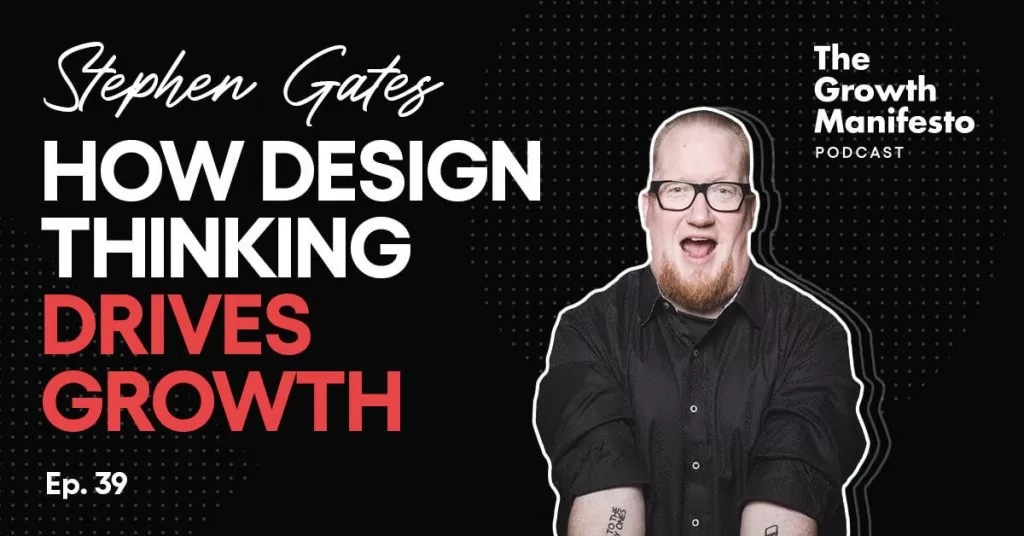
This episode is a discussion with Stephen Gates – Head Design Evangelist at Invision, Host of The Crazy One podcast, international keynote speaker and a leading authority in Human Centred Design, where we talk about how design thinking can drive business growth.
Key takeaways
- Design maturity, tested across 12 dimensions in a 2,200-company study, found 83 percent of firms sit in the middle to bottom of the curve.
- High-maturity design teams ship products that earn about four times more revenue, cost five times less to make and reach market six times faster.
- Great design is a visual expression of great thinking, so skipping the research and insight work makes even polished output fail to have impact.
- InVision has run 100 percent remote since founding in 2011, and even sceptical studies show remote work is about 20 percent more efficient.
- Hiring for creative roles should test self-awareness, asking how someone has an idea and what they need to be happy, not just their portfolio.
Chapters
About the guest
Transcript
Auto-generated from the episode audio, so expect the odd mis-heard word. Timestamps open the video at that point.
If you start 100% remote, that is vastly different than we all used to being in an office, and now we've been forced into being remote. I think that for me, the areas that I will often start with them are probably not the traditional areas that people would think because I can see two different teams. They have the same tools, the same processes. They hire the same people. One is wildly successful. The other one's a low-grade dumpster fire. For me, it's that ability to look at issues around trust, issues around communication, issues around how are people empowered? How are we taking on these cultural barriers that exist inside of every company?
How are we bringing transparency to that? Because I think in many cases, that's often what separates the higher performing teams from the rest is their ability to be transparent, to trust each other, and to really be there not only for themselves, but other people as well. You're listening to the Growth Manifesto podcast, a Zoom video series brought to you by Web Profits, a digital growth consultancy that helps global and national businesses attract, acquire and retain customers through digital marketing. This episode is a discussion with Stephen Gates, head design evangelist at InVision, host of the Crazy One podcast,
international keynote speaker, and the leading authority in human-centered design, where we talk about how design thinking can drive business growth. So let's get into it. All right. So today we're talking with Stephen Gates, who's the head design evangelist at Envision, host of the Crazy One podcast, keynote speaker, human-centered design leader. He's been leading in-house teams and agency teams. He's built multiple Fortune 100 brands
and he's worked with some of the world's most innovative companies like Apple, like Google, like Nike, like Airbnb, like Amazon. He's won more awards than I can actually say. He's won over 150 awards. He's been featured in hundreds of publications around the world. Like I prepared to create a pretty good intro. This was a really hard intro. You've done a lot, a lot, a lot of stuff. But before we get into that, everyone, please just subscribe and say that you get the
latest episodes as soon as they're released. But Stephen, welcome. Welcome. Thanks for having me. I think if it makes you feel any better, I used to look at my portfolio and see all the mistakes and feel like I have just as much imposter syndrome as everybody else. But yeah, I've been lucky to do some cool stuff throughout my career. Yeah. And that imposter syndrome, because I just had Seth Godin on the podcast and he says that is a key part of being creative. You cannot be creative without having that imposter syndrome. There's something connected with that. So I
figured let's start with creativity and design. How do you define creativity and then how do you define design? It's a great question. And I think this is something I talk about a lot because for me, great design is a visual expression of great thinking. And I think that as you look at a lot of the career coaching I do, a lot of the teams I work with, even in my own career, a lot of it has been based in creativity, which means the ability to have ideas, to solve problems in a different way, to be able to go through and to do some of those things about how do we think and approach
things, design then being whatever form and shape that takes, whether it's an app of video, like sort of whatever that is. And then in many cases, as you look at teams, as you look at careers, the ones who are able to base that in creativity and be able to do something new, who can wrangle that imposter syndrome that every single person has. And Seth is completely right. I think that's where you're going to find value with whatever people think is success or sort of whatever that is. And then design is often, like I said, is the ability and it's important,
but it often is valued and looked at differently. Yeah, because it's like the creative side of it is like the madman. It's like, hmm, this is the idea. And then the design is all of the people that have to make that idea just look good. Is that like a good way to explain it or is that a bad way to explain it? And feel free, correct me if I'm wrong. I mean, for me, like madman is always sort of a bit of a caricature of sort of creativity. So I think it's a reference a lot of people use. Here's the thing that I would say, right, is that I think everybody, everybody, I don't care who you are, is creative.
And that's one of the things that I love is like I work with companies like Fisher Price. If you go in and talk to a bunch of a room full of kindergartners, everybody's a painter, everybody's a singer, everybody's a superhero. Like they are very free in that creativity. And it's only through time, education, our careers, society that, you know, those of us who sort of do this for a living are kind of the kids that survived. and and i think that in many cases you know so everybody is creative just a lot of us forgot design is the design is that execution that does take a skill set there's usually a fairly high
wall to be able to get into it so i think you know that's like that's been my long-standing joke is like if you ever want to scale design if you want to have it be a bigger part of your company don't ever use the word design because i think a lot of people feel alienated by it i always do an icebreaker like it's a simple thing to see in people i have everybody turn to the person next to them and spend two minutes sketching them. The first word that everybody says after they do that is I'm sorry. And again, that's just, that's not what this is. Yeah, sure. You mentioned the word crazy a lot. You've got the crazy one podcast,
your approach to design. You mentioned the word crazy. What do you mean by crazy when you talk about design and creativity? What I mean by crazy, and so for me, the podcast that I've had of the crazy one over the last four and a half years has really been an outshoot of my own career and what I see in a lot of other people that I think for too many of us, we seem to feel like there's this invisible script or there's a right way to do this. There's a right way to create. There's a right way to have this career. There's a certain set of steps you're supposed to take.
And my thing is like for creatives, the way that we are, the way that we have a career, the way that we work never looks like anybody else. So I think we all tend to sit in this perpetual state of feeling like we don't measure up, of feeling like we aren't doing it the right way, of feeling like these sort of things. Crazy to me was a way to be able to sort of claim and see that difference and that uniqueness as power, not as a weakness. Because as a creative, your unique perspective, your unique experience and skills, that's what makes you great. That's
what sets you apart from everybody else. But I think for too many people, they see that as, oh, I'm not like everybody else. So I'm not doing it right. So I think that's what for me is it's been just sort of trying to embrace that mentality because I think for most creatives, that's their biggest struggle is just making peace with themselves. I get it. And then, but then how does that now start to fit into business? Because I, because I know that you talk about design and its influence on business, right?
And then you've got this crazy approach. So maybe let's start with like, how do you believe that design influences business? So, yeah, so I mean, I'll say for that, I mean, for me, there's a difference between crazy and stupid. So for me, I think like, you know, craziest data informed, crazy is thoughtful, crazy is not abandoned and reckless. I think though that for me, in many cases, And again, as we go back to the word that we use, I think that, you know, design often struggles to have an impact on business whenever it's design is just being seen as execution.
I think creativity can have one of the most profound impacts on business there are out there right now. I think for a lot of teams, as they talk about collaboration, teamwork, innovation, agile, like whatever that is, in many cases, that is a hunt for creativity and, again, reminding people how they do it. So, you know, for me, I think it's an outcome and an approach. So I think that's the thing that I've seen over the course of my career is going into companies and be able to remind people of that. We would ship seven times more product in the first year than we did the past seven years.
Like at Citi, we won digital bank of the year within 18 months of taking that approach. I can tell you the teams that are high in sort of a creative IQ, they can ship product about four times faster, five times cheaper. Their companies are worth about 26 times more. It's not voodoo. It's just a more human-centered approach to doing things that in often cases requires a recalibration around collaboration and how do we work with our customers. And what do you mean by human-centered? What I mean by human-centered is it's interesting because I think for a lot of companies, what kills their creativity, what kills their business is in many cases, there is sort of an internal war over who's right.
design right is technology right is engineering right or executives right like who's right when the end of the day your customer doesn't give a damn about any of that so i think that for me what it what it really is is it's a recalibration to remember that we are designing for people that have needs that too many times whenever we convince ourselves that this is what a customer wants without actually talking to them this is why we launch stuff that people don't want and we don't get the business impact and we there's there are a few too many companies who i work with when they ask me sort of what their superpower is, my answer is their ability to rationalize mediocrity.
They talk themselves into why their customers want this stuff without actually working with them. So for me, it's human-centered in that there are real people and the real people in the way that we work come together, trust each other and work internally, but then also how do we work with our customers? And how do you figure out what the customers want? You go talk to them. How many do you talk to? Like, do you know what I mean? matter. Well, so for me, that's always been a huge part of my work is trying to break my ideas. I don't want to go do research to validate what I think. I want to go do research to see
if what I'm doing actually works. Now, who I talk to probably tends to be a little bit different because I believe in, I want to talk to amateurs and professionals. I think there's sort of this myth that I want to go talk to the average consumer. The average consumer to me yields average insights. I want to go talk to beginners, somebody who has never done what I'm designing for because there's a lot of truth in how naive they are. And then I want to talk to professionals. I want to talk to somebody who does this all the time. So if I'm designing a chef's knife, I want to talk to somebody who's never cooked and a professional chef because there's on the one
and that naiveness is going to give me insights. And then the professional is going to do that. So again, I think trying to take your ideas to those extremes yields much better results. so do you have the idea first and then you're going out to clarify or to confirm or do you go out without any idea and try to kind of identify it through the discussions yeah so i mean my my approach has always sort of been a traditional design thinking design sprint whatever sort of methodology is if i want to go out and just find out what are the facts right like what is so for
me whenever i worked at start hotels instead of staying in corporate housing i lived in a hotel for 364 days. Like I wanted to live in and actually see what was going on. Out of that, you find the insight, the unmet need. What's that thing that people want? Maybe they know it, maybe they don't. Then let's go have a bunch of ideas and then let's go test those. Because again, I think whatever you say, here's the one idea, you tend to look for validation as opposed to, again, sort of opportunity. How many ideas would you say is a good place to start
to test, you know? I would say probably no. For me, it's that sort of, depending on what it is, two to four at the most. Because anything over three or four is just, you're just shotgunning and hoping. And I think, again, if I've done the facts and done some insights, I should be able to narrow it down to something a little bit smaller. But for me, that's what I'm looking for is to be able to say, okay, look, is the insight right? And if the insight's right, then how do we start to do the execution? If the execution's right, then how do I start to do the design? so it's a rolling iterative process where that way I'm sure at each step I'm validating what
I'm doing and I'm building on it so when you talk about design you're not just talking about and sorry to say this like um because I'm not a designer so I'm probably not going to be using the right words about the photoshop part right about the part where it's just the visual that's almost the last part which comes together it's that first part it's that product design 100% Right. And that's why I said, I think that that to me is design as an executional piece, which is we've done all this work, we've done all this thinking, and this is the, we just give it
shape and form. Because for me, that's why I said, right. Great design is a visual expression of great thinking. So if I haven't done the work, if I haven't done the thinking, it doesn't matter how pretty it is. It's not going to have an impact. So, you know, for me, it really is doing all the work that leads up to, and I think that's the problem is that everybody likes the outcome. That's what everybody wants to go for is like, what does it look like? And I think in many cases, as the more modern creative, your job in many cases, I think, is just trying to keep people open to possibility.
Yeah. And so you've got product strategy and you also have then the UX and then you had the design, right? Like, are they the three parts or are there like additional parts in that process? I think in many cases for me, this is when sort of visual design has become product design. That it used to be, like you said, we would just come together and we design something we like and we put it out there. I mean, for me now in an organization, it's working with the engineering team. It's working with product. It's working with executives. It's working with research and strategy.
It's with and these are all making, quote unquote, design decisions. So I think in many cases, it also each one can't function on its own because, you know, that's that thing. like, you know, design without engineering is an art gallery and engineering without design is a parking lot. And so sort of, we, we, we, we sort of need, we need each other to be able to do these things. And so that's where, for me, a lot of that collaboration and teamwork, but, but for me, it also very much is that like design is no longer a department. And, and, but I think also for me, it is, it's talking about it more as creativity and how do we all come together to be a part of
that and solve it. That's where the magic happens. That's interesting because it, it seems like, you would be treading on a lot of toes. Like, and so you'd come in as a head of design and now all of a sudden, you're messing with product, messing with marketing, you're messing with sales. You're just with strategy. Like you're just now having to kind of influence a lot of departments around you. Yeah. And I think, you know, as certain people have said, like I'm into good trouble,
but I think, you know, for me, what I'm trying to do is I'm just trying to find the source of truth. And I think for a lot of the teams that I coach, for a lot of the teams that I've led, it's just about, great, let's take those requirements. Let's take that product strategy. Let's do those things. And let's actually see if that's what people want. Because to me, that reality is going to happen at some point. And all I want to do is facilitate the conversation and see how do we come to the best idea, the best insight. And because for me, like I said, this is not about who's right, but how do we actually have real conversations
and find some source of truth in the work that we're doing that is not based in who has the biggest title or who has the biggest org. So now we're talking about the design maturity of an organization, right? And so there are some organizations that are extremely high and there are the majority that are extremely low. Could you just explain the difference between? Yeah, so two and a half years ago when I joined Envision, it really was based out of, out of my public speaking,
out of talking to a lot of my friends and things like that, seeing that I'd never seen more organizations that wanted creativity. They wanted design. They wanted probably, I would argue that we haven't seen since the last industrial revolution, yet there was so much frustration. There was so much like, how do we know what to do next? So whenever I got to envision had worked with some, a number of amazing collaborators. And what we said was basically, how do we determine the maturity of an organization? As we look at their creativity and design, what are the different dimensions that we could use to decide which are the ones that are doing it really well and which are the ones that struggle?
So the initial model, we came up with 12 different dimensions that we look at and that out of that, we can look at where does an organization sit on a sort of a five-tiered scale of one is often to what you said. Teams are just sort of told to make it pretty or the again, everybody's sort of doing what an executive says up into level five, which is going to be very mature. that sort of creative approach is central to the business. And this tends to be indicative of all the companies that we love. So out of that came a maturity model. And we had gone out then and done
what was the world's largest study of this, where we talked to 2,200 different companies all over the world. And out of that, the results that we found were sort of what we suspected is that 83% of the world's companies are in the middle to the bottom of that maturity curve. So we have an incredible opportunity, incredible desire for innovation, yet there is something that is sort of keeping that from happening and that how do we do that? And then the model helps us to be able to go in, do the evaluation, and then create a roadmap about what are the things we need to work on to start moving that team or that company up that maturity curve.
And what are some of those things? It's all sorts of things. I think, you know, one is that in a lot of cases that the bottom sort of one through three is just how do teams define success? How do they do research? How do they, you know, instead of just taking whatever everybody gives them and making the best of it, how do we institute process? How do we institute KPIs and metrics? How do we start to put measurement and collaboration and those sort of things in place? And then with some of the higher
ones, then it really just becomes about, again, what is the institutional impact of executive behavior, of working on feedback, of looking at, you know, how are we workshopping ideas and doing different things like that. It's always a little bit different because you can't take an organization of any size and say, okay, look, you're one maturity level, you're one score. But usually in general, we're able to sort of start to identify what are those things or behaviors that are going to start to be able to lay the framework for them to start to build that sort of creative muscle and maturity. And so the more mature a company is in their design approach, the more sales they make,
more revenue the faster the product gets shipped there are significant advantages oh yeah no i think of thinking well yeah i think because that's the thing that we've definitely seen is that because in many cases we'll sort of get people are sort of like hey what's the impact of design how do we you know quantify what that is and and it's sort of what we've been talking about that it is both an approach and an outcome so an approach and how do we bring people together an outcome in what design is. But no, on average, what we've seen with this data is as you look at
high maturity teams versus low maturity teams, the projects that go out the door make about four times more money because they're actually connected to what consumers want. Since there isn't the endless back and forth, they're able to do it about five times cheaper that their ability to get it to market because they're doing that and they're sure what it is they're doing is about six times faster. And the valuation of those companies on average is about 26 times higher because of all, again, if I can do it and make more money and do it more cheaply and do it faster, the valuation tends to then follow that. So if the leadership of a company
is into this process, that's where the best results are going to come through. Like it's better kind of having a top-down approach than having the bottom up. I think, you know, for most of the time when we see the most success, there is an executive sponsor, godfather, godmother, somebody who's going to be able to say, look, I'm going to give this the support, the cover fire, or the whatever it is to be able to let us do some of these things to prove this value, to be able to try this out, that we're going to get
over these sort of antiquated thinking of this is going to take longer, and it's going to be more difficult. And we're going to, and so again, I think that in many cases is where we see when we're able to come in and institute that with that sort of support, that's where transformation works. And that in many cases, when it's grassroots, whenever it's, you know, a little bit more, you know, it concentrates a little bit more on sort of a way a company behaves as opposed to the way they think. That's why 75% of transformation work fails is because again, we aren't empowering everybody in doing those sorts of actions to let it really come to life. Is this why Apple is so
successful because they started off with both engineering and the art at the same time like steve steve wozniak and steve jobs or is this just like a cliche um yeah i mean i get asked about that just because of the work i've done with that i mean look here here's here's what i would say is i think the differentiator with apple or nike or a lot of those big companies. I think one is there is a genuine dedication to how do we put out the best product
and to really look and to really mean what that is. I think organizationally, they really trust their people. Again, they aren't hiring different people. They aren't doing different things. I think they have pushed the power down through those organizations to empower those teams to be able to make decisions, to invest in that. Again, people all the time are like, we want to be like Spotify. It's like, that's great. But you know, any team in Spotify can do a test on up to a million consumers without asking anybody. So again,
I think that investment to, to trusting people, to creativity, and that what it is they say they do is sort of not a tagline. Like if you go to Apple and you talk to people and they talk about changing the world, that that's a genuine goal. That's not just sort of like, gee, that would be nice to be able to say. Yeah. And so I'm just trying to get my head around it, right? Because the context of this whole discussion, it's like, so when you talk about product design, is that also like service design? Is that also, it's the design of what you deliver to a client
for what they spend? Yeah. And so I think, you know, for me, this is why for a lot of the work that I've done, I try to base it in a design methodology, whether it's design thinking or design sprints or where we have the freedom in a framework. Because I think at its core, you can use design thinking or that design approach for anything. I think I can use it to construct an org. I can use it to design an app. I think one of the best moments, so when I was at Citi, we had scaled our design thinking practice from zero to all 300,000 people in the firm. And one of the best moments was walking into a conference room on a floor that
was not mine, that was occupied by a team that wasn't mine. And in design thinking, there's a famous statement called a how might we that you use to launch a brainstorm well there on the whiteboard was written how might we have a great baby shower so again they'd even seen the value the value had transcended work and so that that's the thing is that it's it's more of what is the approach that we can use to solve whatever the problem is that's in front of us that's super thank you um thank you for explaining that i'm i'm learning right now this is no it's part of the podcast as well because i get to learn yeah no and that's that's literally why i have the oddly
you know, enigmatic title of design evangelist, because I think you're certainly not alone. I think one on the design side, we haven't done ourselves any favors in trying to make this accessible. But I think also, again, in trying to say, okay, look, that this is inclusive, this is this sort of thing. And hey, if we can just sort of open up to it, again, this is why my job literally exists. So let's talk about that job. What does that job actually mean? You're a head design evangelist at envision right which has over seven million users um and since march this
year you acquired well like before march it was at five million and now it's at seven so you're quite two million so we'll get to that in a second but what does head design event yeah head design evangelist that's right like i thought it got wrong but what does that mean well yeah i know it sounds dangerously like something out of that hbo documentary series silicon valley where it's like, what does that mean? What it really is, is just, it's this conversation. This is what the job is, is that about 70 or 80% of my time is coming in as a teacher, a coach, a therapist,
an interventionist to sort of work with brands of all sizes and all maturities to help them figure out this very conversation. We say we want design. We say we want to be more creative. What does that look like? How do we actually get that done? What is the approach we should do? And I think that takes a lot of different forms in how I do that. But it really is just coming in and saying that for a lot of companies, they need a third party or that sort of consultant who can come in and I think oftentimes say the things that might be politically suicidal for somebody to say internally, to be able to say, look, this is what's going on.
and to be able to bring in something like the design maturity model where we can then benchmark and base this in data to have that conversation. So that's really what I do is to come in and just to help companies figure out how to be more creative and innovative and sort of embrace design. Okay. And what's interesting, because I was doing a lot of research on this one here is 100% of the Fortune 100 are on the app. Right. Why? what is it about this app that i like because that's a pretty good stat like i mean that would
be like in headlines and stuff you know but like yeah no no there's a lot of ceos that have you know our app on all their phones and those sort of things because i think that you know the reason why is again as you talk about what is it that those teams are doing different or higher maturity teams are doing differently i think that ability where it's not let's have an idea let's design it and let's launch it. Now it's let's find some insights. Let's prototype a bunch of ideas. Let's see what works. Let's refine those. Let's kind of do it some more. And we need a single central source of truth
as we do that. So I think our tools range from a virtual whiteboard, which since COVID everybody loves, is that ability to put up to several hundred people into a virtual whiteboard. Everybody gets their own marker. We can sort of all get in there and work. The ability to prototype ideas, to design, to be able to help our engineers sort of bring that to life. And that's what I said, is I think that was what we tapped into was just that want of how do we find something we all can put in our hands and relate to and work with and
to make that creative process accessible to everybody. So Envisions, and forgive me for the wrong example, but it's like Google Docs, but for design, like where you can collaborate, like in a document, you can collaborate through the design process. Is that because I'm trying to make it. I think, you know, you're headed in the right direction. Yeah. So I think, you know, the tools can take a bunch of different forms and sort of like, you know, a Google Doc or anything else. You can use it a lot of different ways. But it is it's about how do we get to primarily cloud based collaborative tools to help with
the design process, sort of like a design operating system inside of a company where we can come in and be able to say, great, if everybody needs to come together and do a brainstorm, here's a whiteboard. If you want to collect a bunch of assets to do a mood board, here's another tool for that. If you want to build a prototype or design something and that the ecosystem that we have is all interconnected. So that then again, everybody can access and it's a single source of truth because often that those tooling can get very fragmented, which can make it hard to be able to kind of, again, point people to one place where they can figure out what's going on.
so you feel the gap almost like but in this approach to design thinking and integrating that across a company and what envision does is that it kind of connects like all of the stakeholders like in a company is that right and it's kind of before you open um the photoshop software so it's at the thinking stage it's like a thinking app kind of thing and i would yeah i I would say sort of to our conversation, as we had sort of talked about, you need an approach
and a methodology that's going to bring people together and allow them to be able to brainstorm. That sort of allows you to get people to the table on how to do the approach. Our tools then allow that to actually come to life. So if you have different teams in different places in the world, if you, again, now if people are just even in the same city, but in different places, that ability to come together, to collaborate, to build, to prototype, to do those sort of things, and then be able to have it in sort of one place makes it as a much easier communication tool, because I think that's what these companies have tapped into is that often their systems are fragmented, their
teams are fragmented, and that ability to say, okay, great, here's one way that we can work, I think often, again, really provides them with something that they've really been wanting. Yeah, so we use InVision app, but only for one part of the process. And so now, like, as part of this process of actually conducting the research, I was like, wow, Envision does a lot more than just the feedback on some designs and some other parts. So it may have started that way, like a fair few years ago, but it seems to have expanded pretty quickly in the last two years in terms of the
features. No, it definitely has. And I think even for us, as recently as last week, Freehand, which was that whiteboarding tool, I think a lot of it for us is even using these as platforms for different companies to be able to now show off how do they use the tools. So, you know, we launched a bunch of templates and this is everybody from like American Express to Xbox to KPMG to IBM, where they're sort of coming through and now they're sharing, hey, look, these are the templates we use. This is the way that we work. So again, I think, you know, that ability for them to be able to see, you know, that there's a lot of different ways to be able to use it. Because again, I think
that's the part of any creative process is you can do it a lot of different ways, which is, I think both the strength and the challenge in sometimes in tools like that. Yeah. There's so many places that I want to take this conversation right now. Let's talk about those larger companies, but what's an example of how they would be using this to push product faster? Yeah, I think, you know, what we see is, and for a lot of the companies we work with, I think what they're able to do is to be able to get those insights, get those ideas for whatever
it is, apps, websites, whatever that is, and to be able to quickly get them into a prototype and get them in front of consumers. So if you look at what's been going on with COVID, there's a lot of different companies where their ability to say, okay, look, what is curbside delivery going to look like? What is in-store pickup going to look like? What are we? And so the ability to quickly get this into testing and be able to quickly see what works and then the ability to then, great, go ahead, design it, code it, launch it. That way to be able to do that, to be able to move with speed, but also certainty. Because that often is the balance of, hey, we have this idea, but if we're not able to prototype it and test it, then in many cases, we're sort of hoping that that's going to work.
And I think, you know, that's a lot of the advice that we work on, like hope is just not a strategy. And so when you say test it, like, is that with customers? Is that through focus groups? Is that, how do you mean test it? I think for a lot of teams, it means tested with customers. Now that can be online testing. There's a lot of different portals. It can be going into the store. It can be. But I think in many cases, it is about how do we get this into the hands of real consumers to see, does it work? How do they work with it? I think this is where this whole prototyping piece becomes really critical because even
as a designer, somebody, you know, you can say, did this work? Yes or no. If it took somebody five minutes to make it work, it didn't really work, right? So I think that ability to watch, how do people use it? Could we be better? Can we try different variations? And again, those ideas can come from anywhere. But that fluidity and that sort of, you know, agile way of being able to work makes a really big difference. Yeah. Okay. And you acquired 2 million new customers in the last six months. How? Like, what were some of the things that happened that kind of just led to that?
I think one has just sort of been the natural growth that we've been on of more companies really wanting to figure out how do they make design a bigger part of what it is they do. I think obviously, you know, there's been a big push because of COVID and things like that of into online tooling of how do we as we're all separate come together to run a brainstorm or do a workshop or design something or. So, again, I think there's a lot of those. And I think we've seen a real compression in remote work in this sort of style of collaboration and that sort of digital nomad kind of approach to things.
There's been a real compression that's been happening. And so, again, there's just been a big uptake and a big interest in the tools that we had because this was sort of the workflow that we've always been building towards. Yeah, right. Let's talk about remote work because you guys also won the overall remote tech company of the year. We did. Well, so it's been interesting. So as a company, we were founded in 2011. and the entire company which is i mean the number varies every day somewhere around seven or eight
hundred people is has been a hundred percent remote since we were founded and it's been 700 to 800 people have been a hundred percent remote since you started yes just like how hard is it for people to even consider right now and it's just for the listeners to manage 10 people remotely you got seven to 800 people that's that's impressive and and i think you know the last few months have been interesting because so I've been with the company just somewhere over two and a half years. And so for the first, you know, whatever it was, year and three quarters, two
years, you're sort of a bit of a sideshow oddity where it's sort of like, oh, wow, that's interesting. You guys can do that. And then obviously COVID hit and everybody had to do that. And it was sort of like, wait, wait, wait, wait, wait, can you come in and come talk to us about this? So I think it absolutely requires a different way of working, a different way of onboarding, a different way of hiring. But I think, you know, for us and other companies, it is really proven. And again, I think a lot of other companies have been forced to see that, you know, even the most skeptical studies will show you that remote work is about 20% more efficient than being in an office. But so yeah,
we have obviously huge teams. All of these teams have been 100% remote since we started. Got a few questions there. There always are. No worries. um what's the difference in how the team actually works like like in being remote i think i think i think you have to be more deliberate because in many cases i think this is what a lot of companies have discovered was as they went from being in person to being fully remote two two big things really happened i think one is in that shift a lot of the organizational
sin got exposed which was really the things that we could overcome by running into each other in the hallway and issues that we probably longstanding issues around leadership, trust, tooling, process, those sort of things came to the surface because we didn't have the shared context of we can smooth over those cracks by being in person. And I think the other one is just that you need to deal with people and relate to them differently. And so a lot of it for us is really just being more deliberate in how you work in simple
things. Like whenever you start a meeting, you don't jump right into business. You actually want to talk to somebody that, you know, you want to think about how do you use your tools differently with it? For us, Slack isn't just for work. There's a water cooler channel. If you want to talk about cars or games or dogs or kids or other things like that, how do you form a community? How do we make time for each other? And, you know, again, there's a great little bot that we have called Donut. And just Donut every week randomly introduces you to a new person and sets up a virtual coffee. So I think that there is a little bit of sort of needing to be more deliberate because I
think as everyone has experienced over the last few months, it is very easy to suffer in silence. It's very easy to feel disconnected whenever you can turn on a webcam and put on a good performance for 30 or 60 minutes and feel fairly disconnected. So you have to lead differently. You have to empower empathy and create sort of different connections. But then again, you have to create more spaces for that to happen. And so, you know, for us, you know, most of the time for a lot of other companies, my onboarding was somebody gave me a laptop and said, good luck. For us, it's two weeks of about 50 hours of onboarding of being able to get to know those sort of things, right?
Like it's just, it's a very different sort of approach. And I think that's where a lot of teams are struggling is they're sort of carrying the in-person legacy thinking into remote. So what are the, some of the things that with onboarding, because obviously like, you know, you go through the whole process, you interview hundreds of people, you shortlist, you shortlist further. you do some final checks and then someone starts and then you screw up the onboarding and then the whole experience is gone. And then all that work is for naught, right? Like how, like, but what are some like good approaches to onboarding remotely?
Right. I think that for us, the first week is just, how do you do this? How do you work remotely? What does that look like? How do you set up your own space? What is it that we value in the way that we work? Just very basic, no matter, irregardless to sort of what your position is, what does this look like? What are healthy habits? What are good ways of interacting? Again, you know that whenever you do this, when you start the day and end the day, starts to blur a little bit. Let's talk about that. We know that this concept of like,
I would wake up in the morning and have personal time and commute to an office, have work time, commute back home. Well, that tends to get put into a blender. So let's talk about that. Right. So I think there's just some of the basic human aspects of that. And then the next week is, okay, great. Now let's talk about and be able to train for what does your position look like? So what are those, what are the expectations of the team? How do we communicate? How do we start to have somebody where you can shadow? How do we do those sorts of things? So you can start to onboard and get up to speed because that's what you said is this is not a, hey, I'm going to go run into somebody in the lunchroom sort of thing. So again,
we need to be more deliberate in that approach. You've got a lot of good content in there. I'm trying to keep it concise. I've got so many pathways I want to take it, but let's, let's continue to keep it concise, concise enough. Leading teams now, right? Remotely is I think a challenge for every leader these days, especially because, especially for like a lot of the companies that work online, they're all essentially pretty much everybody I know is working from home at least 50% of the
time right and it's now optional to go into an office if you have to go at all right as a leader how do you lead a team remotely because it's different when they're in the office because you can see them you can yeah it's different but how do you do it remotely no 100% and because I think you when you're in the office you have the benefit of seeing somebody's body language the way they interact, sort of dropping by their desk and doing things like that. I think we see a large variety, but I think a lot of the cases for me, with the leaders that I work with, it's much more
around issues of trust. A lot of leaders are sort of just inundating their teams with calendars and sort of this fear of missing out. And so that ability of saying, okay, look, let's be clear about when do we have a meeting? How do we work asynchronously? Even simple things about how do you communicate? Whenever I send you an email or a text or a Slack, what does that mean? If I text you, is that the bat phone and you need me to call me right now or do I get back to you today? So I think one is just doing the foundational things. But a lot of it is sort of what I said before about empowering trust, about having real conversations with the team. Some of the best
practices we see of doing things like having anxiety parties, just getting people together and saying, look, what are you stressed about? What is not working? How do we get real feedback on what that is. Even if I don't have the answer, let's get together and let's talk about that to be able to make sure that, again, we're caring for people as people, as being able to really feel like there's a connection for them. Some teams I know do. So just quickly, it's an anxiety party. That sounds like every party I've gone to. Yeah. Unintentionally, I think that's been every
meeting for the last seven or eight months has been an unintentional anxiety party. Okay. yeah but i think that a lot of that leadership is how do we set you know traditionally what leadership has done of setting a responsibility and the accountability that comes with it but making sure that you know we're being proactive in what those channels are making sure that we're being proactive in reaching out and understanding that you know the need to create psychologically safe places to be able to make places where people can raise their hand and say look i'm not 100 today to be able to trust them to be able to sort of do that work and
that that open communication, I think those are going to be that sort of risk-taking, that sort of vulnerability is a lot of the new leadership currency. And I think as a byproduct, the teams that don't want to lean into that are finding out this is not something that we're experiencing as a company or an industry, that this is something that's happening globally. And if there are companies that are investing in that sort of leadership and coaching and doing those things, your talent will go to those places that support them that way. And so I think that ability to be able to blend that sort of hands-on with servant leadership to be able to say, okay, look, how do I give you that freedom in a framework where you know what it is we want, but I'm going to trust you to do it in a way that's going to work for you.
And how do you build teams that produce or how do you create those high performance teams remotely? And so the first part is the environment. And that's what we just spoke about. Now it's about the work. Right. And there's this big discussion on work is better when you're in the same office because you can talk with each other and there's the bouncing of ideas and all the energy. We don't really have that option now. But yeah, how do you ensure that high performance work?
Yeah. And I think part of what it is for me is sort of calling out what we're going through with COVID is remote in a different form. Because I think for us, remote used to be work from anywhere, not work from home. And that we did. Once a quarter, we used to get, once a year, the entire company would get together because we valued building relationships in person. And the next quarter, your team would get together, next quarter, your division, next quarter, your team. So that allowed us to be able to balance some part of that in person, right? And now that's been taken away. But for me around the work is that it really is, it's about, again, going back to
investing in trust, honesty, transparency. Because again, as we talk about the teams at Nike or Apple or Google or whatever it is, there is a real level of almost brutality in the way that they will talk to each other and how honest they are with each other and the way that they share with each other what it is they really think. It's not in service of politics or some internal agenda, but it's in service of the best idea. And so in many cases, that ability to figure out for your team and that size, how much of it is we need to come together and do a brainstorm, How much of it is individual work?
What are the standards that we're going to hold ourselves to? What's the behaviors that we want to create about what is our mental approach to the work that we do? Again, I think one of the things that we do, and I encourage with a lot of other companies is one of the things around that is whenever you start to work here, you get seven little business cards. And these have all of our company values on them. And that what this allows you to do is to be able to, whenever somebody is working in that way, is doing the high performing, is doing that, you can hold up that card and call them out on it. but it also gives you the ability to be empowered that if that's not happening,
every single member of the team is empowered to be able to push for that work to be better. And I think that that does become a big part of remote and that high performing work is that every person on the team needs to know that they are empowered to be a part of that process. They are empowered to support the good, but also to push back on the things where we said, look, this isn't the way we said we're going to work. Yeah, right. Sounds complex. it sounds like there's a lot of changes that a lot of organizations are going to have to make
to operate this way from the old way of working. Not for InVision that started that way, but it seems like there is a big shift for lots of organizations, you know? And so is there any advice to them, you know, which is the majority at the moment? Well, no, I think this, this has been the last six or eight months of my life has been working with these companies that are going through that because you're 100% right, right? If you start 100% remote, that is vastly different than we all used to being in an office. And now we've been forced into being remote. I think that
for me, you know, the areas that I will often start with them are probably not the traditional areas that people would think because I can see two different teams, they have the same tools, the same processes, they hire the same people, one is wildly successful. The other one's a low grade dumpster fire. For me, it's that ability to look at issues around trust, issues around communication issues around how are people empowered? How are we taking on these cultural barriers that exist inside of every company? How are we bringing transparency to that? Because I think in many cases, that's often what separates the higher performing teams from the rest is their
ability to be transparent, to trust each other and to really be there not only for themselves, but other people as well. And how do you build that transparency? Like, is it Zoom calls with just, you know, Slack updates or, you know, like, is there an approach? Is there something to think about? Yeah. And I think the challenge is every company, every, and again, I've worked with so many different ones. Every company is dysfunctional. They all have their unique sort of flavor of what
that is. I think it's just, it really is. How do we connect with what is actually going on? Not what do we think is going on? What do we think the customer journey is? What's really going on with that. And then how do we have, I think, the transparency to recognize it and then the accountability to start to put things in place to action against trying to fix it? There's not going to be a magic bullet. There's not an easy way to be able to do it. But I think, again, that ability to say, look, these are the things that we need to improve and these are the things we're going to do. This is how we're going to measure it. And these are the standards we're going to hold
ourselves to. Because I think a lot of apathy around that or fear or whatever it is often happens whenever we're aware of what the problems are, but we don't know how they're being fixed or we've tried it and it didn't feel like it was really being measured. So again, I think it can take a lot of different forms, but in many cases, that ability to sort of identify what it is, say, this is what we're going to do, and then be transparent about what the process is and ask everybody to sort of be a part of the process, that usually is a really good start. Okay. Okay.
That's my last question on remote. I've got one more question because I just have to ask, and then we'll go into the quickfire questions, which is questions that we'll just go through really quickly. Oh, makes sense. Quickfire. You've won over 150 major design awards. Yeah. What's your approach? What's your approach? Not going into a project, trying to win a design award. Look, at the end of the day, I think I didn't do any of the work that I did to try to win an award, right? Like it was great that
it happened. It was great that we've been able to do what we did. I think a lot of it for me was going in and saying, look, you know, how do we create something that we feel like solves a real unmet need? How do we be able to work together to bring it to life in a way that that's going to really be the, to what our vision is. And then how do we continue to iterate on that? And because then I think you're creating experiences, you're creating work, you're creating impact that gets noticed. And that I think for too many people, it's sort of like, look, you know, if you start a podcast, cause you want to be famous, that's a great recipe to never be famous. I think you have
to have an opinion. You have to be able to have a perspective. You have to have a value proposition. And so I think, you know, for me that the awards have always been a nice by-product and have been, I think, a testament to the quality of the work. But I think that those were the things that we sort of worried about after the work was done. And what's interesting about that is that through this podcast um today it seems that that thinking that that it starts at the very beginning at the
research state at the questioning like questioning everything and ensuring it's human-centered design which means that the visual parts last but the design awards oftentimes they put forward their visual right no and and i think that's where for me i you know i think with this role and other things like that, try to counter that perspective because that's why I said at the beginning that great design is a visual expression of great thinking. That's always been the foundation of my work. And I think of a lot of great design work is it solves a need you didn't know you have.
There's an elegant solution that, something very simple takes a huge amount of work, but it really is. Because I think if you've done the homework, you've done the research, you've done, and that's why I said, for me, I'm always a human-centered, data-informed creative because it very much really is about doing those sort of things of being able to think it through. Because then when we do that, the actual design, the execution is just all of that thinking brought to life. And then that's why it tends to win awards is because the details have been thought out. There's nothing that is superfluous in there that we've looked at every little detail and every little
part of it. And so then that's where the design really feels like it means something and does something. That's awesome. That's awesome. That's good stuff. I'm very inspired at the moment. Quickfire questions. I've got five quick questions for you. Number one, what book has had the biggest impact on your success? Oh, there's one called Orbiting the Giant Hairball, which I think it's a, I think the subtitle is like a Corporate Fool's Guide to Surviving with Grace and Dignity or something. It was by Gordon McKenzie, who has since passed away. That's one I tend to go back to a lot. I
think that was the first one that sort of looked at the intersection between design and creativity and corporate culture. So I go back to that one a lot. Scott Belsky's making ideas happen. There's a whole litany of those, but I think that orbiting the giant hairball tends to be the one I go back to the most. And great headline too. Number two, what's your number one piece of advice for hiring awesome people? Ooh. I think really understanding, I mean, for me, it's really been going in and understanding two things.
Because the two questions that I'll often ask in the hiring process, one is, can you tell me how you have an idea? Which is basically I'm looking at what is their level of self-awareness to how do they actually go about their work? And the other one which trips up a lot of people is, can you tell me what you need to be happy? Which is that I'm looking for a level of emotional self-awareness and have they thought about what they want out of their career. So again, I think in starting with that, because in a lot of cases for me, similar to the design conversation, the world is full of people that can make pretty pictures. I'm interested in people that can think, that can pivot, that have some level of self-awareness
and ambition. And that tends to be more of what I'm interested in. That's great. I haven't heard those two before either. I'm going to start using them too. They're really hard to answer. No, they are. And there are people I've had who have come back two and three days later and said, I've not slept because I don't know the answers to those. And I think for me, there's not a right answer. What I'm just simply trying to gauge is a level of self-awareness. And are they even aware that these are, that creativity and things like that are things that cannot be left to happenstance because that, that's sort of like creativity without results is called art and that's not
what we do. Yeah. And that's a whole nother podcast. What's your best management or productivity tip? Your best time management or productivity tip? I think that for me, it really is about sort of going into every week with a pretty clear sense of what are the two or three things that matter? What are the two or three things that I really need to get done? Because in many cases, I'll often describe for a lot of managers, they tend to get like 40 lanes wide and a quarter mile long where they're doing a lot, not very well. And I think if you're able to go in there with that clarity, it doesn't mean you might not have to pivot, but the things that are going to support
those things you need to get done, the things that are going to support moving those bigger things forward, those are the things that you're going to need to focus on, make time for, do whatever it is. And the rest either need to be put off, delegated, thought about differently, do something so that you're actually having an impact. You're there for the team. You're doing whatever those sort of things are. And then I think in leaders, too many times it's easy to get too diluted or to, again, have an incredibly busy 60-hour week and get to the end of it and realize you haven't had the impact that you wanted. Yeah, that's great. What's the best piece of
business advice that you've ever received? Probably that a leader is just someone who is willing to be the most confident, uncertain person. The most confident, uncertain person. What does that mean? Because I think that for a lot of business, for a lot of if you want to create an impact, leadership in many cases is about taking a lot of data, a lot of different inputs and saying, generally, I think this is what we need to do. I don't think there's anything of 100% certainty in what goes into that. But I think your willingness to be able to create
direction, to be able to create belief, to be able to create alignment in what it is we're going to do will drive business results. And then in many cases, when you're not able to get it, it's because there's lack of clarity, lack of alignment, too many politics, those sort of things. And that it's just simply the accepting that that often is what leadership is, is that it's going to be the way that Seth Godin said before, everybody has imposter syndrome. leadership has their own version of it as well and so for me that business advice of just sort of embracing it and that in many cases the confidence you want and the outcome you want
is is on the other side of fear stress anxiety and uncertainty yeah right cool um and the last question how do you relax after a crazy day at the office at the home office now for me it's so i think every part of my life tends to be creative for me it's cooking because i think in many cases, I'm dealing with problems that are of a magnitude that they are not solved in a day. And so for me, the ability to be creative, but to start and finish something that I love for people that I love that is creative in the span of anywhere from 20 minutes to two hours is
incredibly therapeutic. And so that ability to be creative, to be expressive, to do it in a different form for me is sort of my go-to. And again, I think in a lot of cases for me, a great bridge into, again, still using up some of that creative energy and sort of bridging into coming out of that work mode. That's super interesting. I've never really approached cooking that way, which is probably why I don't cook that much, but I'm going to use it now. I'm going to try and hack my brain and say it's a creative
process that starts and finishes. Well, I think that's a lot of it for me. And I think that's where my inspiration is I've gone in my career. While I find my peers to be motivating, I don't always find them inspiring. And so for me, I talk to chefs and tattoo artists and street artists and a lot of people where we share kind of the creative condition, but the outputs are different in the same way, you know, every chef gets a tomato, but what they do with it is vastly different. And so, yeah, I think for me, it really has been about embracing that I, you know, working my
creative process doesn't just have to be when I'm sitting here in front of a computer and understanding my process, something, my creativity on demand, that there's a lot of other things that you can do, cooking, studying improv, all kinds of things to be able to sort of work on that. Yeah. Awesome. Steven, if there's one thing that you'd like other people that are listening to this podcast to do, like one place to go, a site or somewhere, what should they do? I would say, look, I'd say if you're interested in the tools that we've talked about, checking those out, you can go to envisionapp.com. I've got about 108 episodes on my podcast talking about
creativity, imposter syndrome, all sorts of different things. You can check that out. Just head over to thecrazyone.com. It's thecrazyandthenumberone.com where you can listen to that. And yeah, if anybody has any questions, if I can be any help with maybe they're going through this and thinking, hey, I'm struggling with that, they can feel free to reach out and I'm happy to work with them or their team. And I can confirm as well. I mean, I did check out a few of the podcast, a few of the videos, a few of the keynotes, pretty inspiring stuff. And you're, you are extremely engaging and very straight up. It's, um, it's like a breath of fresh air,
like in, um, this space, you know, so it's highly recommended. Oh, no, thanks so much. I think that's, I think that's sort of my goal with the crazy one and things like that is that that reaction isn't the exception to the rule anymore. Yeah. That that level of honesty and transparency and our ability to share what we're all going through that to me is what that crazy one is, is that ability to not do what I think too many of us fall victim to where we look at social media and feel like we don't measure up. And when you compare your insides to everybody else's outsides, it's comparison that usually leaves you feeling
wanting and insecure. Yeah. That's a super point to finish on. Stephen, thank you so much for coming on the podcast. This has been such a great conversation. Everyone is listening, subscribe, check out those links that he just said and we'll talk soon thanks Stephen sure thing thanks so much for having me see you