How Super Coffee went from $0 to $400m valuation in 5 years
Jimmy DeCicco explains how he and his brothers built Super Coffee from a college dorm room to a $400 million valuation through in-store sampling and celebrity investors.
 with Jimmy DeCicco


Overview
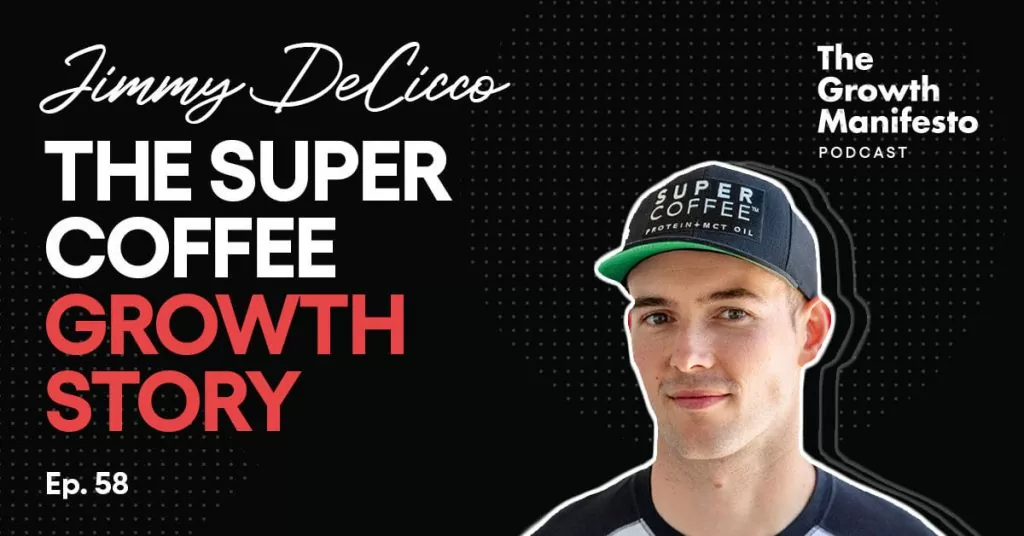
This episode is with Jimmy DeCicco – CEO and co-founder of Super Coffee, which launched in 2015 and is now in 40,000 stores across the US, the brand has become the fastest growing private company in food and beverage and is the 3rd most popular ready-to-drink coffee in America after Starbucks and Dunkin Doughnuts, and its revenue grew 106% to $55m in 2020, helping it reach a $400m valuation. In this episode we talk about how to launch and scale up a beverage brand.
Key takeaways
- Super Coffee's founders refused to leave a Whole Foods store until their product became the best-selling bottled coffee there.
- After Shark Tank aired without a deal in 2018, Super Coffee still raised $15 million in December at a $50 million valuation.
- Revenue grew from $4 million in 2018 to $26 million in 2019, funded by expanding distribution city by city across the US.
- Celebrity investors like Patrick Schwarzenegger take stock options tied to performance rather than cash, which keeps their promotion authentic.
- Rough, unpolished iPhone footage outperforms highly produced content in Super Coffee's Facebook ads because it feels more relatable.
Chapters
- Intro: how Super Coffee began
- Jordan's dorm room coffee idea
- Winning the first Whole Foods store
- Landing the Shark Tank opportunity
- Raising the Series A round
- Building an omni-channel e-commerce business
- Celebrity investors over cash endorsements
- Overcoming imposter syndrome and scaling
- What's next: Series C and expansion
About the guest
Jimmy DeCicco
Jimmy DeCicco is CEO and co-founder of Super Coffee, which launched in 2015 and is now in 40,000 stores across the US, has become the fastest growing private company in food and beverage, is the 3rd most popular ready-to-drink coffee in America after Starbucks and Dunkin Doughnuts, and grew revenue 106 percent to $55m in 2020, helping it reach a $400m valuation.
Transcript
Auto-generated from the episode audio, so expect the odd mis-heard word. Timestamps open the video at that point.
And before long, he said, wow, this is a problem that goes well beyond me and my campus. I can't be a full-time student athlete and share this solution with the world. So he called me and our middle brother, Jake, and said, fellas, I'm dropping out of school to sell coffee. And that's how we got started. There he is behind me trying to play hoops. You're listening to the Growth Manifesto podcast, where we host in-depth interviews with business leaders, authors, industry experts, and entrepreneurs with a singular focus around business growth. At the end of each podcast, we want you to walk away inspired, to think bigger, and to have actionable takeaways you can apply to improve your business.
Each episode is like a masterclass on a key topic, so make sure to browse the episodes to find the topics that are most relevant to your biggest business challenges today. This podcast is brought to you by Web Profits, a digital growth consultancy that helps challenge your brands drive growth in a complex and fragmented digital landscape. You can find out more about Web Profits at webprofits.io. Now, let's get into it. Today, we're talking with Jimmy DeCicco, CEO and co-founder of Super Coffee, which launched
in 2015 and is now in 40,000 stores across the US. The brand has become the fastest growing private company within the food and beverage space and is the third most popular ready to drink coffee within the US. That's after Starbucks and Dunkin' Donuts, which we've all heard about. And its revenue grew 106% to $55 million 2020, helping it reach a $400 million valuation. This is from 2015. So today we'll be talking about how to launch and scale up a beverage brand.
And just quickly before we get started, make sure to go ahead and hit that subscribe button so you get the latest episodes as soon as they're released. And let's get into it. Welcome, Jimmy. Alex, thanks for having me, man. I'm happy to be here. Yeah, I'm super excited about this story because there's not many people that go from their dorm room to 400 million valuation in about five years. So, and to crack the beverage space, you know, it's a big one. So like this podcast, like I really want to try to understand exactly your journey, challenges, the things that work, the things that didn't work. And we'll have a
conversation in between. Cool. Cool. That's good. So let's just start at the very beginning. How did you get the idea for super coffee? So admittedly, it wasn't my idea. I'm the oldest with three brothers and I started super coffee with my two younger brothers. We all played sports in college. Our youngest brother, Jordan was playing basketball. He's a starting point guard, a full scholarship player, uh, his freshman year. And he was falling asleep in class. You know, he didn't, he didn't want to drink the sugary Starbucks Frappuccino that had 40 grams of sugar and 300 calories. Uh, so he started brewing his own coffee really for himself, just cause he was
tired. You know, he was, he was focused on basketball. He was locked in as a student athlete. He had no ambitions or aspirations to start a company, but this coffee that he brewed for himself that had the protein, the healthy fat, zero sugar, it worked so well for him that he started selling it to his teammates and his classmates and his coaches. And before long, he said, wow, this is a problem that goes well beyond me and my campus. I can't be a full-time student athlete and share this solution with the world. So he called me and our middle brother, Jake, and said, fellas, I'm dropping out of school to sell coffee. And that's how we got started.
there he is behind me trying to play hoops. How many were being sold before he thought, let's start this as a company? But what kind of volume are we talking about in the beginning, just when you got the idea like, hey, this could be a business? Yeah. So at first he was like, he didn't want to make money from his friends, but it was expensive to make with the protein and the coffee. He bought a couple of blenders. So he was just charging people his costs. But that turned into like 500 bucks a week, then $1,000 a week,
which for a college student, that's a lot of money. So yeah, I mean, it must have been several hundred bottles per week. And then that's when he said, hey, let's see if we can get this into commerce. So how do you produce several hundred bottles a week from a dorm room? Like what's like a quick, like the quick kind of setup for something like that. That sounds like a bit of a production line. Literally exactly what you think. So it was, it was blenders that you buy any target or grocery store.
So we had blenders. He would brew the coffee. So he'd have a hot pot of coffee, dump it in. And then we ordered these bottles from China and we'd fill them up and we'd cap them. And then we'd stick like a sticky label on them from, from FedEx or something like this. And that's, that's what we were selling. So it was a lot of manual labor. And then once we got into our first store, we showed up to a Whole Foods market in Washington, D.C., right near Georgetown's campus. And we said, hey, we're super coffee and you guys don't carry anything like this. And the store manager tried it. He said, hey, this is pretty good. Bring your bring your fellow student athletes up to my store to shop and I'll give your product a shot.
So just like that, we get into one Whole Foods and we didn't leave that store. We poured samples at that store every day until we became the best selling bottled coffee. And that's when we realized we'd need some type of culinary kitchen, some larger facilities rather than just a blender in the dorm room. Yeah, sure. I mean, let's just I mean, this is going to be a very quick story for the listeners, right? Because you've done a lot of things since that point. Right. So I'm going to try and move quickly through the story, but still tell the story. Right. So totally. You went to Whole Foods. Right. So why did you choose Whole Foods and kind of how did you get them to say yes to you?
Yeah. So this was before Amazon owned Whole Foods. You know, this was towards the end of 2015. And every region, Whole Foods splits up the U.S. into 11 different regions. It's a it's a very like they sort of each region has its own local program where they bring in like farmers market goods, local purveyors of different items. So we we pitched into that local program. We got a hold of the right store manager and he gave us a shot. And then you could go store by store. So we took the data from that first store that we went to,
and we brought it to the store down the street and said, hey, we're the best-selling bottle of coffee at your store up the street. You guys should bring it in here. So that's what we did. We went store by store. We wouldn't leave an existing store until we were the best-selling coffee. And then we'd move on to the next one. And by the end of that first year, we had a pretty good data story saying like, hey, in these 20 stores in the greater Washington DC area, we're the best-selling bottle of coffee. And now if you invest in super coffee with your capital, we can take that from DC to Baltimore to Philadelphia. And that's really what we did. We went city by city. Okay. And I won't get to that point, but just quickly, just,
just for the story, because I'm super interested is most people will go to Whole Foods and they'll get their product on the shelves. Right. And so they'll get a chance, but that wasn't enough for you guys. You guys wanted to really make it the best-selling product within the store. What kind of things did you do for that first store to really make it sell? Yeah. So we learned early on, and this fundamental belief still holds true to this day, is that our jobs begin once our product gets on the shelf.
A lot of brands think that they can have a good product or good packaging, good branding, and it'll sell itself. It's just not the case. There's so much noise in today's world. There's so many promotions and advertisements and things like that, that we really need it. it's a lot of hard work. You know, it's good old fashioned elbow grease where we would show up and it's a game. It's like a real estate game of space. You know, there's a limited, there's a limited real estate within a cooler that holds all the beverages. So we wanted as much space in that cooler as we can. And that space is earned. So the best selling products have the most space
because it makes the most money for the store. So we figured that out early on. And we're like, wow, let's pump up these numbers by showing up every day to pour samples for customers, educate them on the flavors, teach them about the story. You know, and back then the product wasn't very good, you know, it was clumpy and didn't taste great, but people love the hustle. They love the story. So they supported local business. And the best part about it was we were collecting real-time feedback from real people. And we turned that feedback into product innovations and renovations. Yeah. And so the store owner just let you just kind of have a store there.
Is that what happened? Was that like, how did you kind of just pour samples? Like, you know what I mean? Like I'm trying to get into your headspace because like a lot of people have tried to launch the beverage brands before, but not many have kind of achieved traction. And I believe it's like in those first few things that you did that kind of started the ball rolling. Right. And so I'm just trying to understand how did you get him to say yes to samples? So he didn't always say yes. Sometimes we had to ask for forgiveness instead of permission.
But it was it was really just a sampling table, you know. and it's, it's good for them because it provides value to the customers. It's a free sample. So it's kind of like Costco, you know, how Costco always has the tasting boots and things like that. So whole foods used to do that a ton, especially, I mean, this was long before COVID. And it was, they encouraged it because during a, during a sampling event for any product sales, every brand would see a big sales spike because people were buying what they were tasting. And then for us, it's like, if they gave us two feet on a shelf, we would take four feet, you know? And if he told
us we could sample for two hours, we would sample for four hours, you know, and it was just one of those things where it's like, oh, sorry, we got lost track of time. You know, we were passionate about it and it wasn't easy. You know, it's a lot to set up a table and bring in your product and clean up and do it all the right way. But we knew that that was the only way we had because we didn't have money to advertise. So, but we did have was time and three guys to show up and work hard. And how long did it take you to make that first store successful until you moved on to the second store? So we, we broke that store's weekly sales record in the first four hours. And I mean,
we called everybody we knew in DC, we had every sports team coming through there. So, I mean, the numbers were off the charts that first week, but I don't think we moved to the second store until two weeks later. The first store was on Georgetown's campus. And then the second store was on George Washington's campus. So two universities, we kind of made them rivals against each other. Oh, good. So strategy was already kind of at the very, very start. And so two weeks is quick. And so then you went from the one store to 10 stores. And then like, how did you scale production to 10 stores? Totally. So, uh, we, once we were in that
first store, like it wasn't feasible because we were selling a couple of hundred bottles a day. At that point, it wasn't feasible to just do it in blenders. So we, uh, there was a domino sugar factory up in Baltimore and they actually had a bottling line in the back that they didn't use. which is ironic because our products are sugar-free. But the manager was like, yeah, come on in. And just my last shift ends at 8 p.m. And my first shift gets in at 6 a.m. You guys can work here all night, just clean up and be out by 6 a.m. So we would basically lease this equipment from some guy and we'd produce, I mean, it was still a grind.
You know, we were working just like, it was probably a hundred gallon kettle versus a little blender that we had in the dorm room. Yeah, sure. And so, I mean, you must've been having a lot of your super coffee across those nights and mornings. I mean, how many hours did you sleep in those first couple of years? Oh man. So on, on nights where we had production, we would, we would produce until two or three in the morning. And then at four or five in the morning, we would, we'd basically roll the dice and whatever brother drew the short stick would make deliveries. So one of us was going from production, taking that product to eight to 10 whole foods the
next day. So, uh, but I mean, it's all we had, you know, it was like the no jobs, no families, like obviously mom and dad love us and support us, but like no wives or mortgages or anything like that. Yeah. Sure. And so was that the, the main, um, promotion channel or the distribution channel like in the first 18 months or so, like, was that the strategy? That was it. That was everything we had. So 18 months and we, we leased a little van from Nissan, a delivery van, a white one, and we put our branding on the outside of that. So we would
drive that all around DC and Maryland and Virginia, uh, making deliveries, but then we'd pour samples. We didn't even do things like street fairs or festivals. Like our belief was our, our impact needed to be really close to the point of sale, basically where we could hand it to somebody and they'd check it out with their eggs, their bread, their groceries. Cause that like a farmer's market or a 5k or a local street festival, you're banking on that person to remember your product and then buy it the next time they're in a store. The conversion rate is a lot lower than when you're actually in the store. Yeah, sure. And then, so when did you kind of have the shark tank opportunity?
Because you went from all these stores in Whole Foods and then you went on Shark Tank, you know, so how did like, what happened between those two points and kind of, how did you get that Shark Tank opportunity? Yeah. So the, it all stemmed from this Whole Foods sort of hustle that we had in the early days where everybody we'd meet was like, oh, the story is so good. you guys are so cute. Like you should go on shark tank. And we would roll our eyes and smile, like politely. And like, we looked at it. Shark tank was 40,000 companies applied every year for
a hundred spots. So for us, I mean, we were so damn busy making product and making deliveries that like, that just felt like a gamble, you know, and a distraction, if you will. And then 18 months in, we, uh, I saw on LinkedIn, some second degree connection commented on somebody else's page and said like, Hey, my friend's a producer for shark tank. They're looking for companies had nothing to do with us. But I slid in there and I DM the guy. I was like, Hey, this is who I am. We're super coffee. My brothers and I started this. And the next day I was on the phone with the producer. So it's basically like our application was at the top of the list. And then our episode of
Shark Tank aired in February of 2018. Yeah. And, you know, I mean, I love to hear your version of the experience, but I've spoken to a few people that have been on a Shark Tank and they say that kind of outside of like the investment or not the the exposure the exposure is the game changer so i'd love to hear like your experience of it yeah yeah so i mean we actually needed the money right like we were raising money you actually need the cash too yeah yeah we needed the cash so we were out there not desperate to get a deal but we wanted a deal and the guest shark on
our episode was a gentleman named rohan oza rohan was the chief marketing officer at vitamin water Yeah, because I was just doing some research beforehand because that was the big story that I heard about. I think they sold, was it $4 billion? $4 billion. $4 billion to Coca-Cola? That's right. This is back in 2006. Okay, cool. So he was on the show. He was on the show, exactly. And he's done it time and time again. He was an early investor in BAI, BAI sold to Dr. Pepper for $1.7 billion. So like Rohan is the guy in beverage.
And like we were sort of myopically focused on him. You know, like Mark Cuban's cool. Barbara. They're all, they're all cool. But we're like, we want Rohan. Um, the, the disadvantage that we had was we filmed our episode at 7.00 AM on a Saturday morning and that the sharks were going to record all day long. There was like maybe a dozen other companies after us. So we were Rohan's first episode ever. So I think he was a little nervous, a little star struck, maybe didn't want to come out of the gate strong and do a deal. Uh, but it was, I mean, after the show aired, we didn't even get an offer from any of the sharks. Like they thought the valuation was too
high. Rohan liked the taste, but he was conflicted in a couple other beverage brands. Um, so didn't get an offer. We felt disappointed. You know, we felt like we just lost the national championship on, on television. Uh, but the, the, I mean, people didn't care about what happened. They just were excited that they saw us on shark tank. You know, so we were hanging at signs and grocery stores. We were building even bigger displays. Now, like we would go to all the store managers at this point, we're probably in, I don't know, maybe a thousand or 2000 grocery stores. And we would say, Hey, we were just on shark tank. All of your customers are looking for us. We need
better placement, right? We need, we need the end caps and cooler displays. And they gave it to us, you know, and, and, uh, it really helped blow up the brand from that point. So I guess, long story short, shark tank is what you make it, you know, cause some people will see it the night that it airs, but like for us, I mean, we're, we're humble and like embarrassing when it, when it comes to talking about accolades, we were not shy saying we went on shark tank. You guys got it. You guys got to put us out there, you know? So we, we definitely leveraged that. I mean, it sounds like you guys are not shy with the hustle, right? Like you're happy to go to, to, to find the area
that you believe is that's the spot. If we can make that part work, then everything else can work. And so, yeah, you're shy, except when the stakes are really high, when the stakes are high, it sounds like you guys are kind of, you don't mind, you know, just going that extra step and asking for things which you may feel a bit shy to ask sometimes, right? Totally. Totally. No. And I think that's the, uh, the athletes in us, you know, like we grew up sports was such a big part of our identity. Both mom and dad played sports in college. And I remember our mom would drop us
off to school and kindergarten. And she would say, boys go kick today's ass. And we'd be like, yes, mommy, we will. So that's just the mentality, you know, and we're always polite about it. We like our mantra at super coffee is work hard and be nice to people, but we're not ashamed or we're not afraid to work hard, you know? And if that pisses some people off and I'm sorry. Yeah, nah, that's fine. And don't worry about those people that are pisses off. It's fine. It's all good. So then you, you needed the money. You didn't get the money off shark tank, but you got massive exposure.
And so how did you then kind of scale the company from there? Because obviously you still need the money. So what was your strategy then to get the money? Yeah. So our episode of Shark Tank aired in February and we were asking for a million dollars for 10% of the company, right? So we put a $10 million valuation on the business. Later that year in December of 2018, we raised $15 million at a 50 million post money valuation. So once Shark Tank aired, we got some inbound from different investors, but we were sort like we had enough cash in the bank to really jump, push up sales.
So Shark Tank helped with that. And you started to see massive growth month over month, year over year, right? Just following the shark tank exposure, which brought us, it exposed us to a different level of institutional investors. Cause up until this point, it was just friends and family. Like we didn't have, we didn't really have, like, we don't come from money. So mom and dad couldn't invest. And like, we would meet people pouring, like as we were pouring samples at Whole Foods, some, one guy was like, I'm a lawyer. How can I help you? It's like, well, do you have any wealthy clients who would look like to invest in a coffee company? That's literally how we raised our first money from angel investors.
But now Shark Tank sort of exposed us to a wider, broader audience. And then we brought on our first institutional capital. We raised our Series A in December of 2018. And that $15 million really fueled our growth from $4 million in sales in 2018 to $26 million in sales in 2019. And at that point, that story of us being the best-selling coffee in one store, two stores, three stores, became best-selling bottle of coffee in DC, Philadelphia, New York City, the entire Northeast. And we were able to spin that narrative that like, hey, Mr. Investor, if you invest in us,
we'll take this to the East or to the West Coast and become the best-selling bottle of coffee over there. So it was really the same strategy from that very first store, just at scale. And so what did you learn about the raising finance process? Yeah, because it's Series A, a series B, you have celebrity investors like Jennifer Lopez, Alex Rodriguez, and Patrick Schwarzenegger, right? So can you just talk through, I mean, there's so many questions I have, but let's just start off by what's the big lesson that you've learned from
the fundraising process? So there isn't any one way to raise money, right? I think that's the biggest lesson I've learned, right? That the right way is the way that works. And I think a lot of us psych ourselves out. I certainly did. When you go in with an expectation of like, oh, this is how it has to be done. Or this is how like you raise your series seed and then your series A and then your series B. And like, there's a process and term sheets and all this stuff. We, what we did was very unconventional, you know, raising money sort of as we went from different angels who we'd meet along the way, um, strike like doing convertible note rounds in between equity rounds. I think
there's a lot of right ways to do it. Uh, and, and I think that was one of, one of the biggest lessons. The other thing too, is like, there's no formula for, for how to value a business. Your company is worth whatever an investor is willing to pay for it. And I think some people who are more persuasive than others, maybe Adam Newman at WeWork can get a higher valuation than some people who are a bit more, a bit more grounded. Right. But it was, it was interesting that like the valuation is whatever somebody is willing to pay. There's no multiple, there's no formula to calculate what your company's worth. What did you use the Series A for? What was that
first big chunk of cash that came into the company? Like, damn, okay, cool. We got like 15 mil now, roughly. We should spend it some to scale. How did you invest the first investment? Yeah. So when we closed that round, we had 15 full-time employees. And then a year after that, we had 50. So we hired 35 new people with that funding and we scaled, we were basically just available in the Northeast from Washington, DC to Boston. We scaled down South to Florida, West to, we started to launch in Texas and Chicago, and then all the way out to the West
coast. So it was really national expansion. And what fuels that growth, I mean, anytime you launch a new grocery store, whether it's like a Walmart or a target or a whole foods, they're slotting fees. So there's a pay to play in the US. You actually have to invest to get on the shelf. So a lot of those are upfront one-time fees that that funding went to. Distributors have all kinds of incentives. There's billbacks and promotion. So a lot of it was just getting product on shelf and then incentivizing shoppers and distributors to buy more of it. And so you wanted to really make that first investment successful, right? Because that's
a series A and you wanted to go to series B and obviously to show the investors that, hey, like we might be young but we're going to make this work right and so how did you like what was some of the things that you did to really make sure that you know that investment was going to be successful yeah because obviously like it's easy to pay fees you know here here here here right it's easy to spend money right and everyone that has a business actually knows that right but it's it's harder to take that and actually have that return exactly what you think it's going to
return. So what were some of the things that you did to really make sure that that investment performed? Yeah. And it goes back to our roots. We weren't afraid to work hard. We poured more samples. We taught our teams how to pour samples. We sort of multiplied our efforts through our partners. And with that, we also do what you say you're going to do. So with that $15 million, we said, we're going to do $25 million in sales next year up from the $4 million that we did this year. And we ended up doing 26 million, but we don't talk about. So that was where the emphasis
was is like, Hey, we, we beat, we did what we told you we were going to do. We ended up having to raise another 5 million in the summer of 2019. So really just six months after we closed our, our, our series a. And so we ended up spending 20 to get to 26 instead of spending 15 to get to 25. But the story was, Hey, we beat 25, right? Yeah. People sort of ignored the bottom line. So, I mean, we sort of did what we said we were going to do, at least on the top line. And it's okay, right? Because we're in a growth business. Nobody's valuing us on our EBITDA multiple or our profitability.
They want to see how many customers we can acquire, how sticky they are, how much share can we steal from the competition. So we definitely, we're not afraid to overinvest in that stuff. And going from 4 million to 26 million is still a pretty good feat. And what's interesting is that you maintained the strategy, which you started off in that first Whole Foods store. pour samples, talk to people, care, listen, you know, the feedback loops. Like it's really, it's really interesting like to hear it because you think, well, if I had 15 mil, I would do everything different. But actually you're just doing the same thing at scale,
you know, the same thing that's working at scale. And so when did you start to kind of expand out the distribution channels, like the promotional tactics, like the e-commerce store, You know, so at what point did you start to say, hey, you know, we need to have these other streams of revenue as well? Yeah. So the year we did $4 million to 2018, a million of that was online. And a lot of that, we knew we were going to go on Shark Tank that year. So we made sure that the Amazon listings were up and ready and inventory was stocked on our website.
So like that was really the catalyst for launching our online business. and even today, e-commerce is still 20% of our overall revenue. And what we learned along the way is that the business truly is omni-channel, where when we're in stores pouring samples, those customers, sure, they might buy a bottle from us that day, but they might go subscribe on Amazon, right? And vice versa. Somebody might see our Facebook ad and then go buy it in their local grocery store. So that's, I would say 2019, the year we did 25 million,
5 million of which, or 26 million, 5 million of that was online. And we were spending probably a million dollars on Facebook ads that year. But that was the year we realized that, hey, Facebook ads aren't just performance. There's not just direct attribution here to the online conversions. People are seeing this stuff and then they're buying it in stores as well. Yeah. And it's really hard to track what people see and what people think because they've seen the ad so many times with all the different versions and all the messaging. And so all we do is we track last click conversion, sometimes first click conversions, but it's really hard to
go all the way sometimes to go, well, they saw the ad 28 times across the platform, right? But you spent a million dollars on Facebook ads, and then I'm sure you probably would have spent just more last year since the sales were at like 55 mil. Yep. But what do you find works best for your company from a Facebook ads promotional strategy perspective? Yeah. So it's, it's funny. It's, it's sort of the opposite of what you'd think, like the highly, the highly produced edited content. That's actually very well done performs the worst for us. And what
we found is like people, people relate to, uh, the common folks. So like we would, we like crappy iPhone user-generated content. That's kind of like blurry and not that great that does the best. The other, the other thing is like our, our bottles, uh, aren't see-through. You can't see the liquid inside the bottles. So showing what's inside, making it appetizing, this healthy indulgence has performed pretty well too. Keto was big in 2018, 2019. That was a hot buzzword for us.
I think we've since moved away from that as it's cooling off. We're now like, this tastes like a Starbucks Frappuccino and it's good for you. It's that mass market. So it sounds like in the beginning, you were focusing on more health conscious consumers, right? Like more kind of the athlete crowds and stuff like that. Right. And so the first thing, is that true? Yeah, absolutely. Kind of like the target in the beginning were athletes and kind of health conscious people. Yeah. And that was the low hanging fruit, right? That was the message. This is, this is coffee enhanced with medium
chain triglycerides. It helps support your ketosis. You know, it was very technical, but what we've quickly realized is like, most people aren't very technical, you know? So we, totally moved away from that. Our product still provides all of that stuff, but we don't talk about biohacking or anything anymore. We say this is 299. It's sweet like a Frappuccino. It's 80 calories and it's zero sugar. Yeah. And what's so good about that is that, you know, that's what people are going to buy because people know calories, right? Everyone knows calories, right? But MCT oils and all that type of stuff, which I love, and I'm going to get some of your coffee,
but I don't think it's in Australia yet, is it? Is it in Australia? Not yet. Not yet. And they got to ship it through a post office box or something to taste it. But anyway, but like, it sounds like it's being kind of salt on the simple things, but then there's all these other advanced benefits to the product. Now, how did you that change your strategy in the beginning? Cause it sounds like in the beginning, you'd be leveraging a lot more influences talking about the health benefits and how it kind of tastes and stuff like that.
Like, is that true? Yeah. Yeah. So what's interesting is like you have your target consumer, like the person you're trying to speak to through your messaging, but then you have your consuming target, the people who actually buy your products. And what we learned as we added distribution is the consuming target really doesn't respond to what the messaging is. They truly respond to, they buy what's available. And this is the problem that my brother Jordan saw at his college campus. He's like, why are all my classmates drinking Starbucks Rappuccino? And the answer is it was the only thing that was available. Right. So as we started getting into rural America, Walmarts, gas stations and things like that, people would buy us because we were available.
But that demographic wasn't the health conscious, healthy hustler that we were targeting. You know, they were buying it because it was affordable. It tasted good. It provided them with the benefits. So, yeah, I mean, our message is still targeted. Like anytime you're talking to a target consumer, you want it to be aspirational. Right. You want to find it like the me I want to be. So we still call it that healthy hustler. You know, a lot of people in America have aspirations to be healthier or to be better tomorrow than they are today. And even if they're not, you know, we have plenty of people who are on weight loss journeys
and recovering alcoholics and things like that, that use super coffee. So that was an interesting thing that I've learned over the last couple of years. So it was one of your strategies and, and forgive me because this is the market that's coming out of me now. I thought you were stocked in particular stores in particular areas. Let's say, for example, the Walmart, like in some location, that you would launch some Facebook ads to that area to promote that stock in that store? Like, is that kind of like one of the tactics which you may have used?
Yes, because I went there right away. I was like, let's do this. This is brilliant. You know, we'll geofence an area. We'll drive everybody in there. Exactly. Unfortunately, it's a very expensive way to lose money fast just because there's zero attribution, right? And you don't see, it's not like we tried it in select markets with select stores. And there wasn't even a meaningful lift in sales, you know, so we were just burning cash. But what we do as a tactic sometimes is like, if we're, let's say we have a big presentation coming up at, to get into a grocery chain, we'll, we'll geofence the headquarters of
that grocery chain so that everybody who's in there just sees our ads on their phone and they're like, wow, this brand must be bigger than it seems. Yeah, no, that's awesome. And there's so many applications to Facebook. I just, for all the people that are listening, there's so much which you can do that's really strategic in terms of trying to get the message out that's not maybe the direct sale. Like, I think that's a fantastic example of that. Let's jump quickly now to the celebrity investors because that sounds like a real game changer in terms of attracting funding,
but also promotion. Like it's a combination things, yeah? So how did you get that idea and how did you actually launch it? Yeah. So it's a, it's a good question. And it's been a tactic that's been used for, for years. You know, I think vitamin water was, was one of the first brands who did it with 50 cent and Jennifer Aniston, you know, uh, by did it with, uh, with Justin Timberlake. And then you have Gatorade has all kinds of athletes, you know, Coke and Mountain Dew are doing the same thing now. So we, it's certainly not a novel concept. Um, and for us, like we're not in the business of paying cash endorsements. Like we can't pay,
We can't compete with Coca-Cola when they pay LeBron James to push their new launch. So what we did, we wanted it to be as authentic as possible. Patrick Schwarzenegger is actually our first celebrity investor back in 2018. He saw us on Shark Tank, DMed us on Instagram and said, boys, I love this product. Those sharks are stupid. They missed out. How can I get involved? And so what we did with Patrick was we said, hey, we'd love to get you into the business. We want you to be an owner rather than an endorsed celebrity. please invest in our upcoming round. We'll actually even give you a discount to the round
if you invest now. And then we put together a stock option package for him based on deliverables of service over the next couple of years. And that was a model that worked really well. It's tricky. Doing deals with athletes is tricky because they have so many people trying to protect their time, money, and image, you know, their, their financial advisors, their agents, their, their managers, things like that. And they never want to commit to anything in a contract. So like when you're, when you're doing a marketing services agreement with an athlete, a lot of times they'll say, Hey, can we just promote this at our discretion?
And I'll be like, I mean, I wish, but if I'm going to give you a hundred thousand dollars worth of stock options, we're going to need a little bit more than discretion, you know? And some of them, somebody like Patrick was like, he's certainly over delivered. I think the key is to have somebody who's attracted to your business and authentically uses the product rather than going out and saying like, Hey, I'm a big Tom Brady fan. I want Tom Brady to push this. Tom Brady doesn't like the product. It's just going to be a transaction that everybody sees through. And so it's a combination of, let's say they have
to put in some funds and they also get stock options on performance. Is that right? Yeah, exactly. It's a combination. Right. Those services have a cash value. If somebody's posting on Instagram or making public appearances or shooting a commercial, there's a cash value that comes with that that's based on their previous gigs or the relevance of their celebrity at this point. So we typically apply a cash value to the services. We agree on it with the athlete or their agent, and then we hold them accountable to that. But sometimes it's like, we'll keep the
services light and then hope that they over deliver. And most times they do. It's up to us as owners and entrepreneurs to build those relationships to the point where people want to help us because they like us rather than because they have to. And it seems like it's a fantastic way to get the message out because all of a sudden you have all these celebrities promoting it through their marketing services agreement, right? To get the stock options. But now there's a lot of people that people have heard about talking about this product. And so how has that
helped the growth of the company of Super Coffee? Yeah. Well, so first I think influencers influencers influence other influencers. Right. And it creates this, this, this FOMO, you know, like, right. Yeah. So like, you got to think about it for a second, but like athletes or celebrities, other athletes and celebrities follow them and are friends with them, you know, so they see what Patrick's doing or what JLo's doing or what Alex Rodriguez is doing. And they're like, dang, what's that? You know, and then Alex is pushing it to his friends
and his network, or he's bringing it on the air when he's doing Sunday night baseball, things like that. And it really creates this fear of missing out. So it attracts other athletes and celebrities to the brand. And I think that's more of more of the influence than actually influencing the consumer. Like what's interesting is like the, the, the mega celebrities, like a Jennifer Lopez, she's got 150 million followers on Instagram. She posted drinking super coffee a few weeks ago, and we didn't see, it wasn't even a blip on the radar. You know, it's not like we saw a spike in
sales. There's not like we got new followers or anything like that. But you have to believe that it was good for brand awareness and people were talking about it and looking for it, that type of deal. But it's certainly not performance advertising. And the nice thing about having JLo as an investor is she could have charged us half a million dollars for that post and it would have been the biggest waste of money we've ever spent. That's interesting because I think a lot of brands out there, they want to get the celebrity to do a post because they think if I do one post,
because you probably heard about the Kardashians have done a post and then have sold everything out. But this is a perfect example where it's not that simple. It's never that simple. It's not like, well, if they post all of a sudden I can make a million dollars in sales, right? It's far more complex, but it does sound like the brand equity across all those celebrities is helping the brand. So kind of has, um, what's it called? Um, the brand search increased on Google, like significantly, like since this whole kind of, but the celebrity strategy, uh, launched.
Yeah, it certainly has, but again, not like precipitous spikes. It's, it's sort of compounding and gradual over time, but it's, it's meaningful, you know, and it's not, it's not just based on distribution growth or earned media or things like that. Uh, it's, it's more people searching it. And exactly for that reason, people find folks now on Tik TOK, on Instagram, on Facebook. Um, I do think that celebrities are pretty influential in their, their physical interactions as well, whether they're at the Grammys or at a sporting event or things like that. And, uh, some of our, some of our athletes bring super coffee everywhere just because they're
proud and they want to see it win. That's fantastic. I mean, you have such a good strategy and a good story and the digital things just on the side, but obviously that's 20% of your revenue, but the strategy is in person, is the taste tests, is the celebrity endorsements, is the marketing services with the stock options approach. And so it's a really cool journey and like the valuation is not about 400 mil, like I'm probably wrong. Right. But that's
kind of the latest thing I saw. Like, would you do anything like differently in terms of that strategy? Like if you had to start again, it's, it's tough to say that we would, because everything we've done to this point has led us here. You know, we couldn't have skipped any of the hard lessons. We couldn't have skipped any of the mistakes. You know, I think we could have gotten here. Like if we started super coffee today, there's certain things that we would, we would do differently in terms of where we launch, how we go to market, how we price it, some of the distributors we choose to work with, things like that. And we probably could have scaled it much
faster had we launched today versus back then. But those first two years, that's where we learned the most. Those are the lessons that taught us the business. And even today, I still pour samples on the weekend because that's what works. Yeah. Yeah, sure. And from a personal side of things, right? Because obviously you started this thing when you were 22. Is that right? That's right. Yeah. So now you're 28. Is that right? That's right. If I can do simple math, which is good. Cool. So you've been doing this for six
years, right? Now, I think I started my first company when I was 21, 22, nowhere near to the success of yours, by the way, to be very clear. But like as a younger entrepreneur, you feel like you, you don't like, you're not worthy or something, or like you, it's like the imposter syndrome is like, like a big thing. Right. And so how did you overcome that, that thing? Right. Cause obviously like you have overcome it and you've surpassed most people in the world right
now. Right. But so how did you overcome that in the beginning? So I'm glad that appears obvious because it's certainly, it's certainly not true. Right. Like I still feel imposter syndrome every day. You know, I still feel guilty on days where like, I'm not working as hard as I could be. And in the early days, the only thing we knew was how to work hard. So like, obviously we didn't have the credentials. We didn't have a track record. We didn't have sales data, you know, so it was just hard work. It was showing up. It was exhausting. It was discouraging. There was a lot of times where I was like, why the hell are we doing this? You know, like we're never going to get there.
And I think it's intimidating to really look at the top of the mountain or look at where competitors like Starbucks and Dunkin are and say, geez, we're never going to get there. But what we can do every single day is just take one step at a time. And that's what my brother say is like, how do you move a mountain one stone at a time? So for us, it's just this compounding effort. If you, if you bring that effort to work every single day, six years later, it's going to, it's going to, you're going to build something pretty awesome. And then you get confidence along the way. So I'm certainly more confident today than I was, but now I'm like, dang,
we've got 110 employees. We're valued at nearly half a billion dollars. Like, why am I the one that's running this? You know, like how could I possibly be the person ready to do this? And we, we have, we've surrounded ourselves with great advisors and great coaches. And I think one thing we learned from our executive coach is that that's not unique to us. Everybody at any level of leadership, all of, all of the CEOs that, that our coach coaches feel some level of imposter syndrome. And the other thing that's interesting is they all feel guilty when they're taking time off, you know? And, and I think that's a fascinating like psychology
because it just means that people are putting pressure on themselves to, to be great, you know? And I certainly feel that too. So it's something that I'm working on, you know, I want to be happier in the moment, enjoy this journey rather than like grinding myself. In terms of like the lessons, right. Because obviously like you just spoke about a few lessons, but you know, to go from the three brothers, you know, that are pouring samples, like in a Whole Foods, just hustling and then, you know, trying to work at night to get all the bottling thing from the factory to 110 staff at $55 million in sales, right? That's got to be hard, right? So how did
you try, like, how did you just kind of handle that scale, that recruitment? I mean, you know, so we have like a hundred and something staff as well, but we got there slower than you got there, right? You know, so you're there quick, right? And so how did you manage that speed of recruitment, ensuring there's a good culture, ensuring you got good people, you know, because at that size, it's all about the people, right? And so how did you figure that out? Like, and what have you
learned in terms of that side of things? Yeah. So again, it's not a perfect process. Everything is iterative and you want to get hiring right because it's much more expensive to hire somebody and fire them than it is to spend the right time hiring the right people. What we learned is that ship breaks. At 20 people, the systems break. At 50 people, the systems break. At 100 people, the system breaks. We've learned that throughout the way. We weren't ready for the 100 people when we went from 50 to 100. We had to build those systems. We say all the time, we're building
the ship as it's flying. I think you learn from mistakes pretty quickly. We can start to get intuitive. We, we, we tap some of our investors and, and, uh, our, like our advisors and say like, Hey, what should we expect? You know? And I think now the business is at a point where we can really attract top talent. Um, my brother, Jordan, our youngest brother, he's, he's super passionate about hiring people who are smarter than we are, you know? So we're, we're surrounding ourselves with those folks and everybody brings, uh, some, some new knowledge, some new systems,
some new processes to the business. And that's, what's so great about building a company is it's, it's a reflection of the diverse people that you have within it. And I think for my brothers and I, our number one goal right now is surrounding ourselves with the right people, but also maintaining the culture and the values and not just in a way that's like wall would, right. Like integrity, respect, you know, stuff like that. It's like what leading by example and really articulating and showing what this energy is rather than telling is super helpful in recruiting the right
folks to join this mission with us. Yeah, sure. I mean, and you would have had to learn so much over the last five years, like this to scale of that quick, this would have been intense. Right. And so what would you say was the biggest thing that you learned? You know, so what was the biggest piece of advice which you could pass on to somebody else who's listening right now? That's kind of in their first year, the grinding stuff. There's nothing working yet. it's kind of like, um, you're still kind of having the noodles and the bread, you know what I mean?
Like, like, what would you say to them? I would say first you are qualified to do this, right? There's nothing special about me and my brothers. We were, we were decent students at a lower middle class high school, you know, like we're, we're normal, very normal people. Uh, so I think get that out of your head that like entrepreneurs are uniquely qualified to do something that others can't. I think it's about how long can you stay in there? You know, how gritty are you to do it? And then the second thing that stays true from day one through now, even harder now is people management. It requires a lot of work, a lot of intentional effort, you know, and it's not in a
bad way. I think if somebody is not acting in accordance with your values or where you want them to act or how you want them to act, that just requires conversation and development and work together. So I think one thing that we established early on is this commitment to trust or this commitment to transparency. And it's a culture where everybody provides feedback and accepts it, you know, and that's an uncomfortable thing to overcome, right? The easy thing to do is to say nothing or to talk shit behind somebody's back, which happens at a lot of companies. But for me to say, Alex, man, like I saw the way you showed up in that meeting and you were
distracted, you were on your phone, like next time I'd love you to, for you to be there. One, that's uncomfortable for me to say that to you. And two, you're like, Oh, damn it. Jim's Jim caught me. Like I feel bad now, you know? So like, there's definitely an awkwardness that comes to that, but we've created a culture that where that's acceptable. And it's when you, when you understand that the person providing the feedback is coming from a good place, you sort of accept it as a gift rather than as like a, you don't get defensive, you know, like I think it's, it's natural instinct to defend yourself and say, well, I was on my phone because I had an emergency like fuck you Jim. Yeah. And look, I think it's those kind of, kind of harder, honest conversations
that can really help a culture become stronger. It's like a relationship, right? But it's like relationship with a much bigger family. Right. I prefer not family, but the team, right. You know, everyone's like a team, but still you got to be honest, like, and to communicate. So I think that's a fantastic piece of advice. And just on that point as well, people management is the hardest thing in the world because they're people, right? And they're all different. And there's no like, it's not like that's the way that it happens, right? Like it's not like Facebook ads,
right? Like you're like, okay, cool. So here's a strategy one, strategy two. There's like, it's complicated, right? And as you scale up, you need to learn the people side of things. And so I think that's a fantastic point. What's next for Super Coffee? Because obviously like there's going to be competitors trying to eat your lunch, right? Like, you know, like, um, you guys are doing well right now, but you've got some pretty big competitors that you probably want to sell to, but they're going to try to beat you first. Right. So how are you preparing to kind of
have that battle? You know? Yeah. And so what's next right now, we're, we're raising, raising more capital. We're raising our series C, uh, bringing on another $50 million this summer. It's going well so far, but that's going to fuel growth. And the disadvantage we have right now is we're still laying the distribution foundation, right? Like we're not even in half of the accounts that Starbucks is available in or Dunkin' Donuts is available in. So we're trying to level the playing field by chipping away at just generally where we're available. And what's difficult is all of our resources are dedicated to getting product on shelf
and supporting the product where it's currently distributed versus Starbucks and Dunkin' who all of their resources are focused on the accounts that they've been in for a decade or decades, right? And their efforts are now on repeat purchases and retention and new flavors and discounts and things like that. So we're starting at a bit of a disadvantage there. I think building out the distribution, continuing to win at the account level, the good old fashioned way, there's no substitute for a human being going into a store and building a display or pouring samples and educating customers. So that's where most of the proceeds of this next round are going
to go. And then international white space, like you said, we're not available in Australia yet. we're only available in the continental U S actually, we might have a couple of stores in Australia, which is pretty cool. Or sorry, not Australia, Alaska. I was like, where's the, no, you got me thinking down under Alaska, but nothing in Australia yet. And so I think international expansion is exciting because it's right now it's all white space. You know, China drinks five times more bottled coffee than the U S Japan is a big, ready to drink coffee country. So a lot of opportunity there.
And that's really where we'll go after we establish this beachhead further in the US. And so will you IPO? I don't know. I mean, it's certainly an option. I think we've built a really strong sales and marketing brand. We haven't built a foundational business in the sense that we don't own our own factories. We don't have our own distribution networks. And those two things are really expensive. Those two pieces right there really take a chunk out of our gross margin. Um, so a lot of brands like us, like, like you said about vitamin water are built to sell to a strategic who has those synergies.
Vitamin water is now produced by Coca-Cola and factories for a couple of pennies, you know, and it's distributed, it's distributed on Coca-Cola trucks. So the margin on that thing is damn near 70%. Whereas for us, like we're, we're like in the, in the thirties. Um, so to go public, like we don't get a factory and we don't get trucks. but there are some some interesting case studies of some public companies right now similar in size to us that that are doing really well like celsius energy drink is a good one that that i've referenced quite a bit yeah right and kind of how much is the way that it was
uh the way that it's going to be you know because that old way of like you got to have the factory and all that type of jazz that's not how airbnb did it right now that's not what i'm saying about you guys because it's different because there is product right but you know how much of the old way like is affecting your decision for the future yeah and so it's it's funny is the old way has made it harder for us you know because honestly like when coke spent four billion dollars for vitamin water that was a bad investment they never made that money back
so now ceos of strategics like anheuser-busch and nestle and coca-cola they're under a lot more scrutiny and none of them want to be wrong none of them want to overpay for a brand like us so it's harder for us to get an outsized valuation like that in the private markets versus what's happening in the public markets right now with SPACs and retail trading, things like Robinhood. You know, Robinhood is an interesting thing because for the first time in our lifetimes, we can influence public company valuations just because like the people on Robinhood love Super Coffee.
You know, they know the brand and it's like, dang, I could put $100 into this company. If we get enough of those folks to do it, it's a different game than it was five years ago or even two years ago. it's the reddit warriors right um it's the reddit warriors the reddit warriors yeah like if you can become you know the company on wall street bets which has got its ups and downs uh but that's still super helpful listen jimmy thank you so much for coming on the podcast today man um and thank you for sharing your story it's such a fabulous story it's such an amazing story and it's the story that
they write about in books now it's but it's just the beginning of your story right so i'm extremely kind of aware of that part of it. But for the listeners, if you would want them to take an action to check out a site or to do something, what would you like them to do? First is just work hard and be nice to people. I think we all need to do more of that. And honestly, if you're doing both of those things, you're usually going to be right. It's usually going to work out in your favor. And you can't have just one. If you work hard and you're an asshole, we don't want to work
with you. And if you're nice to people, that's great. But if you don't work hard, you're of little use to us as well. So work hard and be nice to people. And then check us out. We're at drink super coffee on Instagram. We're always posting new, new partnerships, new promotions, discounts, giveaways, that type of thing. Follow along the journey on LinkedIn. I'm just at Jimmy DeSico. So I would love to stay connected with you guys as well. And all the links from the show notes, Jimmy, again, mate, thank you so much. And congratulations on the beginning, right? it's so exciting to see what happens next mate um but yeah uh thanks so much for coming on the
podcast and we'll talk soon alex thanks man when i come to australia we're gonna pour samples together yes please look mate like i can't wait to have some because i want high caffeine and i want low calories and i want all those mctos and all the other stuff that's in them so i'm now disappointed that i can't buy it so you know so hurry up right yes sir coming right up thanks Thank you. Bye. See you. Thanks for listening to the Growth Manifesto podcast. If you enjoyed the episode, please give us a five-star rating on iTunes.
For more episodes, please visit growthmanifesto.com forward slash podcast. And if you need help driving growth for your company, please get in touch with us at webprofits.io.