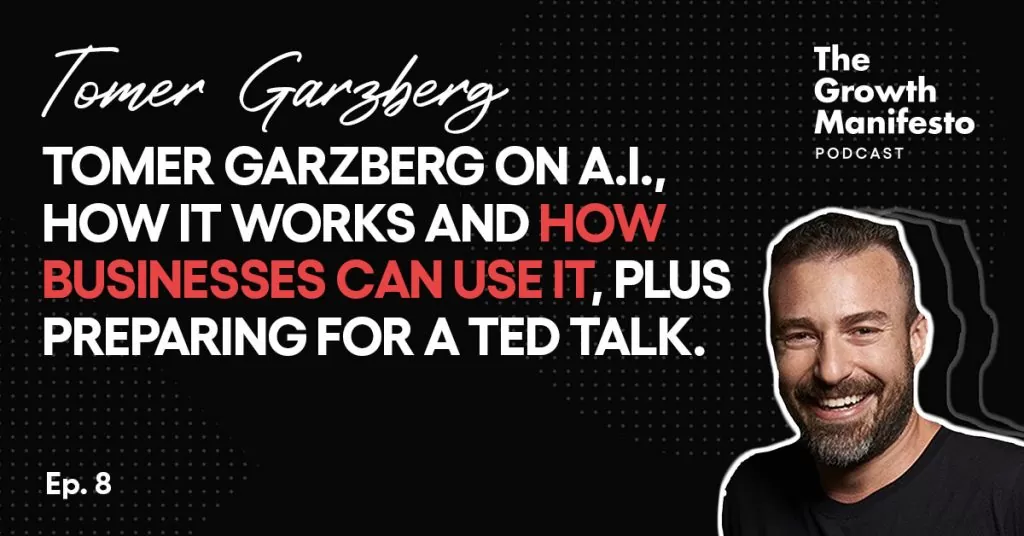
Tomer Garzberg on A.I., how it works and how businesses can use it, plus preparing for a TED talk.
Gronade co-founder Tomer Garzberg explains what AI actually is, why it depends on data, and what preparing his TED talk really took.
 with Tomer Garzberg


Overview
In this episode we interview Tomer Garzberg, CEO & Co-Founder at Gronade – an A.I. solutions company the solves real world problems for data-rich companies. He’s also done a TED talk on data and A.I. for the future of work. In this episode we define A.I., we talk about how it works, we go into how businesses can start using it, and we really take the time to answer all the questions that most businesses have around A.I. Plus we talk a bit about the preparation that goes into a TED talk.
SHOW NOTES
Key takeaways
- Tomer argues that automation replaces individual tasks within a job, not the whole job, so most professions survive AI adoption.
- He says AI is only as good as its data, and machine learning fails outright when an organisation has no usable data set.
- Tomer describes a project where staff rostering data revealed one employee was dragging down team sales performance because of a personal divorce.
- He says any organisation that adopts its first AI or automation tool has a 72 percent chance of adopting a second one quickly.
- Preparing his TED talk took about 120 hours of rewriting and memorising, and coaches could still bar him from the stage.
Chapters
About the guest
Transcript
Auto-generated from the episode audio, so expect the odd mis-heard word. Timestamps open the video at that point.
You're listening to the Growth Manifesto podcast, brought to you by Web Profits, where we share inspiring stories of real people who've succeeded in the marketing and business world. Today, we interview Tamir Garsberg, CEO and co-founder at GrownAid, an AI solutions company that solves real-world problems for data-rich companies. He's also done a TED Talk on data and AI for the future of work. In this episode, we define AI, we talk about how it works, we go into how businesses can start to use it and we really take the time to answer all the questions that most businesses have
around artificial intelligence. Plus, we talk a bit about the preparation that goes into a TED Talk. So, let's get into it. Alex, how are you? I'm good, mate. How are you? Very good. Very good to see you. And Tom Eyre, welcome to the show. Thanks for having me. Very, very welcome. I'm going to start off with you, Alex. Oh, are you? Yeah, I'm excited for you. Okay. Wow. What happened? Now, you're a shy person, but you actually got, Web Profits got a really cool award last night. Oh, okay. Cool. I was wondering where you're going to go with that.
Yeah, yeah, yeah. It's state professional, so I'm very happy. Yeah. Yeah. So, we won the SEM Rush Award for the best B2C campaign for a campaign that we did for Logitech. Oh, well done. So, that was pretty cool. Yeah. Yeah, it was pretty cool. And I had a few drinks. And what was interesting was that there were quite a few people that have been seeing this podcast. And they were like, hey, I really like your content. And I'm like, the podcast? And they're like, no, no, no, the video. And I'm like, oh, the video of the podcast. Yeah. Because that's how people actually will see the content these days.
They don't actually listen to podcasts as much as what you think anymore, especially how we promote it. But I thought that was cool. But I'm excited that other people are actually watching it. Yeah. Like, fair enough. I mean, there's a fair bit of effort going into it. I certainly hope people are going to watch it and give five-star reviews. Now, I've got to be honest with you, Tamir. Tom Air, isn't it? We've had a few amazing guests on this program, and most of the guests, actually all the guests that we've had on board, I get really excited about, and I'm really looking forward to interviewing
and asking a few questions. With you, Tamir, I am so excited. Not so much. I am. No, no, no. I'll be honest with you. I am so, so excited about interviewing you today and having a chat because you've done a TED Talk, and you're into AI, and I'll be honest with you and I'm crapping my pants because I want to know if I'm going to have a job in 10 years and what's AI going to do to me and my profession. So we're going to do a deep dive down in that. So it should be really exciting. Sounds good. But yeah, I mean, like, you know, Alex pretty well,
like you guys go way back. Yeah, pretty far. Yeah, yeah. Yeah, that's how time goes, right? Like all of a sudden, I think I reached out to Tamer seven years ago, six years ago, five, five, five, through LinkedIn, just going, hey, we should catch up and he's like, yeah, cool. We'll catch up because I was looking for somebody to help us with, I think like a specific role here. And I found all of the growth hackers in Sydney and I contacted all of them. And he was, I think, one of the seven that had it in their profile.
He's been caught up at that time. He told me some stories about some of the things that he'd experimented with, which maybe we'll get to at the end of this. And yeah, he was a fantastic guy. And, you know, we've caught up a fair few times ever since. It's been a while. It's been a while since then. Like oxidized slowly since then. Mate, you are absolutely amazing. You've done a TED Talk and it was called What Happens When We Take Humans Out of Work? And that's one of the things that you're really well known for. And I wouldn't mind just having a quick chat about that.
What was that TED Talk about? Yeah. Yeah. So it's really interesting because when I first started Grenade and kind of evolved into more of an AI play, a lot of the fear-mongering around AI was that it's going to take jobs, right? And really, I like to be relatively provocative when I do some of these talks, especially the TED Talk, but it was really kind of to paint a picture as to what actually happens to humans
and why, for example, why do we actually fear that AI is going to take our jobs. And, you know, kind of what is the, where's the truth or the reality behind it? And so the talk is really exploring not necessarily what happens in the future because no one cares. Anyone can make that up. It's about looking at the limitations of technology today and the limitations of human labor and exploring those intersections. And so if you look historically back into all of the industrial revolutions, they're calling this one
the fourth industrial revolution. We've had three before that. We had the steam engine, we had the, you know, domestication of electricity, and we've had computerization of things. Each of them have been born because of human inefficiency. They don't, didn't just, you know, they didn't just get invented for no reason. There was inefficiencies in the workplace, populations booming. We need to support that population. We need to get more value out of each human. And so each of these innovations have kind of come in and sure, some jobs have gone,
but I think what people fail to realize that it's not actually jobs that are essentially made redundant because of the technology, it's particular tasks within those jobs. And so if you look at, you know, if you break down your day-to-day and the things that you do at your job, the times where you feel the most robotic or the times where you feel the most process-driven the times where you feel almost the least fulfilled with your job oftentimes are the tasks the machine can do and inverse of that creativity innovation fulfillment really comes
from us being more human about things and so that's what machines are coming in to do they're actually coming in to make us more human and that's essentially the argument that I play out in the TED talk and you know the talks that I've done ever since yeah it's quite an interesting it's quite a tenacious sort of viewpoint that you take because you're saying it's going to make our lives better, it's going to give us back our sense of purpose and whatnot and take away the mundaneness in life. Now, a lot of people are still sitting on the fence like a Neil on Muscle
and we're going, no, no, no, AI is going to come in and take our jobs. But I agree with you because back in, AI has been around for a while and I remember there was some early research in the 1940s and 50s where a scientist actually wrote to the Ford Motor Company and they said, hey, look, we're really concerned about your employees because – employees, sorry – saying that, you know, we've got robots that are going to come in and start working on the assembly line because it's more efficient, there'll be less mistakes, and, you know, then people can do other jobs. And they didn't take any notice of it.
But it took 50 years for us to really come down that path. And I remember on your TED Talk one of the things that you do speak about, and I love the opening on it, is where you open up a slide and it's just blank. yeah it was just a brilliant way to open so let's talk about robotics and ai and and i mean let's take away the fear where people are thinking you know i'm gonna lose my job where do you see the future going with ai uh so i mean really what i see it happening is um a shift in the dynamics of how work looks and feels right so we um the way that our work structure is
define today is quite an old one. You know, it's not, it's not the way that we were kind of say the nine to five mentality is, is something that was created by the manufacturing industry a long, long time ago. Um, in order to obviously create shift work, actually they were used, they used to, um, exploit, um, humans a lot more than that before the nine to five kind of laws came in, right? You could actually use slave labor, child labor, you could do whatever you wanted, work them 16 hours a day if you wanted to, until they passed out. Um, you know, then there were rules and regulations that came in. And it was the Ford Motor Company that first kind of
heroed setting up the structure of the nine to five, getting people in, doing their thing, giving people weekends off mainly for religious purposes. And then they just kind of rolled it out for everybody. And so the way that we're working today, even though we're kind of more digital and more free and we can work at home and, you know, do whatever we want. It's relatively broken in terms of, you know, how we spend our time doing work. And so what I think is going to happen is, is that technology will come in and make every individual who is employed much more
productive, but that actually might mean that we can work less and earn the same, if not more, which means that work-life balance isn't necessarily just some kind of, you know, lingo that employers try to use to get people to jump on board but it's actually reality you know that we actually have a family life that we have a social life we have a life well outside of work work is just a way for us to i guess achieve a sense of purpose in terms of building something for ourselves and building knowledge and whatever so i think what we're going to see is
shorter careers, shorter work days, shorter weeks, lots of, I guess, micro learning. As you know, you might get employed to come in and you might get employed to come in and, for example, train a new AI engine for a particular organization. Then they, you know, you might basically make yourself redundant, but the knowledge that you've achieved there might help you with going through to somebody else. So it'd be almost like contracting kind of vibe.
That's what I think, but no one knows for sure. So would the jobs be training AI? Is that, because I just heard that was like the first kind of example at which you put. So there's going to be the people, the software engineers and all that, those types of roles, which are going to be finite. There's not going to be that many of them out there, right? They obviously could be taken over by AI eventually too. but like what kind of outside of creating the AI rules? Well, actually, can we start by just defining it?
Because I think there's a miscommunication between AI and machine learning. Right. What's the difference? So really- Before we go down the path of like all the different parts. That's a good idea because I'll start my talks with this. So AI really is nothing. AI is essentially just a marketing term. It's an umbrella statement for a bunch of technologies which sits underneath it. And essentially, these tools that sit underneath it, these essentially techniques,
statistical, mathematical, computer science type of techniques to query data with. The most prominent one being machine learning. You have natural language processing, intelligent process automation. There's a number of them. But for the most part, the most popular ones are kind of machine learning, natural language processing. process automation. And each of those things really, you know, what they've done is they've come in to a point and the reason why they've been so transformational is because for the first
time ever, we've made something that's been science fiction into science nonfiction, right? Being able to make predictions is, you know, that was make-believe before this. But now an organization is able to look historically at events that they want to repeat or events that they don't want to repeat so for example customer churn and identify the factors that lead to churn for example train a machine to identify those characteristics and then set that machine loose on their current live customers and based on their likelihood of um i guess having features
that are indicative of people who have churned in the past it can predict those who's going to leave you next type of thing. In which case you can, what you've done is you've been able to, rather than after the fact, which is the way most business has been done, you're able to buy yourself some time to do something about between now and for example, rather than trying to get a customer back after they've ever left you, being able to understand that, we've got four weeks until this person's going to leave. We believe they're going to leave because of this. What can we do about it?
It's much easier to save somebody from leaving. than to ask them to come back. So really the machine learning is pretty interesting and pretty transformational, but it's only as good as the data that you feed it. And data is really kind of the primary problem and solution with this whole industry. Natural language processing is essentially a way for a probabilistic AI, so an AI to look at a piece of natural language from a human and try to,
to a certain degree of confidence, determine the intention of that statement. What's an example of that statement? So for example, let's say you're talking to Siri or whatever and you say something like, what's the weather going to be like today? If that statement in its kind of current structure has been programmed into Siri before, it'll have a certain degree of confidence
associated with that statement. So that statement literally means it might go, I'm 90% confident that you just want to know what the weather is like today. But if you said it in a really abstract way, right? Siri might fail. Sometimes it does. He goes, I don't know. I don't know what you want. And what that comes down to is having a team in the back, which I'm sure Apple does, a team in the back of data scientists taking all of those unhandled exceptions and associating those exceptions with an intention. So there's a lot of people in the background trying to make AI do its thing.
Yeah, okay. So it is a data problem. It always has been, always will be. So if there's no data, there's no machine learning. And just for like this part of it, right? So in talking about the rest of the podcast, can we say AI or should we just say machine learning? Are you okay to say AI? It's much better for like the little snippets that we're going to make. We're going to talk about AI. It's going to be better on social, I think the machine learning. And plus I understand. it's for Tony it's not for the marketing purpose of it it's for the people out there
that are just simpletons like myself and we get AI we understand it's a good encompassing term but so for AI then so then it requires a lot of data what if it doesn't have data what happens then if there's no data it fails right so there's just there's just no such thing as an AI that operates without data so are there going to be jobs industries and things that just don't have enough data that is like so you know just coming back to your question at the very start about the jobs at risk well all the ones that have any data will potentially be at risk but are they ones that don't have data or that don't have enough
i mean i don't know about industries or organizations that haven't collected data because we've worked with a gamut of industries even some that you know we we had assumed that their data governance wouldn't actually be as strong as some of the others and what you'll see is it's not a question of having data or not because i think mainly a lot of the orgs do have it it's a it's a question about the state and accessibility of that data and the cleanliness of it which is really where all the work comes in there's no automatic ai so a lot of the times if you're having a tool or a solution that requires a customer's
data set, getting that data is the primary problem. And then having somebody, you know, remove personally identifiable information from it, clean it, transform it, make it kind of clean enough for an algorithm to run its way through it and do its thing. So the question really is, if you don't have data, how do you get it? And, you know, for the most part, if there is no data, you can make it as well. So we have done projects in the past
where there is just no data present. So you need to create systems which attract data in. And that implies that you do have a user pool or some kind of funnel, for lack of a better term, of customers who are going to come in or users who are going to come in, utilize whatever product or service that you're trying to utilize and you're able to collect that information and then do something with it later on. So you can't have the intention without having the data, but you need to basically build a data capturing system
in order to get there. So I think it's just a matter of time. And presumably though, there will be AIs, and again, this is not my area, so I may be talking about it incorrectly, but presumably there will be AIs for tasks across businesses, right? And so I could go out there and try this thing myself, but this AI over here that's being sold but this organization has basically connected to all of the laundromats like in the world, which are all small businesses that can then provide some kind of value.
Like, is that a pathway? Like I'm trying to understand or I'm trying to paint a picture of how this will evolve in the next 20 years. Cause I think that's the part, because like we talked to Sam Harris and Elon Musk. I mean, I don't, but like I'm listening to them online and they're talking, about a hundred years time yeah but in 20 years time but how's it going to change things you know yeah what's going to happen and i think that's right because i think um who actually gives a shit in a hundred years time we're dead right so let's just talk about 20 years um and and so
and really i guess the the moral of the story is because i always talk about um empathy in the application of ai is how do we actually leave this world in a better position um than how we found it So anyone, any organization who has the opportunity or has the capabilities to build AI, sure, they're going to build it with a commercial lens. But at the end of the day, the one thing that machines don't have, which this is essentially just a machine, is empathy. And so at the end of the day, what you have is a very blunt result. If we've got any kind of biases,
if we've got any kind of, you know, I guess ways in which we operate that might be questionable, if a human did them themselves, if they kind of incorporated all those kind of, maybe kind of nasty type of characteristics, they come out in the data, right? There's no hiding from it. So if you've been, say, biased in the past, if your team's biased in the past, the machine learning model that you build is biased by default.
And really what happens is that you can, say, You build an AI that then determines the next best action that takes that action, but it will be a biased action. So we need humans as filters between the output of AI and how the parties that are going to be affected by it receive that information. So what happens is that in say in 20 years time, and so kind of coming back to your point, what you could probably look at essentially what's happening the industry is super infantile so
you've got all these different orgs and all these different startups and whatever all attacking ai from different kind of perspectives and whatever but eventually yeah there might be almost like a network of them right we kind of like contextually hand off to another to perform the next task right because they've all been trained right um so there might be almost like an app marketplace of ai that you can just plug into and pre-trained and you know whatever depending on what you're trying to do uh but at the same time i think what's that what that's going to do is it's going
to again you know remove a lot of that mundaneness uh from our lives and enable us to be a lot more human so i think that the jobs that we will have or we'll own um allow us to be more creative more innovative and that's the way that i see it so just because um i just want to clarify yeah um the ai's are essentially apps like if we want to put that as the example right and we basically install the app kind of kind of we install the maybe like um to the company or to the business
for a specific kind of outcome is that right like is that how you're explaining it i'm trying to yeah so understand so currently to do that is very hard because the only thing the only kind of plug and play ai solutions you can do are very generalized right they're not they're not kind of customized to your business and your needs and your and your customers needs so they might be very generic yeah right so you can probably look at a lot of um off-the-shelf chatbots for example which are fine at conversations kind of at the top level but if you're going down to problem
solving mode with a customer they're just going to fail on you right so you need your own data set to make any off the shelf solution work properly. Work properly. So if we look at kind of a future where maybe there are particular use cases for particular industries where a bot has actually been pre-trained to solve. So let's say a bank selling a credit card or selling a home loan or FAQs around,
which savings account should I open up. More or less, a lot of the banks would offer very similar products. So some slight tweaks would be fine. What you're buying really is the collection of data or the training that bot has had based on the volume of data that it's been exposed to. So it's the training. That's the part that's got the value because the algorithm is just a blank algorithm at that point that hasn't been trained on anything. It's true. all the hard work is is in training it so and to train it you need really good quality and a lot of
data um so yeah like i said the the the the last mile is this the sexy stuff right yeah the rest of it is lots of housekeeping this is where i get scared todge is going to be exciting and i'm going to be scared at the same time so what you've got is if it's simple data we can get that we can put that in and we can create some AI so we can replicate it quite easily, which to me, I mean, like I've already heard where there's a burger flippers, there's even a barista that comes along,
they've worked it all out, this, that, the other. So what frightens me, if we're going to talk about the next 20 years, is that the simple, we'll call them simple trades, which are highly skilled trades are going to be replaced by AI. What happens then? So another very interesting point that I've looked at. So I have this chart that I think it was McKinsey that put it together. And they looked at the global population, the global working population and the distribution over particular industry types.
And what you have is back in the 1800s, the majority of the population was employed in agriculture. And there was just like very minuscule ones and kind of everything else, whatever it might be. And what you can see is over time, with the industrial revolutions that have happened, the majority of those revolutions really had a go at agriculture to the point where right now it's one of the smallest industries in the world. However, if you look back, the global population was much smaller then too.
It's much bigger since the 1800s, yet there is a working population with jobs that were never around back in the 1800s. So yes, jobs will go. That's not the thing that we should fear because the job itself is irrelevant. It's the tasks that we perform in that job. And where's the transferability in those tasks? Absolutely. Let's have a look. What are some companies that are using AI really effectively at the moment? Yeah, so I mean, it's really interesting. So you see a lot of insurance companies
using it as well for risk profiling. That's pretty big. And that because of the volume of customers that they've had, you know, the types of insurance products that they've purchased, the particular demographics and how their life played out, you know, you can actually build predictors on that. So, you know, if somebody's signing up for insurance today and you've got a bunch of customers who you can, you know, you've segmented out your historical customers and then you've been able to identify which bucket they fall into in terms of risk profile and how their life might play out
and what about, you know, how much risk they are of you having to pay them out. pretty powerful it's it's a really good way to uh to i guess start looking at how the world is going to play out from an insurance perspective you've also got other ones like for example the tech industry is probably the most advanced in this space um they would be able to predict a whole bunch of things you know for example you know if you even look at marketing that space is that space is really kind of benefited
from this type of technology. I spoke about churn before, but you can predict a whole bunch of things. For example, recommendation algorithms in terms of what the customer is likely to buy next and a whole bunch of stuff. But then there are other industries, really kind of obscure ones. So for example, aged care, who are using it to explore what characteristics, for example, in aged care, if you have a whole bunch of residents, and they're all on a, well, they're all on a path of decline, right?
Because that's just the nature of being a human. Being able to identify who requires more care based on a whole bunch of other, you know, a whole bunch of data sets such as mobility and- Yeah, so one of the things I heard, because I went to a talk in San Francisco from Google, right? And they were all about AI. This is back in, must have been 2016 or 17. They were so bought in. They were just like, it's basically here, already like done and i'm like okay just relax you know a little bit but they talked about um what a potential application of ai was is that you swallow some some uh nanobots right and these
nanobots are inside and they're sending a bunch of kind of a bunch of information out to like a central server and now they're all starting to learn now they can predict heart attacks like at the very start yeah they can predict a lot of these things and i'm like i don't want to swallow any nanobots but if everyone's following it right then all of a sudden that's the data it saves your life it saves you it predicts a lot of stuff it prevents a lot of stuff yeah but it's scary it creates a conundrum because you know why it's interesting because in that
particular scenario you not swallowing the pill you could be killing someone else right because it's your data too so you don't know um so for example for it for an ai i'm just imagining some here's the salesperson now going out going just drink just just have the nanobots come on adrian have the nanobots i'm just picturing that old couple together and they've got the pill they go so if i don't take this what happens to her and it's funny right because um you know obviously no matter what it is and forever, AI will need data, right?
And for it to make a proper prediction about, say, a heart attack, it needs to have a lot of data about that. But there might be some genetic things that might be quite rare to you. There might be some other factors in your health that might be quite rare to you that if enough people like you took that pill and it was able to build enough of a data set, it could then predict that properly in somebody else. So yeah, there's a conundrum. So there's a responsibility almost.
Almost to be part of it. And if you're not part of it, you're part of the problem. This is one of the problems with AI. This is where now we're trying to replicate God. That's what we're doing. That's one of the arguments with AI is that we're trying to be God, right? So if we can say that, because then they'll come down to this thing of destiny and faith and all that and da, da, da. No, no, take that right. will be in charge of our own lives now so you're gonna have that debate as well yeah uh and i think that's where it comes down to having human layers between between outcomes right so if a if an ai
looked at the globe population and goes here's all the people that are going to cause trouble go for it you know set up your killer drones with facial recognition these are all the people that no but just on that point no this is a great point because I was having a chat this morning and I was saying hey cool so yeah so today we're going to be talking about AI on the podcast and they were saying that they were having some lunch yesterday with someone and they were talking about this stuff and they said that this person was talking
extremely friendly to Siri and saying thank you and please in case one day they turn and they become mean and they wanted me to ask that question. I'm like, look, if I can integrate it somehow, like I'll ask, but is that a thing? This guy's in line with what he's saying. I'm with you on this one, Alex. I want to know too. But is it a thing because these are not stupid people. Yeah. You know, these are actually super smart, but they don't understand how it works. Yeah. Is it a thing? Well, it comes down to, you said it was Siri. Yeah.
Siri or Google. It comes down to what Apple wants to do, right? I mean, if you see Apple as a fundamentally good company, that they would never create kind of killer series and kind of kill you if you bought an Android, then I think you've got nothing to worry about. Also, they have a responsibility. The question is never about, and it never will be, is AI good or bad? Are we good or bad? Because that is just a tool, right? And it's like a car.
But like I saw this interesting story a couple of years ago, let's say. where Facebook created, well, so one of Facebook's AIs created a language and they didn't understand it. So they had to shut it down. Yeah. Right? And that's what we heard about. So I don't know what we're not hearing about, but they had to shut it down. Yeah. So they were scared of something. Yeah. So that means that we can't control it all. No, that was poor PR. Was it poor PR? Yeah. They just, I mean. So what was that?
Because all I heard was a headline, I think probably on Facebook anyway. about Facebook. You can think of it this way, right? So AI is essentially a project. They set up a new project, right? A translation AI. Right. And it created its own language as an intermediary. Turns out they were putting a lot of money into this and it was shit, right? So would you keep pouring money into a project that wasn't yielding any business value? Probably not, right? Okay. But sensationalism is sexier than reality sometimes.
I feel better now. I didn't investigate it too much. I was like, oh my God, machines are taking over. Yeah, look, like I said, it's easy to be afraid of things that are kind of outside of our sphere of knowledge. But as it turns out, this is just math. Just math. Hey, what are you seeing out there? Are companies actually gearing up towards using more AI within their organisation? Yeah. So what are you seeing out there? Because that's quite interesting. So it's interesting because I read this stat the other day
that any org who's implementing or has implemented their first AI or process automation tool is 72% of those orgs are likely to do it again, like in a very quick succession. Turns out that if you don't do this and your competitors are doing it, what they're doing is they're reducing their operational expenditure pretty significantly. Imagine for a lot of these orgs, a human customer service team, for example,
is pretty expensive. It's an expensive line item on a profit and loss statement. And so if you had a way where you go, okay, well, 60% of these queries a bot can handle 24-7, never have to worry about it. And the complex stuff, my team does the rest. You could repurpose those individuals through your organization, you know, reskill them, have them perform more complex tasks you know, you don't really have to fire them but the interesting thing about that
is that what they've done now is they've reduced their expenses significantly to be able to provide the same or better service and a better customer experience than their competitors so what they're able to do, if you do that enough you proliferate that through all types of areas through your organization, you're going to get to a point where you can offer prices that no one's ever been able to do before in your industry ever. And what happens then is you start to monopolize that market. And, you know, if you haven't kept up,
if you're a competitor that's gone, you know, we're not going to do that. We're not going to do that. We're going to do that. Well, it's the end of you. So like... So can I ask something here, Tony? Yeah, go ahead. Because now I'm sold. Yeah, yeah, absolutely. I want AI now, right? And I'm sure there's going to be other organizations going, wow, this sounds really good. and that was a very compelling argument. What do I do? How do I start? So where's the place I can actually start? Because we have a bunch of data here. Don't know the first place to start. I've spoken to a few AI providers.
They're so busy with the big corporates, right? They pay them 20 times more than we can afford, right? And so there's not that many people that can do it and the ones who can do it, they're extremely highly in demand by the biggest of corporations that are already the monopolies. So what does a company do that isn't the big four banks, the big four accounting firms, the big four this and that? Yeah, so I think the first thing to do is, I think before you even try to consider AI, it's about looking at what needs fixing, right?
So if you have, you know, it can come down to a number of different things. It could be financially, like where are we, where are we spending the most money to deliver on our customer expectations and then you can break that down and go why is this costing so much right so yeah sure a lot of that might be very creative and whatever some of it might be very process driven that you might be you know paying somebody to literally act like a machine a machine is always going to surpass a machine right so a machine is always going to surpass a human yeah in terms of being a machine right yeah a human's
always going to because they don't have to sleep yeah that's right yes machines can just do 24 7 yeah faster yeah and they they don't need to take lunch breaks and they need to go home but the um so the idea is to try and work out okay is it a thing you know is it a financial operational thing is it a um almost a workplace uh fulfillment thing right so um are there things that the employees are doing that they hate doing right that you couldn't pay someone enough money to do
it full-time uh and other times is it it's it's more about going well is it a uh getting a product or getting something to a customer faster uh kind of thing that where humans are being almost like the roadblock in that process right because we have to go home at some point right so really it's about identifying where those where that low-hanging fruit is in the organization and going okay so if we were going to do it we're going to do it here right and so if it is process
driven i think that you because it has to be then most likely you've got a collection of data there right right and then the trick is to try and work out how you start and you'd start not by trying to boil the ocean and build this kind of super monster AI thing that replaces everybody. It's about, you build it like a startup, very lean, run a proof of concept. And for that, you do need obviously skills. You need a data scientist potentially or a computer scientist.
They are in demand, especially in Australia. The talent pool is relatively small and high demand. and so we need to start thinking more globally in terms of where we get our talent from and how we operate to kind of take advantage of all this. So I've got the problem or the thing which I'm trying to solve, the data which I'm trying to find or the predictions which I'm trying to make
and I say, cool, I look for a data scientist. Yeah? Yeah. And they can code the algorithms and they've got all the tools. Is that enough? Or is there someone else that then has to do a different part? Yeah. What's the part? Is it just like, cool, I just find a data scientist and go, teach me what Tony teaches me. There's a number of different steps, right? So you need somebody who knows how to, I guess, build a model or build a machine learning model, for example.
They're typically a data scientist. Okay. And what they're going to do is they're going to take a bunch of your historical data and they're going to create a static result. It's basically going, here's my predictions, right? Here's how you would, here's the factors which might, I'll talk about churn because that's easy. Here's the factors which would, are most likely to lead to churn, right? That's very static. That's not basically going to do anything. And if it's important enough to you, over time, those factors might change, right? So you can either A,
keep using that data scientist to perform that report every month or whatever, or you get, say, a software engineer to start to operationalize that algorithm in a piece of software. And that might essentially mean ingesting fresh data, transforming that programmatically, going into the model, spitting out the results and going, here's my predictions for this month. So it's constantly changing. Still a data scientist. Yeah, so that's the, because what we're trying to,
okay, so with Churn specifically, we're looking at predictable patterns right right and i'd be really intrigued to see what these patterns are because if there was if you could pick out you know person be going free see ya sort of thing you'll be having that that you would it can work in two ways you can either work with that person knowing their predictable pattern and saying hey you know we reckon you're going to be out of here or you're a client you might leave in three months time or whatever that may be and that's really really exciting can work the other way as well as like oh just wait out three months
and they're gone sort of thing. But things are changing because let's say for example, like things where, because we're human beings, right? And let's say if I'm a client, but I'm going through a divorce. I've been your client for three years, but now I'm just going through a divorce. My life's turned out and things are changing. How do you predict, how will it predict that? Are you saying, because then they'll have to get a new set of data and that new data will be when you're going through a divorce. Yeah, it's interesting, right? So we did a project recently where we looked at staff performance at a retailer, right?
So basically looking at the history of shift work, of shifts at this particular organization and the performance of product, right? So how much product did you sell and who was working and what's the performance of each particular store based on the people who work there? And what was really interesting is that it identified particular individuals who have a tendency to bring down performance in the rest of the team, regardless of who they're matched with.
You don't mean disrupting the culture itself? Yeah. Okay. Basically affecting everyone's ability to sell more. Yeah, sure. It's the bad apples. It's the rotten apples, the ones that make all the other ones rotten. Is that what it is? Potentially, yes. And one of them was. The other interesting one was we identified somebody who had in the past being a very positive influence and but very recently was kind of drop was kind of making kind of the performance drop off turns out she was going through a divorce you know and so the
idea is not that it goes get rid of that person you know it basically allows you to take some action so obviously you're not just going to go all right well machine says go you're out but the ability to speak to it then we go look we're noticing something um and for them to offer assistance to kind of bring that person back up i think that's the key right and this is why i talk about empathetically making decisions as opposed to just going you know here's who you kill go yeah absolutely and the empathy part's really really interesting um how we do this and it's
something that alex knows that i'm passionate about just quick one i've done really well biting my tongue for this empathy stuff i've written it down no we're gonna get to it we're to get to it. So getting there. Just quickly, because I'm just trying to understand this for myself and for the people out there listening. So this company, they just gave you what kind of data? Yeah, that's what I want to ask. See, Alex, we are so on the same page. That's great. I want to know, like what did they, yeah, what did they give you? Yeah, of course, like what was the data? Because this is the part where I'm like, it wasn't, yeah, it wasn't very granular, right? So obviously the more granular the data, the better the output.
What we literally had was rostering, historical rostering in all of its configurations, right? because some people might work today and then they might, you know, you don't know what the mix is. So the machine was looking at the mix of that and then we were trying to align it with types of products. Sales numbers and stuff? Types of products and sales that were happening. So it wasn't a very, it wasn't very like a detailed bot where, you know, you can trace the performance of,
you know, you could trace the performance of, say a product down to a super super granular level and going you know if you have this this and this person you're going to sell more of that it's more about the overall performance and how the mix of stuff affects the performance so I'm getting it slowly he hasn't given us enough he's skating there it's good I think it's really just
you get a bunch of data you need to clean that data this is the part that takes quite a lot of time but assuming it's not as clean but we've got the data we put data into the computer into a software of some sort and then you run an algorithm over it and then you pull stuff out. Now it's not that simple I know but I'm just trying to simplify is that the part? Yeah so you get data that you have permission to use it comes to you in a
server or get access to it. The cleaning process happens there. Then there are a bunch of tools that data scientists use to query that data, to clean that data. And then there are a bunch of models that they can build, or some of them are off the shelf, or open sourced or whatever, that you can bring in. And I think what we have to remember is that the data scientist doesn't actually know what's going to work. They have an idea of what might work. but the science part of data science literally implies experimentation so what you're doing is
you're going here are a bunch of things that might work here are a bunch of techniques i might apply a bunch of algos i might apply and each of them have their own particular output some of them are super high um super high confidence in terms of being right but it's got no business value whatsoever other than others uh would have a great business value if they weren't so poor in confidence ratings. So it's about finding that magic balance. That's where the art is, right? That's where the experienced person is because I could just put some data into some algorithm. Like I saw three, four years ago
the Azure platform had this thing where you just pull across the algorithm and you pull across the data set and it wasn't that easy, apparently. So you need a hypothesis and that's where you're drawing. So it's not as simple as black and white. So you're looking at predictability and saying, well, okay, if we've got so many LTIs or we've got absentees in this pattern here and their sales are up or down and you're looking at which staff member's on, which one's not, how they performed in the path. But the hypothesis would be we reckon if people are turning up, I don't know,
more frequently and blah, blah, blah, then sales will go up. Or if this person's not here, then that's it. So it is quite science-driven and that's what I do like about it because there is room for improvement. Always room for improvement. and that's the thing that when you launch say an AI solution day one its performance is probably going to be okay but over time the machine learning component literally means you're going to try and reinforce that learning so over time it become more accurate and also there's an adaptability
so if there's a kind of new market forces or seasonality or whatever that the bot's never seen or the AI's never seen it might struggle with that So you need to have people around that tool to support that thing. And so that's the interesting thing about it is, you know, yes, it's highly experimental, highly manual. Only the output is sexy, right? But that's all people see. I think the journey is actually quite cute.
And this is where it is. What makes a human being cute is when you're vulnerable and you make mistakes. Of course. so when I said I'll go oh and if you have a look at things like you know uh we've got movies out there where you had WALL-E where WALL-E was all about this robot and and you actually the audience actually got emotionally attached to this robot right right didn't exist it was on another planet and that's what it was but even like the Terminator right is a cyborg it's a robot but we had these elements where we made it where we felt sorry for them we had empathy for them and they drew
information from us yeah and became strong it said this is what ai sort of is like like we want to help it out it's not perfect yeah so it's true so we get attached to it right yeah you're pretty nice tony i think you want to go down the empathy path don't you i think i think we should go look you've written it like nine times you're sure you don't want to go down i've got it's got it morals um being more human you know what what it does actually that the thing one thing i would like to ask is that i think the other problem that i see with ai is yes it will make us more efficient in the workplace it will free us up with more time but a lot of us through um many
different um ages have identified ourselves or our status as being tied to our job or our profession now we're saying you know what you don't have to work as much do whatever you want and i think that's where one of the problems going to be you know you look at people who retire and they go i'm retired and within three months they're bored yeah yeah so that i think that's going to possibly be another problem in the future that what do we do with all our free time yeah so i think it's like i said i think it comes down to a restructuring of how we see work right and i think
really it comes down to the fact that yeah we kind of get tied to jobs because that feels like you know that that gives that gives our purpose a title yeah but it's really that we got hired for the tasks that we can perform in that job not the job itself you didn't get hired for the title you got hired because you can perform xyz tasks you can lift up a hammer and knock it out yeah yeah i'll get it yeah so it's about really identifying where your strengths are in that thing and going okay well is a machine likely to take this right and if it is how do i upskill so that it's it's
it's um you know i have a greater purpose uh because again when it comes down to you versus a machine operationally uh financially um you know and product in terms of productivity you're not going to win that yeah yeah absolutely it's just the way it is yep so there's a big um a big debate on who owns the data you know um there's lots of conversations that are coming out of the
US, especially around the Senate. And there's conversations around there's like an oligopoly of the data giants, the Facebooks, the Amazons, the Googles that are just sucking up pretty much all the data. And there's no real laws to stop it. But that data is going to be the currency of the future. It's like the oil. Yeah. Like it's like that now. Right. Yeah. so what what can we do about that
because it feels like yeah you know we might have like an algorithm that we could take ourselves but the world is going to change by these big companies that have the best AIs that have all the scientists all the data scientists that have all the money now as well and they're now across the borders of countries so they're not really controlled by any one country like you know how does that kind of future play out you know and it's a big question i don't know
if you've got the answer for it but i'd be interested to know yes thoughts or not you know some of it's probably uh beyond uh my my knowledge sphere but i think the interesting thing about this is we're seeing a little bit of legislation come through with data you know you've got gdpr which is probably the most prevalent one which came out of europe which basically um defines what personally identifiable information is as a standard. And essentially all organizations who subscribe to it
are trusted, right, to that they're going to protect your personally identifiable information. Turns out a lot of that information is not necessarily as important to training in AI, right? AI doesn't care what your name is, doesn't care where your address is, maybe a suburb. All the finer details which make you an individual are not necessarily important enough to an AI. It's more your behavioral characteristics and what you've done and the way you transact. And the fact that you're a male that lives here
and does X, Y, Z is more important than who you are exactly. So, and I think there are talks now about essentially being able to be an owner of your own data, regardless of who has it. You've got frequent flyers or flybys or bank or whatever, that you have the control of seeing what they have and being able to maybe self-select yourself out of things or whatever. So insofar as that, I think that's still a progressing,
still a very much progressing area in terms of data because again, it's very new. Everything's infantile right now. So kind of anything goes and there's a lot of very interesting spaces. So for example, even now, there's a very lucrative second market on the dark web for stolen data sets, right? So people who are performing sabotage at their own place of employment. Selling it. Selling it. Wow. Right? And so of course, of course, if you. That's some advanced kind of like underworld stuff then, isn't it? It's like, hey, Tony, I got the latest data set.
Do you want? 50 bucks. 50 bucks. But I'm a Bitcoin only. No, no, it's not Bitcoin. That's trackable. sorry yeah they get sold for a lot more and that's been around for a long time so for example people um stealing credit card information from you know banks and whatever and selling it on the second market that's been around for a long time but now uh you know just like you could uh be say just like you could be for example a software engineer and get employed by an employer to build
product that does good, you can also use your spare time to build a piece of software that can do very bad things. So data science is no different. If you have access to a data set that could help you, I don't know, predict markets or it gives the underworld another interesting space to play in. It's a new currency, isn't it? It's like what Alex said, AI is the new oil field that we've got out there.
So it's the new gold rush. Let's get as much data as we can. Absolutely. And like I said, some of these markets as well where you see these data sets where someone goes, I've got data from this particular organization, 100 million rows of customers and their transactions and whatever. And their GPS locations at the time of their purchase and their heart rate at the time of the thing. They've got interesting stuff. It's pretty huge. And like I said, a lot of these breaches that happen of these large organizations too. I mean, you don't know where that duplicates
of their data sets have gone as well. Yeah. Right? Some of them are made public. But that's life. Do you know what I mean? I think on this planet, you're going to have people that do good. Yeah. And there's going to be others that just steal and rob. Yeah, it's true. But I think the difference now, Tony, is that the application of the theft is so much more across the population. It can have like a much bigger impact than like in, say for example, in the 1900s, right? Like where it's not going to affect that many people, right?
They can't because there's no internet yet. I agree, but it still has an impact. Yeah, it still has an impact. It still has an impact one way or another. So we're talking about theft where we're, and that's it. Once something gets stolen, then it's going to impact one or many or maybe even a country. Yeah, for example, like, I mean, you know, if you were able to kind of get your hands on a report on members of the population who have the propensity to become very addicted to pharmaceutical drugs, and you're a bad person, you've just made a lot of money.
Yep. Right? So that's kind of the point. It's like how, you know, there are a lot of bad people. Yeah, sure. And that's probably the nicer version of kind of how it could be used, you know? Yeah, but, you know, those people that we term as bad, they ain't going to flip all the sudden become good. They're going to have to find out other ways to be bad. So don't worry about that. But then what do you do? It's true. That's what he was saying. It's not the AI that's bad, it's people. Yeah. That's what I mean. And the thing is you could build the same algorithm. A pharmaceutical company could build the same algorithm
and potentially go out and help individuals who are, it's the same algorithm, right? But it's basically the way that the human is going to use that data, right? And that's what it comes down to is intention. The reach is so much bigger now, isn't it? That's what AI does because it's got all the data. Thanks to social media and all the social networks as well. Yeah, intention is a big thing, isn't it? Yeah, absolutely. We could go into another five hours of this because there's a lot of large organizations that come across as having the right intention.
However, morally you're not doing business the correct way and supplying things. And you can go down that path quite a fair bit. One thing I am really interested in is when you did do your TED Talk, which is an amazing thing. You came on board and did a fantastic talk. I'm really interested in what's the process that you went through when you actually did a TED Talk? It's really cool. I mean, it was interesting because it was –
it's one of those things that you have on your bucket list like I want to do a TED Talk one day. Were you doing talks before this? Yeah. Yeah, cool, cool. I've been doing a lot of talks. I've been speaking for about a decade now. Yeah, nice. and uh yeah so so it was almost like i guess right place right time um they were um brought in for um westpac's 200th birthday so a lot of the times what you'll see is there's a lot of tedx events around the world that they're basically uh independently organized events but there's
only one Ted Institute, right? And so Ted Institute operates out of the US and they, they have these events that they've been financed to go and set up in other countries for, on behalf of other organizations. So this was, you know, Ted presented by Westpac, right? And so they, you know, they, they brought them in and, you know, that's kind of what happens. And so they went through this whole process of trying to, you know, find out who should be on this thing and people were able to apply. And, you know, I was fortunate
enough to be given an opportunity to pitch to the TED panel. They were talking to me through, from New York and, you know, told them about my idea about, you know, kind of almost scaring the population into, you know, here's what happens when you're out of work, but really kind of the the story being that we're actually going to be okay. Yeah. And they really liked that journey because it was more, it was a practical discussion. It wasn't a futurist discussion. It was more about practicalities of what machines are capable of,
why, you know, we shouldn't be afraid of stuff. It was a present conversation. It wasn't past or future tense. So yeah. What's happening now? Because really people are more concerned about what's happening now, right? Again, a hundred years time, we're in the dirt. So who cares? the idea is that the idea is that um you know how does this affect me now how does this affect maybe my children's lives and so yeah the process uh was pretty cool it was uh you know they kind of they they resourced a lot of um support so um there was a process of where okay they said go
off go off and write your script they went off and wrote my script and uh got it got torn up like the whole script yeah they said start again you're like the pressure's on now what was that like now you're an established speaker prior to coming on to ted right you've been doing it for quite a while 10 years and you know your stuff right and then you give this draft over to ted and i guess not no good yeah and i think they did that on purpose um how did you react though like internally what happened to you i i accepted it
as part of the journey. Yeah, yeah. Because it's like, you know, they said, oh, this particular topic, I think seven minutes worth, right? Seven minute talk, right? Whatever. You go off and you write this, you know, seven minute talk and you think you're being really cool and you did all this research. And then they go, yeah, look, I mean, you start off with the past and then you talk about the future. We're not interested in that, you know. You know, there's some good bits in there, but we're not going to tell you what they are. go start again right so you just wow that's your feedback yeah that was my feedback with my initial
kind of script writing coaches uh so i went off and i wrote it again and then uh they were like okay see this is kind of a little bit more along the lines of what we like and we will like that you said this thing uh but yeah go start again so so by the third time i'd come back and it was you know you're taking kind of that they're trying not to influence yep they want it to be how dramatically are you changing this are you doing like getting rid of 80 50 percent oh it
was the first time it was 100 rewrite a completely new train of thought yep right second time was kind of getting there um i yeah i probably only kept like three percent and uh and it was starting it started to get really good so then um you know you write this script and you start talking about a whole bunch of stuff and then they're looking at this and go because they sing it through the lens of the ted brand right and you know it's kind of their idea
about how you structure your points and where you where you discuss them so where i spoke about dark factories to open that was kind of their thing right they were like okay we're gonna bring this up front. I've got to say it's a cool opening though. It's a cool opening. It was my idea to do the black slides. Yeah. And I really messed with their IT with their, uh, their tech team because they're like, do we start on the third slide, which is not blank? Why is it two blank slides? We'll just delete the second one. And I said, I said, make sure you don't need the second one because I wanted the dramatic click. I still wanted to click. They're like, do you really have
to click? Right. So this is like, do you really have to click when you're up there? Cause you're going to another black slide. And I said, no, but it's like, I don't want to lie to the audience. yeah so it's this really cool thing about um well he's like you know so after you wrote the script um they teach you how to memorize and just talk um to a point where you can do it in your sleep sure and and you know you're doing a whole bunch of these techniques where by the time you know it so well you're able to go out um in public with noise everywhere music
in your ear and just kind of like do it repeatedly and once you know it so well that you're sick of your own voice and you're sick of the talk before you've even given it they teach you how to perform it right right let's go through some memory techniques well what were the techniques they gave you yeah so um it was really interesting because there was um so there was enough time i think it was like eight weeks building up to this thing so um essentially they the technique that they like to do was you almost brute force it into your memory so you start by just repetition
repetition but almost like you know you've got the script in front of you you kind of put it to the side and you start writing the first paragraph kind of by memory and then you look back and you go oh kind of i missed a whole point here i forgot that part so you scratch that and you try to do it again from memory you can't do it again again and again again until um you're able to pretty much write the script out without looking at the script and then you try to say it without because then you can see the words that you've written and then you're saying it but then and then you
know you're delivering i was delivering this over video to them and they're like we can see you reading it even like i wasn't reading it but i was reading it in my head like we can see oh really okay so you're looking up yeah yeah they're like you need to learn it more yeah i'm like all right shit and so and then there's a point where it's so there is a point where you're literally standing there and you're just going and you're just saying it they're like okay now we'll teach you how to deliver it. And so they teach you how to deliver it in a more human way. Like a very, you know, how many hours did that take you? I reckon, I reckon about 120 hours all up that I spent.
It was like a part-time job. Nine minute and 52 second talk. Not that I haven't watched it once or twice. He's my public speaking coach. And like for ages, I'm like, man, how do I get better? It's like, how many times are you practicing your speech before you talk? I'm like, what do you mean practice? He's like, mate, everyone who does like a speech, like does it extremely well, has practiced it so many times. Yeah. I mean. So how many hours again? About 120. No, that wasn't for me.
That was for hours. I got it, man. I got it. It's 120 hours, bro. That's where we're at. The other really interesting thing is that, so after you're done, because they had a number of speakers on that day, you kind of given the all clear by your coaches and whatever you go okay you're ready for the stage and then you get to this the event on the event day and um you know they're you're you have to deliver the talk in front of the staff and what all these like the guys that flew in from
new york and whatever right and then they go away and discuss because you're presenting it the way you're going to do it and we address the same way and whatever they go away and discuss and they come back and then they decide whether you're going on stage or not even literally like you know no like wow a couple of hours just before that whether are you ted ready or not are you serious that's the standard they could they literally can cut you if they don't think where are you more nervous doing this this pre-talk or the actual ted talk itself it's funny because the pre-talk
you've seen these people on camera and whatever and you know they're not that intimidating and you've been spending a lot of time with coaches but because you know that however you present it to them determines whether you get on that stage or not. It's so far more nerve-wracking than getting on stage. And so if, you know, for example, if they said you're not ready, right, and you have a few hours, there were coaches there. There were coaches there that would take you into a room
and try to like iron you out, right? And then you got another chance. but I mean, it's at the end of the day, it's like their brand. This is like a boxer going in for a weigh-in and they're like 30 grams over. Yeah. Man, go lose that 30 grams really quick. In two hours. Yeah, in two hours, right? Yeah. So tell me about, they asked you to act it out as well. So what, because that's another art form in itself, not just delivering, but they're actually performing. Yeah. So how do you not look like, you're kind of robotic or reading it out of your brain,
you know, which was really cool. and they teach you how to look at the audience. So, you know, you might have an audience of, you know, a couple hundred, maybe a thousand, sometimes tens of thousands of people. How do you make everyone feel like you're speaking to them? And, you know, a whole bunch of that stuff. It's essentially the whole experience, which is it was worth its weight in gold, right? Like that changed the way I spoke forever. Yeah, I was going to say, did it? Because they always say a TED Talk's different
to when you do a keynote. Oh, yeah. Yeah, right. Yeah. It's very much more performance. What it makes you appreciate is that facts are cool, right? But stories are way better, right? Have you heard that before, Tony? I just wonder if you heard that. Alex and I are yin and yang. I stutter normally, but I'm glad I got that out before you. He's all about storytelling. That's his thing. Alex is like, can you just get to the fact? Okay, no, no, no, but wait. What are you going to understand? But he believes.
Go on your side. Tell me more about stories. How important are they? You're on head side. And it's really cool, right? And it was, I mean, I'll tell you what, the most transformational part was not the TED Talk itself because, you know, you do the TED Talk and whatever. They take that video away and then they cut it and they edit it and they make it like really like polished before it goes up on TED.com. And then it was when it was published that my life changed dramatically. It was that moment. because my LinkedIn like burnt down, right?
It was just literally just people reaching out, going, you know, that was really incredible. Oh, we'd like you to do a tour. Could you come and do whatever? It was literally next level. I'd never seen anything like it. I'd never seen anything like it. Well done, man. That's awesome. Congrats. That's really, really cool. Yeah, because I have known him before and after Ted. Yeah, yeah. The after Ted is way more traveling in like all the classes and like all the nice cars like because the big corporations are now paying for him
to go and talk to them about this stuff, right? Well, I ended up getting an agent because it was really hard to manage the stream of requests. And so that's been a really good experience. So yeah, the speaking career has become a lot more professional, you know, and it's almost like you just become a lot more valued when someone's you know paying you to be there and to speak about things but also the quality of what you're delivering it it matches that yeah um matches
their expectation now being trained up to my head 120 hours practicing one thing and then all the presentation the storytelling it's not just that exactly you're right Alex but it's also the 10 years before that too yeah I mean that that kind of that kind of relieves a lot of the nervousness I remember some of the other speakers on the day, that was the first ever talk they've ever done in front of. And you got, and you're going to put me through this. This is their first talk and you're putting me through it. You must be thinking, geez. No, no. I mean, it's really interesting. And I'm sure they all went through their own similar experiences
and they will have a different story to retell about it. So I guess what, for example, a lot of the speaking before Ted kind of removed a lot of the, I'll remove a lot of the fears that I might have had on the day. For example, public speaking in front of an audience type of day. Right. It's like, it's almost like, you know, if you've got a, if you've got an injury and you've got a bandaid on it, it's better off just ripping the bandaid off and letting it heal.
Right. So just exposing yourself. Not that way, but getting on stage, getting on stage, getting on stage. Don't cut that out. It's like, yeah, getting on, like for example like training was on a bike right you can keep riding bike for training was eventually you're gonna have to take the wheels you're probably gonna fall it's probably gonna hurt you're probably gonna like it um but at the end of the day if you still want to ride a bike you're gonna have to keep going out there and getting that bike you know upright it's a bit like that so you fell a lot of times before the ted talk oh yeah a lot of pain 100 yeah it's almost
like i started early enough for for that not to really kind of affect uh my career or or kind of the way that my personal brand played out um but it's cool like it's really cool it's it's a great way to um it's a great way to you know for example to get your story out there generate leads and and that sort of thing yeah and you've got a great story honestly if you listen to this and you haven't heard tamir's um ted talk go out and listen to it it is called um i forgot i forgot i just threw away the piece of paper that was yeah what happens when we take humans out of work that's the
I don't watch my own talk. And we'll put it into the show notes as well. So there'll be like a link there. I watch it every night. Do you know what? Knowing now your story about what went into it, it just gives it so much more meaning because there's a story attached. And stories are important, Tony. Did you get that? But I think like it would be good because we didn't talk about your company and we didn't talk about what you actually do. You actually help organizations with this stuff, right? So what's your company name, what's your website? What's the way that people can get in touch?
And who do you help? Yeah, sure. So I founded Grenade almost five years ago. And grenade.com with an O, so G-R-O-N-A-D-E. And what we do is we help organizations take their siloed data sets and turn it more into an asset, right? So we take, you know, they might want to solve a particular problem with their business. And a lot of these orgs are huge. so there's you know the data might literally live everywhere and there's there's a lot of it
so what you're doing is you're getting that data you're putting it all in one spot we're turning that into an asset and then on top of that asset we're building machine learning applications or whatever to interrogate that data and come up with outcomes business outcomes and you know we work across many 80 percent of our business comes from financial services but the other 20% is literally everyone else. FMCG, clean energy, aged care, agriculture, engineering, you name it. So we haven't had to become experts in industry types.
We've literally just become experts in data. Turns out data is data, right? I remember the example you give about the law firm, the junior. Oh, yeah. Is that an example of something? What's the example? Just because if someone's listening. Oh, yeah. So it's interesting. It's a good story. but it's all about the story. So there's a backstory that I wasn't able to tell on, on the talk, but we helped an, we helped a law firm essentially create a, a junior lawyer.
Yeah. Right. And that was essentially a, so for example, they used to get a lot of interns in, right. That would, you know, file through papers and whatever, find things and, you know, search databases, and a whole bunch of stuff for information. So it turns out when you create a legal document, there's a, a lot of it is boilerplate except for special conditions. That's kind of the magic, that's kind of like where the, you know, the nuts and bolts is of a deal.
And so again, rather than try to rewrite that statement from scratch, they try to see whether or not they've covered this particular type of scenario in the past. and that requires a lot of just search work from juniors. And so in this particular firm, they had a bunch of interns, they would train them up, get them to do stuff and then end of internship, they leave and they have to do the whole thing again, right? So what they wanted to do is to be able to identify if we have this particular problem,
to be able to put the particular problem in and to see whether they could not only identify historical applications that had that in there, but what's probably the best way to craft that statement, right? And so from a surface level, it seems relatively simple. But the power of that particular, the junior, is that junior never really needs to be retrained ever again. It's accessible to everybody. And now when interns come in, instead of doing very menial, boring tasks,
they can actually do more interesting stuff, right? so that's kind of it it's almost like so you built a junior lawyer AI yeah it's basically like a very young untrained junior lawyer who's just kind of getting there you know but but he's very good at searching stuff so five years are they going to be a lawyer or they're still going to be a junior research assistant yeah I think style it's interesting because you can see a lot of legal tech stuff coming out. So for the most part
where the law is interpretable in a very binary way and contracts can be written in a very binary way, for the most part those particular tasks are probably going to go. But there are very unique cases where you need kind of very smart lawyers to work through that. And sometimes it's not about an AI, it's about having people in the room and negotiating. negotiations you know because that's kind of where people feel heard yeah so it's an example of what you can do and so kind of like it's majority to financial organizations but it's pretty much any
organization that is looking to get like a business outcome out of the data yeah absolutely is there a certain size organization which would start you know like like like if it's going to be like under say a thousand people staff that's not really it like is there a size like if someone like listening right now? Not particularly. So we work with a lot of corporates, right? So corporates are our gem, but we literally refer to our customers as data rich, right? So it doesn't matter what size you are,
as long as you have a richness in a data set that is useful. So you could be quite a small organization with a very vast data set that could potentially predict whatever XYZ. That's still a good use case. So what does rich data mean? Because again, like I'm trying to think, should I use 10 there? I probably will use. It's basically volume. Like, you know, how much volume do you have? And again, the question is how much data is enough data? You know, how long is a piece of string? But it's for the particular problem set
that you're trying to solve. You know, for example, have you been accumulating that data over the course of a few years? If you're say someone the size of Google to solve that same problem, you only need probably a day's worth of data to do that, right? so it really comes down to you know what's the problem that you're trying to solve and in terms of the volume of data that you collect what's the kind of span of time that you would need in order to build something healthy enough for machine learning algo to use because in this particular scenario
with data more is more right? More is more More is more So if someone's not sure because I know that probably I wouldn't still be sure they can just get in touch with you right? Yeah And they can ask right? Yeah we can do you know explorations uh come in identify what your problem is um uh try to kind of workshop what the outcome might look like so for example not just it's not just about producing that output but it's also being able to present the information to the right person at the right place at the right time to be able to take that action sometimes it's about automating that action
as well if you trust it enough right it's not life or death or you know someone's gonna get hurt for example you know uh sending somebody out a form or signing them up to you know some kind of service based on a bunch of stuff that they've said it's probably you could probably automate that but if it's you know go out and buy this pharmaceutical drug you're probably going to want someone in between that right yeah sure uh so the idea is that um the idea is that every unique every unique case is as unique as the business itself um the even if you're solving this say
you know we work with banks you can work with each of the big four with the same problem the data is going to be different right and it might be the same type of data but you still got to clean it still got you know process it they might have had a system change in the last year which renders all of the historical data irrelevant for this particular task so and their challenges are different too so it's always they're looking for different outcomes potentially absolutely yeah so So it is a case-by-case basis and that's why there's no magic bullet. It's about kind of really understanding what the business needs
and what data exists in order to solve that problem and then, again, building this in a very agile way, kind of like a proof of concept. Great. I understand it a lot better now than before. I think, well, it's been interesting because a side benefit of this podcast is I got to try to understand it better because I know all the terms, I know all the parts, but not what does it actually mean? And I think we've gotten a fair way through that today.
So, yeah, like I thank you for sharing everything which you've shared today. And, yeah, it's been good. Yeah, and actually I've got to be honest with you. I'm not actually that scared or worried about AI after talking. I'm actually quite excited about it. The applications for it are absolutely amazing. So thanks for sharing. Because what I'm looking at is business is going to be a lot more efficient. People are going to be better skilled, right? they're going to be able to produce and actually contribute more to the planet, which is really exciting as well. So there's so many positive benefits to it and I love it.
So thanks so much for sharing. And also thanks about the TED experience. That's awesome. That was really interesting as well. Yeah, for sure. It's been a lot of good fun. You are absolutely awesome. You're a fantastic person. When's your next speaking gig? So they happen all the time, but they're often private gigs. So they're often like kind of funded by corporates and their own events or summits and that sort of thing. Yep. But I often kind of, if there's a public one that I do, I often list it on my website, so tomergarsberg.com. Yep. We'll put those, give a link in the show notes as well.
Yeah, absolutely. Like I said, I'm kind of everywhere. So, you know, if you want me to do a talk, I can come out and do a talk as well. It's pretty cool. That is awesome because somebody, I guarantee it, somebody like the 4,000 people that listen to this podcast daily, one of them will actually ring you up and say, I think it's more. It's more than that. No, no, it's heaps more than that actually. It does really, really well. Mate, thank you so much. And I'm pretty sure we'll see you around. Absolutely. Thanks so much for having me. Yeah. Thanks, Tamir. Thank you.
Thanks for listening to the Growth Manifesto podcast. If you enjoyed this episode, please head on over to iTunes and give us a five-star rating. For more episodes, please visit growthmanifesto.com forward slash podcast. you