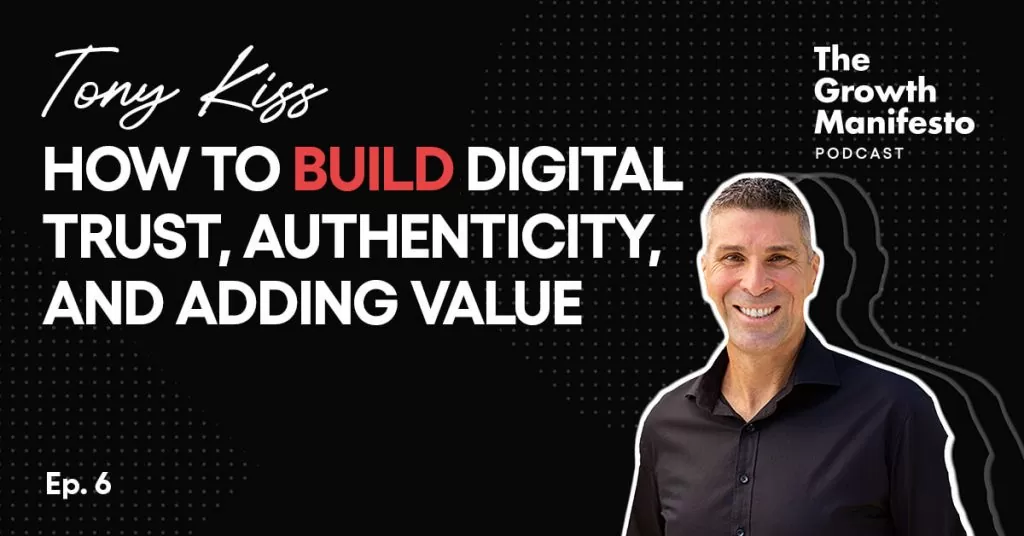
How to Build Digital Trust, Authenticity, and Adding Value
Tony Sharma and Alex Cleanthous discuss how consistency, authenticity and video content build digital trust with an audience.
 with Tony Sharma and Alex Cleanthous


Overview
Today is a bit of a different episode, where Tony and Alex discuss how to build trust in the digital world. They talk about authenticity, adding value, and why content is the best way to position your business in the hearts and minds of your audience.
SHOW NOTES
Key takeaways
- Balanced reviews with four-star and three-star ratings feel more authentic than an account of only five-star reviews.
- A restaurant can motivate happy customers to leave reviews by offering an incentive such as a free dessert or a monthly prize.
- Video builds trust faster than other formats because viewers can see facial expressions and read a person's genuine personality.
- A content strategy needs at least 18 months to 2 years before it builds enough trust to change buying behaviour.
- Businesses should budget for advertising their content, since organic reach alone shows the same posts to the same small audience repeatedly.
Chapters
About the guest
Transcript
Auto-generated from the episode audio, so expect the odd mis-heard word. Timestamps open the video at that point.
You're listening to the Growth Manifesto podcast brought to you by Web Profits, where we share inspiring stories of real people who've succeeded in the marketing and business world. Today is a bit of a different episode where Tony and I discuss how to build trust in the digital world. We talk about authenticity, adding value, and why content is the best way to position your business in the hearts and minds of your audience. So let's get into it. We were looking at websites before and we were looking at marketing
and digital marketing in particular. And one of the things that we were looking at was the importance of trust. One of the things that you shared with me was, you know, if you're going to send out video content or if you're going to have a web page, you have to have something where people can trust you. And that has absolutely boggled my mind. Tell me the importance of trust, especially in digital marketing and on your web page. again, you get straight in there. Did you want me to warm up? I know.
No, I love it. I love it. I love it. Yeah. Okay, cool. So trust is important. Yeah. All right. So we're done? Yeah, done. That's all we needed. Just joking. Just joking. Trust is big. Trust is big. I mean, how many times have you heard somebody say, oh, you've got to see my chiropractor. They're the best. Apparently, everybody's got the best chiropractor, right? So I think that's why it's so important to get a referral, right?
Because it's instant trust. It's trust in somebody else's opinion that you trust, yeah? It's much harder online. It's much harder in the digital space because everybody can say stuff, right? But it's hard to know actually who's the company that's for real, right? And it's so full on these days, especially with Facebook ads and everyone's an expert and everybody kind of has experience and everybody kind of has the case studies and everybody
has the website. You know, how do you know the company that is actually going to deliver? About half an hour ago, we were just talking about how to make the tonykiss.com.au website successful, right? Now, you've got somebody like me who you know, right? But then if you didn't have me, how would you know the company to speak with? What would you look for? Because obviously it's like hard. Cool. You say, okay, cool.
So I've got a website. I'm confused or whatever it was. Yes. So what was your experience of it? The whole experience was when I came to you, I said, look, I've got a website. I need it to work. I need to get more traffic there. And then so the question that you put out there, why have I come to you? Why do I trust you with my business? And the reason that I came to you is because I know you. we know each other pretty well now. I know you work and I really respect your work and I know you get results. So that's where the trust comes from. It's from knowing your work really, really well. So that was nice and easy. That was a no brainer. If I didn't know you, wow, I don't know.
So what would you look for? Okay. The second point I'd go for is if I didn't know somebody like you, I'd actually look for a referral. So a friend of mine that's in business that was looking for the same thing and got the result they wanted. So that would be my second point of view. Right. Now, what happens if you contacted all your friends and everyone who you knew and you still couldn't find a company that was trustworthy because the contacts out there, they don't have one either? Yeah. Then what do you do? Yeah, look, for myself, I would go out online and I'd start researching and I'd look for people within my industry, seeing what works.
and then to be honest with you, I'm just looking for somebody that I deal business with. So I'd put out the problem and say, oh, okay. They look like they know what they're doing because they've got really good stats. They've got a bit of a video link and it's really easy to deal with. So it's got to be easy for me. Okay. But I wouldn't make a quick decision. I would most probably be a person that would take weeks before I'd make my... That's pretty quick still. Is it? I think to hire somebody to help you in the digital space,
you're probably going to take some time, right? Yep. But it applies across the board. I think it's harder if it's trying to find a service provider because that's a person, right? Or it's a company of people. Yep. And so I think how do you tell the difference between the 17 websites that all have stats, that all look good, that all have the same thing, right? and then you speak to them and all of them say something a little bit different. Yeah. Right? And then you're like, wow, I'm actually just more confused now.
Yeah, exactly. So how do you then assess the company to work with on that? Yeah, I would be looking for somebody I know personally, you know, to be honest with you, the first thing I'd be looking at price and price gets really knocked out of the way quite quickly for me if they ask the right questions. One thing they'll normally ask is, what have you tried before? what's worked what are you looking for who's your target client etc um what's in your budget and things like that and the more questions they ask me the more they qualify me they the more that
i know they care about me and i want to know that i can work with somebody if things change and if it's flexible and things like and if people hit that criteria i think oh wow okay i'm in and then price doesn't really become an issue i've got trust there because they're not trying to sell they're trying to support. Right. And when I feel that support, that's when, for me, that's the sales process. Yeah, exactly. Well, before the sales process can start, right, there are a few things a company can do to help increase their trust with their audience online.
You know, I think a few things include to be consistent. Yeah, so for example, like if you're creating some content to consistently create that content, I think adding value is super important. and creating some content like this content, right, that is all about just providing value, like enough, and to not ask to receive anything back, you know, and to be consistent in that. I think the whole kind of experience of the customer, yeah,
so from the point that they have come to the website to connecting with the salesperson or not, and the whole experience is a component of that as well. I also think there's other parts around it in terms of, say for example, the reviews online. That's a thing that people are going to be looking for, right? But not too many good ones because if there's too many good ones and there's, yeah, say for example, if there's a company that has all five-star reviews
and there's no four-stars or three-stars or one-star, and they've gotten 20,000 of them, it's like, is that real? you know so there is like a level of authenticity it's kind of um that fun word that we use yep authenticity out there where people kind of have their filters up you know and so people are i think a lot more sophisticated in identifying stuff that maybe doesn't sound right if that makes sense yep so so i think authentic has been important it's interesting what you say is where
you go in and you go, you'll have the different reviews. You go five-star, four-star, three-star reviews as well. And you put all three of them up there, which is quite a nice balance. Just as you said that, I was just seeing what resonated with me around that. And I went, oh, okay, now I think I'd want to deal with all five-star reviews. But then I'm thinking through my head, I go, what would a four-star review sound like? Or what would a three-star review? And they wouldn't be negative. They'll still be positive, but they would be more realistic. Yeah. Say, for example, if I'm trying to book a hotel. so I'll go to TripAdvisor
and I'll look at the five star reviews and the one star reviews and potentially a couple of the two star reviews but I'm trying to find the extremes just to see the part that's so good or the part that's so bad but I want to see the bad stuff and I want to kind of see is it like a trend or is it just a person who's annoying which happens out there as well who has extremely high expectations and who's not the best person to have at that kind of hotel, right?
But that part's important too, you know? And so actually having a solid presence online is critically important to establishing that trust and to be visible, you know, consistently over the years, you know? That has a huge impact, you know, the time thing, you know, just the consistency part. If you're adding content consistently every single week for years and years and years, people are going to know you and people are going to either love you or hate you, but they're going to know you, yeah? And so I think that's probably the best way to establish trust online, yeah,
is to create extremely helpful content that can add value to people's lives. Yeah, I noticed that you do a lot of that and you have for many years now at Webprofits where you do, you've got your books that you give away for free online, but also you do your video content that you do a lot of, and you're giving away information all the time. So what's the idea or the strategy behind that? Well, it's, someone here at the front door? A few years ago, like I,
so one of my mentors, like a long time ago, 20 years ago or something like that, his name was Jay Abraham. Yeah. And he's like a marketing expert. Like he's still around today as well. He's excellent. He's a guru. He's a guru, right? And so all of the greats have studied under him. You know what I mean? And kind of his whole thing is to be preeminent. Yeah. Is to be seen as the expert.
Is to be seen as the thought leader. is that that positioning is the best of all of the positioning out there because then people come to you because they trust you. That was 20 years ago. It was a lot harder back then. But today with all the stuff in terms of say Instagram and Facebook and all the social media, actually providing content on a regular basis, it kind of establishes the company as an authority.
That's such good positioning across the board in terms of actually helping us attract the types of companies that we want to work with, if that makes sense. Yeah, it does. It's almost like that final frontier where you're moving through and it's only the strongest will survive through that final frontier and then as long as you stay around long enough and you're consistent with your marketing and your content delivery, that you will actually get that reputation of being the expert or the authority in that field. Whereas I think one of the problems that we've got here
in today's modern times, we can have somebody who's Insta famous or Facebook famous and they're claiming to be the expert, but we're seeing also a lot of them fade away quite quickly. Their success is quick and they fade away quite quickly. What would you say to somebody, let's say like myself or another business person, who has people like that as competition? It's a good question. I think the world is full of that, you know, and I think it's about having the long-term mindset, you know.
It's about kind of heading into it just saying that this is going to happen forever, yeah. And so trying to find a way to make that actually work, you know, so to ensure that however you create that content, that it's sustainable, yeah. It doesn't have to be the sexiest stuff or the most kind of professionally produced stuff, but the content has to be good. And if the content is good and it's consistent, then it's going to add value. There's a lot of content out there that looks professionally done, but the substance is not there.
So it's all about substance. And the better the content, the better the advice, and the more, I guess, disruptive or counterintuitive it is, the better it's going to be you know because it takes somebody confident that has experience to say stuff that is kind of a counterintuitive but still correct if that makes sense right because it can easily get shut down online you know it's so easy to put out um to to to have an
opinion online and to have like a huge discussion, you know, from people who disagree with you. Yeah, look, I've got a few friends in business and one in particular that I'm thinking about, she's going through a part where she's running a great business, but she's getting some interesting feedback online and it's not positive, it's all negative. And it's only about 5% of the feedback that she gets however that five percent is being really damaging towards her bottom line
so you know and you know the people that throwing out the the thing they're either competition or just those whinges how would you deal with something like to protect your brand or your image can you tell me what kind of company it is or it's in the food industry so so it's okay so if it's like a restaurant of some sort yeah yeah um and there are people out there that are giving some bad reviews. I mean, that's really, really important for restaurants, right? Really, really important. So, one of the things I would do for a restaurant is I would have a way
to, what's the word, to encourage people to post a positive review or just to post a review. Unfortunately, people need to be motivated to post a review oftentimes, right? And they're more motivated if they're unhappy. So how do you then create the motivation to post something if they're happy as well? Yeah. Like it's not to provide them something just to post a positive review.
It's just to post a review. So for example, if it's like a restaurant of some sort, she may offer, say for example, it could be a free dessert to people that post a review now it could be any type of review but that's something that they could offer or they could have something in the restaurant that across the month there's going to be a person that they choose that will get a couple of meals for freely because they posted
a review right something like that and so now they're starting to kind of encourage people to post reviews because then you get the right amount in terms of balance. Right, yeah. That's the only problem in terms of reviews, right? You need to find a way to kind of automate it, yeah, to ensure that also the happy people are also talking because most of the time it's the unhappy people that talk. Yeah. But I'm the same, right? I'm extremely happy with everything I see, yeah, but there's going to be like a bad spot that I go to one time
that are just extremely rude. wow I'm so much more motivated to post a review now because I don't have any other out like I'm just like well that's all I've got at the moment right and so that's bad for restaurants that thing or any business at all especially for restaurants especially for restaurants because everybody has a look at the reviews star ratings and stuff like that and it affects all of the rankings in terms of say I mean in terms of say like the Google Locals and Trip Advisors and stuff like that right and so to find a way to get people
to post a review, that's going to be the key for her. Yeah, absolutely. It's quite funny you say that about reviews. I actually look at reviews as well and I must be a sensitive shopper or a buyer. Basically, if I get one or two negative reviews, I don't care where it's coming from. I don't think about the source of it, but it's enough for me to deter me from actually purchasing from that site. Ah, so if you see some negative reviews, that's what happens, huh? Yeah, because I'm trying to flip through as much information as I can.
And if I get one or two, I go, yep, that's enough for me and I'll move on to the next. Right, right. And so some more advanced tactics now, right, is that you probably would have had a look at the website already prior to searching to find the reviews, right? So what a company could do at that point is to start to retarget the people with ads. and to show them content or to show them some information that's helpful,
you know, to start to establish that trust through consistency of content, you know, because at some point as well, if you see some like a specific ad time and time and time again, you're going to start to go, I kind of like this company, like, or you're going to hate the ad, but like assuming that it's a good ad, like and say for example, like it is for food or for something that's like a purchase or something like that. There's a lot of things that the company can do to advertise specific messages to support that trust,
if that makes sense. Now, you're not going to be able to convince everybody to look at all the reviews, but it's kind of to put a focus on it and to have a process around it. That's going to be the key. Okay. With a business itself, if we go back to Jay Abraham's example and also what you do at Web Profits as well, where you're playing the long game. The long game. The long game. Definitely. When you're pumping out content, what's the shortest you can play the long game for to be successful? On a serious note. Are you hacking this right now?
No, no, no. What's the shortest to play the long game? Yeah, because I think some people just give up just before they hit that tipping point. It's a hard one, right? Because- How long do you persevere for is the question, yeah. Well, the challenge is when people start to put out content and just expect that people will find it. Yep. They're not going to find it. Maybe you could be lucky, yeah, and something will hit and something will happen and something on Instagram will be picked up and it's so compelling that there are going to be some people
that share it and it goes organic. I mean, in terms of the followers and so everyone starts to see that content. That's for 1% of the businesses out there. So for 99% of the businesses that are producing content, they need to get people to see their content. Otherwise, what's the point? So creating content just to create content but not having anybody see it, that's a huge mistake, right? And so that's like just starting there, yeah? Assuming that the content that is being created
like is being promoted and I would suggest something like Facebook ads or Instagram ads or stuff like that can help to push it. But the content itself is going to be consumed. Yeah. It's important at that point to see the feedback and to stay consistent. Now, how long should a company be advertising that content? Yeah. And be producing that content? Yeah. What's the shortest amount of time to play the long game? Yeah. Yep. I would have an outlook of 18 months to two years as a minimum.
Yeah. That long. Okay. Yeah. I prefer to say five years to 10 years, but that's not how it goes in life anyway, right? Like in general. And we've been doing it for the last seven years, 10 years now. Okay. Yeah. For a while. Yeah. Where you've been releasing content. Yeah. Yeah. Yeah. What was the first bit of content you actually released? I think I wrote an article. Okay. It was an article on the war between Yahoo and Google. Oh, right. Okay. Back in 2006. Back when there was a war. Yeah. Yeah. Yeah. That wall has been won.
Did that get some traction? No. Okay. It was pretty horrible content, right? What was your next bit? Not that you have to remember, but was it the week after? Was it a month after? It was the week after, yes. I think I committed to publishing something every week. For how long? And it was about, I didn't say for how long. I'm still trying now, you know? So that was back in 2006 or seven or eight, something like that. It was pretty bad content. Like it wasn't that bad. It just wasn't that good, right? It was just like in the middle.
Yeah. Like it was in the middle. Like it talked about something. It didn't have anything like in there that was too groundbreaking. And yeah, like there was no thought leadership behind it. It was more just, hey, there's kind of this thing happening over there. Yeah. That's interesting, isn't it, right? Something like that, right? And then over time, I expanded out like into tactics and strategies. And then after that, expanded in to how to think about stuff. and then just got like a lot more advanced in terms of the length and the depth of the content and stuff like that, yeah.
And so it certainly evolves. I mean, like even like this podcast and even the Web Profits, the Digital Insights series, you know, like the first time I stood in front of a camera, I actually sat down and it was up here and I had like a really cheap camera. Like I'm just looking at the video person right now. He would have been so disappointed in the quality of that content. But I just had a camera. I just sat down and I just kind of spoke to camera without a script and just kind of I just recorded it.
It took me about three hours for a six-minute video because what do I know about recording a video? Don't. We've all been there, mate. I've done the same day. And it just evolved over time, right? And the one thing which I've been confident in is putting stuff out that's not perfect. Yeah. I'm okay with that. Yeah. It gets harder the bigger the company gets and the more kind of prestige the brand might have or if there is a brand now because if you're putting out stuff that's just dodgy, I mean to terms actually how like it looks
and stuff like that, maybe that can affect the brand, you know? And I think that actually holds a lot of people back. Yeah. A lot of people back. It's like, oh, well, yeah, well, yeah, look, cool, so I can make some content. I have something to say, but it's not going to look good. It's going to sound thing or it's going to look kind of like homemade or something like that. Yeah. Yeah, and so that kind of stops people. Yeah, I hear that a lot, Alex. Well, because it's a thing, right? Yeah, I'd suffer with that a bit as well. I mean, who doesn't? Because everyone wants to present the best version of themselves
and their company, right? And so then they're like, oh, well, if I do it like that, that's not going to look that good, right? And then all of a sudden, the company isn't going to be seen the right way, and that stops people. But what's the alternative? Just to not make the content? Not make the content, that's right, and you're never seen. and then you're never seen and then you don't build that trust. Yep. Right. And what's interesting is with content is that it's the lowest cost way to stay or to communicate on an ongoing basis,
providing value to an audience. Yeah. Like just creating it, you know, like it's the hardest part about it is actually to stand in front of the camera or to write the article. You know what I mean? That's kind of the hardest part, but it's important to put it out there. Why do you find it hard or why did you find it hard initially? Well, A, you don't know what you're doing. You have an idea. So like if I have a look at say, for example, the videos, right? The first video I did had no lighting, had a pretty dodgy camera, had a pretty bad frame,
had bad sound. It was like pretty much it because I didn't know anything at the time and I was like, okay, cool. I'll just create a video because that's what I want to do and I'll just make a video and I put it out there. And I put it out there and some of the feedback I got was like, wow, that looks pretty like math. Just from some friends I know and stuff like that. But then from the market, they liked it. Plus I'm on the camera and I'm talking about my stutter because obviously I've got a stutter
and I'm just like, look, I've got a stutter, but look, I'm talking about conversion rates. I think that was the first one, right? It's about conversion rates. Okay, yeah, yeah. And I just put it out there and then the feedback was good. Yep. And then- Did that build your confidence to do the second? Hell yeah, definitely. I was like, wow. And then after about 10 of them, we started to get some people actually speaking to us because of the videos. So that was only like three months in. That's pretty good. That's a good conversion. If you're doing 10 videos, it's really cost you time at this point. It's time only. I mean, I had the, yeah, so I had a camera.
It was a pretty cheap camera at the time as well. You know, I didn't have any support around it. I didn't have any lights. I didn't have anything. Yeah, yeah. But yeah, and so that was enough to start with, you know. So I still tried my best, you know, to make it look a certain way. Yeah. Yeah. But it still compared to these days looked like a backyard job. Yeah. But I've got to be honest with you. I've actually followed your video career from a very early age up until now. And sure, equipment's gotten better.
But you've actually evolved with being on a camera and speaking. You're a fantastic speaker now and you're great on camera as well. And I say that also when I show other people, I go, oh, okay, we're doing a podcast. This is Alex. And a lot of people go, wow, he's really good. Oh, yeah. He's been doing this for a while. Yeah, sure. Right? So, and I think that's the other thing where somebody's going to watch somebody like yourself and they could get intimidated where really they should get inspired to go out there and give it a crack and get on a camera going, okay, well, Alex has got on camera. He's done.
He's put himself out there. We might as well all do it. Yeah. You know? Yeah. Hey, look, if I can be the one who intimidates others because of how professional I look, well, I call that a win. That's not how I feel, right? I just like, I think this is the other part. Like, and I think we had this conversation starting this podcast was like, look, we haven't done a podcast before properly, you know, like I've done, like I've tried, you know, how's it going to flow and, you know, like how's our structure going to be like, and
how are we going to actually like engage, you know, with our guests and stuff like that and, you know, how's that's all going to work? And we said, hey, listen, the first one's going to be the worst one. And certainly it was. Yeah. And the second one got better and the third one got better. And I think we only started to release them after the third one. We were like, yeah, no. So we still tried, but then we tried again, tried again, right? Now, it's never going to be like as good as the thousandth episode. Yes. It can't be. I think people have to be mindful of that as well, that if they're going to go there and give it a crack, especially if they're new in the industry, not new in business, but new in the industry.
So they could be around for a while and they could be one where they were just supported by a word of mouth sort of clientele. Now they've got to go out to marketplace. So they're new to industry. I think they should still jump on the camera because they've got to get a voice out there and people have to get to know who they are. Now, I've watched a few people, including yourself, and we talked about trust. if you're doing a piece to camera, if you're doing something for video, how can you gain quicker trust or instant trust with an audience that don't know you?
Well, this is your thing. This is your thing. So I'm going to bounce back to you. Just so you know, like I started to work with Tony about four years ago, three, four years ago, just to help me speak in front of the camera better. And it's been awesome. I think actually, just before we jump back to your point, the biggest thing that I got from Tony at the very start, and there's been quite a lot was you just have to be more Alex. You just have to be more you. I'm like, who am I? I don't know who I am to, you know, to be more of that.
You know, I'm getting there, you know, and I think like I look at kind of some of the biggest kind of influences in the podcast space, the people that have all the top podcasts and they're fully themselves, fully. Fully, yeah. Oh, what a loss. They are like the extreme version of themselves, obviously because they've gotten the feedback and it's been good that they can be themselves. And so I do think that there's something about becoming more comfortable in who you are on camera and not to be something that you think people want, but to be yourself.
That's hard. Yeah, that's it. And look, the only way that comes about, and we both know this, is by doing more mic time or stage time. That means getting on that camera a lot more, getting on the microphone. Like this just feels normal now for you and I to talk. yep definitely so but it's been recorded and you know hundreds of millions of people listen to this uh but there's that art as well and and i think also so if i if i was going to coach somebody through how do you become authentic or get trust online from doing a piece there i'd say the first thing was don't try to look so good don't be so professional just be you and that's really hard
because you don't know who you is exactly right that was really that was the hardest thing i'm like tony you tell me who i am yeah and you're like oh just that part you know like kind of like how like you say that yep i'm like oh that's me yeah yeah you know and so it's the same thing and so how would you you know just give advice to somebody to be themselves like you know because like it's it's a hard thing yep to think about you know like i kind of experience and i'm like i don't know what that actually looks like yeah to do that i think you've got to take yourself out
of your own mind so what you've got to do is think about your product or your service whatever that that may be and think about what the the end product or service what it delivers right and then put yourself in the position of that person and then you've got to think about what struggles are they going through right now or what problems might they have and then talk from a level of being absolutely sincere where you understand their problem so if it was something like public speaking um you'd go in there and you talk about the truth so you go hi how are you i'm tony um today we're going to talk about how to overcome the fear of public speaking and i know myself i
I used to be in that position as well. And I'll tell you what, many years ago I went through this and then I did some training. And from that training I was able to get up in front of a microphone and say, I'm lucky enough now to have enough people to come through my courses and my training programs to actually do that. So what I'd be saying to you is if you genuinely have this fear of public speaking but you know you have to or you want to, just give me a call. I'll give you 30 minutes for free or something like that. And then I'd go on. So I'll be going with the principles. So you're just being like relaxed in how you talk. That was very, very relaxed and kind of like a little pitch,
which was great. You should go to him too. He's great. But to get to the point where you can just talk, like you're going to talk to like a friend or to somebody in front of you, something happens on camera where you get a camera up and all of a sudden you're like, so welcome to the video. My name is Alex Pleanthus. and so all of a sudden it becomes a lot more tight. Yeah, it's rigid, right? So is there just kind of some exercises or something that people can do or is it just like just practice time and time and time and time again
until it becomes like a lot more relaxed or scripting it? Or like, you know, what are some of the things that someone can do? A couple of things. I'd script. I'd go straight off the cuff. I would script to start off. Scripting is a good thing, so it'll give you a formula on how to go through things. You know, Alex, I think that the biggest thing is when you're on camera or when you're on a microphone on a podcast is that you don't care about the outcome you really don't care whether and when I mean that you don't care whether you're being liked if you sound awesome if you look good if you do anything like that you're not worried if
you sell that product yes or no but what you want to do is you want to actually have a genuine connection with somebody out there listening to this who's going to resonate with that and you're being you and that takes a while to get used to it actually to tap into that um and then so when we're going back to trust i mean like you look at um there's two that i think it we're talking about trust online and how do we get that on the internet i think what we've discovered here it's a two two prong approach is go out there deliver the content and do it time and time again yeah
script yourself i think that's the key isn't it yeah and then start getting feedback on how it's helping people out and how you're sounding and what you're doing really well. And I think there's an evolution of that. And I don't think there is a shortcut. I really don't. So then with that in mind, I think it's sometimes hard to get some feedback from people that will give you honest feedback. Yeah. So what I would suggest. Get a coach. This is pretty good. It's so you're straight. You might cry for a little while, but I'm all good with that. Look, I cried for a little bit just in that moment trying to figure out who I was, but it was actually helpful.
Really, really helpful. So highly recommended. But to really put some money behind advertising your content. Yeah. And I would start with Facebook ads. Yep. Yes. Facebook, Instagram ads, right? Start there. Right. Because you're quickly going to see how people engage or not. And if you're getting any people actually starting to comment or to like or to heart it or whatever else it is, that will give you some feedback. Yeah. If people are not engaging with it, that's some more feedback, you know.
But I like your point about just being consistent and just putting stuff out there, you know, because like as much as I practiced that first time that I did the first video, it was still nowhere near as good as it was a couple of years later. It doesn't matter how much I practice it, yeah, because there is something to putting stuff out, yeah, Like to put stuff into the wild and see what happens with it. Like you can't continue to record stuff and to never release it
because then you don't really improve, right? Because that pressure of hitting the publish button and promoting it isn't there, you know? And so we're talking a lot about the video side of things and I think that's because that's where trust is built fastest. Yeah, right, okay. I do think that. I think especially with social media these days, the right type of content, the right type of angle, you see the person's personality, it's easy to see the facial expressions, it's easy to get a different type of engagement.
So certainly I think the best way is to create some video content. But there are other ways of doing it as well in terms of, I say for example, static images or consistency of the content and actually having some articles that are awesome that's good too but video is like the number one because you get to see the person and that's critically important have you got any data on the popularity of is it like Facebook stories or the Insta stories you know how you've got you go through and they've got little video clips and all that
I'm seeing that's becoming more popular but have you got any data on that on how popular that is IGTV is extremely popular these days I don't have the stats on me right now unfortunately maybe we can add some of those stats into the show notes It's certainly like I would be creating the same piece of content and I'll be uploading it on to LinkedIn, on to Instagram, on to Facebook and on to YouTube and just seeing the place where I'm getting the most engagement. It's the best way to do it too. I mean like I like it because people are already conditioned to give feedback on these platforms.
Yeah, there's a conversation where you want to create content that is specific just to that platform and not have the same content across every platform because if someone is following you across all of them, then that content is going to be seen by them over and over again. Yeah, it's just a repeated process, yeah. But I don't know if I agree with that as much. that's assuming that you have a high organic reach.
That's assuming that that person is on that platform at that specific time. Your biggest challenge is just to get people to see your content organically. I'm also saying that it's good to spend some money on advertising that content. And if you're going to advertise it, that's on Facebook. But I would still upload it on LinkedIn if it's specific for a business audience. and on to YouTube because that's a place as well where you could get like a bunch of organic traffic potentially.
Yep. Do you find there's a different psychology behind using paid ads versus just going for free content? From whose perspective? From the business owner's point of view. I do think that. I think that a lot of people in business treat content as some type of, what's that word? It's almost like a right. It's almost kind of like a human right or something like that.
It's like, well, if I make content, then it should be seen. But they don't think of it as a business saying, this is a cost of marketing. I'm going to put some money into marketing this thing. And so when people create content and don't spend money on advertising it, they're trying to find some like loophole into how to get advertising for free. Yeah. That's what they're trying to do. And that whole psychology is going to slow everything down. Trying to figure it out, trying all that stuff.
It's like such a waste of your time, you know? Like you should still do the content maybe, but probably who's going to see it? I don't know. It's the same 60 people over and over again that are seeing your content. Maybe that could be okay. I'm of the but that's not going to convert into sales it's not going to grow you yeah and it might be your family and friends yep that's on Instagram right so what you need is a scalable way to get that content out there and the best way is Facebook ads the best way by far and not a lot of spend either it could be say between
10 to 50 bucks a post okay that's not much but that will get that content like in front of thousands of people right and that's a captive audience as well isn't it? It's not captive. Well they're more captive than everywhere else because they're scrolling down their feed. Yeah. So yes it is a targeted audience but your content has to be the one that captivates them. Yeah sorry. Yeah. Yeah. But it's not that captive you know. It's just kind of like in their feed. Yeah. And so then they're going to scroll past it and if it's good
enough they might see it. Yeah. And if targeting is good then people can start to engage with it. yeah and then when they start to engage with it consistently over a few months a couple of years that's how you're going to get some fans of your business yeah the ones who like it there's going to be ones who don't care that's fine that's that's that's actually the world the world doesn't care about you but if you can get a small percentage who do care yeah that's a win yeah because that's all you want to do is build on the ones so you want to reinvest into the ones that do
care pretty much it's really good instead of like try to expand it out you know yeah try to expand it out you know I think um but it's just the psychology behind it yes spend money on promoting the content something anything you know have a budget for it because now all of a sudden you're thinking wow I'm making content that I'm going to spend money on now do you approach it the same way or do you do it a bit better yeah is it like a bit more in like depth now like is it like a bit more of like well if I'm spending money this has to add a lot more value otherwise I'm just talking
just to talk, right? And that's a problem. And the thing is, you're so right because if I just talk or I send out content and I'm not putting a financial backing behind it, I don't expect a return on investment. I don't really care and if it doesn't fail and I go, oh, I gave it a shot, it didn't work, right? Or if it works, I go, wow, I'm a genius, you know? That's interesting. Yeah, you know, if that worked, it wouldn't really work that way. It barely works, by the way. Yeah, that's what I was going to say. The stats would be wrong on that. It rarely works, yeah. Yeah, right? Well, just because of the amount of people that put content out. I mean, social media is pretty much all content from, yeah,
just from the brands and companies and friends and family and just videos and content and like images and cat images and dog images and like this is what it is, right? So it's just all content, right? And so to stand out, your content has to be better than all that content but to be seen, you need to promote it. Yep. What about from a video point of view? how long should a video clip be on let's say Facebook or Insta? There's a big discussion about this too. Yeah, there's – what's your personal opinion?
Well, I think the biggest thing to focus on is the quality of the content above anything else. So you always want to be concise but it can be like a – but there could be a video for half an hour that's concise, right? Do you want to make a bunch of short content? great but then you need to be better at editing or you just need to make that short content you know there's some content that's just going to be better but that's a bit longer you know that could be six seven eight minutes at the same time i've seen some content that's half an hour
to one hour long that gets a ton of engagement like our podcast our podcast is better in terms of the short stuff on those platforms right because it's like an hour and a half and it's more of a consuming style thing, right? It depends on your content. It depends on what's being done, right? I do think like as a general rule, three minutes to five minutes is probably, it's probably like a good amount of time
to get across a message. That's of value. If it's too short, then what are you saying? Yeah. Right? If it's too long, then question yourself, is it absolutely essential that it's that long? You know? The other thing is if you start to promote content, you get to see the stats of how far people are actually consuming that video. Yeah? So coming back to your point around the length of content, like I'm okay to have an extremely long video,
but just as long as there are some people that are watching it all the way through. yeah like so if i've got a small percentage who have seen 100 of the video then i'm happy because i know that everyone's going to be different yeah like and the majority are probably going to see it for under a minute and so make sure all the good stuff at the very start right but but i also want to have content that the people who want to consume are going to consume all the way through because they're going to be the fans yeah right right and so that's that's that's the that's the perspective i have it's not a common perspective i guess um and there's a lot of different kind
of opinions out there on that. Absolutely. Alex, we have spoken about trust. We've talked about the success of a digital marketing campaign, about being consistent and going out there and just giving it a shot and then also investing into your advertising. I suppose, what am I looking for? What's the word? Advertising. Marketing plan. Your marketing plan. You know, Adrian, when you edit this, thank you for cutting that bit out. Please leave this in. I just went blank. Like I said, what the hell just happened?
That's okay. That'll happen sometime. I think we're going to have a longer bloopers reel than anything else. Well, the conversation is that this is to be yourself on camera, right? Yeah. And this is the part where we should probably leave this stuff in, you know? Absolutely. No, because it's like we feel so pressured to be perfect. Yeah. In everything we do, you know? It's just constant out there, right? And we're always striving for that, but, you know, I think it's okay not to be. We're human beings.
Yes, we can stuff up. It's so cool. But it's so true. So what we're saying, we've talked about. Something about a marketing plan. Yes, well, you've got to back yourself on your marketing, right? You've got to put your money behind you. You've got to put your marketing. Oh, my God. It's transferable. But no, it's been really, really super cool. So we've talked about the importance of, you know, just getting content out there. It's about trust, right? So this is about trust and about establishing trust and to be seen as the preferred option across everyone else in the space, right? And if you like are producing content
that is extremely value adding on a consistent basis, that's kind of the best way of doing it. I guess that's where this whole conversation has come back around full circle, you know? Because yeah, trust is about longevity to a degree. If I'm around long enough and I'm consistent enough, then people will trust me. Yeah, definitely. And that's what it's all about and that's what people have to understand. Definitely. Alex, thank you. Thanks for the chat, Tony. This has been fun again. It's been a good chat. It has been. All right, mate. I'll see you next week. Yeah, you will. We've got Jack DeLuce on next week. Do we? Yes. Great. Very excited about that.
Yeah, yeah. Interesting guy. This should be a good chat. It'd be awesome. All right? Awesome. And we should thank these guys for setting up twice. That's a longer story. But that's cool for today. All right. See you later. Bye. Thanks. Bye. Thanks for listening to the Growth Manifesto podcast. If you enjoyed this episode, please head on over to iTunes and give us a five-star rating. For more episodes, please visit growthmanifesto.com forward slash podcast.