Leadership and cultureStrategyPersonal growth
Dr Melinda Muth, on leadership, culture and how to build highly effective teams.
Dr Melinda Muth explains how culture, team size and honest conversation shape effective leadership, using her work with Alex and Paul as a case study.
 with Dr Melinda Muth
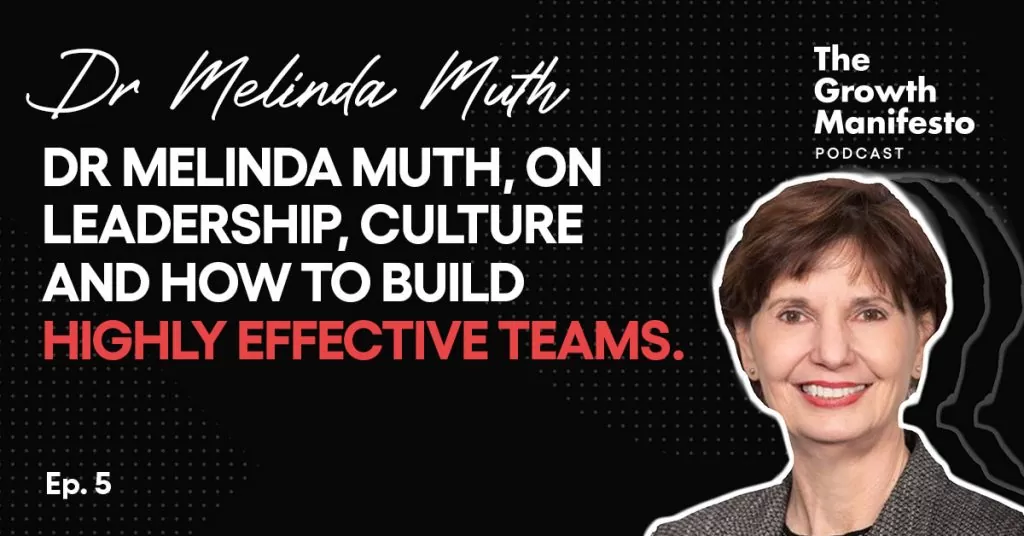


Overview
In this episode, we interview Dr Melinda Muth, Managing Director of Streamwise Learning, Facilitator, Board Advisor and Fellow of the Australian Institute of Company Directors, Director of the Harvard Club Australia and author of the book “Setting the Tone from the Top: How director conversations shape culture”. We talk about leadership, culture and how to build highly effective teams.
SHOW NOTES
Key takeaways
- Culture is the shared mindset about what makes success, shaped by who a company hires, what its leaders do, and its reward system.
- A town hall that lets staff speak openly in small groups can surface answers people already knew but were too afraid to share.
- Effective decision-making groups work best at around 7 people, while human social networks cap out at roughly 150 relationships.
- Idea generation and idea evaluation need separate people and separate stages, since criticising an idea as it's raised stops people contributing.
- Leaders should watch for stress before people break, since sustained pressure raises cortisol and adrenaline and leads to burnout and mistakes.
Chapters
About the guest
Dr Melinda Muth
Dr Melinda Muth is the managing director of Streamwise Learning, a facilitator and board advisor, a Fellow of the Australian Institute of Company Directors, a director of the Harvard Club Australia and author of the book Setting the Tone from the Top: How Director Conversations Shape Culture.
Transcript
Auto-generated from the episode audio, so expect the odd mis-heard word. Timestamps open the video at that point.
You're listening to the Growth Manifesto podcast, brought to you by Web Profits, where we share inspiring stories of real people who've succeeded in the marketing and business world. Today, we interview Melinda Muth, Managing Director of Streamwise Learning, Facilitator, Board Advisor, and Fellow of the Australian Institute of Company Directors, Director of the Harvard Club Australia, and author of the book, Setting the Tone from the Top, How Director Conversations Shape Culture. We talk about leadership, culture, and how to build highly effective teams.
So, let's get into it. I did it most probably for the same reasons as you wanted to get up on stage for. Actually, what were the reasons why you wanted to get up on stage? To make people laugh. Yeah. Because there's more laughter needed in the world. Are you a funny person? Well, I don't know. Although when I did the AICD course last week, one of the participants said to me, you're so funny.
Yep. But see, laughter leads to learning. You know, it opens up brain. Sure. Absolutely. Do you have a funny filter for life? Can you say the funny stuff? It's sort of a black comedy thing. Yeah, but it's there, right? It's definitely there. It's there. It's there, but it's kind of black. Yeah, yeah. But I think that's really important too. I think if you've got that filter, that's going to help you out as well. The other thing that – one of the reasons I got into it is the same reason as you, is when people go, hey, Melinda, you're really funny.
You should get up on stage. And you think, yeah, I am. And you go out to dinner parties and I'm pretty sure that people will tell you that you're quite funny and whatnot. I've had this feedback that I'm zany. Zany. Or zany or quirky. Yeah, yeah. And I'll say – the way I'll put – people say, oh, you should do writing because you're so funny, the things you say or talk about. So how do you take that? Because I get told, oh, that's really quirky of people. Like, what are you trying to say? What's quirky mean exactly?
Does quirky mean? So I say, that's a compliment. Thank you. The thing is, it's real improv with me. Like I'll say something and I get a reaction. I don't even remember it. It's not like I can repeat it. Yeah, yeah. Yep. Yep, that's the whole thing and that's the art of it. and then so Alex you get called is it quirky or zany? I get called lots of things. No but no because it's quite interesting what does come out because you do have I get called unique. Unique? Unique. Quite a lot. So I just take that as a compliment. I don't want to delve into it too far
with that kind of Well unique is a lovely comment because you're getting acknowledged as a human being. As long as you're getting some acknowledgement it's good isn't it? I think it's a positive and I like that you take it on board as a positive, which is really good. Adrian, how are we going? All focused up, we're good? We're rolling. All right, ladies and gentlemen, we're all rolling. Thank you for that, Adrian, by the way. I've worked with a lot of people that focus in life and you're okay. That's what I like about it.
What you say now is thank you for the feedback. All righty, so what we'll do, Melinda, what we normally do is we normally roll into this and we don't know when we're going to start. We're going to start chatting and Adrian will decide when he does all that. Okay. But I am very, very excited about today's podcast on Growth Manifesto. Alex, I know that you're very excited as well. How are you, mate? Very well, mate. How are you, Tony? Very good. Very good to see you. You're looking nice and ten, by the way, just back from holidays. Yes. I was overseas in Europe for three weeks.
Yep. So that was good. And it was actually a holiday for the first time. I mean, I still did like an hour or two per day of checking emails and Slack and all that. But there was no productive work. How can you say that? No productive work. It was a real holiday. Oh, by the way, I was checking in on emails two or three times a day. Normally, it's my most productive time. I mean, I can do some writing and this and that. I can do research and innovation. You know multitasking is a myth. Exactly. You know it's a myth. It actually lowers the quality of your decision making by at least 10%. But that's why on holidays it's so good because there's no distractions.
I can focus in on one thing for hours and hours and hours. And I didn't do that this time. Do you know what I'm just going to say? And we're going to introduce you, Dr. Melinda Muth, amazing woman. I'm going to give you a proper introduction. But what I've just loved, just watching that interaction now between you and Alex, is Melinda, you're actually a consultant for Alex and have been for the last seven years. And I love it how he's gone straight into like almost student-made like, but I did do my work overseas. It was like really, really good. It was like, I mean, like. And then I'm lecturing him. I go, no. You know. That is going to ruin your speech.
So whatever you're doing is amazing. Dr. Melinda Muth, let me introduce you properly. You're an educator and author, a board advisor, the Australian Institute of Company Directors. You're a speaker, a facilitator. You're also the managing director of Streamwise Learning and its Institute of Food and Grocery Management. This is a nice one. This is where we have so much in common. A graduate of Harvard Business School. Yes. I went to Wollongong University. Wollongong University is a good school. School. This is Harvard, though.
This is beautiful. I love it. The street cred you've got on there. You're also an author. You've got this book called Setting the Tone from the Top, and I'd love to get into that today. You've worked globally. You've worked in Australia. You've worked in Asia. You've worked all over America as well. You previously held a number of senior executive roles, including the National Director of Business Development Marketing for Deloitte. You hold a PhD from the Australian Graduate School of Management. for research in the field of corporate governance. Now, that's quite interesting because that really fits in with what you do. You love your charity work as well.
Oh, I do, I do, I do. You've got this one called Paint the Town Red, which is a mission which is simply to read, talk, sing, and a theme for children from birth so they are ready to learn at school. I'd love to know more about that. Fits with the education theme. Yeah, absolutely. You love education. I do. And you're a consultant. You specialize in personal and team effectiveness. All right, so it's all about decision-making, group effectiveness. You mainly deal with senior executives and leadership teams, and you help individuals' teams to innovate, solve problems, and take action.
You are an amazing human being. Thank you for that feedback. You are absolutely... Well, people write their bios so it sounds good. You're not going to write it so you don't sound good. Yeah, but if I can say... Was that fair? I know. But if I can say, you know, there's some people who have to try to find stuff. I think you need to kind of have to choose which stuff to put first and which stuff to include or not. And it's pretty impressive. The stuff which you've done and the stuff which you're continuing to do, it's pretty impressive. Sometimes I've wondered, though, if that's a problem, though,
because it doesn't look like there's a coherent thread to what I do. I think there is. Yeah, I think there is too. Oh, that's good. Let's find it. Yes. Well, let's look at this, Alex. You know what I'm really excited about or interested about is where did your passion come from, from developing teams and people themselves? From observing people and seeing that they would be trying to solve a problem and they'd be hung up on the actual, if I could say, technical content of what they were doing, but they were speaking
at cross purposes. And then they were getting angry or worked up or disrespectful toward each other and then the whole thing would fall apart. So I thought behavior is a huge piece of making things work and people don't notice their own behavior. And so if you're in the kind of role that I have, that's a facilitation role and people have agreed to let you play that role, you can keep the conversation moving and hopefully you can teach them some skills so they don't need
help to do it themselves. Yeah, absolutely. So what was it for you? What was a point where you said in your career, I've got to make a difference. I've seen a few behaviors. Was it within yourself or was it in others that you saw? Gee, that's a hard question to ask. I think a lot of it was in myself. I was saying to you earlier that I grew up in a very religious household with real values around integrity, honesty, and your behavior
and what you owe to the rest of the world, especially if you're a lucky person. There's something about sharing and giving back. So I don't really practice the religion in which I was raised because I don't have much time for rituals or things like that. What has stuck with me is those values because despite the fact that I argued with my dad all the time about it, he was an exemplar of those values. and I can say that I really respected that.
Yep. And I would want that for myself. I would like to be a person who's considered decent. Well, I consider you decent, Melinda. Oh, thank you, Alex. I mean, just to give some context, I mean, I think I met you through Paul, my business partner, seven years ago now probably, six, seven years ago. And I spoke to Paul and he's like, look, there's this person. who I used to report to on the board of directors of the company,
which I was the CEO at, and she's really nice. She really tells you how it is. So she comes across really, really friendly, and I told this to Tony as well, but she's strong. And she will tell you how it is. And, you know, we started to work together like seven years ago, and you've helped me along the way. And there's not many people who can – what's the word? put me in my place? Is that the right way to put it? Oh, I would never have done that, would I? No. I wasn't doing that.
Melinda, you said a couple of times, slow down, Alex. You're going too fast. And, you know, people tell me that all the time and I don't listen. But with Melinda, she got me to listen. And everybody else in the company was like, wow. Yep. How did she do that? Can I just say, Melinda, that is amazing. Oh, is it? Mm-hmm. You don't know how amazing that is. Like he's amazed. We're blown away. And I love Alex to death, but if you can do that, it is beautiful.
So I really like that. What I'm really interested in is how did your relationship start? So what were the things, Alex, that you found in your business? You'd sit down with Paul and go, hey, we need somebody like Melinda to come on board. And just before you do do that is how did you first find Alex when you met him? Oh, I thought he was fantastic because he's an innovator. Yep. He's really, and he's fast. I mean, if you want to get it all, he's got to slow down so you can catch up with it. But he's like, he's action man.
I like that. So what was it? Is that fair? Yeah, it's true. I'm not trying to be me. I took that as a compliment again. I think I'm an optimist. Yes. No, it is. That's how it's meant. Yeah. Yeah. So, yeah. So when, so what was the question again? So the question was, what happened in your business to actually reach out to Melinda and say, hey? I remember. Yeah, I remember too. I'm trying to figure out the best way to put it succinctly. We, I mean, I think this was about seven years ago, right?
So we were like 13 years in business now. So we're six years in business. And we had a major crossroads in kind of restructuring our company to be the most effective that it could be. I guess having experienced a bit of a, I guess like a downturn and having to make a major shift very quickly and being able to navigate that shift in a productive way. And so at the end of it, we're stronger.
And the hardest part about that was the people part, you know. And so we're like, you know, that's not our strength and we're getting better, I would say. but at the time it was like we needed some really solid experience and advice on how to progress. And that's when we engaged Melinda and she really helped us to really understand the psychology of the team and how to present it and like, you know, to have a town hall. And that was the beginning of the town hall. And that was the beginning of kind of our shift
from the traditional agency structure to the producer model which led to the fluid model and so on. But I remember at the time, she was talking about concepts that were only starting to implement like next month, right? And this was like seven years ago. And so I started off by saying, she talks and she shares ideas and it stops my brain because it's so complex and it's so lateral that I can't comprehend it.
And that's the part where she is extremely powerful in, you know, and I guess her understanding of the psychology of the team and the staff and what happens if you get stressed and stuff like that, you know, that's extraordinary insight, especially at a time of actually having to shift the organisation. Yeah, sure. And it's a great intro into this because, as you know, Melinda, the Growth Manifesto podcast is to inspire growth in other organisations, whether it's with their culture or just their innovation process and all that.
And I think the best thing that we've got you in today is that we've got a real case study here, right? So in saying that, when you first walked in, did you see there were common problems within web profits that you'd see in many other businesses as well? And if you did, where do you start? i think the answer is yes because someone like me who works in a lot of different places i guess you're sort of like a bee you're going from flower to flower to flower and you other people are just on the same flower so they only see those petals and if you see all these
other things then you see there's a pattern there so i'm i think i'm good at pattern recognition the thing was when paul first called me uh the first meeting about it was over at the accountant's office. And I think he said something to me like he wanted a contrarian view. I think those were his words. And he thought I was good at that. And I didn't quite know how to take that. I thought, but I knew that if I was going to meet at an accountant's office, I definitely would not be
saying the same thing as an accountant says, I just knew that. I just knew it. And of course, Because if things are tough, it's usually about the dollars. And if you're an accountant and you're counting up, you want the accounts to count up properly. So you usually say, well, let's cut costs. And I think that that's the knee-jerk reaction to what people do. and if they actually engaged people more in the thinking
before they took a move like that, they would come out better off. And that's why I can remember sitting in that sort of loft-type room and saying, you know, what if you cut the wrong services, the wrong people? What if you actually injure the business? And then we started talking about, well, how would we figure out what to do? And then I said, well, I've been to your office and you all
sit in one room. Do you not think that the people sitting in that room observe each other and know what's going on? That's not like they're out of it. Whatever we're talking about here, they already know about it. They already know sitting in one room. I mean, other complex businesses, you don't have people sitting all in one room. But that's why I came up with the town hall idea. And I remember saying that that's what you want to do because... And what's a town hall just for people who don't know what that actually means? I used the phrase town hall because that's
how people used to solve problems, you know, sort of in the early days of democracy. You'd gather people together and they would all share their thoughts in a group. Now, I know that sort of devolved into, you know, maybe some things that are less than positive and in today's world, but it was like getting all the people together to say what we see, what our views are. And, and I thought they were all sitting in one room and the answers in the room, maybe somebody's not being heard or they're just afraid to say it. So all you have to do
is give them the opportunity because people know, people don't get credit for the things that they know. It's the same, you know, way that adults sometimes treat little kids like they don't know what's going on. Believe me, they know what's going on. It's amazing you say it because we do. I've been in situations like that. You've been in situations, you know there's something, there's a negative vibe there or just a vibe that's not working. And the fear of not being able to speak up is just, oh, it's terrifying. So myself, I go one of two ways. I either sit
there and say nothing or I say something and I unfortunately I come from a Hungarian background and we only have black and white and it's like we just say it how it is so I either have I say it exactly how I see it and then I get chastised for it I just like yep see you later you're out of here or they go that's an interesting point but you got to simmer down your feedback. Well you know that's an interesting comment because that's whatever that's what we all do We say it the way we see it. The problem is every human brain is unique, so it sees things different ways.
And it's the inability of one brain to understand that another brain sees a different thing and respect that that might have some validity that actually results in we won't let anybody talk because if they all talk and they all give different views, we won't be able to do anything with it. We won't be able to manage it. We won't be able to get it under control. and they might say things that we don't agree with and then we won't get our own way or we'll see some sense in what they're saying
and then we might lose face because we change our mind. Right, so how do you deal with that? I mean, like you've got Alex and Paul sitting there and you most probably had these fears as well, like people might say stuff that we're not going to be happy with or we're not going to change the organisation or the values around it from what you've heard. So you would have had to have coached them around that, is that correct? I did. Paul said, you were there. He said, well, how are we going town hall? How do we do that? What does it look like? I think that's the biggest one, right, is that you don't know what you don't know, right?
And when you need to make a big change and you think it's for the best and I mean, you trust it's for the best, but you don't know what the process is. saying you don't have the experience of somebody like Melinda until you have that experience to say, actually, that's okay. That's a process. And you'll be surprised potentially on what can come out of it. And they might all actually say that's actually the right idea. But they might come up with a better idea.
And that's what I said. And that's what you said. And that's what we did, and it was true. And I said, whatever ideas they come up with, do not take an action immediately. I think that made your brain hurt. Don't take action? Do not take action. What's the point of an idea with no action? And if I recall, it was not long before Christmas. Yes. And who wants to come to a meeting and hear they're going to suffer in some way right before Christmas? Only Scrooge would do that.
Yes. You know how many companies, like, they give people the sack or they do horrible things to them right before Christmas and then go, you know, go off and have a nice holiday. Gee, thanks a lot. Yeah. You know, so I thought that the process should be a way to have everyone articulate their view. So that was like breaking the group down into smaller groups and then having them, I think I asked you, write things on, each group had to write things on flip charts, if I recall. Something like that. Yeah, I think it evolved.
Because I wasn't there, so I don't know exactly how you did it, but I suggested a process. And then I remember Paul called me up and he said, it went like you said. And a lot of the things that people said were the things you were already thinking. So then, you know, there's a book called The Abilene Paradox. I don't know if you've ever heard of that. And it actually describes this, you know, one of the biases in the human brain. that people don't speak up, so they all take a trip that nobody wanted to take
because nobody wanted to say anything to each other. But on this occasion, people spoke up, both of you spoke up, and there was convergence and agreement. And then, as I recall, people actually put their hand up to say, you know, I can see where you're going. It doesn't work for me. Paul said something to me about getting a thank you for that process, process, you know, that people made their own decisions because, you know, everyone likes to have agency over their own life and to take a decision themselves instead of being told to
take one. Yeah. I think like one of the interesting, what's the word? The interesting, I guess that lessons out of that whole thing is like, if you build the right culture and you have the right people, you can trust them and you should trust them and you should be giving them the information and the transparency and include them in the process and don't try to put everything on to your own shoulders,
which is kind of like how everybody kind of handles it. They're like, well, actually I should be doing this myself and I should be going that direction. But actually say, hey, it's a team for a reason. but was that hard for you Alex let's be really feeding for a second because you saying that now sounds really cool and it's logical and it's what you should do but being a business owner to have that level of transparency and and trust and honesty with your staff was that an easy thing for you to actually accept of course not what's not but that's why you have somebody who's like
Melinda to kind of to say that's how you do it you know and that's why like you like I am a big proponent of having experts around because they've gone through stuff. They've seen stuff. They have a lot more experience. Yes. Like if I want to do anything in life, I don't want to figure it out myself. I want to find someone who's awesome and get them to tell me this is the way to do it. Right. And it's not that simple. Right. And there's still action. But, you know, of course it's not simple, you know, but then you take an action, you listen, you see what happens, you get positive feedback, the cycle begins.
Right. and then all of a sudden like you go, oh, this inclusion thing's something. It's a real thing. This inclusion thing. This thing actually works. But you touched on something really important and you started to talk about company culture and the impact that it had on your culture and you can see where this goes. So do you want to open that up a little bit? Yeah, sure. All right, go for it. Oh, which part do you want to open up? I guess like – well, I think like the big thing which I can start to open up with I guess is, you know, we talk about the company culture a lot and, you know,
we often get told that our culture is a good culture and stuff like that. And it's always like, yeah, cool. And you often get asked on kind of, you know, what's the best way to create a company culture. So I figured, you know, we could take a second potentially to define what is culture because it's such a hot topic. Thank you. It's such a hot topic. but I don't think people really, it's like air or something. So yeah, like we start there maybe
and then this could go into a number of directions. So we'll see if we can just get it into something that the people who are listening can action. But I think to get to that point, they need to understand it first. So could you help to maybe define it, Melinda? Oh, it'd be my pleasure because I'm getting very upset about the usage of the word culture at present because it's become one of the words and it seems to be a bucket that covers everything that's not finance that's wrong in a place it's the culture you know it's this it's you know
whatever it is it's the culture well tell me how you define culture oh well then you'll get lots of different definitions the most favored one seems to be the way we do things around here i'm thinking that's making me none the wiser about how i'm going to sort out what's going wrong Yep. So it really is about behavior and behavior is driven by the mindsets that people hold. So it is like air because you cannot see people's mindsets. And they're all different because everybody's brain and their experience, their training, their wisdom is completely separate. And people see with their brains, not their eyeballs, if that makes any sense.
When people look at something, they're seeing it with their brain and their experience and their lens. And so their brain is looking to match something up. So if they hear something that is in opposition, they're likely to reject it. And so when you found a company, the way you do things, the way you interact, the fact that you included... There's a little fly there and I can see... Oh, a fly? Yeah. Culture fly? It's a cult.
It's one of those. You know what? When you talk about something as rich as culture, they'll come running and they'll even fly in. Oh, even they'll fly in. It's because we were mentioning air. Because, you know, you can't see air. If there was no air right now, there would be no podcast because we wouldn't be breathing. But people don't want to put any emphasis on things they can't see. what people see is what matters to them like celebrity or whatever so people can create these images
that are something you can see and the reality of it is unseen and that's how culture is so what is it still? so it's the what is it? it's the mindsets the beliefs that are formed in a place about what makes success here and what is allowable to do and not do. And people pick that up from what they see their leaders do and say, and they pick that up from decisions,
and they pick that up from the behaviors that are allowed or not allowed. So it's something really, really difficult to measure. What you can say about culture is what are the elements that impact people's mindsets, how they think about things. So number one, it matters who's on the team, who you recruit. You know, it's, I think, a special kind of person that works at Web Profits because there's a value set and a similar attitude and a commitment and a passion,
and that's got a lot to do with who you hire here. Because I know you spend a lot of time on that, who's going to be on the team. It's very interesting. I talk about that a lot in relation to corporate governance. But, you know, sometimes there's no control over who's on the board. They're elected or appointed. And then I say to people in classes, if you were going to have an award-winning team, would you elect the kicker? I mean, like, people, the way the interactions are going to happen are going to depend on who's on the team.
So it really matters who you hire. That's number one. And then, you know, you want to say something, Tony? No, I just like breathing like that. Oh, okay. Yeah, it's cool. I think you're about to allude to it now, so I'm going to allow you. Because then once people get hired, then they're in the place. And you can have some formal induction processes and tell them some things so they can see the visuals. They can look at your website and see the values. I always make jokes about that, though, because if you look at every website, they all say they value teamwork. So there's the things that show, but there are things that don't show.
So when people come to a place, they might hear that there's a set of values. Then they're going to observe whether they're actually in practice or not. And if you said that teamwork mattered at WebProfits, I think people would see that, yes, it does. Because that's how the place operates. You can see how people share information, how they work together in groups, how they pull together in groups. So people can observe that. So you get the right people. Then they observe those team behaviors. so you know there's an induction formal and informal then there's a reward system because
you know people go towards rewards so they can have all these values but if if the reward system is set up that pulls them away from those values then there's you know a misalignment there a gap and that can create some ambiguity or issues around people saying there's a gap here and they might want to speak up about it, they might not. And then the other big thing is the leaders and how they behave,
whether they're willing to listen to that or not. And the example that you and Paul set when you did that town hall, I think that would have been very powerful. it did get a great result didn't it and then i i remember later on after that uh there was some other thing that happened and paul called me up again and he said oh things are going really well we have to add people do you remember that and he said the accountant was saying that you should be adding people and he wanted to know what i thought of that and i thought it's going to be same as
before if the accountants are saying that i'm probably going to say the opposite you are contrarian in that way. Well, because that's a, I'm not trying to make light of accountants either. That's really important stuff. But that's one view on the world. And one, one view about how to do things. So I think I said at that stage to you and to Paul, well, hang on. Why is it that you need to add more people? Have you examined what is the reason it looks like there's more work?
And that's when I made your brain hurt. Because if you're doing something and you just want to do more of it, so you just keep running harder and adding people on to keep doing those moves, that's not necessarily going to take you where you want to go. You might have to be looking at the parts of the operation and why they're stressed. And if you change that, maybe you don't need to actually add anybody. but that's how overheads grow and you get this huge bureaucracy
and just on that point because it's a good one at the time we were making too many sales and that was the problem oh really? we did that whole analysis of sales and that kind of led to stress stress and we'll come back to that a bit later because I think that's a good one But just come back to culture part because I like the definition of that. So it's basically it's what I guess is in the shared collective minds of the team
and it's what they kind of observe. It's the reward systems and all those components. At what point, I guess, does culture start to be created? So a person that's just started a company and it's a couple of staff. Is it starting there? Yes, that's exactly where it's starting. Is that where it starts? Because you can see stories about lots of companies
that have been around for a long time and they're still referring back to their founders and what the founders did. I mean, even though Steve Jobs isn't around anymore, I am sure that his way of looking at the world and way of doing things is still alive in the brains of a lot of people at Apple in the way that they do things. Because the founding principles of a company come from the people who started. I think Atlassian would be an example of that.
And they're a company that gets a lot of accolades for their culture. and I even wrote a I put that story in the book because they there was some interview with the two founders and they were talking about how people wanted to come to work at Atlassian because it was so cool and what they thought the culture was was pool tables and beanies on backwards and we're having a good time and that isn't actually what made Atlassian a success that might have been a sign of
flexibility and willing to be different. But that's something that, you know, just to come to a place because it looks cool and different, that isn't actually what made Atlassian a success. So they ended up, as I understand the story, getting all the people together who were there with them from the start. You know, a cross-section of people. Ooh, maybe it was like a town hall. Or some kind of a workshop to really, you know, talk about and chew over what is it that makes this place what it is?
What is it about how we behave? What do we value as principles of success? Because that's what makes our culture what it is. And they decided from that what their hiring principles were going to be. So that's really interesting because this is a conversation I think that we're having with Tony yesterday just in preparation for this interview. was just in the parts of culture which are challenging, right? And so it starts when it's just a couple of people, right?
But then the example which you just gave about Atlassian was that they pulled together the people that had just started to create their hiring policies. No, no, sorry, I didn't make myself clear. The people who had been there from the start. From the start. To put together their hiring policies, all right, to ensure that there was a strong culture. So this is like a larger organization now trying to really set the culture kind of actively, yeah? Well, to understand what it actually is.
Because when you start something, you're not thinking about that. You're just thinking about, I've got to make this thing go. And I'm making daily decisions that are saying something about my mindset and what I value. If I had made that suggestion to you and Paul and you said, oh, forget that, we're just going to ax these costs out of the business, that would have said something to everybody about what matters around here and it's just the dollars. That isn't the message you sent. That's right. The message you sent was people can have a say-so and they have value in this even though we know we have to take hard decisions.
So that's what people got from that decision. So then I guess the question is then the larger the larger the larger the company is, the harder it is to change that culture or to fix a toxic culture potentially. Right. And so like at what point is it too difficult or or and how can a company approach something like that?
Well, I think what I thought was cool about the Atlassian example is they pretty early in the piece tried to identify what was the source of their success. What is it about the way they were interacting that made them successful? And I do this sometimes in classes. I try to get people to think about success and what are the factors that make success. And it gives them psychic pain because people are really only tuned into what goes wrong because that's how humans are hardwired.
You know, the pain of loss is more motivational than the satisfaction of gain. And it's, you know, there are interesting researchers who I haven't, you know, created this point of view because there are other people that talk about it. But if you understand what creates success, if you can articulate that and make that clear, then people know what to do to be successful. And don't we all value what makes success?
Why do we spend so much time looking at what causes failure? Because we've got that right now. We just had a banking royal commission. So everybody's running after whatever came out of that. and I'm not saying that that's not important, but it's all relative to a total package and to understand the sources of your success and what belief system people have about what makes them successful. That's what culture is. And if you never articulate that,
you probably don't even know exactly what you've got. So how can you change it if you don't even know what you've got in the first place? Are things changing though? I mean, I've been reading snippets of your book, and I also look at, so we're looking at culture and looking at the values that we install. And if we go back to an Alassian, you know, it's from the origins where the culture was set and things like that. In your book, you're talking about more of the directors should be concerned with the culture, where they have a direct impact in actually bringing that up and installing the culture they want to have. I think I was actually saying they need to realize that they have limited capacity to do that if they're not in the business 365 days a year.
But what they can do is pay attention to the quality of the conversation they have among themselves and with their CEO and be aware of the tone that they have set by the decisions they've taken. If every time something goes wrong, it's only about the numbers and you better make the numbers, then everybody knows that's the only thing that matters. The humanity of the place won't matter at all. You've heard that old line about the engagement surveys. You know, give it five to survive.
Yeah, yeah, absolutely. Because it doesn't matter. It's about the numbers. So are we shifting the focus within business, within the corporate world, from trying to please the shareholder to actually embracing a culture and keeping our stakeholders more engaged and happier? Is there a shift there? I know we've got to do both, but how do you perceive it? Well, we're talking about it a lot. I'm not sure any of it's changed. Because people talk a lot. There's a lot of noise. Yeah, there is. But coming back to the original question, then at what point is it too big to –
or it becomes too difficult to change? Not too difficult, but it becomes like, wow, it'd be hard to change the culture at, say, for example, like a big full bank, I would assume, because the size of it, right? But it doesn't always have to be that way. But at what point? Is it 100? Is it 500? Is it 1,000 staff? You know, like at what point is it like, uh-oh, we got to a certain size. That's great because we're successful, but the culture is pretty much ingrained now.
Well, I've tried to take a look at some of those things. I don't know if I have really good answers about it. Which is best in your experience. But there is evidence that says that the best size for an effective decision-making group is seven. so then i never understand why people make teams that are 12 or 20 or they make you know the size of an average australian board is 9 to 12 or if you're in a university the university's good governance guide says please limit it to 22 i mean yeah okay so you've already so there's a thing
about building blocks of seven that comes from the evolution of humans yeah and then there's another part of that whole stream of research that the human brain has a capacity of up to about 150. I mean, I don't know if we can be completely exact, but you know, just over a hundred, say it's a, say it's 150 that people can keep track of relationships among a group of about 150. So that means they either know that person personally, or they know someone
who knows them very, very well. And so you can't game the system when there's 150 people because somebody's going to find out. Yep. Okay, and the information and the communication flows better. So there's a little piece of evidence about 150. There's some companies who try to organize their divisions around those numbers. because if you grow up to 150 and you keep the people in that group pretty clear on how we operate
and we can pick it up pretty quickly if we're not operating that way, now you've got a building block of 150. So then your job is to get maybe another building block of 150. And if you can't manage those groups of 150, then maybe it's just too complicated. But we seem in our society to worship anything that's large, even if it doesn't work. You know, we want to make it bigger and bigger and bigger.
And you see this all the time. You see all these mergers and acquisitions. They don't work. So they buy them up. They add them up. Then they break them down. It's kind of like in physics, you know, how things gather together and then they break up. so to answer your question about when can we when can we fix it it it it depends on if it's structured in in those kinds of of groupings and once it gets way beyond that uh well you know i'm not so sure because if if you look around the world at where democracy seems to be working at
societies that are a bit smaller like five million and they have different kinds of structures and those structures hold. Like look at Switzerland. They have those things called, I think it's cantons, you know, how they organize their decision making. And they've got a strong culture. But, you know, what's the culture of the United States? It has 50 states. It has a, you know, it has government structures that seem to be under a lot of pressure. So once things are really, really big, you know, is there really a culture that you could say that
belongs to every person i'm i'm not really sure do you work more on a micro level then within teams so yeah uh well i i you know i i like to talk to people about their the micro and the macro because you know when i started talking about that pod thing with you yeah and you were like you're making my brain hurt please stop yeah yeah like i'm still in like account manager a structure with specialists and associates and everyone's just talking to each other. And then what did you say
to me the other day when I came in here? I'm like, I think we're going to do pods. So what are pods? Is it just breaking down your company into smaller sections? We have a service called Fluid and it's a team. At the moment, those teams are created upon demand and it's not always the same team. And the pods is having the same team. And so there's a team that is always there together and they're always working together. And there's a lot of value in that.
A lot of learning. And there's efficiencies and support and it just becomes a much stronger team. Now, to get to that point, taking us like six, seven years, we've had to change a few things internally. But to think about that, Back in the day, there's account managers and departments and specialists and no one talks to each other, right? Yeah, yeah. To this pod structure, it broke my brain. I just couldn't.
I was like, look, too far ahead. It's hierarchical. A step towards it was, you know, changing our internal structures and stuff like that but still keeping some of it similar. It's like moving from a hierarchical structure that's gotten too big and too many layers to make it work anymore to a networked structure of groups of teams, which is what I'm trying to describe with this 150 thing. Yeah, that's what I thought you were trying to say. Yeah, yeah, yeah. So that makes totally good sense. So that they can collaborate.
Because the issue there is if the network structure doesn't have some strong ties between the groups, then they just become teams competing against each other. Because humans just love us and them. It's like it's in our genetic code. So how would you – okay, so thanks for asking that question. Quick takeaways if there are – I guess if there are any. Is there like specific things people can do to change a culture
to a more positive – or just to change it in some way? Well, I have to go back to saying they need to understand what it is first because a lot of times they don't, you know, if you want to change something and you haven't actually understood what it is in the first place, well, you know, good luck. So you need to understand what you've got in order to decide what are the things you need to do to change it. And the main thing to change is thinking.
You know, the biggest fences in the world are in people's heads. Okay, but then, cool, so then how do I action that? The way to action that is to try to get people together in forums where they can talk and it's safe to do so because they'll know what to do but you have to make it safe for them to talk so a lot of the things about um changing culture are let's dump that word it's about changing mindsets and changing behavior you know how much do people want to reflect on their own behavior and change it not very much so what do we have to change then
what what are we changing from well that that's what i'm saying about whatever the culture is you need to understand what it is what are the sources of our success and is that still legitimate in the current environment we're working in because one of the things about you know the years since i said pods the world has changed too you know like google didn't stay the same in nothing in your operating model, the response to the environment's changed a lot. And so that sort of pushes people
along because they can see they can't get a reward unless they do something differently. And then they're willing to come to some kind of meeting discussion. There's some impetus, there's something we can see. But the companies that are the most successful change before they can see it and before they have to. So would you say, and just a couple of points here. So would you say then that, because I like quick, easy, simple points to take action with, which you never like to give me the answers to, which is always. I love that.
Just give me the bite size of this. Come on, hurry up. I want the vaccination. I don't want to do, you know, I want a healthy heart, but I want to eat crap, you know. But is it, say for example, to focus on recruitment, to look at the KPIs internally, to look at kind of the social parts of the company? Like, is that the part? Like, I'm trying to kind of get a little. I think you have to look at all of those things, you know, because who's on the team really matters.
And then how they come to the belief system that they, about, you know, what works in this place is observing what leaders do. You know, and leaders are doing things all the time. And there's a mismatch between their intent and their impact. So you might think you're going around doing one thing. So it requires some self-reflection. And, you know, how many leaders are doing that? You know, looking at get the mirror out. So it starts at the top, basically, right? Well, that's, you know, water flows best downhill.
It's an interesting point you bring up because it's something that Peter Drucker actually wrote a book on. It's about self-management. It's more about an introspective look at leadership where leaders are asking to actually look within now. So with the leaders that you do with now, how are you finding that conversation to go down with leaders where you actually ask them, hey, look, there are a few results that may not be going in your favor, but you're not aware of it. And we have to take a look at ourselves and actually take responsibility for our own actions. This is one of the great paradoxes of life.
The people. Simple question, though, isn't it? Yeah. It's such a nice. This is a dinner conversation. But the people who need the most help are the least willing to do it. Yeah. And the people who are the growing, improving people, they're always looking for the feedback. You know, there's the normal curve in statistics. When you think about that, there's only a very few companies that were way out front that are successful. And you can look in different industries and you don't say, oh, you know, there's 10 that are doing really well.
It's usually one or two. Then there's a big, you know, pack that are sort of okay, maybe on the edge, and then there's ones that are just really limping along. So in terms of how people decide what they're actually willing, what are they actually willing to see? They just want to be in the pack where everybody's doing the same thing because we're not really willing to take a hard look because we've never built up the capacity to have conversations that are really, oh, I hate this word, but I'll say it.
The robust conversation. The robust usually ends up as a robust up because people, they don't know how to have a good conversation. You know, words really matter. They're the symbols of our thoughts. They're the window into the mindset. So if you can't have a good exchange and an effective conversation, you won't have good relationships and then you've got nothing. You've got no tools to change anything about people's mindsets if you don't have effective conversations.
But Melinda, I'm employed as a director. I've got this little plaque on my table saying my director and I've got this expected behaviour that I must demonstrate. Since who said that? Who said that? But is that a thought that's out there? Well, I think, you know, people, well, I teach at the Australian Institute of Company Directors, so I don't say anything different there than I'm saying to you right now. And I think people are quite open to that. And yes, you know, people have an idea
about what a board of directors does. It's probably some mental image of a big, long table with high-back chairs. They're going to sit around this table and deliberate somehow. It's like some black box. And if we get that role, we have to be very serious. Yeah, right. We have to be very serious. If I can take this conversation into another direction, because just before I forget, because I haven't taken down the note.
I'm like, take down the note, but then I'm still so thrilled. There's a little squiggly that somebody else wrote, but that wasn't my squiggly. That was the key. I wondered if that was like a symbol of something, a symbol of the culture of the notes. It's a symbol of speed that's going slower. But you talked before about the companies that are staying ahead. What are characteristics of that? Because obviously you've had a lot of experience and seeing companies at all stages of their maturation. So what are some of the things that the companies who get to stay ahead of the curve, I guess, exhibit?
So what are some of the things that they kind of, I guess, are doing or how are they operating? What are some of the things that they have instilled that has allowed them that? Probably that whole openness to the conversation. I think the companies that perform the worst are run by command and control people who think that they're supposed to know it all. And that only works to a certain degree. If you're in a world as complex as ours, you need lots of people.
Nobody has all the answers. So you need to have openness. It makes me think of the guy from Intel, you know, who used to say, only the paranoid survive. You know, so whatever... Andy Grove. Yeah, Andy Grove. So whatever you're doing, you better be looking at it and figuring out if it's past its use by date. So that's a mindset. And I know there are lots of conversations like that that have gone on in that company over time.
And that would be because the leader is leading on that. So, you know, there's different structures that companies put in place. and you know to get really successful at something you want to be you know really efficient so if people are doing the same thing uh over and over and they're getting better and better and better at it to expect them to innovate out of that i think is just really kind of crazy so you know what you see in big companies is they they wait for somebody else to be small and do something
that looks good and then they buy it right so so you you can see that that that's a structure for companies, but the ones that are really super sharp, they'll create those groups inside, like hive them off into a new small team, and they'll have different incentives. They're not part of the business as usual, because those companies know that business as usual will someday run out of gas. So they set up structures to create the new thinking, the new ideas.
And then if they look like they're going to be potentially legit, then bring them inside. It's about that structure thing, how you break up the structures and give it some life. My business partner used to, he's always telling me the story about when he worked in a big bank. and he had a team that you know since they reported to him they were like a skunk works he he hid them off from everybody else to you know be coming up with things uh and do that undisturbed uh although
they had to meet criteria it couldn't just be you know hanging out talking about stuff not going anywhere you know because you have to put you know time limits and things on that you know if a company like 3M's the one that people always bring up. They have time that people have to spend and demonstrate how they spent it looking at new ideas. That doesn't mean every idea gets up because you have to have tons of ideas to have one good one. But you have to set up some separate process
for that. You can't expect people to innovate and be efficient at the same time. That's the whole issue about innovation and change. Cool. So now we're starting to touch on organizational change, which is cool. And this is the part where I would say is the part which I've experienced your expertise. Let's put a sentence that is the most. You know, I think this is the part where the majority of companies have the biggest challenge, right?
And you spoke before about, you know, cool. So there's like an area that specializes or that focuses on trying to innovate. and to kind of to break the mold. But then they have to kind of pull what they've learned back into a company that doesn't want to change. Can you talk through like, you know, some of the challenges around that or potentially, you know, like the companies that have challenges and, you know, how do you approach it, you know, because I know the experience I've had of, you know.
Well, it's what kind of structures you set up to do the thinking and then at what point you take the ideas and then you filter them and you find out which ones are the front runners. And then you need to take those away from the innovator thinker crowd and put it into another team. You don't just have the ideas people run over and say, oh, I had this idea. Maybe a way to describe it is I have a friend who uses this phrase.
it may sound weird, thinking hygiene. Okay. So what I mean by that is the kind of thinking and the structures and the group processes that you have to generate ideas are completely different than what you do to evaluate ideas. If you try to do idea generation and idea evaluation at the same time, you hear people around tables with something like this. Somebody says, what about this? And somebody else says, we did that before. Then somebody comes, so then the person who put the idea up goes completely silent.
So somebody else tries something and somebody says, oh, yeah, that'll never work. Well, pretty soon nobody around the table is putting any ideas up at all, and they may never again because you tried to do thinking and evaluation at the same time. So what you need to do is when you put people around a table and you want them to generate ideas, there's ways and means and tools of doing that, and you have to keep them on idea generation. And then you've got a storehouse of ideas.
Then you have to stop idea generation. And then you have to review objectives and criteria and purpose and all those things. And you have to filter the ideas. So say you generated 100 ideas. So you go through a filtering process and 10 of them look good. Well, then give them to the evaluation people and let them try to kill it. See if any of them will still stand up. But those are separate groups of people. If you think you're going to get the same kind of thinking out of the same people,
people's brains aren't the same. People that are good at idea generation who are, I guess, nutters like me. You know, like I wouldn't necessarily be as good at evaluation because I wouldn't have as much energy for that. So save people for the things that they're good at. And separate them in the process. Separate them in the process so it has different stages. And it's the leader's job to manage the dynamic of the people doing that. And I don't think leaders spend enough time on that
because they're all behavioral things. Instead, leaders are looking at the dollars and the PR. Because there's all kinds of things that people do and humans are, you know, we're good mimics. We see somebody else doing it, so we do it. And, oh, that's the way you do it. Well, I'm sorry, you know. It doesn't work. You know, people keep doing the same things because somebody else is doing it. You know, how you organize people and you structure their conversations
and you give them the tools to get through a really effective dialogue, that's a skill. I don't think we really spend much time on that because that's that soft stuff. And that's the part I guess as well there, Melinda, where because it's so hard and it's so not simple, not many companies are doing it, which is probably why other companies don't survive over the long term. Probably. I mean, some companies are. Some companies are what? Some companies are doing what I talk about. Of course some are.
It's just really hard to do, isn't it? Sure it is because, you know, to do that kind of thing, you have to not only be in it but on it you have to look at yourself uh and like i i think i'm reasonably good at doing some of these things but then you know i'm not good at it every day of the week like i put um somebody that i work with under a lot of pressure in the last few weeks that person sort of just had a meltdown and you know took a stick to me um and i thought oh you
You know, pushed that a little too hard. So I explained to that person why I did what I did. I think I retrieved it. It seems to be all right now. But, you know, then I had to do some, you know, profuse apologizing. So that brings up this other part. And sorry, Tony, I'm just jumping between all the parts because I've had so much experience of Belinda's time. No, no, no, it's good. I love sitting here and listening. I've got, like, front row seats to this. It's like, I'm happy as. I don't know. Is this working? Give me some feedback.
Yeah, this is good so far. But you talked about you put somebody under an immense amount of pressure. And they responded. I'm known around here for putting pressure on things, you know, and like I don't, I can't, not that I can't help it. That's just how I, that's just kind of the default is like we're running that way. I think you can help it. I can help. That's why I stopped saying it because I'm like, and actually I can help it. It's just my default. Yeah, sure. And we've all got one. But I think, and this is kind of the conversation a few years ago
that we had where we had to slow down sales because there was too much going on. People were breaking. Yeah, and this was the first. Really, that was happening. They were. Well, because when you're selling time, if you sell too much time, people have to kind of like they're going to get stuck, right? And then you can't recruit fast enough to ensure the culture is the same culture. and so something has to give, right? And that was the first time that I understood what stress does. And could you just explain the stressed mind?
Because I think sometimes like in organisations, they're pushing on so many fronts. They want to change stuff over there, but they have the current structure already in place. They have existing operation. And so that's causing an immense amount of pressure on the team and then stress happens. And so how does that stress affect that team? Well, you know, stress is a physical thing. It's actually translated from, you know, this behavior into something that is, you know,
it's actually a physical, it's physical. I mean, people are physically feeling something. People experience a workplace as a, you know, a survival zone and, you know, they're on red alert about what they need to do. And the more stress they've got, they actually become sick. They're pumping more cortisol through their system and more adrenaline, and it's stressing their major organs. I mean, you know, when people don't get a rest, they can keep going for a while until they start to get a physical illness.
But have you ever noticed the phenomena of people just being under complete stress, and then they go on a holiday and they get sick? I mean, I've had that. Well, that is because you were pumping so much adrenaline through your system. You know, a human body is not like a machine. I mean, people might want to pretend that they can get away on no sleep, but a human body is not a thing that plugs into a socket in the wall. It wears out and different humans have more or less capacity for handling stress. Some people are quite resilient and they can handle more and some people can't handle it as well.
And in this business, people are customer, super customer responsive. and then have piling, piling more work on them when the culture is about being super responsive and really giving the service and then they can't give the service, this is breaking people. So then they keep trying to do it. Then they're wearing themselves out. So then they're worn out. They start making bad decisions. They make more mistakes. Then there's more mistakes. There's more things to fix up. There's more work to do. People start arguing with each other.
Relationships are breaking down. This is not a good state. It's not a good state. You know, when people go through a relationship breakdown, there's so many stress points. There's a scale that measures that. It's like divorce and death rate almost the same points. And, you know, you can look at those scales and they can predict that somebody will have a major illness in six months' time. People start to break. They literally start to break. You can say that they're going to keep doing all these things, but they're going to start to break.
Why do we have all this discussion of mental illness in this country at the moment? Because people are having a hard time coping. There's a lot of things at work, and then you look at the news, and you want to slit your wrists. I stopped watching the news, actually, because of that reason. It's a good strategy, because some of that stuff you just don't need to know, because it's all bad, and nobody prints any good news stories. I don't know if you've seen that book called Factfulness that Hans Rosling did. Oh, his TED Talk's fantastic. He sadly has passed away. But, you know, it shows, you know, all the things that demonstrate the world's getting better and better and better.
Right. Oh, that's the good news that we don't actually. Yeah, it's the good news we don't hear because we only, you know, go off and look at that one thing. You know, like when a plane crashes, everybody's like, oh, I don't want to get on a plane. Well, one plane crashes. 50,000 planes took off in a day and everything was perfect. One crashed. Like, is the world, do planes, are they a positive good experience or not? They're a positive, good experience. So we get things out of sync. But, you know, if people are experiencing enough of what's bad
or that's weighing them down, they start to crack. It's no good putting them under that pressure. How do you know before it happens and what can you do after it happens? Before what happens? You put your team under too much stress. And what do you do after the first time it's happened because you didn't know what that limit was? Well, if you've got eyeballs and you're tuned into this and what the workload is and what a person can physically withstand, you ought to know it way before it ever happens.
If you're a decent leader, you ought to know it because whatever your own stress load is isn't necessarily what other people can handle. And you can observe how people are interacting with each other because when I've been in here and talked to you about what was going on, I could hear it just in what you were telling me. I didn't even have to physically see it. And then, you know, we had some situations where I've come in where I've interviewed people because they might be willing to say something to me that they're not willing to say to you or Paul. And I never say who said what, but that was you as leaders making a safe channel just using me.
So, you know, you ought to be taking the temperature of a place all the time. Why wait till people are broken? This is what we do all the time. You know, we wait until there's a physical injury we can see. And then if we never see it and they die, oh, well, we missed that one. Can't bring them back now. Too bad. Yeah, got it. Got it. Isn't it true? Yeah. Don't you wait until somebody's really broken and try to fix them? Or do you want to be doing things monitoring all the time?
Yeah. See, but I think, you know, that in the time that I've known, you know, So you and the folk at Web Profits, I think at least you're doing things about that or you're listening. We try. I think so. We definitely try. Yeah. I guess I was asking just for the listeners who may kind of be like in a situation where potentially they weren't aware because it's pretty hard to be like a founder potentially that's got, I'd say, 16 staff and they maybe haven't kind of recruited it and they're under stress and they're under their own pressure. Then also as well, they've got their team under pressure and haven't considered it.
And then maybe they could be saying, well, actually, I am guilty of this. What do I do now? Well, one of the things is the leader has to look after themselves because you will have no hope of noticing anything in other people if you're so off the planet yourself. And lots of leaders do that. To be a leader in anything requires a lot of energy. So every leader has to have some kind of sustaining practices and some level of self-awareness. Why did Ariana Huffington write that book about sleep?
Because she had some mythic belief that you can get away without sleep. And I hear lots of people say that, oh, I get away with four hours. I'm like, you're lying to yourself. She basically threw that out the window. She goes, I can't function without seven hours sleep. And then she said how much more productive she was after seven or eight hours sleep. There's plenty of science about that. That's when the body repairs itself. So if you want to believe in the hero myth that you can get away without sleep, okay, go ahead and believe in it, but you're telling yourself a funny story because it's just not true. But, you know, facts are kind of out of fashion, you know, evidence fashion. Yeah. Because people
want to, just because people have an expectation or a belief doesn't mean it's true. Sometimes I say this to people, you know, you might be suffering from utopia syndrome. There is no utopia, you know, just because you want something doesn't make it so. Yep. But do we need more role models then like um ariana huffington as well to go around say hey we need a more balanced lifestyle from a leadership point of view well i don't know i don't i'm a bit of a skeptic about the world of celebrity because we don't know that much about those people and we don't really know what they
do and you can make all kinds of stuff up on instagram or whatever we don't really we don't really know um i think it's up to each person i mean i have this very simple belief yeah that if each person who's a leader, who's in a leadership role, is willing to do their part and look at themselves. If we were all doing that, we'd all be fine. Why are we just waiting until somebody else proves it to us? Because they're a big voice, because they've got a big name? Is that why we should believe something? You know, I think you, all you can really control
in life is yourself and and you can't control your environment and you you know you have to respond to things but you know you can control your own behavior and your responses if you're willing to do so but you know there's a psychology trait locus of control you know so some people think the world's happening to them and some people think they are happening to the world so the people that are you know on the the side of you know i'm making it happen have have more of a chance of doing so.
I'm not saying the other people couldn't overcome that, but people have different sets of beliefs. You can see people just sit down and say, I used to work on the Lifeline phones. Did you? Yeah. So did I. Oh, yeah. Did you change your name all the time? Or did you keep your name? I think I kept my name. I always changed it. You did? Oh, you're very lifeline. This is Brad speaking. oh gee i'd like to talk to you with that voice maybe they don't want to talk to me with this
accent what what a rewarding thing to do though yeah yeah yeah but and then but you would hear people and and you know and this is what you find in counseling work and you do coaching work you know you listen to what somebody's saying you can hear they're on the wheel and then if you you make some suggestions and they're not able to take it up and they want to be in stuck the world's happening to me well i i guess the world will happen to you because you you know you you can't see it and it takes different people different amounts of time to come to a realization but
every person can look at themselves and how they behave in the world yeah and how they lead other people you can that's something you can control it doesn't matter what headlines are what some celebrity is doing you you do that okay melinda do you need like alex your example is beautiful because you and Paul, when you were pushing, the sales guys go out there, go, let's go push, push, push. You'd have a whole lot of enthusiasm. You'd have got numbers on the board. It's great. You've got enthusiasm driving you. Absolutely.
There's no doubt about it. But you had to hit rock bottom towards a degree or people had to hit rock bottom before there was a change. Like you weren't just saying, oh, there's a little bit of a problem. I wouldn't call it rock bottom. I think rock bottom is a long way down. Yeah. But I think there's enough stress there that is causing. It was showing. What was the stress out of 10? So 10 being the worst and? Oh, eight. Eight, okay. Stress levels. But everything was like the sales were excellent. Sure.
And so it seemed that it was going well until the team was not. And I said to Alex, what are the margins on all those customer jobs? Right. You know, because there's more measures than sales because sales can look good. but if you're not making money on each job and you stress the people with giving them five jobs that weren't making much money, wouldn't it have been better not to take those jobs on and be choosy about which jobs and get the one that makes the big margin? That was the kind of conversation we were having. It's just so hard when you're trying to grow a business
and you're trying to find stuff that works. If you hit something that is working, you want to really push it, right? I get it. Unfortunately, we don't sell software where you just scale software, you know? And so that was a part of it too, you know? But to find the balance between the customer and the thing which they want, the amount which you charge, the staff which you have, the service which you provide, the ability to attract additional staff as you scale. These are very difficult things to combine together.
And then at the same time to look after the culture and the people and everything there to make it fun and enjoyable to spend time and to go home on time. and to innovate at the same time and to include it. It's a challenge. It's a challenging part. So that's what's so hard about business. You've done it. You've done that, you and Paul. Doing it. Are doing it. But that's because you're willing to look at things. Yeah, definitely willing to look at things. You're willing to look at things. I think that's what all that emotional intelligence, leadership,
leadership, awareness, self-awareness. That's what that's about. Okay. And the willingness to include other people because if things are that complex, one person is not going to have the answer to all that. I'll tell you what's interesting about that, right? Because last year or the year before, I had to present something at the annual conference, right? And the next one's up next week, which I'm very excited about. And I had this big presentation trying to sell this idea to people. and I work with Tony who's an excellent consultant
in terms of this Tony here. He's a public speaking consultant. He's a public speaking coach and he's helped me quite a lot. But he's like, whoa, whoa, whoa, whoa, whoa. Stop trying to sell people on this idea. Actually ask them questions. and he changed my whole perspective on just how I present now in front of people. I just get them to do all the talking and it's great because they're collectively way smarter than me
and I hardly ever have the answer and so I go in going, cool, so here's the problem and we're all going to talk about it and it really comes out pretty well and so I give quite a lot of respect to Tony in just kind of changing that psychology and I think it's similar. It's the same thing. It's a similar thing. It's a town hall idea. It's a town hall idea. How do we get engagement? Helt Schultz, the former co-founder of Ritz Carlton, says it really well. He goes, how do you create a place that others want to be a part of?
And the way he did that, he just asked them. They'll tell you. And they told him. And that's exactly what you're saying. But you don't have to think about it because I had this vision of like, I'm going to go up and I'm going to present this thing. And I'm like, is this the best way to sell it? And he's like, whoa. He's like, how many slides is that? It was like, oh, 78. He's like, he stopped at slide two. He's like, well, look how small that scroll bar is. Maybe five and put pictures in all of them. Which is what he got me to do, which was great.
And so I think it's similar. I know, but thank you for that, Alex and Melinda. What I'm thinking, going full circle on this. Okay. Going full circle from what we were saying. So getting through the stresses of being a business owner, going through, it's like charting something. you're going to have highs and lows the whole lot. But what we're saying is if we had our company culture and our values from an early piece where you said you can actually do it from one or two people, that's where it's got to stem from, Melinda, you would most probably be the best person to sit down
and chat with to actually get some clarity around that. Correct me if I'm wrong, but I would love to. If I was going to start something off and go, this is the scale that we want to build to, what's the mindset that we need now? What kind of working conditions do we have? What kind of culture do we have? Like, how would you help somebody out like that? Well, you know, at the very beginning, it's hard to, it's hard to dictate what the working conditions will be because you're just, you are going to be moving so fast, you know, to keep it going. But you do have to, at the very beginning, I think, have a very clear purpose and set of objectives.
Yep. And also a set of values that you are not going to let go of. Mm-hmm. And not some list of values on some page somewhere, but something that you are keeping front and center every time you make a decision. So when you make a decision, you've actually referred to those values. I started a business once here in Australia, and sadly I was not as successful as Alex and Paul, although it was during the recession we had to have. That was my best degree, University of Hard Knocks.
Oh, yeah, yeah, yeah. Yeah, but there was a stage where the product I was shipping, the fabric that it was made out, it was in the rag trade. You wouldn't know what to look at me now, but anyway, that's my first degree, fashion design. So the fabric that was shipped, it was flawed. And I thought, I'm between a rock and a hard place now because if I, well, I have to spend all this money to replace it and the supplier was like not negotiating at all.
You're too small, you're a little fish. what do you think the world's going to you know do you a favor go away uh so if i replaced it then i was going to have to it was going to be very expensive and it was also going to delay um the customer orders and uh piss off the sales people because you know they wouldn't get their commission on time it was either do that or ship crap okay so here you are what do you do
myself. What do you do? Why did I say me? Like I should have flicked this over to Alex. I normally do this. What do you do? Ship crap or make them wait and spend more money you don't have. Which one do you do? If for myself with the values that I hold, I would have said, you know what, let's deliver what we promised. So let's give them quality and let's get a long-term gain. That's what I did. That's me personally. And, oh, boy, was I running hard, you know, to keep all the salespeople in the boat and have them talk to the customers because they could cancel the orders.
Yeah. You know, so that was really juggling. But I had to do what I believe is the right thing to do. Yeah. You know, and I took a lot of decisions like that. In the long term, that business didn't work. And part of the reason it didn't work is I was worn out on it. I had, you know, one of those looking in the mirror moments at one stage where I thought, you know, it's not going to work because I'm tired of this. I'm worn out on this. I don't enjoy it anymore.
I don't have a passion for this. So I'm not going to be able to inspire anybody else. So I will have to look to, you know, exit and do something else, which is what I did. So I didn't, you know, I didn't go bankrupt or anything like that. I just called it. Yep, called it. I just called it off. And that's a hard space to find in a business as well. There's not like an easy stopping space on things. But if I hadn't said, what is my purpose about this and what values do I have,
then I could have made that trade-off decision. Because I've seen a lot of people trade off their principles because it's too tough to go the other direction and you don't think it's going to work. Because, you know, a lot of people that start businesses fail the first time. We don't seem to like that so much in Australia. You seem to get, you know, you can get a few fails on the board in other countries and you can still, you know, get going. Because, you know, you try something new, it doesn't always work. It doesn't always work. I failed a few times before. Really?
Yeah, like five, six, seven. Oh, man. You learn things from that. Really great lessons. You learn things from that. And the thing is then you have to be mentally strong enough to say, well, I'm not a disaster as a human being because this didn't work because lots of things don't work. But I took those tough decisions and it wasn't that long after that decision that I decided to call it off because that was really hard
and it just made the whole game even tougher. What year was that? Was that 208 when this happened, 209? Oh, no. Earlier? Geez, I need to put more makeup on for this. A lot, a lot older than that. No, it was a lot longer ago than that. Because then I had to go on this journey through the wilderness to find the next thing to do. And people that know me now, they probably wouldn't know that I ever had a retail business or that I ever had a, you know, I used to be a, I used to work at Neiman Marcus.
Like, you know, I have a thing about, It's a big fashion department store in the United States. It's like a David Jones in the US. Oh, it's like a DJ. Yeah, okay, cool. No, beyond DJs and beyond. Massive. Okay. And so, you know, they're the ones that have the catalog with the crazy thing in it every year in Dallas. I'll have to take your word for it. Oh, I was taking my word for it. Okay. Come on, Tony. In Dallas. In Dallas, of course, yes, yes. You know, it's like another life. It's not like you can't reinvent yourself and try other things. and the things that I learned then, I kept with me.
And it's not like I don't look back on that sometimes and go, gee, that was a real failure. It doesn't make you go, oh, yay, I feel so good. But, you know, like you get some perspective on it. You have to be open to the fact that you might fail if you're going to start something up. You really do. What was your motive behind writing your book, setting the tone from the top? Because, you know, I facilitate a lot of courses. I've done, you know, a lot of teaching because the career that I had after that business was,
I got the PhD and I went on the faculty at the business school at UNSW. And I loved, you know, I loved the teaching and it was all the topics about managing people because in that business, you know, you can see how much the relationships matter. You know, the relationships with those 40 sales people that I had, you know, all those things really mattered. And also, you know, like what would motivate them? How do you motivate people? Like all the behavioral things were just so interesting to me. So in the course of doing all that training,
people ask you a lot of questions and oftentimes the questions are about the people things just like the reason i ended up you know talking to alex and paul in the first way those are the questions people ask and and then if if you're in a classroom with 25 people it's hard to zero in on one person's uh thing and get all the nuance of it so you can give them some advice because then you're boring the other 24 people so i thought like the things that i think work i'm going to write, I'm going to write them down. And then I, and Bob Selden, my co-author, he's a good friend
of mine and he's, he's, you know, he's written other, other books. And so he, what actually was the catalyst for this one is he wrote another, a new book and I read it and I thought, oh, you know, that's, that's got something in it that's going to answer people's questions. And so I, I introduced him to the publisher at the Institute of Company Directors, because I was thinking the publisher would just take his book or get him to write something, because, you know, there were all these gems in the book, because Bob's a terrific colleague. So the publisher at AICD asked us to
come to a meeting. I thought I was just, like, coming along for the ride, and he said, I think you've onto something here and you need to write a book that's for directors so you know that's where i so that that's the the genesis of that book basically people asking about how do i handle these difficult situations with people and wanting you know to give some understanding about how you do that and some some tools and some guidance that's what yeah sorry
I was just going to ask how somebody would buy that. Through the Australian Institute of Company Directors. It's a Kindle book on Amazon. So we'll put a link in the show notes so they can just get it as well. So it's on Amazon, which is probably the place everybody is going to buy it. And then there's some other links to get the physical book. Is that right? Yeah. Great. Absolutely. Sorry. Great. Look, I think that's a good amount of conversation for today around this stuff. I mean, I know how much we can talk about it because we've talked about this for hours and hours and hours and hours and hours.
Thank you for coming on the show today. What a pleasure. Thanks for the opportunity. It's been a lot of fun. I just want to give a quick, what's the word, a quick plug that you're open to consulting other organizations, right? Sure. And how would somebody get in touch with you if they need to? They can look on the StreamWise Learning website and see all about us. StreamWiseLearning.com.au And you can see all the things that we do.
And there's not just me. There's my co-author on the book and all the other people that I work with. And I like to think that the thing that binds us together is we all have a similar value set about how we do things. Great. Thank you so much for coming on the show today. This has been awesome and it's been great to share some of the experience I've had with you, with everyone else. Thank you, Alex. Awesome. And what a pleasure to meet you, Tony. So thanks for – It's been cool. Thank you both. I've had front row seats, by the way. I've learned about pods. I've learned about a culture.
I've learned about how values are set. And the other thing is about stress and the importance of identifying it. And the importance of having somebody like Dr. Melinda to come into your office to save it. And Alex, sharing the stuff that you've gone through. I've loved how authentic you are and how honest you are and open with the information that you do divulge. And I think people are going to get a lot out of this. So you guys have both been fantastic. Thank you for front row seats and I'll see you guys later. Yeah, cool. Thanks. Thanks for listening to the Growth Manifesto podcast. If you enjoyed this episode, please head on over to iTunes and give us a five-star rating.
For more episodes, please visit growthmanifesto.com forward slash podcast. you